


2 Chronicles 21:1
- וַיִּשְׁכַּבvai·yish·Kavand he lay downH7901Conj-w ¦ V-Qal-ConsecImperf-3msVerb Qal Consecutive Imperfect 3rd Singular Masculineוַandיִּשְׁכַּבhe lay down
- יְהוֹשָׁפָטye·ho·sha·FatJehoshaphatH3092N-proper-mNoun Proper Masculine
- עִם'imwithH5973PrepPreposition
- אֲבֹתָיו'a·vo·Tavhis ancestorsH1N-fpc ¦ 3msNoun Plural Feminine Constructאֲבֹתָיancestorsוhis
- וַיִּקָּבֵרvai·yi·ka·Verand he was buriedH6912Conj-w ¦ V-Niphal-ConsecImperf-3msVerb Niphal Consecutive Imperfect 3rd Singular Masculineוַandיִּקָּבֵרhe was buried
- עִם'imwithH5973PrepPreposition
- אֲבֹתָיו'a·vo·Tavhis ancestorsH1N-fpc ¦ 3msNoun Plural Feminine Constructאֲבֹתָיancestorsוhis
- בְּעִירbe·'Irin [the] city ofH5892Prep-b ¦ N-fscNoun Singular Feminine Constructבְּinעִיר[the] city of
- דָּוִידda·VidDavidH1732N-proper-mNoun Proper Masculine
- וַיִּמְלֹךְvai·yim·Lokhand he became kingH4427Conj-w ¦ V-Qal-ConsecImperf-3msVerb Qal Consecutive Imperfect 3rd Singular Masculineוַandיִּמְלֹךְhe became king
- יְהוֹרָםye·ho·RamJehoramH3088N-proper-mNoun Proper Masculine
- בְּנוֹbe·Nohis sonH1121N-msc ¦ 3msNoun Singular Masculine Constructבְּנsonוֹhis
- תַּחְתָּיוtach·Tavin place of himH8478N-mpc ¦ 3msNoun Plural Masculine Constructתַּחְתָּיin place ofוhim
English is a literal word-by-word gloss of the Hebrew, not the KJV's wording. Why?
This is the original text the KJV's translators worked from — each Hebrew word with its own literal English meaning in this verse, prepared by scholars at Tyndale House, Cambridge. The KJV translates whole sentences, not word by word, so its wording differs: one Hebrew word can become several English words, and the KJV may choose “the LORD” where the gloss reads “Yahweh”. Both are faithful — they answer different questions. For the KJV's own rendering, switch to the KJV text.
Details
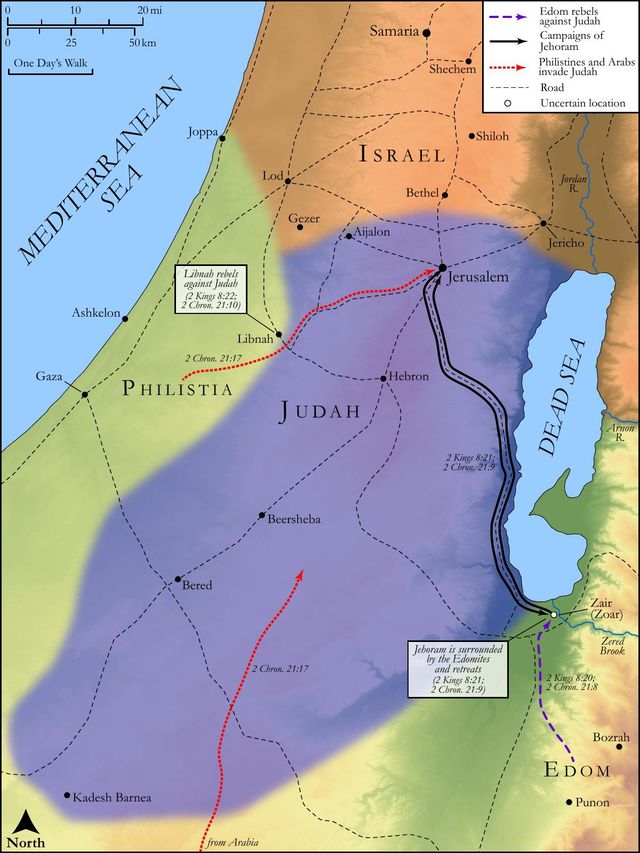
See on the biblical-era map
Study this verse
Public-domain commentary
Matthew Henry
From his Commentary on the Whole Bible. Henry comments on passages, not single verses — this entry covers 2 Chronicles 21:1–11. His two-level outline is real structure in the source text, so it is rendered as structure.
We find here,
I.That Jehoshaphat was a very careful indulgent father to Jehoram.
He had many sons, who are here named (Ch2 21:2), and it is said (Ch2 21:13) that they were better than Jehoram, had a great deal more wisdom and virtue, and lived up to their education, which he went counter to. They were very hopeful, and any of them more fit for the crown than he; and yet, because he was the first-born (Ch2 21:3), his father secured the kingdom to him, and portioned his brethren and disposed of them so as that they would be easy and give him no disturbance; as Abraham, when he made Isaac his heir, dismissed his other children with gifts. Herein Jehoshaphat was very kind and fair to his son, which might have obliged him to be respectful to him, and tread in the steps of so good a father. But it is no new thing for the children that have been most indulged by their parents to be least dutiful to them. Whether in doing this he acted wisely and well for his people, and was just to them, I cannot say. His birthright entitled him to a double portion of his father's estate, Deu 21:17. But if he appeared utterly unfit for government (the end of which is the good of the people), and likely to undo all that his father had done, it would have been better perhaps to have set him aside, and taken the next that was hopeful, and not inclined as he was to idolatry. Power is a sacred thing, with which men may either do much good or much hurt; and therefore Detur digniori - Let him that deserves it have it. Salus populi suprema lex - The security of the people is the first consideration.
II.That Jehoram was a most barbarous brother to his father's sons.
As soon as he had settled himself in the throne he slew all his brethren with the sword, either by false accusation, under colour of law, or rather by assassination. By some wicked hand or other he got them all murdered, pretending (it is likely) that he could not think himself safe in the government till they were taken out of the way. Those that mean ill themselves are commonly, without cause, jealous of those about them. The wicked fear where no fear is, or pretend to do so, in order to conceal their malice. Jehoram, it is likely, hated his brethren and slew them for the same reason that Cain hated Abel and slew him, because their piety condemned his impiety and won them that esteem with the people which he had lost. With them he slew divers of the princes of Israel, who adhered to them, or were likely to avenge their death. The princes of Judah, those who had taught the good knowledge of the Lord (Ch2 17:7), are here called princes of Israel, as before fathers of Israel (Ch2 19:8), because they were Israelites indeed, men of integrity. The sword which the good father had put into their hands this wicked son sheathed in their bowels. Woe unto him that thus foundeth a kingdom in blood (Hab 2:12); it will prove a foundation that will sink the superstructure.
III.That Jehoram was a most wicked king, who corrupted and debauched his kingdom, and ruined the reformation that his good father and grandfather had carried on: He walked in the way of the house of Ahab (Ch2 21:6), made high places, which the people were of themselves too forward to make, and did his utmost to set up idolatry again, Ch2 21:11.
1.As for the inhabitants of Jerusalem, where he kept his court, he easily drew them into his spiritual whoredom: He caused them to commit fornication, seducing them to eat things sacrificed to idols, Rev 2:20.
2.The country people seem to have been brought to it with more difficulty; but those that would not be corrupted by flatteries were driven by force to partake in his abominable idolatries: He compelled Judah thereto. He used that power for the destruction of the church which was given him for the edification of it.
IV.That when he forsook God and his worship his subjects withdrew from their allegiance to him.
1.Some of the provinces abroad that were tributaries to him did so. The Edomites revolted (Ch2 21:8), and, though he chastised them (Ch2 21:9), yet he could not reduce them, Ch2 21:10.
2.One of the cities of his own kingdom did so. Libnah revolted (Ch2 21:10) and set up for a free state, as of old it had a king of its own, Jos 12:15. And the reason is here given, not only why God permitted it, but why they did it; they shook off his government because he had forsaken the Lord God of his fathers, had become an idolater and a worshipper of false gods, and they could not continue subject to him without some danger of being themselves also drawn away from God and their duty. While he adhered to God they adhered to him; but, when he cast God off, they cast him off. Whether this reason will justify them in their revolt of no, it will justify God's providence which ordered it so.
V.That yet God was tender of his covenant with the house of David, and therefore would not destroy the royal family, though it was so wretchedly corrupted and degenerated, Ch2 21:7. These things we had before, Kg2 8:19-22. The tenour of the covenant was that David's seed should be visited for their transgressions, but the covenant should never be broken, Psa 89:30, etc.
Continue studying 2 Chronicles 21:1 across the web’s major study libraries — every link below opens this exact verse, chapter, or book on the destination site.
Read & Compare
 BibleGatewayThis verse in more than 200 translations and 70 languages.
 Bible.comThe YouVersion reader — hundreds of translations, reading plans, and highlights.
 ESV.orgCrossway's official English Standard Version reader.
 NET BibleThe NET translation with 60,000+ translators' notes on every rendering decision.
 STEP BibleTyndale House's free study tool — original text, vocabulary, and scholarly resources.
 BibliaLogos Bible Software's free web reader.
 USCCBThe New American Bible (Revised Edition) with the U.S. bishops' study notes.
Commentaries
 BibleHub CommentariesDozens of classic commentaries on this verse, gathered on one page.
 StudyLightMore than 100 commentary sets — the largest collection on the web.
 BibleRefPlain-English commentary on what this verse means, verse by verse.
 Enduring WordDavid Guzik's free commentary on this chapter, widely used by Bible teachers.
 Bible Study ToolsVerse commentary alongside Greek and Hebrew study aids.
Original Language & Research
- BibleHub InterlinearThe verse word by word — original language, transliteration, and English.
- BibleHub LexiconEvery word's original-language definition and Strong's entry.
 Blue Letter BibleDeep-study tools — Strong's numbers, concordance, and word studies.
 SefariaThe Hebrew text with Rashi and centuries of Jewish commentary.
Sermons, Hymns & Audio


TrulyRandomVerse is not affiliated with these sites and doesn’t control their content. They’re linked because they’re genuinely useful.
Summary
2 Chronicles 21:1 meticulously records the transition of power in the kingdom of Judah, marking the end of King Jehoshaphat's generally righteous and prosperous reign and the immediate ascension of his son, Jehoram, to the throne. This verse employs a standard formulaic expression for royal succession, signaling a pivotal moment in the narrative where a period of stability and spiritual fidelity gives way to a new era under Jehoram, whose subsequent rule would dramatically diverge from his father's godly example, introducing a period of significant moral and political decline for Judah.
Context
ShowHideLiterary Context
This verse serves as a critical narrative hinge, bridging the detailed and largely positive account of Jehoshaphat's reign (found in 2 Chronicles 17-20) with the somber and tragic narrative of Jehoram's rule (detailed in 2 Chronicles 21:2-20). The preceding chapters extensively laud Jehoshaphat for his zealous efforts to restore true worship, his comprehensive judicial reforms, and the miraculous divine intervention that granted him victory over a formidable coalition of enemies, resulting in a period of peace and prosperity for Judah. The abrupt transition introduced by this verse, from Jehoshaphat's peaceful passing to Jehoram's immediate consolidation of power through the brutal murder of his brothers (as explicitly detailed in 2 Chronicles 21:4), starkly contrasts the two reigns. This immediate shift foreshadows the severe spiritual and political consequences that will befall Judah under Jehoram's wicked leadership, setting a tone of impending judgment.
Historical & Cultural Context
The phrase "slept with his fathers" is a deeply ingrained biblical idiom, a respectful euphemism signifying a peaceful death and being gathered to one's ancestors. This expression is commonly used for kings and patriarchs, denoting an honorable end to their life and reign. The subsequent mention of being "buried with his fathers in the city of David" refers to Jerusalem, specifically the royal necropolis within or near the capital, a place of high honor reserved for the kings of Judah. This burial practice served to affirm the continuity of the Davidic dynasty and the legitimate transfer of power to the successor. During the 9th century BCE, Judah, though geographically smaller and politically less powerful than the northern kingdom of Israel, maintained its distinct identity and the unbroken lineage of the Davidic throne. The orderly succession from father to son was paramount for political stability, yet, as the narrative of Jehoram's reign vividly illustrates, the moral and spiritual character of the reigning king proved far more determinative for the nation's spiritual and political health than mere dynastic continuity. The enduring Davidic covenant, promising an eternal dynasty (see 2 Samuel 7:12-16), provided the theological framework for this succession, even when individual kings deviated significantly from God's righteous ways.
Key Themes
ShowHideThis concise verse encapsulates several profound and interconnected themes central to the Chronicler's theological agenda. Firstly, Royal Succession is explicitly highlighted, underscoring the established and divinely sanctioned pattern of power transfer within the Davidic monarchy, which was crucial for the kingdom's stability and the continuity of God's covenant promises. Secondly, the theme of Legacy and Influence is powerfully introduced. Jehoshaphat's death invites reflection on his generally righteous reign and its positive impact, while the immediate mention of Jehoram, whose wickedness is soon detailed (e.g., 2 Chronicles 21:6), creates a stark contrast, powerfully illustrating that a godly heritage does not automatically guarantee godly offspring. This emphasizes the individual's personal accountability before God, regardless of parental example. Thirdly, Divine Sovereignty is implicitly affirmed. Even amidst the natural cycle of death and succession, the biblical narrative consistently points to God's overarching control and His continued work within the lineage of David, despite the unfaithfulness of individual kings. The Chronicler frequently emphasizes the direct correlation between the king's obedience to God and the nation's prosperity, a principle that will be severely tested and tragically violated under Jehoram's rule, leading to divine judgment as seen in 2 Chronicles 21:12-19.
Exposition and Analysis
ShowHideKey Word Analysis
ShowHideThis primitive word refers to a "father" in both a literal and figurative sense, encompassing ancestors or predecessors. In the phrase "slept with his fathers," it denotes joining the line of deceased kings and patriarchs, implying a proper and honorable end to Jehoshaphat's life, consistent with his royal status and generally righteous conduct. It signifies being gathered to one's ancestors.
A primitive root meaning "to lie down" or "to sleep." In the context of death, particularly for kings and patriarchs, it functions as a common and respectful euphemism. It signifies a peaceful passing, as if one is simply going to rest, and often implies being gathered to one's ancestors. This term does not inherently convey specific theological meaning about the afterlife but simply denotes the cessation of earthly life and reign.
A primitive root meaning "to reign" or, inceptively, "to ascend the throne." It can also causatively mean "to induct into royalty." In this verse, it clearly indicates the formal and legitimate transfer of royal authority from Jehoshaphat to his son Jehoram, emphasizing the continuity of the Davidic monarchy despite the change in leadership.
Verse Breakdown
ShowHide"¶ Now Jehoshaphat slept with his fathers,"
This initial clause formally marks the conclusion of King Jehoshaphat's earthly life and the end of his reign. The "¶" symbol, a paragraph mark in the KJV, often indicates a new section or a significant narrative transition. The idiom "slept with his fathers" is a gentle and respectful euphemism for death, particularly fitting for a king. It suggests a peaceful and honorable end, aligning with Jehoshaphat's generally righteous character and the period of relative stability and prosperity that marked his rule.
"and was buried with his fathers in the city of David."
This part of the verse specifies the honorable and customary burial place for King Jehoshaphat. "The city of David" refers to Jerusalem, specifically the royal tombs located within or immediately adjacent to the capital. This burial site was a privileged honor reserved for the kings of Judah, signifying their royal status, their integral connection to the foundational Davidic lineage, and their esteemed place within the nation's history. It underscores the formal and proper conclusion of his reign and the continuity of the royal line.
"And Jehoram his son reigned in his stead."
This final clause announces the immediate and legitimate succession of Jehoram to the throne. The phrase "his son" explicitly emphasizes the dynastic continuity within the sacred Davidic line, reinforcing the legitimacy of Jehoram's claim to the kingship. "Reigned in his stead" confirms the formal and recognized transfer of royal power, setting the narrative stage for the account of Jehoram's kingship, which, as the subsequent chapters reveal, would dramatically and tragically diverge from the righteous path established by his father.
Literary Devices
ShowHideThe verse employs several significant literary techniques. Formulaic Language is prominently featured in the standard phrase "slept with his fathers, and was buried with his fathers in the city of David." This common biblical idiom, used consistently for the death and burial of kings and patriarchs (e.g., David in 1 Kings 2:10, Solomon in 1 Kings 11:43), provides a sense of continuity, legitimacy, and historical rhythm to the narrative of royal succession. The abrupt transition from the positive portrayal of Jehoshaphat's death and honorable burial to the immediate, unadorned mention of Jehoram's ascension creates a subtle yet powerful Juxtaposition. This stark contrast, especially when read in light of the preceding chapters on Jehoshaphat's piety and the subsequent chapters detailing Jehoram's wickedness, serves as a poignant Foreshadowing. While the verse itself maintains a neutral, factual tone, its strategic placement within the Chronicler's narrative imbues it with a profound sense of impending change, making it a pivotal moment that signals a dramatic shift in the spiritual and moral trajectory of Judah's leadership.
Theological and Thematic Connections
ShowHideThis seemingly straightforward verse is replete with profound theological implications, particularly concerning the enduring nature of the Davidic covenant and the inherent responsibilities of kingship in Israel. It subtly highlights God's unwavering faithfulness in maintaining the Davidic line, even when individual kings, such as Jehoram, would prove profoundly unfaithful. The orderly succession, though divinely ordained for the stability and continuity of the kingdom, also underscores the profound individual accountability of each ruler before God. While Jehoshaphat's godly legacy was significant and impactful, it did not automatically transfer to his son, Jehoram, emphasizing that personal righteousness and a genuine relationship with God are matters of individual choice and commitment, not merely inherited status. This enduring tension between divine promise and human responsibility is a recurring and central theme woven throughout the Deuteronomistic history and the Chronicler's theological narrative.
Reflection and Application
ShowHideThe transition of power, whether within a national leadership, a family unit, a church, or any organizational structure, is an inevitable and continuous facet of human experience. This verse serves as a potent reminder that while leadership roles and responsibilities pass from one generation to the next, the profound impact of a leader's character, choices, and spiritual disposition resonates far beyond their immediate tenure. Jehoshaphat's legacy was predominantly one of earnestly seeking the Lord and implementing significant spiritual reforms, thereby providing a robust and positive spiritual foundation for his son. However, Jehoram's subsequent actions, detailed in the following verses, powerfully illustrate that even the most godly heritage does not guarantee personal godliness or spiritual fidelity. Each individual, irrespective of their upbringing, inherited status, or the exemplary figures who preceded them, is ultimately and personally accountable for their own choices and their relationship with God. This profound truth compels us to consider not only the legacy we may have inherited but, more critically, the legacy we are actively constructing through our daily decisions, our moral integrity, and our unwavering commitment to Christ. We are called to live faithfully and purposefully, understanding that our lives, both in public and private spheres, possess the potential to profoundly influence those who will follow us, yet always remembering that true spiritual transformation and enduring righteousness are deeply personal journeys of faith, repentance, and obedience to God.
Questions for Reflection
ShowHideFAQ
ShowHideWhat does the phrase "slept with his fathers" signify in the Bible?
ShowHide"Slept with his fathers" is a common biblical idiom or euphemism for death, particularly for kings and patriarchs. It signifies a peaceful passing and being gathered to one's ancestors. This phrase emphasizes the continuity of lineage and often implies an honorable end to life, suggesting the deceased joined their forebears in the realm of the dead. It does not inherently convey specific theological details about the afterlife but simply marks the cessation of earthly life and reign, often preceding a description of burial. This phrase is used for many kings throughout the Old Testament, both those considered righteous and those who were wicked, though in Jehoshaphat's case, it aligns with his generally righteous reign and honorable end.
Why was being "buried in the city of David" significant for a king?
ShowHideBeing "buried in the city of David" (referring to Jerusalem) was a highly significant honor reserved for the kings of Judah. It indicated a proper, esteemed, and royal burial, placing the deceased king among his predecessors in the royal necropolis. This practice underscored the legitimacy of the king's reign, his integral connection to the foundational Davidic dynasty, and his enduring place within the history of the kingdom. It was a symbol of their status and a mark of respect, in contrast to being buried elsewhere or in a less distinguished manner. For instance, some wicked kings, like Jehoram himself, were explicitly denied burial in the royal tombs, highlighting the importance and symbolic weight of this privilege (see 2 Chronicles 21:20).
How does this verse set the stage for the rest of Jehoram's reign in 2 Chronicles?
ShowHideThis verse, while seemingly a straightforward record of succession, subtly yet powerfully sets the stage for a dramatic and dark period in Judah's history. By immediately following the extensive and largely positive account of Jehoshaphat's reign, the introduction of Jehoram creates a stark and unsettling contrast. The subsequent verses in 2 Chronicles 21 quickly and tragically reveal Jehoram's profound wickedness, including the brutal murder of his own brothers and his leading Judah into widespread idolatry, a direct and severe repudiation of his father's godly policies and reforms. Thus, this verse serves as a pivotal transition from an era of relative faithfulness and prosperity to one of severe spiritual decline, national judgment, and immense suffering, foreshadowing the calamities that would inevitably befall Judah under Jehoram's ungodly rule.
Christ-Centered Fulfillment
ShowHideThe seemingly simple transition of power recorded in 2 Chronicles 21:1, from the passing of King Jehoshaphat to the ascension of his son Jehoram, finds its ultimate fulfillment and profound theological significance in the person and eternal reign of Jesus Christ. The Davidic kingship, though divinely established and promised to be eternal through the Davidic covenant (as powerfully articulated in 2 Samuel 7:12-16), was always imperfect and temporary in its earthly manifestations. Kings like Jehoshaphat, though largely righteous and a blessing to their people, eventually "slept with their fathers," and even the most pious among them were often succeeded by flawed or even wicked heirs like Jehoram. This constant cycle of succession, death, and often moral and spiritual decline in the Old Testament points inexorably to the desperate human need for a perfect, unwavering, and eternal King. Jesus, uniquely identified as the Son of David (a title emphasized from the very beginning of the New Testament in Matthew 1:1), is the only King whose reign is truly everlasting and whose character is perfectly righteous and untainted by sin. Unlike earthly kings who pass away and are buried, Jesus' death was not a final earthly demise but a triumphant act of atonement for sin, and His glorious resurrection secured His eternal reign, ensuring that He will never "sleep with his fathers" in the sense of a permanent end to His kingship. His kingdom is not subject to human frailty, the vagaries of succession, or the moral failings of individual rulers, but is an eternal dominion (as prophesied by the angel Gabriel in Luke 1:32-33). Thus, every earthly succession, even one as pivotal as that in 2 Chronicles 21:1, ultimately serves as a shadow, pointing forward to the one true King who reigns forever and ever, whose kingdom has no end, and who alone holds ultimate authority and power (as declared in Revelation 11:15).