


2 Chronicles 9:31
- וַיִּשְׁכַּבvai·yish·Kavand he lay downH7901Conj-w ¦ V-Qal-ConsecImperf-3msVerb Qal Consecutive Imperfect 3rd Singular Masculineוַandיִּשְׁכַּבhe lay down
- שְׁלֹמֹהshe·lo·MohSolomonH8010N-proper-mNoun Proper Masculine
- עִם'imwithH5973PrepPreposition
- אֲבֹתָיו'a·vo·Tavhis ancestorsH1N-fpc ¦ 3msNoun Plural Feminine Constructאֲבֹתָיancestorsוhis
- וַיִּקְבְּרֻהוּvai·yik·be·Ru·huand people buried himH6912Conj-w ¦ V-Qal-ConsecImperf-3mp ¦ 3msVerb Qal Consecutive Imperfect 3rd Plural Masculineוַandיִּקְבְּרֻpeople buriedהוּhim
- בְּעִירbe·'Irin [the] city ofH5892Prep-b ¦ N-fscNoun Singular Feminine Constructבְּinעִיר[the] city of
- דָּוִידda·VidDavidH1732N-proper-mNoun Proper Masculine
- אָבִיו'a·Vivhis fatherH1N-msc ¦ 3msNoun Singular Masculine Constructאָבִיfatherוhis
- וַיִּמְלֹךְvai·yim·Lokhand he became kingH4427Conj-w ¦ V-Qal-ConsecImperf-3msVerb Qal Consecutive Imperfect 3rd Singular Masculineוַandיִּמְלֹךְhe became king
- רְחַבְעָםre·chav·'AmRehoboamH7346N-proper-mNoun Proper Masculine
- בְּנוֹbe·Nohis sonH1121N-msc ¦ 3msNoun Singular Masculine Constructבְּנsonוֹhis
- תַּחְתָּיוtach·Tavin place of himH8478N-mpc ¦ 3msNoun Plural Masculine Constructתַּחְתָּיin place ofוhim
English is a literal word-by-word gloss of the Hebrew, not the KJV's wording. Why?
This is the original text the KJV's translators worked from — each Hebrew word with its own literal English meaning in this verse, prepared by scholars at Tyndale House, Cambridge. The KJV translates whole sentences, not word by word, so its wording differs: one Hebrew word can become several English words, and the KJV may choose “the LORD” where the gloss reads “Yahweh”. Both are faithful — they answer different questions. For the KJV's own rendering, switch to the KJV text.
Details
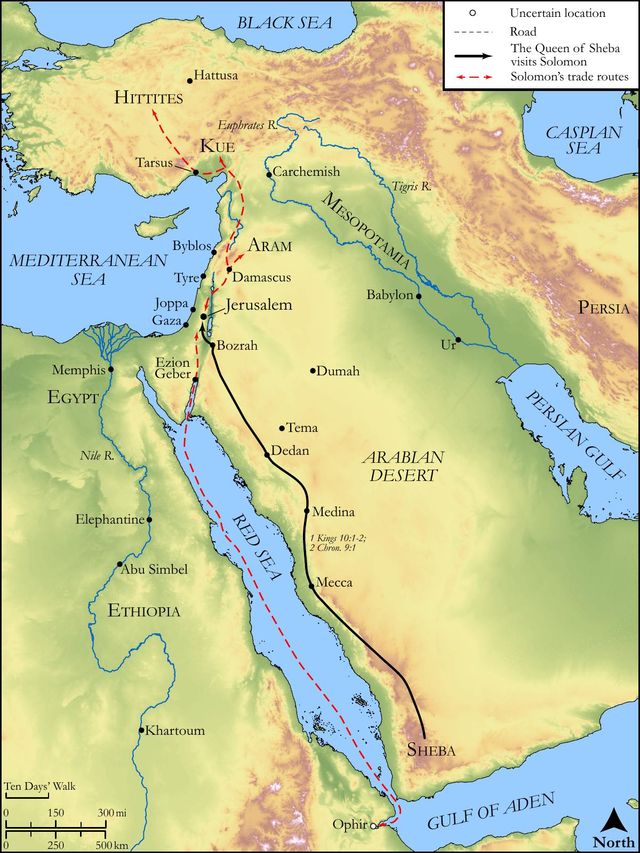
See on the biblical-era map
Study this verse
Public-domain commentary
Matthew Henry
From his Commentary on the Whole Bible. Henry comments on passages, not single verses — this entry covers 2 Chronicles 9:13–31. His two-level outline is real structure in the source text, so it is rendered as structure.
We have here Solomon in his throne, and Solomon in his grave; for the throne would not secure him from the grave. Mors sceptra ligonibus aequat - Death wrenches from the hand the sceptre as well as the spade.
I.Here is Solomon reigning in wealth and power, in ease and fulness, such as, for aught I know, could never since be paralleled by any king whatsoever. In cannot pretend to be critical in comparing the grandeur of Solomon with that of some of the great princes of the earth. But I may observe that the most illustrious of them were famed for their wars, whereas Solomon reigned forty years in profound peace. Some of those that might be thought to vie with Solomon affected retirement, kept people in awe by keeping them at a great distance; nobody must see them, or come near him, upon pain of death: but Solomon went much abroad, and appeared in public business. So that, all things considered, the promise was fulfilled, that God would give him riches, and wealth, and honour, such as no kings have had, or shall have, Ch2 1:12.
1.Never any prince appeared in public with great splendour than Solomon did, which to those that judge by the sight of the eye, as most people do, would very much recommend him. He had 200 targets and 300 shields, all of beaten gold, carried before him (Ch2 9:15, Ch2 9:16), and sat upon a most stately throne, Ch2 9:17-19. There was not the like in any kingdom. The lustre wherein he appeared was typical of the spiritual glory of the kingdom of the Messiah and but a faint representation of his throne, which is above every throne. Solomon's pomp was all artificial; and therefore our Saviour prefers the natural beauty of the lilies of the field before it. Mat 6:29, Solomon, in all his glory, was not arrayed like one of these.
2.Never any prince had greater plenty of gold and silver, though there were no gold or silver mines in his own kingdom. Either he made himself master of the mines in other countries, and, having a populous country, sent hands to dig out those rich metals, or, having a fruitful country, he exported the commodities of it and with them fetched home all this gold that is here spoken of, Ch2 9:13, Ch2 9:14-21.
3.Never any prince had such presents brought him by all his neighbours as Solomon had: All the kings of Arabia, and governors of the country, brought him gold and silver (Ch2 9:14), not as tribute which he extorted from them, but as freewill offerings to procure his favour, or in a way of exchange for some of the productions of his husbandry, corn or cattle. All the kings of the earth brought him presents, that is, all in those parts of the world (Ch2 9:24, Ch2 9:28), because they coveted his acquaintance and friendship. Herein he was a type of Christ, to whom, as soon as he was born, the wise men of the east brought presents, gold, frankincense, and myrrh (Mat 2:11), and to whom all that are about him must bring presents, Psa 76:11; Rom 12:1.
4.Never any prince was so renowned for wisdom, so courted, so consulted, so admired (Ch2 9:23): The kings of the earth (for it was too great a favour for common persons to pretend to) sought to hear his wisdom - his natural philosophy, or his skill in physic, or his state policy, or his rules of prudence for the conduct of human life, or perhaps the principles of his religion, and the reasons of it. The application which they then made to Solomon to hear his wisdom will aggravate, shame, and condemn, men's general contempt of Christ and his gospel. Though in them are hidden all the treasures of wisdom and knowledge, yet none of the princes of this world desire to know them, for they are foolishness to them, Co1 2:8, Co1 2:14.
II.Here is Solomon dying, stripped of his pomp, and leaving all his wealth and power, not to one concerning whom he knew not whether he would be a wise man or a fool (Ecc 2:19), but who he knew would be a fool. This was not only vanity but vexation of spirit, Ch2 9:29-31. It is very observable that no mention is here made of Solomon's departure from God in his latter days, not the least hint given of it,
1.Because the Holy Ghost would teach us not to take delight in repeating the faults and follies of others. If those that have been in reputation for wisdom and honour misbehave, though it may be of use to take notice of their misconduct for warning to ourselves and others, yet we must not be forward to mention it, once the speaking of it is enough; why should that unpleasing string be again struck upon? Why can we not do as the sacred historian here does, speak largely of that in others which is praise-worthy, without saying any thing of their blemishes, yea, though they have been gross and obvious? This is but doing as we would be done by.
2.Because, though he fell, yet he was not utterly cast down. His sin is not again recorded, because it was repented of, and pardoned, and became as if it had never been. Scripture-silence sometimes speaks. I am willing to believe that its silence here concerning the sin of Solomon is an intimation that none of the sins he committed were mentioned against him, Eze 33:16. When God pardons sin he casts it behind his back and remembers it no more.
Continue studying 2 Chronicles 9:31 across the web’s major study libraries — every link below opens this exact verse, chapter, or book on the destination site.
Read & Compare
 BibleGatewayThis verse in more than 200 translations and 70 languages.
 Bible.comThe YouVersion reader — hundreds of translations, reading plans, and highlights.
 ESV.orgCrossway's official English Standard Version reader.
 NET BibleThe NET translation with 60,000+ translators' notes on every rendering decision.
 STEP BibleTyndale House's free study tool — original text, vocabulary, and scholarly resources.
 BibliaLogos Bible Software's free web reader.
 USCCBThe New American Bible (Revised Edition) with the U.S. bishops' study notes.
Commentaries
 BibleHub CommentariesDozens of classic commentaries on this verse, gathered on one page.
 StudyLightMore than 100 commentary sets — the largest collection on the web.
 BibleRefPlain-English commentary on what this verse means, verse by verse.
 Enduring WordDavid Guzik's free commentary on this chapter, widely used by Bible teachers.
 Bible Study ToolsVerse commentary alongside Greek and Hebrew study aids.
Original Language & Research
- BibleHub InterlinearThe verse word by word — original language, transliteration, and English.
- BibleHub LexiconEvery word's original-language definition and Strong's entry.
 Blue Letter BibleDeep-study tools — Strong's numbers, concordance, and word studies.
 SefariaThe Hebrew text with Rashi and centuries of Jewish commentary.
Sermons, Hymns & Audio


TrulyRandomVerse is not affiliated with these sites and doesn’t control their content. They’re linked because they’re genuinely useful.
Summary
2 Chronicles 9:31 serves as a concise yet profoundly significant narrative hinge, marking the end of King Solomon's illustrious reign, which was characterized by unparalleled wisdom, wealth, and the construction of the Temple. This pivotal verse records his death, his burial in the royal necropolis within the city founded by his father, David, and the immediate succession of his son, Rehoboam, to the throne. It draws a definitive close to a golden era for the united kingdom of Israel, simultaneously setting the stage for the dramatic and ultimately divisive events that would soon unfold under the new monarch.
Context
ShowHideLiterary Context
This verse provides the concluding summary of the Chronicler's extensive and largely positive account of Solomon's reign, meticulously detailed across chapters 1 through 9 of 2 Chronicles. The preceding narrative has celebrated Solomon's divinely granted wisdom, his immense wealth, his diplomatic achievements, and, most importantly for the Chronicler's theological agenda, his fulfillment of David's vision to construct and dedicate the glorious Temple in Jerusalem. The global recognition of Solomon's splendor, exemplified by the visit of the Queen of Sheba, immediately precedes this verse. 2 Chronicles 9:31 functions as an abrupt yet necessary narrative transition, shifting from the zenith of Israelite power and unity to the inevitable reality of human mortality and dynastic succession. It directly prepares the reader for the subsequent tragic events of the kingdom's division, which are immediately recounted in 2 Chronicles 10.
Historical & Cultural Context
In the monarchies of the ancient Near East, the death of a king and the succession of an heir were moments of both established continuity and potential vulnerability. The idiomatic phrase "slept with his fathers" was a common biblical euphemism for death, particularly for kings and patriarchs, conveying a peaceful passing and the joining of ancestral lineages. This phrase underscored the natural order of life and death within a dynastic framework. Burial in the "city of David" (Jerusalem) was a distinct privilege reserved for the Davidic kings, reinforcing Solomon's legitimate place within this divinely ordained dynasty and emphasizing the sacredness and centrality of the capital. The immediate mention of Rehoboam's succession highlights the established custom of primogeniture and the smooth, albeit ultimately ill-fated, transfer of power, which was crucial for maintaining stability in the kingdom.
Key Themes
ShowHide2 Chronicles 9:31 encapsulates several profound themes that resonate throughout the Chronicler's work and the broader biblical narrative. Firstly, it underscores the transience of human power and life, reminding readers that all earthly reigns, even those as glorious as Solomon's, are finite and subject to mortality. Secondly, it emphasizes dynastic continuity through the Davidic covenant, as Solomon's burial in the "city of David his father" and the succession of his son, Rehoboam, directly fulfill the divine promise of an enduring lineage made to David (2 Samuel 7:12-16). This continuity, despite future challenges, ultimately points to the Messiah. Thirdly, the verse highlights divine sovereignty in succession, as the transfer of power, though humanly executed, is ultimately within God's overarching plan for His people. Finally, it marks the end of a golden age for Israel, signaling the close of a period of unparalleled unity, peace, and prosperity, and foreshadowing the subsequent decline and division detailed in 2 Chronicles 10.
Exposition and Analysis
ShowHideKey Word Analysis
ShowHideA primitive root meaning "to lie down" for various purposes, including rest, sexual connection, or decease. In this context, it is a common biblical euphemism for death, particularly for kings and patriarchs. It conveys a sense of a peaceful, natural end to life, rather than a violent one, and signifies joining one's ancestors in the realm of the dead, emphasizing the continuity of generations and the common destiny of humanity.
Refers to a city as a guarded place or encampment. In this verse, "city of David" specifically denotes Jerusalem, the ancient Jebusite fortress conquered by David, which became the royal capital and burial ground for the kings of Judah. Solomon's burial here firmly roots him within the Davidic dynasty and underscores the legitimacy of his reign and the continuity of the covenant line established with David.
A primitive root meaning "to reign" or, inceptively, "to ascend the throne." It can also causatively mean "to induct into royalty." Here, it signifies the immediate and official transfer of royal authority from the deceased king to his designated successor, Rehoboam. This emphasizes the smooth, established process of succession in the Israelite monarchy, ensuring there was no power vacuum.
Verse Breakdown
ShowHide"And Solomon slept with his fathers"
This clause announces the death of King Solomon, the third king of united Israel. The euphemistic language "slept with his fathers" is a common biblical idiom for the peaceful passing of a prominent figure, particularly a king. It underscores Solomon's mortality and the finite nature of even the most glorious human reign, placing him within the long line of his ancestors who had also passed away.
"and he was buried in the city of David his father"
This part specifies Solomon's burial place. Being interred in the "city of David" (Jerusalem) signifies his royal status and his direct connection to the Davidic covenant. This location was the sacred burial ground for the kings of Judah, reinforcing the legitimacy of his rule and the continuity of the royal line that God had promised to David. It also highlights Jerusalem's central importance as the political and religious heart of the kingdom.
"and Rehoboam his son reigned in his stead"
This final clause immediately identifies Solomon's successor, Rehoboam. The phrase "reigned in his stead" indicates a direct and immediate transfer of power, ensuring the continuity of the monarchy without a period of interregnum. This swift succession, however, sets the stage for the dramatic and tragic events of the kingdom's division, which would soon follow due to Rehoboam's poor leadership and the people's grievances.
Literary Devices
ShowHideThe Chronicler employs several literary devices in this concise verse to convey significant meaning efficiently. The most prominent is Euphemism, seen in the phrase "slept with his fathers," which gracefully communicates death without explicit or graphic detail, maintaining a tone of respect and continuity. This verse also functions as a powerful moment of Transition, marking the abrupt end of the Chronicler's detailed and largely positive portrayal of Solomon's reign and pivoting the narrative towards the tumultuous events that follow. There is an element of Foreshadowing in its very brevity and the immediate mention of Rehoboam's succession, as the reader familiar with the broader biblical narrative (or about to encounter 2 Chronicles 10) knows that this seemingly smooth transition will lead to significant national upheaval. Finally, the verse's Conciseness is a characteristic of the Chronicler's style when summarizing the end of a king's reign, focusing on essential facts of death, burial, and succession rather than the circumstances of death, thereby maintaining narrative flow and emphasis on the Davidic line.
Theological and Thematic Connections
ShowHide2 Chronicles 9:31, though brief, is pregnant with theological significance. It powerfully underscores the universal truth of human mortality, reminding us that even the wisest and most powerful of kings, like Solomon, are ultimately subject to death. This transience of earthly power serves as a profound theological statement on the ultimate sovereignty of God over all human endeavors and reigns. Despite the grandeur of Solomon's kingdom, his death highlights that no human achievement or dynasty is eternal apart from God's sustaining hand. Yet, the verse simultaneously affirms God's faithfulness to His covenant promises. Solomon's burial in the "city of David his father" and the immediate succession of his son, Rehoboam, are direct echoes of the Davidic covenant (2 Samuel 7), which promised an enduring dynasty. This continuity, even through flawed human leaders, points to God's unwavering commitment to His redemptive plan, which would ultimately culminate in the perfect and eternal reign of the Messiah.
Reflection and Application
ShowHideThe concise summary of Solomon's passing in 2 Chronicles 9:31 offers a potent reminder of the transient nature of all earthly power, wisdom, and glory. Even for a king whose reign was marked by unparalleled prosperity and divine favor, the ultimate reality of death brings an end to his earthly endeavors. This should humble us, encouraging us to hold loosely to worldly achievements, positions, and possessions, recognizing their temporary nature. Our focus should shift from building personal empires to investing in eternal values and contributing to God's enduring kingdom. Furthermore, the immediate succession of Rehoboam highlights the critical importance of faithful and wise leadership transitions. Whether in families, churches, or workplaces, we are called to prepare the next generation, not just for positions of authority, but for lives of integrity and service, ensuring that the legacy we leave is one that honors God and serves others. This verse ultimately invites us to live with an eternal perspective, understanding that while human leaders come and go, God's sovereign plan endures, culminating in His perfect and everlasting reign.
Questions for Reflection
ShowHideFAQ
ShowHideWhy is Solomon's death described so briefly, especially after such a detailed account of his reign?
ShowHideThe Chronicler's primary focus throughout the book is on the Davidic dynasty, the Temple, and the worship of God. While Solomon's reign was glorious, the Chronicler emphasizes the construction and dedication of the Temple, and the establishment of proper worship. The death of a king, while significant, is often summarized concisely in biblical narratives once the key aspects of their reign (from the Chronicler's perspective) have been covered. The brevity here serves to quickly transition to the next crucial event: the succession of Rehoboam and the subsequent division of the kingdom, which is of greater theological and historical interest for the Chronicler's narrative purpose. It signifies the end of an era, but the focus quickly shifts to the implications for the ongoing Davidic line, as seen in 2 Chronicles 10.
What is the significance of Solomon being buried in the "city of David his father"?
ShowHideBeing buried in the "city of David" (Jerusalem) was a distinct honor and privilege reserved for the kings of Judah from the Davidic line. It underscored Solomon's legitimate place within this divinely appointed dynasty and reinforced the continuity of the covenant God made with David (2 Samuel 7:12-16). This burial location also highlighted Jerusalem's central role as the political and spiritual capital of the united kingdom, a status established by David and cemented by Solomon's building of the Temple there. It was a symbolic act affirming the stability and continuity of the Davidic throne, even as one king passed away and another ascended.
Christ-Centered Fulfillment
ShowHide2 Chronicles 9:31, marking the end of Solomon's glorious but ultimately finite reign, powerfully points to the necessity and reality of Christ's eternal and perfect kingship. Solomon, despite his unparalleled wisdom and wealth, and his pivotal role in building the Temple, was a mortal king whose reign eventually concluded, leading to a fractured kingdom. His death and the subsequent succession of Rehoboam underscore the inherent limitations and imperfections of human rule. This narrative void, the longing for a king whose reign would truly be without end and whose wisdom would never fail, is profoundly fulfilled in Jesus Christ. He is the true Son of David, the one to whom the Davidic covenant ultimately points. Unlike Solomon, whose kingdom eventually divided, Jesus' kingdom "will have no end" (as declared in Luke 1:32-33). He is the ultimate temple, the dwelling place of God among humanity (John 2:19-21), and the source of true, inexhaustible wisdom (1 Corinthians 1:30). Solomon "slept with his fathers," but Jesus conquered death, rising to reign eternally at the right hand of God (Hebrews 1:8). Thus, Solomon's passing, rather than being a narrative dead end, serves as a poignant reminder of the temporary nature of all earthly glory and intensifies our longing for the everlasting, perfect reign of the Lamb of God, who is King of kings and Lord of lords (Revelation 11:15).