


2 Chronicles 10:1
- וַיֵּלֶךְvai·Ye·lekhand he wentH1980Conj-w ¦ V-Qal-ConsecImperf-3msVerb Qal Consecutive Imperfect 3rd Singular Masculineוַandיֵּלֶךְhe went
- רְחַבְעָםre·chav·'AmRehoboamH7346N-proper-mNoun Proper Masculine
- שְׁכֶמָהshe·Khe·mahShechem towardsH7927N-proper ¦ SfxNoun Proper LocationשְׁכֶמָShechemהtowards
- כִּיkiforH3588PrtParticle Conditional
- שְׁכֶםshe·KhemShechemH7927N-properNoun Proper Location
- בָּאוּBa·'uthey had comeH935V-Qal-Perf-3cpVerb Qal Perfect 3rd Plural common gender
- כָלkholallH3605N-mscNoun Singular Masculine Construct
- יִשְׂרָאֵלYis·ra·'ElIsraelH3478N-properNoun Proper Location
- לְהַמְלִיךְle·ham·Likhto make kingH4427Prep-l ¦ V-Hiphil-InfVerb Hiphil Infinitive Constructלְtoהַמְלִיךְmake king
- אֹתוֹ'o·To<obj.> himH853DirObjM ¦ 3msParticle Object Indicatorאֹת<obj.>וֹhim
English is a literal word-by-word gloss of the Hebrew, not the KJV's wording. Why?
This is the original text the KJV's translators worked from — each Hebrew word with its own literal English meaning in this verse, prepared by scholars at Tyndale House, Cambridge. The KJV translates whole sentences, not word by word, so its wording differs: one Hebrew word can become several English words, and the KJV may choose “the LORD” where the gloss reads “Yahweh”. Both are faithful — they answer different questions. For the KJV's own rendering, switch to the KJV text.
Details
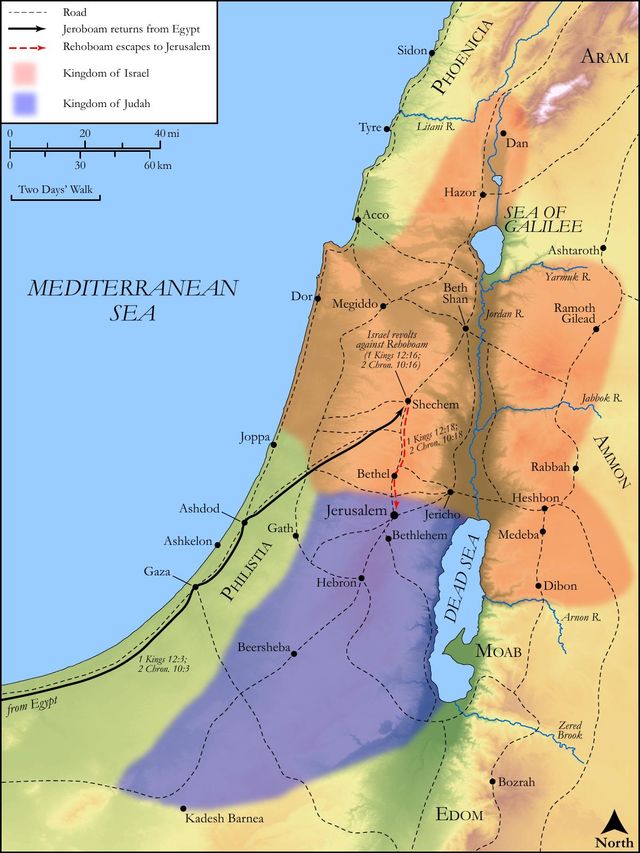
See on the biblical-era map
Study this verse
Public-domain commentary
Matthew Henry
From his Commentary on the Whole Bible. Henry comments on passages, not single verses — this entry covers 2 Chronicles 10:1–11.
We may observe here, 1. The wisest and best cannot give every body content. Solomon enriched and advanced his kingdom, did all (one would think) that could be done to make then happy and easy; and yet either he was indiscreet in burdening them with the imposition of taxes and services, or at least there was some colour of reason to think him so. No man is perfectly wise. It is probable that it was when Solomon had declined from God and his duty that his wisdom failed him, and God left him to himself to act in this impolitic manner. Even Solomon's treasures were exhausted by his love of women; and probably it was to maintain them, and their pride, luxury, and idolatry, that he burdened his subjects. 2. Turbulent and ungrateful spirits will find fault with the government, and complain of grievances, when they have very little reason to do so. Had they not peace in Solomon's time? They were never plundered by invaders, as formerly, never put in fear by the alarms of war, nor obliged to hazard their lives in the high places of the field. Had they not plenty - meat enough, and money enough? What would they more? O fortunatos nimium, sua si bona norint! - O happy, if they knew their happy state! And yet they complain that Solomon made their yoke grievous. If any complain thus of the yoke of Christ, that they might have a pretence to break his bands in sunder and cast away his cords from them, we are sure that he never gave them any cause at all for the complaint, whatever Solomon did. His yoke is easy, and his burden is light. He never made us serve with an offering, nor wearied us with incense. 3. Many ruin themselves and their interests by trampling upon and provoking their inferiors. Rehoboam thought that because he was king he might assume as much authority as his father had done, might have what he would, and do what he would, and carry all before him. But, though he wore his father's crown, he wanted his father's brains, and ought to have considered that, being quite a different man from what his father was, he ought to take other measures. Such a wise man as Solomon may do as we will, but such a fool as Rehoboam must do as he can. The high-mettled horse may be kicked and spurred by him that has the art of managing him; but, if an unskilful horseman do it, it is at his peril. Rehoboam paid dearly for threatening, and talking big, and thinking to carry matters with a high hand. It was Job's wisdom, as well as his virtue, that he despised not the cause of his man-servant or maid-servant, when they argued with him (Job 31:13), but heard them patiently, considered their reasons, and gave them a soft answer. And a similar tender consideration of those in subjection, and a forwardness to make them easy, will be the comfort and praise of all in authority, in the church, in the state, and in families. 4. Moderate counsels are generally wisest and best. Gentleness will do what violence will not do. Most people love to be accosted mildly. Rehoboam's old experienced counsellors directed him to this method (v. 7): "Be kind to this people, and please them, and speak good words to them, and thou art sure of them for ever." Good words cost nothing but a little self-denial, and yet they purchase good things. 5. God often fulfils the counsels of his own wisdom by infatuating men, and giving them up to the counsels of their own folly. No more needs to be done to ruin men than to leave them to themselves, and their own pride and passion.
Continue studying 2 Chronicles 10:1 across the web’s major study libraries — every link below opens this exact verse, chapter, or book on the destination site.
Read & Compare
 BibleGatewayThis verse in more than 200 translations and 70 languages.
 Bible.comThe YouVersion reader — hundreds of translations, reading plans, and highlights.
 ESV.orgCrossway's official English Standard Version reader.
 NET BibleThe NET translation with 60,000+ translators' notes on every rendering decision.
 STEP BibleTyndale House's free study tool — original text, vocabulary, and scholarly resources.
 BibliaLogos Bible Software's free web reader.
 USCCBThe New American Bible (Revised Edition) with the U.S. bishops' study notes.
Commentaries
 BibleHub CommentariesDozens of classic commentaries on this verse, gathered on one page.
 StudyLightMore than 100 commentary sets — the largest collection on the web.
 BibleRefPlain-English commentary on what this verse means, verse by verse.
 Enduring WordDavid Guzik's free commentary on this chapter, widely used by Bible teachers.
 Bible Study ToolsVerse commentary alongside Greek and Hebrew study aids.
Original Language & Research
- BibleHub InterlinearThe verse word by word — original language, transliteration, and English.
- BibleHub LexiconEvery word's original-language definition and Strong's entry.
 Blue Letter BibleDeep-study tools — Strong's numbers, concordance, and word studies.
 SefariaThe Hebrew text with Rashi and centuries of Jewish commentary.
Sermons, Hymns & Audio


TrulyRandomVerse is not affiliated with these sites and doesn’t control their content. They’re linked because they’re genuinely useful.
Summary
Second Chronicles 10:1 initiates the poignant account of the Israelite monarchy's division, immediately following the death of King Solomon. It meticulously records Rehoboam, Solomon's son and designated heir, undertaking a journey to Shechem, a city of profound historical and spiritual significance in the northern tribal territories. This journey was necessitated by the assembly of "all Israel" at this location, not merely to passively acknowledge his succession, but to actively "make him king," signaling a critical juncture where the terms of his reign would be negotiated and consented to, thereby setting the tragic stage for the kingdom's irreparable fragmentation.
Context
ShowHideLiterary Context
This verse serves as a stark and immediate transition from the unparalleled glory and prosperity of Solomon's reign, detailed in the preceding chapters of 2 Chronicles, to the catastrophic division of the united monarchy. Chapter 9 culminates with the Chronicler's summary of Solomon's immense wealth, profound wisdom, and eventual death, emphasizing the zenith of Israelite power and peace under his rule. Chapter 10 then abruptly shifts the geographical focus from Jerusalem, the established capital and spiritual center, to Shechem, a move that immediately signals that the succession was far from a simple, uncontested transfer of power. The Chronicler, writing from a post-exilic perspective, meticulously documents this pivotal turning point, not merely as a historical event, but as a profound theological explanation for Judah's subsequent history. He underscores the consequences of human choices—particularly those of leadership—in light of God's enduring covenant, portraying the division as both a result of human failure and a fulfillment of divine decree. The events of this chapter closely parallel those found in 1 Kings 12, yet the Chronicler's account offers a distinct theological emphasis, particularly highlighting the sanctity of the Davidic line and the centrality of the temple in Jerusalem, even amidst national fragmentation.
Historical & Cultural Context
Shechem was an exceptionally ancient and highly significant city, predating Jerusalem as a spiritual and political hub for the Israelite tribes. Its historical resonance was deep: it was here that Abraham first built an altar upon entering Canaan, receiving a divine promise (Genesis 12:6-7); Jacob later buried his foreign gods there, signifying a commitment to Yahweh (Genesis 35:4); and most notably, Joshua gathered all the tribes for a solemn covenant renewal ceremony, where they pledged allegiance to the Lord (Joshua 24:1-28). Its strategic location in the territory of Ephraim, a prominent northern tribe, made it a natural and traditional gathering point for the northern tribes. These tribes had increasingly felt overlooked by Jerusalem's growing prominence and burdened by the heavy taxation and forced labor imposed by Solomon's extensive building projects. The act of "all Israel" gathering at Shechem to "make him king" was not merely a ceremonial anointing but reflected a traditional practice where the people formally acknowledged and invested their monarch, often with explicit conditions. This assembly was intended as a forum for negotiation, reflecting the enduring tribal nature of Israelite society, even under a centralized monarchy, and their desire to assert their rights.
Key Themes
ShowHideThis foundational verse immediately introduces several crucial themes that will profoundly shape the subsequent narrative of 2 Chronicles. First, it highlights the theme of succession and legitimate authority, questioning whether Rehoboam's hereditary claim alone would suffice without the active consent and affirmation of the people, especially the powerful and increasingly restless northern tribes. Second, the very location and nature of the assembly at Shechem immediately set the stage for the seeds of division. The fact that the assembly convened outside the established capital of Jerusalem inherently suggests underlying tensions, a desire for negotiation, and a reluctance to simply submit to Davidic rule without conditions. The ensuing narrative will swiftly reveal how Rehoboam's poor judgment and his refusal to heed wise counsel directly precipitate the fragmentation of the kingdom, powerfully illustrating the destructive consequences of pride, inflexibility, and unresponsiveness in leadership. Finally, though not explicitly stated in this single verse, the Chronicler's broader theological framework implies the overarching theme of divine sovereignty. The subsequent division, while directly resulting from human folly, is ultimately presented as a fulfillment of God's prophetic word against Solomon's house due to his idolatry and unfaithfulness (1 Kings 11:29-39). This complex interplay of human agency and divine purpose is a central tenet of the Chronicler's message throughout the book.
Exposition and Analysis
ShowHideKey Word Analysis
ShowHideFrom the roots "to enlarge" and "people," meaning "a people has enlarged" or "he enlarges the people." This name ironically foreshadows the opposite outcome of his reign—the tragic division and reduction of the united kingdom he inherited. As Solomon's son, he was the designated heir to a vast, prosperous, yet heavily burdened kingdom, and his character and crucial decisions would prove catastrophic.
Meaning "ridge" or "shoulder," this ancient city in the central hill country held immense historical and religious significance for Israel. It was a traditional site for tribal gatherings, covenant renewal, and significant national events, as seen in Joshua 24. Its selection as the gathering point for "all Israel" was not arbitrary; it represented a neutral ground, a traditional site for inter-tribal deliberation, and potentially a deliberate assertion of northern tribal authority against Jerusalem's exclusive prominence.
A primitive root meaning "to reign," or "to ascend the throne," and causatively, "to induct into royalty." The Hebrew verb here signifies an active, formal process of investiture by the people, not merely a passive acceptance of hereditary succession. It implies that Rehoboam's kingship was contingent upon the people's consent and that they intended to negotiate the terms of their allegiance, rather than simply submitting to his rule without question. This active "making" underscores the people's agency and sets the stage for their demands.
Verse Breakdown
ShowHide"And Rehoboam went to Shechem:"
This opening clause immediately establishes the primary actor and the crucial setting. Rehoboam's journey to Shechem, rather than conducting his coronation in Jerusalem, is a highly significant detail. It indicates that the initiative for the succession process came, at least in part, from "all Israel" and that Rehoboam recognized the necessity of engaging with the broader tribal leadership, particularly the powerful northern tribes, who had convened there. This act, seemingly one of engagement and political pragmatism, ironically sets the stage for his ultimate downfall.
"for to Shechem were all Israel come"
This explanatory clause provides the reason for Rehoboam's journey. The phrase "all Israel" signifies the collective body of the tribes, emphasizing the national scope and unified voice of the gathering. Their deliberate decision to assemble at Shechem, a historical site of covenant and tribal unity, underscores their intent to deliberate on the terms of Rehoboam's rule, rather than simply anoint him in the Davidic capital. It highlights the significant agency of the people within the monarchical system, asserting their right to be heard and to participate in the establishment of their king.
"to make him king."
This final phrase explicitly states the purpose of the gathering, emphasizing the active nature of the process. It was not a mere formality but an active process of "making" or "installing" him as king. This implies that the people, particularly the northern tribes who bore the brunt of Solomon's heavy burdens, viewed their allegiance as conditional, dependent on Rehoboam's willingness to address their grievances and alleviate their hardships. This sets the stage for the pivotal confrontation and the subsequent, tragic division of the united kingdom.
Literary Devices
ShowHideThe Chronicler masterfully employs several literary devices in this concise yet potent verse. The Setting of Shechem is deeply symbolic and profoundly ironic. Historically a revered place of unity, covenant renewal, and tribal assembly, it now becomes the crucible for division, tragically highlighting the unraveling of the united kingdom. The very act of Rehoboam going to Shechem, rather than the people coming to him in Jerusalem, subtly employs Inversion or a significant shift in expected royal protocol, signaling that the people held considerable leverage and initiative. This detail, combined with the phrase "all Israel come to make him king," serves as potent Foreshadowing, hinting at the underlying tensions and the conditional nature of the people's allegiance that will soon erupt into open rebellion. The verse also utilizes Juxtaposition by presenting the formal act of "making him king" against the backdrop of the impending rupture, creating a powerful dramatic tension that propels the narrative forward with a sense of impending doom.
Theological and Thematic Connections
ShowHide2 Chronicles 10:1, though brief, is pregnant with theological significance, serving as the gateway to understanding the Chronicler's profound perspective on the division of the kingdom. It underscores the critical and often fraught interplay between human leadership and divine will. While Rehoboam's journey to Shechem initially appears to be a pragmatic political maneuver, the subsequent narrative reveals it as the fateful stage where human pride, poor counsel, and a lack of discernment clash directly with God's sovereign purpose, which had already been declared against Solomon's house due to his unfaithfulness and idolatry. The Chronicler emphasizes that the division, while undeniably a direct consequence of Rehoboam's folly and the people's grievances, was ultimately part of God's larger plan to discipline His people and to maintain the integrity of His eternal covenant with David, even if through a reduced and fragmented kingdom. This verse thus introduces profound themes of accountability in leadership, the devastating consequences of neglecting wise counsel, and the mysterious yet powerful working of God's hand in human history, even through moments of profound failure and division.
Reflection and Application
ShowHideThe opening of 2 Chronicles 10 offers a profound and enduring lesson on the nature of leadership and the critical importance of humility, responsiveness, and wisdom. Rehoboam's initial willingness to travel to Shechem might suggest a nascent recognition of the need to engage with his people and secure their consent. However, the subsequent events reveal that mere presence or a superficial gesture is insufficient; true leadership demands a heart that genuinely listens, discerns the needs and burdens of the people, and responds with wisdom, compassion, and a commitment to their well-being. This narrative serves as a timeless reminder that authority, whether exercised in the home, within the church, in the workplace, or in government, is a sacred trust that demands careful and conscientious stewardship. Leaders are called to prioritize the welfare of those they serve, to actively seek and humbly heed wise counsel, and to diligently avoid the insidious pitfalls of pride, self-interest, and rigidity, which can inevitably lead to division, discord, and ruin. For believers, this historical account underscores the call to exercise any sphere of influence with integrity, understanding that our decisions have far-reaching and often unforeseen consequences, not only for ourselves but for the communities and relationships we impact.
Questions for Reflection
ShowHideFAQ
ShowHideWhy did Rehoboam go to Shechem instead of being crowned in Jerusalem, the capital?
ShowHideRehoboam went to Shechem because "all Israel" had gathered there to "make him king." This indicates that the northern tribes, in particular, desired to negotiate the terms of their allegiance to the new king, rather than simply accepting him without question in Jerusalem. Shechem was a historically significant site for tribal gatherings and covenant renewal (e.g., Joshua 24), making it a neutral and traditional location for such a national assembly. Their presence there signaled their intent to assert their voice and address grievances, particularly the heavy burdens imposed by Solomon's reign, before formally recognizing Rehoboam's kingship. This move by the tribes was a deliberate assertion of their agency and a challenge to the automatic hereditary succession from the Davidic line.
Christ-Centered Fulfillment
ShowHideThe tragic division of the kingdom, initiated at Shechem through Rehoboam's profound folly and self-serving pride, profoundly highlights humanity's desperate and enduring need for a perfect King—one whose reign brings genuine unity, lasting peace, and true justice, rather than fragmentation and suffering. Rehoboam, though a son of David and heir to the throne, utterly failed to bear the true mantle of kingship, demonstrating a self-centered and oppressive attitude that led to the devastating collapse of the united monarchy. In stark and glorious contrast, Jesus Christ, the ultimate and eternal Son of David, embodies the perfect King. Unlike Rehoboam, who sought to burden his people with heavier yokes, Jesus lovingly invites the weary and heavily burdened to find true rest in Him, declaring, "My yoke is easy, and my burden is light". He did not seek to rule through oppressive force, disregard for His people's cries, or selfish ambition, but rather through humble service, even to the ultimate point of giving His very life as a ransom for many (Mark 10:45). The divided kingdom of Israel, born from human pride and sin, serves as a poignant foreshadowing of the spiritual division of humanity apart from God, yet it powerfully points forward to Christ. Through His atoning sacrifice on the cross, He breaks down all walls of hostility and unites all who believe into one spiritual kingdom, a people gathered under one true Shepherd (John 10:16). His is a kingdom that will never be divided, for of the increase of His government and peace there will be no end, and He will establish it with justice and righteousness forevermore (Isaiah 9:7).