


Matthew 11:30
- ὁhoTheG3588T-NSMDefinite article Nominative Singular Masculine
- γὰρgarforG1063CONJConjunction
- ζυγόςzugosyokeG2218N-NSMNoun Nominative Singular Masculine
- μουmouof MineG3165P-1GSPersonal pronoun Genitive 1st Singular
- χρηστὸςchrēstos[is] easyG5543A-NSMAdjective Nominative Singular Masculine
- καὶkaiandG2532CONJConjunction
- τὸtotheG3588T-NSNDefinite article Nominative Singular Neuter
- φορτίονphortionburdenG5413N-NSNNoun Nominative Singular Neuter
- μουmouof MineG3165P-1GSPersonal pronoun Genitive 1st Singular
- ἐλαφρόνelaphronlightG1645A-NSNAdjective Nominative Singular Neuter
- ἐστινestinisG1510V-PAI-3SVerb Present Active Indicative 3rd Singular
English is a literal word-by-word gloss of the Greek, not the KJV's wording. Why?
This is the original text the KJV's translators worked from — each Greek word with its own literal English meaning in this verse, prepared by scholars at Tyndale House, Cambridge. The KJV translates whole sentences, not word by word, so its wording differs: one Greek word can become several English words, and the KJV may choose “charity” where the gloss reads “love”. Both are faithful — they answer different questions. For the KJV's own rendering, switch to the KJV text.
Details
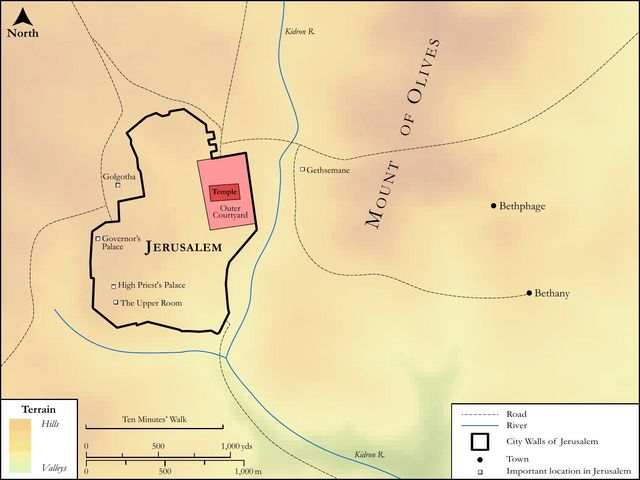
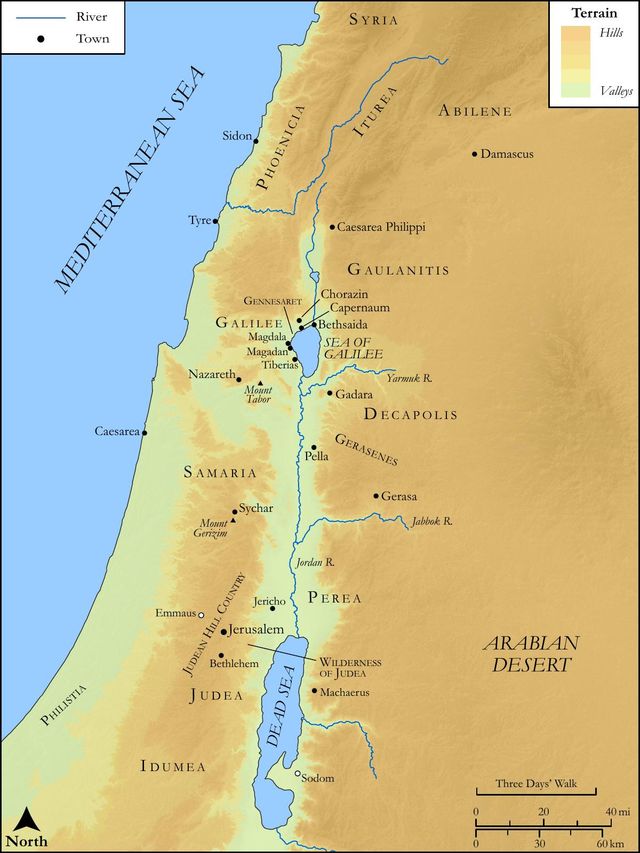
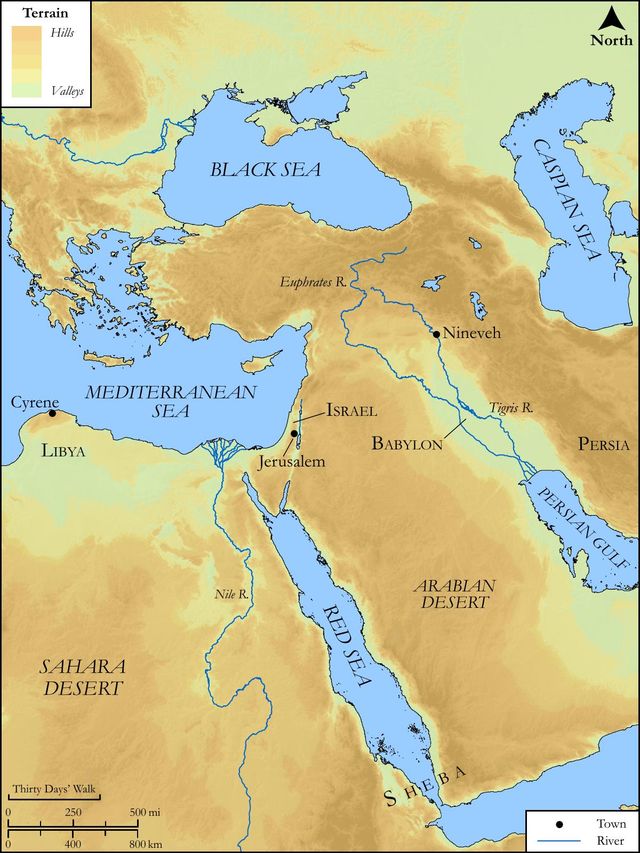
See on the biblical-era map
Study this verse
Public-domain commentary
Matthew Henry
From his Commentary on the Whole Bible. Henry comments on passages, not single verses — this entry covers Matthew 11:25–30. His four-level outline is real structure in the source text, so it is rendered as structure.
In these verses we have Christ looking up to heaven, with thanksgiving to his Father for the sovereignty and security of the covenant of redemption; and looking around him upon this earth, with an offer to all the children of men, to whom these presents shall come, of the privileges and benefits of the covenant of grace.
I.Christ here returns thanks to God for his favour to those babes who had the mysteries of the gospel revealed to them (Mat 11:25, Mat 11:26).
Jesus answered and said. It is called an answer, though no other words are before recorded but his own, because it is so comfortable a reply to the melancholy considerations preceding, and is aptly set in the balance against them. The sin and ruin of those woeful cities, no doubt, was a grief to the Lord Jesus; he could not but weep over them, as he did over Jerusalem (Luk 19:41); with this thought therefore he refreshes himself; and to make it the more refreshing, he puts it into a thanksgiving; that for all this, there is a remnant, though but babes, to whom the things of the gospel are revealed. Though Israel be not gathered, yet shall he be glorious. Note, We may take great encouragement in looking upward to God, when round about us we see nothing but what is discouraging. It is sad to see how regardless most men are of their own happiness, but it is comfortable to think that the wise and faithful God will, however, effectually secure the interests of his own glory. Jesus answered and said, I thank thee. Note, Thanksgiving is a proper answer to dark and disquieting thoughts, and may be an effectual means to silence them. Songs of praise are sovereign cordials to drooping souls, and will help to cure melancholy. When we have no other answer ready to the suggestions of grief and fear, we may have recourse to this, I thank thee, O Father; let us bless God that it is not worse with us than it is.
Now in this thanksgiving of Christ, we may observe,
1.The titles he gives to God; O Father, Lord of heaven and earth. Note,
(1.)In all our approaches to God, by praise as well as by prayer, it is good for us to eye him as a Father, and to fasten on that relation, not only when we ask for the mercies we want, but when we give thanks for the mercies we have received. Mercies are then doubly sweet, and powerful to enlarge the heart in praise, when they are received as tokens of a Father's love, and gifts of a Father's hand; Giving thanks to the Father, Col 1:12. It becomes children to be grateful, and to say, Thank you, father, as readily as, Pray, father.
(2.)When we come to God as a Father, we must withal remember, that he is Lord of heaven and earth; which obliges us to come to him with reverence, as to the sovereign Lord of all, and yet with confidence, as one able to do for us whatever we need or can desire; to defend us from all evil and to supply us with all good. Christ, in Melchizedec, had long since blessed God as the Possessor, or Lord of heaven and earth; and in all our thanksgivings for mercies in the stream, we must give him the glory of the all-sufficiency that is in the fountain.
2.The thing he gives thanks for: Because thou has hid these things from the wise and prudent, and yet revealed them to babes. These things; he does not say what things, but means the great things of the gospel, the things that belong to our peace, Luk 19:42. he spoke thus emphatically of them, these things, because they were things that filled him, and should fill us: all other things are as nothing to these things.
Note (1.) The great things of the everlasting gospel have been and are hid from many that were wise and prudent, that were eminent for learning and worldly policy; some of the greatest scholars and the greatest statesmen have been the greatest strangers to gospel mysteries. The world by wisdom knew not God, Co1 1:21. Nay, there is an opposition given to the gospel, by a science falsely so called, Ti1 6:20. Those who are most expert in things sensible and secular, are commonly least experienced in spiritual things. Men may dive deeply into the mysteries of nature and into the mysteries of state, and yet be ignorant of, and mistake about, the mysteries of the kingdom of heaven, for want of an experience of the power of them.
(2.)While the wise and prudent men of the world are in the dark about gospel mysteries, even the babes in Christ have the sanctifying saving knowledge of them: Thou hast revealed them unto babes. Such the disciples of Christ were; men of mean birth and education; no scholars, no artists, no politicians, unlearned and ignorant men, Act 4:13. Thus are the secrets of wisdom, which are double to that which is (Job 11:6), made known to babes and sucklings, that out of their mouth strength might be ordained (Psa 8:2), and God's praise thereby perfected. The learned men of the world were not made choice of to be the preachers of the gospel, but the foolish things of the world (Co1 2:6, Co1 2:8, Co1 2:10).
(3.)This difference between the prudent and the babes is of God's own making.
[1.]It is he that has hid these things from the wise and prudent; he gave them parts, and learning, and much of human understanding above others, and they were proud of that, and rested in it, and looked no further; and therefore God justly denies them the Spirit of wisdom and revelation, and then, though they hear the sound of the gospel tidings, they are to them as a strange thing. God is not the Author of their ignorance and error, but he leaves them to themselves, and their sin becomes their punishment, and the Lord is righteous in it. See Joh 12:39, Joh 12:40; Rom 11:7, Rom 11:8; Act 28:26, Act 28:27. Had they honoured God with the wisdom and prudence they had, he would have given them the knowledge of these better things; but because they served their lusts with them, he has hid their hearts from this understanding.
[2.]It is he that has revealed them unto babes. Things revealed belong to our children (Deu 29:29), and to them he gives an understanding to receive these things, and the impressions of them. Thus he resists the proud, and gives grace to the humble, Jam 4:6.
(4.)This dispensation must be resolved into the divine sovereignty. Christ himself referred it to that; Even so, Father, for so it seemed good in thy sight. Christ here subscribes to the will of his Father in this matter; Even so. Let God take what ways he pleases to glorify himself, and make us of what instruments he pleases for the carrying on of his own work; his grace is his own, and he may give or withhold it as he pleases. We can give no reason why Peter, a fisherman, should be made an apostle, and not Nicodemus, a Pharisee, and a ruler of the Jews, though he also believed in Christ; but so it seemed good in God's sight. Christ said this in the hearing of his disciples, to show them that it was not for any merit of their own that they were thus dignified and distinguished, but purely from God's good pleasure; he made them to differ.
(5.)This way of dispensing divine grace is to be acknowledged by us, as it was by our Lord Jesus, with all thankfulness. We must thank God,
[1.]That these things are revealed; the mystery hid from ages and generations is manifested; that they are revealed, not to a few, but to be published to all the world.
[2.]That they are revealed to babes; that the meek and humble are beautified with this salvation; and this honour put upon those whom the world pours contempt upon.
[3.]It magnifies the mercy to them, that these things are hid from the wise and prudent: distinguishing favours are the most obliging. As Job adored the name of the Lord in taking away as well as in giving, so may we in hiding these things from the wise and prudent, as well as in revealing them unto babes; not as it is their misery, but as it is a method by which self is abased, proud thoughts brought down, all flesh silenced, and divine power and wisdom made to shine the more bright. See Co1 1:27, Co1 1:31.
II.Christ here makes a gracious offer of the benefits of the gospel to all, and these are the things which are revealed to babes, Mat 11:25, etc. Observe here,
1.The solemn preface which ushers in this call or invitation, both to command our attention to it, and to encourage our compliance with it. That we might have strong consolation, in flying for refuge to this hope set before us, Christ prefixes his authority, produces his credentials; we shall see he is empowered to make this offer.
Two things he here lays before us, Mat 11:27.
(1.)His commission from the Father: All things are delivered unto me of my Father. Christ, as God, is equal in power and glory with the Father; but as Mediator he receives his power and glory from the Father; has all judgment committed to him. He is authorized to settle a new covenant between God and man, and to offer peace and happiness to the apostate world, upon such terms as he should think fit: he was sanctified and sealed to be the sole Plenipotentiary, to concert and establish this great affair. In order to this, he has all power both in heaven and in earth, (Mat 28:18); power over all flesh (Joh 17:2); authority to execute judgment, Joh 5:22, Joh 5:27. This encourages us to come to Christ, that he is commissioned to receive us, and to give us what we come for, and has all things delivered to him for that purpose, by him who is Lord of all. All powers, all treasures are in his hand. Observe, The Father has delivered his all into the hands of the Lord Jesus; let us but deliver our all into his hand and the work is done; God has made him the great Referee, the blessed Daysman, to lay his hand upon us both; that which we have to do is to agree to the reference, to submit to the arbitration of the Lord Jesus, for the taking up of this unhappy controversy, and to enter into bonds to stand to his award.
(2.)His intimacy with the Father: No man knoweth the Son but the Father, Neither knoweth any man the Father save the Son. This gives us a further satisfaction, and an abundant one. Ambassadors use to have not only their commissions, which they produce, but their instructions, which they reserve to themselves, to be made use of as there is occasion in their negotiations; our Lord Jesus had both, not only authority, but ability, for his undertaking. In transacting the great business of our redemption, the Father and the Son are the parties principally concerned; the counsel of peace is between them, Zac 6:13. It must therefore be a great encouragement to us to be assured, that they understood one another very well in this affair; that the Father knew the Son, and the Son knew the Father, and both perfectly (a mutual consciousness we may call it, between the Father and the Son), so that there could be no mistake in the settling of this matter; as often there is among men, to the overthrow of contracts, and the breaking of the measures taken, through their misunderstanding one another. The Son had lain in the bosom of the Father from eternity; he was a secretioribus - of the cabinet-council, Joh 1:18. He was by him, as one brought up with him (Pro 8:30), so that none knows the Father save the Son, he adds, and he to whom the Son will reveal him. Note,
[1.]The happiness of men lies in an acquaintance with God; it is life eternal, it is the perfection of rational beings.
[2.]Those who would have an acquaintance with God, must apply themselves to Jesus Christ; for the light of the knowledge of the glory of God shines in the face of Christ, Co2 4:6. We are obliged to Christ for all the revelation we have of God the Father's will and love, ever since Adam sinned; there is no comfortable intercourse between a holy God and sinful man, but in and by a Mediator, Joh 14:6.
2.Here is the offer itself that is made to us, and an invitation to accept of it. After so solemn a preface, we may well expect something very great; and it is a faithful saying, and well worthy of all acceptation; words whereby we may be saved. We are here invited to Christ as our Priest, Prince, and Prophet, to be saved, and, in order to that, to be ruled and taught by him.
(1.)We must come to Jesus Christ as our Rest, and repose ourselves in him (Mat 11:28), Come unto me all ye that labour. Observe,
[1.]The character of the persons invited; all that labour, and are heavy laden. This is a word in season to him that is weary, Isa 50:4. Those who complain of the burthen of the ceremonial law, which was an intolerable yoke, and was made much more so by the tradition of the elders (Luk 11:46), let them come to Christ, and they shall be made easy; he came to free his church from this yoke, to cancel the imposition of those carnal ordinances, and to introduce a purer and more spiritual way of worship; but it is rather to be understood of the burthen of sin, both the guilt and the power of it. Note, All those, and those only, are invited to rest in Christ, that are sensible of sin as a burthen, and groan under it; that are not only convinced of the evil of sin, of their own sin, but are contrite in soul for it; that are really sick of their sins, weary of the service of the world and of the flesh; that see their state sad and dangerous by reason of sin, and are in pain and fear about it, as Ephraim (Jer 31:18-20), the prodigal (Luk 15:17), the publican (Luk 18:13), Peter's hearers (Act 2:37), Paul (Act 9:4, Act 9:6, Act 9:9), the jailor (Act 16:29, Act 16:30). This is a necessary preparative for pardon and peace. The Comforter must first convince (Joh 16:8); I have torn and then will heal.
[2.]The invitation itself: Come unto me. That glorious display of Christ's greatness which we had (Mat 11:27), as Lord of all, might frighten us from him, but see here how he holds out the golden sceptre, that we may touch the top of it and may live. Note, It is the duty and interest of weary and heavy laden sinners to come to Jesus Christ. Renouncing all those things which stand in opposition to him, or in competition with him, we must accept of him, as our Physician and Advocate, and give up ourselves to his conduct and government; freely willing to be saved by him, in his own way, and upon his own terms. Come and cast that burden upon him, under which thou art heavy laden. This is the gospel call, The Spirit saith, Come; and the bride saith, Come; let him that is athirst come; Whoever will, let him come.
[3.]The blessing promised to those that do come: I will give you rest. Christ is our Noah, whose name signifies rest, for this same shall give us rest. Gen 5:29; Gen 8:9. Truly rest is good (Gen 49:15), especially to those that labour and are heavy laden, Ecc 5:12. Note, Jesus Christ will give assured rest to those weary souls, that by a lively faith come to him for it; rest from the terror of sin, in a well-grounded peace of conscience; rest from the power of sin, in a regular order of the soul, and its due government of itself; a rest in God, and a complacency of soul, in his love. Psa 11:6, Psa 11:7. This is that rest which remains for the people of God (Heb 4:9), begun in grace, and perfected in glory.
(2.)We must come to Jesus Christ as our Ruler, and submit ourselves to him (Mat 11:29). Take my yoke upon you. This must go along with the former, for Christ is exalted to be both a Prince and a Saviour, a Priest upon his throne. The rest he promises is a release from the drudgery of sin, not from the service of God, but an obligation to the duty we owe to him. Note, Christ has a yoke for our necks, as well as a crown for our heads, and this yoke he expects we should take upon us and draw in. To call those who are weary and heavy laden, to take a yoke upon them, looks like adding affliction to the afflicted; but the pertinency of it lies in the word my: "You are under a yoke which makes you weary: shake that off and try mine, which will make you easy." Servants are said to be under the yoke (Ti1 6:1), and subjects, Kg1 12:10. To take Christ's yoke upon us, is to put ourselves into the relation to servants and subjects to him, and then of conduct ourselves accordingly, in a conscientious obedience to all his commands, and a cheerful submission to all his disposals: it is to obey the gospel of Christ, to yield ourselves to the Lord: it is Christ's yoke; the yoke he has appointed; a yoke he has himself drawn in before us, for he learned obedience, and which he does by his Spirit draw in with us, for he helpeth our infirmities, Rom 8:26. A yoke speaks some hardship, but if the beast must draw, the yoke helps him. Christ's commands are all in our favour: we must take this yoke upon us to draw in it. We are yoked to work, and therefore must be diligent; we are yoked to submit, and therefore must be humble and patient: we are yoked together with our fellow-servants, and therefore must keep up the communion of saints: and the words of the wise are as goads, to those who are thus yoked.
Now this is the hardest part of our lesson, and therefore it is qualified (Mat 11:30). My yoke is easy and my burden is light; you need not be afraid of it.
[1.]The yoke of Christ's commands is an easy yoke; it is chrēstos, not only easy, but gracious, so the word signifies; it is sweet and pleasant; there is nothing in it to gall the yielding neck, nothing to hurt us, but, on the contrary, must to refresh us. It is a yoke that is lined with love. Such is the nature of all Christ's commands, so reasonable in themselves, so profitable to us, and all summed up in one word, and that a sweet word, love. So powerful are the assistances he gives us, so suitable the encouragements, and so strong the consolations, that are to be found in the way of duty, that we may truly say, it is a yoke of pleasantness. It is easy to the new nature, very easy to him that understandeth, Pro 14:6. It may be a little hard at first, but it is easy afterwards; the love of God and the hope of heaven will make it easy.
[2.]The burden of Christ's cross is a light burden, very light: afflictions from Christ, which befall us as men; afflictions for Christ, which befall us as Christians; the latter are especially meant. This burden in itself is not joyous, but grievous; yet as it is Christ's, it is light. Paul knew as much of it as any man, and he calls it a light affliction, Co2 4:17. God's presence (Isa 43:2), Christ's sympathy (Isa. 73:9, Dan 3:25), and especially the Spirit's aids and comforts (Co2 1:5), make suffering for Christ light and easy. As afflictions abound, and are prolonged, consolations abound, and are prolonged too. Let this therefore reconcile us to the difficulties, and help us over the discouragements, we may meet with, both in doing work and suffering work; though we may lose for Christ, we shall not lose by him.
(3.)We must come to Jesus Christ as our Teacher, and set ourselves to learn of him, Mat 11:29. Christ has erected a great school, and has invited us to be his scholars. We must enter ourselves, associate with his scholars, and daily attend the instructions he gives by his word and Spirit. We must converse much with what he said, and have it ready to use upon all occasions; we must conform to what he did, and follow his steps, Pe1 2:21. Some make the following words, for I am meek and lowly in heart, to be the particular lesson we are required to learn from the example of Christ. We must learn of him to be meek and lowly, and must mortify our pride and passion, which render us so unlike to him. We must so learn of Christ as to learn Christ (Eph 4:20), for he is both Teacher and Lesson, Guide and Way, and All in All.
Two reasons are given why we must learn of Christ.
[1.]I am meek and lowly in heart, and therefore fit to teach you.
First, He is meek, and can have compassion on the ignorant, whom others would be in a passion with. Many able teachers are hot and hasty, which is a great discouragement to those who are dull and slow; but Christ knows how to bear with such, and to open their understandings. His carriage towards his twelve disciples was a specimen of this; he was mild and gentle with them, and made the best of them; though they were heedless and forgetful, he was not extreme to mark their follies. Secondly, He is lowly in heart. He condescends to teach poor scholars, to teach novices; he chose disciples, not from the court, nor the schools, but from the seaside. He teaches the first principles, such things as are milk for babes; he stoops to the meanest capacities; he taught Ephraim to go, Hos 11:3. Who teaches like him? It is an encouragement to us to put ourselves to school to such a Teacher. This humility and meekness, as it qualifies him to be a Teacher, so it will be the best qualification of those who are to be taught by him; for the meek will he guide in judgment, Psa 25:9.
[2.]You shall find rest to your souls. This promise is borrowed from Jer 6:16, for Christ delighted to express himself in the language of the prophets, to show the harmony between the two Testaments. Note, First, Rest for the soul is the most desirable rest; to have the soul to dwell at ease. Secondly, The only way, and a sure way to find rest for our souls is, to sit at Christ's feet and hear his word. The way of duty is the way of rest. The understanding finds rest in the knowledge of God and Jesus Christ, and is there abundantly satisfied, finding that wisdom in the gospel which has been sought for in vain throughout the whole creation, Job 28:12. The truths Christ teaches are such as we may venture our souls upon. The affections find rest in the love of God and Jesus Christ, and meet with that in them which gives them an abundant satisfaction; quietness and assurance for ever. And those satisfactions will be perfected and perpetuated in heaven, where we shall see and enjoy God immediately, shall see him as he is, and enjoy him as he is ours. This rest is to be had with Christ for all those who learn of him.
Well, this is the sum and substance of the gospel call and offer: we are here told, in a few words, what the Lord Jesus requires of us, and it agrees with what God said of him once and again. This is my beloved Son, in whom I am well pleased, hear ye him.
Historical interpretation
Nine Centuries of Reception
18 surviving comments on this verse. Each one is dated, so this reads as a timeline rather than a list.
Select a marker to jump to its quote. Markers stagger vertically where authors wrote within a few decades of each other.
And so they upbraid the discipline of monogamy with being a heresy; nor is there any other cause whence they find themselves compelled to deny the Paraclete more than the fact that they esteem Him to be the institutor of a novel discipline, and a discipline which they find most harsh: so that this is already the first ground on which we must join issue in a general handling (of the subject), whether there is room for maintaining that the Paraclete has taught any such thing as can either be charged with novelty, in opposition to catholic tradition, or with burdensomeness, in opposition to the "light burden" of the Lord.
He calls to Him those that were labouring under the hardships of the Law, and those who are burdened with the sins of this world.
He holds forth the inducements of a pleasant yoke, and a light burden, that to them that believe He may afford the knowledge of that good which He alone knoweth in the Father.
And what is more pleasant than that yoke, what lighter than that burden? To be made better, to abstain from wickedness, to choose the good, and refuse the evil, to love all men, to hate none, to gain eternal things, not to be taken with things present, to be unwilling to do that to another which yourself would be pained to suffer.
If the yoke is easy and the burden light, why did he call “the way” “narrow”? It is narrow to the careless, for to the zealous the Lord’s tasks are light. For even if they involve bodily suffering for a little while, yet the one who is now nourished with good hopes is the devout one who easily bears these pains.
If then He reveals the Father, He reveals Himself also. But the one he omits as a thing manifest, but mentions the other because there might be a doubt concerning it. Herein also He instructs us that He is so one with the Father, that it is not possible for any to come to the Father, but through the Son. For this had above all things given offence, that He seemed to be against God, and therefore He strove by all means to overthrow this notion.
By what He had said, He brought His disciples to have a desire towards Him, showing them His unspeakable excellence; and now He invites them to Him, saying, Come unto me, all ye that labour and are heavy laden.
He said not, Come ye, this man and that man, but All whosoever are in trouble, in sorrow, or in sin, not that I may exact punishment of you, but that I may remit your sins. Come ye, not that I have need of your glory, but that I seek your salvation. And I will refresh you; not, I will save you, only; but that is much greater, I will refresh you, that is, I will set you in all quietness.
And therefore in beginning the Divine Law He begins with humility, and sets before us a great reward, saying, And ye shall find rest for your souls. This is the highest reward, you shall not only be made useful to others, but shall make yourself to have peace; and He gives you the promise of it before it comes, but when it is come, you shall rejoice in perpetual rest. And that they might not be afraid because He had spoken of a burden, therefore He adds, For my yoke is pleasant, and my burden light.
But whatever I may say, my speech will present no such proof as the actual trial. Wherefore I would there were present here with us some one of those who have attained unto that summit of self-restraint, and then you would know assuredly the delight thereof; and that none of those that are enamored of voluntary poverty would accept wealth, though ten thousand were to offer it.
But would these, say you, ever consent to become poor, and to cast away the anxieties which they have? And what of that? This is but a proof of their madness and grievous disease, not of anything very pleasurable in the thing. And this even themselves would testify to us, who are daily lamenting over these their anxieties, and accounting their life to be not worth living. But not so those others; rather they laugh, leap for joy, and the wearers of the diadem do not so glory, as they do in their poverty.
Again, to turn the cheek is, to him that gives heed, a less grievous thing than to smite another; for from this the contest hath beginning, in that termination: and whereas by the former thou hast kindled the other's pile too, by the latter thou hast quenched even thine own flames. But that not to be burnt is a pleasanter thing than to be burnt, surely plain to every man. And if this hold in regard of bodies, much more in a soul.
And whether is lighter, to contend, or to be crowned? to fight, or to have the prize? and to endure waves, or to run into harbor? Therefore also, to die is better than to live. For the one withdraws us from waves and dangers, while the other adds unto them, and makes a man subject to numberless plots and distresses, which have made life not worth living in thine account.
And if thou disbelievest our sayings, hearken to them that have seen the countenances of the martyrs in the time of their conflicts, how when scourged and flayed, they were exceeding joyful and glad, and when exposed upon hot irons, rejoiced, and were glad of heart, more than such as lie upon a bed of roses. Wherefore Paul also said, when he was at the point of departing hence, and closing his life by a violent death, "joy, and rejoice with you all; for the same cause also do ye joy, and rejoice with me." Seest thou with what exceeding strength of language he invites the whole world to partake in his gladness? So great a good did he know his departure hence to be, so desirable, and lovely, and worthy of prayer, that formidable thing, death.
But that virtue's yoke is sweet and light, is manifest many other ways also; but to conclude, if you please, let us look also at the burdens of sin. Let us then bring forward the covetous, the retailers and second-hand dealers in shameless bargains. What now could be a heavier burden than such transactions? how many sorrows, how many anxieties, how many disappointments, how many dangers, how many plots and wars, daily spring up from these gains? how many troubles and disturbances? For as one can never see the sea without waves, so neither such a soul without anxiety, and despondency, and fear, and disturbance; yea, the second overtakes the first, and again others come up, and when these are not yet ceased, others come to a head.
Or wouldest thou see the souls of the revilers, and of the passionate? Why, what is worse than this torture? what, than the wounds they have within? what, than the furnace that is continually burning, and the flame that is never quenched?
Or of the sensual, and of such as cleave unto this present life? Why, what more grievous than this bondage? They live the life of Cain, dwelling in continual trembling and fear at every death that happens; the kinsmen of the dead mourn not so much, as these do for their own end.
What again fuller of turmoil, and more frantic, than such as are puffed up with pride? "For learn," saith He, "of me, for I am meek and lowly in heart, and ye shall find rest unto your souls." Because long-suffering is the mother of all good things.
Fear thou not therefore, neither start away from the yoke that lightens thee of all these things, but put thyself under it with all forwardness, and then thou shalt know well the pleasure thereof. For it doth not at all bruise thy neck, but is put on thee for good order's sake only, and to persuade thee to walk seemly, and to lead thee unto the royal road, and to deliver thee from the precipices on either side, and to make thee walk with ease in the narrow way.
Since then so great are its benefits, so great its security, so great its gladness, let us with all our soul, with all our diligence, draw this yoke; that we may both here "find rest unto our souls," and attain unto the good things to come, by the grace and love towards man of our Lord Jesus Christ, to whom be glory and might, now and ever, and world without end. Amen.
Next, having brought them by His words to an earnest desire, and having signified His unspeakable power, He after that invites them, saying. "Come unto me, all ye that labor and are heavy laden, and I will give you rest." Not this or that person, but all that are in anxiety, in sorrows, in sins. Come, not that I may call you to account, but that I may do away your sins; come, not that I want your honor, but that I want your salvation. "For I," saith He, "will give you rest." He said not, "I will save you," only; but what was much more, "I will place you in all security."
"Take my yoke upon you, and learn of me, for I am meek and lowly in heart; and ye shall find rest unto your souls. For my yoke is easy, and my burden is light." Thus, "be not afraid," saith He, "hearing of a yoke, for it is easy: fear not, because I said, 'a burden,' for it is light."
And how said He before, "The gate is narrow and the way strait?" Whilst thou art careless, whilst thou art supine; whereas, if thou duly perform His words, the burden will be light; wherefore also He hath now called it so.
But how are they duly performed? If thou art become lowly, and meek, and gentle. For this virtue is the mother of all strictness of life. Wherefore also, when beginning those divine laws, with this He began. And here again He doeth the very same, and exceeding great is the reward He appoints. "For not to another only dost thou become serviceable; but thyself also above all thou refreshest," saith He. "For ye shall find rest unto your souls."
Even before the things to come, He gives thee here thy recompense, and bestows the prize already, making the saying acceptable, both hereby, and by setting Himself forward as an example. For, "Of what art thou afraid?" saith He, "lest thou shouldest be a loser by thy low estate? Look to me, and to all that is mine; learn of me, and then shalt thou know distinctly how great thy blessing." Seest thou how in all ways He is leading them to humility? By His own doings: "Learn of me, for I am meek." By what themselves are to gain; for, "Ye shall find," saith He, "rest unto your souls." By what He bestows on them; for, "I too will refresh you," saith He. By rendering it light; "For my yoke is easy, and my burden is light." So likewise doth Paul, saying, "For the present light affliction, which is but for a moment, worketh a far more exceeding and eternal weight of glory."
And how, some one may say, is the burden light, when He saith, "Except one hate father and mother;" and, "Whosoever taketh not up his cross, and followeth after me, is not worthy of me:" and, "Whosoever forsaketh not all that he hath, cannot be my disciple:" when He commands even to give up our very life? Let Paul teach thee, saying, "Who shall separate us from the love of Christ? Shall tribulation, or distress, or persecution, or famine, or nakedness, or peril, or sword?" And that, "The sufferings of this present time are not worthy to be compared with the glory that shall be revealed in us." Let those teach thee, who return from the council of the Jews after plenty of stripes, and "rejoice that they were counted worthy to suffer shame for the name of Christ." And if thou art still afraid and tremblest at hearing of the yoke and the burden, the fear comes not of the nature of the thing, but of thy remissness; since if thou art prepared, and in earnest, all will be easy to thee and light. Since for this cause Christ also, to signify that we too must needs labor ourselves, did not mention the gracious things only, and then hold His peace, nor the painful things only, but set down both. Thus He both spake of "a yoke," and called it "easy;" both named a burden, and added that it was "light;" that thou shouldest neither flee from them as toilsome, nor despise them as over easy.
But if even after all this, virtue seem to thee an irksome thing, consider that vice is more irksome. And this very thing He was intimating, in that He said not first, "Take my yoke upon you," but before that, "Come, ye that labor and are heavy laden;" implying that sin too hath labor, and a burden that is heavy and hard to bear. For He said not only, "Ye that labor," but also, "that are heavy laden." This the prophet too was speaking of, when in that description of her nature, "As an heavy burden they weighed heavy upon me." And Zacharias too, describing her, saith she is "A talent of lead."
And this moreover experience itself proves. For nothing so weighs upon the soul, and presses it down, as consciousness of sin; nothing so much gives it wings, and raises it on high, as the attainment of righteousness and virtue.
And mark it: what is more grievous, I pray thee, than to have no possessions? to turn the cheek, and when smitten not to smite again? to die by a violent death? Yet nevertheless, if we practise self-command, all these things are light and easy, and pleasurable.
Such a spirit as this let us too acquire, and whatever we may suffer we shall bear it easily, and before the Kingdom, we shall reap here the gain accruing from lowliness of mind. Thus "learn," saith He, "of me, for I am meek and lowly in heart, and ye shall find rest unto your souls." Therefore in order that we may enjoy rest both here and hereafter, let us with great diligence implant in our souls the mother of all things that are good, I mean humility. For thus we shall be enabled both to pass over the sea of this life without waves, and to end our voyage in that calm harbor; by the grace and love towards man of our Lord Jesus Christ, to whom be glory and might for ever and ever. Amen.
Seest thou that everywhere practice is required, and the proof by works? "For by their fruits," saith He, "ye shall know them." And what commends our own life? Is it indeed a display of miracles, or the perfection of an excellent conversation? Very evidently it is the second.
By practice I mean, not thy fasting, nor yet thy strewing sackcloth and ashes under thee, but if thou despise wealth, as it ought to be despised; if thou be kindly affectioned, if thou give thy bread to the hungry, if thou control anger, if thou cast out vainglory, if thou put away envy. So He Himself used to teach: for, "Learn of me," saith He, "for I am meek and lowly in heart." He did not say, "for I fasted," although surely He might have spoken of the forty days, yet He saith not this; but, "I am meek and lowly in heart."
(Verse 30.) For my yoke is easy, and my burden is light. How is the Gospel lighter than the Law, when in the Law murder is condemned, but in the Gospel anger is condemned? In what way is the grace of the Gospel easier, when in the Law adultery is punished, but in the Gospel lust is punished? In the Law there are many precepts, which the Apostle teaches cannot be fully fulfilled (Acts 15). In the Law, works are required, and whoever does them shall live. In the Gospel, the will is sought, and even if it does not have the desired effect, it does not lose the reward. The Gospel commands what we are able to do: that we do not desire, namely, this is within our power. When the law does not punish the will, it punishes the effect, so that you do not commit adultery. Imagine a virgin prostitute in persecution. This virgin is accepted according to the Gospel, since she does not sin by her own will, but she is rejected in the Law as if corrupted.
That the burden of sin is heavy the Prophet Zachariah bears witness, saying, that wickedness sitteth upon a talent of lead. (Zech. 5:7.) And the Psalmist fills it up, Thy iniquities are grown heavy upon me. (Ps. 38:4)
And how is the Gospel lighter than the Law, seeing in the Law murder and adultery, but under the Gospel anger and concupiscence also, are punished? Because by the Law many things are commanded which the Apostle fully teaches us cannot be fulfilled; by the Law works are required, by the Gospel the will is sought for, which even if it goes not into act, yet does not lose its reward. The Gospel commands what we can do, as that we lust not; this is in our own power; the Law punishes not the will but the act, as adultery. Suppose a virgin to have been violated in time of persecution; as here was not the will she is held as a virgin under the Gospel; under the Law she is cast out as defiled.
How is it then that he himself demands a high degree of strictness? He answers, “You have not yet had experience of things that are mine, and for this reason you think this way. But if you would take up my yoke and would believe in those things I give, you would find the greatest difference between the things that are from me and those that are from Moses. From me there is great, patient endurance and kindness. Seeing such a weight of sins—murders and self-love and things more unnamable than these—I am longsuffering and bear with those who do these things, not despising them but waiting for them to repent. If ever they should repent and change their ways, I immediately forgive them, not remembering their former acts. But the law of Moses is not like this. When you sin, it immediately punishes the sinner. It knows no repentance. It promises no remission. When I make demands about the covenant, I am not so much preoccupied with investigating the things that happened. For me, it is enough that a soul choose what is good with a genuine resolution. But the law goes overboard, both adding more punishments to the smaller ones and cursing the transgressors. Therefore my yoke is good on account of forgiveness, and my burden is light because it is not a collection of customs and various observances but decisions of the soul.”
So then they who with unfearing neck have submitted to the yoke of the Lord endure such hardships and dangers, that they seem to be called not from labour to rest, but from rest to labour. But the Holy Spirit was there who, as the outward man decayed, renewed the inward man day by day, and giving a foretaste of spiritual rest in the rich pleasures of God in the hope of blessedness to come, smoothed all that seemed rough, lightened all that was heavy. Men suffer amputations and burnings, that at the price of sharper pain they may be delivered from torments less but more lasting, as boils or swellings. What storms and dangers will not merchants undergo that they may acquire perishing riches? Even those who love not riches endure the same hardships; but those that love them endure the same, but to them they are not hardships. For love makes right easy, and almost nought all things however dreadful and monstrous. How much more easily then does love do that for true happiness, which avarice does for misery as far as it can?
Joseph asked Poemen, ‘How should we fast?’ Poemen said, ‘I suggest that everyone should eat a little less than he wants, every day.’ Joseph said to him, ‘When you were a young man, didn’t you fast for two days on end?’ He said to him, ‘That’s right, I used to fast three days on end, even for a week. But the great hermits have tested all these things, and they found that it is good to eat something every day, but on some days a little less. They have shown us that this is the king’s highway, for it is easy and light.’
Therefore let everyone who wants life and desires to see good days put down the yoke of iniquity and malice. The prophet says, “Let us burst their bonds and thrust their yoke from us.” For unless one throws behind the yoke of iniquity, that is, the spark of all vices, one cannot take up the agreeable and light yoke of Christ. But if the yoke of Christ is so agreeable and light, how is it that divine religion seems so harsh and bitter to some people? It is bitter to some because the heart that has been tainted by earthly desires cannot love heavenly things. It has not yet come to Christ, so that it can take up his yoke and learn that he is gentle and humble of heart. Hence we observe, my dearest friends, from the teaching of our Lord, that unless a person is gentle and humble of heart, he or she cannot bear the yoke of Christ.
Come, He says, not with the feet, but with the life, not in the body, but in faith. For that is a spiritual approach by which any man approaches God; and therefore it follows, Take my yoke upon you.
(Mor. xxx. 15.) For a cruel yoke and hard weight of servitude it is to be subject to the things of time, to be ambitious of the things of earth, to cling to falling things, to seek to stand in things that stand not, to desire things that pass away, but to be unwilling to pass away with them. For while all things fly away against our wish, those things which had first harassed the mind in desire of gaining them, now oppress it with fear of losing them.
(Mor. iv. 33.) What burden is it to put upon the neck of our mind that He bids us shun all desire that disturbs, and turn from the toilsome paths of this world?
(non occ.) I will not only take from you your burden, but will satisfy you with inward refreshment.
The yoke of Christ is Christ's Gospel, which joins and yokes together Jews and Gentiles in the unity of the faith. This we are commanded to take upon us, that is, to have in honour; lest perchance setting it beneath us, that is wrongly despising it, we should trample upon it with the miry feet of unholiness; wherefore He adds, Learn of me.
We must learn then from our Saviour to be meek in temper, and lowly in mind; let us hurt none, let us despise none, and the virtues which we have shown in deed let us retain in our heart.
But how is Christ's yoke pleasant, seeing it was said above, Narrow is the way which leadeth unto life? (Mat. 7:14.) That which is entered upon by a narrow entrance is in process of time made broad by the unspeakable sweetness of love.
. The yoke of Christ is humility and meekness. For he who humbles himself before all men has rest and remains untroubled; but he who is vainglorious and arrogant is ever encompassed by troubles as he does not wish to be less than anyone but is always thinking how to be esteemed more highly and how to defeat his enemies. Therefore the yoke of Christ, which is humility, is light, for it is easier for our lowly nature to be humbled than to be exalted. But all the commandments of Christ are also called a yoke, and they are light because of the reward to come, even though for a time they appear heavy.
Continue studying Matthew 11:30 across the web’s major study libraries — every link below opens this exact verse, chapter, or book on the destination site.
Read & Compare
 BibleGatewayThis verse in more than 200 translations and 70 languages.
 Bible.comThe YouVersion reader — hundreds of translations, reading plans, and highlights.
 ESV.orgCrossway's official English Standard Version reader.
 NET BibleThe NET translation with 60,000+ translators' notes on every rendering decision.
 STEP BibleTyndale House's free study tool — original text, vocabulary, and scholarly resources.
 BibliaLogos Bible Software's free web reader.
 USCCBThe New American Bible (Revised Edition) with the U.S. bishops' study notes.
Commentaries
 BibleHub CommentariesDozens of classic commentaries on this verse, gathered on one page.
 StudyLightMore than 100 commentary sets — the largest collection on the web.
 BibleRefPlain-English commentary on what this verse means, verse by verse.
 Enduring WordDavid Guzik's free commentary on this chapter, widely used by Bible teachers.
 Bible Study ToolsVerse commentary alongside Greek and Hebrew study aids.
Original Language & Research
- BibleHub InterlinearThe verse word by word — original language, transliteration, and English.
- BibleHub LexiconEvery word's original-language definition and Strong's entry.
 Blue Letter BibleDeep-study tools — Strong's numbers, concordance, and word studies.
 CNTR CollationThe earliest Greek manuscripts of this verse, collated letter by letter.
Sermons, Hymns & Audio


TrulyRandomVerse is not affiliated with these sites and doesn’t control their content. They’re linked because they’re genuinely useful.
Summary
Matthew 11:30 serves as the profound conclusion to Jesus' tender invitation, revealing the liberating nature of discipleship under His authority. It assures those who accept His call that His "yoke" – a symbol of submission and instruction – is not burdensome but "easy," and His "burden" – the responsibilities of following Him – is not heavy but "light." This verse encapsulates the promise of true spiritual rest and refreshment found in yielding to Christ's gentle and gracious leadership, contrasting sharply with the oppressive demands of human religious systems.
Context
ShowHideLiterary Context
Matthew 11:30 culminates a significant section of Jesus' teaching and ministry. Preceding this verse, Jesus laments over the unrepentant cities of Chorazin, Bethsaida, and Capernaum, highlighting their spiritual blindness despite witnessing His mighty works (Matthew 11:20-24). Immediately following this judgment, Jesus offers a prayer of praise to His Father for revealing spiritual truths to the humble and childlike, rather than to the wise and discerning of the world (Matthew 11:25-26). He then declares His unique, unparalleled relationship with the Father, asserting His sole authority to reveal the Father to humanity (Matthew 11:27). It is against this backdrop of divine authority and revelation that Jesus extends His universal invitation in Matthew 11:28-29: "Come unto me, all ye that labour and are heavy laden, and I will give you rest. Take my yoke upon you, and learn of me; for I am meek and lowly in heart: and ye shall find rest unto your souls." Verse 30 then provides the compelling reason and assurance for accepting this invitation, explaining why His yoke is desirable and how it differs fundamentally from other burdens.
Historical & Cultural Context
The imagery of a "yoke" was deeply resonant in the ancient world, particularly within Jewish culture. Literally, a yoke was a wooden beam fitted over the necks of two oxen, enabling them to pull a plow or cart together, symbolizing shared labor, submission, and guidance. Metaphorically, "taking a yoke" signified submission to a master, a system of teaching, or a way of life. In Jewish tradition, rabbis often spoke of taking on the "yoke of the Torah" or the "yoke of the kingdom of heaven," referring to the obligations and responsibilities of following God's law. However, by Jesus' time, the legalistic interpretations and countless extra-biblical traditions imposed by the religious leaders had become an unbearable burden for the common people, as Jesus Himself critiques in Matthew 23:4. The "burden" (φορτίον, phortíon) also refers to a load or cargo, often implying a heavy weight. Thus, Jesus' audience would immediately grasp the contrast He presents: instead of the oppressive, human-made religious burdens that crushed the spirit, He offers a divine alternative that brings rest and lightness.
Key Themes
ShowHideMatthew 11:30 contributes significantly to several major themes within the Gospel of Matthew and broader biblical theology. A primary theme is Divine Rest, which Jesus offers not merely as physical respite, but as profound spiritual peace for the soul, found uniquely in Him. This rest is a fulfillment of the longing for true Sabbath rest, transcending the limitations of legalistic observances. Another crucial theme is Gentle Discipleship, where taking Jesus' "yoke" signifies entering into a personal relationship of learning and obedience with Him. Unlike other masters or systems, His way is characterized by His own meekness and lowliness of heart (Matthew 11:29), making His demands gracious and beneficial, designed for human flourishing. The concept of a Light Burden emphasizes that living according to Jesus' will is not oppressive but liberating, contrasting with the "yoke of bondage" that legalism imposes, as seen in Galatians 5:1. Finally, the theme of Ease and Goodness highlights that Jesus' yoke is "easy" (χρηστός, chrēstós), implying it is well-fitting, kind, and beneficial, perfectly suited to the individual, leading to true goodness rather than crushing them under impossible demands.
Exposition and Analysis
ShowHideKey Word Analysis
ShowHideFrom the root meaning "to join," especially by a "yoke." It refers to a coupling, literally the beam of a balance, but figuratively, it denotes servitude, a law, or an obligation. In this context, it symbolizes submission to Jesus' authority, His teaching, and the way of life He prescribes for His followers. It implies a partnership in labor, where Jesus Himself bears the heavier part of the load.
Derived from a word meaning "to employ." It describes something employed, useful, and by implication, good, pleasant, kind, or well-fitting. When applied to Jesus' yoke, it means it is not harsh or galling, but rather beneficial, gracious, and perfectly adapted to the needs of the one who bears it, leading to a life of goodness and spiritual well-being.
This word means light in weight, not heavy. It emphasizes the direct contrast with the burdensome religious obligations imposed by human traditions. Jesus' "burden" is not oppressive but is easily borne, implying that the demands of following Him are not overwhelming, but are made manageable through His grace and empowering presence.
Verse Breakdown
ShowHide"For my yoke is easy"
The conjunction "For" (Greek, gár) introduces the reason or explanation for the preceding invitation to "take my yoke upon you" (Matthew 11:29). Jesus' yoke, representing His authority, teaching, and the life of discipleship, is characterized as "easy." This ease does not imply an absence of effort or challenge, but rather that it is well-fitting, beneficial, and gracious. Unlike the ill-fitting, burdensome yokes of legalism or worldly systems, Jesus' way is perfectly suited to the human soul, designed for flourishing and spiritual health.
"and my burden is light"
This phrase further clarifies and reinforces the nature of Jesus' call. The "burden" (Greek, phortíon) refers to the responsibilities, duties, or obligations that come with following Christ. While all of life involves burdens, Jesus promises that His burden is "light" in weight. This lightness stems from His divine assistance, His empowering Spirit, and the grace He provides, which enables believers to carry out His will without being crushed. It stands in stark contrast to the heavy, unmanageable loads imposed by human religious leaders or the weight of sin and self-effort.
Literary Devices
ShowHideMatthew 11:30 is rich in Metaphor, primarily through the use of "yoke" and "burden." The "yoke" serves as a powerful metaphor for submission, discipleship, and the system of teaching or authority one embraces. The "burden" metaphorically represents the responsibilities and demands associated with that system. The verse also employs striking Contrast, setting Jesus' "easy yoke" and "light burden" against the implied heavy and oppressive yokes and burdens of the legalistic religious system of His day, or indeed any system that does not offer true spiritual rest. There is an element of Paradox as well: Jesus offers a "burden," yet it is "light"; He demands a "yoke," yet it is "easy." This paradox highlights the counter-intuitive nature of God's kingdom, where true freedom and rest are found not in autonomy, but in submission to the gentle authority of Christ.
Theological and Thematic Connections
ShowHideMatthew 11:30 encapsulates a core theological truth about the nature of God's kingdom and the character of Jesus Christ. It reveals that authentic spirituality is not found in striving under oppressive rules or self-imposed burdens, but in humble submission to a loving and gracious Savior. This verse underscores the New Covenant reality where the law is written on hearts, and obedience flows from a relationship of grace, not from a spirit of bondage. It speaks to the divine wisdom that designs a path perfectly suited for humanity's true well-being, offering rest for the soul amidst life's struggles. The "easy" and "light" nature of Jesus' demands highlights His compassion and His empowering presence, ensuring that His followers are never left to bear their burdens alone. This promise of rest and ease is a profound invitation to all who are weary, burdened by sin, legalism, or the pressures of life, to find solace and strength in Christ.
Reflection and Application
ShowHideMatthew 11:30 extends a timeless invitation to every individual, urging us to honestly assess the burdens we carry. Are we weighed down by the relentless pursuit of worldly success, the crushing expectations of others, the guilt of past failures, or the self-imposed demands of a legalistic faith? Jesus offers a radical alternative: His "yoke" is not a tool of oppression but an instrument of alignment, designed to help us pull life's load in partnership with Him. To take His yoke means to surrender our own striving, our self-sufficiency, and our attempts to earn God's favor, choosing instead to learn from His meek and lowly heart. This leads to a profound spiritual rest that transcends circumstances, a peace that guards our hearts and minds. The "lightness" of His burden comes from His strength perfecting our weakness, His grace empowering our obedience, and His presence transforming our perspective. It means that even the challenges of Christian living are made bearable and even joyful when borne in dependence on Him.
Questions for Reflection
ShowHideFAQ
ShowHideWhat does Jesus mean by "my yoke"?
ShowHideIn ancient times, a yoke was a wooden beam placed on the necks of oxen to enable them to pull a plow or cart together. Metaphorically, a "yoke" symbolized submission to a master, a system of law, or a way of life. When Jesus speaks of "my yoke," He is inviting people to submit to His authority, His teachings, and His way of life as His disciples. Unlike the heavy and often oppressive "yoke of the Law" as interpreted by the Pharisees, which added countless human traditions and burdens (Matthew 23:4), Jesus' yoke is described as "easy" and "well-fitting," designed to bring rest and not to crush. It represents a partnership with Him, where He bears the greater weight.
How can Jesus' burden be "light" when following Him often involves sacrifice and difficulty?
ShowHideThe "lightness" of Jesus' burden does not imply an absence of challenge or sacrifice in the Christian life. Indeed, Jesus Himself spoke of taking up one's cross (Matthew 16:24). However, the "lightness" refers to the nature of the burden and the source of the strength to bear it. Unlike burdens imposed by human legalism or the crushing weight of sin, Jesus' burden is light because it is perfectly suited to us, empowered by His grace, and shared with Him. He is the one who ultimately bore the heaviest burden—the sin of the world (John 1:29). When we walk with Him, He carries the load with us, making our part manageable. The demands of Christ are not grievous (1 John 5:3) because they are rooted in love and lead to true life, unlike the futile striving of self-effort.
Christ-Centered Fulfillment
ShowHideMatthew 11:30 finds its ultimate fulfillment in the person and work of Jesus Christ. He is the one who, in His divine meekness and lowliness of heart (Matthew 11:29), perfectly embodies the "easy yoke" and "light burden." As the Son of God, He possessed all authority (Matthew 28:18), yet He did not wield it to oppress, but to serve and redeem. The true "burden" from which humanity needed deliverance was the crushing weight of sin and the curse of the Law (Galatians 3:13). Jesus, through His sacrificial death on the cross, bore that ultimate burden, becoming the Lamb of God who takes away the sin of the world (John 1:29). His atoning work provides the only true rest for the soul, a rest from the futile striving for righteousness and the condemnation of sin (Hebrews 4:9-10). Thus, His yoke is easy and His burden is light because He has already carried the unbearable weight, inviting us to walk in the freedom and grace secured by His finished work, empowering us by His Spirit to live a life of joyful obedience, rather than one of burdensome obligation (Romans 8:1-4).