


Jeremiah 6:16
Bible text: King James Version (1769 Blayney text) · Public domain
Bible text: King James Version with Strong's numbers · Public domain
Bible text: Berean Standard Bible · Public domain
Bible text: American Standard Version (1901) · Public domain
Bible text: World English Bible, Messianic edition · Public domain
Bible text: Geneva Bible (1599) · Public domain
Bible text: Young's Literal Translation · Public domain
- כֹּהkohthusH3541AdvAdverb
- אָמַר'a·Marhe saysH559V-Qal-Perf-3msVerb Qal Perfect 3rd Singular Masculine
- יְהוָהYah·wehYahwehH3068N-properNoun Proper Title
- עִמְדוּ'im·DustandH5975V-Qal-Imp-2mpVerb Qal Imperative 2nd Plural Masculine
- עַל'alatH5921PrepPreposition
- דְּרָכִיםde·ra·Khim[the] roadsH1870N-cpNoun Plural common gender Absolute
- וּרְאוּu·re·'Uand lookH7200Conj-w ¦ V-Qal-Imp-2mpVerb Qal Imperative 2nd Plural Masculineוּandרְאוּlook
- וְשַׁאֲלוּve·sha·'a·Luand askH7592Conj-w ¦ V-Qal-Imp-2mpVerb Qal Imperative 2nd Plural Masculineוְandשַׁאֲלוּask
- לִנְתִבוֹתlin·ti·Votof paths ofH5410Prep-l ¦ N-fpcNoun Plural Feminine Constructלִofנְתִבוֹתpaths of
- עוֹלָםo·Lamancient timeH5769N-msNoun Singular Masculine Absolute
- אֵי'eiwhere?H335InterrogParticle Interrogative
- זֶהzehthisH2088PrtParticle Demonstrative
- דֶרֶךְDe·rekh[is] [the] way ofH1870N-cscNoun Singular common gender Construct
- הַטּוֹבha·tOvthe goodH2896Art ¦ Adj-msAdjective Singular Masculine Absoluteהַtheטּוֹבgood
- וּלְכוּu·le·khuand walkH1980Conj-w ¦ V-Qal-Imp-2mpVerb Qal Imperative 2nd Plural Masculineוּandלְכוּwalk
- בָהּVahin <the> itPrep-b ¦ 3fsSuffix Personal 3rd Singular Feminineבָin <the>הּit
- וּמִצְאוּu·mitz·'Uand findH4672Conj-w ¦ V-Qal-Imp-2mpVerb Qal Imperative 2nd Plural Masculineוּandמִצְאוּfind
- מַרְגּוֹעַmar·Go·a'restH4771N-msNoun Singular Masculine Absolute
- לְנַפְשְׁכֶםle·naf·she·Khemfor your selfH5315Prep-l ¦ N-fsc ¦ 2mpNoun Singular Feminine Constructלְforנַפְשְׁselfכֶםyour
- וַיֹּאמְרוּvai·yo·me·Ruand they saidH559Conj-w ¦ V-Qal-ConsecImperf-3mpVerb Qal Consecutive Imperfect 3rd Plural Masculineוַandיֹּאמְרוּthey said
- לֹאlo'notH3808NegParticle Negative
- נֵלֵךְne·Lekhwe will walkH1980V-Qal-Imperf-1cpVerb Qal Imperfect 1st Plural common gender
English is a literal word-by-word gloss of the Hebrew, not the KJV's wording. Why?
This is the original text the KJV's translators worked from — each Hebrew word with its own literal English meaning in this verse, prepared by scholars at Tyndale House, Cambridge. The KJV translates whole sentences, not word by word, so its wording differs: one Hebrew word can become several English words, and the KJV may choose “the LORD” where the gloss reads “Yahweh”. Both are faithful — they answer different questions. For the KJV's own rendering, switch to the KJV text.
Details
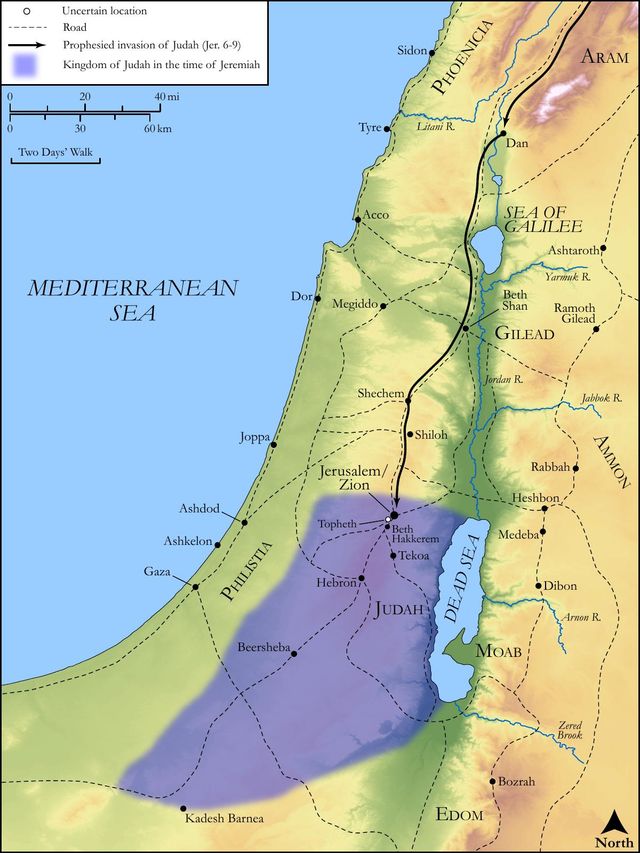
See on the biblical-era map
Study this verse
Public-domain commentary
Matthew Henry
From his Commentary on the Whole Bible. Henry comments on passages, not single verses — this entry covers Jeremiah 6:9–17. His three-level outline is real structure in the source text, so it is rendered as structure.
The heads of this paragraph are the very same with those of the last; for precept must be upon precept and line upon line.
I.The ruin of Judah and Jerusalem is here threatened.
We had before the haste which the Chaldea army made to the war (Jer 6:4, Jer 6:5); now here we have the havoc made by the war. How lamentable are the desolations here described! The enemy shall so long quarter among them, and be so insatiable in their thirst after blood and treasure, that they shall seize all they can meet with, and what escapes them at one time shall fall into their hands another (Jer 6:9): They shall thoroughly glean the remnant of Israel as a vine; as the grape-gatherer, who is resolved to leave none behind, still turns back his hand into the baskets, to put more in, till he has gathered all, so that they be picked up by the enemy, though dispersed, though hid, and none of them shall escape their eye and hand. Perhaps the people, being given to covetousness (Jer 6:13), had not observed that law of God which forbade them to glean all their grapes (Lev 19:10), and now they themselves shall be in like manner thoroughly gleaned and shall either fall by the sword or go into captivity. This is explained Jer 6:11, Jer 6:12, where God's fury and his hand are said to be poured out and stretched out, in the fury and by the hand of the Chaldeans; for even wicked men are often made use of as God's hand (Psa 17:14), and in their anger we may see God angry. Now see on whom the fury is poured out in full vials - upon the children abroad, or in the streets, where they are playing (Zac 8:5) or whither they run out innocently to look about them: the sword of the merciless Chaldeans shall not spare them, Jer 9:21. The children perish in the calamity which the fathers' sins have procured. The execution shall likewise reach the assembly of young men, their merry meetings, their clubs which they keep up to strengthen one another's hands in wickedness; they shall be cut off together. Nor shall those only fall into the enemies' hands who meet for lewdness (Jer 5:7), but even the husband with the wife shall be taken, these two in bed together, and neither left, but both taken prisoners. And, as they have no compassion for the weak but fair sex, so they have none for the decrepit but venerable age: The old with the full of days, whose deaths can contribute no more to their safety than their lives to their service, who are not in a capacity to do them either good or harm, shall be either cut off or carried off. Their houses shall then be turned to others (Jer 6:12); the conquerors shall dwell in their habitations, use their goods, and live upon their stores; their fields and vines shall fall together into their hands, as was threatened, Deu 28:30, etc. For God stretches out his hand upon the inhabitants of the land, and none can go out of the reach of it. Now as to this denunciation of God's wrath,
1.The prophet justifies himself in preaching thus terribly, for herein he dealt faithfully (Jer 6:11): "I am full of the fury of the Lord, full of the thoughts and apprehensions of it, and am carried out with a powerful impulse, by the spirit of prophecy, to speak of it thus vehemently." He took no delight in threatening, nor was it any pleasure to him with such sermons as these to make those about him uneasy; but he could not contain himself; he was weary with holding in; he suppressed it as long as he could, as long as he durst, but he was so full of power by the Spirit of the Lord of hosts that he must speak, whether they will hear or whether they will forbear. Note, When ministers preach the terrors of the Lord according to the scripture we have no reason to be displeased at them; for they are but messengers, and must deliver their message, pleasing or unpleasing.
2.He condemns the false prophets who preached plausibly, for therein they flattered people and dealt unfaithfully (Jer 6:13, Jer 6:14): The priest and the prophet, who should be their watchmen and monitors, have dealt falsely, have not been true to their trust not told the people their faults and the danger they were in; they should have been their physicians, but they murdered their patients by letting them have their will, by giving them every thing that had a mind to, and flattering them into an opinion that they were in no danger (Jer 6:14): They have healed the hurt of the daughter of my people slightly, or according to the cure of some slight hurt, skinning over the wound and never searching it to the bottom, applying lenitives only, when there was need of corrosives, soothing people in their sins, and giving them opiates to make them easy for the present, while the disease was preying upon the vitals. They said, "Peace peace - all shall be well." (if there were some thinking people among them, who were awake, and apprehensive of danger, they soon stopped their mouths with their priestly and prophetical authority, boldly averring that neither church nor state was in any danger), when there is no peace, because they went on in their idolatries and daring impieties. Note, Those are to be reckoned our false friends (that is, our worst and most dangerous enemies) who flatter us in a sinful way.
II.The sin of Judah and Jerusalem, which provoked God to bring this ruin upon them and justified him in it, is here declared.
1.They would by no means bear to be told of their faults, nor of the danger they were in. God bids the prophet give them warning of the judgment coming (Jer 6:9), "but," says he, "to whom shall I speak and give warning? I cannot find out any that will so much as give me a patient hearing. I may give warning long enough, but these is nobody that will take warning. I cannot speak that they may hear, cannot speak to any purpose, or with any hope of success; for their ear is uncircumcised, it is carnal and fleshly, indisposed to receive the voice of God, so that they cannot hearken. They have, as it were, a thick skin grown over the organs of hearing, so that divine things might to as much purpose be spoken to a stone as to them. Nay, they are not only deaf to it, but prejudiced against it; therefore they cannot hear, because they are resolved that they will not: The word of the Lord is unto them a reproach; both the reproofs and the threatenings of the word are so;" they reckoned themselves wronged and affronted by both, and resented the prophet's plain-dealing with them as they would the most causeless slander and calumny. This was kicking against the pricks (Act 9:5), as the lawyers against the word of Christ, Luk 11:45, Thus saying, thou repoachest us also. Note, Those reproofs that are counted reproaches, and hated as such, will certainly be turned into the heaviest woes. When it is here said, They have no delight in the word, more is implied than is expressed; "they have an antipathy to it; their hearts rise at it; it exasperates them, and enrages their corruptions, and they are ready to fly in the face and pull out the eyes of their reprovers." And how can those expect that the word of the Lord should speak any comfort to them who have no delight in it, but would rather be any where than within hearing of it?
2.They were inordinately set upon the world, and wholly carried away by the love of it (Jer 6:13): "From the least of them even to the greatest, old and young, rich and poor, high and low, those of all ranks, professions, and employments, every one is given to covetousness, greedy of filthy lucre, all for what they can get, per fas per nefas - right or wrong;" and this made them oppressive and violent (Jer 6:6, Jer 6:7), for of those evils, as well as others, the love of money is the bitter root. Nay, and this hardened their hearts against the word of God and his prophets. It was the covetous Pharisees that derided Christ, Luk 16:14.
3.They had become impudent in sin and were past shame. After such a high charge of flagrant crimes proved upon them, it was very proper to ask (Jer 6:15), Were they ashamed when they had committed all these abominations, which are such a reproach to their reason and religion? Did they blush at the conviction, and acknowledge that confusion of face belonged to them? If so, there is some hope of them yet. But, alas! there did not appear so much as this colour of virtue among them; their hearts were so hardened that they were not at all ashamed, neither could they blush, they had so brazened their faces. They even gloried in their wickedness, and openly confronted the convictions which should have humbled them and brought them to repentance. They resolved to face it out against God himself and not to own their guilt. Some refer this to the priests and prophets, who had healed the people slightly and told them that they should have peace, and yet were not ashamed of their treachery and falsehood, no, not when the event disproved them and gave them the lie. Those that are shameless are graceless and their case is hopeless. But those that will not submit to a penitential shame, nor take that to themselves as their due, shall not escape an utter ruin; for so it follows: Therefore they shall fall among those that fall; they shall have their portion with those that are quite undone; and, when God visits the nation in wrath, they shall be sure to be cast down and be made to tremble, because they would not blush. Note, Those that sin and cannot blush for it are in an evil case now, and it will be worse with them shortly. At first they hardened themselves and would not blush, afterwards they were so hardened that they could not. Quod unum habebant in malis bonum perdunt, peccandi verecundiam - they have lost the only good property which once blended itself with many bad ones, that is, shame for having done amiss. - Senec. De Vit. Beat.
III.They are put in mind of the good counsel which had been often given them, but in vain. They had a great deal said to them to little purpose,
1.By way of advice concerning their duty, Jer 6:16. God had been used to say to them, Stand in the ways and see. That is,
(1.)He would have them to consider, not to proceed rashly, but to do as travellers in the road, who are in care to find the right way which will bring them to their journey's end, and therefore pause and enquire for it. If they have any reason to think that they have missed their way, they are not easy till they have obtained satisfaction. O that men would be thus wise for their souls, and would ponder the path of their feet, as those that believe lawful and unlawful are of no less consequence to us than the right way and the wrong are to a traveller!
(2.)He would have them to consult antiquity, the observations and experiences of those that went before them: "Ask for the old paths, enquire of the former age (Job 8:8), ask thy father, thy elders (Deu 32:7), and thou wilt find that the way of godliness and righteousness has always been the way which God has owned and blessed and in which men have prospered. Ask for the old paths, the paths prescribed by the law of God, the written word, that true standard of antiquity. Ask for the paths that the patriarchs travelled in before you, Abraham, and Isaac, and Jacob; and, as you hope to inherit the promises made to them, tread in their steps. Ask for the old paths, Where is the good way?" We must not be guided merely by antiquity, as if the plea of prescription and long usage were alone sufficient to justify our path. No; there is an old way which wicked men have trodden, Job 22:15. But, when we ask for the old paths, it is only in order to find out the good way, the highway of the upright. Note, The way of religion and godliness is a good old way, the way that all the saints in all ages have walked in.
(3.)He would have them to resolve to act according to the result of these enquiries: "When you have found out which is the good way, walk therein, practise accordingly, keep closely to that way, proceed, and persevere in it." Some make this counsel to be given them with reference to the struggles that were between the true and false prophets, between those that said they should have peace and those that told them trouble was at the door; they pretended they knew not which to believe: "Stand in the way," says God, "and see, and enquire, which of these two agrees with the written word and the usual methods of God's providence, which of these directs you to the good way, and do accordingly." (4.) He assures them that, if they do thus, it will secure the welfare and satisfaction of their own souls: "Walk in the good old way and you will find your walking in that way will be easy and pleasant; you will enjoy both your God and yourselves, and the way will lead you to true rest. Though it cost you some pains to walk in that way, you will find an abundant recompence at your journey's end." (5.) He laments that this good counsel, which was so rational in itself and so proper for them, could not find acceptance: "But they said, We will not walk therein, not only we will not be at the pains to enquire which is the good way, the good old way; but when it is told us, and we have nothing to say to the contrary but that it is the right way, yet we will not deny ourselves and our humours so far as to walk in it." Thus multitudes are ruined for ever by downright wilfulness.
2.By way of admonition concerning their danger. Because they would not be ruled by fair reasoning, God takes another method with them; by less judgments he threatens greater, and sends his prophets to give them this explication of them, and to frighten them with an apprehension of the danger they were in (Jer 6:17); Also I set watchmen over you. God's ministers are watchmen, and it is a great mercy to have them set over us in the Lord. Now observe here,
(1.)The fair warning given by these watchmen. This was the burden of their song; they cried again and again, Hearken to the sound of the trumpet. God, in his providence, sounds the trumpet (Zac 9:14); the watchmen hear it themselves and are affected with it (Jer 4:19), and they are to call upon others to hearken to it too, to hear the Lord's controversy, to observe the voice of Providence, to improve it, and answer the intentions of it.
(2.)This fair warning slighted: "But they said, We will not hearken; we will not hear, we will not heed, we will not believe; the prophets may as well save themselves and us the trouble." The reason why sinners perish is because they do not hearken to the sound of the trumpet; and the reason why they do not is because they will not; and they have no reason to give why they will not but because they will not, that is, they are herein most unreasonable. One may more easily deal with ten men's reasons than one man's will.
Historical interpretation
Two Centuries of Reception
6 surviving comments on this verse. Each one is dated, so this reads as a timeline rather than a list.
Select a marker to jump to its quote. Markers stagger vertically where authors wrote within a few decades of each other.
Since the soul became too enfeebled for the apprehension of realities, we needed a divine teacher. The Savior is sent down—a teacher and leader in the acquisition of the good, as the secret and sacred token of the great Providence. “Where, then, is the scribe? Where is the searcher of this world? Has not God made foolish the wisdom of this world?” it is said. And again, “I will destroy the wisdom of the wise, and bring to nothing the understanding of the prudent,” speaks plainly of those who are wise in their own eyes and contentious. Excellently, therefore, Jeremiah says, “Thus says the Lord, ‘Stand in the ways, and ask for the eternal paths, what is the good way, and walk in it, and you shall find expiation for your souls.’ ”
What sprinklings shall we now employ while we celebrate the feast? Who will be our guide as we haste to this festival? None can do this, my beloved, but him whom you will name with me, even our Lord Jesus Christ, who said, “I am the Way.” For it is he who, according to the blessed John, “takes away the sin of the world.” He purifies our souls, as Jeremiah the prophet says in a certain place, “Stand in the ways and see, enquire, and look which is the good path, and you shall find in it cleansing for your souls.”
What are the marks of the person who fears the Lord? What is the stamp of those “who walk in his ways.” There are many ways, and the many ways lead to the one way. Wherefore it says in Jeremiah: “Stand beside the ways of the Lord, and ask for the eternal pathways. Find the one way, and walk it.” Notice that it says, “Stand beside the pathways of the Lord, and ask for the eternal paths of the Lord. Find the one way, and then walk it.” Through many ways, we find the one way. The same thought occurs in the gospel.
When you eat your meals, remember that you must immediately afterwards pray and read. Have a fixed number of lines of Holy Scripture, and render it as your task to your Lord. On no account resign yourself to sleep until you have filled the basket of your breast with a thread of this weaving. After the Holy Scriptures you should read the writings of learned people, of those at any rate whose faith is well known. You need not go into the mire to seek for gold. You have many pearls. Buy the one pearl with these. Stand, as Jeremiah says, in more ways than one so that you may come on the true way that leads to the Father.
(Versed 16 and following) Thus says the Lord: Stand on the roads and see, and inquire about the ancient paths, which is the good way, and walk in it, and you will find refreshment (or purification) for your souls. And they said: we will not walk (or we will not go). And I appointed watchmen over you, listen to the sound of the trumpet. And they said, we will not listen. Therefore hear (or they have heard) O nations: and know (or know) the congregation (or those who feed the flocks): or according to Symmachus, and know (the testimony that is in them) how much I will do to them. Listen, O earth. If the parable of the Gospel is understood, it will provide understanding of this place: in which a good merchant is said to sell all pearls, in order to buy the most precious pearl for its price (Matth. XIII); which, indeed, through the Patriarchs and Prophets, we come to him who says: I am the way (John XIV). Therefore, we must stand in the prophets, and contemplate and inquire diligently about the ancient or eternal paths, which have been trodden by many holy ones, which are more significantly called 'trails' in Greek, which is the good way in the Gospel (Matth. VII), and we must walk in it: and when this way is found, it provides refreshment or purification for the souls of believers. But they replied in opposition, we will not walk in the way of the Gospel: as the Prophet specifically says about the perfidy of the Jews. And immediately he brings forth: And I have set watchmen over you. No doubt that the chorus of the Apostles is indicated, according to Ezekiel: Son of man, I have made you a watchman for the house of Israel (Ezek. III, 17). And I have commanded you to listen to the sound of the trumpet, or the commandments of the Gospel, or the teachings of the Apostles, according to Isaiah: Go up to the high mountain, herald of good news to Zion; lift up your voice with strength, O Jerusalem, herald of good news (Isai. XL, 9). They said: We will not listen; and when invited to the dinner, they did not want to come: therefore it is said: Hear, O nations. This is what the Apostles followed, when they spoke in Lycaonia: It was necessary for you to speak the word of God first: but because you reject it, and judge yourselves unworthy of eternal life: behold, we turn to the nations (Acts 13:46). And know, congregation, not at all Jewish, but of all nations: whether you who shepherd the flocks, bishops and priests and all the ecclesiastical order: or you know the testimony that is in them. For the testimony of God is faithful, providing wisdom to the little ones (Psalm 18:8). To whom the Lord speaks: Do not be afraid, little flock (Luke 12:31). And: Behold, I and the children whom God has given me (Isaiah 8:18). Therefore, know the great things I will do for the unbelieving people. And it is added: Hear, O earth, the whole world is called to listen: just as we read in the beginning of Isaiah: Hear, O heavens, and give ear, O earth (ibid., 1); what the Lord will do for the people of Judah.
The holy prophets might themselves be considered as “many ways”; our Lord, however, is the truly good way. In fact, listen to his words, “I am the way, the truth and the life.” But each of the prophetic ways leads to this way, Moses the lawgiver hinting at this in his words, “The Lord our God will raise up for you from among your brothers a prophet like me.” David, king and prophet, and also Isaiah, Micah, Ezekiel and each of the prophets give a glimpse of this way. And as there is one way leading to the biggest cities that we are accustomed to call kingly and royal—whereas some paths do conduct people from both town and country to this one way—so there is one way leading to the Father, the only-begotten Son of God, while the blessed prophets lead people to this one way who choose to travel by the particular path they represent. The prophetic word, therefore, bids Jews to search out the prophetic ways and through them to discover the good way and travel in it.
Continue studying Jeremiah 6:16 across the web’s major study libraries — every link below opens this exact verse, chapter, or book on the destination site.
Read & Compare
 BibleGatewayThis verse in more than 200 translations and 70 languages.
 Bible.comThe YouVersion reader — hundreds of translations, reading plans, and highlights.
 ESV.orgCrossway's official English Standard Version reader.
 NET BibleThe NET translation with 60,000+ translators' notes on every rendering decision.
 STEP BibleTyndale House's free study tool — original text, vocabulary, and scholarly resources.
 BibliaLogos Bible Software's free web reader.
 USCCBThe New American Bible (Revised Edition) with the U.S. bishops' study notes.
Commentaries
 BibleHub CommentariesDozens of classic commentaries on this verse, gathered on one page.
 StudyLightMore than 100 commentary sets — the largest collection on the web.
 BibleRefPlain-English commentary on what this verse means, verse by verse.
 Enduring WordDavid Guzik's free commentary on this chapter, widely used by Bible teachers.
 Bible Study ToolsVerse commentary alongside Greek and Hebrew study aids.
Original Language & Research
- BibleHub InterlinearThe verse word by word — original language, transliteration, and English.
- BibleHub LexiconEvery word's original-language definition and Strong's entry.
 Blue Letter BibleDeep-study tools — Strong's numbers, concordance, and word studies.
 SefariaThe Hebrew text with Rashi and centuries of Jewish commentary.
Sermons, Hymns & Audio


TrulyRandomVerse is not affiliated with these sites and doesn’t control their content. They’re linked because they’re genuinely useful.
Summary
Jeremiah 6:16 presents a profound divine appeal from the LORD to His people, Judah, urging them to pause, discern their current spiritual trajectory, and return to the ancient, established paths of covenant faithfulness. It is a gracious invitation to embrace "the good way" that promises spiritual rest and profound peace for their souls. Tragically, the verse culminates in the people's defiant rejection of this divine wisdom, illustrating their deep-seated rebellion and foreshadowing the inevitable consequences of their stubbornness.
Context
ShowHideLiterary Context
Jeremiah 6:16 is situated within a series of prophetic pronouncements where Jeremiah delivers God's indictment against Judah for their pervasive sin, idolatry, and oppression. Chapters 1-6 primarily focus on the nation's apostasy and the impending judgment from the north (Babylon). This specific verse acts as a poignant interlude, a final, earnest plea from God before the full weight of judgment is described in subsequent passages. It stands as a stark contrast to the people's hardened hearts, emphasizing God's persistent desire for their repentance and restoration, even amidst severe warnings of destruction. The surrounding verses detail the corruption of Jerusalem, the false prophets, and the people's insensitivity to God's warnings, making the call to "ask for the old paths" a desperate, last-ditch effort to avert disaster and highlight God's enduring patience despite their profound spiritual decline.
Historical & Cultural Context
The prophet Jeremiah ministered during a tumultuous period in Judah's history, spanning the reigns of Kings Josiah, Jehoiakim, and Zedekiah, from approximately 627 to 586 BC. This era was marked by the decline of Assyrian power and the rise of Babylon, which posed an existential threat to Judah. Spiritually, the nation was in deep decline, having largely abandoned the covenant obligations established at Sinai. Despite Josiah's reforms, the people's hearts remained largely unrepentant, engaging in widespread idolatry (including child sacrifice), oppression, and a superficial religiosity that lacked true devotion to Yahweh. The "ways" and "paths" mentioned in the verse refer not to literal roads but to their moral, spiritual, and covenantal conduct, reflecting the established norms and traditions of their ancestors who walked in obedience to God's Law. The cultural context reveals a society that had become comfortable in its sin, valuing convenience and self-will over divine guidance, thus making the call to return to the "old paths" a radical summons to societal and spiritual transformation.
Key Themes
ShowHideJeremiah 6:16 encapsulates several core themes prevalent throughout the book of Jeremiah and the prophetic literature. Firstly, it highlights the theme of apostasy and rebellion, as Judah has clearly deviated from the "good way" of the LORD. Secondly, it underscores divine lament and patience, as God, through Jeremiah, expresses sorrow over His people's condition and offers a clear path to avoid impending judgment. The call to "ask for the old paths" emphasizes the theme of covenant faithfulness, urging a return to the foundational truths and principles laid out in the Mosaic Law, which promised blessing for obedience and curses for disobedience, as seen in Deuteronomy 28. The promise of "rest for your souls" introduces the theme of spiritual peace and well-being that results from genuine repentance and obedience, contrasting with the turmoil of sin. Finally, the people's blunt refusal, "We will not walk therein," powerfully conveys the theme of stubbornness and hardened hearts, a recurring motif in Jeremiah that ultimately leads to the nation's downfall and exile, as prophesied in passages like Jeremiah 7:24.
Exposition and Analysis
ShowHideKey Word Analysis
ShowHideFrom the root meaning "to tread," this word, translated as "ways" and "way," signifies more than just a physical road. It encompasses a course of life, a mode of action, or a moral and spiritual conduct. In this context, it refers to the path one chooses to walk in life, whether it aligns with God's will or deviates from it. The "good way" is therefore a life lived in accordance with divine principles, leading to prosperity and well-being.
Translated as "old" in "old paths," this term denotes something ancient, everlasting, or "time out of mind." It implies not merely chronological age but an enduring quality, something established, perpetual, and therefore eternally relevant. Thus, the "old paths" are not outdated traditions but foundational, divinely ordained ways that possess timeless validity and wisdom.
From a root meaning "to settle down," this word, rendered as "rest," literally means a resting place or a place of repose. Figuratively, it conveys a deep sense of inner tranquility, peace, and security for the soul. It's the settled peace that comes from aligning one's life with God's design, contrasting sharply with the unrest and turmoil of rebellion and disobedience.
Verse Breakdown
ShowHide"Thus saith the LORD"
This opening phrase establishes the divine authority and origin of the message. It is not Jeremiah's personal opinion or human counsel but a direct oracle from Yahweh (H3068, Yᵉhôvâh'), the covenant God of Israel, underscoring the gravity, truthfulness, and binding nature of the pronouncement. It demands immediate and serious attention.
"Stand ye in the ways, and see, and ask for the old paths"
This is a threefold divine imperative to Judah. "Stand" (H5975, ʻâmad') implies a halt, a pause in their current destructive course, urging them to cease their errant ways. "See" (H7200, râʼâh') urges careful observation and discernment of their present spiritual condition and the consequences of their choices. "Ask" (H7592, shâʼal') for the "old paths" (H5410, nâthîyb' with H5769, ʻôwlâm') is a directive to inquire about and seek out the ancient, established ways of God's covenant, the foundational truths and righteous living practiced by faithful generations, which they had abandoned.
"where [is] the good way, and walk therein"
This specifies the object of their search: "the good way" (H2896, ṭôwb' with H1870, derek'). This is the path of obedience, justice, and faithfulness to God, which is inherently beneficial and leads to well-being. The command to "walk therein" (H3212, yâlak') is an imperative for active, intentional, and sustained adherence to this righteous path, translating discernment into action.
"and ye shall find rest for your souls"
This is the divine promise and consequence of obedience. Walking in the good way leads to margôwaʻ (H4771) for their nephesh (H5315, souls/lives)—a deep spiritual peace, security, and inner tranquility that only God can provide. This profound rest contrasts sharply with the unrest, anxiety, and turmoil of their current rebellious state, offering genuine spiritual solace.
"But they said, We will not walk [therein]."
This stark, defiant statement (H559, ʼâmar') reveals the tragic climax of the verse. Despite the clear divine command, the promise of rest, and the imminent threat, the people of Judah, in their hardened hearts, utterly reject God's gracious invitation. This blunt refusal underscores their profound stubbornness, spiritual blindness, and seals their fate, highlighting the ultimate tragedy of human free will exercised against divine grace.
Literary Devices
ShowHideJeremiah 6:16 employs several powerful literary devices that amplify its message and emotional impact. Metaphor is central, as "ways" (H1870, derek') and "paths" (H5410, nâthîyb') are used to represent moral and spiritual conduct rather than literal roads. The "old paths" and "good way" are metaphors for the established covenant relationship and righteous living commanded by God. The phrase "rest for your souls" uses Synecdoche, where "souls" (H5315, nephesh') represents the entire person, emphasizing a holistic, inner peace that permeates one's whole being. There is a strong Contrast between the divine invitation and promise ("find rest for your souls") and the human rejection ("We will not walk therein"), highlighting the tragic choice made by Judah and the chasm between God's desire and human will. The passage also functions as a Divine Oracle, explicitly marked by the authoritative phrase "Thus saith the LORD" (H3068, Yᵉhôvâh'), lending it immense authority, solemnity, and prophetic weight. The structure itself presents a profound Dilemma or a Call to Decision, where God presents two clear options: choose the good way and find rest, or reject it and face the inevitable consequences.
Theological and Thematic Connections
ShowHideJeremiah 6:16 serves as a powerful theological statement on the nature of divine grace, human free will, and the consequences of moral choice. God, in His steadfast love and unwavering patience, continually offers a path of life and peace, even to a rebellious people. The "old paths" represent the unchanging truth and wisdom of God's Word, which remains relevant across generations, providing the only true foundation for spiritual well-being and societal flourishing. The promised "rest for your souls" points to a profound spiritual reality—a peace that transcends worldly circumstances and inner turmoil, found only in humble obedience and trust in God. Judah's rejection, however, underscores the tragic reality of human stubbornness and the perilous consequences of refusing divine guidance, demonstrating that God's judgment is not arbitrary but a just and sorrowful response to persistent rebellion against His gracious invitations. This verse highlights the tension between God's sovereign call and humanity's capacity for defiant refusal, a theme that reverberates throughout biblical history.
Reflection and Application
ShowHideJeremiah 6:16 resonates deeply with contemporary believers, urging us to engage in critical self-examination regarding our spiritual walk. In a world constantly pushing for novelty, innovation, and fleeting trends, this verse calls us to pause and "ask for the old paths"—to return to the timeless, unchanging truths of God's Word and the foundational principles of Christian faith. Are we diligently seeking out and walking in the "good way" of obedience, justice, and love, or have we, like ancient Judah, drifted into paths of convenience, compromise, or self-reliance, valuing personal autonomy over divine wisdom? The promise of "rest for your souls" remains a powerful incentive, reminding us that true peace, contentment, and spiritual security are not found in worldly pursuits, self-fulfillment, or endless striving, but in humble submission to God's will and His established ways. This verse serves as a sober warning against the spiritual arrogance and hardened heart that refuses divine guidance, emphasizing that while God's patience is immense, persistent rebellion ultimately leads to spiritual unrest, anxiety, and separation from His blessing. It challenges us to choose wisely, for our souls' peace depends on it.
Questions for Reflection
ShowHideFAQ
ShowHideWhat are the "old paths" that Jeremiah refers to?
ShowHideThe "old paths" (Hebrew: nethiybah 'olam') refer not to outdated traditions, but to the ancient, established, and enduring ways of God's covenant with Israel. These are the foundational truths, commandments, and principles revealed in the Mosaic Law and lived out by faithful ancestors. They represent a life of obedience, justice, righteousness, and faithfulness to Yahweh, which had proven to be the source of blessing and true well-being for the nation. It's a call to return to the unchanging divine standard rather than following contemporary deviations or syncretistic practices that had led them astray. This concept is deeply rooted in the wisdom tradition, where the path of righteousness is contrasted with the path of folly, as seen in Proverbs 4:18-19.
Why is "rest for your souls" promised to those who walk in the good way?
ShowHideThe promise of "rest for your souls" (Hebrew: _margôwaʻ nephesh'_) signifies a deep, inner tranquility, peace, and security that comes from aligning one's life with God's will. When people walk in God's "good way," they experience spiritual contentment, freedom from the turmoil of sin and rebellion, and the assurance of God's presence and blessing. This rest contrasts sharply with the spiritual unrest, anxiety, and ultimate judgment that result from disobedience and pursuing one's own destructive paths, as Judah was doing. It's a holistic peace that permeates one's entire being, a shalom that encompasses well-being in all aspects of life, both individual and communal. This concept of rest is a recurring theme in Scripture, often linked to obedience and trust, as exemplified in Psalm 23:2.
What does Judah's rejection, "We will not walk therein," signify for us today?
ShowHideJudah's blunt refusal, "We will not walk therein," signifies a profound act of rebellion and a hardened heart against God's gracious invitation. For us today, it serves as a solemn warning against spiritual stubbornness, pride, and the dangers of intellectual or emotional resistance to divine truth. It highlights the human tendency to prefer self-will and perceived autonomy over God's wisdom, even when God's way promises true flourishing and peace. It reminds us that while God offers grace and guidance, He also respects human choice, and persistent rejection of His path leads to inevitable negative consequences and spiritual unrest. This stubbornness is a recurring theme in the prophetic books, often leading to divine judgment, as seen in Isaiah 30:15.
Christ-Centered Fulfillment
ShowHideJeremiah 6:16 finds its ultimate and most profound fulfillment in Jesus Christ. While Jeremiah called the people to return to the "old paths" of the Mosaic Covenant, these paths, though good and righteous, were ultimately a shadow pointing to the perfect "Way" (Hebrew: derek') that is Jesus Himself. He definitively declares, "I am the way, the truth, and the life. No one comes to the Father except through me" (John 14:6). The "good way" that Judah was called to walk in is perfectly embodied in Christ, who perfectly fulfilled the Law and lived a life of complete obedience to the Father, even to the point of death on a cross (Philippians 2:8). Moreover, the "rest for your souls" that was promised in Jeremiah is fully realized in Christ. He extends the most beautiful invitation: "Come to me, all you who are weary and burdened, and I will give you rest. Take my yoke upon you and learn from me, for I am gentle and humble in heart, and you will find rest for your souls" (Matthew 11:28-29). This is not merely a cessation of physical labor, but a deep, spiritual repose that comes from being reconciled to God through His atoning work, freeing us from the burden of sin and the futility of self-effort. The New Testament further elaborates on this rest in Hebrews 4, speaking of a "Sabbath-rest" that remains for the people of God, entered into by faith in Christ, who is our ultimate High Priest and the source of our eternal peace. Thus, the ancient call to return to the good way and find rest is perfectly answered in the person and work of Jesus, who is both the path and the source of eternal peace and salvation for all who believe (Acts 4:12).