


Colossians 2:6
Bible text: King James Version (1769 Blayney text) · Public domain
Bible text: Berean Standard Bible · Public domain
Bible text: American Standard Version (1901) · Public domain
Bible text: World English Bible, Messianic edition · Public domain
Bible text: Geneva Bible (1599) · Public domain
Bible text: Young's Literal Translation · Public domain
- ὩςHōsJust asG5613PRTParticle or Disjunctive
- οὖνounthereforeG3767CONJConjunction
- παρελάβετεparelabeteyou have receivedG3880V-2AAI-2PVerb 2nd Aorist Active Indicative 2nd Plural
- τὸνton<the>G3588T-ASMDefinite article Accusative Singular Masculine
- ΧριστὸνChristonChristG5547N-ASM-TNoun Accusative Singular Masculine Title
- ἸησοῦνIēsounJesusG2424N-ASM-PNoun Accusative Singular Masculine Individual
- τὸνtontheG3588T-ASMDefinite article Accusative Singular Masculine
- κύριονkurionLordG2962N-ASM-TNoun Accusative Singular Masculine Title
- ἐνeninG1722PREPPreposition
- αὐτῷautōHimG846P-DSMPersonal pronoun Dative Singular Masculine
- περιπατεῖτεperipateitedo walkG4043V-PAM-2PVerb Present Active Imperative 2nd Plural
English is a literal word-by-word gloss of the Greek, not the KJV's wording. Why?
This is the original text the KJV's translators worked from — each Greek word with its own literal English meaning in this verse, prepared by scholars at Tyndale House, Cambridge. The KJV translates whole sentences, not word by word, so its wording differs: one Greek word can become several English words, and the KJV may choose “charity” where the gloss reads “love”. Both are faithful — they answer different questions. For the KJV's own rendering, switch to the KJV text.
Details
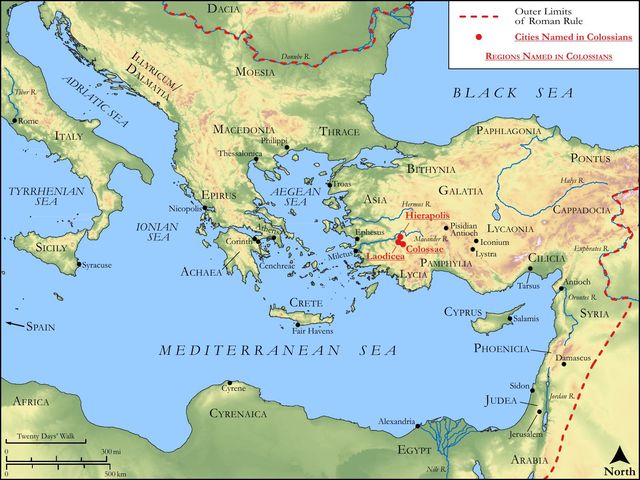
See on the biblical-era maps

Study this verse
Public-domain commentary
Matthew Henry
From his Commentary on the Whole Bible. Henry comments on passages, not single verses — this entry covers Colossians 2:4–12. His three-level outline is real structure in the source text, so it is rendered as structure.
The apostle cautions the Colossians against deceivers (Col 2:4): And this I say lest any man beguile you with enticing words; and Col 2:8, Lest any man spoil you. He insists so much upon the perfection of Christ and the gospel revelation, to preserve them from the ensnaring insinuations of those who would corrupt their principles. Note, 1. The way in which Satan spoils souls is by beguiling them. He deceives them, and by this means slays them. He is the old serpent who beguiled Eve through his subtlety, Co2 11:3. He could not ruin us if he did not cheat us; and he could not cheat us but by our own fault and folly. 2. Satan's agents, who aim to spoil them, beguile them with enticing words. See the danger of enticing words; how many are ruined by the flattery of those who lie in wait to deceive, and by the false disguises and fair appearances of evil principles and wicked practices. By good words, and fair speeches, they deceive the hearts of the simple, Rom 16:18. "You ought to stand upon your guard against enticing words, and be aware and afraid of those who would entice you to any evil; for that which they aim at is to spoil you." If sinners entice thee, consent thou not, Pro 1:10. Observe,
I.A sovereign antidote against seducers (Col 2:6, Col 2:7):
As you have therefore received Christ Jesus the Lord, so walk you in him, rooted and built up, etc. Here note,
1.All Christians have, in profession at least, received Jesus Christ the Lord, received him as Christ, the great prophet of the church, anointed by God to reveal his will; as Jesus the great high priest, and Saviour from sin and wrath, by the expiatory sacrifice of himself; and as Lord, or sovereign and king, whom we are to obey and be subject to. - Received him, consented to him, taken him for ours in every relation and every capacity, and for all the purposes and uses of them.
2.The great concern of those who have received Christ is to walk in him - to make their practices conformable to their principles and their conversation agreeable to their engagements. As we have received Christ, or consented to be his, so we must walk with him in our daily course and keep up our communion with him.
3.The more closely we walk with Christ the more we are rooted and established in the faith. A good conversation is the best establishment of a good faith. If we walk in him, we shall be rooted in him; and the more firmly we are rooted in him the more closely we shall walk in him: Rooted and built up. Observe, We cannot be built up in Christ, unless we be first rooted in him. We must be united to him by a lively faith, and heartily consent to his covenant, and then we shall grow up in him in all things. - As you have been taught - "according to the rule of the Christian doctrine, in which you have been instructed." Observe, A good education has a good influence upon our establishment. We must be established in the faith, as we have been taught, abounding therein. Observe, Being established in the faith, we must abound therein, and improve in it more and more; and this with thanksgiving. The way to have the benefit and comfort of God's grace is to be much in giving thanks for it. We must join thanksgiving to all our improvements, and be sensible of the mercy of all our privileges and attainments. Observe,
II.The fair warning given us of our danger:
Beware lest any man spoil you through philosophy and vain deceit, after the tradition of men, after the rudiments of the world, and not after Christ, Col 2:8. There is a philosophy which is a noble exercise of our reasonable faculties, and highly serviceable to religion, such a study of the works of God as leads us to the knowledge of God and confirms our faith in him. But there is a philosophy which is vain and deceitful, which is prejudicial to religion, and sets up the wisdom of man in competition with the wisdom of God, and while it pleases men's fancies ruins their faith; as nice and curious speculations about things above us, or of no use and concern to us; or a care of words and terms of art, which have only an empty and often a cheating appearance of knowledge. After the tradition of men, after the rudiments of the world: this plainly reflects upon the Jewish pedagogy or economy, as well as the Pagan learning. The Jews governed themselves by the traditions of their elders and the rudiments or elements of the world, the rites and observances which were only preparatory and introductory to the gospel state; the Gentiles mixed their maxims of philosophy with their Christian principles; and both alienated their minds from Christ. Those who pin their faith on other men's sleeves, and walk in the way of the world, have turned away from following after Christ. The deceivers were especially the Jewish teachers, who endeavoured to keep up the law of Moses in conjunction with the gospel of Christ, but really in competition with it and contradiction to it. Now here the apostle shows,
1.That we have in Christ the substance of all the shadows of the ceremonial law; for example,
(1.)Had they then the Shechinah, or special presence of God, called the glory, from the visible token of it? So have we now in Jesus Christ (Col 2:9): For in him dwelleth all the fulness of the Godhead bodily. Under the law, the presence of God dwelt between the cherubim, in a cloud which covered the mercy-seat; but now it dwells in the person of our Redeemer, who partakes of our nature, and is bone of our bone and flesh of our flesh, and has more clearly declared the Father to us. It dwells in him bodily; not as the body is opposed to the spirit, but as the body is opposed to the shadow. The fulness of the Godhead dwells in the Christ really, and not figuratively; for he is both God and man.
(2.)Had they circumcision, which was the seal of the covenant? In Christ we are circumcised with the circumcision made without hands (Col 2:11), by the work of regeneration in us, which is the spiritual or Christian circumcision. He is a Jew who is one inwardly, and circumcision is that of the heart, Rom 2:29. This is owing to Christ, and belongs to the Christian dispensation. It is made without hands; not by the power of any creature, but by the power of the blessed Spirit of God. We are born of the Spirit, Joh 3:5. And it is the washing of regeneration, and renewing of the Holy Spirit, Tit 3:5. It consists in putting off the body of the sins of the flesh, in renouncing sin and reforming our lives, not in mere external rites. It is not the putting away of the filth of the flesh, but the answer of a good conscience towards God, Pe1 3:21. And it is not enough to put away some one particular sin, but we must put off the whole body of sin. The old man must be crucified, and the body of sin destroyed, Rom 6:6. Christ was circumcised, and, by virtue of our union to him, we partake of that effectual grace which puts off the body of the sins of the flesh. Again, The Jews thought themselves complete in the ceremonial law; but we are complete in Christ, Col 2:10. That was imperfect and defective; if the first covenant had been faultless, there would no place have been sought for the second (Heb 8:7), and the law was but a shadow of good things, and could never, by those sacrifices, make the comers thereunto perfect, Heb 10:1. But all the defects of it are made up in the gospel of Christ, by the complete sacrifice for sin and revelation of the will of God. Which is the head of all principality and power. As the Old Testament priesthood had its perfection in Christ, so likewise had the kingdom of David, which was the eminent principality and power under the Old Testament, and which the Jews valued themselves so much upon. And he is the Lord and head of all the powers in heaven and earth, of angels and men. Angels, and authorities, and powers are subject to him, Pe1 3:22.
2.We have communion with Christ in his whole undertaking (Col 2:12): Buried with him in baptism, wherein also you have risen with him. We are both buried and rise with him, and both are signified by our baptism; not that there is anything in the sign or ceremony of baptism which represents this burying and rising, any more than the crucifixion of Christ is represented by any visible resemblance in the Lord's supper: and he is speaking of the circumcision made without hands; and says it is through the faith of the operation of God. But the thing signified by our baptism is that we are buried with Christ, as baptism is the seal of the covenant and an obligation to our dying to sin; and that we are raised with Christ, as it is a seal and obligation to our living to righteousness, or newness of life. God in baptism engages to be to us a God, and we become engaged to be his people, and by his grace to die to sin and to live to righteousness, or put off the old man and put on the new.
Historical interpretation
Two Centuries of Reception
2 surviving comments on this verse. Each one is dated, so this reads as a timeline rather than a list.
Select a marker to jump to its quote. Markers stagger vertically where authors wrote within a few decades of each other.
"As ye have therefore received Christ Jesus the Lord, so walk in Him, rooted and built up in Him, and stablished in the faith.".
"Beware lest any man spoil you of faith in Christ by philosophy and vain deceit "which does away with providence, "after the tradition of men; "for the philosophy which is in accordance with divine tradition establishes and confirms providence, which, being done away with, the economy of the Saviour appears a myth, while we are influenced "after the elements of the world, and not after Christ."
Again, he takes hold on them beforehand with their own testimony, saying, "As therefore ye received." We introduce no strange addition, he saith, neither do ye. "Walk ye in Him," for He is the Way that leadeth to the Father: not in the Angels; this way leadeth not thither. "Rooted," that is, fixed; not one while going this way, another that, but "rooted": now that which is rooted, never can remove. Observe how appropriate are the expressions he employs. "And built up," that is, in thought attaining unto Him. "And stablished" in Him, that is, holding Him, built as on a foundation. He shows that they had fallen down, for the word "built" has this force. For the faith is in truth a building; and needs both a strong foundation, and secure construction. For both if any one build not upon a secure foundation it will shake; and even though he do, if it be not firm, it will not stand. "As ye were taught." Again, the word "As." "Abounding," he saith, "in thanksgiving"; for this is the part of well-disposed persons, I say not simply to give thanks, but with great abundance, more than ye learned, if possible, with much ambition.
Continue studying Colossians 2:6 across the web’s major study libraries — every link below opens this exact verse, chapter, or book on the destination site.
Read & Compare
 BibleGatewayThis verse in more than 200 translations and 70 languages.
 Bible.comThe YouVersion reader — hundreds of translations, reading plans, and highlights.
 ESV.orgCrossway's official English Standard Version reader.
 NET BibleThe NET translation with 60,000+ translators' notes on every rendering decision.
 STEP BibleTyndale House's free study tool — original text, vocabulary, and scholarly resources.
 BibliaLogos Bible Software's free web reader.
 USCCBThe New American Bible (Revised Edition) with the U.S. bishops' study notes.
Commentaries
 BibleHub CommentariesDozens of classic commentaries on this verse, gathered on one page.
 StudyLightMore than 100 commentary sets — the largest collection on the web.
 BibleRefPlain-English commentary on what this verse means, verse by verse.
 Enduring WordDavid Guzik's free commentary on this chapter, widely used by Bible teachers.
 Bible Study ToolsVerse commentary alongside Greek and Hebrew study aids.
Original Language & Research
- BibleHub InterlinearThe verse word by word — original language, transliteration, and English.
- BibleHub LexiconEvery word's original-language definition and Strong's entry.
 Blue Letter BibleDeep-study tools — Strong's numbers, concordance, and word studies.
 CNTR CollationThe earliest Greek manuscripts of this verse, collated letter by letter.
Sermons, Hymns & Audio


TrulyRandomVerse is not affiliated with these sites and doesn’t control their content. They’re linked because they’re genuinely useful.
Summary
Colossians 2:6 serves as a foundational exhortation for believers, reminding them that just as they initially embraced Christ Jesus as Lord through faith, so too should their entire lives be continually lived in union with Him. This verse calls for a consistent and ongoing lifestyle that reflects the profound spiritual reality of having received Christ, emphasizing the sufficiency of Christ as the sole basis for both salvation and sanctification.
Context
ShowHideLiterary Context
Colossians 2:6 follows Paul's earnest desire for the Colossian believers to have "all riches of the full assurance of understanding, to the acknowledgement of the mystery of God, and of the Father, and of Christ" (Colossians 2:2). The preceding verses emphasize the hidden treasures of wisdom and knowledge found exclusively in Christ, serving as a bulwark against deceptive philosophical arguments and empty traditions that threatened to lead them astray (Colossians 2:4 and Colossians 2:8). Verse 6, therefore, transitions from a theological defense of Christ's supremacy to a practical imperative, grounding the Christian walk firmly in the initial reception of Christ, thereby setting the stage for subsequent warnings against specific heresies and legalistic practices in the chapter.
Historical & Cultural Context
The church in Colossae faced a unique blend of syncretistic heresies. This "Colossian heresy" combined elements of Jewish legalism (circumcision, dietary laws, observance of festivals – Colossians 2:16), Gnostic tendencies (emphasizing secret knowledge, asceticism, and the worship of angels – Colossians 2:18), and philosophical speculation. These false teachings diminished the absolute supremacy and sufficiency of Christ, suggesting that believers needed something more than Christ for spiritual completeness. Paul's letter directly counters these errors by asserting Christ's preeminence and the fullness that believers already possess in Him (Colossians 2:9-10). The exhortation to "walk in him" directly addresses the need for the Colossians to remain steadfast in the truth they received, rather than being swayed by external pressures or novel doctrines.
Key Themes
ShowHideThe verse powerfully encapsulates several key themes prevalent throughout the book of Colossians. Firstly, the sufficiency of Christ is paramount; believers have received Christ Jesus the Lord, indicating that He is all that is needed for salvation and spiritual life. There is no need for additional rituals or philosophies, as all fullness dwells in Him (Colossians 1:19). Secondly, the theme of union with Christ is central; the command to "walk in him" signifies a continuous, intimate relationship where Christ is the sphere and source of one's daily existence. This union is the basis for spiritual growth and maturity. Thirdly, practical Christian living is emphasized, showing that true doctrine must always lead to transformed conduct. The way one begins the Christian life (by receiving Christ) is the way one is to continue it (by walking in Him), forming a coherent and consistent spiritual journey.
Exposition and Analysis
ShowHideKey Word Analysis
ShowHideThis term (G3880) signifies "to receive near," implying an intimate association or acceptance. In the context of the gospel, it refers to the personal and active embrace of Christ and the truth about Him, not merely intellectual assent but a profound spiritual transaction where one takes Christ to oneself. It denotes the initial act of conversion, where the believer accepts Christ as He is presented in the gospel.
This word (G4043) literally means "to tread all around" or "to walk at large." Figuratively, it is a common biblical metaphor for one's daily conduct, manner of life, or spiritual journey. The present imperative tense indicates a continuous, ongoing action. Therefore, "walk ye" is a call to a lifestyle of consistent obedience, fellowship, and progression in Christ, reflecting the spiritual reality of being united with Him.
As a primary preposition (G1722), "in" denotes a fixed position, state, or sphere. When applied to "walk in him," it signifies that Christ is the very environment, source, and sphere of the believer's life. It implies a deep, abiding union where Christ's character, teachings, and power permeate and direct every aspect of one's existence. It is not merely walking with Him, but walking within the reality of who He is.
Verse Breakdown
ShowHide"As ye have therefore received Christ Jesus the Lord"
This clause establishes the foundational premise for the exhortation that follows. It refers to the past, decisive act of conversion where the Colossian believers, and by extension all believers, personally accepted Jesus as the Christ (Messiah) and acknowledged His divine authority as Lord. This reception is not merely intellectual assent but a profound spiritual embrace of His person and work, signifying the beginning of their new life in Him. The use of "therefore" (G3767, oûn) logically connects this past reception to the subsequent command.
"so walk ye in him"
This is the imperative command, directly flowing from the preceding statement. The "so" (G5613, hōs) indicates a correspondence: the manner in which they received Christ should be the manner in which they continue to live. "Walk" is a continuous action, implying a lifestyle. To "walk in him" means to live one's daily life in continuous dependence on, obedience to, and fellowship with Christ. It encompasses embodying His character, following His teachings, and drawing upon His power, making Him the central focus and sphere of all existence.
Literary Devices
ShowHideColossians 2:6 prominently features Metaphor. The verb "walk" (Greek: peripatéō) is a common biblical metaphor for one's conduct, lifestyle, or journey through life. It transforms a physical action into a spiritual and ethical one, vividly portraying the Christian life as a continuous, active progression. The phrase "in him" further enhances this metaphor, suggesting that Christ is the very environment or sphere within which this walk takes place, emphasizing the believer's profound Union with Christ. The structure of the verse also demonstrates a form of Parallelism or Correspondence, where the initial act of "receiving" Christ is directly mirrored by the ongoing act of "walking" in Him, highlighting the consistency required between conversion and daily living.
Theological and Thematic Connections
ShowHideColossians 2:6 underscores the profound theological truth that the Christian life is a seamless continuum, initiated by grace through faith and sustained by that same grace through ongoing faith. The initial act of "receiving Christ Jesus the Lord" is not merely an entry point but establishes the very nature of the subsequent "walk." This implies that salvation is not a one-time transaction followed by a separate set of rules, but rather an organic union with Christ that permeates every aspect of existence. The sufficiency of Christ, a dominant theme in Colossians, is powerfully reinforced here: because all fullness dwells in Him, believers need nothing more than Him for their spiritual completeness and daily sustenance. To walk in Him is to find all wisdom, righteousness, sanctification, and redemption in Christ alone, rejecting any additions or substitutions.
Reflection and Application
ShowHideColossians 2:6 offers a profound and practical challenge for every believer. It calls us to remember the simplicity and profundity of our initial encounter with Christ – the moment we truly "received Christ Jesus the Lord." This foundational act of faith, where we acknowledged His sovereignty and embraced His saving work, is not merely a historical event but the defining reality that shapes our entire existence. The command to "so walk ye in him" then becomes a powerful call to consistency. It means that the same faith, dependence, and surrender that marked our conversion must characterize our daily lives. This "walk" is not about striving in our own strength or adding human traditions to Christ's finished work, but about continually drawing from His life, obeying His Spirit, and allowing His character to be formed within us. It is a call to live out our identity as those united with Christ, finding all our sufficiency, purpose, and direction in Him alone, thereby resisting the myriad of distractions and false teachings that seek to pull us away from this singular focus.
Questions for Reflection
ShowHideFAQ
ShowHideWhat does it mean to "receive Christ Jesus the Lord"?
ShowHideTo "receive Christ Jesus the Lord" signifies a personal and active embrace of Jesus as the Messiah (Christ) and as the sovereign ruler over one's life (Lord). It's more than just intellectual agreement; it's a spiritual transaction involving faith, repentance, and a surrender of one's life to Him. This act marks the beginning of one's salvation and new life, as described in passages like John 1:12 where those who receive Him are given the right to become children of God.
What does "walk ye in him" practically entail for a believer today?
ShowHide"Walk ye in him" is a powerful metaphor for living a life that is consistently aligned with Christ. Practically, it means to live in continuous dependence on Him, drawing strength and guidance from His Spirit. It involves obeying His commands (John 14:15), imitating His character (Ephesians 5:2), and making Him the central focus of all decisions and actions. It's a call to spiritual growth, where one's daily conduct reflects the reality of their union with Christ, as seen in the call to "walk worthy of the Lord unto all pleasing" (Colossians 1:10).
Christ-Centered Fulfillment
ShowHideColossians 2:6 finds its ultimate Christ-centered fulfillment in the very person and ongoing work of Jesus Christ, who is both the object of our initial faith and the sphere of our continuous walk. When we "received Christ Jesus the Lord," we were united with Him in His death, burial, and resurrection, as Paul explains in Romans 6:3-4. This union means that our old self was crucified with Him, and we were raised to walk in newness of life, a direct fulfillment of the "so walk ye in him" command. Christ, through His Holy Spirit, indwells believers, making this continuous walk not a mere human effort but a Spirit-empowered reality. He is the Vine, and we are the branches, called to abide in Him to bear fruit (John 15:5). Our "walk in him" is a daily manifestation of His life within us, a progressive conformity to His image (2 Corinthians 3:18), and a living testimony to His complete sufficiency for all aspects of salvation and sanctification. He is not just the starting point but the ongoing source, sustainer, and goal of our entire Christian journey, ensuring that "as ye have therefore received Christ Jesus the Lord, so walk ye in him" is a call to live out the very life of Christ Himself.