


2 Corinthians 5:7
Bible text: King James Version (1769 Blayney text) · Public domain
Bible text: Berean Standard Bible · Public domain
Bible text: American Standard Version (1901) · Public domain
Bible text: World English Bible, Messianic edition · Public domain
Bible text: Geneva Bible (1599) · Public domain
Bible text: Young's Literal Translation · Public domain
- διὰdiathroughG1223PREPPreposition
- πίστεωςpisteōsfaithG4102N-GSFNoun Genitive Singular Feminine
- γὰρgarforG1063CONJConjunction
- περιπατοῦμενperipatoumenwe walkG4043V-PAI-1PVerb Present Active Indicative 1st Plural
- οὐounotG3756PRT-NNegative Particle Negative
- διὰdiathroughG1223PREPPreposition
- εἴδουςeidoussightG1491N-GSNNoun Genitive Singular Neuter
English is a literal word-by-word gloss of the Greek, not the KJV's wording. Why?
This is the original text the KJV's translators worked from — each Greek word with its own literal English meaning in this verse, prepared by scholars at Tyndale House, Cambridge. The KJV translates whole sentences, not word by word, so its wording differs: one Greek word can become several English words, and the KJV may choose “charity” where the gloss reads “love”. Both are faithful — they answer different questions. For the KJV's own rendering, switch to the KJV text.
Details
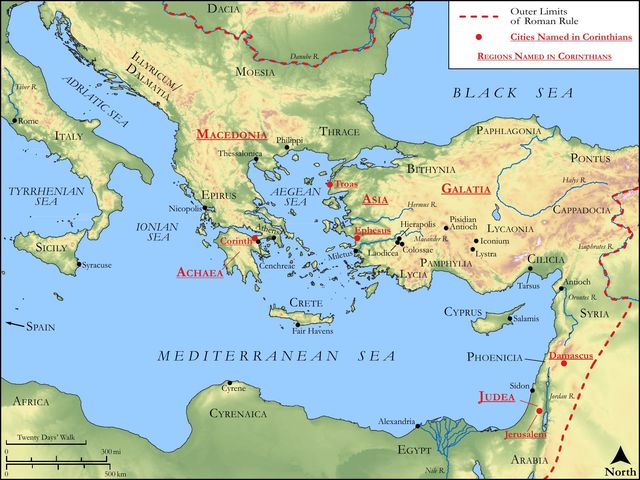
See on the biblical-era maps

Study this verse
Public-domain commentary
Matthew Henry
From his Commentary on the Whole Bible. Henry comments on passages, not single verses — this entry covers 2 Corinthians 5:1–11. His four-level outline is real structure in the source text, so it is rendered as structure.
The apostle in these verses pursues the argument of the former chapter, concerning the grounds of their courage and patience under afflictions. And,
I.He mentions their expectation, and desire, and assurance, of eternal happiness after death, Co2 5:1-5. Observe particularly,
1.The believer's expectation of eternal happiness after death, Co2 5:1. He does not only know, or is well assured by faith of the truth and reality of the thing itself - that there is another and a happy life after this present life is ended, but he has good hope through grace of his interest in that everlasting blessedness of the unseen world: "We know that we have a building of God, we have a firm and well-grounded expectation of the future felicity." Let us take notice,
(1.)What heaven is in the eye and hope of a believer. He looks upon it as a house, or habitation, a dwelling-place, a resting-place, a hiding-place, our Father's house, where there are many mansions, and our everlasting home. It is a house in the heavens, in that high and holy place which as far excels all the palaces of this earth as the heavens are high above the earth. It is a building of God, whose builder and maker is God, and therefore is worthy of its author; the happiness of the future state is what God hath prepared for those that love him. It is eternal in the heavens, everlasting habitations, not like the earthly tabernacles, the poor cottages of clay in which our souls now dwell, which are mouldering and decaying, and whose foundations are in the dust.
(2.)When it is expected this happiness shall be enjoyed - immediately after death, so soon as our house of this earthly tabernacle is dissolved. Note,
[1.]That the body, this earthly house, is but a tabernacle, that must be dissolved shortly; the nails or pins will be drawn, and the cords be loosed, and then the body will return to dust as it was.
[2.]When this comes to pass, then comes the house not made with hands. The spirit returns to God who gave it; and such as have walked with God here shall dwell with God for ever.
2.The believer's earnest desire after this future blessedness, which is expressed by this word, stenazomen - we groan, which denotes,
(1.)A groaning of sorrow under a heavy load; so believers groan under the burden of life: In this we groan earnestly, Co2 5:2. We that are in this tabernacle groan, being burdened, Co2 5:4. The body of flesh is a heavy burden, the calamities of life are a heavy load. But believers groan because burdened with a body of sin, and the many corruptions that are still remaining and raging in them. This makes them complain, O wretched man that I am! Rom 7:24.
(2.)There is a groaning of desire after the happiness of another life; and thus believers groan: Earnestly desiring to be clothed upon with our house which is from heaven (Co2 5:2), to obtain a blessed immortality, that mortality might be swallowed up of life (Co2 5:4), that being found clothed, we may not be naked (Co2 5:3), that, if it were the will of God, we might not sleep, but be changed; for it is not desirable in itself to be unclothed. Death considered merely as a separation of soul and body is not to be desired, but rather dreaded; but, considered as a passage to glory, the believer is willing rather to die than live, to be absent from the body, that he may be present with the Lord (Co2 5:1), to leave this body that he may go to Christ, and to put off these rags of mortality that he may put on the robes of glory. Note,
[1.]Death will strip us of the clothing of flesh, and all the comforts of life, as well as put an end to all our troubles here below. Naked we came into this world, and naked shall we go out of it. But,
[2.]Gracious souls are not found naked in the other world; no, they are clothed with garments of praise, with robes of righteousness and glory. They shall be delivered out of all their troubles, and shall have washed their robes and made them white in the blood of the Lamb, Rev 7:14.
3.The believer's assurance of his interest in this future blessedness, on a double account: - (1.) From the experience of the grace of God, in preparing and making him meet for this blessedness. He that hath wrought us for the self-same thing is God, Co2 5:5. Note, All who are designed for heaven hereafter are wrought or prepared for heaven while they are here; the stones of that spiritual building and temple above are squared and fashioned here below. And he that hath wrought us for this is God, because nothing less than a divine power can make a soul partaker of a divine nature; no hand less than the hand of God can work us for this thing. A great deal is to be done to prepare our souls for heaven, and that preparation of the heart is from the Lord. (2.) The earnest of the Spirit gave them this assurance: for an earnest is part of payment, and secures the full payment. The present graces and comforts of the Spirit are earnests of everlasting grace and comfort.
II.The apostle deduces an inference for the comfort of believers in their present state and condition in this world, Co2 5:6-8. Here observe,
1.What their present state or condition is: they are absent from the Lord (Co2 5:6); they are pilgrims and strangers in this world; they do but sojourn here in their earthly home, or in this tabernacle; and though God is with us here, by his Spirit, and in his ordinances, yet we are not with him as we hope to be: we cannot see his face while we live: For we walk by faith, not by sight, Co2 5:7. We have not the vision and fruition of God, as of an object that is present with us, and as we hope for hereafter, when we shall see as we are seen. Note, Faith is for this world, and sight is reserved for the other world: and it is our duty, and will be our interest, to walk by faith, till we come to live by sight.
2.How comfortable and courageous we ought to be in all the troubles of life, and in the hour of death: Therefore we are, or ought to be, always confident (Co2 5:6), and again (Co2 5:8), We are confident, and willing rather to be absent from the body. True Christians, if they duly considered the prospect faith gives them of another world, and the good reasons of their hope of blessedness after death, would be comforted under the troubles of life, and supported in the hour of death: they should take courage, when they are encountering the last enemy, and be willing rather to die than live, when it is the will of God that they should put off this tabernacle. Note, As those who are born from above long to be there, so it is but being absent from the body, and we shall very soon be present with the Lord - but to die, and be with Christ - but to close our eyes to all things in this world, and we shall open them in a world of glory. Faith will be turned into sight.
III.He proceeds to deduce an inference to excite and quicken himself and others to duty, Co2 5:9-11.
So it is that well-grounded hopes of heaven will be far from giving the least encouragement to sloth and sinful security; on the contrary, they should stir us up to use the greatest care and diligence in religion: Wherefore, or because we hope to be present with the Lord, we labour and take pains, Co2 5:9. Philotimoumetha - We are ambitious, and labour as industriously as the most ambitious men do to obtain what they aim at. Here observe,
1.What it was that the apostle was thus ambitious of - acceptance with God. We labour that, living and dying, whether present in the body or absent from the body, we may be accepted of him, the Lord (Co2 5:9), that we may please him who hath chosen us, that our great Lord may say to us, Well done. This they coveted as the greatest favour and the highest honour: it was the summit of their ambition.
2.What further quickening motives they had to excite their diligence, from the consideration of the judgment to come, Co2 5:10, Co2 5:11. There are many things relating to this great matter that should awe the best of men into the utmost care and diligence in religion; for example, the certainty of this judgment, for we must appear; the universality of it, for we must all appear; the great Judge before whose judgment-seat we must appear, the Lord Jesus Christ, who himself will appear in flaming fire; the recompence to be then received, for things done in the body, which will be very particular (unto every one), and very just, according to what we have done, whether good or bad. The apostle calls this awful judgment the terror of the Lord (Co2 5:11), and, by the consideration thereof, was excited to persuade men to repent, and live a holy life, that, when Christ shall appear terribly, they may appear before him comfortably. And, concerning his fidelity and diligence, he comfortably appeals unto God, and the consciences of those he wrote to: We are made manifest unto God, and I trust also are made manifest in your consciences.
Historical interpretation
Three Centuries of Reception
8 surviving comments on this verse. Each one is dated, so this reads as a timeline rather than a list.
Select a marker to jump to its quote. Markers stagger vertically where authors wrote within a few decades of each other.
If, then, the Lord counts the natural beauty of the body inferior to that of the soul, what thinks He of spurious beauty, rejecting utterly as He does all falsehood? "For we walk by faith, not by sight.".
"For we walk by faith, not by sight"
For the "house in heaven "with which we desire to be "clothed "is immortality; with which, when we are clothed, every weakness and mortality will be entirely "swallowed up "in it, being consumed by endless life. "For we walk by faith, not by sight; "
"That whilst we are at home in the body, we are absent from the Lord (for we walk by faith, not by sight); we are of good courage, I say, and are willing to be absent from the body, and to be at home with the Lord." That which is greater than all he has put last, for to be with Christ is better, than receiving an incorruptible [body.] But what he means is this: 'He quencheth not our life that warreth against and killeth us; be not afraid; be of good courage even when hewn in pieces. For not only doth he set thee free from corruption and a burden, but he also sendeth thee quickly to the Lord.' Wherefore neither did he say, "whilst we 'are' in the body:" as of those who are in a foreign and strange land. "Knowing therefore that whilst we are at home in the body, we are absent from the Lord: we are of good courage, I say, and willing to be absent from the body, and to be at home with the Lord." Seest thou how keeping back what was painful, the names of death and the end, he has employed instead of them such as excite great longing, calling them presence with God; and passing over those things which are accounted to be sweet, the things of life, he hath expressed them by painful names, calling the life here an absence from the Lord? Now this he did, both that no one might fondly linger amongst present things, but rather be aweary of them; and that none when about to die might be disquieted, but might even rejoice as departing unto greater goods. Then that none might say on hearing that we are absent from the Lord, 'Why speakest thou thus? Are we then estranged from Him whilst we are here?' he in anticipation corrected such a thought, saying, "For we walk by faith, not by sight." Even here indeed we know Him, but not so clearly. As he says also elsewhere, "in a mirror," and "darkly." "We are of good courage, I say, and willing." Wonderful! to what hath he brought round the discourse? To an extreme desire of death, having shown the grievous to be pleasurable, and the pleasurable grievous. For by the term, "we are willing" he means, 'we are desirous.' Of what are we desirous? Of being "absent from the body, and at home with the Lord." And thus he does perpetually, (as I showed also before) turning round the objection of his opponents unto the very contrary.
By faith we hope in God, for his form is not visible to us. But we believe that we shall dwell with him and that we shall see him as far as it is possible for a human being to see him. For Moses saw him when he was still in the body, and the angels see him in the way that is possible for them.
Therefore, amid the shadows of this life in which “we are absent from the Lord” as long as “we walk by faith and not by sight,” the Christian soul should consider itself desolate and should not cease from praying and from attending with the eye of faith to the word of the divine and sacred Scriptures.
We cannot now see what we shall be like, but we discern it by faith alone. That is why after the death of the body we want to stand in the presence of God.
Nevertheless, when we hear at the same time of the justified and the glorified, let us not assign both the work of justification and glorification to the same moment in the present time. For the grace of justification is given in the present time, but the grace of glorification is saved as a future grace. The one is of faith, the other of sight. Paul says that now “we walk by faith, not by sight.” What the saints believe now, then they will see.
In the time before the Messiah came, the expectation of the godly was to die and go to Sheol. Jonah (most likely) actually died and cried out to God from the depths of Sheol (Jon. 2:1). The psalmist expected that Sheol would swallow him up (Ps. 18:5; 86:13; 116:3).
In the parable of Lazarus and the rich man, they both died and went down to Hades. In that parable, Hades was divided in two by a vast chasm. The side where Lazarus was had the name of Abraham’s bosom (Luke 16:23), while the rich man was in torment in Hades. Nevertheless, it was possible for communication to occur across the chasm.
In our text [Matt. 12:40], Jesus said that He was going to be three days and nights in the heart of the earth. But He also told the thief on the cross that He would be with him in Paradise that same day (Luke 23:43). So then, Abraham’s bosom was also known as Paradise. To the Greeks, this went by the name of Elysium. This is where Jesus went, and preached across the chasm.
The Greek word for the lowest pit of Hades, the worst part, was Tartarus. This word is used once in the New Testament (without any redefinition, mind). Peter tells us this: “For if God spared not the angels that sinned, but cast them down to hell [Tartarus], and delivered them into chains of darkness, to be reserved unto judgment” (2 Peter 2:4).
While in Hades, the Lord preached. But the preaching was not “second chance” preaching. Rather the word used is one used for heralding or announcing, not the word for preaching the gospel. “By which also he went and preached unto the spirits in prison; Which sometime were disobedient, when once the longsuffering of God waited in the days of Noah, while the ark was a preparing, wherein few, that is, eight souls were saved by water” (1 Pet. 3:19–20). The Lord was announcing their final defeat to the “sons of God” and Nephilim both. And this, incidentally, tells us how momentous the rebellion at the time of the Flood actually was. Thousands of years after their definitive defeat, Jesus went to them to announce their final defeat.
The Bible teaches us that Jesus is the king of all things. The devil is not the ruler of Gehenna—Jesus is. The lake of fire was prepared for the devil and his angels (Matt. 25:41). It is a place of torment for the devil. Furthermore, Jesus holds the keys to Hades as well. “I am he that liveth, and was dead; and, behold, I am alive for evermore, Amen; and have the keys of hell [Hades] and of death.” (Rev. 1:18). Jesus, not the devil, is the King of Hell. Jesus, not the devil, is the Lord of Hades.
When the Lord rose from the dead, He led captivity captive (Eph. 4:8)—all the saints in the Old Testament who had died and gone to Abraham’s bosom were transferred when Paradise was moved (Matt. 27:52). And by the time of Paul, Paradise was up (2 Cor. 12:4). So if you had lived in the Old Testament, you would have died and gone down to Sheol/Hades. But the part of Hades that contained the saints of God has been emptied out, and now when God’s people die, what happens? To be absent from the body is to be present with the Lord (2 Cor. 5:6, 8). We still go to Paradise, but Paradise itself has been moved into the heavens.
Continue studying 2 Corinthians 5:7 across the web’s major study libraries — every link below opens this exact verse, chapter, or book on the destination site.
Read & Compare
 BibleGatewayThis verse in more than 200 translations and 70 languages.
 Bible.comThe YouVersion reader — hundreds of translations, reading plans, and highlights.
 ESV.orgCrossway's official English Standard Version reader.
 NET BibleThe NET translation with 60,000+ translators' notes on every rendering decision.
 STEP BibleTyndale House's free study tool — original text, vocabulary, and scholarly resources.
 BibliaLogos Bible Software's free web reader.
 USCCBThe New American Bible (Revised Edition) with the U.S. bishops' study notes.
Commentaries
 BibleHub CommentariesDozens of classic commentaries on this verse, gathered on one page.
 StudyLightMore than 100 commentary sets — the largest collection on the web.
 BibleRefPlain-English commentary on what this verse means, verse by verse.
 Enduring WordDavid Guzik's free commentary on this chapter, widely used by Bible teachers.
 Bible Study ToolsVerse commentary alongside Greek and Hebrew study aids.
Original Language & Research
- BibleHub InterlinearThe verse word by word — original language, transliteration, and English.
- BibleHub LexiconEvery word's original-language definition and Strong's entry.
 Blue Letter BibleDeep-study tools — Strong's numbers, concordance, and word studies.
 CNTR CollationThe earliest Greek manuscripts of this verse, collated letter by letter.
Sermons, Hymns & Audio


TrulyRandomVerse is not affiliated with these sites and doesn’t control their content. They’re linked because they’re genuinely useful.
Summary
Second Corinthians 5:7 articulates a foundational principle of the Christian life: the believer's journey and conduct are governed by an unwavering trust in God and His unseen realities, rather than being dictated by what is physically observable or immediately apparent. This verse serves as a concise theological declaration, explaining the source of Christian hope and confidence amidst the temporal challenges and uncertainties of earthly existence, grounding spiritual reality in divine assurance over sensory perception.
Context
ShowHideLiterary Context
This verse is strategically placed within a profound theological discourse in 2 Corinthians 4-5. Paul has just concluded a discussion on the surpassing glory of the new covenant ministry, contrasting the fading glory of the old with the eternal weight of glory found in Christ (2 Corinthians 3:7-18). In 2 Corinthians 4:7-18, he speaks of the "treasure in earthen vessels," highlighting the fragility of human existence against the backdrop of God's power. He then transitions to the theme of the temporary nature of the physical body ("earthly tent") versus the eternal dwelling prepared by God (2 Corinthians 5:1-5). The longing for this heavenly dwelling and the confidence in future resurrection are central. Verse 7, "For we walk by faith, not by sight," provides the theological rationale for this confidence and hope, explaining how believers can live with such assurance despite the present sufferings and the unseen nature of their eternal reward. It sets the stage for Paul's subsequent declaration of being "at home with the Lord" (2 Corinthians 5:8) and the ambition to be pleasing to Him (2 Corinthians 5:9).
Historical & Cultural Context
Paul's ministry took place in a Hellenistic world where philosophical thought often emphasized empirical evidence and rational deduction as primary paths to truth. Yet, the early Christian communities, including those in Corinth, were called to embrace a reality that transcended the visible. The Corinthians themselves struggled with various issues, including factionalism, moral laxity, and a tendency to evaluate spiritual leaders based on outward appearances or rhetorical skill (2 Corinthians 10:7-11). Paul, in contrast, consistently pointed to the unseen power of God, the spiritual nature of the gospel, and the transformative work of the Holy Spirit. His own life was a testament to walking by faith, enduring immense suffering, persecution, and weakness, yet maintaining unwavering hope in God's faithfulness and ultimate triumph (2 Corinthians 11:23-30). This verse, therefore, was not merely a theological abstract but a practical guide for living in a world that often demanded tangible proof, reminding believers that their ultimate allegiance and understanding of reality stemmed from divine revelation, not human perception.
Key Themes
ShowHideThe verse encapsulates several crucial themes prevalent in Paul's theology and the broader New Testament. Firstly, it underscores the supremacy of faith over sensory perception. For the Christian, truth and reality are not limited to what can be seen or empirically verified, but are rooted in God's revelation and promises. This is foundational to understanding the nature of God, who is Spirit and unseen, and His kingdom, which is "not of this world" (John 18:36). Secondly, it emphasizes an eternal perspective. Believers are called to live with their gaze fixed on unseen, eternal realities, rather than being consumed by the temporary and fleeting affairs of this world (2 Corinthians 4:18). This perspective empowers them to endure suffering and maintain hope, knowing that their ultimate reward and home are with the Lord. Thirdly, it highlights trust in God's unseen hand. "Walking by faith" implies a deep, active reliance on God's character, His faithfulness, and His sovereign plan, even when circumstances seem contradictory or the path ahead is unclear. It is a call to live in dependence on God's Word as the ultimate guide, rather than relying on human wisdom or visible outcomes.
Exposition and Analysis
ShowHideKey Word Analysis
ShowHideThis particle serves as a crucial connective, indicating a reason or explanation. It signals that the statement "we walk by faith, not by sight" is providing the rationale for the preceding confidence and hope Paul expressed regarding the future heavenly dwelling and being present with the Lord. It explains how believers can maintain such assurance despite the temporary nature of their earthly bodies.
Derived from "around" and "to tread," this verb literally means "to walk about" or "to tread all around." Figuratively, and more commonly in the New Testament, it refers to one's conduct, manner of life, or daily journey. It encompasses the whole tenor of a person's existence, how they deport themselves, and how they navigate life. Thus, "we walk by faith" means our entire life's journey, our decisions, and our behavior are governed by faith.
This term signifies persuasion, credence, moral conviction, and reliance. It is not merely intellectual assent but a deep-seated trust and confidence in God, His truthfulness, and His promises. In the context of salvation, it specifically refers to reliance upon Christ. Here, it denotes the principle by which believers live, trusting in unseen divine realities.
From a root meaning "to see," this noun refers to a view, form, appearance, or shape. In this context, it represents the tangible, the observable, the sensory experience, and the immediate physical evidence. It stands in direct contrast to "faith," which apprehends the unseen.
Verse Breakdown
ShowHide"For we walk by faith,"
This clause establishes the fundamental mode of Christian existence. The "for" links this statement as the reason or explanation for the confidence and hope expressed earlier in the chapter regarding the eternal dwelling and being present with the Lord. "We walk" signifies the entirety of the Christian's life, their conduct, and their journey through the world. This "walk" is "by faith," meaning that their entire orientation, their decisions, their understanding of reality, and their hope are grounded in trust in God and His unseen promises, rather than on what is physically verifiable. It implies a dynamic, ongoing reliance on God's faithfulness.
"not by sight:"
This phrase serves as a direct antithesis to the preceding one, clarifying what does not govern the Christian walk. "Sight" here refers to sensory perception, empirical evidence, or what is immediately apparent to the human eye or other senses. It is not a dismissal of physical reality, but a declaration that physical reality is not the ultimate arbiter of truth or the sole basis for Christian living. The believer's life is not limited or defined by visible circumstances, worldly standards, or what can be proven empirically, but by a deeper, spiritual apprehension of truth.
Literary Devices
ShowHidePaul employs a powerful Antithesis or Contrast in this verse, juxtaposing "faith" and "sight" to highlight the distinct and opposing principles that govern the Christian life versus the worldly life. This stark contrast serves to emphasize the radical nature of Christian epistemology, where unseen spiritual realities take precedence over visible phenomena. Furthermore, the phrase "we walk by faith" utilizes Metaphor, as "walk" (Greek: peripatéō) is a common biblical metaphor for one's conduct, lifestyle, or moral journey. It transforms a physical act into a comprehensive description of spiritual orientation. The use of "sight" can also be seen as a form of Synecdoche, where a part (sight, as in sensory perception) stands for the whole of empirical, tangible reality. This literary craftsmanship makes the verse concise yet profoundly impactful, clearly delineating the spiritual foundation of Christian living.
Theological and Thematic Connections
ShowHideThe profound declaration of 2 Corinthians 5:7 resonates deeply with core biblical truths about the nature of God, humanity, and salvation. It asserts that genuine spiritual reality transcends the limitations of human perception, demanding a posture of trust in the unseen God and His promises. This concept is not merely about believing in something abstract, but about living a life actively dependent on God's character and Word, even when circumstances contradict visible evidence. It is a call to align one's entire existence with an eternal perspective, recognizing that the most significant realities are spiritual and apprehended through faith, not through the transient experiences of the physical world. This theological truth empowers believers to persevere through trials, make choices aligned with God's will, and live with an enduring hope that transcends immediate circumstances.
Reflection and Application
ShowHideThe call to "walk by faith, not by sight" is profoundly practical for the contemporary believer, offering a compass for navigating a world often driven by visible outcomes and immediate gratification. It challenges us to re-evaluate our sources of truth and security. When faced with daunting challenges, financial instability, health crises, or relational brokenness, our natural inclination is to rely on what we can see, control, or empirically verify. However, this verse redirects our gaze to the unseen faithfulness of God, His sovereign plan, and His eternal promises. It encourages us to make decisions not solely based on visible advantages or worldly wisdom, but on prayerful discernment, adherence to biblical principles, and trust in God's leading, even when the path is unclear. Living by faith means cultivating a deep-seated confidence that God is at work, even when we cannot perceive His hand, and that His ultimate purposes will prevail. This principle fosters resilience, peace, and a profound sense of purpose, enabling us to live with an eternal perspective that transcends the fleeting nature of earthly circumstances.
Questions for Reflection
ShowHideFAQ
ShowHideWhat does it practically mean to "walk by faith" in everyday life?
ShowHideTo "walk by faith" practically means to live your life in active dependence on God and His Word, rather than being solely guided by your senses, circumstances, or human reasoning. It involves trusting God's character and promises even when you cannot see how things will work out. This manifests in several ways: making decisions based on biblical principles rather than worldly advantages, persevering through difficulties with hope because you believe God is at work, praying and relying on divine intervention rather than only human effort, and valuing unseen spiritual realities (like God's kingdom, eternal life, and His presence) more than temporary material possessions or visible success. For example, if you are facing a financial struggle, walking by faith might mean trusting God to provide while responsibly managing resources, rather than panicking or resorting to unethical means. It's about living with the conviction that "God is able to do exceeding abundantly above all that we ask or think" (Ephesians 3:20).
Does "not by sight" mean that Christians should ignore reality or be irrational?
ShowHideNo, "not by sight" does not mean ignoring reality or being irrational. Instead, it means that our physical sight and sensory perceptions are not the ultimate or sole basis for our understanding of truth or for our decision-making. Christians are called to be wise and discerning, using the reason and senses God has given them. However, the verse emphasizes that there is a higher reality—God's unseen kingdom, His sovereign will, and His eternal promises—that transcends what is immediately visible. For example, a doctor will use their sight and medical knowledge to diagnose an illness (reality), but a Christian patient will also walk by faith, trusting God for healing or strength, even if the prognosis is dire (Philippians 4:6-7). It's about recognizing the limitations of human perception and prioritizing divine revelation as the ultimate guide for life.
Christ-Centered Fulfillment
ShowHideThe principle of walking by faith finds its ultimate embodiment and fulfillment in Jesus Christ. He is the very object and author of our faith, the one in whom all God's promises are "Yes" and "Amen" (2 Corinthians 1:20). Jesus Himself consistently walked by faith in His Father's will, even when it led to the cross, an act of ultimate trust in the unseen plan of redemption (Hebrews 12:2). His resurrection, though unseen by many, became the cornerstone of Christian faith, proving God's power over death and securing eternal life for all who believe (Romans 10:9). Through Christ, we are given the Holy Spirit, who enables us to live by faith, granting us spiritual discernment to apprehend unseen truths and empowering us to endure trials with hope (Romans 8:24-25). Our faith is not a blind leap into the unknown, but a confident trust in the resurrected Lord, who has already conquered the visible realm of sin and death, and who promises a future glory that far surpasses anything we can now perceive (1 Corinthians 15:20-22). Thus, to walk by faith is to walk in the footsteps of Christ, relying on His finished work and the unseen reality of His present reign and future return.