


Job 28:12
Bible text: King James Version (1769 Blayney text) · Public domain
Bible text: Berean Standard Bible · Public domain
Bible text: American Standard Version (1901) · Public domain
Bible text: World English Bible, Messianic edition · Public domain
Bible text: Geneva Bible (1599) · Public domain
Bible text: Young's Literal Translation · Public domain
- וְהַחָכְמָהVe·ha·cha·khe·mahand <the> wisdomH2451Conj-w ¦ Art ¦ N-fsNoun Singular Feminine Absoluteוְandהַ<the>חָכְמָהwisdom
- מֵאַיִןme·'A·yinfrom where?H370Prep-m ¦ InterrogParticle Interrogativeמֵfromאַיִןwhere?
- תִּמָּצֵאti·ma·Tze'will it be foundH4672V-Niphal-Imperf-3fsVerb Niphal Imperfect 3rd Singular Feminine
- וְאֵיve·'Eiand where?H335Conj-w ¦ InterrogParticle Interrogativeוְandאֵיwhere?
- זֶהzehthisH2088PrtParticle Demonstrative
- מְקוֹםme·Kom[is the] place ofH4725N-mscNoun Singular Masculine Construct
- בִּינָהbi·NahunderstandingH998N-fsNoun Singular Feminine Absolute
English is a literal word-by-word gloss of the Hebrew, not the KJV's wording. Why?
This is the original text the KJV's translators worked from — each Hebrew word with its own literal English meaning in this verse, prepared by scholars at Tyndale House, Cambridge. The KJV translates whole sentences, not word by word, so its wording differs: one Hebrew word can become several English words, and the KJV may choose “the LORD” where the gloss reads “Yahweh”. Both are faithful — they answer different questions. For the KJV's own rendering, switch to the KJV text.
Details
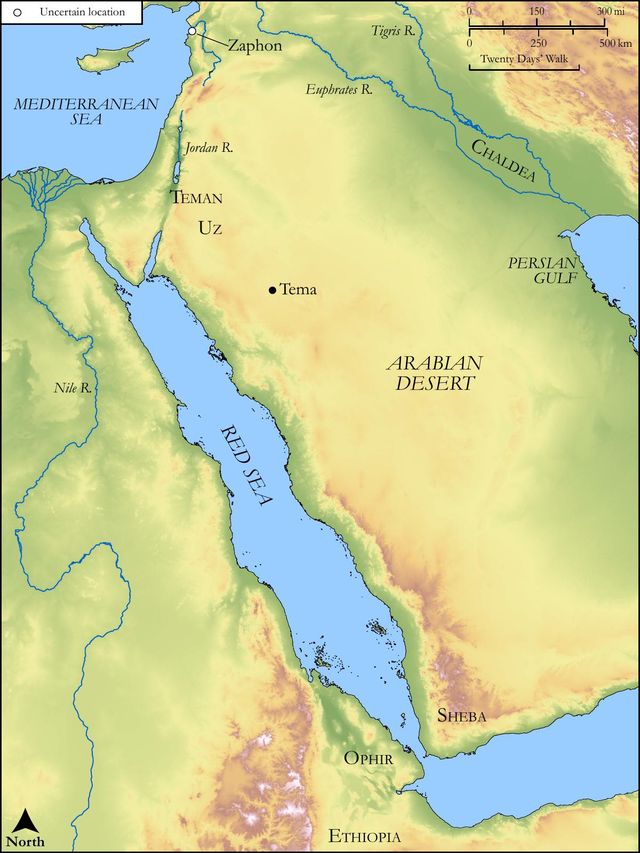
See on the biblical-era map
Study this verse
Public-domain commentary
Matthew Henry
From his Commentary on the Whole Bible. Henry comments on passages, not single verses — this entry covers Job 28:12–19. His three-level outline is real structure in the source text, so it is rendered as structure.
Job, having spoken of the wealth of the world, which men put such a value upon and take so much pains for, here comes to speak of another more valuable jewel, and that is, wisdom and understanding, the knowing and enjoying of God and ourselves. Those that found out all those ways and means to enrich themselves thought themselves very wise; but Job will not own theirs to be wisdom. He supposes them to gain their point, and to bring to light what they sought for (Job 28:11), and yet asks, "Where is wisdom? for it is not here." This their way is their folly. We must therefore seek it somewhere else, and it will be found nowhere but in the principles and practices of religion. There is more true knowledge, satisfaction, and happiness, in sound divinity, which shows us the way to the joys of heaven, than in natural philosophy or mathematics, which help us to find a way into the bowels of the earth. Two things cannot be found out concerning this wisdom: -
I.The price of it, for that is inestimable; its worth is infinitely more than all the riches in this world: Man knows not the price thereof (Job 28:13), that is,
1.Few put a due value upon it. Men know not the worth of it, its innate excellency, their need of it, and of what unspeakable advantage it will be to them; and therefore, though they have many a price in their hand to get this wisdom, yet they have no heart to it, Pro 17:16. The cock in the fable knew not the value of the precious stone he found in the dunghill, and therefore would rather have lighted on a barley-corn. Men know not the worth of grace, and therefore will take no pains to get it.
2.None can possibly give a valuable consideration for it, with all the wealth this world can furnish them with. This Job enlarges upon Job 28:15, etc., where he makes an inventory of the bona notabilia - the most valuable treasures of this world. Gold is five times mentioned; silver comes in also; and then several precious stones, the onyx and sapphire, pearls and rubies, and the topaz of Ethiopia. These are the things that are highest prized in the world's markets: but if a man would give, not only these, heaps of these, but all the substance of his house, all he is worth in the world, for wisdom, it would utterly be contemned. These may give a man some advantage in seeking wisdom, as they did to Solomon, but there is no purchasing wisdom with these. It is a gift of the Holy Ghost, which cannot be bought with money, Act 8:20. As it does not run in the blood, and so come to us by descent, so it cannot be got for money, nor does it come to us by purchase. Spiritual gifts are conferred without money and without price, because no money can be a price for them. Wisdom is likewise a more valuable gift to him that has it, makes him richer and happier, than gold or precious stones. It is better to get wisdom than gold. Gold is another's, wisdom our own; gold is for the body and time, wisdom for the soul and eternity. Let that which is most precious in God's account be so in ours. See Pro 3:14, etc.
II.The place of it, for that is undiscoverable. Where shall wisdom be found? Job 28:12. He asks this,
1.As one that truly desired to find it. This is a question we should all put. While the most of men are asking, "Where shall money be found?" we should ask, Where may wisdom be found? that we may seek it and find it, not vain philosophy, or carnal policy, but true religion; for that is the only true wisdom, that is it which best improves our faculties and best secures our spiritual and eternal welfare. This is that which we should cry after and dig for, Pro 2:3, Pro 2:4.
2.As one that utterly despaired of finding it any where but in God, and any way but by divine revelation: It is not found in this land of the living, Job 28:13. We cannot attain to a right understanding of God and his will, of ourselves and our duty and interest, by reading any books or men, but by reading God's book and the men of God. Such is the degeneracy of human nature that there is no true wisdom to be found with any but those who are born again, and who, through grace, partake of the divine nature. As for others, even the most ingenious and industrious, they can tell us no tidings of this lost wisdom.
(1.)Ask the miners, and by them the depth will say, It is not in me, Job 28:14. Those who dig into the bowels of the earth, to rifle the treasures there, cannot in these dark recesses find this rare jewel, nor with all their art make themselves masters of it.
(2.)Ask the mariners, and by them the sea will say, It is not in me. It can never be got either by trading on the waters or diving into them, can never be sucked from the abundance of the seas or the treasures hidden in the sand. Where there is a vein for the silver there is no vein for wisdom, none for grace. Men can more easily break through the difficulties they meet with in getting worldly wealth than through those they meet with in getting heavenly wisdom, and they will take more pains to learn how to live in this world than how to live for ever in a better world. So blind and foolish has man become that it is in vain to ask him, Where is the place of wisdom, and which is the road that leads to it?
Historical interpretation
Historical reception
2 surviving comments on this verse. Each one is dated, so this reads as a timeline rather than a list.
“And it is not found in the land of those that live sweetly.” What is denoted in this passage by the title of the “land,” except the soul of man? Concerning which the psalmist says, “My soul thirsts after you, as a land without water.” But this wisdom cannot “be found in the land of those that live sweetly,” because the person who is still fed with the pleasures of this life is severed from the perception of eternal Wisdom. For if he were truly wise-minded, being banished from the interior delights, he would mourn over that blind estate of his exile into which he has fallen. Thus Solomon says, “He that adds knowledge, adds pain also.” For the more a person begins to know what he has lost, the more he begins to bewail the sentence of his corruption that he has received. For he sees how he has fallen and how that from the joys of paradise he has come to the woes of present life, from the company of the angels to caring for necessities. He considers in what a number of perils he now lies prostrate, who before without peril disdained to stand. He bewails the exile that being accursed he undergoes. He sighs after the state of heavenly glory that he might be enjoying in security, if he had not had a mind to commit sin.… “The bottomless pit says, ‘It is not with me.’ ” What does he call the “bottomless pit?” The hearts of people who by their fall are now floating in darkness and the murkiness of double dealing. Wisdom does not reside in this “bottomless pit.” In this way the wicked mind, while it longs to be wise in a carnal way, shows itself foolish as to things spiritual. Which same “bottomless pit” declares that his Wisdom “is not with” it; because the wicked mind, while it longs to be wise in a carnal way, shows itself foolish as to things spiritual. Paul testifies, “The wisdom of this world is foolishness with God.” Thus, so much the more completely is everyone rendered foolish within, as he endeavors to appear wise outside.… “And the sea says, ‘It is not with me.’ ” For what is there denoted by the name of the sea except the bitter disquietude of worldly minds, which while they fall foul of one another in enmities by turns, dash themselves together like encountering waves? The life of worldly persons is rightly called “a sea,” because, while it is agitated by the tempestuous stirrings of actions, it is parted from the tranquility and steadfastness of interior Wisdom. The opposite of this condition was well said by the prophet, “Upon whom shall my spirit rest but upon him who is humble and quiet and who trembles at my words?”
61. It is first to be noted, that two points be proposed to himself, and two he adds making answer. For to this that he said above, Where shall wisdom be found, and where is the place of understanding? he answered in this verse, The depth saith, It is not with me; and the sea saith, It is not with me. But in answer to that which he had said, Man knoweth not the place thereof; neither is it found in the land of them that live pleasantly; he gave the lower verse, saying, Fine gold shall not be given for it; neither shall silver be weighed for the price thereof. So then he answered to both questions, yet in adding to what he had objected, not in solving it. For when he enquired the place of Wisdom, and then answered below, The depth saith, It is not with me; he pointed out not where it was, but where it was not. Again when he said that’ the price thereof was not known by man,’ and rejoined to this below, fine gold shall not be given for it; he showed not what was the price of it, but what was not. For it is plain to all that neither can this wisdom of man be held in a place, nor be bought with riches. But the holy man being full of mystical ideas sends us on for the making out other things, so that we should look for not wisdom created, but Wisdom creating; for except in those words we search the secret depths of allegory, surely those things that follow are utterly deserving of disregard, if they be estimated according to the historical narration alone. For a little afterwards he saith, Gold and glass cannot equal it; and while, as we know, glass is far and incomparably of lower price than gold, wherefore after the name of gold, which is unquestionably a precious metal, byway of unlimited praise did he say that ‘glass’ too is not equal to wisdom? So by the mere difficulty of the letter, we are forced that we be quick sighted to the mystical sentiments in these words. So then what wisdom is it, the holy man is contemplating, but that of which Paul the Apostle saith, Christ the Power of God, and the Wisdom of God? [1 Cor. 1, 24] Concerning which it is written by Solomon; Wisdom hath builded her house [Prov. 9, 1]; and of which the Psalmist saith; In wisdom hast Thou made all things. [Ps. 104, 24] Of this same Wisdom ‘man knoweth not the price,’ because he findeth nothing worthy of the estimate thereof. Now this price of Wisdom is not said at once ‘to be,’ and not ‘to be known,’ but as for this reason ‘not to be known,’ because it is wanting, in that manner of speaking by which a person caught in a strait, when he finds no remedy of succour, is wont to confess that’ what to do he knows not.’
62. So then ‘not to know the price of this Wisdom,’ is to find no meriting of meet practice whereby to obtain it. For we give a price with this object, that instead of it we may possess ourselves of that object which we long after. But what have we given, that we should deserve to obtain this Wisdom, which is Christ? Since it is by grace we are redeemed. For those works alone by living badly have we given, for which if a ,just return were reserved, not Christ but punishments would be rendered back [c]. But man deserved one thing in the way of justice, and obtained another in respect of grace. Let Paul bear witness, before the time that his mind received the seed of unbought truth, with what briars of error he was overlaid. Who was before, he says, a blasphemer, and a persecutor, and injurious, but I obtained mercy, because I did it ignorantly in unbelief. [1 Tim. 1, 13] Let him testify for what sort of persons Christ deigned to die, While we were yet sinners, he says, Christ in due time died for the ungodly. [Rom. 5, 8. 6.] We, then, who on Wisdom’s coming were found ungodly, what title of good practice have we given, whereby we might obtain to receive that Wisdom? ‘The price of this Wisdom man knoweth not,’ because whoso is separated from brute animals by the understanding faculty of reason, understands that he is not saved by his own merits, knows and sees that he had not given any thing of good practice that he might come to faith. For it is as it were to give a price for the obtaining of Wisdom, to anticipate the coming to the knowledge of God by the merchandize of one’s conduct.
63. He had learnt that of this Wisdom there is ‘no price,’ who said, Who hath first given unto Him, and it shall be recompensed unto him again. [Rom. 11, 35] Hence it is written again, For by grace are ye saved through faith; and that not of yourselves; it is the gift of God. [Eph. 2, 8] Not of works, lest any man should boast. Hence concerning himself he again speaks, saying, By the grace of God I am what I am. [1 Cor. 15, 10] And as by the inspiration of this same grace, the practices of the parts of virtue are at once engendered in the heart, so that from free will also conduct should follow, which after this life the Eternal Recompensing should answer to, he thereupon added, And His grace which was bestowed upon me was not in vain. But there are those who exult that they are in a sound state by their own powers, and pride themselves that by their own merits going before they have been redeemed, whose declaration, surely, is found to be contradictory to themselves, because, while they maintain themselves at once ‘innocent’ and’ redeemed,’ this very name of redemption they make null and void in themselves. For everyone that is redeemed is doubtless set free from some sort of captivity. Whence then is this said person redeemed, if he was not before captive under sin? It is plain then that he greatly misjudges who judges so. For heavenly grace does not find desert of man, in order to make it come, but after it has come, causes the same; and God, when He comes to the undeserving mind, at once sets it forth to Himself deserving by so coming, and causes therein merit for Him to recompense, whereas He had found only that for Him to punish.
64. It is good herein to recall the eyes of the mind to that robber, who from the jaws of the devil ascended the Cross, and from the Cross mounted to Paradise. Let us behold what sort of person he came to the stock of the Cross, what sort of person he went from the Cross. He came bound by his brother’s blood, he came bloodstained, but by interior grace he was changed on the Cross; and he who inflicted death upon a brother, of the Lord when dying proclaimed the life, saying, Lord, remember me when Thou comest into Thy Kingdom. [Luke 23, 42] On the Cross the nails had bound fast his hands and feet, and there remained nought in him that punishment left free, but the tongue and the heart. But God inspiring it, he offered all to Him that he found free in himself, so that according to that which is written, he should with the heart believe unto righteousness, and with the mouth make confession unto salvation. [Rom. 10, 10] But that in the hearts of the faithful there are three virtues in a special inner abiding, the Apostle testifies, saying, And now abideth faith, hope, charity [1 Cor. 13, 13]; all of which the robber being filled with instantaneous grace both received and kept on the Cross. For he had faith, who believed the Lord was about to reign, when he saw Him dying equally with himself; he had hope, who begged for admission into His kingdom, saying, Lord, remember me when Thou comest into Thy kingdom. Charity also in his death he livingly retained, who at once charged home for his iniquity a brother and fellow robber dying for the like crime, and preached to him the life which he had learnt, saying, Dost not thou fear God, seeing thou art in the same condemnation? And we indeed justly: for we receive the due reward of our deeds: but this Man hath done nothing amiss. [Luke 23, 40. 41.] He that came such to the Cross by sin, see what he departed from the Cross by grace. He confessed the Lord, Whom he beheld dying along with himself by human frailty, at the time that the Apostles denied Him, Whom they had seen doing miracles by divine power.
65. But they who make out that man is saved by his own powers, fancy that that same confession of man is from the efficacy of man by himself. Which if it were so, the Psalmist would not say in praise of God, Confession and great doing are His work. [Ps. 111, 3] So that from Him we receive it to confess what is right, by Whom it is granted us to practise what is great also. Therefore because we have not given aught of good practice, whereby we might deserve to be vouchsafed this Wisdom, let it be rightly said, Man knoweth not its price. Inasmuch as he that henceforth uses reason looks down upon himself under the perception of this Wisdom so much the deeper, in proportion as he more truly knows the interior depth of that Wisdom, so as to see that he has attained to her being unworthy, by the which it is brought to pass without price, that he should be made worthy.
Continue studying Job 28:12 across the web’s major study libraries — every link below opens this exact verse, chapter, or book on the destination site.
Read & Compare
 BibleGatewayThis verse in more than 200 translations and 70 languages.
 Bible.comThe YouVersion reader — hundreds of translations, reading plans, and highlights.
 ESV.orgCrossway's official English Standard Version reader.
 NET BibleThe NET translation with 60,000+ translators' notes on every rendering decision.
 STEP BibleTyndale House's free study tool — original text, vocabulary, and scholarly resources.
 BibliaLogos Bible Software's free web reader.
 USCCBThe New American Bible (Revised Edition) with the U.S. bishops' study notes.
Commentaries
 BibleHub CommentariesDozens of classic commentaries on this verse, gathered on one page.
 StudyLightMore than 100 commentary sets — the largest collection on the web.
 BibleRefPlain-English commentary on what this verse means, verse by verse.
 Enduring WordDavid Guzik's free commentary on this chapter, widely used by Bible teachers.
 Bible Study ToolsVerse commentary alongside Greek and Hebrew study aids.
Original Language & Research
- BibleHub InterlinearThe verse word by word — original language, transliteration, and English.
- BibleHub LexiconEvery word's original-language definition and Strong's entry.
 Blue Letter BibleDeep-study tools — Strong's numbers, concordance, and word studies.
 SefariaThe Hebrew text with Rashi and centuries of Jewish commentary.
Sermons, Hymns & Audio


TrulyRandomVerse is not affiliated with these sites and doesn’t control their content. They’re linked because they’re genuinely useful.
Summary
Job 28:12 poses a profound rhetorical question, "But where shall wisdom be found? and where [is] the place of understanding?" This pivotal verse marks a dramatic shift in Job's discourse, moving from humanity's impressive mastery over the physical world and its ability to unearth material treasures to a contemplative search for a far more elusive and invaluable possession: true wisdom. It underscores the stark contrast between human ingenuity in exploiting the earth's resources and humanity's inherent inability to discover ultimate truth and profound understanding through its own efforts, thereby setting the stage for the chapter's climactic revelation about the divine, exclusive source of genuine wisdom.
Context
ShowHideLiterary Context
Chapter 28 functions as a remarkable poetic interlude, a hymn to wisdom, strategically placed within the larger narrative of the Book of Job. It interrupts the cyclical arguments between Job and his three friends, offering a profound meditation on the nature and origin of wisdom that transcends their immediate theological debates. Prior to verse 12, Job eloquently details the extraordinary lengths to which humans go to extract precious metals and stones from the earth. Verses Job 28:1-11 paint a vivid picture of miners delving deep into the ground, cutting tunnels, overcoming immense obstacles, and bringing hidden riches to light. This detailed portrayal of human mastery over the physical world—unearthing silver, gold, sapphire, and onyx—serves as a powerful setup for the rhetorical question of verse 12. The question then dramatically shifts the focus from the material treasures that human effort can unearth to the immaterial treasure of wisdom, which remains stubbornly beyond human grasp. This stark contrast highlights a central problem: if humanity can conquer the deepest parts of the earth, why can it not find wisdom? The subsequent verses (Job 28:13-22) further elaborate on wisdom's inaccessibility and pricelessness, before the chapter culminates in the declaration that only God knows the path to wisdom (Job 28:23-28).
Historical & Cultural Context
The Book of Job is set in the land of Uz among the men of the east, where mining for precious metals and stones was a well-established, arduous, and often perilous enterprise. The detailed descriptions of mining techniques in Job 28:1-11 reflect a sophisticated understanding of such operations, including shaft digging, tunneling, and the use of lamps in the subterranean darkness. This context underscores the immense human effort, technological skill, and daring involved in these endeavors. Culturally, wisdom was highly prized among the men of the east and in Israel. Wisdom literature, encompassing proverbs, ethical teachings, and philosophical reflections, constituted a significant literary genre. However, the wisdom sought was not merely intellectual prowess but often practical skill, moral discernment, and a profound understanding of the divine order. The question "where shall wisdom be found?" resonates deeply within this cultural milieu, as it challenges the prevailing humanistic assumptions about knowledge acquisition and points towards a transcendental source. While many ancient wisdom traditions acknowledged divine inspiration, Job 28 gives a uniquely biblical emphasis on God's exclusive knowledge and ultimate sovereignty over true wisdom.
Key Themes
ShowHideJob 28:12 contributes significantly to several overarching themes within the Book of Job and biblical wisdom literature. Firstly, it powerfully establishes the Elusiveness of True Wisdom. Despite humanity's remarkable capacity for ingenuity and exploration, the verse asserts that ultimate wisdom and understanding cannot be found through human effort, material wealth, or earthly exploration. Unlike gold or diamonds, wisdom cannot be excavated or purchased, a point further emphasized in Job 28:15-19. Secondly, it implicitly points to the Superiority of Divine Wisdom. By posing the question, the chapter strongly suggests that human intellect, while impressive in its own sphere, is inherently limited and cannot attain ultimate understanding on its own. This sets the stage for the chapter's conclusion, where wisdom is unequivocally identified as belonging to God alone, as seen in Job 28:23. Finally, the verse highlights Human Limitations in discerning ultimate truth. Despite our advancements and ability to manipulate the physical world, there are fundamental questions and profound truths that remain beyond our inherent capacity to discover or comprehend. This acknowledgment of human boundaries is a recurring motif in Job, challenging human presumption and calling for humility before the divine.
Exposition and Analysis
ShowHideKey Word Analysis
ShowHideThis Hebrew term (H2451) is rich in meaning, encompassing more than mere intellectual knowledge or cunning. It refers to practical skill (e.g., in craftsmanship, as seen in Exodus 31:3), moral insight, and spiritual understanding. In the context of wisdom literature, chokmâh is the ability to apply knowledge rightly, to discern truth, and to live skillfully in accordance with God's design and the created order. It is often personified as a divine attribute or agent in creation (Proverbs 8). Here, its elusiveness underscores that it is not a commodity or a natural resource to be discovered or acquired by human means.
This word (H998) signifies discernment, insight, and the ability to distinguish between things, to comprehend relationships, and to grasp the deeper meaning of concepts. It implies a profound comprehension beyond surface-level observation, enabling one to make sense of complex realities and draw correct conclusions. While chokmâh often pertains to practical living and skill, bîynâh is about perceptive insight and the capacity to analyze and interpret. The pairing of chokmâh and bîynâh in this verse emphasizes a comprehensive grasp of truth that is both practical and profoundly perceptive, highlighting its dual inaccessibility to human endeavor.
Verse Breakdown
ShowHide"But where shall wisdom be found?"
The conjunction "But" (וְאֵין, wəʾên, related to H370 'where') creates a stark contrast with the preceding verses (Job 28:1-11), which detail humanity's success in finding earthly treasures. This rhetorical question immediately shifts the focus from the tangible and humanly attainable to the intangible and seemingly unattainable. It implies that wisdom is not readily discoverable through the same means by which silver and gold are found; it cannot be located, excavated, or purchased. The phrasing suggests a diligent search, a quest, but one that has been fruitless in the earthly realm.
"and where [is] the place of understanding?"
This parallel question reinforces the first, employing the concept of "place" (H4725, mâqôwm) to highlight the elusive nature of understanding. Just as one might locate a vein of ore or a deposit of precious stones, the speaker asks for a specific geographical or conceptual location for understanding, implying that no such earthly "place" exists. The repetition and synonymous parallelism emphasize the profound difficulty, if not impossibility, of human beings independently locating or acquiring this vital quality. It underscores that wisdom and understanding are not material possessions or geographical locations accessible by human effort, but rather transcendent realities.
Literary Devices
ShowHideJob 28:12 masterfully employs several literary devices to convey its profound message about the inaccessibility of wisdom through human means. The most prominent is Rhetorical Question, which is central to the verse's impact. By posing two unanswerable questions ("But where shall wisdom be found? and where [is] the place of understanding?"), the text compels the reader to confront the inherent limits of human knowledge and power. These questions are not asked for information but to emphasize the absolute unavailability of wisdom through human endeavor, thereby preparing the audience for the divine answer that follows later in the chapter. The verse also utilizes Parallelism, specifically synonymous parallelism, where the second line reiterates and intensifies the meaning of the first ("wisdom" paralleled with "understanding," and "found" with "place"). This repetition adds emphasis and poetic rhythm, reinforcing the core idea of wisdom's elusiveness and its non-material nature. Furthermore, there is a strong element of Contrast established between this verse and the preceding detailed description of human mining prowess. The contrast between humanity's remarkable ability to extract material wealth from the deepest parts of the earth and its utter inability to locate wisdom highlights the qualitative difference between earthly treasures and divine truth, elevating wisdom to a transcendent realm.
Theological and Thematic Connections
ShowHideJob 28:12 serves as a pivotal theological statement, asserting that true wisdom and understanding are not commodities to be unearthed or purchased by human effort, but rather transcendent qualities whose source lies beyond human reach. This profound truth resonates throughout biblical wisdom literature, challenging humanistic assumptions about self-sufficiency and pointing towards a divine origin for genuine insight. The verse sets the stage for the chapter's ultimate declaration that only God comprehends the path to wisdom, underscoring humanity's absolute dependence on divine revelation for ultimate truth. It highlights the vast chasm between human ingenuity in the material realm and human limitation in the spiritual and intellectual domains, thereby humbling humanity before the infinite knowledge and sovereign wisdom of the Creator.
Reflection and Application
ShowHideIn an era saturated with information and marked by unprecedented technological advancement, Job 28:12 offers a timeless and vital challenge to our assumptions about knowledge and truth. We often operate under the implicit belief that every answer can be found through human ingenuity, scientific discovery, or the sheer accumulation of data. However, this verse powerfully reminds us that there is a realm of profound wisdom and understanding—pertaining to life's deepest meaning, moral guidance, and ultimate purpose—that remains stubbornly beyond the grasp of human exploration or acquisition. It calls us to a posture of humility, acknowledging the inherent limits of our intellect and the necessity of looking beyond ourselves for ultimate truth. True wisdom is not something we can excavate from the earth, purchase with wealth, or engineer with technology; it is a divine gift. Therefore, our quest for genuine insight must ultimately lead us to the One who possesses all wisdom, prompting us to seek Him diligently in His revealed Word (Psalm 119:105) and through the illumination of His Holy Spirit (John 16:13), rather than relying solely on our own limited capacities or the world's fleeting wisdom.
Questions for Reflection
ShowHideFAQ
ShowHideDoes Job 28:12 imply that wisdom is completely unattainable for humans?
ShowHideNo, Job 28:12 does not imply that wisdom is completely unattainable for humans, but rather that it cannot be found or acquired through human effort or earthly means alone. The rhetorical question, "But where shall wisdom be found? and where [is] the place of understanding?", highlights the stark contrast between humanity's impressive ability to extract material wealth from the earth and its inherent inability to independently discover ultimate wisdom. The chapter then provides the divine answer: wisdom belongs to God. Job 28:23 states, "God understandeth the way thereof, and he knoweth the place thereof." Furthermore, Job 28:28 concludes, "And unto man he said, Behold, the fear of the Lord, that is wisdom; and to depart from evil is understanding." This means that while humans cannot find wisdom on their own terms, God reveals it to those who fear Him and depart from evil. Therefore, wisdom is indeed attainable for humanity, but only as a gracious gift from God and through a life of reverence and obedient submission to Him.
Christ-Centered Fulfillment
ShowHideJob 28:12, with its profound rhetorical question concerning the elusive nature of wisdom, finds its ultimate and glorious fulfillment in the person of Jesus Christ. While the Old Testament points to God as the sole possessor and dispenser of wisdom, the New Testament reveals that this divine wisdom is fully embodied, incarnated, and made accessible in Christ. The apostle Paul declares that Christ "is made unto us wisdom from God, and righteousness, and sanctification, and redemption" (1 Corinthians 1:30). The "place of understanding" that Job sought is no longer a hidden, unlocatable realm, but a living person. In Christ, "are hid all the treasures of wisdom and knowledge" (Colossians 2:3), making Him the very embodiment of divine insight. Therefore, humanity's quest for wisdom, so poignantly expressed by Job, culminates in a personal encounter with the Son of God. He is the Logos, the eternal Word and very wisdom of God incarnate, through whom all things were made and in whom all true understanding resides. To find Christ is to find the wisdom that the world cannot provide, a wisdom that leads to eternal life and a true comprehension of God's redemptive purposes (John 17:3). He is the Lamb of God who takes away the sin of the world, embodying the ultimate wisdom of God's plan to reconcile humanity to Himself.