


Hosea 11:3
Bible text: King James Version (1769 Blayney text) · Public domain
Bible text: Berean Standard Bible · Public domain
Bible text: American Standard Version (1901) · Public domain
Bible text: World English Bible, Messianic edition · Public domain
Bible text: Geneva Bible (1599) · Public domain
Bible text: Young's Literal Translation · Public domain
- וְאָנֹכִיve·'a·no·Khiand IH595Conj-w ¦ Pro-1csPronoun Personal 1st Singular common genderוְandאָנֹכִיI
- תִרְגַּלְתִּיtir·Gal·tiI taught to walkH8637V-Tiphil-Perf-1csVerb Tiphil Perfect 1st Singular common gender
- לְאֶפְרַיִםle·'ef·Ra·yim<to> EphraimH669Prep-l ¦ N-proper-mNoun Proper Masculineלְ<to>אֶפְרַיִםEphraim
- קָחָםka·Chamhe took themH3947V-Qal-Inf ¦ 3mpVerb Qal Infinitive Constructקָחָhe tookםthem
- עַל'alonH5921PrepPreposition
- זְרוֹעֹתָיוze·ro·'o·Tavhis armsH2220N-fpc ¦ 3msNoun Plural Feminine Constructזְרוֹעֹתָיarmsוhis
- וְלֹאve·Lo'and notH3808Conj-w ¦ NegParticle Negativeוְandלֹאnot
- יָדְעוּya·de·'Uthey knewH3045V-Qal-Perf-3cpVerb Qal Perfect 3rd Plural common gender
- כִּיkithatH3588PrtParticle Conditional
- רְפָאתִיםre·fa·TimI had healed themH7495V-Qal-Perf-1cs ¦ 3mpVerb Qal Perfect 1st Singular common genderרְפָאתִיI had healedםthem
English is a literal word-by-word gloss of the Hebrew, not the KJV's wording. Why?
This is the original text the KJV's translators worked from — each Hebrew word with its own literal English meaning in this verse, prepared by scholars at Tyndale House, Cambridge. The KJV translates whole sentences, not word by word, so its wording differs: one Hebrew word can become several English words, and the KJV may choose “the LORD” where the gloss reads “Yahweh”. Both are faithful — they answer different questions. For the KJV's own rendering, switch to the KJV text.
Details
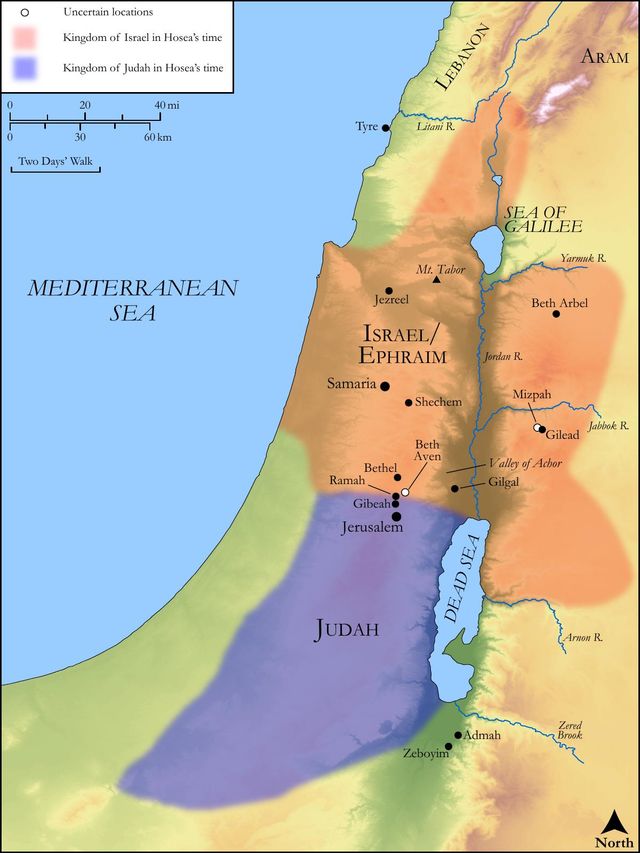
See on the biblical-era map
Study this verse
Public-domain commentary
Matthew Henry
From his Commentary on the Whole Bible. Henry comments on passages, not single verses — this entry covers Hosea 11:1–7. His three-level outline is real structure in the source text, so it is rendered as structure.
Here we find,
I.God very gracious to Israel.
They were a people for whom he had done more than for any people under heaven, and to whom he had given more, which they are here, I will not say upbraided with (for God gives, and upbraids not), but put in mind of, as an aggravation of their sin and an encouragement to repentance.
1.He had a kindness for them when they were young (Hos 11:1): When Israel was a child then I loved him; when they first began to multiply into a nation in Egypt God then set his love upon them, and chose them because he loved them, because he would love them, Deu 7:7, Deu 7:8. When they were weak and helpless as children, foolish and froward as children, when they were outcasts, and children exposed, then God loved them; he pitied them, and testified his goodwill to them; he bore them as the nurse does the sucking child, nourished them, and suffered their manners. Note, Those that have grown up, nay, those that have grown old, ought often to reflect upon the goodness of God to them in their childhood.
2.He delivered them out of the house of bondage: I called my son out of Egypt, because a son, because a beloved son. When God demanded Israel's discharge from Pharaoh he called them his son, his first-born. Note, Those whom God loves he calls out of the bondage of sin and Satan into the glorious liberty of his children. These words are said to have been fulfilled in Christ, when, upon the death of Herod, he and his parents were called out of Egypt (Mat 2:15), so that the words have a double aspect, speaking historically of the calling of Israel out of Egypt and prophetically of the bringing of Christ thence; and the former was a type of the latter, and a pledge and earnest of the many and great favours God had in reserve for that people, especially the sending of his Son into the world, and the bringing him again into the land of Israel when they had unkindly driven him out, and he might justly never have returned. The calling of Christ out of Egypt was a figure of the calling of all that are his, through him, out of spiritual slavery.
3.He gave them a good education, took care of them, took pains with them, not only as a father or tutor, but, such is the condescension of divine grace, as a mother or nurse (Hos 11:3): I taught Ephraim also to go, as a child in leading-strings is taught. When they were in the wilderness God led them by the pillar of cloud and fire, showed them the way in which they should go, and bore them up, taking them by the arms. He taught them to go in the way of his commandments, by the institutions of the ceremonial law, which were as tutors and governors to that people under age. He took them by the arms, to guide them, that they might not stray, and to hold them up, that they might not stumble and fall. God's spiritual Israel are thus supported. Thou has holden me by my right hand, Psa 73:23.
4.When any thing was amiss with them, or they were ever so little out of order, he was their physician: "I healed them; I not only took a tender care of them (a friend may do that), but wrought an effectual cure: it is a God only that can do that. I am the Lord that healeth thee (Exo 15:26), that redresseth all thy grievances." 5. He brought them into his service by mild and gentle methods (Hos 11:4): I drew them with cords of a man, with bands of love. Note, It is God's work to draw poor souls to himself; and none can come to him except he draw them, Joh 6:44. He draws,
(1.)With the cords of a man, with such cords as men draw with that have a principle of humanity, or such cords as men are drawn with; he dealt with them as men, in an equitable rational way, in an easy gentle way, with the cords of Adam. He dealt with them as with Adam in innocency, bringing them at once into a paradise, and into covenant with himself.
(2.)With bands of love, or cartropes of love. This word signifies stronger cords than the former. He did not drive them by force into his service, whether they would or no, nor rule them with rigour, nor detain them by violence, but his attractives were all loving and endearing, all sweet and gentle, that he might overcome them with kindness. Moses, whom he made their guide, was the meekest man in the world. Kindnesses among men we commonly call obligations, or bonds, bonds of love. Thus God draws with the savour of his good ointments (Sol 1:4), draws with lovingkindness, Jer 31:3. Thus God deals with us, and we must deal in like manner with those that are under our instruction and government, deal rationally and mildly with them. 6. He eased them of the burdens they had been long groaning under: I was to them as those that take off the yoke on their jaws, alluding to the care of the good husbandman, who is merciful to his beast, and will not tire him with hard and constant labour. Probably, in those times, the yoke on the neck of the oxen was fastened with some bridle, or headstall, over the jaws, which muzzled the mouth of the ox. Israel in Egypt were thus restrained from the enjoyments of their comforts and constrained to hard labour; but God eased them, removed their shoulder from the burden, Psa 81:6. Note, Liberty is a great mercy, especially out of bondage. 7. He supplied them with food convenient. In Egypt they fared hard, but, when God brought them out, he laid meat unto them, as the husbandman, when he has unyoked his cattle, fodders them. God rained manna about their camp, bread from heaven, angels' food; other creatures seek their meat, but God laid meat to his own people, as we do to our children, was himself their caterer and carver, anticipated them with the blessings of goodness.
II.Here is Israel very ungrateful to God.
1.They were deaf and disobedient to his voice. He spoke to them by his messengers, Moses and his other prophets, called them from their sins, called them to himself, to their work and duty; but as they called them so they went from them; they rebelled in those particular instances wherein they were admonished; the more pressing and importunate the prophets were with them, to persuade them to that which was good, the more refractory they were, and the more resolute in their evil ways, disobeying for disobedience-sake. This foolishness is bound in the hearts of children, who, as soon as they are taught to go, will go from those that call them.
2.They were fond of idols, and worshipped them: They sacrificed to Baalim, first one Baal and then another, and burnt incense to graven images, though they were called to by the prophets of the Lord again and again not to do this abominable thing which he hated. Idolatry was the sin which from the beginning, and all along, had most easily beset them.
3.They were regardless of God, and of his favours to them: They knew not that I healed them. They looked only at Moses and Aaron, the instruments of their relief, and, when any thing was amiss, quarrelled with them, but looked not through them to God who employed them. Or, When God corrected them, and kept them under a severe discipline, they understood not that it was for their good, and that God thereby healed them, and it was necessary for the perfecting of their cure, else they would have been better reconciled to the methods God took. Note, Ignorance is at the bottom of ingratitude, Hos 2:8.
4.They were strongly inclined to apostasy. This is the blackest article in the charge (Hos 11:7): My people are bent to backsliding from me. Every word here is aggravating.
(1.)They backslide. There is no hold of them, no stedfastness in them; they seem to come forward, towards God, but they quickly slide back again, and are as a deceitful bow.
(2.)They backslide from me, from God, the chief good, the fountain of life and living waters, from their God who never turned from them, nor war as a wilderness to them.
(3.)They are bent to backslide; they are ready to sin; there is in their natures a propensity to that which is evil; at the best they hang in suspense between God and the world, so that a little thing serves to draw them the wrong way; they are forward to close with every temptation. It also intimates that they are resolute in sin; their hearts are fully set in them to do evil the bias is strong that way; and they persist in their backslidings, whatever is said or done to stop them; and yet, (4.) "They are, in profession, my people. They are called by my name, and profess relation to me; they are mine, whom I have done much for and expect much from, whom I have nourished and brought up, as children, and yet they backslide from me." Note, In our repentance we ought to lament not only our backslidings, but our bent to backslide, not only our actual transgressions, but our original corruption, the sin that dwells in us, the carnal mind.
5.They were strangely averse to repentance and reformation. Here are two expressions of their obstinacy: - (1.) They refused to return, Hos 11:5. So much were they bent to backslide that, though they could not but find, upon trial, the folly of their backslidings, and that when they forsook God they changed for the worse, yet they went on frowardly. I have loved strangers, and after them I will go. They were commanded to return, were courted and entreated to return, were promised that if they would they should be kindly received, but they refused. (2.) Though they called them to the Most High. God's prophets and ministers called them to return to the God from whom they had revolted, to the most high God, from whom they had sunk into this wretched degeneracy; they called them from the worship of the idols, which were so much below them, and the worship of which was therefore their disparagement, to the true God, who was so much above them, and the worship of whom was therefore their preferment; they called them from this earth to high and heavenly things; but they called in vain. None at all would exalt him. Though he is the most high God they would not acknowledge him to be so, would do nothing to honour him nor give him the glory due to his name. Or, They would not exalt themselves, would not rise out of that state of apostasy and misery into which they had precipitated themselves; but there they contentedly lay still, would not lift up their heads nor lift up their souls. Note, God's faithful ministers have taken a great deal of pains, to no purpose, with backsliding children, have called them to the Most High; but none would stir, none at all would exalt him.
III.Here is God very angry, and justly so, with Israel; see what are the tokens of God's displeasure with which they are here threatened.
1.God, who brought them out of Egypt, to take them for a people to himself, since they would not be faithful to him, shall bring them into a worse condition than he at first found them in (Hos 11:5): "He shall not return into the land of Egypt, though that was a house of bondage grievous enough; but he shall go into a harder service, for the Assyrian shall be his king, who will use him worse than ever Pharaoh did." They shall not return into Egypt, which lies near, where they may hear often from their own country, and whence they may hope shortly to return to it again; but they shall be carried into Assyria, which lies much more remote, and where they shall be cut off from all correspondence with their own land and from all hopes of returning to it, and justly, because they refused to return. Note, Those that will not return to the duties they have left cannot expect to return to the comforts they have lost.
2.God, who gave them Canaan, that good land, and a very safe and comfortable settlement in it, shall bring his judgments upon them there, which shall make their habitation unsafe and uncomfortable (Hos 11:6): The sword shall come upon them, the sword of war, the sword of a foreign enemy, prevailing against them and triumphing over them.
(1.)This judgment shall spread far. The sword shall fasten upon their cities, those nests of people and store-houses of wealth; it shall likewise reach to their branches, the country villages (so some), the citizens themselves (so others), or the bars (so the word signifies) and gates of their city, or all the branches of their revenue and wealth, or their children, the branches of their families.
(2.)It shall last long: It shall abide on their cities. David thought three months flying before his enemies was the only judgment of the three that was to be excepted against; but this sword shall abide much longer than three months on the cities of Israel. They continued their rebellions against God, and therefore God continued his judgments on them.
(3.)It shall make a full end: It shall consume their branches, and devour them, and lay all waste, and this because of their own counsels, that is, because they would have their own projects, which God therefore, in a way of righteous judgment, gave them up to. Note, The confusion of sinners is owing to their contrivance. God's counsels would have saved them, but their own counsels ruined them.
Historical interpretation
Historical reception
2 surviving comments on this verse. Each one is dated, so this reads as a timeline rather than a list.
Select a marker to jump to its quote. Markers stagger vertically where authors wrote within a few decades of each other.
"And I, as a foster father to Ephraim, carried them in my arms, and they did not know that I healed them. I drew them with cords of Adam, with the bonds of love. And I will be to them like one who lifts the yoke from their cheeks, and I inclined to him so he could eat." LXX: "And I gathered" ((or "placed")) Ephraim, I took him up on my arm; and they did not know that I healed them in the corruption of humans. I drew them with the cords of my love. And I will be to them like one who gives slaps on his cheeks, and I will look at him being strong." The Hebrew and the edition of the interpreters differ much from one another. Therefore, let us try to recount the history according to the Hebrews; to write a comprehensive account according to the Septuagint. The one who said above: "I loved the son of Israel, and called him out of Egypt," and later brought to light the crime he had committed, "they were sacrificing to the Baals and to the idols," now tells how Israel was beloved through as per Deuteronomy: "The Lord your God has carried you, as a man carries his little son, in all the ways that you have gone," "until you came to this place" (Deut. I, 31). And in another place: "He spread his wings and took him, and carried him on his shoulders" (Ibid. XXXII, 11). I, he said, who was a father, became a nurse, and I carried my little one in my arms, so that he would not be harmed in the wilderness, and so that he would not be frightened by either heat or darkness. In the day I was a cloud, in the night a pillar of fire (Exod. XIII): so that those who I had protected, I might enlighten and heal them with my light. And when they had sinned and had made themselves a calf's head, I gave them a place for repentance, and they did not know that I cured them, and for the space of forty years, I covered the wound of idolatry and restored them to their former health. But I cared for them because of the cords and bands of charity, with which I bound them as if with Abraham, Isaac, and Jacob. Indeed, Aquilae, Symmachus, Septuagint, and Theodotio translated "Adam" as "men": so they would say, "I will draw them in the cords of men, in the bands of charity." And what follows: "I will be to them as one lifting up the yoke," for which Symmachus interpreted: "and they thought that I would put a yoke on their jaw," is understood in two ways: either I took away from them the yoke of all the nations round about, or they thought that my Law was like the heaviest weight of a yoke. And I gave them manna to eat in the desert (Exodus 16), that they might eat, for this is what he says, "I have turned to him to be fed:" for which Symmachus interpreted, "and I have turned to him with food." Not that God turned to him, but that he made the food of manna turn to him. Otherwise: I loved them so much and was such a merciful shepherd, that I myself carried the sick sheep on my shoulders (Luke 15): but they themselves did not know that I cared for them with my passion; and as I am a lover of all people, I drew them to believe in the bonds of love, according to what is written in the Gospel: "No one comes to me unless the Father who sent me draws him" (John 6:44). And they thought my yoke light, to be very heavy: and I turned to them forsaking the kingdom of heaven, to eat with them, assuming the form of a man, or gave them food of my body: both the food and the guest. Let us go to spiritual understanding, according to the Septuagint only interpreters: lest if we want to explain both according to history and according to interpretation, we tend to the size of the book. When they sacrifice Baalim, things they have made from their own hearts, and when they flee from my face at my call (for thus it is contained in the Septuagint), I, the most merciful Lord, bound the feet of Ephraim so that they would not flee further from me: this is what συνεπόδισα means. But I bound (them) by the testimonies of the Scriptures, and by the discussion of the teachers of the Church, so that by patience it would hold bound with its arms those who did not understand that God's patience was an opportunity for their salvation. Hence, in the corruption of men, namely, of teachers, who had deceived them bound by the coldness of their treachery, I extended the warmth of faith and, as it were, binding those who resisted, I bound them with the bonds of my love. And because they did not run according to their own will, but were dragged by ropes, I slightly struck their cheeks with slaps, not punishing them, but correcting and improving. "The judge tears flesh, twists with ropes, and tortures with whips and fire. But a father, he who is, strikes the wanton son with the palm of his hand. And he did not say beautifully, 'I will beat them with slaps,' but striking the cheeks with his hand like a man. But God strikes errant sons with the threat of punishments, with the reading of the Gospel, and with the testimony of the prophets. And when he strikes thus on the cheek, that he may drive out from the foul mouth of heretics their bread and doctrine: then he looks at him, his son having been beaten, saying to him, 'Look at me, and have mercy on me.'" (Psalm LXXXV,16) And again: "Look upon me and hear me, O Lord my God" (Psalm XII, 4). And when he has looked upon him, he shall prevail, or be helpful to them, that is, he shall overcome his adversaries, and shall make slaves flee. And he shall give them true and sweet food, who before devoured the lies and most bitter food of heretics.
“Because I am kind and good, I bound the feet of Ephraim,” that is, the whole Israel … although he was awkward. God himself declares why this is so: “I will take them in my arms.” This image is from child raising. Those who take infants in their arms are those who bind their feet, bringing their feet together. For it is necessary, I think, that the thighs and knees of anyone who sits down should be drawn together. And in fact this is so. “I bound the feet” as, for instance, it was written about Abraham, who bound his son Isaac when he thought to bring him as a sacrifice to God. One must note that the Hebrew version and other versions do not have “I bound the feet” but rather “I became as one who nourishes Ephraim.”
Continue studying Hosea 11:3 across the web’s major study libraries — every link below opens this exact verse, chapter, or book on the destination site.
Read & Compare
 BibleGatewayThis verse in more than 200 translations and 70 languages.
 Bible.comThe YouVersion reader — hundreds of translations, reading plans, and highlights.
 ESV.orgCrossway's official English Standard Version reader.
 NET BibleThe NET translation with 60,000+ translators' notes on every rendering decision.
 STEP BibleTyndale House's free study tool — original text, vocabulary, and scholarly resources.
 BibliaLogos Bible Software's free web reader.
 USCCBThe New American Bible (Revised Edition) with the U.S. bishops' study notes.
Commentaries
 BibleHub CommentariesDozens of classic commentaries on this verse, gathered on one page.
 StudyLightMore than 100 commentary sets — the largest collection on the web.
 BibleRefPlain-English commentary on what this verse means, verse by verse.
 Enduring WordDavid Guzik's free commentary on this chapter, widely used by Bible teachers.
 Bible Study ToolsVerse commentary alongside Greek and Hebrew study aids.
Original Language & Research
- BibleHub InterlinearThe verse word by word — original language, transliteration, and English.
- BibleHub LexiconEvery word's original-language definition and Strong's entry.
 Blue Letter BibleDeep-study tools — Strong's numbers, concordance, and word studies.
 SefariaThe Hebrew text with Rashi and centuries of Jewish commentary.
Sermons, Hymns & Audio


TrulyRandomVerse is not affiliated with these sites and doesn’t control their content. They’re linked because they’re genuinely useful.
Summary
Hosea 11:3 profoundly illustrates God's tender, parental love and unwavering care for Israel, personified as Ephraim, from their nascent stages as a nation. Despite God's intimate guidance, protection, and continuous healing, the people tragically failed to acknowledge His benevolent hand, demonstrating a profound spiritual blindness and ingratitude that underscored their persistent rebellion.
Context
ShowHideLiterary Context
Hosea 11:3 is nestled within a deeply poignant passage (Hosea 11:1-11) where the prophet Hosea conveys God's profound lament over Israel's spiritual unfaithfulness. Having recalled calling Israel out of Egypt as a child in Hosea 11:1, the narrative shifts to God's ongoing, nurturing care for His people, likening Himself to a tender parent. This verse specifically highlights the intimate, foundational care God provided from Israel's infancy as a nation, contrasting His steadfast love with their persistent idolatry and unresponsiveness. The passage as a whole underscores the tension between God's enduring covenant love and Israel's repeated betrayal, setting the stage for God's internal struggle between justice and compassion.
Historical & Cultural Context
The Book of Hosea was delivered to the Northern Kingdom of Israel, often referred to as "Ephraim" due to its dominant tribe, in the decades leading up to its catastrophic fall to Assyria in 722 BCE. Spiritually, Israel had abandoned their covenant with Yahweh, engaging in widespread idolatry, syncretism, and reliance on foreign political alliances rather than on God. This spiritual adultery was rampant, mirroring the prophet's own domestic tragedy with his unfaithful wife, Gomer. The imagery of a parent teaching a child to walk was a common and deeply resonant picture of intimate care and foundational instruction in Israel, emphasizing the absolute dependence of the child on the parent. God's recalling of Israel's history from the Exodus onward serves as a powerful reminder of His unique and consistent involvement in their national life, a history they had willfully forgotten.
Key Themes
ShowHideThis verse powerfully contributes to several overarching themes in Hosea and the broader Old Testament. Firstly, it vividly portrays God's Tender, Parental Love and Care, depicting Him as a nurturing father who patiently teaches His child to walk and sustains them, a theme also echoed in Deuteronomy 32:10-12. Secondly, it highlights Divine Healing and Sustenance, as God consistently restored, delivered, and provided for Israel, not just physically but spiritually, a role He often takes as the Great Physician, as seen in Exodus 15:26. Finally, and tragically, the verse underscores Israel's Spiritual Blindness and Ingratitude. Despite God's undeniable and profound care, Israel "knew not," demonstrating a willful ignorance and forgetfulness of God's hand in their lives, a recurring lament found in prophetic literature, such as Jeremiah 2:32.
Exposition and Analysis
ShowHideKey Word Analysis
ShowHideFrom a denominative root meaning "to cause to walk," this verb vividly depicts God's patient, step-by-step instruction, much like a parent guiding a toddler. It implies careful training, support, and the imparting of fundamental skills necessary for life and progress. This isn't just passive observation but active, hands-on involvement in Israel's development.
This word refers to the arm as "stretched out," symbolizing strength, power, and help. In the context of "taking them by their arms," it evokes the image of a parent holding a child's arms to steady them, preventing falls, and providing support as they learn to walk. It signifies God's protective, empowering, and intimate physical assistance, showcasing His mighty strength applied with tender care.
This primitive root is rich in meaning, encompassing not just intellectual knowledge but also experiential, relational, and intimate knowing. When Israel "knew not," it implies a profound failure to recognize, acknowledge, and experientially understand God's consistent actions on their behalf. It's a spiritual amnesia, a lack of relational awareness and gratitude, rather than mere ignorance.
This verb means "to mend (by stitching)," and figuratively, "to cure" or "to make whole." It signifies God's comprehensive work of restoration, deliverance from all forms of brokenness—physical, spiritual, and national. It speaks to His continuous acts of bringing health, wholeness, and relief from distress, encompassing their liberation from slavery, protection from enemies, and spiritual restoration from their sin.
Verse Breakdown
ShowHide"I taught Ephraim also to go"
This clause establishes God's initiative and active role as a nurturing parent. The imagery of teaching a child to walk emphasizes the foundational, patient, and intimate instruction God provided to Israel from its earliest national beginnings, guiding them through the wilderness and establishing them as a people.
"taking them by their arms"
This vivid detail reinforces the tenderness and direct involvement of God's care. It portrays God not merely as a distant instructor but as one who physically supports and stabilizes His beloved child, preventing falls and offering constant assistance in their journey. This speaks to His protective presence and empowering strength.
"but they knew not"
This is the tragic turning point, highlighting Israel's profound spiritual blindness and ingratitude. Despite God's undeniable and intimate care, they failed to recognize, acknowledge, or experientially understand His benevolent hand in their lives. This "not knowing" indicates a deliberate forgetfulness and a lack of relational awareness towards their divine Parent.
"that I healed them"
This final clause reveals the extent of God's continuous provision and restoration. "Healed" encompasses not only physical well-being but also deliverance from various forms of brokenness—slavery, enemies, and spiritual sickness. Israel's failure to recognize this comprehensive healing underscores their deep spiritual amnesia and their propensity to attribute blessings to idols or their own strength.
Literary Devices
ShowHideHosea 11:3 is rich in Personification, as God is depicted with human-like parental attributes, tenderly teaching, taking, and healing. This makes His love relatable and profound. The entire verse functions as an extended Metaphor, portraying the relationship between God and Israel as that of a loving parent and a dependent, yet rebellious, child. This central metaphor underpins the entire chapter. There is also a strong element of Irony: the divine Parent provides perfect, intimate care, yet the child, Israel, remains oblivious and ungrateful. This stark contrast highlights the tragic nature of Israel's spiritual condition and the depth of God's unrequited love. The use of Pathos is evident as God expresses His sorrow and lament over their ignorance, drawing the reader into His divine grief.
Theological and Thematic Connections
ShowHideHosea 11:3 powerfully articulates the enduring tension between God's steadfast covenant love and humanity's propensity for unfaithfulness. It reveals God's character as a compassionate, patient, and actively involved Father who initiates and sustains His relationship with His people, even when they are undeserving. The "healing" aspect points to God's redemptive nature, always seeking to restore His creation from brokenness. However, Israel's "not knowing" underscores the tragic reality of human spiritual blindness and the profound ingratitude that can arise from taking divine grace for granted, leading to a rupture in the covenant relationship. This verse serves as a timeless reminder that true knowledge of God is not merely intellectual assent but a relational recognition of His active presence and benevolent hand in our lives.
Reflection and Application
ShowHideHosea 11:3 offers a profound mirror for contemporary believers, revealing the unchanging nature of God's tender, parental care and our often-similar spiritual amnesia. Just as God taught Ephraim to go, taking them by their arms, He continues to guide, sustain, and heal us in countless ways, often unseen or unacknowledged. We, too, can become so accustomed to His grace that we fail to recognize His constant hand in our lives, attributing blessings to chance or our own efforts. This verse calls us to cultivate a profound awareness of God's active presence, to intentionally seek out and acknowledge His daily provisions, protections, and healing mercies. It challenges us to move beyond a superficial understanding of God to a deep, relational "knowing" that fosters genuine gratitude and responsive obedience. By recognizing His unwavering love, even in our imperfections, we are drawn into a deeper, more intimate relationship with our heavenly Father, allowing His patient love to transform our hearts and guide our steps.
Questions for Reflection
ShowHideFAQ
ShowHideWhy is Ephraim used to represent Israel in this verse?
ShowHideIn the context of the Book of Hosea, "Ephraim" is frequently used as a synecdoche to refer to the entire Northern Kingdom of Israel. Ephraim was the most numerous and influential of the ten tribes that formed the Northern Kingdom after the division of the monarchy (see 1 Kings 11). Its territory was strategically important, and its capital, Samaria, was located within its tribal lands. Therefore, using "Ephraim" was a concise way for the prophet to address the dominant political and spiritual entity of the Northern Kingdom, highlighting their particular unfaithfulness despite God's intimate care for them as a whole.
What does "knew not" imply about Israel's relationship with God?
ShowHideThe phrase "knew not" (Hebrew: yada') is far more profound than simple ignorance. It implies a willful refusal to acknowledge, recognize, or experientially understand God's continuous and benevolent actions on their behalf. This "not knowing" signifies a deep relational failure and spiritual blindness. Despite God's consistent parental care—teaching them, supporting them, and healing them—Israel failed to attribute their blessings and deliverance to Him. Instead, they often credited pagan deities or their own strength, demonstrating a profound ingratitude and a breach of the covenant relationship. This spiritual amnesia led to their persistent rebellion and ultimate downfall, underscoring that true knowledge of God is not just intellectual but involves a responsive, grateful heart.
Christ-Centered Fulfillment
ShowHideHosea 11:3, with its poignant depiction of God's tender, parental love for an ungrateful Israel, finds its ultimate and most profound fulfillment in the person and work of Jesus Christ. While Israel "knew not" the God who taught them to walk and healed them, Jesus, as the perfect embodiment of God's love, came to a world that largely "knew Him not" (John 1:10). He is the divine Son who perfectly reveals the Father's heart, demonstrating the very patient, nurturing care described in Hosea. Jesus not only taught His disciples "to go" in the way of righteousness but also literally "took them by their arms," guiding them, healing their infirmities, and comforting their souls (Matthew 11:28-30). He is the ultimate Healer, making whole not just bodies but spirits, offering forgiveness and reconciliation for the very spiritual blindness and ingratitude that plagued Ephraim. In His life, death, and resurrection, Christ perfectly fulfilled God's redemptive purposes, extending the Father's healing and guidance to all who would believe, becoming the true Lamb of God who takes away the sin of the world (John 1:29). His lament over Jerusalem (Luke 19:41-44) echoes God's sorrow over Ephraim, revealing the steadfast love of God who continues to reach out, even when His children refuse to know Him.