


Acts 13:18
“Paul's Sermon in Pisidian Antioch”Acts 13:14–41
Bible text: King James Version (1769 Blayney text) · Public domain
Bible text: Berean Standard Bible · Public domain
Bible text: American Standard Version (1901) · Public domain
Bible text: World English Bible, Messianic edition · Public domain
Bible text: Geneva Bible (1599) · Public domain
Bible text: Young's Literal Translation · Public domain
- καὶkaiandG2532CONJConjunction
- ὡςhōsof aboutG5613PRTParticle or Disjunctive
- τεσσερακονταετῆtesserakontaetēforty yearsG5063A-ASMAdjective Accusative Singular Masculine
- χρόνονchrononfor a periodG5550N-ASMNoun Accusative Singular Masculine
- ἐτροποφόρησενetropophorēsenHe endured the waysG5159V-AAI-3SVerb Aorist Active Indicative 3rd Singular
- αὐτοὺςautousof themG846P-APMPersonal pronoun Accusative Plural Masculine
- ἐνeninG1722PREPPreposition
- τῇtēatheG3588T-DSFDefinite article Dative Singular Feminine
- ἐρήμῳerēmōwildernessG2048A-DSFAdjective Dative Singular Feminine
English is a literal word-by-word gloss of the Greek, not the KJV's wording. Why?
This is the original text the KJV's translators worked from — each Greek word with its own literal English meaning in this verse, prepared by scholars at Tyndale House, Cambridge. The KJV translates whole sentences, not word by word, so its wording differs: one Greek word can become several English words, and the KJV may choose “charity” where the gloss reads “love”. Both are faithful — they answer different questions. For the KJV's own rendering, switch to the KJV text.
Words in [ ] are added by the English.
Details
See on the biblical-era maps
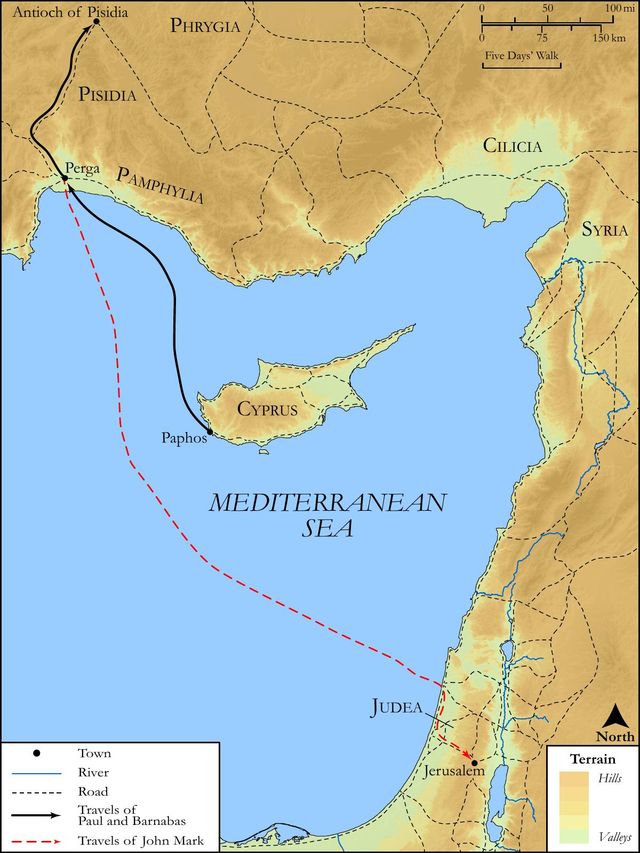
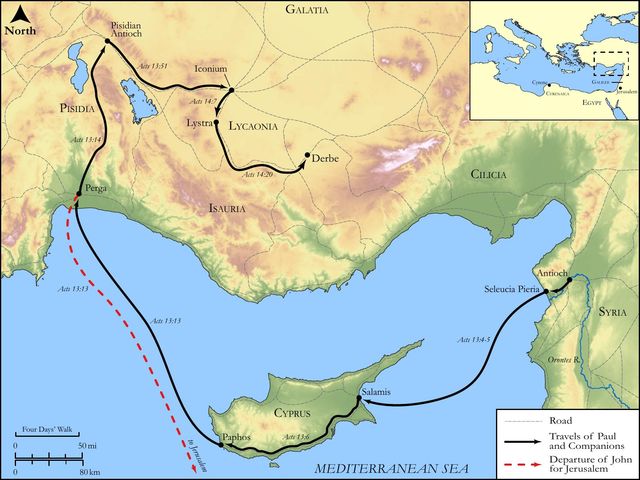
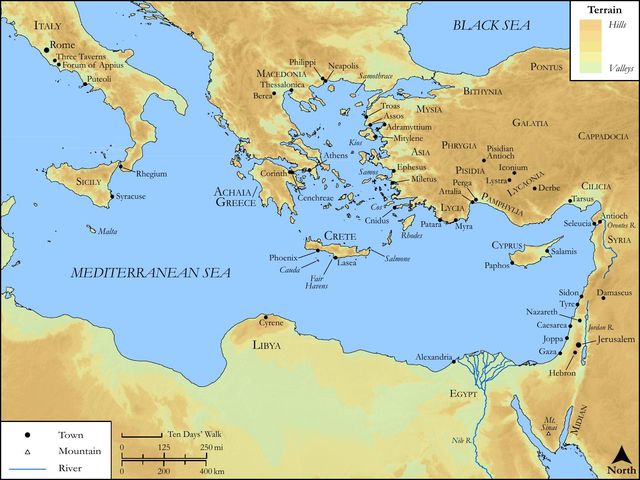
Study this verse
Public-domain commentary
Matthew Henry
From his Commentary on the Whole Bible. Henry wrote on whole passages, and this entry covers Acts 13:14–41. He set out his notes in a four-level outline, kept here as he numbered it.
Perga in Pamphylia was a noted place, especially for a temple there erected to the goddess Diana, yet nothing at all is related of what Paul and Barnabas did there, only that thither they came (v. 13), and thence they departed, v. 14. But the history of the apostles' travels, as that of Christ's, passes by many things worthy to have been recorded, because, if all had been written, the world could not have contained the books. But the next place we find them in is another Antioch, said to be in Pisidia, to distinguish it from that Antioch in Syria from which they were sent out. Pisidia was a province of the Lesser Asia, bordering upon Pamphylia; this Antioch, it is likely, was the metropolis of it. Abundance of Jews lived there, and to them the gospel was to be first preached; and Paul's sermon to them is what we have in these verses, which, it is likely, is the substance of what was preached by the apostles generally to the Jews in all places; for in dealing with them the proper way was to show them how the New Testament, which they would have them to receive, exactly agreed with the Old Testament, which they not only received, but were zealous for. We have here,
I.The appearance which Paul and Barnabas made in a religious assembly of the Jews at Antioch, v.
14. Though they had lately had such good success with a Roman deputy, yet, when they came to Antioch, they did not enquire for the chief magistrate, nor make their court to him, but they applied to the Jews, which is a further proof of their good affection to them and their desire of their welfare. 1. They observed their time of worship, on the sabbath day, the Jewish sabbath. The first day of the week they observed among themselves as a Christian sabbath; but, if they will meet the Jews, it must be on the seventh-day sabbath, which therefore, upon such occasions, they did as yet sometimes observe. For, though it was by the death of Christ that the ceremonial law died, yet it was in the ruins of Jerusalem that it was to be buried; and therefore, though the morality of the fourth commandment was entirely transferred to the Christian sabbath, yet it was not incongruous to join with the Jews in their sabbath sanctification. 2. They met them in their place of worship, in the synagogue. Note, Sabbath days should be kept holy in solemn assemblies; they are instituted chiefly for public worship. The sabbath day is a holy convocation, and for that reason no servile work must be done therein. Paul and Barnabas were strangers; but, wherever we come, we must enquire out God's faithful worshippers, and join with them (as these apostles here did), as those that desire to keep up a communion with all saints; though they were strangers, yet they were admitted into the synagogue, and to sit down there. Care should be taken in places of public worship that strangers be accommodated, even the poorest; for, of those of whom we know nothing else, we know this, that they have precious souls, for which our charity binds us to be concerned.
II.The invitation given them to preach.
1.The usual service of the synagogue was performed (v. 15): The law and the prophets were read, a portion of each, the lessons for the day. Note, When we come together to worship God, we must do it not only by prayer and praise, but by the reading and hearing of the word of God; hereby we give him the glory due to his name, as our Lord and Lawgiver.
2.When that was done, they were asked by the rulers of the synagogue to give them a sermon (v. 15): They sent a messenger to them with the respectful message, Men and brethren, if you have any word of exhortation for the people, say on. It is probable that the rulers of the synagogue had met with them, and been in private conversation with them before; and, if they had not an affection to the gospel, yet they had at least the curiosity to hear Paul preach; and therefore not only gave him permission, but begged the favour of him that he would speak a word of exhortation to the people. Note,
(1.)The bare reading of the scriptures in the public assemblies is not sufficient, but they should be expounded, and the people exhorted out of them. This is spreading the net, and assisting people in doing that which is necessary to the making of the word profitable to them—that is, the applying of it to themselves.
(2.)Those that preside, and have power, in public assemblies, should provide for a word of exhortation to the people, whenever they come together.
(3.)Sometimes a word of exhortation from a strange minister may be of great use to the people, provided he be well approved. It is likely Paul did often preach in the synagogue, when he was not thus invited to it by the rulers of the synagogues; for he often preached with much contention, 1 Thess. ii. 2. But these were more noble, more generous, than the rulers of the synagogues generally were.
III.The sermon Paul preached in the synagogue of the Jews, at the invitation of the rulers of the synagogue.
He gladly embraced the opportunity given him to preach Christ to his countrymen the Jews. He did not object to them that he was a stranger, and that it was none of his business; nor object to himself, that he might get ill-will by preaching Christ among the Jews; but stood up, as one prepared and determined to speak, and beckoned with his hand, to excite and prepare them to hear. He waved his hand as an orator, not only desiring silence and attention, but endeavouring to move affection, and to show himself in earnest. Perhaps, upon the moving of them to give an exhortation to the people, there were those in the synagogue that were ready to mutiny against the rulers, and opposed the toleration of Paul's preaching, and that occasioned some tumult and commotion, which Paul endeavoured to quiet by that decent motion of his hand; as also by his modest desire of a patient impartial hearing: "Men of Israel, that are Jews by birth, and you that fear God, that are proselyted to the Jewish religion, give audience; let me beg your attention a little, for I have something to say to you which concerns your everlasting peace, and would not say it in vain." Now this excellent sermon is recorded, to show that those who preached the gospel to the Gentiles did it not till they had first used their utmost endeavours with the Jews, to persuade them to come in and take the benefit of it; and that they had no prejudice at all against the Jewish nation, nor any desire that they should perish, but rather that they should turn and live. Every thing is touched in this sermon that might be proper either to convince the judgment or insinuate into the affections of the Jews, to prevail with them to receive and embrace Christ as the promised Messiah.
1.He owns them to be God's favourite people, whom he had taken into special relation to himself, and for whom he had done great things. Probably the Jews of the dispersion, that lived in other countries, being more in danger of mingling with the nations, were more jealous of their peculiarity than those that lived in their own land were; and therefore Paul is here very careful to take notice of it, to their honour.
(1.)That the God of the whole earth was, in a particular manner, the God of this people Israel, a God in covenant with them, and that he had given them a revelation of his mind and will, such as he had not given to any other nation or people; so that hereby they were distinguished from, and dignified above, all their neighbours, having peculiar precepts to be governed by, and peculiar promises to depend upon.
(2.)That he had chosen their fathers to be his friends: Abraham was called the friend of God; to be his prophets, by whom he would reveal his mind to his church, and to be the trustees of his covenant with the church. He puts them in mind of this, to let them know that the reason why God favoured them, though undeserving, and ill deserving, was because he would adhere to the choice he had made of their fathers, Deut. vii. 7, 8. They were beloved purely for the fathers' sakes, Rom. xi. 28.
(3.)That he had exalted that people, and put a great deal of honour upon them, had advanced them into a people, and raised them from nothing, when they dwelt as strangers in the land of Egypt, and had nothing in them to recommend them to the divine favour. They ought to remember this, and to infer hence that God was no debtor to them; for it was ex mero motu—out of his mere good pleasure, and not upon a valuable consideration, that they had the grant of the divine favour; and therefore it was revocable at pleasure; and God did them no wrong if he at length plucked up the hedge of their peculiarity. But they were debtors to him, and obliged to receive such further discoveries as he should make to his church.
(4.)That he had with a high hand brought them out of Egypt, where they were not only strangers, but captives, had delivered them at the expense of a great many miracles, both of mercy to them and judgment on their oppressors (signs and wonders, Deut. iv. 34), and at the expense of a great many lives, all the first-born of Egypt, Pharaoh, and all his host, in the Red Sea; I gave Egypt for thy ransom, gave men for thee. Isa. xliii. 3, 4.
(5.)That he had suffered their manners forty years in the wilderness, v. 18, Etropophoresen. Some think it should be read, etrophophoresen—he educated them, because this is the word the Septuagint use concerning the fatherly care God took of that people, Deut. i. 31. Both may be included; for,
[1.]God made a great deal of provision for them for forty years in the wilderness: miracles were their daily bread, and kept them from starving: They lacked not any thing.
[2.]He exercised a great deal of patience with them. They were a provoking, murmuring, unbelieving people; and yet he bore with them, did not deal with them as they deserved, but suffered his anger many a time to be turned away by the prayer and intercession of Moses. So many years as we have each of us lived in this world, we must own that God has thus been as a tender father to us, has supplied our wants, has fed us all our life long unto this day, has been indulgent to us, a God of pardons (as he was to Israel, Neh. ix. 17), and not extreme to mark what we have done amiss; we have tried his patience, and yet not tired it. Let not the Jews insist too much upon the privileges of their peculiarity, for they have forfeited them a thousand times.
(6.)That he had put them in possession of the land of Canaan (v. 19): When he had destroyed seven nations in the land of Canaan, that were doomed to be rooted out to make room for them, he divided their land to them by lot, and put them in possession of it. This was a signal favour of God to them, and he owns that hereby a great honour was put upon them, from which he would not in the least derogate.
(7.)That he had raised up men, inspirited from heaven, to deliver them out of the hands of those that invaded their rights, and oppressed them after their settlement in Canaan, v. 20, 21.
[1.]He gave them judges, men qualified for public service, and, by an immediate impulse upon their spirits, called to it, pro re nata—as the occasion required. Though they were a provoking people, and were never in servitude but their sin brought them to it, yet upon their petition a deliverer was raised up. The critics find some difficulty in computing these four hundred and fifty years. From the deliverance out of Egypt to David's expulsion of the Jebusites from the stronghold of Zion, which completed the casting out of the heathen nations, was four hundred and fifty years; and most of that time they were under judges. Others thus: The government of the judges, from the death of Joshua to the death of Eli, was just three hundred and thirty-nine years, but it is said to be [os] as it were four hundred and fifty years, because the years of their servitude to the several nations that oppressed them, though really they were included in the years of the judges, are yet mentioned in the history as if they had been distinct from them. Now these, all put together, make one hundred and eleven years, which added to the three hundred and thirty nine, make them four hundred and fifty; as so many, though not really so many.
[2.]He governed them by a prophet, Samuel, a man divinely inspired to preside in their affairs.
[3.]He afterwards at their request set a king over them (v. 21), Saul, the son of Cis. Samuel's government and his lasted forty years, which was a kind of transition from the theocracy to the kingly government.
[4.]At last, he made David their king, v. 22. When God had removed Saul, for his mal-administration, he raised up unto them David to be their king, and made a covenant of royalty with him, and with his seed. When he had removed one king, he did not leave them as sheep without a shepherd, but soon raised up another, raised him up from a mean and low estate, raised him up on high, 2 Sam. xxiii. 1. He quotes the testimony God gave concerning him, First, That his choice was divine: I have found David, Ps. lxxxix. 20. God himself pitched upon him. Finding implies seeking; as if God had ransacked all the families of Israel to find a man fit for his purpose, and this was he. Secondly, That his character was divine: A man after my own heart, such a one as I would have, one on whom the image of God is stamped, and therefore one in whom God is well pleased and whom he approves. This character was given of him before he was first anointed, 1 Sam. xiii. 14. The Lord hath sought out a man after his own heart, such a one as he would have. Thirdly, That his conduct was divine, and under divine direction: He shall fulfil all my will. He shall desire and endeavour to do the will of God, and shall be enabled to do it, and employed in the doing of it, and go through with it. Now all this seems to show not only the special favour of God to the people of Israel (with the acknowledgment of which the apostle is very willing to oblige them) but the further favours of another nature which he designed them, and which were now, by the preaching of the gospel, offered to them. Their deliverance out of Egypt, and settlement in Canaan, were types and figures of good things to come. The changes of their government showed that it made nothing perfect, and therefore must give way to the spiritual kingdom of the Messiah, which was now in the setting up, and which, if they would admit it and submit to it, would be the glory of their people Israel; and therefore they needed not conceive any jealousy at all of the preaching of the gospel, as if it tended in the least to damage the true excellences of the Jewish church.
2.He gives them a full account of our Lord Jesus, passing from David to the Son of David, and shows that this Jesus is his promised Seed (v. 23): Of this man's seed, from that root of Jesse, from that man after God's own heart, hath God, according to his promise, raised unto Israel a Saviour—Jesus, who carries salvation in his name.
(1.)How welcome should the preaching of the gospel of Christ be to the Jews, and how should they embrace it, as well worthy of all acceptation, when it brought them the tidings,
[1.]Of a Saviour, to deliver them out of the hands of their enemies, as the judges of old, who were therefore called saviours; but this a Saviour to do that for them which, it appears by the history, those could not do—to save them from their sins, their worst enemies.
[2.]A Saviour of God's raising up, that has his commission from heaven.
[3.]Raised up to be a Saviour unto Israel, to them in the first place: He was sent to bless them; so far was the gospel from designing the gathering of them.
[4.]Raised up of the seed of David, that ancient royal family, which the people of Israel gloried so much in, and which at this time, to the great disgrace of the whole nation, was buried in obscurity. It ought to be a great satisfaction to them that God had raised up this horn of salvation for them in the house of his servant David, Luke i. 69.
[5.]Raised up according to his promise, the promise to David (Ps. cxxxii. 11), the promise to the Old-Testament church in the latter times of it: I will raise unto David a righteous branch, Jer. xxiii. 5. This promise was it to which the twelve tribes hoped to come (ch. xxvi. 7); why then should they entertain it so coldly, now that it was brought to them? Now,
(2.)Concerning this Jesus, he tells them,
[1.]That John the Baptist was his harbinger and forerunner, that great man whom all acknowledged to be a prophet. Let them not say that the Messiah's coming was a surprise upon them, and that this might excuse them if they took time to consider whether they should entertain him or no; for they had sufficient warning by John, who preached before his coming, v. 24. Two things he did—First, He made way for his entrance, by preaching the baptism of repentance, not to a few select disciples, but to all the people of Israel. He showed them their sins, warned them of the wrath to come, called them to repentance, and to bring forth fruits meet for repentance, and bound those to this who were willing to be bound by the solemn rite or sign of baptism; and by this he made ready a people prepared for the Lord Jesus, to whom his grace would be acceptable when they were thus brought to know themselves. Secondly, He gave notice of his approach (v. 25): As he fulfilled his course, when he was going on vigorously in his work, and had had wonderful success in it, and an established interest: "Now," saith he to those that attended his ministry, "Whom think you that I am? What notions have you of me, what expectations from me? You may be thinking that I am the Messiah, whom you expect; but you are mistaken, I am not he (see John i. 20), but he is at the door; behold, there cometh one immediately after me, who will so far exceed me upon all accounts, that I am not worthy to be employed in the meanest office about him, no, not to help him on and off with his shoes—whose shoes of his feet I am not worthy to loose, and you may guess who that must be."
[2.]That the rulers and people of the Jews, who should have welcomed him, and been his willing, forward, faithful subjects, were his persecutors and murderers. When the apostles preach Christ as the Saviour, they are so far from concealing his ignominious death, and drawing a veil over it, that they always preach Christ crucified, yea, and (though this added much to the reproach of his sufferings) crucified by his own people, by those that dwelt in Jerusalem, the holy city—the royal city, and their rulers, v. 27. First, Their sin was that though they found no cause of death in him, could not prove him, no, nor had any colour to suspect him, guilty of any crime (the judge himself that tried him, when he had heard all they could say against him, declared he found no fault with him), yet they desired Pilate that he might be slain (v. 28), and presented their address against Christ with such fury and outrage that they compelled Pilate to crucify him, not only contrary to his inclination, but contrary to his conscience; they condemned him to so great a death, though they could not convict him of the least sin. Paul cannot charge this upon his hearers, as Peter did (ch. ii. 23): You have with wicked hands crucified and slain him; for these, though Jews, were far enough off; but he charges it upon the Jews at Jerusalem and the rulers, to show what little reason those Jews of the dispersion had to be so jealous for the honour of their nation as they were, when it had brought upon itself such a load and stain of guilt as this, and how justly they might have been cut off from all benefit by the Messiah, who had thus abused him, and yet they were not; but, notwithstanding all this, the preaching of this gospel shall begin at Jerusalem. Secondly, The reason of this was because they knew him not, v. 27. They knew not who he was, nor what errand he came into the world upon; for, if they had known, they would not have crucified the Lord of glory. Christ owned this in extenuation of their crime: They know not what they do; and so did Peter: I wot that through ignorance you did this, ch. iii. 17. It was also because they knew not the voice of the prophets though they heard them read every sabbath day. They did not understand nor consider that it was foretold that the Messiah should suffer, or else they would never have been the instruments of his suffering. Note, Many that read the prophets do not know the voice of the prophets, do not understand the meaning of the scriptures; they have the sound of the gospel in their ears, but not the sense of it in their heads, nor the savour of it in their hearts. And therefore men do not know Christ, nor know how to carry it towards him, because they do not know the voice of the prophets, who testified beforehand concerning Christ. Thirdly, God overruled them, for the accomplishment of the prophecies of the Old-Testament: Because they knew not the voice of the prophets, which warned them not to touch God's Anointed, they fulfilled them in condemning him; for so it was written that Messiah the prince shall be cut off, but not for himself. Note, It is possible that men may be fulfilling scripture prophecies, even when they are breaking scripture precepts, particularly in the persecution of the church, as in the persecution of Christ. And this justifies the reason which is sometimes given for the obscurity of scripture prophecies, that, if they were too plain and obvious, the accomplishment of them would thereby be prevented. So Paul saith here, Because they knew not the voice of the prophets, therefore they have fulfilled them, which implies that if they had understood them they would not have fulfilled them. Fourthly, All that was foretold concerning the sufferings of the Messiah was fulfilled in Christ (v. 29): When they had fulfilled all the rest that was written of him, even to the giving of him vinegar to drink in his thirst, then they fulfilled what was foretold concerning his being buried. They took him down from the tree, and laid him in a sepulchre. This is taken notice of here as that which made his resurrection the more illustrious. Christ was separated from this world, as those that are buried have nothing more to do with this world, nor this world with them; and therefore our complete separation from sin is represented by our being buried with Christ. And a good Christian will be willing to be buried alive with Christ. They laid him in a sepulchre, and thought they had him fast.
[3.]That he rose again from the dead, and saw no corruption. This was the great truth that was to be preached; for it is the main pillar, by which the whole fabric of the gospel is supported, and therefore he insists largely upon this, and shows,
First, That he rose by consent. When he was imprisoned in the grave for our debt, he did not break prison, but had a fair and legal discharge from the arrest he was under (v. 30): God raised him from the dead, sent an angel on purpose to roll away the stone from the prison-door, returned to him the spirit which at his death he had committed into the hands of his Father, and quickened him by the Holy Ghost. His enemies laid him in a sepulchre, with design he should always lay there; but God said, No; and it was soon seen whose purpose should stand, his or theirs.
Secondly, That there was sufficient proof of his having risen (v. 31): He was seen many days, in divers places, upon divers occasions, by those that were most intimately acquainted with him; for they came up with him from Galilee to Jerusalem, were his constant attendants, and they are his witnesses unto the people. They were appointed to be so, have attested the thing many a time, and are ready to attest it, though they were to die for the same. Paul says nothing of his own seeing him, which was more convincing to himself than it could be when produced to others.
Thirdly, That the resurrection of Christ was the performance of the promise made to the patriarchs; it was not only true news, but good news: "In declaring this, we declare unto you glad tidings (v. 32, 33), which should be in a particular manner acceptable to you Jews. So far are we from designing to put any slur upon you, or do you any wrong, that the doctrine we preach, if you receive it aright, and understand it, brings you the greatest honour and satisfaction imaginable; for it is in the resurrection of Christ that the promise which was made to your fathers is fulfilled to you." He acknowledges it to be the dignity of the Jewish nation that to them pertained the promises (Rom. ix. 4), that they were the heirs of the promise, as they were the children of the patriarchs to whom the promises were first made. The great promise of the Old Testament was that of the Messiah, in whom all the families of the earth should be blessed, and not the family of Abraham only; though it was to be the peculiar honour of that family that he should be raised up of it, yet it was to be the common benefit of all families that he should be raised up to them. Note, 1. God hath raised up Jesus, advanced him, and exalted him; raised him again (so we read it), meaning from the dead. We may take in both senses. God raised up Jesus to be a prophet at his baptism, to be a priest to make atonement at his death, and to be a king to rule over all at his ascension; and his raising him up from the dead was the confirmation and ratification of all these commissions, and proved him raised of God to these offices. 2. This is the fulfilling of the promises made to the fathers, the promise of sending the Messiah, and of all those benefits and blessings which were to be had with him and by him: "This is he that should come, and in him you have all that God promised in the Messiah, though not all that you promised yourselves." Paul puts himself into the number of the Jews to whom the promise was fulfilled: To us their children. Now, if those who preached the gospel brought them these glad tidings, instead of looking upon them as enemies to their nation, they ought to caress them as their best friends, and embrace their doctrine with both arms; for if they valued the promise so much, and themselves by it, much more the performance. And the preaching of the gospel to the Gentiles, which was the great thing that the Jews found themselves aggrieved at, was so far from infringing the promise made to them that the promise itself, that all the families of the earth should be blessed in the Messiah, could not otherwise be accomplished.
Fourthly, That the resurrection of Christ was the great proof of his being the Son of God, and confirms what was written in the second Psalm (thus ancient was the order in which the Psalms are now placed), Thou art my Son, this day have I begotten thee. That the resurrection of Christ from the dead was designed to evidence and evince this is plain from that of the apostle (Rom. i. 4): He was declared to be the Son of God with power, by the resurrection from the dead. When he was first raised up out of obscurity, God declared concerning him by a voice from heaven, This is my beloved Son (Matt. iii. 17), which has a plain reference to that in the second Psalm, Thou art my Son. Abundance of truth there is couched in those words: that this Jesus was begotten of the Father before all worlds—was the brightness of his glory and the express image of his person, as the son is of the father's—that he was the logos, the eternal thought of the eternal mind,—that he was conceived by the power of the Holy Ghost in the womb of the virgin; for upon this account, also, that holy thing was called the Son of God (Luke i. 35), that he was God's agent in creating and governing the world, and in redeeming it and reconciling it to himself, and faithful as a son in his own house, and as such was heir of all things. Now all this, which was declared at Christ's baptism and again at his transfiguration, was undeniably proved by his resurrection. The decree which was so long before declared was then confirmed; and the reason why it was impossible he should be held by the bands of death was because he was the Son of God, and consequently had life in himself, which he could not lay down but with a design to resume it. When his eternal generation is spoken of, it is not improper to say, This day have I begotten thee; for from everlasting to everlasting is with God as it were one and the same eternal day. Yet it may also be accommodated to his resurrection, in a subordinate sense, "This day have I made it to appear that I have begotten thee, and this day have I begotten all that are given to thee;" for it is said (1 Pet. i. 3) that the God and Father of our Lord Jesus Christ, as our God and Father, hath begotten us again to a lively hope, by the resurrection of Jesus Christ from the dead.
Fifthly, That his being raised the third day, so as not to see corruption, and to a heavenly life, so as no more to return to corruption, that is, to the state of the dead, as others did who were raised to life, further confirms his being the Messiah promised.
a.He rose to die no more; so it is expressed, Rom. vi. 9: As concerning that he raised him up from the dead, now no more to return to corruption, that is, to the grave, which is called corruption, Job xvii. 14. Lazarus came out of the grave with his grave-clothes on, because he was to use them again; but Christ, having no more occasion for them, left them behind. Now this was the fulfilling of that scripture (Isa. lv. 3), I will give you the sure mercies of David; ta hosia Dabid ta pista—the holy things of David, the faithful things; for in the promise made to David, and in him to Christ, great stress is laid upon the faithfulness of God (Ps. lxxxix. 1, 2, 5, 24, 33), and upon the oath God had sworn by his holiness, Ps. lxxxix. 35. Now this makes them sure mercies indeed that he who is entrusted with the dispensing of them has risen to die no more; so that he ever lives to see his own will executed, and the blessings he hath purchased for us given out to us. As, if Christ had died and had not risen again, so if he had risen to die again, we had come short of the sure mercies, or at least could not have been sure of them.
b.He rose so soon after he was dead that his body did not see corruption; for it is not till the third day that the body begins to change. Now this was promised to David; it was one of the sure mercies of David, for it was said to him in Ps. xvi. 10, Neither wilt thou suffer thy Holy One to see corruption, v. 35. God had promised to David that he would raise up the Messiah of his seed, who should therefore be a man, but should not, like other men, see corruption. This promise could not have its accomplishment in David, but looked forward to Christ.
(a.)It could not be accomplished in David himself (v. 36), for David, after he had served his own generation, by the will of God, who raised him up to be what he was, fell asleep, and was laid to his fathers, and saw corruption. Here we have a short account of the life, death, and burial, of the patriarch David, and his continuance under the power of death. [a.] His life: He served his own generation, by the will of God, before he slept the sleep of death. David was a useful good man; he did good in the world by the will of God. He made God's precepts his rule; he served his own generation so as therein to serve God; he so served and pleased men (as whatever the king did pleased the people, 2 Sam. iii. 36), as still to keep himself the faithful servant of God. See Gal. i. 10. He served the good of men, but did not serve the will of men. Or, by the will of God's providence so ordering it, qualifying him for, and calling him to, a public station, he served his own generation; for every creature is that to us which God makes it to be. David was a great blessing to the age wherein he lived; he was the servant of his generation: many are the curse, and plague, and burden of their generation. Even those that are in a lower and narrower sphere must look upon it that they live to serve their generation; and those that will do good in the world must make themselves servants of all, 1 Cor. ix. 19. We were not born for ourselves, but are members of communities, to which we must study to be serviceable. Yet here is the difference between David and Christ, that David was to serve only his own generation, that generation in which he lived, and therefore when he had done what he had to do, and written what he had to write, he died, and continued in the grave; but Christ (not by his writings or words upon record only as David, but by his personal agency) was to serve all generations, must ever live to reign over the house of Jacob, not as David, for forty years, but for all ages, as long as the sun and moon endure, Ps. lxxxix. 29, 36, 37. His throne must be as the days of heaven, and all generations must be blessed in him, Ps. lxxii. 17. [b.] His death: He fell asleep. Death is a sleep, a quiet rest, to those who, while they lived, laboured in the service of God and their generation. Observe, He did not fall asleep till he had served his generation, till he had done the work for which God raised him up. God's servants have their work assigned them; and, when they have accomplished as a hireling their day, then, and not till then, they are called to rest. God's witnesses never die till they have finished their testimony; and then the sleep, the death, of the labouring man will be sweet. David was not permitted to build the temple, and therefore when he had made preparation for it, which was the service he was designed to, he fell asleep, and left the work to Solomon. [c.] His burial: He was laid to his fathers. Though he was buried in the city of David (1 Kings ii. 10), and not in the sepulchre of Jesse his father in Bethlehem, yet he might be said to be laid to his fathers; for the grave, in general, is the habitation of our fathers, of those that are gone before us, Ps. xlix. 19. [d.] His continuance in the grave: He saw corruption. We are sure he did not rise again; this Peter insists upon when he freely speaks of the patriarch David (ch. ii. 29): He is both dead and buried, and his sepulchre is with us unto this day. He saw corruption, and therefore that promise could not have its accomplishment in him. But,
(b.)It was accomplished in the Lord Jesus (v. 37): He whom God raised again saw no corruption; for it was in him that the sure mercies were to be reserved for us. He rose the third day, and therefore did not see corruption then; and he rose to die no more, and therefore never did. Of him therefore the promise must be understood, and no other.
c.Having given them this account of the Lord Jesus, he comes to make application of it.
(a.)In the midst of his discourse, to engage their attention, he had told his hearers that they were concerned in all this (v. 26): "To you is the word of this salvation sent, to you first. If you by your unbelief make it a word of rejection to you, you may thank yourselves; but it is sent to you for a word of salvation; if it be not so, it is your own fault." Let them not peevishly argue that because it was sent to the Gentiles, who had no communion with them, therefore it was not sent to them; for to them it was sent in the first place. "To you men this is sent, and not to the angels that sinned. To you living men, and not to the congregation of the dead and damned, whose day of grace is over." He therefore speaks to them with tenderness and respect: You are men and brethren; and so we are to look upon all those that stand fair with us for the great salvation as having the word of salvation sent to them. Those to whom he does by warrant from heaven here bring the word of salvation are, [a.] The native Jews, Hebrews of the Hebrews, as Paul himself was: "Children of the stock of Abraham, though a degenerate race, yet to you is this word of salvation sent; nay, it is therefore sent to you, to save you from your sins." It is an advantage to be of a good stock; for, though salvation does not always follow the children of godly parents, yet the word of salvation does: Abraham will command his children and his house-hold after him. [b.] The proselytes, the Gentiles by birth, that were in some degree brought over to the Jews' religion: "Whosoever among you that feareth God. You that have a sense of natural religion, and have subjected yourselves to the laws of that, and taken hold of the comforts of that, to you is the word of this salvation sent; you need the further discoveries and directions of revealed religion, are prepared for them, and will bid them welcome, and therefore shall certainly be welcome to take the benefit of them."
(b.)In the close of his discourse he applies what he had said concerning Christ to his hearers. He had told them a long story concerning this Jesus; now they would be ready to ask, What is all this to us? And he tells them plainly what it is to them.
[a.]It will be their unspeakable advantage if they embrace Jesus Christ, and believe this word of salvation. It will relieve them where their greatest danger lies; and that is from the guilt of their sins: "Be it known unto you therefore, men and brethren—we are warranted to proclaim it to you, and you are called to take notice of it." He did not stand up to preach before them, but to preach to them, and not without hopes of prevailing with them; for they are men, reasonable creatures, and capable of being argued with; they are brethren, spoken to, and dealt with, by men like themselves; not only of the same nature, but of the same nation. It is proper for the preachers of the gospel to call their hearers brethren, as speaking familiarly to them, and with an affectionate concern for their welfare, and as being equally interested with them in the gospel they preach. Let all that hear the gospel of Christ know these two things—1st, That it is an act of indemnity granted by the King of kings to the children of men, who stand attainted at his bar of treason against his crown and dignity; and it is for and in consideration of the mediation of Christ between God and man that this act of grace is passed and proclaimed (v. 38): "Through this man, who died and rose again, is preached unto you the forgiveness of sins. We have to tell you, in God's name, that your sins, though many and great, may be forgiven, and how it is come about that they may be so, without any injury to God's honour, and how you may obtain the forgiveness of your sins. We are to preach repentance for the remission of sins, and divine grace giving both repentance and remission of sins. The remission of sins is through this man. By his merit it was purchased, in his name it is offered, and by his authority it is bestowed; and therefore you are concerned to be acquainted with him, and interested in him. We preach to you the forgiveness of sins. That is the salvation we bring you, the word of God; and therefore you ought to bid us welcome and look upon us as your friends, and messengers of good tidings." 2ndly, That it does that for us which the law of Moses could not do. The Jews were jealous for the law, and because it prescribed expiatory and pacificatory sacrifices, and a great variety of purifications, fancied they might be justified by it before God. "No," saith Paul, "be it known to you that it is by Christ only that those who believe in him, and none else, are justified from all things, from all the guilt and stain of sin, from which you could not be justified by the law of Moses" (v. 39); therefore they ought to entertain and embrace the gospel, and not to adhere to the law in opposition to it, because the gospel is perfective, not destructive, of the law. Note, 1. The great concern of sinners it to be justified, to be acquitted from guilt and accepted as righteous in God's sight. 2. Those who are truly justified are acquitted from all their guilt; for if any be left charged upon the sinner he is undone. 3. It was impossible for a sinner to be justified by the law of Moses. Not by his moral law, for we have all broken it, and are transgressing it daily, so that instead of justifying us it condemns us. Not by his remedial law, for it was not possible that the blood of bulls and goats should take away sin, should satisfy God's offended justice, or pacify the sinner's wounded conscience. It was but a ritual and typical institution. See Heb. ix. 9; x. 1, 4. 4. By Jesus Christ we obtain a complete justification; for by him a complete atonement was made for sin. We are justified, not only by him as our Judge, but by him as our righteousness, the Lord our righteousness. 5. All that believe in Christ, that rely upon him and give up themselves to be ruled by him, are justified by him, and none but they. 6. What the law could not do for us, in that it was weak, that the gospel of Christ does; and therefore it was folly, out of a jealousy for the law of Moses and the honour of that institution, to conceive a jealousy of the gospel of Christ and the designs of that more perfect institution.
[b.]It is at their utmost peril if they reject the gospel of Christ, and turn their backs upon the offer now made them (v. 40, 41): Beware therefore; you have a fair invitation given you, look to yourselves, lest you either neglect or oppose it." Note, Those to whom the gospel is preached must see themselves upon their trial and good behaviour, and are concerned to beware lest they be found refusers of the grace offered. "Beware lest you not only come short of the blessings and benefits spoken of in the prophets as coming upon those that believe, but fall under the doom spoken of in the prophets as coming upon those that persist in unbelief: lest that come upon you which is spoken of." Note, The threatenings are warnings ; what we are told will come upon impenitent sinners is designed to awaken us to beware lest it should come upon us. Now the prophecy referred to we have Hab. i. 5, where the destruction of the Jewish nation by the Chaldeans is foretold as an incredible unparalleled destruction; and this is here applied to the destruction that was coming upon that nation by the Romans, for their rejecting the gospel of Christ. The apostle follows the Septuagint translation, which reads, Behold, you despisers (for, behold, you among the heathen); because it made the text more apposite to his purpose. 1st, "Take heed lest the guilt come upon you which was spoken of in the prophets—the guilt of despising the gospel and the tenders of it, and despising the Gentiles that were advanced to partake of it. Beware lest it be said to you, Behold, you despisers." Note, It is the ruin of many that they despise religion, they look upon it as a thing below them, and are not willing to stoop to it. 2ndly, "Take heed lest the judgment come upon you which was spoken of in the prophets: that you shall wonder and perish, that is, wonderfully perish; your perdition shall be amazing to yourselves and all about you." Those that will not wonder and be saved shall wonder and perish. Those that enjoyed the privileges of the church, and flattered themselves with a conceit that these would save them, will wonder when they find their vain presumption overruled and that their privileges do but make their condemnation the more intolerable. Let the unbelieving Jews expect that God will work a work in their days which you shall in no wise believe, though a man declare it unto you. This may be understood as a prediction, either, 1. Of their sin, that they should be incredulous, that that great work of God, the redemption of the world by Christ, though it should be in the most solemn manner declared unto them, yet they would in no wise believe it, Isa. liii. 1, Who hath believed our report? Though it was of God's working, to whom nothing is impossible, and of his declaring, who cannot lie, yet they would not give credit to it. Those that had the honour and advantage to have this work wrought in their days had not the grace to believe it. Or, 2. Of their destruction. The dissolving of the Jewish polity, the taking of the kingdom of God from them and giving it to the Gentiles, the destruction of their holy house and city, and the dispersion of their people, was a work which one would not have believed should have ever been done, considering how much they had been the favourites of Heaven. The calamities that were brought upon them were such as were never before brought upon any people, Matt. xxiv. 21. It was said of their destruction by the Chaldeans, and it was true of their last destruction, All the inhabitants of the world would not have believed that the enemy would have entered into the gates of Jerusalem as they did, Lam. iv. 12. Thus is there a strange punishment to the workers of iniquity, especially to the despisers of Christ, Job xxxi. 3.
Historical interpretation
Historical reception
1 surviving comment on this verse from the historical church.
And observe, how he passes over the times of their calamities, and nowhere brings forward their faults, but only God's kindness, leaving those for themselves to think over. "And about the time of forty years suffered He their manners in the wilderness."
Continue studying Acts 13:18 across the web’s major study libraries — every link below opens this exact verse, chapter, or book on the destination site.
Read & Compare
 BibleGatewayThis verse in more than 200 translations and 70 languages.
 Bible.comThe YouVersion reader — hundreds of translations, reading plans, and highlights.
 ESV.orgCrossway's official English Standard Version reader.
 NET BibleThe NET translation with 60,000+ translators' notes on every rendering decision.
 STEP BibleTyndale House's free study tool — original text, vocabulary, and scholarly resources.
 BibliaLogos Bible Software's free web reader.
 USCCBThe New American Bible (Revised Edition) with the U.S. bishops' study notes.
Commentaries
 BibleHub CommentariesDozens of classic commentaries on this verse, gathered on one page.
 StudyLightMore than 100 commentary sets — the largest collection on the web.
 BibleRefPlain-English commentary on what this verse means, verse by verse.
 Enduring WordDavid Guzik's free commentary on this chapter, widely used by Bible teachers.
 Bible Study ToolsVerse commentary alongside Greek and Hebrew study aids.
Original Language & Research
- BibleHub InterlinearThe verse word by word — original language, transliteration, and English.
- BibleHub LexiconEvery word's original-language definition and Strong's entry.
 Blue Letter BibleDeep-study tools — Strong's numbers, concordance, and word studies.
 CNTR CollationThe earliest Greek manuscripts of this verse, collated letter by letter.
Sermons, Hymns & Audio


TrulyRandomVerse is not affiliated with these sites and doesn’t control their content. They’re linked because they’re genuinely useful.
Written with AI assistance. Always check it against Scripture.
This verse
For about forty years in the wilderness God patiently put up with the conduct of a complaining and unbelieving people.
“And about the time of forty years”
“About” marks a round figure for the span of a generation.
“suffered he their manners”
“Manners” are ways of behaving: the complaints, the idolatry and the challenges to God’s authority. God carried a people who kept provoking him.
“in the wilderness.”
The desert was where Israel was tested and where God’s daily provision was plainest.
Passage studyActs 13:14–41
Paul Preaches the Risen Jesus at Antioch
Summary
On a Sabbath in Antioch in Pisidia, the rulers of the synagogue invite Paul to speak, and he preaches the first of his sermons that Acts records. He traces what God did for Israel from the fathers to David, and then announces that from David’s seed God has raised up a Saviour, Jesus. The rulers at Jerusalem condemned him, and in doing so they fulfilled the prophets they heard read every Sabbath. “But God raised him from the dead.” From Psalm 2, Isaiah 55 and Psalm 16 Paul shows that this rising was promised long before. He then offers his hearers the forgiveness of sins and a justification that the law of Moses was unable to give, and he closes with a warning from the prophets to any who would despise it.
How Paul came to preach in the synagogue at Antioch
Paul and Barnabas had been set apart by the Holy Spirit and sent out by the church at Antioch in Syria (Acts 13:2–3). John Mark had just left them at Perga (Acts 13:13), a parting that later brought conflict between the two men. Perga lay on the coastal plain of Pamphylia. From there they went up into the mountain country of Asia Minor and came to Antioch in Pisidia, a Roman colony in the province of Galatia. Roman citizens and army veterans had been settled there, it stood on a main trade route, and it had a large Jewish community. A message preached in such a city could travel on along the roads, in keeping with the Lord’s command to make disciples of all nations (Matthew 28:19–20).
On the Sabbath they went into the synagogue. The word synagōgḗ means an assembly, and it names both the gathering and the building where it met. Sábbaton comes from the Hebrew word for rest and names the seventh day of the week, the day when the community came together to hear Scripture. Beginning in the synagogue was Paul’s settled practice. He did the same at Thessalonica, where he reasoned from the Scriptures that Christ had to suffer and rise again (Acts 17:2–3), and at Corinth (Acts 18:4). The people there, Jews and the Gentiles who worshipped with them, already knew the Old Testament, so Paul could show them Jesus as the one it promised. This also followed the order of the gospel, which is the power of God for salvation “to the Jew first, and also to the Greek” (Romans 1:16). Jesus himself came first to his own people (John 1:11) and taught in the synagogue at Nazareth, where he declared the Scripture fulfilled in himself (Luke 4:16–21).
A synagogue service in that day had prayers, readings from the Law and the Prophets, an address and a blessing. The Law is the five books from Genesis to Deuteronomy. The Prophets take in the histories of Joshua, Judges, Samuel and Kings together with the books of the prophets. Anágnōsis is the word for this public reading aloud. When it was over, the rulers of the synagogue sent word to the visitors, following the courtesy of inviting a travelling teacher to address the people. They asked for a “word of exhortation”. Paráklēsis takes in appeal, encouragement and comfort, so they wanted a message that would strengthen the congregation and stir it to respond. “Say on” is the verb légō, to set something out in words, and it gave Paul the floor for a full address.
So an ordinary custom became God’s open door for the gospel. The Scriptures that had just been read are the ones that testify of Christ (John 5:39). They look ahead to him from the first promise in Genesis 3:15, the prophets foretold his sufferings and the glory that would follow (1 Peter 1:10–11), and the risen Jesus himself explained them as speaking of him (Luke 24:27). Paul’s sermon does the same. He stood up (anístēmi) and beckoned with his hand. Kataseíō means to signal with a downward motion, the gesture a speaker used to quiet a room. His first request, “give audience”, is the verb akoúō, to hear, and here it is a call to listen closely.
Who are the “men of Israel” and those “that fear God”?
“Men of Israel” are the Jews of the synagogue, both those born Jews and those who had fully converted. “Ye that fear God” (phoboumenoi ton Theon in Greek) are Gentiles who worshipped the God of Israel and lived by the moral teaching they heard in the synagogue. They had stopped short of full conversion, which for a man meant circumcision and taking on the whole law of Moses. Peter had already grasped, in the house of the God-fearing Cornelius, that God’s salvation is for Jew and Gentile alike (Acts 10:34–35). Paul names both groups here and again in verse 26, so from its first sentence the sermon is for the two together.
When many in this synagogue later rejected the message, Paul and Barnabas turned to the Gentiles (Acts 13:46–48), for God had long ago promised a light for the nations (Isaiah 49:6). Jesus spoke of other sheep, outside this fold, whom he must bring (John 10:16). In him the wall between Jew and Gentile is broken down and the two are made one new people (Ephesians 2:11–22, Galatians 3:28).
What Israel’s history shows about God
Paul starts with what God has done, on ground every hearer shared. In verses 17 to 22 God is the one who chooses, exalts, brings out, bears with, destroys, divides, gives, removes and raises up. The history is told as the story of his faithfulness, and it prepares the synagogue to see Jesus as the goal of that story.
“The God of this people of Israel chose our fathers.” Eklégomai means to pick out, to select. God chose Abraham, Isaac and Jacob out of his own love and purpose, and Moses told Israel that the LORD’s choice of them rested wholly on his love and on his oath (Deuteronomy 7:6–8). He “exalted the people” while they lived as strangers in Egypt. Hypsóō means to lift up. Israel was a company of foreign residents there, and later of slaves, yet God made them fruitful until the land was filled with them (Exodus 1:7).
Then “with an high arm” he brought them out. The arm, brachíōn, stands for strength, and a high (hypsēlós) arm is the Old Testament’s phrase for God’s power shown openly in the Exodus (Deuteronomy 26:8, Psalm 136:11–12, Isaiah 51:9–10). Scripture speaks of God’s arm in human terms so that we can picture his strength at work. Israel kept the memory of that rescue every year at Passover. It points on to a greater rescue, in which God has delivered us from the power of darkness and brought us into the kingdom of his Son (Colossians 1:13–14). Christ is the arm of the LORD of which Isaiah speaks (Isaiah 53:1), and after his suffering God highly exalted him and gave him the name above every name (Philippians 2:9).
For about forty years God “suffered he their manners” in the wilderness. Tropophoréō joins the words for a person’s ways and for carrying, so the sense is that God put up with their conduct. The wilderness, érēmos, is a lonely, desert place, and Israel’s years there were marked by grumbling, the golden calf and unbelief. The forty years themselves (tessarakontaetḗs, “of forty years”) were God’s discipline on that unbelief (Numbers 14:33–34), and he was grieved with that generation (Psalm 95:10). Yet through all of it he fed them with manna, gave them water and kept their clothes from wearing out (Nehemiah 9:21), and in his compassion he forgave them (Psalm 78:38). His patience is meant to lead people to repentance (Romans 2:4). Paul recalls it so that his hearers will see how gracious God is, and will be ready for the grace he is about to announce. Where Israel failed its testing in the wilderness, Jesus was tempted there for forty days and obeyed (Matthew 4:1–11). God’s patience with sinners reaches its height at the cross, where Christ died for us while we were still sinners (Romans 5:8).
Next God “destroyed seven nations in the land of Chanaan”. Kathairéō means to pull down, and éthnos is a nation or people. The seven are named in the law: Hittites, Girgashites, Amorites, Canaanites, Perizzites, Hivites and Jebusites (Deuteronomy 7:1–2). Their removal was God’s judgment on idolatry, child sacrifice and deep corruption that had defiled the land (Leviticus 18:24–28). It also kept the promise he had made to Abraham that his descendants would have this land (Genesis 12:7, Genesis 15:18–21). The land, gē, was then shared out by lot. Kataklērodotéō means to give out portions by lot, the method used for the tribes under Joshua (Joshua 14:2, Psalm 78:55). The lot kept the tribes from quarrelling and showed that each portion came from God’s own hand, and Joshua records that God had kept his promises to Israel (Joshua 21:43–45). Believers have a better inheritance in Christ, “incorruptible, and undefiled, and that fadeth not away, reserved in heaven” (1 Peter 1:4, Ephesians 1:11). It was won by the one who through death destroyed the power of death and triumphed over the powers of evil (Hebrews 2:14, Colossians 2:15).
After that “he gave unto them judges”. The verb is dídōmi, to give, and it makes the judges God’s gift. A judge, kritḗs, was a leader God raised up in a crisis to rescue Israel from its oppressors and to give justice. Those were years of tribal division, of mixing with Canaanite worship and of moral decay: “there was no king in Israel: every man did that which was right in his own eyes” (Judges 21:25). Israel fell away again and again, and each time God raised up a deliverer (Judges 2:16–19). Hebrews remembers these judges for their faith (Hebrews 11:32). The line ends with Samuel, the last of the judges and the first of the great prophets, who judged Israel all his days (1 Samuel 7:15–17) and whose ministry led into the time of the kings.
How do the “four hundred and fifty years” fit the rest of Scripture?
Paul gives a round figure for a long period, as his word “about” shows, and he gives it to display God’s long patience. The number is hard to set beside 1 Kings 6:1, which counts 480 years from the Exodus to the fourth year of Solomon. One explanation is that the 450 years (étos is the ordinary word for a year) run from the division of the land to Samuel and add up the judges’ terms and the times of oppression as they stand, some of which overlapped. Another is that the figure reaches further back and takes in the wilderness years, or even the time in Egypt. Ancient reckoning often used round numbers and different starting points, and Paul’s purpose in a sermon is to show how long God kept providing for his people.
Why did God give Israel a king?
God granted the request, let Israel learn from it, and kept guiding events toward the king he had in mind. “And afterward they desired a king.” Aitéō means to ask, and it can carry the force of a demand. The elders came to Samuel because his sons were corrupt and because they wanted to be like the nations around them (1 Samuel 8:5). The LORD told Samuel that in asking for a king they had rejected him as their ruler (1 Samuel 8:7). Even so, “God gave unto them Saul”, and the verb is dídōmi again. Hosea later speaks of God giving Israel a king and taking him away (Hosea 13:11). Saul was the son of Cis, the Greek form of Kish, of the small tribe of Benjamin, and he reigned forty years. His failure showed how far a king chosen to match the nations fell short of what God’s people needed.
Saul disobeyed, and God “removed him” (1 Samuel 15:23). Then he “raised up” David. Egeírō means to rouse or raise, and here it means that God brought David forward and set him on the throne. Samuel anointed him at God’s direction (1 Samuel 16:13), and God took him from the sheepfolds to shepherd his people (Psalm 78:70–72). Paul then gives God’s own testimony to David. It goes back to Samuel’s word to Saul that the LORD had sought a man after his own heart (1 Samuel 13:14), and it is echoed in the psalm of God’s covenant with David (Psalm 89:20–37).
What does “a man after mine own heart” mean, when David sinned so badly?
It means that David’s heart was set on God. The heart, kardía, is the centre of a person, where thought, feeling, will and intention live. David wanted to please God, listened when God corrected him and came back when he had fallen. He sinned grievously against Bathsheba and Uriah (2 Samuel 11), and when he was confronted he repented from the heart (Psalm 51). Saul kept putting his own will and the people’s approval ahead of God’s plain commands. So the phrase describes the direction of David’s life, and Scripture is honest that the man himself was far from sinless.
God adds that David “shall fulfil all my will”. Thélēma is what God has purposed. Through David God established the kingdom, secured Jerusalem, prepared for the temple, and above all made the covenant that promised David a descendant whose throne would stand for ever (2 Samuel 7:12–16). David carried out that will in part. Jesus, the Son of David (Matthew 1:1), carried it out wholly, for he came down from heaven to do the will of him who sent him (John 6:38).
A Saviour from David’s seed, announced by John
“Of this man’s seed hath God according to his promise raised unto Israel a Saviour, Jesus.” The whole history has been moving toward this sentence. Spérma is seed, and so a descendant. Every Jew in the room knew that the Messiah was to come from David’s line, because God had pledged it to David and the prophets had repeated it (Isaiah 9:6–7). Epangelía is a promise, and this one is God’s own. Gabriel told Mary that her son would be given the throne of his father David and would reign for ever (Luke 1:32–33). Paul writes elsewhere that Jesus was made of the seed of David according to the flesh and “declared to be the Son of God with power” by the resurrection from the dead (Romans 1:3–4).
“Raised” here is egeírō, the verb just used of David in verse 22. God brought Jesus onto the scene for Israel, as he had brought David. In verse 30 the same verb will mean raising from the dead. Sōtḗr means a deliverer. Israel had known deliverers before, in the judges and the kings, and each was partial and passing. Jesus is the Judge to whom the Father has given authority (John 5:27), the prophet like Moses whom God promised to raise up (Deuteronomy 18:15, Acts 3:22), and the King of kings (Revelation 19:16) whose kingdom “is not of this world” (John 18:36). His rescue is from sin and death. He is Lord of all (Acts 10:36), God gave him so that whoever believes in him should have everlasting life (John 3:16), and his is the one name given under heaven by which we must be saved (Acts 4:12).
Before Jesus came forward, John had prepared the way. Iōánnēs is the Greek form of the Hebrew name Yochanan. He “first preached”, prokērýssō, to herald beforehand, as a herald goes ahead of a king. “Before his coming” is literally “before the face of his entrance”: pró is before, prósōpon is face or presence, and eísodos is an entrance, here the entry of Jesus on his public work. John’s message was “the baptism of repentance”. Metánoia is a change of mind, a turning from sin to God that shows itself in a changed life. Washings for purity were familiar to the Jews, and John’s baptism stood apart from them as a single public act of turning, made in readiness for the kingdom. He preached repentance in the wilderness (Matthew 3:1–2), he baptized for the remission of sins (Mark 1:4), and crowds came out to him at the Jordan (Matthew 3:5–6). He was the messenger and the voice in the wilderness that the prophets had promised (Malachi 3:1, Isaiah 40:3).
As John “fulfilled his course”, he turned every eye away from himself. Plēróō means to fill up, to complete, and his course (drómos, a race) was the work God had given him. Hopes for the Messiah ran high under Roman rule, and people wondered in their hearts whether John was the Christ (Luke 3:15). He answered plainly that he was a different man (John 1:20) and pointed to the one coming after him, “whose shoes of his feet I am not worthy to loose”. Áxios is worthy or fit, and lýō is to loosen or untie. Untying a master’s sandals was the work of the lowest slave in a house. John, a prophet whom crowds revered, counted himself unfit for even that service to Jesus (Matthew 3:11, Mark 1:7–8, John 1:27). Jesus came after John in time, yet he was before him, the Word who was in the beginning with God and by whom all things were made (John 1:1–3, Colossians 1:15–17). John called him “the Lamb of God, which taketh away the sin of the world” (John 1:29–30). And the one whose sandals John felt unfit to touch came “not to be ministered unto, but to minister, and to give his life a ransom for many” (Mark 10:45). Paul calls John as a witness because his name was widely honoured, and John’s own testimony was that the Christ was another, far greater than himself.
Was John’s baptism the same as Christian baptism?
John’s baptism prepared people for a Saviour who was still to come, and Christian baptism rests on what that Saviour has finished. John’s was a sign of repentance in readiness for the Messiah. Christian baptism was given by the risen Jesus, in the name of the Father, the Son and the Holy Ghost (Matthew 28:19–20). It speaks of union with Christ in his death, burial and resurrection (Romans 6:3–4), of the forgiveness of sins and of the gift of the Holy Spirit (Acts 2:38). John himself said that the one coming after him would baptize with the Holy Ghost and with fire (Matthew 3:11). Repentance stays at the heart of the message, for Jesus commanded that repentance and remission of sins be preached in his name among all nations (Luke 24:44–48).
How the rulers fulfilled the prophets by condemning Jesus
Paul now turns from history to his hearers: “to you is the word of this salvation sent.” He calls them “children of the stock of Abraham”, where génos means kin or family line, and he again includes “whosoever among you feareth God”, using phobéō, which means to fear and so to hold in awe and reverence. Sōtēría is rescue or safety, here deliverance from sin and its consequences and peace with God. The message “is sent” (apestalē), and the sender is God. Salvation comes to these people as his gift, brought to their own door. The Word that is sent is finally Jesus himself, the Word made flesh (John 1:14), who came to seek and to save that which was lost (Luke 19:10).
Then Paul faces the hardest fact for a synagogue to hear, that the Messiah was put to death by his own people in their holy city. He explains it in a single sentence. The people of Jerusalem and their rulers “knew him not”. Agnoéō means to be ignorant of, to fail to recognize. They also failed to understand “the voices of the prophets” (phōnḗ, a voice or sound), though those voices were read aloud to them every Sabbath. And by condemning him “they have fulfilled them”, plēróō again, to fill up or complete. The prophets had spoken of his birth (Isaiah 7:14), his ministry (Isaiah 61:1–2), his suffering (Isaiah 53:5) and his rising (Psalm 16:10). The men who knew those pages best carried out what was written there and were blind to what they were doing. They had looked for a conquering king, and a humble, suffering Messiah was a stumbling block to them, most of all to those whose authority he threatened. Jesus had lamented over this city (Luke 13:34), and Paul speaks elsewhere of the same blindness in the rulers of this world (1 Corinthians 2:8).
Did God make the rulers ignorant so that Jesus would be crucified?
God brought his plan to pass through choices that were the rulers’ own. Their ignorance was blameworthy, because they had the Scriptures and they had seen and heard Jesus, and they shut their eyes to both. Peter holds the two truths together when he says that Jesus was delivered up “by the determinate counsel and foreknowledge of God” and yet crucified by “wicked hands” (Acts 2:23). Paul’s sermon says that their deed fulfilled prophecy, and it leaves the blindness and the decision as theirs. The cross is the clearest case of what is true everywhere, that God works all things together for good to those who love him (Romans 8:28).
Why was Jesus put to death when no charge could be found?
Jesus died because his accusers demanded it and the governor gave way, and Paul wants the synagogue to know that he died innocent. “And though they found no cause of death in him, yet desired they Pilate that he should be slain.” The words are those of a courtroom. Heurískō is to find, here a finding after examination. Aitía is a cause, and in law a charge or crime. Anairéō means to take away and so to put to death. A capital charge needed witnesses who agreed (Deuteronomy 17:6), and the case against Jesus failed that test. Pilate, the Roman governor whose approval an execution required, declared Jesus innocent again and again (John 18:38, John 19:4, John 19:6, Luke 23:22). He gave way when the leaders and the crowd pressed him and warned him that releasing a man who called himself a king would set him against Caesar (John 19:12). He washed his hands before the crowd and still gave the order (Matthew 27:24).
That innocence is at the centre of the gospel. Isaiah had foretold a servant who was silent before his accusers, cut off out of the land of the living, and given a grave though he had “done no violence” (Isaiah 53:7–9). Because he was without blemish he could be the lamb whose precious blood redeems us (1 Peter 1:18–19). He “was delivered for our offences, and was raised again for our justification” (Romans 4:25).
Why does Paul say “the tree” and mention the tomb?
Paul’s word for the cross recalls the curse of the law, and the tomb proves that Jesus truly died. “And when they had fulfilled all that was written of him” uses a third verb, teléō, to bring to an end, to carry out in full. Gráphō is to write, used here of what stands written in Scripture, and Paul later told King Agrippa that his whole message was what the prophets and Moses said would come (Acts 26:22). Then “they took him down from the tree”. Paul says xýlon, wood or timber, where he might have used stauros, the usual word for a cross. The choice recalls the law: “he that is hanged is accursed of God” (Deuteronomy 21:22–23), a passage that also required the body to be buried the same day. Paul draws out the meaning in his letter to the Galatians, that Christ has redeemed us from the curse of the law by being made a curse for us (Galatians 3:13).
Rome often left the crucified on their crosses as a warning, but Jewish practice required burial before sundown. The Gospels tell how Joseph of Arimathaea, with Nicodemus, wrapped the body in linen with spices and laid it in a new tomb cut from rock (Matthew 27:57–61, John 19:38–42). A sepulchre (mnēmeîon) is such a tomb. The burial belongs to the gospel itself: “Christ died for our sins according to the scriptures; and that he was buried, and that he rose again the third day according to the scriptures” (1 Corinthians 15:3–8). A man taken down dead and laid in a tomb had truly died, which answers any thought that he only swooned, and it means that what happened next was a victory over death itself.
“But God raised him from the dead”
Everything in the sermon turns on these words. Men condemned Jesus, asked for his death and buried him, and God reversed their verdict. Theós with the article is the one true God, and he is the one who acts. Egeírō, to waken or raise, now has its full sense. “From the dead” is ek, out of, with nekrós, the dead: Jesus was truly among the dead, and God brought him out from among them. Paul states it as a fact. In a synagogue the claim had a ready meaning, because the Jews already hoped for a resurrection of the righteous at the end (Daniel 12:2), while Greeks were inclined to mock the idea, as some did at Athens (Acts 17:32). To say that God had already raised one man was to say that the promised age had begun in him.
The resurrection is God’s verdict on Jesus. It shows that his death for sins was accepted, that sin and death are beaten, and that he is who he said he was. Paul says bluntly that “if Christ be not risen, then is our preaching vain, and your faith is also vain” (1 Corinthians 15:14). The power that raised him set him at God’s right hand, far above every other power (Ephesians 1:19–23), where he now makes intercession for us (Romans 8:34).
Who saw the risen Jesus?
Paul rests the claim on witnesses, as the law required for any matter to be established (Deuteronomy 19:15). Jesus “was seen”, optánomai, the ordinary word for appearing or being seen, and he was seen “many days”, pleíōn (more, many) with hēméra (day). Acts sets the time at forty days (Acts 1:3). Meetings repeated over weeks, with time to talk with him, answer any thought of a passing vision or a mistake about who he was. The witnesses were “them which came up with him from Galilee to Jerusalem”, the disciples who had been with him from the start of his ministry to its end and knew him well. That same long companionship was the qualification named for an apostle (Acts 1:21–22). They “are his witnesses unto the people”. A mártys is one who testifies to what he has seen, and from this word English has “martyr”, for a witness who holds to his testimony at the cost of his life. Jesus had told them that they would be his witnesses to the ends of the earth (Acts 1:8).
Scripture names others who saw him: Mary Magdalene (John 20:11–18), the other women (Matthew 28:9–10), two disciples on the road to Emmaus (Luke 24:13–35) and above five hundred brethren at once (1 Corinthians 15:3–8).
What is the promise made to the fathers?
It is the promise of blessing through Abraham’s seed and of an everlasting throne for David’s son, and Paul’s good news is that God has kept it. “We declare unto you glad tidings” is one verb, euangelízō, to announce good news, the word from which “evangelize” comes. The phrase echoes the angel’s good tidings at the birth of Jesus (Luke 2:10). The fathers (patḗr, father or ancestor) are Abraham, Isaac and Jacob and the line that came from them. To Abraham God promised that in him and in his seed all the nations of the earth would be blessed (Genesis 12:1–3, Genesis 22:18). To David he promised a son on his throne for ever.
“God hath fulfilled the same unto us their children”, and here the verb is the strengthened ekplēróō, to fill out completely. So the English “fulfilled” in verses 27, 29 and 33 stands for three Greek verbs, plēróō, teléō and ekplēróō, and together they say that everything written has been carried through to the end. He who promised is faithful (Hebrews 10:23), and all the promises of God find their Yea and Amen in Christ (2 Corinthians 1:20).
What does “this day have I begotten thee” mean?
Paul quotes Psalm 2:7 as God’s word over Jesus in raising him, so “this day” is the day of resurrection, when God publicly declared Jesus his Son and enthroned him as King. Gennáō means to beget or bring forth. Psalm 2 is a psalm of the LORD’s anointed king, and in it the decree “Thou art my Son” belongs to the day the king is installed. Jesus was already the eternal Son of the Father, and he had already been born of the virgin. The psalm’s “this day” speaks of a further moment, when by the resurrection he was openly shown to be the Son and entered on his reign as Messiah. Paul writes the same in Romans, that he was “declared to be the Son of God with power” by the resurrection from the dead (Romans 1:3–4). Hebrews quotes the same line to show how far the Son stands above the angels (Hebrews 1:5).
“Raised up” in this verse is anístēmi, to stand up or rise, the verb used when Paul stood up to speak in verse 16. With “again”, and with the words “from the dead” in the next verse, it speaks of resurrection.
What are “the sure mercies of David”?
They are the faithful, holy promises God made to David, above all the promise of a house, a kingdom and a throne established for ever (2 Samuel 7:12–16, Psalm 89:3–4). Paul quotes Isaiah 55:3, where God offers an everlasting covenant and calls it “the sure mercies of David”. In the Greek the phrase is ta hosia Dabid ta pista. Hósios means holy, right by God’s own character, and here in the plural it names the holy things pledged to David, God’s covenant kindnesses. Pistós means trustworthy, faithful.
Paul’s reasoning is simple. An everlasting kingdom needs a king who lives for ever, and a king who rose only to die again would leave the promise unkept. So when God raised Jesus “now no more to return to corruption”, he made David’s mercies sure. And God says “I will give you” these mercies. In Isaiah the promise is held out to all God’s people, and in Christ it reaches everyone who believes.
Diaphthorá, corruption, means decay, the breaking down of a body in the grave, and the word comes back in every verse from 34 to 37. It marks the difference between Jesus and everyone else who was ever raised. The widow’s son at Nain (Luke 7:11–17) and Lazarus (John 11:43–44) came back to the life they had before, and in time they died again. Jesus rose to a glorified life beyond the reach of death, and death’s dominion over him is ended (Romans 6:9–10).
How does Psalm 16 show that the Christ would rise?
The psalm says of God’s Holy One something that was true of Jesus alone, and so it points beyond David to him. “Thou shalt not suffer thine Holy One to see corruption” (Psalm 16:10). “Suffer” here is dídōmi, to give, in the sense of allowing, so the keeping is God’s own act. “Holy One” is hósios, the very word behind “mercies” in the verse before, so the holy promises and the Holy One are bound together in Paul’s Greek. To “see” corruption (eídō, to see) is to undergo it.
David wrote the psalm, yet David “served his own generation by the will of God, fell on sleep, and was laid unto his fathers, and saw corruption”. Hypēretéō means to serve as an assistant under orders, geneá is the people of one time, and boulḗ is God’s counsel or purpose. David did his work for his own age as God willed, died, was buried with his ancestors, and his body returned to dust. “Fell on sleep” is Scripture’s gentle way of speaking of death. The psalm’s promise therefore reaches beyond its writer to another. “But he, whom God raised again, saw no corruption.” Peter made the same argument from the same psalm at Pentecost, pointing to David’s tomb (Acts 2:25–32), and Paul later told Agrippa the same about Christ’s rising (Acts 26:23). The two apostles read the psalm in the same way.
Death came into the world through sin (Romans 5:12), and the return to dust is part of the curse on sin (Genesis 3:19). Jesus “knew no sin” (2 Corinthians 5:21), and his body was kept whole in the grave. His rising is the firstfruits of a harvest: as in Adam all die, so in Christ all shall be made alive, each in his own order (1 Corinthians 15:20–23). On that day “this corruptible must put on incorruption”, and death will be swallowed up in victory (1 Corinthians 15:53–57). Jesus said, “I am the resurrection, and the life” (John 11:25–26).
Forgiveness and justification through this man
“Be it known unto you therefore.” Gnōstós means known, and the phrase is a formal announcement. “Therefore” is oûn, a small word of consequence that ties the offer to all that Paul has just said about the death and rising of Jesus. Then comes the offer itself: “through this man is preached unto you the forgiveness of sins.” Katangéllō is to proclaim publicly. Áphesis comes from a verb meaning to send away or let go, and it means release, pardon, the cancelling of a debt. Sins (hamartía) forgiven in this sense are sent away for good. The offer is made “through this man”, the Jesus whose story Paul has told, and it is made “unto you”, the people sitting in that room. In him we have redemption through his blood (Ephesians 1:7).
For a synagogue this was a new thing to hear. These hearers had been taught to seek forgiveness through the law and the sacrifices of the temple. Those sacrifices were offered day after day, for “without shedding of blood is no remission” (Hebrews 9:22), yet the blood of animals was unable to take sins away (Hebrews 10:4). Christ offered one sacrifice for sins for ever (Hebrews 10:11–14). His is the blood of the new testament, shed for many for the remission of sins (Matthew 26:28). God was in Christ reconciling the world to himself (2 Corinthians 5:18–19), and God has made this same Jesus both Lord and Christ (Acts 2:36).
Verse 39 adds a second gift: “by him all that believe are justified from all things.” Dikaióō means to pronounce righteous, to acquit. It is the verdict of a judge, and God gives it to the sinner who believes. Pisteúō means to believe, and so to trust, to rest one’s whole case on Christ. Paul says “all” of the people and “all” of the things, so the verdict covers every believer, Jew or God-fearer, and every sin. This is the first sounding in Acts of what Paul’s letters teach at length, that “a man is justified by faith without the deeds of the law” (Romans 3:28, Galatians 2:16).
Was the law of Moses a failure?
The law is holy and good, and it did the work God gave it to do. Nómos here is the whole body of commands God gave Israel through Moses. It showed God’s character and his standard, it exposed sin, and it was “our schoolmaster to bring us unto Christ” (Galatians 3:24). Justifying sinners lay outside its task. It could show a sinner his guilt, and there its power stopped, because all of us break it. Christ kept it, bore its curse in our place (Galatians 3:13), and “is the end of the law for righteousness to every one that believeth” (Romans 10:4). So Paul’s words “from which ye could not be justified by the law of Moses” describe our need, and his good news is that in Christ the verdict of “righteous” is freely given.
The warning Paul takes from the prophets
“Beware therefore.” Blépō means to look, and as a command it means “see to it” or “take heed”. The oûn (“therefore”) ties the warning to the offer, since so great a gift makes the hearer answerable for what he does with it. “Lest” is mḗ, and “come upon” is epérchomai, built from epí (upon) and the verb to come, used of something that overtakes a person. What may overtake them is what “is spoken of in the prophets”. A prophḗtēs is one who speaks God’s message, and Paul means the Old Testament prophets whom his hearers revered. He quotes one of them, Habakkuk 1:5.
In Habakkuk’s day God announced a work so unexpected that Judah would hardly believe it when told: he was bringing the Babylonians to judge his own people. Paul says the same pattern holds now. God has done a greater and stranger work in the death and resurrection of his Son, and those who scorn it face a judgment as real as Judah’s. Isaiah too speaks of God’s “strange work” (Isaiah 28:21–22).
“Behold, ye despisers, and wonder, and perish.” A kataphrontḗs is one who looks down on something, a scorner. Thaumázō means to wonder or marvel, and here the marvelling of the scorners ends in their ruin. Aphanízō means to make unseen, to cause to vanish, and so to be destroyed. It speaks of final ruin, the opposite of the everlasting life promised to those who believe. John says that “he that believeth not is condemned already” (John 3:18).
“I work a work in your days.” The work is God’s own, done in the hearers’ lifetime, and it is Christ: his coming in the flesh, his death, his rising, and the free offer of pardon through faith. It is “a work which ye shall in no wise believe, though a man declare it unto you”. John records the same hardness in those who saw the miracles of Jesus and still withheld their faith (John 12:37).
Is God’s work impossible to believe?
Many do believe it, and to them it is the power of God. The saying describes how strange the gospel is to human pride and expectation: a crucified Messiah, and righteousness given freely to those who trust him. “The preaching of the cross is to them that perish foolishness; but unto us which are saved it is the power of God” (1 Corinthians 1:18). Christ crucified was a stumblingblock to Jews and foolishness to Greeks (1 Corinthians 1:23), yet “as many as received him, to them gave he power to become the sons of God” (John 1:12). Paul’s hearers in Antioch were divided in just this way.
Hebrews gives the same warning to the church. We ought to give earnest heed to what we have heard, for how shall we escape if we neglect so great salvation (Hebrews 2:1–3)? Christ’s is the only sacrifice for sins, and those who turn from it have only judgment left to expect (Hebrews 10:26–27).
What this sermon gives us
Paul’s sermon gives us the gospel as one story. The God who chose the fathers, bore with a stubborn people for forty years, and gave them land, judges and kings is the God who gave his Son. His patience through all those generations shows who he is, and so does the way he kept his word, even through the sins of people who should have known better.
It gives us a Saviour who is alive. David served his own generation and sleeps with his fathers. Jesus serves every generation, because God raised him to a life beyond the reach of decay. Our faith rests on witnesses who walked with him from Galilee, saw him die and saw him alive for many days.
It gives us a full pardon. The forgiveness preached in Antioch is a sending away of sins, and the justification is “from all things”. If your conscience keeps a list that your own efforts have failed to clear, verse 39 speaks to that list: all who believe are justified by him.
And it gives us an honest ending. The word that offers pardon also tells us that God’s greatest work can be heard and still refused. The sermon leaves each hearer, then and now, face to face with Jesus, the Saviour God promised, raised and still offers.
Acts 13:14
“But when they departed from Perga,”
“But” is dé, a small connective that carries the account on from John Mark’s departure to the next stage of the journey.
“they came to Antioch in Pisidia,”
“Came” is paragínomai, to arrive. The road had taken them from the coast up into the interior.
“and went into the synagogue on the sabbath day,”
Eisérchomai is the plain verb for going in, and “day” is hēméra. The Sabbath gathering gave them hearers who knew the Scriptures.
“and sat down.”
Kathízō, to sit down. They took their places in the congregation, and the invitation to speak came from the rulers.
Acts 13:15
“And after the reading of the law and the prophets”
The two readings laid the ground for any address that followed, and Paul’s sermon draws on both.
“the rulers of the synagogue sent unto them, saying,”
A formal invitation from those who governed the synagogue. It was hospitality toward visitors who looked like teachers, and it left the rulers free to weigh the message afterwards.
“Ye men and brethren,”
A respectful greeting that owns the visitors as fellow Jews.
“if ye have any word of exhortation for the people, say on.”
The Greek phrase is logos parakleseos, a word of encouragement and appeal. Paul answers with the good news of Jesus, the truest comfort the people could be given.
Acts 13:16
“Then Paul stood up,”
“Then” is dé again. Rising to his feet marked the start of a formal address.
“and beckoning with his hand said,”
“And” is kaí, the hand is cheír and “said” is épō. The gesture asked for silence before a word was spoken.
“Men of Israel, and ye that fear God,”
“Men” is anḗr and “of Israel” is Israēlítēs, an Israelite. The second group are those who fear (phobéō) God (theós), the Gentile worshippers in the room.
“give audience.”
A command to listen and take in what follows, which shows how weighty Paul held his message to be.
Acts 13:17
“The God of this people of Israel chose our fathers,”
Paul says “our fathers” and counts himself among the people whose story he tells. The history starts with God’s choice.
“and exalted the people when they dwelt as strangers in the land of Egypt,”
Strangers are resident foreigners. God made Israel great in the very place where it was weakest.
“and with an high arm brought he them out of it.”
The Exodus was God’s act from start to finish, carried through against Pharaoh and his army.
Acts 13:18 This verse
“And about the time of forty years”
“About” marks a round figure for the span of a generation.
“suffered he their manners”
“Manners” are ways of behaving: the complaints, the idolatry and the challenges to God’s authority. God carried a people who kept provoking him.
“in the wilderness.”
The desert was where Israel was tested and where God’s daily provision was plainest.
Acts 13:19
“And when he had destroyed seven nations in the land of Chanaan,”
“He” is God, who gave Israel the victory under Joshua. “Chanaan” is the KJV’s spelling of Canaan here. The seven nations are the full list God had named for removal.
“he divided their land to them by lot.”
The land became the tribes’ inheritance, each portion settled by lot so that it was received as God’s assignment.
Acts 13:20
“And after that he gave unto them judges”
Leadership in those years was God’s provision, raised up as each crisis came.
“about the space of four hundred and fifty years,”
A round figure (“about” is hōs) for a long era of falling away and rescue.
“until Samuel the prophet.”
Samuel closes the time of the judges and stands at the door of the time of the kings.
Acts 13:21
“And afterward they desired a king:”
The request came from the people, who wanted the kind of rule the nations around them had.
“and God gave unto them Saul the son of Cis,”
God granted what they asked. “Cis” is Kish, Saul’s father.
“a man of the tribe of Benjamin,”
One of the smaller tribes. David, the next king, would come from Judah.
“by the space of forty years.”
The length of Saul’s reign, which ended in his rejection.
Acts 13:22
“And when he had removed him,”
God deposed Saul for his disobedience. Kings reign and fall at his word.
“he raised up unto them David to be their king;”
David’s kingship was God’s appointment, made in God’s time.
“to whom also he gave testimony, and said,”
God himself bears witness to David’s character.
“I have found David the son of Jesse, a man after mine own heart,”
The words go back to Samuel’s announcement to Saul that the LORD had sought out such a man.
“which shall fulfil all my will.”
David’s reign served God’s purpose, and its greatest fruit was the promised descendant.
Acts 13:23
“Of this man’s seed”
“This man” is David. Jesus is his descendant, as the Messiah had to be.
“hath God according to his promise”
The coming of Jesus was God’s doing and the keeping of his word to David.
“raised unto Israel”
God brought him forward for his people. The resurrection comes later in the sermon, at verse 30.
“a Saviour, Jesus:”
Paul gives the title and then the name, and the rest of the sermon explains both.
Acts 13:24
“When John had first preached before his coming”
John’s work came first in time and prepared for the public appearing of Jesus.
“the baptism of repentance”
A baptism that stood for a turned heart and a changed life.
“to all the people of Israel.”
John’s call went out to the whole nation and was widely heard.
Acts 13:25
“And as John fulfilled his course,”
His task was nearly complete when he spoke these words.
“he said, Whom think ye that I am?”
A question put to the crowds to correct what many were thinking.
“I am not he.”
John’s plain refusal of the title of Christ.
“But, behold, there cometh one after me,”
“But, behold” (allá idoú) turns every eye to the one who follows him.
“whose shoes of his feet I am not worthy to loose.”
The lowest service in a household, and John counts himself beneath it.
Acts 13:26
“Men and brethren, children of the stock of Abraham,”
Paul speaks as a brother to those who share Abraham’s line and the promises given to it.
“and whosoever among you feareth God,”
The Gentile worshippers are addressed in their own right, as they are.
“to you is the word of this salvation sent.”
“The word” is the whole message about Jesus, and it has come to this very synagogue.
Acts 13:27
“For they that dwell at Jerusalem, and their rulers,”
The people of the capital and its governing council, the chief priests and elders.
“because they knew him not,”
They failed to recognize who Jesus was.
“nor yet the voices of the prophets which are read every sabbath day,”
The prophets were heard with the ear week by week and missed with the heart.
“they have fulfilled them in condemning him.”
Their verdict carried out the very prophecies they had misread.
Acts 13:28
“And though they found no cause of death in him,”
The language of a trial: a search for a capital charge that came up empty.
“yet desired they Pilate that he should be slain.”
“Desired” is aitéō, the verb used in verse 21 when the people asked for a king. They asked the governor for an innocent man’s death, and the guilt of the asking was theirs.
Acts 13:29
“And when they had fulfilled all that was written of him,”
The condemnation and the crucifixion completed what Scripture said the Christ would suffer.
“they took him down from the tree,”
His suffering on the cross was over and he was dead. The Gospels name Joseph of Arimathaea and Nicodemus as the men who took the body down.
“and laid him in a sepulchre.”
A real burial in a real tomb, the last step before God acted.
Acts 13:30
“But God”
“But” sets God’s act against everything men had done in the three verses before.
“raised him”
The same Jesus who was crucified and buried was brought back to life in the body.
“from the dead:”
He had been among the dead, and God brought him out from among them.
Acts 13:31
“And he was seen many days”
Repeated appearances over an extended time.
“of them which came up with him from Galilee to Jerusalem,”
His companions through the whole ministry, who made the journey to Jerusalem with him.
“who are his witnesses unto the people.”
Seeing him made them responsible to tell what they had seen, and they were telling it.
Acts 13:32
“And we declare unto you glad tidings,”
“We” is Paul and Barnabas, who bring to Antioch the news the first witnesses were telling.
“how that the promise which was made unto the fathers,”
One promise, given to Abraham and repeated to David. The sentence runs on into verse 33 to say what God has done with it.
Acts 13:33
“God hath fulfilled the same unto us their children,”
The generation sitting in the synagogue has lived to see what the fathers waited for.
“in that he hath raised up Jesus again;”
The raising of Jesus is the act by which the promise is kept.
“as it is also written in the second psalm,”
Paul names the psalm, which his hearers knew as a psalm of God’s anointed King.
“Thou art my Son, this day have I begotten thee.”
God’s decree over his enthroned King, applied to the day Jesus rose.
Acts 13:34
“And as concerning that he raised him up from the dead,”
Paul turns to what kind of rising this was.
“now no more to return to corruption,”
His rising is permanent, and his body is beyond decay for ever.
“he said on this wise, I will give you the sure mercies of David.”
The speaker is God, in Isaiah, and the mercies are promised to his people.
Acts 13:35
“Wherefore he saith also in another psalm,”
A second psalm beside the one quoted in verse 33, brought in as a further proof.
“Thou shalt not suffer”
The keeping of the Holy One from decay is God’s own doing.
“thine Holy One”
The one set apart for God and wholly devoted to him, a title that fits Jesus as it fits no other.
“to see corruption.”
To undergo decay in the grave, which is a further thing than dying.
Acts 13:36
“For David, after he had served his own generation by the will of God,”
David’s service was real, was willed by God, and belonged to his own lifetime.
“fell on sleep,”
He died.
“and was laid unto his fathers,”
He was buried with his ancestors, an honourable burial.
“and saw corruption:”
His body decayed, so the psalm’s Holy One must be another.
Acts 13:37
“But he, whom God raised again,”
“But” is dé, here marking the contrast with David. “Raised” is egeírō, and the one who raises is God.
“saw no corruption.”
The body of Jesus was kept from decay, and the promise of the psalm is met in him.
Acts 13:38
“Be it known unto you therefore, men and brethren,”
A solemn announcement (éstō gnōstós, “let it be known”) to hearers Paul still calls brothers.
“that through this man”
“This man” (toútou) is Jesus, the one through whom the pardon comes.
“is preached unto you”
The offer is made aloud and in public to the people present.
“the forgiveness of sins:”
Release from guilt and its penalty, and peace with God restored.
Acts 13:39
“And by him all that believe are justified from all things,”
Jesus is the source, faith is the way, and the acquittal covers every sin.
“from which ye could not be justified by the law of Moses.”
The law showed sin, and clearing the sinner was beyond its power.
Acts 13:40
“Beware therefore,”
After the offer comes the hearer’s responsibility.
“lest that come upon you,”
A real danger that Paul wants them to escape.
“which is spoken of in the prophets;”
The warning rests on Scripture, and the quotation follows at once.
Acts 13:41
“Behold, ye despisers, and wonder, and perish:”
God’s own words through the prophet, spoken to scorners.
“for I work a work in your days,”
The noun follows its own verb, which presses the point that the deed is God’s and that it is happening in the hearers’ lifetime.
“a work which ye shall in no wise believe, though a man declare it unto you.”
A plain telling by a human messenger leaves the scorner unmoved, which is why Paul warns before he finishes.
Last revised