


Exodus 16:2
Bible text: King James Version (1769 Blayney text) · Public domain
Bible text: King James Version with Strong's numbers · Public domain
Bible text: Berean Standard Bible · Public domain
Bible text: American Standard Version (1901) · Public domain
Bible text: World English Bible, Messianic edition · Public domain
Bible text: Geneva Bible (1599) · Public domain
Bible text: Young's Literal Translation · Public domain
- וַיִּלּוֹנוּvai·yi·li·nuand they grumbledH3885Conj-w ¦ V-Niphal-ConsecImperf-3mpVerb Niphal Consecutive Imperfect 3rd Plural Masculineוַandיִּלּוֹנוּthey grumbled
- כָּלkolallH3605N-mscNoun Singular Masculine Construct
- עֲדַת'a·Dat[the] congregation ofH5712N-fscNoun Singular Feminine Construct
- בְּנֵיbe·nei[the] people ofH1121N-mpcNoun Plural Masculine Construct
- יִשְׂרָאֵלYis·ra·'ElIsraelH3478N-properNoun Proper Location
- עַל'alonH5921PrepPreposition
- מֹשֶׁהmo·ShehMosesH4872N-proper-mNoun Proper Masculine
- וְעַלve·'aland onH5921Conj-w ¦ PrepPrepositionוְandעַלon
- אַהֲרֹן'a·ha·RonAaronH175N-proper-mNoun Proper Masculine
- בַּמִּדְבָּרba·mid·Barin the wildernessH4057Prep-b ¦ N-msNoun Singular Masculine Absoluteבַּin theמִּדְבָּרwilderness
English is a literal word-by-word gloss of the Hebrew, not the KJV's wording. Why?
This is the original text the KJV's translators worked from — each Hebrew word with its own literal English meaning in this verse, prepared by scholars at Tyndale House, Cambridge. The KJV translates whole sentences, not word by word, so its wording differs: one Hebrew word can become several English words, and the KJV may choose “the LORD” where the gloss reads “Yahweh”. Both are faithful — they answer different questions. For the KJV's own rendering, switch to the KJV text.
Details
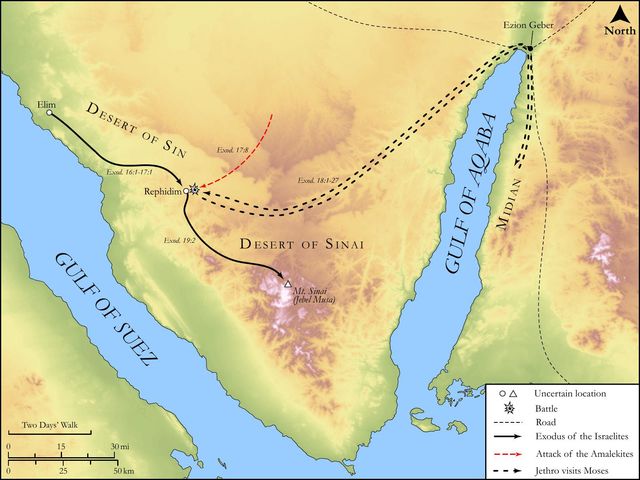
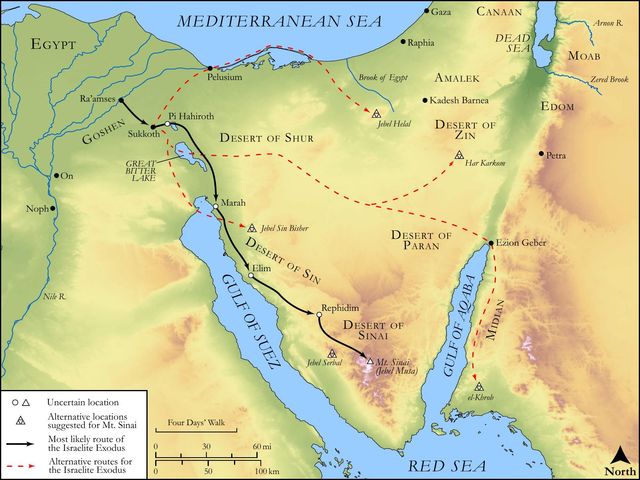
See on the biblical-era maps

Study this verse
Public-domain commentary
Matthew Henry
From his Commentary on the Whole Bible. Henry comments on passages, not single verses — this entry covers Exodus 16:1–12. His four-level outline is real structure in the source text, so it is rendered as structure.
The host of Israel, it seems, took along with them out of Egypt, when they came thence on the fifteenth day of the first month, a month's provisions, which, by the fifteenth day of the second month, was all spent; and here we have,
I.Their discontent and murmuring upon that occasion, Exo 16:2, Exo 16:3.
The whole congregation, the greatest part of them, joined in this mutiny; it was not immediately against God that they murmured, but (which was equivalent) against Moses and Aaron, God's viceregents among them.
1.They count upon being killed in the wilderness - nothing less, at the first appearance of disaster. If the Lord had been pleased to kill them, he could easily have done that in the Red Sea; but then he preserved them, and now could as easily provide for them. It argues great distrust of God, and of his power and goodness, in every distress and appearance of danger to despair of life, and to talk of nothing but being speedily killed.
2.They invidiously charge Moses with a design to starve them when he brought them out of Egypt; whereas what he had done was both by order from God and with a design to promote their welfare. Note, It is no new thing for the greatest kindnesses to be misinterpreted and basely represented as the greatest injuries. The worst colours are sometimes put upon the best actions. Nay,
3.They so far undervalue their deliverance that they wish they had died in Egypt, nay, and died by the hand of the Lord too, that is, by some of the plagues which cut off the Egyptians, as if it were not the hand of the Lord, but of Moses only, that brought them into this hungry wilderness. It is common for people to say of that pain, or sickness, or sore, of which they see not the second causes, "It is what pleases God," as if that were not so likewise which comes by the hand of man, or some visible accident. Prodigious madness! They would rather die by the fleshpots of Egypt, where they found themselves with provision, than live under the guidance of the heavenly pillar in a wilderness and be provided for by the hand of God! they pronounce it better to have fallen in the destruction of God's enemies than to bear the fatherly discipline of his children! We cannot suppose that they had any great plenty in Egypt, how largely soever they now talk of the flesh-pots; nor could they fear dying for want in the wilderness, while they had their flocks and herds with them. But discontent magnifies what is past, and vilifies what is present, without regard to truth or reason. None talk more absurdly than murmurers. Their impatience, ingratitude, and distrust of God, were so much the worse in that they had lately received such miraculous favours, and convincing proofs both that God could help them in the greatest exigencies and that really he had mercy in store for them. See how soon they forgot his works, and provoked him at the sea, even at the Red Sea, Psa 106:7-13. Note, Experiences of God's mercies greatly aggravate our distrusts and murmurings.
II.The care God graciously took for their supply.
Justly he might have said, "I will rain fire and brimstone upon these murmurers, and consume them;" but, quite contrary, he promises to rain bread upon them. Observe,
1.How God makes known to Moses his kind intentions, that he might not be uneasy at their murmurings, nor be tempted to wish he had let them alone in Egypt.
(1.)He takes notice of the people's complaints: I have heard the murmurings of the children of Israel, Exo 16:12. As a God of pity, he took cognizance of their necessity, which was the occasion of their murmuring; as a just and holy God, he took cognizance of their base and unworthy reflections upon his servant Moses, and was much displeased with them. Note, When we begin to fret and be uneasy, we ought to consider that God hears all our murmurings, though silent, and only the murmurings of the heart. Princes, parents, masters, do not hear all the murmurs of their inferiors against them, and it is well they do not, for perhaps they could not bear it; but God hears, and yet bears. We must not think, because God does not immediately take vengeance on men for their sins, that therefore he does not take notice of them; no, he hears the murmurings of Israel, and is grieved with this generation, and yet continues his care of them, as the tender parent of the froward child.
(2.)He promises them a speedy, sufficient, and constant supply, Exo 16:4. Man being made out of the earth, his Maker has wisely ordered him food out of the earth, Psa 104:14. But the people of Israel, typifying the church of the first-born that are written in heaven, and born from above, and being themselves immediately under the direction and government of heaven, receiving their charters, laws, and commissions, from heaven, from heaven also received their food: their law being given by the disposition of angels, they did also eat angels' food. See what God designed in making this provision for them: That I may prove them, whether they will walk in my law or no.
[1.]Thus he tried whether they would trust him, and walk in the law of faith or no, whether they could live from hand to mouth, and (though now uneasy because their provisions were spent) could rest satisfied with the bread of the day in its day, and depend upon God for fresh supplies tomorrow.
[2.]Thus he tried whether they would serve him, and be always faithful to so good a Master, that provided so well for his servants; and hereby he made it appear to all the world, in the issue, what an ungrateful people they were, whom nothing could affect with a sense of obligation. Let favour be shown to them, yet will they not learn righteousness, Isa 26:10.
2.How Moses made known these intentions to Israel, as God ordered him. Here Aaron was his prophet, as he had been to Pharaoh. Moses directed Aaron what to speak to the congregation of Israel (Exo 16:9); and some think that, while Aaron was giving a public summons to the congregation to come near before the Lord, Moses retired to pray, and that the appearance of the glory of the Lord (Exo 16:10) was in answer to his prayer. They are called to come near, as Isa 1:18, Come, and let us reason together. Note, God condescends to give even murmurers a fair hearing; and shall we then despise the cause of our inferiors when they contend with us? Job 31:13.
(1.)He convinces them of the evil of their murmurings. They thought they reflected only upon Moses and Aaron, but here they are told that God was struck at through their sides. This is much insisted on (Exo 16:7, Exo 16:8): "Your murmurings are not against us, then we would have been silent, but against the Lord; it was he that led you into these straits, and not we." Note, When we murmur against those who are instruments of any uneasiness to us, whether justly or unjustly, we should do well to consider how much we reflect upon God by it; men are but God's hand. Those that quarrel with the reproofs and convictions of the word, and are angry with their ministers when they are touched in a tender part, know not what they do, for therein they strive with their Maker. Let this for ever stop the mouth of murmuring, that it is daring impiety to murmur at God, because he is God; and gross absurdity to murmur at men, because they are but men.
(2.)He assures them of the supply of their wants, that since they had harped upon the flesh-pots so much they should for once have flesh in abundance that evening, and bread the next morning, and so on every day thenceforward, Exo 16:8, Exo 16:12. Many there are of whom we say that they are better fed than taught; but the Israelites were thus fed, that they might be taught. He led him about, he instructed him (Deu 32:10); and, as to this instance, see Deu 8:3, He fed thee with manna, that thou mightest know that man doth not live by bread only. And, besides this, here are two things mentioned, which he intended to teach them by sending them manna: - [1.] By this you shall know that the Lord hath brought you out from the land of Egypt, Exo 16:6. That they were brought out of Egypt was plain enough; but so strangely sottish and short-sighted were they that they said it was Moses that brought them out, Exo 16:3. Now God sent them manna, to prove that it was no less than infinite power and goodness that brought them out, and this could perfect what was begun. If Moses only had brought them out of Egypt, he could not thus have fed them; they must therefore own that that was the Lord's doing, because this was so, and both were marvellous in their eyes; yet, long afterwards, they needed to be told that Moses gave them not this bread from heaven, Joh 6:32. [2.] By this you shall know that I am the Lord your God, Exo 16:12. This gave proof of his power as the Lord, and his particular favour to them as their God. When God plagued the Egyptians, it was to make them know that he was the Lord; when he provided for the Israelites, it was to make them know that he was their God.
3.How God himself manifested his glory, to still the murmurings of the people, and to put a reputation upon Moses and Aaron, Exo 16:10. While Aaron was speaking, the glory of the Lord appeared in the cloud. The cloud itself, one would think, was enough both to strike an awe upon them and to give encouragement to them; yet, in a few days, it had grown so familiar to them that it made no impression upon them, unless it shone with an unusual brightness. Note, What God's ministers say to us is then likely to do us good when the glory of God shines in with it upon our souls.
Continue studying Exodus 16:2 across the web’s major study libraries — every link below opens this exact verse, chapter, or book on the destination site.
Read & Compare
 BibleGatewayThis verse in more than 200 translations and 70 languages.
 Bible.comThe YouVersion reader — hundreds of translations, reading plans, and highlights.
 ESV.orgCrossway's official English Standard Version reader.
 NET BibleThe NET translation with 60,000+ translators' notes on every rendering decision.
 STEP BibleTyndale House's free study tool — original text, vocabulary, and scholarly resources.
 BibliaLogos Bible Software's free web reader.
 USCCBThe New American Bible (Revised Edition) with the U.S. bishops' study notes.
Commentaries
 BibleHub CommentariesDozens of classic commentaries on this verse, gathered on one page.
 StudyLightMore than 100 commentary sets — the largest collection on the web.
 BibleRefPlain-English commentary on what this verse means, verse by verse.
 Enduring WordDavid Guzik's free commentary on this chapter, widely used by Bible teachers.
 Bible Study ToolsVerse commentary alongside Greek and Hebrew study aids.
Original Language & Research
- BibleHub InterlinearThe verse word by word — original language, transliteration, and English.
- BibleHub LexiconEvery word's original-language definition and Strong's entry.
 Blue Letter BibleDeep-study tools — Strong's numbers, concordance, and word studies.
 SefariaThe Hebrew text with Rashi and centuries of Jewish commentary.
Sermons, Hymns & Audio


TrulyRandomVerse is not affiliated with these sites and doesn’t control their content. They’re linked because they’re genuinely useful.
Summary
Exodus 16:2 depicts a pivotal moment in the Israelites' wilderness journey, approximately one month after their miraculous deliverance from Egypt and the crossing of the Red Sea. Despite recent awe-inspiring demonstrations of divine power and provision, the entire congregation of the children of Israel expresses widespread discontent and rebellious grumbling against their appointed leaders, Moses and Aaron, due to a perceived lack of food in the desolate wilderness. This verse sets the stage for God's miraculous provision of manna and quail, yet also foreshadows the recurring theme of Israel's faithlessness and murmuring throughout their wilderness wanderings.
Context
ShowHideLiterary Context
Exodus 16:2 is strategically placed in the narrative following a series of dramatic events that underscore God's mighty power and faithful provision. The Israelites have just witnessed the overwhelming defeat of Pharaoh's army at the Red Sea and experienced God's transformation of bitter waters into sweet at Marah. They even found twelve springs and seventy palm trees at Elim, a place of refreshing respite (Exodus 15:27). This verse, however, marks a sharp turn, initiating a cycle of complaint that will characterize much of the wilderness journey, highlighting the people's spiritual immaturity and short-term memory regarding God's faithfulness. It serves as a narrative pivot, transitioning from immediate post-deliverance awe to the harsh realities of wilderness survival and the testing of faith.
Historical & Cultural Context
The scene unfolds in the "wilderness of Sin," a barren and inhospitable region between Elim and Mount Sinai. Sustaining a population estimated to be in the millions (including women, children, and livestock) in such an environment presented an immense logistical challenge. Food and water scarcity were constant threats, making the journey perilous. From a cultural perspective, the Israelites, like the Egyptians among whom they had lived, often viewed the success or failure of a leader as directly tied to the well-being of the people. When hardship struck, it was natural to direct grievances towards those in authority. However, in this unique exodus narrative, Moses and Aaron were not merely human leaders but God's chosen intermediaries, making the people's complaints against them an indirect, yet profound, act of rebellion against God Himself. The Israelites, fresh out of generations of slavery, were accustomed to a master providing for their basic needs, however meagerly. The transition to freedom, requiring absolute dependence on an unseen God in an unknown land, was a profound and terrifying psychological shift, leading to a desire for the perceived security of their past bondage over the uncertainty of divine liberation.
Key Themes
ShowHideExodus 16:2 introduces and amplifies several critical themes that permeate the book of Exodus and the broader Pentateuch. Primarily, it starkly contrasts Divine Providence with Human Faithlessness. Despite God's recent, overwhelming displays of power and provision, such as the Red Sea deliverance and the sweetening of the waters at Marah, the people quickly fall into a pattern of distrust and complaint when faced with new challenges. This highlights the theme of Testing in the Wilderness, where the harsh environment serves as a crucible designed to cultivate absolute dependence on God, rather than on human ingenuity or past provisions. Furthermore, the verse underscores the complexities of Leadership and Rebellion, as the people's complaints against Moses and Aaron are implicitly, and often explicitly, directed against God Himself, challenging His chosen authority and His sovereign plan for His people. Ultimately, this episode also sets the stage for God's unwavering Patience and Covenant Faithfulness, as He responds to their murmuring not with immediate judgment, but with miraculous provision, demonstrating His commitment to His covenant promises despite His people's rebellious hearts, a theme echoed in Psalm 78.
Exposition and Analysis
ShowHideKey Word Analysis
ShowHideA primitive root meaning "to stop (usually over night); by implication, to stay permanently; hence (in a bad sense) to be obstinate (especially in words, to complain)." This word signifies more than a simple expression of need; it denotes a deep-seated, persistent grumbling that questions the authority, wisdom, and goodness of those in charge, and by extension, God Himself. It implies a rebellious attitude, often leading to open dissent, and becomes a recurring motif throughout the wilderness narratives, characterizing Israel's faithlessness and ingratitude despite continuous divine provision.
A feminine noun meaning "a stated assemblage (specifically, a concourse, or generally, a family or crowd)." Its use here emphasizes that the discontent was not isolated to a few individuals but was a widespread, collective expression of rebellion by the entire assembly of Israel. This highlights the pervasive nature of their lack of faith and the significant challenge it posed to Moses' leadership and God's overarching plan for His covenant people.
Meaning "a pasture (i.e. open field, whither cattle are driven); by implication, a desert; also speech (including its organs)." In the biblical narrative, "wilderness" is more than just a geographical location; it is a profound theological setting. It represents a place of desolation, testing, and absolute dependence on God, but also a place of divine revelation and miraculous provision. It symbolizes the crucible of faith, where Israel was meant to learn to rely solely on God's sustaining power.
Verse Breakdown
ShowHide"And the whole congregation"
This phrase emphasizes the collective and pervasive nature of the discontent. It was not a small faction or a few individuals, but the entire assembly of the children of Israel that was united in their complaint, demonstrating a widespread lack of faith and trust.
"of the children of Israel"
Identifies the specific people group, God's chosen covenant people, who were the recipients of His miraculous deliverance and ongoing care. This highlights the irony and gravity of their complaint, given their unique relationship with and recent experience of God's mighty acts.
"murmured"
This is the central action, signifying a deep-seated, rebellious grumbling. It implies a questioning of divine leadership and provision, rather than a humble petition for help. It reveals a heart attitude of discontent, ingratitude, and a profound lack of trust in God's ability or willingness to sustain them.
"against Moses and Aaron"
These were God's divinely appointed leaders and intermediaries. While the complaints were directly aimed at them, they ultimately represented a challenge to God's authority, His wisdom, and His sovereign plan for His people. The people held their human leaders accountable for their circumstances, failing to see God's hand in their journey and His ultimate control.
"in the wilderness"
This specifies the setting, a harsh and challenging environment that served as a crucible for Israel's faith. It underscores the immediate cause of their complaint (lack of food) but also the broader context of their journey, where absolute dependence on God was not merely advisable but essential for survival and spiritual growth.
Literary Devices
ShowHideThe verse employs several literary devices to convey its profound meaning. Repetition is a key element, as the theme of "murmuring" (Hebrew lûn) becomes a recurring motif throughout the wilderness narrative, establishing a consistent pattern of Israel's faithlessness and ingratitude. This repetition serves to emphasize the people's spiritual immaturity and their persistent failure to trust God despite His repeated demonstrations of power and provision. There is also a strong sense of Antithesis or Contrast at play. The recent, awe-inspiring miracles of the Red Sea crossing and the sweetening of the bitter waters stand in stark contrast to the immediate and widespread grumbling of the people. This juxtaposition highlights the human tendency towards forgetfulness and discontent, even in the face of overwhelming evidence of divine faithfulness. Furthermore, the Symbolism of the "wilderness" is crucial; it is not merely a geographical location but a testing ground for faith, a place where the people are stripped of self-sufficiency and forced into absolute dependence on God. The murmuring in this setting underscores their failure to embrace this dependence.
Theological and Thematic Connections
ShowHideExodus 16:2 powerfully illustrates the enduring tension between divine faithfulness and human faithlessness. Despite God's recent, overwhelming demonstrations of power and provision, the Israelites quickly succumb to fear and discontent when faced with immediate hardship. This reveals the deep-seated sinfulness of the human heart, prone to forgetfulness and ingratitude, and quick to question God's benevolent intentions. The murmuring is not merely a complaint about hunger but a profound lack of trust in God's ability and willingness to provide for His people, even as He leads them through a challenging journey. It highlights the immense burden of spiritual leadership, as Moses and Aaron bear the brunt of the people's frustration, yet also underscores God's unwavering patience and commitment to His covenant people, even in their rebellion. The wilderness becomes a classroom where God teaches His people absolute dependence, a lesson they repeatedly fail to grasp.
Reflection and Application
ShowHideExodus 16:2 serves as a timeless mirror reflecting the human condition and our often-struggling journey of faith. It challenges us to examine our own hearts when faced with adversity, scarcity, or uncertainty. Do we, like the Israelites, quickly resort to complaining, blaming, and questioning God's goodness or the wisdom of His plan when our circumstances become uncomfortable? Or do we recall His past faithfulness, His countless provisions, and His unwavering love, choosing instead to trust in His ongoing care? This verse reminds us that true faith is not merely believing in God's existence, but actively trusting His character and His promises even when the path ahead is unclear or difficult. Cultivating a spirit of gratitude, remembering God's past blessings, and patiently waiting on His timing are vital practices that can transform our responses from murmuring to worship, enabling us to navigate our own "wilderness" experiences with a heart of trust rather than discontent.
Questions for Reflection
ShowHideFAQ
ShowHideWhy did the Israelites murmur so quickly after seeing God's miracles?
ShowHideThe Israelites' rapid shift from awe to murmuring highlights the profound challenge of faith and the stubbornness of the human heart. While they had witnessed extraordinary miracles like the Red Sea crossing and the sweetening of Marah's waters, these events, though powerful, did not instantly transform their character or eradicate generations of a slave mentality. Their faith was often superficial, based on immediate gratification rather than a deep, abiding trust in God's character. They were accustomed to the "security" of Egyptian bondage, where food (even if meager) was consistently provided, and the uncertainty of the wilderness journey, coupled with the immense logistical challenges of feeding millions, quickly exposed their spiritual immaturity and fear. Their complaints were less about genuine hunger and more about a fundamental lack of trust in God's ability or willingness to sustain them, revealing a pattern of hardening their hearts, as warned in Hebrews 3:7-11.
Was their complaint justified given the lack of food?
ShowHideWhile the Israelites' need for food was very real and understandable in the desolate wilderness, their attitude of "murmuring" was not justified. There's a crucial distinction between expressing a legitimate need or hardship to God in prayer and engaging in rebellious grumbling and questioning His faithfulness. The Israelites' complaints were characterized by a lack of trust, a short memory of God's past provisions, and an implicit challenge to His leadership through Moses and Aaron. Instead of humbly seeking God's help or recalling His mighty acts, they accused their leaders and, by extension, God, of bringing them into the wilderness to die. This rebellious spirit is what made their murmuring sinful, as seen in the New Testament's warning to do all things without grumbling or questioning. God, in His grace, still provided for their needs, demonstrating His patience even in their rebellion.
Christ-Centered Fulfillment
ShowHideThe murmuring of the Israelites in the wilderness, as depicted in Exodus 16:2, serves as a profound Old Testament type, foreshadowing humanity's pervasive spiritual discontent and inability to sustain itself apart from divine provision. Their longing for the "fleshpots of Egypt" (Exodus 16:3) despite their bondage reveals a preference for perceived earthly security over the liberating, yet challenging, path of faith. This narrative finds its ultimate fulfillment in Jesus Christ, who is the true Bread of Life sent from heaven, providing eternal sustenance that the manna in the wilderness could only symbolize. Unlike the Israelites who repeatedly failed the test of faith, Jesus perfectly obeyed God during His own forty days of temptation in the wilderness, famously declaring that man shall not live by bread alone, but by every word that comes from the mouth of God. He is the faithful leader who does not succumb to the people's demands or their lack of faith, but steadfastly leads His people through the wilderness of this world. Through His perfect life, atoning death, and glorious resurrection, Christ has provided the ultimate answer to humanity's deepest spiritual hunger, offering not just temporary physical provision but eternal life and true satisfaction. He is the Living Water and the Good Shepherd who faithfully guides His flock, ensuring that those who trust in Him will never hunger or thirst again, leading them to the true promised rest that remains for the people of God.