


Exodus 15:24
- וַיִּלֹּנוּvai·yi·Lo·nuand they grumbledH3885Conj-w ¦ V-Niphal-ConsecImperf-3mpVerb Niphal Consecutive Imperfect 3rd Plural Masculineוַandיִּלֹּנוּthey grumbled
- הָעָםha·'Amthe peopleH5971Art ¦ N-msNoun Singular Masculine Absoluteהָtheעָםpeople
- עַל'alonH5921PrepPreposition
- מֹשֶׁהmo·ShehMosesH4872N-proper-mNoun Proper Masculine
- לֵּאמֹרle·Mor<to> sayingH559Prep-l ¦ V-Qal-InfVerb Qal Infinitive Constructלֵּ<to>אמֹרsaying
- מַהmahwhat?H4100InterrogPronoun Interrogative
- נִּשְׁתֶּהnish·Tehwill we drinkH8354V-Qal-Imperf-1cpVerb Qal Imperfect 1st Plural common gender
English is a literal word-by-word gloss of the Hebrew, not the KJV's wording. Why?
This is the original text the KJV's translators worked from — each Hebrew word with its own literal English meaning in this verse, prepared by scholars at Tyndale House, Cambridge. The KJV translates whole sentences, not word by word, so its wording differs: one Hebrew word can become several English words, and the KJV may choose “the LORD” where the gloss reads “Yahweh”. Both are faithful — they answer different questions. For the KJV's own rendering, switch to the KJV text.
Details
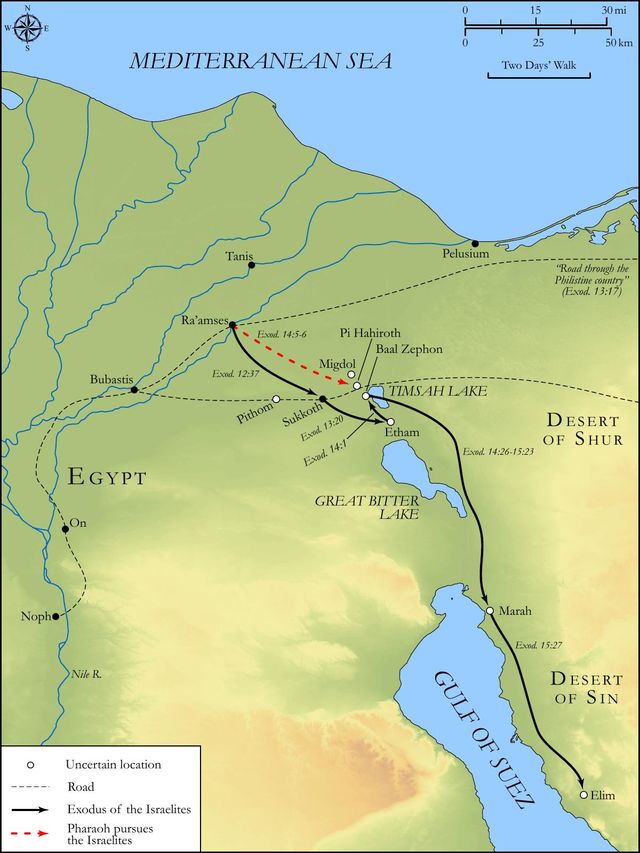
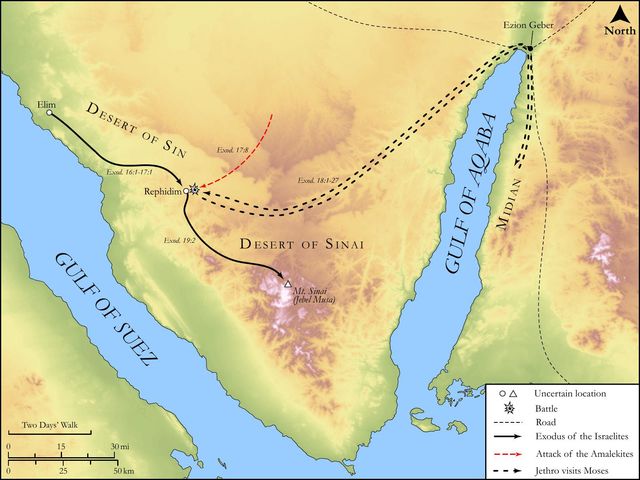
See on the biblical-era maps

Study this verse
Public-domain commentary
Matthew Henry
From his Commentary on the Whole Bible. Henry comments on passages, not single verses — this entry covers Exodus 15:22–27. His three-level outline is real structure in the source text, so it is rendered as structure.
It should seem, it was with some difficulty that Moses prevailed with Israel to leave that triumphant shore on which they sang the foregoing song. They were so taken up with the sight, or with the song, or with the spoiling of the dead bodies, that they cared not to go forward, but Moses with much ado brought them from the Red Sea into a wilderness. The pleasures of our way to Canaan must not retard our progress, but quicken it, though we have a wilderness before us. Now here we are told,
I.That in the wilderness of Shur they had no water, Exo 15:22.
This was a sore trial to the young travellers, and a diminution to their joy; thus God would train them up to difficulties. David, in a dry and thirsty land where no water is, reaches forth towards God, Psa 63:1.
II.That at Marah they had water, but it was bitter, so that though they had been three days without water they could not drink it, because it was extremely unpleasant to the taste or was likely to be prejudicial to their health, or was so brackish that it rather increased their thirst than quenched it, Exo 15:23. Note, God can embitter that to us from which we promise ourselves most satisfaction, and often does so in the wilderness of this world, that our wants and disappointments in the creature may drive us to the Creator, in whose favour alone true comfort is to be had. Now in this distress,
1.The people fretted and quarrelled with Moses, as if he had done ill by them. What shall we drink? is all their clamour, Exo 15:24. Note, The greatest joys and hopes are soon turned into the greatest griefs and fears with those that live by sense only, and not by faith.
2.Moses prayed: He cried unto the Lord, Exo 15:25. The complaints which they brought to him he brought to God, on whom, notwithstanding his elevation, Moses owned a constant dependence. Note, It is the greatest relief of the cares of magistrates and ministers, when those under their charge make them uneasy, that they may have recourse to God by prayer: he is the guide of the church's guides and to him, as the Chief Shepherd, the under-shepherds must upon all occasions apply.
3.God provided graciously for them. He directed Moses to a tree, which he cast into the waters, in consequence of which, all of a sudden, they were made sweet. Some think this wood had a peculiar virtue in it for this purpose, because it is said, God showed him the tree. God is to be acknowledged, not only in the creating of things useful for man, but in discovering their usefulness. Or perhaps this was only a sign, and not at all a means, of the cure, any more than the brazen serpent, or Elisha's casting one cruse full of salt into the waters of Jericho. Some make this tree typical of the cross of Christ, which sweetens the bitter waters of affliction to all the faithful, and enables them to rejoice in tribulation. The Jews' tradition is that the wood of this tree was itself bitter, yet it sweetened the waters of Marah; the bitterness of Christ's sufferings and death alters the property of ours.
4.Upon this occasion, God came upon terms with them, and plainly told them, now that they had got clear of the Egyptians, and had entered into the wilderness, that they were upon their good behaviour, and that according as they carried themselves so it would be well or ill with them: There he made a statute and an ordinance, and settled matters with them. There he proved them, that is, there he put them upon the trial, admitted them as probationers for his favour. In short, he tells them, Exo 15:26,
(1.)What he expected from them, and that was, in one word, obedience. They must diligently hearken to his voice, and give ear to his commandments, that they might know their duty, and not transgress through ignorance; and they must take care in every thing to do that which was right in God's sight, and to keep all his statutes. They must not think, now that they were delivered from their bondage in Egypt, that they had no lord over them, but were their own masters; no, therefore they must look upon themselves as God's servants, because he had loosed their bonds, Psa 116:16; Luk 1:74, Luk 1:75.
(2.)What they might then expect from him: I will put none of these diseases upon thee, that is, "I will not bring upon thee any of the plagues of Egypt." This intimates that, if they were rebellious and disobedient, the very plagues which they had seen inflicted upon their enemies should be brought upon them; so it is threatened, Deu 28:60. God's judgments upon Egypt, as they were mercies to Israel, opening the way to their deliverance, so they were warnings to Israel, and designed to awe them into obedience. Let not the Israelites think, because God had thus highly honoured them in the great things he had done for them, and had proclaimed them to all the world his favourites, that therefore he would connive at their sins and let them do as they would. No, God is no respecter of persons; a rebellious Israelite shall fare no better than a rebellious Egyptian; and so they found, to their cost, before the got to Canaan. "But, if thou wilt be obedient, thou shalt be safe and happy;" the threatening is implied only, but the promise is expressed: "I am the Lord that healeth thee, and will take care of thy comfort wherever thou goest." Note, God is the great physician. If we be kept well, it is he that keeps us; if we be made well, it is he that restores us; he is our life, and the length of our days.
III.That at Elim they had good water, and enough of it, Exo 15:27.
Though God may, for a time, order his people to encamp by the waters of Marah, yet that shall not always be their lot. See how changeable our condition is in this world, from better to worse, from worse to better. Let us therefore learn both how to be abased and how to abound, to rejoice as though we rejoiced not when we are full, and to weep as though we wept not when we are emptied. Here were twelve wells for their supply, one for every tribe, that they might not strive for water, as their fathers had sometimes done; and, for their pleasure, there were seventy palm-trees, under the shadow of which their great men might repose themselves. Note, God can find places of refreshment for his people even in the wilderness of this world, wells in the valley of Baca, lest they should faint in their mind with perpetual fatigue: yet, whatever our delights may be in the land of our pilgrimage, we must remember that we do but encamp by them for a time, that here we have no continuing city.
Continue studying Exodus 15:24 across the web’s major study libraries — every link below opens this exact verse, chapter, or book on the destination site.
Read & Compare
 BibleGatewayThis verse in more than 200 translations and 70 languages.
 Bible.comThe YouVersion reader — hundreds of translations, reading plans, and highlights.
 ESV.orgCrossway's official English Standard Version reader.
 NET BibleThe NET translation with 60,000+ translators' notes on every rendering decision.
 STEP BibleTyndale House's free study tool — original text, vocabulary, and scholarly resources.
 BibliaLogos Bible Software's free web reader.
 USCCBThe New American Bible (Revised Edition) with the U.S. bishops' study notes.
Commentaries
 BibleHub CommentariesDozens of classic commentaries on this verse, gathered on one page.
 StudyLightMore than 100 commentary sets — the largest collection on the web.
 BibleRefPlain-English commentary on what this verse means, verse by verse.
 Enduring WordDavid Guzik's free commentary on this chapter, widely used by Bible teachers.
 Bible Study ToolsVerse commentary alongside Greek and Hebrew study aids.
Original Language & Research
- BibleHub InterlinearThe verse word by word — original language, transliteration, and English.
- BibleHub LexiconEvery word's original-language definition and Strong's entry.
 Blue Letter BibleDeep-study tools — Strong's numbers, concordance, and word studies.
 SefariaThe Hebrew text with Rashi and centuries of Jewish commentary.
Sermons, Hymns & Audio


TrulyRandomVerse is not affiliated with these sites and doesn’t control their content. They’re linked because they’re genuinely useful.
Summary
Exodus 15:24 captures a critical moment in Israel's wilderness journey, just days after their miraculous Red Sea deliverance and the triumphant "Song of Moses." Despite witnessing God's overwhelming power and provision, the people quickly succumb to fear and discontent when faced with a lack of water, murmuring against Moses and, by extension, against God. This verse starkly highlights the fragility of human faith, the rapid shift from exuberant praise to desperate complaint, and the challenging realities of their desert trek, establishing a pattern for future tests of trust and obedience.
Context
ShowHideLiterary Context
This verse is situated immediately after the Israelites' awe-inspiring deliverance from Egyptian bondage through the parting of the Red Sea, recounted in Exodus 14:21-31. The preceding passage, Exodus 15:1-19, presents the "Song of Moses," a magnificent hymn of praise and thanksgiving to Yahweh for His mighty salvation and triumph over Pharaoh's army. Following this peak of spiritual exultation, Exodus 15:22-23 describes their three-day journey into the wilderness of Shur without finding drinkable water, culminating in their arrival at Marah, where the waters were bitter. Exodus 15:24 thus marks a dramatic and swift transition from corporate worship and celebration to collective complaint, underscoring the immediate and pressing physical needs that often overshadowed their recent spiritual triumphs. This rapid shift foreshadows a recurring theme of testing and human failing throughout the wilderness narrative, setting the stage for God's continued miraculous provision and the people's ongoing spiritual formation.
Historical & Cultural Context
The wilderness journey was an essential, albeit arduous, part of God's plan for Israel, designed to transform a nation of slaves into a people wholly dependent on Him. The wilderness of Shur, a desolate region east of the Red Sea, was characterized by extreme aridity, scarce water sources, and harsh conditions, making sustained travel perilous without divine intervention. For a vast multitude, including women, children, and livestock, the lack of water was not merely an inconvenience but an existential threat, a matter of life and death. In ancient Near Eastern cultures, water was a fundamental necessity, and its scarcity often led to desperate measures and social unrest. Furthermore, the Israelites were a newly liberated people, still shedding the mindset of slavery, which often included a tendency to complain and look back to the perceived "security" of their former lives, even if it was in bondage. Their murmuring against Moses reflects not only their immediate physical distress but also a deeper spiritual immaturity and a failure to fully trust the God who had so powerfully delivered them from Pharaoh's oppressive hand. This context highlights the immense challenge of leading such a large and vulnerable population through a hostile environment, where every basic need became a test of faith and leadership.
Key Themes
ShowHideExodus 15:24 contributes significantly to several key themes within the book of Exodus and the broader Pentateuch. It powerfully illustrates the theme of Divine Testing and Provision, demonstrating how God leads His people into challenging circumstances to reveal their hearts and to teach them absolute reliance on Him for every necessity, from physical sustenance to spiritual guidance. This verse also highlights the pervasive theme of Human Faithlessness and Murmuring, showcasing the Israelites' recurring tendency to doubt God's goodness and complain against His appointed leaders, despite overwhelming evidence of His power and faithfulness, a pattern seen repeatedly in passages like Numbers 11:1 and Numbers 14:2-4. Conversely, it underscores the theme of God's Enduring Patience and Faithfulness, as He consistently responds to their complaints with grace and provision rather than immediate judgment, demonstrating His steadfast love and commitment to His covenant people, as He does later at Rephidim in Exodus 17:1-7. Finally, it touches on the theme of Leadership Challenges, depicting the immense burden and spiritual fortitude required of Moses in guiding a people prone to doubt and rebellion.
Exposition and Analysis
ShowHideKey Word Analysis
ShowHideThis verb (H3885) signifies more than simple complaining; it describes a deep, internal discontent that boils over into vocal grumbling, often uttered in low, rebellious tones. It implies an act of being obstinate or staying permanently in a state of complaint, revealing a spirit of distrust and often, an implicit or explicit accusation against God or His appointed leaders. Throughout the wilderness narratives, lûwn consistently characterizes Israel's lack of faith and their rebellious attitude in the face of hardship, demonstrating a heart that questions God's goodness and provision despite His demonstrated faithfulness.
This noun (H5971) refers to the collective body of the Israelites, the chosen nation of God, understood as a congregated unit or a tribe. The use of "the people" emphasizes the widespread and communal nature of the complaint, indicating that this was not an isolated incident but a pervasive sentiment among the multitude. It underscores the challenge of leading a large group whose collective spiritual state could quickly shift from praise to panic, and highlights the shared responsibility for their corporate spiritual condition.
This primitive root verb (H8354) means "to imbibe," highlighting the very basic, immediate physical need that triggered their complaint. The question "What shall we drink?" is not merely a request but an expression of desperation and an implied accusation, suggesting that Moses, and by extension God, had led them into an impossible situation without providing for their most essential need. This word underscores the raw, primal nature of their distress and the fundamental human reliance on water for survival.
Verse Breakdown
ShowHide"And the people murmured against Moses,"
This clause immediately reveals the dramatic shift from the preceding triumph and song of praise to a state of profound discontent. The "murmuring" (Hebrew lûn) signifies a deep-seated grumbling, a low, rebellious complaint that is not merely an expression of need but an accusation. Their complaint is directed "against Moses," who, as God's appointed leader, bore the brunt of their frustration. However, murmuring against Moses was, in essence, murmuring against God Himself, as Moses was God's representative and instrument of deliverance. This highlights a fundamental lack of trust in God's ongoing care and provision, despite the recent, overwhelming evidence of His power at the Red Sea. It sets the stage for a recurring pattern of rebellion in the wilderness.
"saying, What shall we drink?"
This direct question articulates the immediate and pressing physical need that triggered their discontent. The absence of drinkable water for three days had escalated into a crisis for such a vast multitude. The question, while seemingly innocent, carries an undertone of accusation and despair. It implies, "Why have you brought us out here to die of thirst? Where is your provision?" This demonstrates how quickly a vital physical need can overshadow spiritual memory and trust, leading to a focus on the problem rather than the Provider. It also sets the stage for God's miraculous intervention, which often follows such expressions of human inadequacy and doubt, thereby reinforcing His sovereignty and faithfulness.
Literary Devices
ShowHideExodus 15:24 employs several significant literary devices to convey its profound message. The most prominent is Irony, as the people's immediate descent into complaint stands in stark contrast to their recent, exuberant "Song of Moses" (Exodus 15:1-19), a magnificent hymn of praise for God's deliverance. This rapid shift from corporate worship to collective protest highlights the volatile nature of human faith and the fleeting memory of divine intervention when faced with new hardships. There is also a powerful element of Contrast between God's magnificent power displayed at the Red Sea and the people's profound lack of faith just days later. This contrast underscores the human tendency to forget past blessings in the face of present difficulties and to quickly revert to a mindset of scarcity rather than trust. Furthermore, this verse serves as Foreshadowing, establishing a recurring pattern of Israel's murmuring throughout their wilderness journey (e.g., Numbers 14:2-4), which becomes a defining characteristic of their rebellion and a constant test of God's patience and faithfulness. The stark simplicity of the question, "What shall we drink?" also functions as a form of Rhetorical Question, expressing not a genuine inquiry but a desperate, accusatory lament born of fear and distrust.
Theological and Thematic Connections
ShowHideExodus 15:24 is a profound theological statement on the nature of human faith, divine testing, and God's unwavering provision. It reveals the inherent sinfulness and spiritual immaturity of humanity, demonstrating how quickly the memory of God's mighty acts can fade when immediate physical needs arise. The murmuring of the Israelites against Moses, and implicitly against God, underscores the theme of rebellion against divine authority and a lack of trust in God's ongoing care, even after experiencing monumental miracles. This wilderness experience was designed by God not to punish, but to test and refine His people, teaching them absolute dependence on Him for every necessity. It highlights God's patience and His commitment to His covenant, even in the face of human unfaithfulness, as He consistently responds to their complaints with provision rather than immediate judgment, thereby revealing His character as a faithful and compassionate Provider.
Reflection and Application
ShowHideExodus 15:24 serves as a timeless mirror reflecting the human tendency to complain and lose perspective when faced with adversity, even after experiencing profound blessings. For contemporary believers, this passage is a powerful reminder that our faith is often most tested not in moments of triumph, but in the mundane, challenging realities of life, particularly when our basic needs seem unmet. It challenges us to cultivate a deeper trust in God's sovereignty and provision, remembering His past faithfulness in our lives and in the history of salvation, rather than allowing immediate difficulties to overshadow His enduring character. Instead of succumbing to a spirit of murmuring, which often leads to bitterness, ingratitude, and a questioning of God's goodness, we are called to bring our anxieties and needs to God in prayer with thanksgiving, confident that He cares for us and will provide in His perfect timing and way. This wilderness experience encourages us to embrace trials as opportunities for spiritual growth, learning patience and a deeper reliance on God alone, recognizing that He uses such moments to refine our faith, deepen our dependence, and draw us closer to Him, transforming our hearts from complaint to trust.
Questions for Reflection
ShowHideFAQ
ShowHideWhy did the Israelites complain so quickly after seeing such a great miracle?
ShowHideThe rapid shift from praise to complaint highlights several aspects of human nature and the Israelites' spiritual immaturity. Despite witnessing the Red Sea parting and Pharaoh's defeat, their faith was still nascent and largely dependent on immediate circumstances. They were a people newly freed from centuries of slavery, accustomed to a life of provision (albeit under oppression) and not yet trained in absolute reliance on God in the wilderness. The immediate physical threat of thirst, a matter of life and death for such a large multitude, quickly overshadowed their memory of God's recent power. This demonstrates the fragility of human faith when confronted with pressing physical needs, and how easily fear and discomfort can eclipse spiritual gratitude and trust in God's ongoing care. It also underscores that true faith is not merely intellectual assent to past miracles, but an ongoing, active trust in God's character and future provision, even when circumstances are dire.
Was Moses truly the target of their complaint, or was it directed at God?
ShowHideWhile the people's complaint was verbally directed "against Moses," it was implicitly and ultimately directed against God Himself. Moses was God's chosen leader and representative; to complain against Moses was to question God's wisdom, leadership, and provision through His appointed agent. This is a recurring theme in the wilderness narratives, where the people's grumbling against Moses and Aaron is consistently interpreted by God as a direct affront to Him (e.g., Numbers 14:27). Their question, "What shall we drink?" was not just a desperate plea but an accusation that Moses (and therefore God) had led them into an impossible situation without adequate provision. This reveals a deeper spiritual issue of distrust in God's sovereign plan and His ability to care for His people, demonstrating that murmuring against God's servants is ultimately murmuring against God Himself.
Christ-Centered Fulfillment
ShowHideExodus 15:24, with its depiction of a thirsty, murmuring people in the wilderness, finds profound Christ-centered fulfillment in the New Testament. The physical thirst of the Israelites foreshadows humanity's deeper spiritual thirst, a longing that only Christ can satisfy. Just as God provided water for Israel in the desert, Jesus declares Himself to be the Living Water, promising that whoever drinks of Him will never thirst again (John 4:14). He is the ultimate provision in our spiritual wilderness, the Bread of Life who came down from heaven to give life to the world, unlike the manna which sustained Israel but did not grant eternal life. Furthermore, the murmuring of Israel against Moses, God's mediator, finds its antithesis in Christ, the perfect and sinless Mediator who never murmured, even in the face of unimaginable suffering and temptation (Hebrews 4:15). He endured the ultimate wilderness experience—His forty days of temptation—without succumbing to doubt or complaint (Matthew 4:1-11). Through His ultimate sacrifice on the cross, Christ provides not just temporary physical relief but eternal spiritual satisfaction, quenching the deepest thirst of the soul and offering true rest to those who are weary and burdened (Matthew 11:28). He is the ultimate answer to "What shall we drink?", offering Himself as the wellspring of eternal life and the source of all true spiritual sustenance.