


Numbers 20:5
- וְלָמָהve·la·Mahand <to> why?H4100Conj-w ¦ Prep-l ¦ InterrogPronoun Interrogativeוְandלָ<to>מָהwhy?
- הֶעֱלִיתֻנוּhe·'e·li·Tu·nuhave you brought up usH5927V-Hiphil-Perf-2mp ¦ 1cpVerb Hiphil Perfect 2nd Plural Masculineהֶעֱלִיתֻhave you brought upנוּus
- מִמִּצְרַיִםmi·mitz·Ra·yimfrom EgyptH4714Prep-m ¦ N-properNoun Proper LocationמִfromמִּצְרַיִםEgypt
- לְהָבִיאle·ha·Vi'to bringH935Prep-l ¦ V-Hiphil-InfVerb Hiphil Infinitive Constructלְtoהָבִיאbring
- אֹתָנוּ'o·Ta·nu<obj.> usH853DirObjM ¦ 1cpParticle Object Indicatorאֹתָ<obj.>נוּus
- אֶל'eltoH413PrepPreposition
- הַמָּקוֹםha·ma·Komthe placeH4725Art ¦ N-msNoun Singular Masculine Absoluteהַtheמָּקוֹםplace
- הָרָעha·Ra'the evilH7451Art ¦ Adj-msAdjective Singular Masculine Absoluteהָtheרָעevil
- הַזֶּהha·Zeh<the> thisH2088Art ¦ PrtParticle Demonstrativeהַ<the>זֶּהthis
- לֹאlo'notH3808NegParticle Negative
- מְקוֹםme·Koma place ofH4725N-mscNoun Singular Masculine Construct
- זֶרַעZe·ra'seedH2233N-msNoun Singular Masculine Absolute
- וּתְאֵנָהu·te·'e·Nahand fig treeH8384Conj-w ¦ N-fsNoun Singular Feminine Absoluteוּandתְאֵנָהfig tree
- וְגֶפֶןve·Ge·fenand vineH1612Conj-w ¦ N-csNoun Singular common gender Absoluteוְandגֶפֶןvine
- וְרִמּוֹןve·ri·Monand pomegranateH7416Conj-w ¦ N-msNoun Singular Masculine Absoluteוְandרִמּוֹןpomegranate
- וּמַיִםu·Ma·yimand [is] waterH4325Conj-w ¦ N-mpNoun Plural Masculine Absoluteוּandמַיִם[is] water
- אַיִן'A·yinthere notH369N-msNoun Singular Masculine Absolute
- לִשְׁתּוֹתlish·Totto drinkH8354Prep-l ¦ V-Qal-InfVerb Qal Infinitive Constructלִtoשְׁתּוֹתdrink
English is a literal word-by-word gloss of the Hebrew, not the KJV's wording. Why?
This is the original text the KJV's translators worked from — each Hebrew word with its own literal English meaning in this verse, prepared by scholars at Tyndale House, Cambridge. The KJV translates whole sentences, not word by word, so its wording differs: one Hebrew word can become several English words, and the KJV may choose “the LORD” where the gloss reads “Yahweh”. Both are faithful — they answer different questions. For the KJV's own rendering, switch to the KJV text.
Details
See on the biblical-era maps
Study this verse
Public-domain commentary
Matthew Henry
From his Commentary on the Whole Bible. Henry comments on passages, not single verses — this entry covers Numbers 20:1–13. His four-level outline is real structure in the source text, so it is rendered as structure.
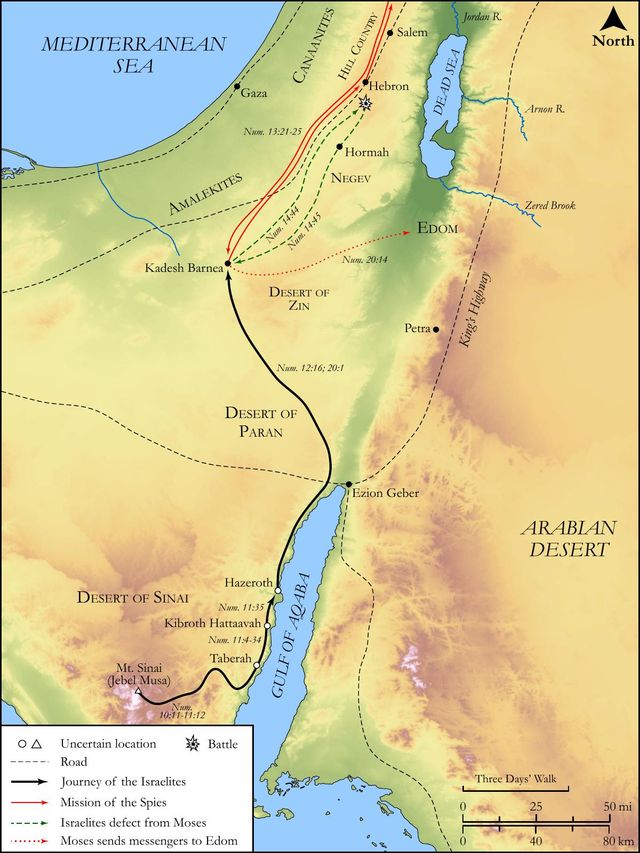
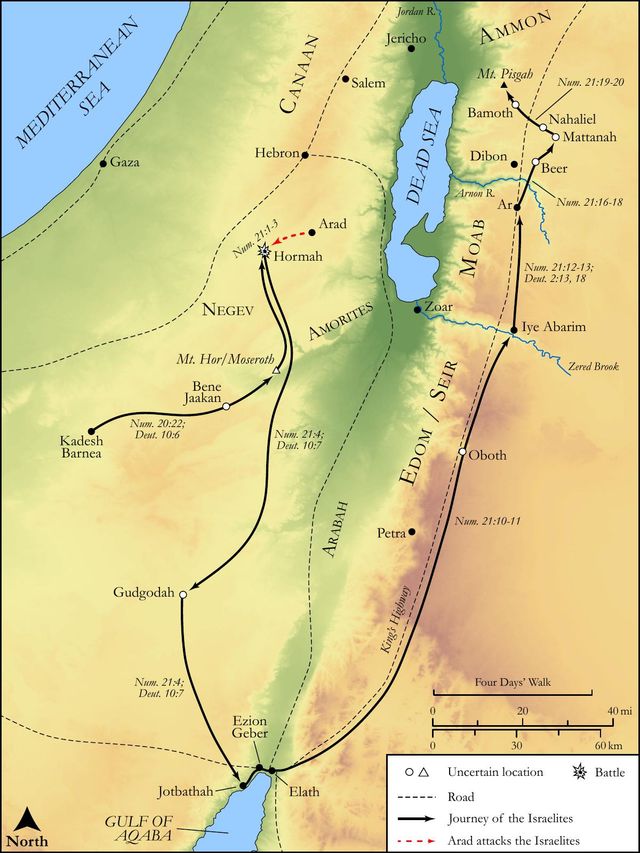
After thirty-eight years' tedious marches, or rather tedious rests, in the wilderness, backward towards the Red Sea, the armies of Israel now at length set their faces towards Canaan again, and had come not far off from the place where they were when, by the righteous sentence of divine Justice, they were made to begin their wanderings. Hitherto they had been led about as in a maze or labyrinth, while execution was doing upon the rebels that were sentenced; but they were now brought into the right way again: they abode in Kadesh (Num 20:1), not Kadesh-barnea, which was near the borders of Canaan, but another Kadesh on the confines of Edom, further off from the land of promise, yet in the way to it from the Red Sea, to which they had been hurried back. Now,
I.Here dies Miriam, the sister of Moses and Aaron, and as it should seem older than either of them.
She must have been so if she was that sister that was set to watch Moses when he was put into the ark of bulrushes, Exo 2:4. Miriam died there, Exo 2:1. She was a prophetess, and had been an instrument of much good to Israel, Mic 6:4. When Moses and Aaron with their rod went before them, to work wonders for them, Miriam with her timbrel went before them in praising God for these wondrous works (Exo 15:20), and therein did them real service; yet she had once been a murmurer (Num 12:1), and must not enter Canaan.
II.Here there is another Meribah.
one place we met with before of that name, in the beginning of their march through the wilderness, which was so called because of the chiding of the children of Israel, Exo 17:7. And now we have another place, at the latter end of their march, which bears the same name for the same reason: This is the water of Meribah, Num 20:13. What was there done was here re-acted.
1.There was no water for the congregation, Num 20:2. The water out of the rock of Rephidim had followed them while there was need of it; but it is probable that for some time they had been in a country where they were supplied in an ordinary way, and when common providence supplied them it was fit that the miracle should cease. But in this place it fell out that there was no water, or not sufficient for the congregation. Note, We live in a wanting world, and, wherever we are, must expect to meet with some inconvenience or other. It is a great mercy to have plenty of water, a mercy which if we found the want of we should own the worth of.
2.Hereupon they murmured, mutinied (Num 20:2), gathered themselves together, and took up arms against Moses and Aaron. They chid with them (Num 20:3), spoke the same absurd and brutish language that their fathers had done before them.
(1.)They wished they had died as malefactors by the hands of divine justice, rather than thus seem for a while neglected by the divine mercy: Would God that we had died when our brethren died before the Lord! Instead of giving God thanks, as they ought to have done, for sparing them, they not only despise the mercy of their reprieve, but quarrel with it, as if God had done them a great deal of wrong in giving them their lives for a prey, and snatching them as brands out of the burning. But they need not wish that they had died with their brethren, they are here taking the ready way to die like their brethren in a little while. Woe unto those that desire the day of the Lord, Amo 5:18.
(2.)They were angry that they were brought out of Egypt, and led through this wilderness, Num 20:4, Num 20:5. They quarrelled with Moses for that which they knew was the Lord's doing; they represented that as an injury which was the greatest favour that ever was done to any people. They prefer slavery before liberty, the house of bondage before the land of promise; and though, the present want was of water only, yet, now that they are disposed to find fault, it shall be looked upon as an insufferable hardship put upon them that they have not vines and figs. It was an aggravation of their crime, [1.] that they had smarted so long for the discontents and distrusts of their fathers. They had borne their whoredoms now almost forty years in the wilderness (Num 14:33); and yet they ventured in the same steps, and, as is charged upon Belshazzar, humbled not their hearts, though they knew all this, Dan 5:22. [2.] That they had had such long and constant experience of God's goodness to them, and of the tenderness and faithfulness of Moses and Aaron. [3.] That Miriam was now lately dead; and, having lost one of their leaders, they ought to have been more respectful to those that were left; but, as if they were resolved to provoke God to leave them as sheep without any shepherd, they grow outrageous against them: instead of condoling with Moses and Aaron for the death of their sister, they add affliction to their grief.
3.Moses and Aaron made them no reply, but retired to the door of the tabernacle to know God's mind in this case, Num 20:6. There they fell on their faces, as formerly on the like occasion, to deprecate the wrath of God and to entreat direction from him. Here is no mention of any thing they said; they knew that God heard the murmurings of the people, and before him they humbly prostrate themselves, making intercessions with groanings that cannot be uttered. There they lay waiting for orders Speak, Lord, for thy servants hear.
4.God appeared, to determine the matter; not on his tribunal of justice, to sentence the rebels according to their deserts; no, he will not return to destroy Ephraim (Hos 11:9), will not always chide; see Gen 8:21. But he appeared,
(1.)On his throne of glory, to silence their unjust murmuring (Num 20:6): The glory of the Lord appeared, to still the tumult of the people, by striking an awe upon them. Note, A believing sight of the glory of the Lord would be an effectual check to our lusts and passions, and would keep our mouths as with a bridle.
(2.)On his throne of grace, to satisfy their just desires. It was requisite that they should have water, and therefore, thought the manner of their petitioning for it was irregular and disorderly, yet God did not take that advantage against them to deny it to them, but gave immediate orders for their supply, Num 20:8. Moses must a second time in God's name command water out of a rock for them, to show that God is as able as ever to supply his people with good things, even in their greatest straits an in the utmost failure of second causes. Almighty power can bring water out of a rock, has done it, and can again, for his arm is not shortened. Lest it should be thought that there was something peculiar in the former rock itself, some secret spring which nature hid before in it, God here bids him broach another, and does not, as then, direct him which he must apply to, but lets him make use of which he pleased, or the first he came to; all alike to Omnipotence.
[1.]God bids him take the rod, that famous rod with which he summoned the plagues of Egypt, and divided the sea, that, having that in his hand, both he and the people might be reminded of the great things God had formerly done for them, and might be encouraged to trust in him now. This rod, it seems, was kept in the tabernacle (Num 20:9), for it was the rod of God, the rod of his strength, as the gospel is called (Psa 110:2), perhaps in allusion to it.
[2.]God bids him gather the assembly, not the elders only, but the people, to be witnesses of what was done, that by their own eyes they might be convinced and made ashamed of their unbelief. There is no fallacy in God's works of wonder, and therefore they shun not the light, nor the inspection and enquiry of many witnesses.
[3.]He bids him speak to the rock, which would do as it was bidden, to shame the people who had been so often spoken to, and would not hear nor obey. Their hearts were harder than this rock, not so tender, not so yielding, not so obedient.
[4.]He promises that the rock should give forth water (Num 20:8), and it did so (Num 20:11): The water came out abundantly. This is an instance, not only of the power of God, that he could thus fetch honey out of the rock, and oil out of the flinty rock, but of his mercy and grace, that he would do it for such a provoking people. This was a new generation (most of the old stock were by this time worn off), yet they were as bad as those that went before them; murmuring ran in the blood, yet the entail of the divine favour was not cut off, but in this instance of it the divine patience shines as brightly as the divine power. He is God and not man, in sparing and pardoning; nay, he not only here gave them the drink which they drank of in common with their beasts (Num 20:8, Num 20:11), but in it he made them to drink spiritual drink, which typified spiritual blessings, for that rock was Christ.
5.Moses and Aaron acted improperly in the management of this matter, so much so that God in displeasure told them immediately that they should not have the honour of bringing Israel into Canaan, Num 20:10-12.
(1.)This is a strange passage of story, yet very instructive.
[1.]It is certain that God was greatly offended, and justly, for he is never angry without cause. Though they were his servants, and had obtained mercy to be faithful, though they were his favourites, and such as he had highly honoured, yet for something they thought, or said, or did, upon this occasion, he put them under the disgrace and mortification of dying, as other unbelieving Israelites did, short of Canaan. And no doubt the crime deserved the punishment.
[2.]Yet it is uncertain what it was in this management that was so provoking to God. The fault was complicated. First, They did not punctually observe their orders, but in some things varied from their commission; God bade them speak to the rock, and they spoke to the people, and smote the rock, which at this time they were not ordered to do, but they thought speaking would not do. When, in distrust of the power of the word, we have recourse to the secular power in matters of pure conscience, we do, as Moses here, smite the rock to which we should only speak, Secondly, They assumed too much of the glory of this work of wonder to themselves: Must we fetch water? as if it were done by some power or worthiness of theirs. Therefore it is charged upon them (Num 20:12) that they did not sanctify God, that is, they did not give him that glory of this miracle which was due unto his name. Thirdly, Unbelief was the great transgression (Num 20:12): You believed me not; nay, it is called rebelling against God's commandment, Num 27:14. The command was to bring water out of the rock, but they rebelled against this command, by distrusting it, and doubting whether it would take effect or no. They speak doubtfully: Must we fetch water? And probably they did in some other ways discover an uncertainty in their own minds whether water would come or no for such a rebellious generation as this was. And perhaps they the rather questioned it, though God had promised it, because the glory of the Lord did not appear before them upon this rock, as it had done upon the rock in Rephidim, Exo 17:6. They would not take God's word without a sign. Dr. Lightfoot's notion of their unbelief is that they doubted whether now at last, when the forty years had expired, they should enter Canaan, and whether they must not for the murmurings of the people be condemned to another period of toil, because a new rock was now opened for their supply, which they took for an indication of their longer stay. And, if so, justly were they kept out of Canaan themselves, while the people entered at the time appointed. Fourthly, They said and did all in heat and passion; this is the account given of the sin (Psa 106:33): They provoked his spirit, so that he spoke unadvisedly with his lips. It was in his passion that he called them rebels. It is true they were so; God had called them so; and Moses afterwards, in the way of a just reproof (Deu 9:24), calls them so without offence; but now it came from a provoked spirit, and was spoken unadvisedly: it was too much like Raca, and Thou fool. His smiting the rock twice (it should seem, not waiting at all for the eruption of the water upon the first stroke) shows that he was in a heat. The same thing said and done with meekness may be justifiable which when said and done in anger may be highly culpable; see Jam 1:20. Fifthly, That which aggravated all the rest, and made it the more provoking, was that it was public, before the eyes of the children of Israel, to whom they should have been examples of faith, and hope, and meekness. We find Moses guilty of sinful distrust, Num 11:22, Num 11:23. That was private between God and him, and therefore was only checked. But his was public; it dishonoured God before Israel, as if he grudged them his favours, and discouraged the people's hope in God, and therefore this was severely punished, and the more because of the dignity and eminency of those that offended.
(2.)From the whole we may learn,
[1.]That the best of men have their failings, even in those graces that they are most eminent for. The man Moses was very meek, and yet here he sinned in passion; wherefore let him that thinks he stands take heed lest he fall.
[2.]That God judges not as man judges concerning sins; we might think that there was not much amiss in what Moses said and did, yet God saw cause to animadvert severely upon it. He knows the frame of men's spirits, what temper they are of, and what temper they are in upon particular occasions, and from what thoughts and intents words and actions do proceed; and we are sure that therefore his judgment is according to truth, when it agrees not with ours. [3.] that God not only takes notice of, and is displeased with, the sins of his people, but that the nearer any are to him the more offensive are their sins, Amo 3:2. It should seem, the Psalmist refers to this sin of Moses and Aaron (Psa 99:8): Thou wast a God that forgavest them, though thou tookest vengeance on their inventions. As many are spared in this life and punished in the other, so many are punished in this life and saved in the other. [4.] That, when our heart is hot within us, we are concerned to take heed that we offend not with our tongue. Yet, [5.] It is an evidence of the sincerity of Moses, and his impartiality in writing, that he himself left this upon record concerning himself, and drew not a veil over his own infirmity, by which it appeared that in what he wrote, as well as what he did, he sought God's glory more than his own.
Lastly, The place is hereupon called Meribah, Num 20:13. It is called Meribah-Kadesh (Deu 32:51), to distinguish it from the other Meribah. It is the water of strife; to perpetuate the remembrance of the people's sin, and Moses's, and yet of God's mercy, who supplied them with water, and owned and honoured Moses notwithstanding. Thus he was sanctified in the, as the Holy One of Israel, so he is called when his mercy rejoices against judgment, Hos 11:9. Moses and Aaron did not sanctify God as they ought in the eyes of Israel (Num 20:12), but God was sanctified in them; for he will not be a loser in his honour by any man. If he be not glorified by us, he will be glorified upon us.
Continue studying Numbers 20:5 across the web’s major study libraries — every link below opens this exact verse, chapter, or book on the destination site.
Read & Compare
 BibleGatewayThis verse in more than 200 translations and 70 languages.
 Bible.comThe YouVersion reader — hundreds of translations, reading plans, and highlights.
 ESV.orgCrossway's official English Standard Version reader.
 NET BibleThe NET translation with 60,000+ translators' notes on every rendering decision.
 STEP BibleTyndale House's free study tool — original text, vocabulary, and scholarly resources.
 BibliaLogos Bible Software's free web reader.
 USCCBThe New American Bible (Revised Edition) with the U.S. bishops' study notes.
Commentaries
 BibleHub CommentariesDozens of classic commentaries on this verse, gathered on one page.
 StudyLightMore than 100 commentary sets — the largest collection on the web.
 BibleRefPlain-English commentary on what this verse means, verse by verse.
 Enduring WordDavid Guzik's free commentary on this chapter, widely used by Bible teachers.
 Bible Study ToolsVerse commentary alongside Greek and Hebrew study aids.
Original Language & Research
- BibleHub InterlinearThe verse word by word — original language, transliteration, and English.
- BibleHub LexiconEvery word's original-language definition and Strong's entry.
 Blue Letter BibleDeep-study tools — Strong's numbers, concordance, and word studies.
 SefariaThe Hebrew text with Rashi and centuries of Jewish commentary.
Sermons, Hymns & Audio


TrulyRandomVerse is not affiliated with these sites and doesn’t control their content. They’re linked because they’re genuinely useful.
Summary
Numbers 20:5 encapsulates a pivotal moment of Israelite rebellion and profound discontent at Kadesh, where the community confronts Moses and Aaron with a vehement complaint regarding the severe lack of water and the perceived barrenness of their wilderness surroundings. This lament expresses a deep-seated ingratitude and a questioning of the very purpose of their divine deliverance from Egypt, revealing a pervasive idealization of their past bondage over the perceived hardships of God's appointed journey and a fundamental failure to trust in His faithful provision.
Context
ShowHideLiterary Context
Numbers 20:5 is strategically placed within the narrative of Israel's wilderness wanderings, marking a crucial turning point. It immediately follows the death of Miriam, Moses' sister, at Kadesh (Numbers 20:1), setting a somber tone for the ensuing events. This complaint, a familiar refrain from the Israelites, directly precedes the highly significant incident at the Waters of Meribah, where Moses, in a moment of frustration, strikes the rock instead of speaking to it as commanded, leading to God's decree that he and Aaron would not enter the Promised Land (Numbers 20:7-13). The recurring pattern of grumbling, echoing earlier episodes like those at Marah (Exodus 15:22-25) and Rephidim (Exodus 17:1-7), consistently underscores Israel's persistent unbelief and the immense strain it placed on Moses' leadership, ultimately culminating in severe consequences for both the people and their leader.
Historical & Cultural Context
The scene unfolds in the desolate Wilderness of Zin, specifically at Kadesh, which served as a significant oasis and a strategic encampment for the Israelites during their prolonged journey. Their nomadic existence in this harsh desert environment stood in stark contrast to the agriculturally rich land of Egypt, which they had left behind, and the fertile land of Canaan, which was their promised inheritance. The specific complaints about the absence of "seed, or of figs, or of vines, or of pomegranates" are not arbitrary; they directly reflect a deep yearning for the settled, agrarian life associated with abundance and security in the ancient Near East. This detailed lament highlights the profound cultural shock and physical hardship of transitioning from a sedentary, provisioned existence to a divinely-led, yet physically demanding, journey that necessitated absolute dependence on supernatural provision.
Key Themes
ShowHideThis verse powerfully encapsulates several overarching themes that permeate the wilderness narrative of the Pentateuch. It vividly illustrates the persistent grumbling and rebellion of the Israelites, demonstrating their spiritual immaturity and their consistent tendency to fixate on immediate discomforts rather than remembering God's past faithfulness and future promises. The accusatory question, "And wherefore have ye made us to come up out of Egypt," exposes a profound instance of forgetting God's deliverance and an alarming idealization of their former bondage, despite the severe oppression they endured under Pharaoh (Exodus 1:11-14). Furthermore, their despairing description of the wilderness as "this evil place" and their exaggerated list of deprivations underscore a fundamental lack of faith and trust in God's ability to provide, even as they stood on the threshold of the land described as flowing with milk and honey (Exodus 3:8). This repeated testing of God's patience ultimately led to the consequences of disobedience, as that generation was condemned to perish in the wilderness (Numbers 14:26-35).
Exposition and Analysis
ShowHideKey Word Analysis
ShowHideThe Hebrew word רַע (raʻ') here denotes something "bad," "unpleasant," "harmful," or "detrimental." In this context, it reflects the Israelites' subjective perception of the wilderness as a place of severe hardship and deprivation, devoid of the comforts and provisions they desired. It is not necessarily a moral judgment on the land itself, but rather a visceral expression of their deep dissatisfaction, suffering, and perceived lack of God's care.
The term זֶרַע (zeraʻ') refers broadly to cultivated grain or anything sown, encompassing the foundational agricultural produce necessary for a settled, self-sustaining existence. Its explicit absence in their complaint signifies the complete lack of basic food crops, emphasizing their utter reliance on the miraculous manna and God's direct, daily provision, which they found insufficient and monotonous.
The word רִמּוֹן (rimmôwn') refers to the pomegranate fruit, which in the ancient Near East was often associated with fertility, abundance, and the lushness of a prosperous land. Its specific mention here, alongside figs and vines, highlights their profound longing for the rich, diverse produce of a cultivated land, contrasting sharply with the barrenness of the desert and underscoring their despair over their current circumstances and the perceived lack of God's goodness.
Verse Breakdown
ShowHide"And wherefore have ye made us to come up out of Egypt, to bring us in unto this evil place?"
This opening clause is a direct, accusatory question, primarily leveled at Moses and Aaron, but implicitly challenging God Himself. It reveals a profound ingratitude and a complete questioning of the divine purpose behind the Exodus. The Israelites imply that their deliverance was a grave mistake, leading them to a worse fate than the slavery they endured, thereby idealizing their past bondage in Egypt.
"it [is] no place of seed, or of figs, or of vines, or of pomegranates;"
This detailed enumeration of missing agricultural staples underscores the depth of their physical discomfort and their fervent longing for a settled, fertile land. The absolute negation ("no place of...") highlights their sense of complete deprivation, emphasizing the barrenness of the wilderness from their perspective and their perceived failure of God's provision to meet their desires for variety and abundance.
"neither [is] there any water to drink."
This final, crucial complaint reveals the immediate and most pressing need that triggered their outburst. Water was an absolute necessity for survival in the arid desert, and its absence brought their accumulated frustration and fear to a boiling point. It serves as the practical catalyst for their broader theological complaint against God's leadership and the perceived inadequacy of His provision.
Literary Devices
ShowHideThe language of Numbers 20:5 employs several powerful literary devices to convey the Israelites' desperate state of mind and the narrative's theological message. Hyperbole is strikingly evident in their sweeping condemnation of the wilderness as "this evil place" and their absolute declaration that it is "no place of seed, or of figs, or of vines, or of pomegranates; neither is there any water to drink." While the desert was indeed harsh, their language exaggerates their plight, reflecting their deep despair and lack of faith rather than an objective assessment of God's miraculous daily provision of manna and occasional water. There is also a profound irony in their lament, as they complain about leaving a land of brutal slavery for a journey to freedom and a promised inheritance. Their words demonstrate a stark contrast between their idealized, albeit false, memory of Egypt's abundance and the harsh reality of the wilderness, as well as between their present suffering and the glorious future promise of Canaan. The verse also functions as a repetition of a narrative pattern, echoing numerous earlier instances of grumbling and rebellion (e.g., Exodus 17:1-7), thereby emphasizing the cyclical nature of their unbelief and the consistent testing of God's patience.
Theological and Thematic Connections
ShowHideNumbers 20:5 serves as a poignant theological commentary on the persistent human tendency towards ingratitude and unbelief in the face of adversity. It powerfully illustrates how quickly a people can forget divine deliverance and miraculous provision when immediate comforts are lacking or when circumstances become challenging. The Israelites' complaint is not merely about physical hardship; it is a profound spiritual failure, a rejection of God's wisdom in leading them through the wilderness and a questioning of His very character and faithfulness. Their desire for the "fleshpots of Egypt" over the freedom and future promised by God reveals a spiritual myopia that prioritizes immediate gratification and perceived security over long-term divine purpose, highlighting the dangers of a faith that is contingent upon favorable circumstances rather than rooted in the unwavering faithfulness of God.
Reflection and Application
ShowHideNumbers 20:5 offers a powerful and convicting mirror for contemporary believers, challenging us to examine our own responses to life's inevitable "wilderness" seasons. Just as the Israelites focused intently on what they lacked—seed, figs, vines, pomegranates, and especially water—we too can become overly preoccupied with our perceived deficiencies, whether they are material comforts, relational fulfillments, or spiritual breakthroughs. This verse serves as a sober warning against the spiritual danger of ingratitude and the pervasive temptation to idealize a past, even one of spiritual or emotional bondage, over the often-uncomfortable and refining journey of faith God has called us to. It reminds us that true spiritual maturity involves cultivating a deep trust in God's provision and purpose, even when circumstances appear barren and our immediate needs seem unmet. Our response to trials and periods of waiting reveals the true depth of our faith; do we succumb to grumbling, accusation, and despair, or do we seek God's guiding hand and cultivate a spirit of thanksgiving, knowing that He is faithfully leading us to a promised destination, perfecting His work in us along the way?
Questions for Reflection
ShowHideFAQ
ShowHideWhy did the Israelites complain so much throughout their wilderness journey?
ShowHideThe Israelites' persistent complaining stemmed from a complex interplay of factors, primarily a deep-seated lack of faith, spiritual immaturity, and a profound misunderstanding of God's character and purposes. Despite witnessing incredible miracles of deliverance from Egypt, including the parting of the Red Sea (Exodus 14:21-22), and receiving daily provision like manna (Exodus 16:1-36), they repeatedly failed to trust God's faithfulness and power. Their focus remained on their immediate physical discomforts—lack of water, limited diet, harsh conditions—rather than on the divine purpose of their journey or the character of the God who was sovereignly leading them. This pattern of grumbling also served as a means of testing God's patience and authority, often leading to divine judgment and further discipline, as seen in the consequences outlined in Numbers 14:26-35).
Was the wilderness truly "evil" as they described it in Numbers 20:5?
ShowHideFrom a purely human perspective of comfort, agricultural productivity, and easy sustenance, the wilderness was indeed a harsh, challenging, and often life-threatening environment. In that sense, the Israelites' description of it as "evil" or undesirable was a subjective reflection of their physical suffering and longing for a more hospitable land. However, from God's divine perspective, the wilderness was not "evil" but a divinely appointed place of testing, teaching, and purification. It was precisely where God humbled them, taught them absolute dependence on Him, and revealed His law and character (Deuteronomy 8:2-3). Their description reflects their subjective, faithless perception rather than God's redemptive and formative purpose for their journey.
How does this specific complaint relate to Moses' sin later in Numbers 20?
ShowHideThe people's intense and relentless grumbling in Numbers 20:5 directly precedes and significantly contributes to Moses' tragic sin of striking the rock in Numbers 20:11. The cumulative effect of decades of Israel's rebellion, unbelief, and constant pressure wore down Moses, leading him to act out of frustration and impatience. Instead of speaking to the rock as God commanded, he struck it twice, seemingly taking credit for the miracle or acting in anger that dishonored God, thereby failing to "honor Me as holy in the eyes of the Israelites" (Numbers 20:12). While Moses' sin was his own, the people's persistent sin created the immense pressure and emotional toll under which he ultimately stumbled, leading to his exclusion from the Promised Land.
Christ-Centered Fulfillment
ShowHideThe wilderness complaints of Israel, epitomized in Numbers 20:5, find their ultimate Christ-centered fulfillment in the person and redemptive work of Jesus. Israel's desperate longing for "seed, or of figs, or of vines, or of pomegranates" and their fervent cry for "water to drink" reveal humanity's deep spiritual hunger and thirst, which no earthly provision or material abundance can truly satisfy. Jesus, however, unequivocally declares Himself to be the true "bread of life" who came down from heaven, so that whoever comes to Him "shall never hunger" (John 6:35). He also offers "living water," promising that whoever drinks of it "will never be thirsty again" (John 4:10, John 7:37-38). Unlike Israel, who constantly looked back with longing to the "fleshpots of Egypt," Jesus perfectly obeyed the Father, even enduring His own wilderness temptation without complaint or wavering faith (Matthew 4:1-11), thereby reversing Israel's pattern of rebellion and establishing a new covenant of faithful obedience. He is the ultimate provision, leading His people not merely to a physical land flowing with milk and honey, but to eternal life and an abundant spiritual inheritance (John 10:10) and ultimately to the true rest that remains for the people of God (Hebrews 4:9-10). In Christ, all our deepest longings for sustenance, security, and belonging are fully met, freeing us from the grumbling spirit of those who refuse to trust in God's perfect and sovereign plan.