


Micah 6:4
Bible text: King James Version (1769 Blayney text) · Public domain
Bible text: Berean Standard Bible · Public domain
Bible text: American Standard Version (1901) · Public domain
Bible text: World English Bible, Messianic edition · Public domain
Bible text: Geneva Bible (1599) · Public domain
Bible text: Young's Literal Translation · Public domain
- כִּיkiforH3588PrtParticle Conditional
- הֶעֱלִתִיךָhe·'e·li·Ti·khaI brought up youH5927V-Hiphil-Perf-1cs ¦ 2msVerb Hiphil Perfect 1st Singular common genderהֶעֱלִתִיI brought upךָyou
- מֵאֶרֶץme·'E·retzfrom [the] land ofH776Prep-m ¦ N-fscNoun Singular Feminine Constructמֵfromאֶרֶץ[the] land of
- מִצְרַיִםmitz·Ra·yimEgyptH4714N-properNoun Proper Location
- וּמִבֵּיתu·mi·Beitand from a house ofH1004Conj-w ¦ Prep-m ¦ N-mscNoun Singular Masculine Constructוּandמִfromבֵּיתa house of
- עֲבָדִים'a·va·DimslavesH5650N-mpNoun Plural Masculine Absolute
- פְּדִיתִיךָpe·di·Ti·khaI ransomed youH6299V-Qal-Perf-1cs ¦ 2msVerb Qal Perfect 1st Singular common genderפְּדִיתִיI ransomedךָyou
- וָאֶשְׁלַחva·'esh·Lachand I sentH7971Conj-w ¦ V-Qal-ConsecImperf-1csVerb Qal Consecutive Imperfect 1st Singular common genderוָandאֶשְׁלַחI sent
- לְפָנֶיךָle·fa·Nei·kha<to> before youH6440Prep-l ¦ N-mpc ¦ 2msNoun Plural Masculine Constructלְ<to>פָנֶיbeforeךָyou
- אֶת'et<obj.>H853DirObjMParticle Object Indicator
- מֹשֶׁהmo·ShehMosesH4872N-proper-mNoun Proper Masculine
- אַהֲרֹן'a·ha·RonAaronH175N-proper-mNoun Proper Masculine
- וּמִרְיָםu·mir·Yamand MiriamH4813Conj-w ¦ N-proper-fNoun Proper FeminineוּandמִרְיָםMiriam
English is a literal word-by-word gloss of the Hebrew, not the KJV's wording. Why?
This is the original text the KJV's translators worked from — each Hebrew word with its own literal English meaning in this verse, prepared by scholars at Tyndale House, Cambridge. The KJV translates whole sentences, not word by word, so its wording differs: one Hebrew word can become several English words, and the KJV may choose “the LORD” where the gloss reads “Yahweh”. Both are faithful — they answer different questions. For the KJV's own rendering, switch to the KJV text.
Details
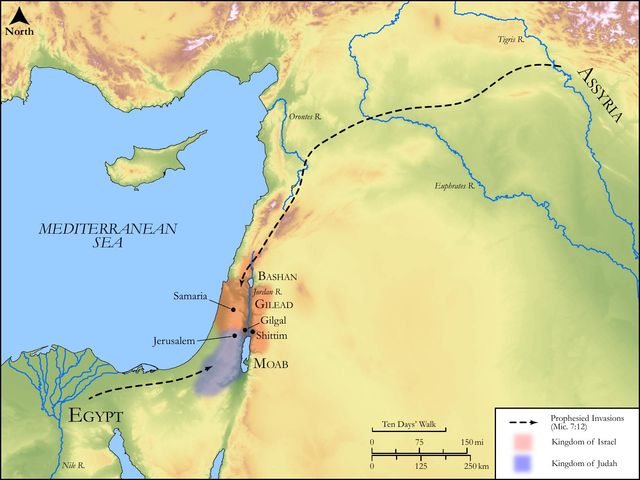
See on the biblical-era map
Study this verse
Public-domain commentary
Matthew Henry
From his Commentary on the Whole Bible. Henry comments on passages, not single verses — this entry covers Micah 6:1–5. His four-level outline is real structure in the source text, so it is rendered as structure.
Here, I. The prefaces to the message are very solemn and such as may engage our most serious attention. 1. The people are commanded to give audience: Hear you now what the Lord says. What the prophet speaks he speaks from God, and in his name; they are therefore bound to hear it, not as the word of a sinful dying man, but of the holy living God. Hear now what he saith, for, first or last, he will be heard. 2. The prophet is commanded to speak in earnest, and to put an emphasis upon what he said: Arise, contend thou before the mountains, or with the mountains, and let the hills hear thy voice, if it were possible; contend with the mountains and hills of Judea, that is, with the inhabitants of those mountains and hills; and, some think, reference is had to those mountains and hills on which they worshipped idols and which were thus polluted. But it is rather to be taken more generally, as appears by his call, not only to the mountains, but to the strong foundations of the earth, pursuant to the instructions given him. This is designed, (1.) To excite the earnestness of the prophet; he must speak as vehemently as if he designed to make even the hills and mountains hear him, must cry aloud, and not spare; what he had to say in God's name he must proclaim publicly before the mountains, as one that was neither ashamed nor afraid to own his message; he must speak as one concerned, as one that desired to speak to the heart, and therefore appeared to speak from the heart. (2.) To expose the stupidity of the people; "Let the hills hear thy voice, for this senseless careless people will not hear it, will not heed it. Let the rocks, the foundations of the earth, that have no ears, hear, since Israel, that has ears, will not hear." It is an appeal to the mountains and hills; let them bear witness that Israel has fair warning given them, and good counsel, if they would but take it. Thus Isaiah begins with, Hear, O heavens! and give ear, O earth! Let them judge between God and his vineyard.
II.The message itself is very affecting.
He is to let all the world know that God has a quarrel with his people, good ground for an action against them. Their offences are public, and therefore so are the articles of impeachment exhibited against them. Take notice the Lord has a controversy with his people and he will plead with Israel, will plead by his prophets, plead by his providences, to make good his charge. Note,
1.Sin begets a controversy between God and man. The righteous God has an action against every sinner, an action of debt, an action of trespass, an action of slander.
2.If Israel, God's own professing people, provoke him by sin, he will let them know that he has a controversy with them; he sees sin in them, and is displeased with it, nay, their sins are more displeasing to him than the sins of others, as they are a greater grief to his Spirit and dishonour to his name.
3.God will plead with those whom he has a controversy with, will plead with his people Israel, that they may be convinced and that he may be justified. In the close of the foregoing chapter he pleaded with the heathen in anger and fury, to bring them to ruin; but here he pleads with Israel in compassion and tenderness, to bring them to repentance, Come now, and let us reason together. God reasons with us, to teach us to reason with ourselves. See the equity of God's cause, it will bear to be pleaded, and sinners themselves will be forced to confess judgment, and to own that God's ways are equal, but their ways are unequal, Eze 18:25. Now,
(1.)God here challenges them to show what he had done against them which might give them occasion to desert him. They had revolted from God and rebelled against him; but had they any cause to do so? (Mic 6:3): "O my people! what have I done unto thee? Wherein have I wearied thee?" If subjects quit their allegiance to their prince, they will pretend (as the ten tribes did when they revolted from Rehoboam), that his yoke is too heavy for them; but can you pretend any such thing? What have I done to you that is unjust or unkind? Wherein have I wearied you with the impositions of service or the exactions of tribute? Have I made you to serve with an offering? Isa 43:23. What iniquity have your fathers found in me? Jer 2:5. He never deceived us, nor disappointed our expectations from him, never did us wrong, nor put disgrace upon us; why then do we wrong and dishonour him, and frustrate his expectations from us? Here is a challenge to all that ever were in God's service to testify against him if they have found him, in any thing, a hard Master, or if they have found his demands unreasonable.
(2.)Since they could not show any thing that he had done against them, he will show them a great deal that he has done for them, which should have engaged them for ever to his service, Mic 6:4, Mic 6:5. They are here directed, and we in them, to look a great way back in their reviews of the divine favour; let them remember their former days, their first days, when they were formed into a people, and the great things God did for them,
[1.]When he brought them out of Egypt, the land of their bondage, Mic 6:4. They were content with their slavery, and almost in love with their chains, for the sake of the garlic and onions they had plenty of; but God brought them up, inspired them with an ambition of liberty and animated them with a resolution by a bold effort to shake off their fetters. The Egyptians held them fast, and would not let the people go; but God redeemed them, not by price, but by force, out of the house of servants, or, rather, the house of bondage, for it is the same word that is used in the preface to the ten commandments, which insinuates that the considerations which are arguments for duty, if they be not improved by us, will be improved against us as aggravations of sin. When he brought them out of Egypt into a vast howling wilderness, as he left not himself without witness, so he left not them without guides, for he sent before them Moses, Aaron, and Miriam, three prophets (says the Chaldee paraphrase), Moses the great prophet of the Old Testament, Aaron his prophet (Exo 7:1), and Miriam a prophetess, Exo 15:20. Note, When we are calling to mind God's former mercies to us we must not forget the mercy of good teachers and governors when we were young; let those be made mention of, to the glory of God, who went before us, saying, This is the way, walk in it; it was God that sent them before us, to prepare the way of the Lord and to prepare a people for him.
[2.]When he brought them into Canaan. God no less glorified himself, and honoured them, in what he did for them when he brought them into the land of their rest than in what he did for them when he brought them out of the land of their servitude. When Moses, Aaron, and Miriam, were dead, yet they found God the same. Let them remember now what God did for them, First, In baffling and defeating the designs of Balak and Balaam against them, which he did by the power he has over the hearts and tongues of men, Mic 6:5. Let them remember what Balak the king of Moab consulted, what mischief he devised and designed to do to Israel, when they encamped in the plains of Moab; that which he consulted was to curse Israel, to divide between them and their God, and to disengage him from the protection of them. Among the heathen, when they made war upon any people, they endeavoured by magic charms or otherwise to get from them their tutelar gods, as to rob Troy of its Palladium. Macrobius has a chapter de ritu evocandi Deos - concerning the solemnity of calling out the gods. Balak would try this against Israel; but remember what Balaam the son of Beor answered him, how contrary to his own intention and inclination; instead of cursing Israel, he blessed them, to the extreme confusion and vexation of Balak. Let them remember the malice of the heathen against them, and for that reason never learn the way of the heathen, nor associate with them. Let them remember the kindness of their God to them, how he turned the curse into a blessing (because the Lord thy God loved thee, as it is, Deu 23:5), and for that reason never forsake him. Note, The disappointing of the devices of the church's enemies ought always to be remembered to the glory of the church's protector, who can make the answer of the tongue directly to contradict the preparation and consultation of the heart, Pro 16:1. Secondly, In bringing them from Shittim, their last lodgment out of Canaan, unto Gilgal, their first lodgment in Canaan. There it was, between Shittim and Gilgal, that, upon the death of Moses, Joshua, a type of Christ, was raised up to put Israel in possession of the land of promise and to fight their battles; there it was that they passed over Jordan through the divided waters, and renewed the covenant of circumcision; these mercies of God to their fathers they must now remember, that they may know the righteousness of the Lord, his righteousness (so the word is), his justice in destroying the Canaanites, his goodness in giving rest to his people Israel, and his faithfulness to his promise made unto the fathers. The remembrance of what God had done to them might convince them of all this, and engage them for ever to his service. Or they may refer to the controversy now pleaded between God and Israel; let them remember God's many favours to them and their fathers, and compare with them their unworthy ungrateful conduct towards him, that they may know the righteousness of the Lord in contending with them, and it may appear that in this controversy he has right on his side; his ways are equal, for he will be justified when he speaks, and clear when he judges.
Historical interpretation
Historical reception
1 surviving comment on this verse from the historical church.
(Verse 3 onwards) O my people, what have I done to you, and how have I wearied you? Answer me! For I brought you up from the land of Egypt, and redeemed you from the house of slavery; and I sent before you Moses, Aaron, and Miriam. O my people, remember, I pray, what Balak king of Moab devised, and what Balaam the son of Beor answered him, from Shittim to Gilgal, that you may know the saving acts of the Lord. LXX: My people, what have I done to you, or how have I troubled you? Answer me: for I brought you out of the land of Egypt, and redeemed you from the house of bondage, and sent before you Moses, and Aaron, and Miriam. My people, remember what Balak, king of Moab, devised against you, and what Balaam, the son of Beor, answered him from Seir unto Gilgal; that the righteousness of the Lord might be known. Symmachus interpreted 'justitiis' or 'justitia' as 'misericordias', and where LXX Shanis; all translated it as Settim. It is the place where Balak, the king of the Moabites, gathered an army against Israel, like the trees that still grow through the desert of Mount Sinai. For in the LXX, whether it be the Ark of the Covenant, or the altar and tabernacle, and other things made of imperishable wood, they are called Settim in Hebrew, which resemble a tree that we commonly call the White Thorn. Therefore, I believe that both LXX σχίνον and σχοῖνοι have been interpreted as lentisk; but gradually, due to a mistake made by copyists, σχοῖνοι, meaning ropes, were read instead of σχίνοις, meaning lentisks. Therefore, God speaks to the people of Israel and challenges them to a judgment, granting them permission to argue against Him. My people, what have I done to you that I should not have done? Or how have I wearied you? Although this is not found in Hebrew. But the father is saddened by his son being flogged, and he visits the sins of the sheep with the shepherd's rod. How have I been troublesome to you? Or, as it is more significantly written in Hebrew, how have I burdened you with my labor? Will you interpret my favors as an insult, and while desiring Egyptian melons and meats, will you grieve being brought out of the land of Egypt, and being freed from the house of slavery with my help, because I have given you Moses as your leader, my friend, and Aaron as your priest, and Miriam as your prophetess? But if this seems insignificant to you, remember that at that time, when Balak, the king of Moab, hired Balaam, a diviner, to curse you and how, against his own will, Balaam, desiring to curse you, blessed you instead (Numbers 22): from Shittim to Gilgal, surveying the entire army of Israel with his eyes and changing places, as if I could not continue going with you and passing over with you. And I did this so that my mercy and justice would be known to you, who love you so much, that even though I curse the blasphemers every day with my mouth, I have not allowed myself to curse you as an enemy. The Hebrews interpret this passage, where it is said, 'from Sethim to Galgal, that you may know the justices of the Lord' (Numbers 25), in this way: from the time you committed fornication in Madian, until the time when Saul was anointed king in Galgal (1 Samuel 10), recall the memory of the evils you have done, and how much good I have done for you, and you will know my mercy towards you. This is how God spoke to carnal Israel according to history. But we, who desire to contemplate the glory of the Lord with an unveiled face, truly have the father Abraham, let us hear when we have sinned against disputing God, and let us be accused by the magnitude of his benefits. For we have served Pharaoh and the Egyptian people, and we have made mud and bricks. And he redeemed us who gave himself as redemption for all, so that we may declare those who were redeemed by the Lord, whom he redeemed from the hand of enemies, and whom he gathered from the regions, for his mercy endures forever. He also sent before our face Moses, the spiritual law, and Aaron, the great high priest, not having a typological Ephod, but carrying the truth, and having on his forehead the seal of holiness that God the Father has signed. And he sent Mary, the prophetess, and she not only accomplished this for us, but also delivered us from the hands of our enemies. For let us remember what he had intended against us, who wanted to devour and to ridicule our congregation, the true devil Balak. For Balak signifies 'the emptying out,' that is, 'depriver,' the king of the paternal water: indeed, according to another etymology, Moab is said to mean paternal water. Therefore, when Balak plotted against us, and he plotted against us through his empty people, which is interpreted as Balaam, God did not allow us to fall under his curses; but on the contrary, He blessed us, compelled by the truth of the matter, the empty people of the nations, born of the one who is in the skin: for Beor signifies 'in the skin,' always devoted to flesh and works of death. And the empty people responded for us, sprung from the one who is entirely in the skin, always changing places, or standing upon thorns, or upon ropes, so that we may also follow the error of the Vulgate edition. But according to the saying of the Savior, the cares of this world, and riches, and pleasures are in which the people are vain. (Matthew 13, Mark 5). But what stands in the ropes, namely in the chains of sins (for each one is bound by the ropes of their own sins (Proverbs 5)), and Isaiah is a witness, saying: Woe to those who draw out their sins like a long rope, and like the strap of a young heifer, their iniquities (Isaiah 5, 18). Therefore, if it stands, it only stands among thorns and ropes; if, however, it wishes to walk around, it does not have a stable step, but is always wavering and unstable, and it reaches even to Gilgal, which means rolling, that is, volatility or instability. If ever we see some rise up against us, and they thirst for our blood with eager jaws, and by the unexpected providence of God, they become for us, who they came against, let us say, 'Balaam came from ropes to Gilgal,' so that the justice of God may be known.
Continue studying Micah 6:4 across the web’s major study libraries — every link below opens this exact verse, chapter, or book on the destination site.
Read & Compare
 BibleGatewayThis verse in more than 200 translations and 70 languages.
 Bible.comThe YouVersion reader — hundreds of translations, reading plans, and highlights.
 ESV.orgCrossway's official English Standard Version reader.
 NET BibleThe NET translation with 60,000+ translators' notes on every rendering decision.
 STEP BibleTyndale House's free study tool — original text, vocabulary, and scholarly resources.
 BibliaLogos Bible Software's free web reader.
 USCCBThe New American Bible (Revised Edition) with the U.S. bishops' study notes.
Commentaries
 BibleHub CommentariesDozens of classic commentaries on this verse, gathered on one page.
 StudyLightMore than 100 commentary sets — the largest collection on the web.
 BibleRefPlain-English commentary on what this verse means, verse by verse.
 Enduring WordDavid Guzik's free commentary on this chapter, widely used by Bible teachers.
 Bible Study ToolsVerse commentary alongside Greek and Hebrew study aids.
Original Language & Research
- BibleHub InterlinearThe verse word by word — original language, transliteration, and English.
- BibleHub LexiconEvery word's original-language definition and Strong's entry.
 Blue Letter BibleDeep-study tools — Strong's numbers, concordance, and word studies.
 SefariaThe Hebrew text with Rashi and centuries of Jewish commentary.
Sermons, Hymns & Audio


TrulyRandomVerse is not affiliated with these sites and doesn’t control their content. They’re linked because they’re genuinely useful.
Summary
Micah 6:4 serves as a foundational declaration within God's "lawsuit" against Israel, reminding His people of His steadfast faithfulness and mighty acts of deliverance in their history. This verse highlights the pivotal Exodus event, where God liberated Israel from Egyptian bondage, and His gracious provision of key leaders—Moses, Aaron, and Miriam—to guide them. It sets the stage for God's rhetorical challenge to Israel, contrasting His unwavering benevolence with their subsequent unfaithfulness, thereby underscoring the depth of their covenantal obligation and the gravity of their rebellion.
Context
ShowHideLiterary Context
Micah 6 opens with a dramatic legal summons, where God calls the mountains and hills to bear witness as He presents His case against Israel (Micah 6:1-2). Before detailing their transgressions, God first appeals to their memory and conscience, asking, "O my people, what have I done unto thee? and wherein have I wearied thee? answer me" (Micah 6:3). Micah 6:4 directly answers this rhetorical question, providing the irrefutable evidence of God's profound goodness and past redemptive acts. This verse, along with Micah 6:5, forms the basis of God's argument, setting His historical benevolence in stark contrast to Israel's current spiritual and moral decay, thereby intensifying the indictment that follows in Micah 6:9-16.
Historical & Cultural Context
The prophet Micah ministered during the reigns of Judah's kings Jotham, Ahaz, and Hezekiah, a period marked by significant spiritual decline, oppression, and political instability in both the northern kingdom of Israel and the southern kingdom of Judah. The people had largely abandoned the Mosaic covenant, engaging in idolatry, oppressing the poor, and corrupting their judicial and religious systems. In this context, God's reminder of the Exodus—the defining event of Israel's national identity and the cornerstone of their covenant relationship with Yahweh—was a potent appeal. The "house of servants" (Egypt) was a vivid, collective memory for the Israelites, representing the profound oppression from which God had miraculously delivered them, establishing His unique claim over them as their Redeemer and King.
Key Themes
ShowHideThis verse powerfully encapsulates several overarching themes central to Micah's prophecy and the broader Old Testament narrative. Firstly, it highlights Divine Deliverance and Redemption, portraying God as the active, powerful agent who frees His people from bondage, a theme foundational to Israel's identity and their understanding of Yahweh's character. The liberation from the land of Egypt is presented as the quintessential act of God's redemptive love. Secondly, the verse underscores God's Unwavering Faithfulness to His Covenant, demonstrating that even when Israel was enslaved and helpless, God initiated their rescue, fulfilling His promises to their forefathers. This divine constancy contrasts sharply with Israel's fickle obedience. Lastly, it emphasizes God's Gracious Provision of Leadership, showcasing His care for His people by sending figures like Moses, Aaron, and Miriam to guide, teach, and intercede for them, ensuring their journey was not without divine direction.
Exposition and Analysis
ShowHideKey Word Analysis
ShowHideThis primitive root signifies "to ascend, intransitively (be high) or actively (mount)." In this context, it denotes God's active, powerful elevation of Israel out of their lowly state of slavery. It's not merely a passive release, but a deliberate, upward movement, emphasizing God's sovereign initiative in their rescue and the raising of a nation from servitude to covenant relationship.
This root means "to sever, i.e., ransom; generally to release, preserve." It implies a deliberate act of liberation, often involving a cost or a powerful intervention to free someone from bondage or danger. Here, it highlights God's specific, costly act of purchasing Israel's freedom from the "house of servants," underscoring the depth of His commitment and the nature of His salvific work.
This noun refers to "a servant," often implying a state of "bondage" or "bondman." When used in the phrase "house of servants," it vividly describes the condition of total subjugation and forced labor that Israel endured in Egypt. It emphasizes the complete lack of freedom and agency from which God's powerful hand delivered them, making the redemption all the more profound.
Verse Breakdown
ShowHide"For I brought thee up out of the land of Egypt"
This clause immediately grounds God's argument in the most significant historical event for Israel: the Exodus. It asserts God's direct, personal agency ("I brought thee up") in their liberation from the oppressive power of Egypt, establishing His foundational role as their deliverer and the one who initiated their national existence.
"and redeemed thee out of the house of servants"
This parallel clause reinforces the first, using the strong theological term "redeemed" to describe the nature of their deliverance. The "house of servants" is a powerful, idiomatic expression for the totality of their bondage in Egypt, emphasizing that their freedom was not accidental or earned, but a deliberate, costly act of divine intervention to purchase them out of utter servitude.
"and I sent before thee Moses, Aaron, and Miriam"
This final clause extends God's benevolent acts beyond mere liberation, highlighting His ongoing provision and guidance. By "sending" these key leaders, God demonstrated His commitment to shepherd His newly freed people, providing prophetic, priestly, and administrative leadership essential for their journey through the wilderness and their formation as a nation under His covenant.
Literary Devices
ShowHideMicah 6:4 employs several potent literary devices. The most prominent is Historical Allusion, specifically to the Exodus narrative, which is the bedrock of Israel's identity and covenant relationship with God. By invoking this foundational event, God appeals to a collective memory that should evoke gratitude and loyalty, making His subsequent challenge to their unfaithfulness all the more poignant. The phrase "house of servants" functions as a powerful Metonymy or Synecdoche, where "house" stands for the entire oppressive rule and "servants" for the state of complete bondage, vividly representing the totality of Israel's servitude in Egypt. Furthermore, the direct, first-person address "For I brought thee up... and redeemed thee... and I sent" uses Anaphora (repetition of "I" in the Hebrew, though implied in English) and Personification of God as a speaking, acting agent, emphasizing His personal involvement and unwavering commitment to His people, setting a stark contrast to their impersonal and distant relationship with Him.
Theological and Thematic Connections
ShowHideMicah 6:4 profoundly illustrates God's covenantal faithfulness and His character as a Redeemer. It reminds Israel, and us, that God's relationship with His people is rooted in His initiating grace and powerful deliverance, not in their merit. This historical act of liberation from Egypt serves as the paradigm for all subsequent divine interventions, establishing God's right to demand obedience and justice from His people. The provision of leaders like Moses, Aaron, and Miriam further underscores God's comprehensive care, demonstrating that His redemption is not just about freeing from bondage, but also about guiding into a new way of life in covenant with Him. This verse sets the stage for the profound ethical demands of Micah 6:8, where living justly, loving mercy, and walking humbly with God are presented as the appropriate response to such immense grace.
Reflection and Application
ShowHideMicah 6:4 serves as a timeless call to remember and reflect upon God's past faithfulness in our own lives and in the grand narrative of salvation. Just as God challenged Israel to recall His mighty acts of deliverance and provision, we too are invited to pause and consider the ways in which God has "brought us up" out of various forms of bondage—whether spiritual, emotional, or circumstantial—and "redeemed" us from the "house of servants" that might enslave us. This verse cultivates a spirit of profound gratitude, reminding us that our freedom and blessings are not self-achieved but are the result of God's initiating grace and powerful intervention. It builds trust, assuring us that the God who acted so powerfully in the past remains faithful and capable in the present and future. Ultimately, remembering God's past goodness should motivate a renewed commitment to live in grateful obedience, inspiring us to walk justly, love mercy, and walk humbly with our God, as He desires.
Questions for Reflection
ShowHideFAQ
ShowHideWhy does God remind Israel of the Exodus in this context?
ShowHideGod reminds Israel of the Exodus in Micah 6:4 to establish the foundation of His covenant relationship with them and to underscore the depth of His benevolence before confronting their unfaithfulness. The Exodus was the defining moment of Israel's national birth and their liberation from slavery, demonstrating God's unique power and His unwavering commitment to His promises. By recalling this act of immense grace, God highlights the stark contrast between His steadfast love and Israel's spiritual rebellion, making His subsequent indictment all the more weighty and their lack of gratitude all the more grievous. It's an appeal to their memory, conscience, and covenant obligation.
Who were Moses, Aaron, and Miriam, and why are they mentioned together?
ShowHideMoses, Aaron, and Miriam were pivotal leaders whom God "sent before" Israel during their journey from Egypt to the Promised Land. Moses was the great lawgiver and prophet, chosen by God to lead Israel out of bondage and deliver the Ten Commandments and the Torah. Aaron was Moses' brother and the first high priest, establishing the Levitical priesthood and mediating between God and the people. Miriam was a prophetess, a leader among the women, and played a significant role in the Exodus, notably leading the women in song after the Red Sea crossing. They are mentioned together in Micah 6:4 as a trio representing the comprehensive leadership God provided—prophetic, priestly, and spiritual—to guide, instruct, and care for His people during their formative years in the wilderness.
Christ-Centered Fulfillment
ShowHideMicah 6:4, while rooted in Israel's historical Exodus, finds its ultimate and profound Christ-centered fulfillment in the person and work of Jesus Christ. Just as God "brought up" Israel from the "land of Egypt" and "redeemed" them from the "house of servants," so too does Christ execute a far greater spiritual Exodus for all humanity. He delivers us not from physical slavery to an earthly empire, but from the spiritual bondage of sin and death, which is the true "house of servants" that holds all people captive (Romans 6:16-18). Jesus is the ultimate Passover Lamb, whose shed blood secures our redemption, a costly act of liberation far surpassing the redemption from Egypt (1 Peter 1:18-19). Furthermore, while God sent Moses, Aaron, and Miriam to guide Israel, Jesus Himself is the supreme Prophet, Priest, and King, embodying all leadership roles. He is the greater Moses, who delivers the new covenant law written on hearts (Jeremiah 31:31-34); the perfect High Priest who intercedes for us eternally; and the ultimate King who shepherds His people into the true promised land of His eternal kingdom (John 10:11). Thus, Micah 6:4 points forward to the comprehensive, eternal redemption and perfect leadership found in Christ alone.