


Micah 6:3
Bible text: King James Version (1769 Blayney text) · Public domain
Bible text: Berean Standard Bible · Public domain
Bible text: American Standard Version (1901) · Public domain
Bible text: World English Bible, Messianic edition · Public domain
Bible text: Geneva Bible (1599) · Public domain
Bible text: Young's Literal Translation · Public domain
- עַמִּי'a·Mimy O peopleH5971N-msc ¦ 1csNoun Singular Masculine ConstructעַמִּO peopleיmy
- מֶהmehwhat?H4100InterrogPronoun Interrogative
- עָשִׂיתִי'a·Si·tihave I doneH6213V-Qal-Perf-1csVerb Qal Perfect 1st Singular common gender
- לְךָle·Khato youPrep-l ¦ 2msSuffix Personal 2nd Singular Masculineלְtoךָyou
- וּמָהu·Mahand what?H4100Conj-w ¦ InterrogPronoun Interrogativeוּandמָהwhat?
- הֶלְאֵתִיךָhel·'e·Ti·khahave I made weary youH3811V-Hiphil-Perf-1cs ¦ 2msVerb Hiphil Perfect 1st Singular common genderהֶלְאֵתִיhave I made wearyךָyou
- עֲנֵה'a·NehtestifyH6030V-Qal-Imp-2msVerb Qal Imperative 2nd Singular Masculine
- בִיViagainst mePrep-b ¦ 1csSuffix Personal 1st Singular common genderבִagainstיme
English is a literal word-by-word gloss of the Hebrew, not the KJV's wording. Why?
This is the original text the KJV's translators worked from — each Hebrew word with its own literal English meaning in this verse, prepared by scholars at Tyndale House, Cambridge. The KJV translates whole sentences, not word by word, so its wording differs: one Hebrew word can become several English words, and the KJV may choose “the LORD” where the gloss reads “Yahweh”. Both are faithful — they answer different questions. For the KJV's own rendering, switch to the KJV text.
Details
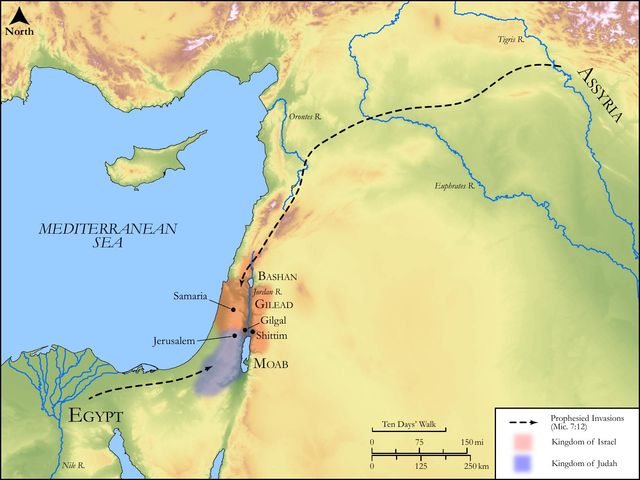
See on the biblical-era map
Study this verse
Public-domain commentary
Matthew Henry
From his Commentary on the Whole Bible. Henry comments on passages, not single verses — this entry covers Micah 6:1–5. His four-level outline is real structure in the source text, so it is rendered as structure.
Here, I. The prefaces to the message are very solemn and such as may engage our most serious attention. 1. The people are commanded to give audience: Hear you now what the Lord says. What the prophet speaks he speaks from God, and in his name; they are therefore bound to hear it, not as the word of a sinful dying man, but of the holy living God. Hear now what he saith, for, first or last, he will be heard. 2. The prophet is commanded to speak in earnest, and to put an emphasis upon what he said: Arise, contend thou before the mountains, or with the mountains, and let the hills hear thy voice, if it were possible; contend with the mountains and hills of Judea, that is, with the inhabitants of those mountains and hills; and, some think, reference is had to those mountains and hills on which they worshipped idols and which were thus polluted. But it is rather to be taken more generally, as appears by his call, not only to the mountains, but to the strong foundations of the earth, pursuant to the instructions given him. This is designed, (1.) To excite the earnestness of the prophet; he must speak as vehemently as if he designed to make even the hills and mountains hear him, must cry aloud, and not spare; what he had to say in God's name he must proclaim publicly before the mountains, as one that was neither ashamed nor afraid to own his message; he must speak as one concerned, as one that desired to speak to the heart, and therefore appeared to speak from the heart. (2.) To expose the stupidity of the people; "Let the hills hear thy voice, for this senseless careless people will not hear it, will not heed it. Let the rocks, the foundations of the earth, that have no ears, hear, since Israel, that has ears, will not hear." It is an appeal to the mountains and hills; let them bear witness that Israel has fair warning given them, and good counsel, if they would but take it. Thus Isaiah begins with, Hear, O heavens! and give ear, O earth! Let them judge between God and his vineyard.
II.The message itself is very affecting.
He is to let all the world know that God has a quarrel with his people, good ground for an action against them. Their offences are public, and therefore so are the articles of impeachment exhibited against them. Take notice the Lord has a controversy with his people and he will plead with Israel, will plead by his prophets, plead by his providences, to make good his charge. Note,
1.Sin begets a controversy between God and man. The righteous God has an action against every sinner, an action of debt, an action of trespass, an action of slander.
2.If Israel, God's own professing people, provoke him by sin, he will let them know that he has a controversy with them; he sees sin in them, and is displeased with it, nay, their sins are more displeasing to him than the sins of others, as they are a greater grief to his Spirit and dishonour to his name.
3.God will plead with those whom he has a controversy with, will plead with his people Israel, that they may be convinced and that he may be justified. In the close of the foregoing chapter he pleaded with the heathen in anger and fury, to bring them to ruin; but here he pleads with Israel in compassion and tenderness, to bring them to repentance, Come now, and let us reason together. God reasons with us, to teach us to reason with ourselves. See the equity of God's cause, it will bear to be pleaded, and sinners themselves will be forced to confess judgment, and to own that God's ways are equal, but their ways are unequal, Eze 18:25. Now,
(1.)God here challenges them to show what he had done against them which might give them occasion to desert him. They had revolted from God and rebelled against him; but had they any cause to do so? (Mic 6:3): "O my people! what have I done unto thee? Wherein have I wearied thee?" If subjects quit their allegiance to their prince, they will pretend (as the ten tribes did when they revolted from Rehoboam), that his yoke is too heavy for them; but can you pretend any such thing? What have I done to you that is unjust or unkind? Wherein have I wearied you with the impositions of service or the exactions of tribute? Have I made you to serve with an offering? Isa 43:23. What iniquity have your fathers found in me? Jer 2:5. He never deceived us, nor disappointed our expectations from him, never did us wrong, nor put disgrace upon us; why then do we wrong and dishonour him, and frustrate his expectations from us? Here is a challenge to all that ever were in God's service to testify against him if they have found him, in any thing, a hard Master, or if they have found his demands unreasonable.
(2.)Since they could not show any thing that he had done against them, he will show them a great deal that he has done for them, which should have engaged them for ever to his service, Mic 6:4, Mic 6:5. They are here directed, and we in them, to look a great way back in their reviews of the divine favour; let them remember their former days, their first days, when they were formed into a people, and the great things God did for them,
[1.]When he brought them out of Egypt, the land of their bondage, Mic 6:4. They were content with their slavery, and almost in love with their chains, for the sake of the garlic and onions they had plenty of; but God brought them up, inspired them with an ambition of liberty and animated them with a resolution by a bold effort to shake off their fetters. The Egyptians held them fast, and would not let the people go; but God redeemed them, not by price, but by force, out of the house of servants, or, rather, the house of bondage, for it is the same word that is used in the preface to the ten commandments, which insinuates that the considerations which are arguments for duty, if they be not improved by us, will be improved against us as aggravations of sin. When he brought them out of Egypt into a vast howling wilderness, as he left not himself without witness, so he left not them without guides, for he sent before them Moses, Aaron, and Miriam, three prophets (says the Chaldee paraphrase), Moses the great prophet of the Old Testament, Aaron his prophet (Exo 7:1), and Miriam a prophetess, Exo 15:20. Note, When we are calling to mind God's former mercies to us we must not forget the mercy of good teachers and governors when we were young; let those be made mention of, to the glory of God, who went before us, saying, This is the way, walk in it; it was God that sent them before us, to prepare the way of the Lord and to prepare a people for him.
[2.]When he brought them into Canaan. God no less glorified himself, and honoured them, in what he did for them when he brought them into the land of their rest than in what he did for them when he brought them out of the land of their servitude. When Moses, Aaron, and Miriam, were dead, yet they found God the same. Let them remember now what God did for them, First, In baffling and defeating the designs of Balak and Balaam against them, which he did by the power he has over the hearts and tongues of men, Mic 6:5. Let them remember what Balak the king of Moab consulted, what mischief he devised and designed to do to Israel, when they encamped in the plains of Moab; that which he consulted was to curse Israel, to divide between them and their God, and to disengage him from the protection of them. Among the heathen, when they made war upon any people, they endeavoured by magic charms or otherwise to get from them their tutelar gods, as to rob Troy of its Palladium. Macrobius has a chapter de ritu evocandi Deos - concerning the solemnity of calling out the gods. Balak would try this against Israel; but remember what Balaam the son of Beor answered him, how contrary to his own intention and inclination; instead of cursing Israel, he blessed them, to the extreme confusion and vexation of Balak. Let them remember the malice of the heathen against them, and for that reason never learn the way of the heathen, nor associate with them. Let them remember the kindness of their God to them, how he turned the curse into a blessing (because the Lord thy God loved thee, as it is, Deu 23:5), and for that reason never forsake him. Note, The disappointing of the devices of the church's enemies ought always to be remembered to the glory of the church's protector, who can make the answer of the tongue directly to contradict the preparation and consultation of the heart, Pro 16:1. Secondly, In bringing them from Shittim, their last lodgment out of Canaan, unto Gilgal, their first lodgment in Canaan. There it was, between Shittim and Gilgal, that, upon the death of Moses, Joshua, a type of Christ, was raised up to put Israel in possession of the land of promise and to fight their battles; there it was that they passed over Jordan through the divided waters, and renewed the covenant of circumcision; these mercies of God to their fathers they must now remember, that they may know the righteousness of the Lord, his righteousness (so the word is), his justice in destroying the Canaanites, his goodness in giving rest to his people Israel, and his faithfulness to his promise made unto the fathers. The remembrance of what God had done to them might convince them of all this, and engage them for ever to his service. Or they may refer to the controversy now pleaded between God and Israel; let them remember God's many favours to them and their fathers, and compare with them their unworthy ungrateful conduct towards him, that they may know the righteousness of the Lord in contending with them, and it may appear that in this controversy he has right on his side; his ways are equal, for he will be justified when he speaks, and clear when he judges.
Historical interpretation
Two Centuries of Reception
4 surviving comments on this verse. Each one is dated, so this reads as a timeline rather than a list.
Select a marker to jump to its quote. Markers stagger vertically where authors wrote within a few decades of each other.
Would you like me to utter to you the words of God to Israel, stiff-necked and hardened? “O my people, what have I done to you, or in what way have I injured you, or wherein have I wearied you?” This language indeed is more fit from me to you who insult me. It is a sad thing that we watch for opportunities against each other and having destroyed our fellowship of spirit by diversities of opinion have become almost more inhuman and savage to one another than even the barbarians who are now engaged in war against us, banded together against us by the Trinity whom we have separated. We are not foreigners making forays and raids upon foreigners or nations of a different language, which is some little consolation in the calamity. But we are making war upon one another, and almost upon those of the same household. Or if you will, we the members of the same body are consuming and being consumed by one another. Nor is this, bad as it is, the extent of our calamity, for we even regard our diminution as a gain. But since we are in such a condition and regulate our faith by the times, let us compare the times with one another; you your emperor, and I my sovereigns; you Ahab and I Josiah.
The third interruption of the Prophet is that, as he is stationed among people who exercise wickedness, he desires to be separated from their contamination. Many think that this refers to the Lord Jesus, because it is His alone not to fear judgment, since He conquers when He is judged. For He has a judgment from an unjust man, into which Christ willingly enters, as you have written: My people, what have I done to you, or in what have I saddened you? Moreover, when the father gives all judgment to him, not as if to an infirm person, but as if to a son, because he himself can undergo judgment? If they think that the judgment of the Father must be undergone by the Son, then the Father surely does not judge anyone, but he has given all judgment to the son; so that everyone may honor the son just as they honor the father. The father honors the son, and do you judge? We have said this so that no one would consider us as placing the person of the Prophet in the place of the Lord due to fear of questioning, when the holy David, foreseeing by the spirit that the Jews would rise up against the passion of the Lord, does not fear the judgment of his faith: he even demands that his cause be distinguished from the nation of persecutors; so that he would not be entangled with the descendants of his wicked generation and the heirs of his posterity, the lineage of the whole Jewish race.
(Verse 3 onwards) O my people, what have I done to you, and how have I wearied you? Answer me! For I brought you up from the land of Egypt, and redeemed you from the house of slavery; and I sent before you Moses, Aaron, and Miriam. O my people, remember, I pray, what Balak king of Moab devised, and what Balaam the son of Beor answered him, from Shittim to Gilgal, that you may know the saving acts of the Lord. LXX: My people, what have I done to you, or how have I troubled you? Answer me: for I brought you out of the land of Egypt, and redeemed you from the house of bondage, and sent before you Moses, and Aaron, and Miriam. My people, remember what Balak, king of Moab, devised against you, and what Balaam, the son of Beor, answered him from Seir unto Gilgal; that the righteousness of the Lord might be known. Symmachus interpreted 'justitiis' or 'justitia' as 'misericordias', and where LXX Shanis; all translated it as Settim. It is the place where Balak, the king of the Moabites, gathered an army against Israel, like the trees that still grow through the desert of Mount Sinai. For in the LXX, whether it be the Ark of the Covenant, or the altar and tabernacle, and other things made of imperishable wood, they are called Settim in Hebrew, which resemble a tree that we commonly call the White Thorn. Therefore, I believe that both LXX σχίνον and σχοῖνοι have been interpreted as lentisk; but gradually, due to a mistake made by copyists, σχοῖνοι, meaning ropes, were read instead of σχίνοις, meaning lentisks. Therefore, God speaks to the people of Israel and challenges them to a judgment, granting them permission to argue against Him. My people, what have I done to you that I should not have done? Or how have I wearied you? Although this is not found in Hebrew. But the father is saddened by his son being flogged, and he visits the sins of the sheep with the shepherd's rod. How have I been troublesome to you? Or, as it is more significantly written in Hebrew, how have I burdened you with my labor? Will you interpret my favors as an insult, and while desiring Egyptian melons and meats, will you grieve being brought out of the land of Egypt, and being freed from the house of slavery with my help, because I have given you Moses as your leader, my friend, and Aaron as your priest, and Miriam as your prophetess? But if this seems insignificant to you, remember that at that time, when Balak, the king of Moab, hired Balaam, a diviner, to curse you and how, against his own will, Balaam, desiring to curse you, blessed you instead (Numbers 22): from Shittim to Gilgal, surveying the entire army of Israel with his eyes and changing places, as if I could not continue going with you and passing over with you. And I did this so that my mercy and justice would be known to you, who love you so much, that even though I curse the blasphemers every day with my mouth, I have not allowed myself to curse you as an enemy. The Hebrews interpret this passage, where it is said, 'from Sethim to Galgal, that you may know the justices of the Lord' (Numbers 25), in this way: from the time you committed fornication in Madian, until the time when Saul was anointed king in Galgal (1 Samuel 10), recall the memory of the evils you have done, and how much good I have done for you, and you will know my mercy towards you. This is how God spoke to carnal Israel according to history. But we, who desire to contemplate the glory of the Lord with an unveiled face, truly have the father Abraham, let us hear when we have sinned against disputing God, and let us be accused by the magnitude of his benefits. For we have served Pharaoh and the Egyptian people, and we have made mud and bricks. And he redeemed us who gave himself as redemption for all, so that we may declare those who were redeemed by the Lord, whom he redeemed from the hand of enemies, and whom he gathered from the regions, for his mercy endures forever. He also sent before our face Moses, the spiritual law, and Aaron, the great high priest, not having a typological Ephod, but carrying the truth, and having on his forehead the seal of holiness that God the Father has signed. And he sent Mary, the prophetess, and she not only accomplished this for us, but also delivered us from the hands of our enemies. For let us remember what he had intended against us, who wanted to devour and to ridicule our congregation, the true devil Balak. For Balak signifies 'the emptying out,' that is, 'depriver,' the king of the paternal water: indeed, according to another etymology, Moab is said to mean paternal water. Therefore, when Balak plotted against us, and he plotted against us through his empty people, which is interpreted as Balaam, God did not allow us to fall under his curses; but on the contrary, He blessed us, compelled by the truth of the matter, the empty people of the nations, born of the one who is in the skin: for Beor signifies 'in the skin,' always devoted to flesh and works of death. And the empty people responded for us, sprung from the one who is entirely in the skin, always changing places, or standing upon thorns, or upon ropes, so that we may also follow the error of the Vulgate edition. But according to the saying of the Savior, the cares of this world, and riches, and pleasures are in which the people are vain. (Matthew 13, Mark 5). But what stands in the ropes, namely in the chains of sins (for each one is bound by the ropes of their own sins (Proverbs 5)), and Isaiah is a witness, saying: Woe to those who draw out their sins like a long rope, and like the strap of a young heifer, their iniquities (Isaiah 5, 18). Therefore, if it stands, it only stands among thorns and ropes; if, however, it wishes to walk around, it does not have a stable step, but is always wavering and unstable, and it reaches even to Gilgal, which means rolling, that is, volatility or instability. If ever we see some rise up against us, and they thirst for our blood with eager jaws, and by the unexpected providence of God, they become for us, who they came against, let us say, 'Balaam came from ropes to Gilgal,' so that the justice of God may be known.
“For the Lord will judge his people, and he will [give] comfort among his servants.” The reason for the previous praise is stated: “For the Lord will judge his people,” that is, the Jewish people, to whom he revealed great miracles and assigned his prophets so that the people would not sin. He also sent to them his own Son, so that their accursed hardness could finally be melted. But because they persisted with accursed obstinacy, he will certainly judge them, because they were unwilling to be his, though he had chosen them from all nations as his possession. To them he says, “Hear, O people, and I will speak,” and elsewhere, “My people, what have I done to you?” So he will judge them. But hear what follows as it concerns the faithful: “He will again have compassion upon us.” He means when he will render their promised rewards to those on earth afflicted with harsh contempt on account of his name. Scripture says of them, “Blessed are they that mourn, for they shall be comforted,” and in another place are the words “He that believes in me is not judged but will pass from death to life. But he that does not believe is already judged.”
Continue studying Micah 6:3 across the web’s major study libraries — every link below opens this exact verse, chapter, or book on the destination site.
Read & Compare
 BibleGatewayThis verse in more than 200 translations and 70 languages.
 Bible.comThe YouVersion reader — hundreds of translations, reading plans, and highlights.
 ESV.orgCrossway's official English Standard Version reader.
 NET BibleThe NET translation with 60,000+ translators' notes on every rendering decision.
 STEP BibleTyndale House's free study tool — original text, vocabulary, and scholarly resources.
 BibliaLogos Bible Software's free web reader.
 USCCBThe New American Bible (Revised Edition) with the U.S. bishops' study notes.
Commentaries
 BibleHub CommentariesDozens of classic commentaries on this verse, gathered on one page.
 StudyLightMore than 100 commentary sets — the largest collection on the web.
 BibleRefPlain-English commentary on what this verse means, verse by verse.
 Enduring WordDavid Guzik's free commentary on this chapter, widely used by Bible teachers.
 Bible Study ToolsVerse commentary alongside Greek and Hebrew study aids.
Original Language & Research
- BibleHub InterlinearThe verse word by word — original language, transliteration, and English.
- BibleHub LexiconEvery word's original-language definition and Strong's entry.
 Blue Letter BibleDeep-study tools — Strong's numbers, concordance, and word studies.
 SefariaThe Hebrew text with Rashi and centuries of Jewish commentary.
Sermons, Hymns & Audio


TrulyRandomVerse is not affiliated with these sites and doesn’t control their content. They’re linked because they’re genuinely useful.
Summary
Micah 6:3 initiates a profound "covenant lawsuit" (Hebrew: rib), a dramatic legal confrontation where God, as the righteous plaintiff, challenges His unfaithful people, Israel. In a series of poignant rhetorical questions, God invites them to present any evidence of wrongdoing on His part, asking what He could possibly have done to burden or weary them. This verse powerfully underscores God's impeccable character and unwavering faithfulness, exposing the baselessness of Israel's rebellion and setting the stage for His recounting of His steadfast love and provision throughout their history.
Context
ShowHideLiterary Context
Micah 6:3 stands at the very beginning of a powerful prophetic oracle (Micah 6:1-8) often identified as a rib or "covenant lawsuit." The preceding verses (Micah 6:1-2) set the scene dramatically, with God calling the mountains and hills – the very foundations of the earth – to serve as witnesses to His case against Israel. This courtroom setting, with creation as witness, emphasizes the gravity of the charges and the universality of God's justice. Verse 3 then immediately launches into God's direct interrogation of His people, serving as the opening statement of the divine plaintiff. It is a direct challenge, intended to elicit a confession of their guilt by demonstrating His own blamelessness, thereby preparing the way for God to recount His mighty acts of deliverance and provision in the subsequent verses (e.g., Micah 6:4-5).
Historical & Cultural Context
The prophet Micah ministered in Judah during the late 8th century BC, a period marked by significant political upheaval and profound moral decay. Both the Northern Kingdom of Israel (which would fall to Assyria in 722 BC) and the Southern Kingdom of Judah were deeply entrenched in oppression, rampant idolatry, and a departure from the Mosaic covenant. The wealthy oppressed the poor, justice was perverted, and religious practices became mere rituals devoid of true devotion (compare Micah 3:1-3 and Micah 6:6-8). The concept of a "covenant lawsuit" was familiar in Israel, reflecting the legal framework of the covenant at Sinai, where the LORD set blessings and curses before the people and brought charges against them for breach of covenant. God, as the LORD of the covenant, employs this familiar legal metaphor to expose Israel's unfaithfulness in light of His own consistent adherence to the covenant.
Key Themes
ShowHideMicah 6:3 powerfully contributes to several overarching themes within the book of Micah and the broader prophetic tradition. Firstly, it highlights God's Impeccable Character and Righteousness, asserting His blamelessness and unwavering faithfulness in His dealings with His people. He has never been arbitrary, burdensome, or unjust. Secondly, it emphasizes Covenant Accountability and Divine Justice, as God calls His people to account for their failure to uphold their end of the covenant relationship, implying a profound sense of betrayal. This sets up the call for genuine repentance and a return to covenant faithfulness, echoing the prophetic call for justice and mercy found in passages like Amos 5:24. Thirdly, the verse employs a Rhetorical Challenge, designed not to gain information God lacks, but to confront Israel's conscience and expose the irrationality and sinfulness of their rebellion. This divine interrogation forces introspection and underscores the profound gulf between God's steadfast love and Israel's persistent unfaithfulness, a theme prevalent throughout the prophetic books (e.g., Jeremiah 2).
Exposition and Analysis
ShowHideKey Word Analysis
ShowHideThis word refers to "a people (as a congregated unit); specifically, a tribe (as those of Israel); hence (collectively) troops or attendants; figuratively, a flock." In the context of Micah 6:3, the address "O my people" is deeply significant. It is not a generic address but highlights the intimate, covenantal relationship God established with Israel. Despite their rebellion, God still claims them as "My people," underscoring His enduring love and the profound betrayal inherent in their unfaithfulness. It evokes a sense of lament and tenderness even amidst the legal confrontation.
This primitive root means "to tire; (figuratively) to be (or make) disgusted; faint, grieve, lothe, (be, make) weary (selves)." God's question, "wherein have I wearied thee?", is a direct challenge to Israel's potential complaints that His commands or His presence have been a burden. By asking this, God asserts that He has never been a source of exhaustion, disgust, or undue hardship for them. On the contrary, His commands were for their good, and His presence was their strength. The weariness they experienced was a result of their own sin, not His demands.
This primitive root properly means "to eye or (generally) to heed, i.e. pay attention; by implication, to respond; by extension to begin to speak; specifically to sing, shout, testify, announce; give account, afflict (by mistake for עָנָה), (cause to, give) answer, bring low (by mistake for עָנָה), cry, hear, Leannoth, lift up, say, [idiom] scholar, (give a) shout, sing (together by course), speak, testify, utter, (bear) witness." In this legal context, "testify against me" is a bold, judicial challenge. God is inviting Israel to present their evidence, to speak up and give an account of any wrong He has done. This invitation is rhetorical, as God knows there is no legitimate testimony against His perfect character and righteous actions. It serves to highlight Israel's lack of a valid defense for their covenant breach.
Verse Breakdown
ShowHide"O my people,"
This opening address is both tender and confrontational. It signifies God's enduring covenant relationship with Israel, despite their unfaithfulness. It's a lamenting plea from a loving Father to His wayward children, setting the stage for a deeply personal, rather than merely legal, interrogation.
"what have I done unto thee?"
This is the first rhetorical question, implying God's perfect blamelessness. He challenges Israel to identify any act of injustice, neglect, or harm He has inflicted upon them. The question serves to highlight the utter lack of justification for their rebellion, as God's actions have always been for their welfare and blessing.
"and wherein have I wearied thee?"
This second rhetorical question probes deeper, addressing any perceived burden or exhaustion caused by God's demands or presence. It implies that God's ways are not burdensome but are designed for life and flourishing. Any weariness Israel experienced was a result of their own sin and departure from His ways, not from God's righteous requirements.
"testify against me."
This is a direct legal challenge, inviting Israel to present their case, to offer evidence or grievances against their divine covenant partner. It underscores the "covenant lawsuit" motif, where God, as the plaintiff, is so confident in His righteousness that He dares the defendant (Israel) to produce any counter-evidence. The implicit answer is that they have none, rendering their rebellion inexcusable.
Literary Devices
ShowHideMicah 6:3 masterfully employs several literary devices to convey its powerful message. The most prominent is the Rhetorical Question, repeated twice, "what have I done unto thee?" and "wherein have I wearied thee?". These are not queries seeking information but forceful statements designed to challenge the audience's assumptions and highlight God's unimpeachable character and blamelessness. They compel introspection and expose the irrationality of Israel's rebellion. This verse is also a prime example of a Covenant Lawsuit (Rib), a legal metaphor common in prophetic literature. God acts as the divine plaintiff, Israel as the defendant, and the very mountains and hills (Micah 6:1-2) are called as witnesses. This framework adds a judicial weight to God's complaint, emphasizing the seriousness of Israel's breach of covenant. Furthermore, there is an element of Pathos or an appeal to emotion. God's address, "O my people," carries a tone of lament and deep disappointment, revealing His hurt at their unfaithfulness despite His unwavering love. This blend of legal formality and heartfelt lament makes the divine accusation particularly potent.
Theological and Thematic Connections
ShowHideMicah 6:3 stands as a powerful testament to the unwavering righteousness and faithfulness of God, a central theological tenet throughout Scripture. It asserts that God's character is beyond reproach; He is never the source of His people's burdens or suffering, but rather their steadfast provider and protector. The verse challenges the human tendency to blame God for difficulties that often stem from our own disobedience or a failure to trust His good intentions. It underscores the nature of the covenant as a reciprocal relationship, where God has consistently fulfilled His part, and now calls His people to account for their failure to uphold theirs. This divine interrogation forces Israel, and by extension all believers, to confront the baselessness of their complaints and the profound unreasonableness of their rebellion against a perfectly just and loving God.
Reflection and Application
ShowHideMicah 6:3 serves as a profound mirror for self-examination, urging us to consider our own relationship with God. In moments of difficulty, frustration, or perceived spiritual dryness, it's easy to fall into the trap of subtly or overtly blaming God, feeling as though His commands are burdensome or that He has somehow failed us. This verse challenges that inclination, compelling us to honestly assess whether our struggles are truly a result of God's actions or, more often, a consequence of our own choices, our departure from His wisdom, or our lack of trust. It calls us to acknowledge God's consistent goodness, His unwavering faithfulness, and the perfect nature of His will. Instead of casting blame, we are invited to take personal responsibility, to confess our own unfaithfulness, and to embrace the truth that God's ways are always for our ultimate good and flourishing. This leads to a deeper gratitude for His character and a renewed commitment to live in faithful obedience, understanding that true freedom and joy are found not in questioning God, but in aligning with His perfect will.
Questions for Reflection
ShowHideFAQ
ShowHideWhat is a "covenant lawsuit" (rib) in the prophetic books?
ShowHideA "covenant lawsuit" (Hebrew: rib) is a recurring literary and theological motif in the Old Testament prophetic books, particularly prominent in Micah, Isaiah, and Jeremiah. It functions as a legal metaphor where God, as the LORD of the covenant, brings charges against His people, Israel, for breaching the terms of their covenant relationship (e.g., the Mosaic covenant established at Mount Sinai). In this divine courtroom drama, God acts as the plaintiff, Israel is the defendant, and often, creation itself (like the mountains and hills in Micah 6:1-2) is called to bear witness. The purpose is not to determine guilt, which is already established, but to highlight Israel's unfaithfulness, justify God's impending judgment, and call the people to repentance and a return to covenant loyalty.
Does God genuinely not know what He has done, or is this a real question?
ShowHideGod's questions in Micah 6:3, "what have I done unto thee? and wherein have I wearied thee?", are rhetorical questions, not literal inquiries born of ignorance. God, being omniscient, knows perfectly well His actions and their impact. The purpose of these questions is to confront Israel's conscience, to force them to acknowledge their baseless complaints and the utter lack of justification for their rebellion against Him. By inviting them to "testify against me," God highlights His own blamelessness and impeccable character, demonstrating that any burden or suffering Israel experienced was a consequence of their own sin and departure from His righteous ways, not a result of any injustice or weariness imposed by God. It's a powerful and poignant challenge designed to expose their guilt and call them to repentance.
How does God's question "wherein have I wearied thee?" relate to the Law?
ShowHideGod's question "wherein have I wearied thee?" directly challenges any perception that His Law or His covenant demands were burdensome or exhausting. From God's perspective, the Law given at Sinai (e.g., Exodus 20) was a gift, a pathway to life, blessing, and flourishing (see Deuteronomy 30:19-20). It was designed for Israel's good, providing moral guidance, establishing a just society, and facilitating their relationship with a holy God. Any "weariness" Israel felt was not inherent in the Law itself, but rather stemmed from their own unfaithfulness, their inability or unwillingness to obey, or their attempts to fulfill it through external ritual rather than internal devotion. Their rebellion against God's loving commands, not the commands themselves, was the true source of their burden and spiritual exhaustion.
Christ-Centered Fulfillment
ShowHideMicah 6:3, with its poignant divine interrogation, finds its ultimate Christ-centered fulfillment in the person and work of Jesus. God's rhetorical questions, "what have I done unto thee? and wherein have I wearied thee? testify against me," powerfully assert His blamelessness and unwavering faithfulness in the Old Covenant. Yet, Israel, in their fallenness, could not truly answer this challenge with a pure heart, for their unfaithfulness was undeniable. Jesus Christ, however, is the perfect embodiment of the answer to these questions. He is the only one who never wearied God, never found God's will burdensome, and always perfectly fulfilled every righteous demand (as seen in Hebrews 4:15). More profoundly, Christ willingly bore the ultimate burden and weariness of humanity's sin, taking upon Himself the very weight that Israel, and all of us, placed upon God through our rebellion. He became sin for us (as stated in 2 Corinthians 5:21), so that we, who are truly weary and burdened by our transgressions, might find rest in Him. His invitation in Matthew 11:28-30 directly addresses the weariness that Micah 6:3 implies is self-inflicted, offering a yoke that is easy and a burden that is light, because He has already borne the heavy weight of our covenant breach. Thus, Christ perfectly vindicates God's blamelessness while simultaneously providing the means for humanity's reconciliation and true spiritual rest.