


Isaiah 43:22
Bible text: King James Version (1769 Blayney text) · Public domain
Bible text: Berean Standard Bible · Public domain
Bible text: American Standard Version (1901) · Public domain
Bible text: World English Bible, Messianic edition · Public domain
Bible text: Geneva Bible (1599) · Public domain
Bible text: Young's Literal Translation · Public domain
- וְלֹאve·lo'and notH3808Conj-w ¦ NegParticle Negativeוְandלֹאnot
- אֹתִי'o·Ti<obj.> meH853DirObjM ¦ 1csParticle Object Indicatorאֹתִ<obj.>יme
- קָרָאתָka·Ra·tayou have called onH7121V-Qal-Perf-2msVerb Qal Perfect 2nd Singular Masculine
- יַעֲקֹבya·'a·KoO JacobH3290N-proper-mNoun Proper Masculine
- כִּיkiforH3588PrtParticle Conditional
- יָגַעְתָּya·Ga'·tayou have grown wearyH3021V-Qal-Perf-2msVerb Qal Perfect 2nd Singular Masculine
- בִּיbiwith mePrep-b ¦ 1csSuffix Personal 1st Singular common genderבִּwithיme
- יִשְׂרָאֵלYis·ra·'ElO IsraelH3478N-properNoun Proper Location
English is a literal word-by-word gloss of the Hebrew, not the KJV's wording. Why?
This is the original text the KJV's translators worked from — each Hebrew word with its own literal English meaning in this verse, prepared by scholars at Tyndale House, Cambridge. The KJV translates whole sentences, not word by word, so its wording differs: one Hebrew word can become several English words, and the KJV may choose “the LORD” where the gloss reads “Yahweh”. Both are faithful — they answer different questions. For the KJV's own rendering, switch to the KJV text.
Details
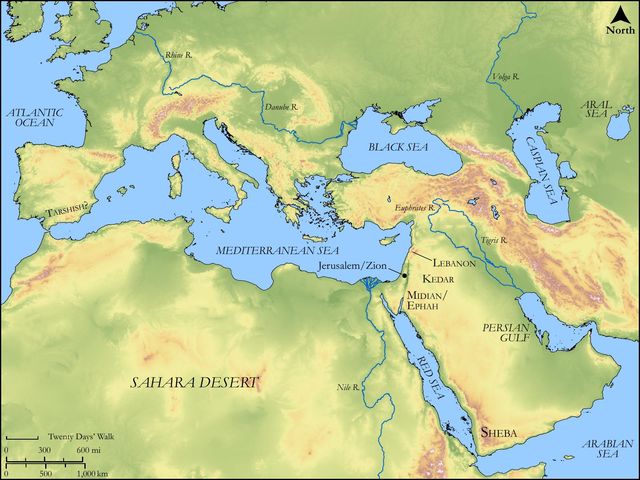
See on the biblical-era map
Study this verse
Public-domain commentary
Matthew Henry
From his Commentary on the Whole Bible. Henry comments on passages, not single verses — this entry covers Isaiah 43:22–28. His four-level outline is real structure in the source text, so it is rendered as structure.
This charge (and a high charge it is which is here exhibited against Jacob and Israel, God's professing people) comes in here, 1. To clear God's justice in bringing them into captivity, and to vindicate that. Were they not in covenant with him? Had they not his sanctuary among them? Why then did the Lord deal thus with his land? Deu 29:24. Here is a good reason given: they had neglected God and had cast him off, and therefore he justly rejected them and gave them to the curse (Isa 43:28); and they must be brought to own this before they are prepared for deliverance; and they did so, Dan 9:5; Neh 9:33. 2. To advance God's mercy in their deliverance and to make that appear more glorious. Many things are before observed to magnify the power of God in it; but this magnifies his goodness, that he should do such great and kind things for a people that had been so very provoking to him and were now suffering the just punishment of their iniquity. The pardoning of their sin was as great an instance of God's power (for so Moses reckons it, Num 14:17, etc.) as the breaking of the yoke of their captivity. Now observe here,
I.What the sins are which they are here charged with.
1.Omissions of the good which God had commanded; and this part of the charge is here much insisted upon. Observe how it comes in with a but; compare Isa 43:21, where God tells them what favours he had bestowed upon them and what his just expectations were from them. He had formed them for himself, intending they should show forth his praise. But they had not done so; they had frustrated God's expectations from them, and made very ill returns to him for his favours. For,
(1.)They had cast off prayer: Thou hast not called upon me, O Jacob! Jacob was a man famous for prayer (Hos 12:4); his seed bore his name, but did not tread in his steps, and therefore are justly upbraided with it. God takes it ill when children degenerate from the virtue and devotion of their pious ancestors. To boast of the name of Jacob, and yet live without prayer, is to mock God and deceive ourselves. If Jacob does not call upon God, who will?
(2.)They had grown weary of their religion: "Thou art Israel, the seed not only of a praying but of a prevailing father, that was a prince with God; and yet, not valuing his experiences any more than his example, thou hast been weary of me." They had been in relation to God, employed in his service and in communion with him; but they began to snuff at it, and to say, Behold, what a weariness is it! Note, Those who neglect to call upon God do in effect tell him they are weary of him and have a mind to change their Master.
(3.)They grudged the expense of their devotion, and were niggardly and penurious in it. They were for a cheap religion; and in those acts of devotion that were costly they desired to be excused. They had not brought, no, not their small cattle, the lambs and kids, which God required for burnt-offerings (Isa 43:23), much less did they bring their greater cattle, pretending they could not spare them, they must have them for the maintenance of their families. So little sense had they of the greatness of God and their obligations to him that they could not find in their hearts to part with a lamb out of their flock for his honour, though he called for it and would graciously have accepted it. Sweet cane, or calamus, was used for the holy oil, incense, and perfume; but they were not willing to be at the charge of that, Isa 43:24. What they had must serve, though it was old and good for nothing; they would not buy fresh. Perhaps it was usual for devout pious persons to bring free-will incense as well as other free-will offerings; but they were not so generous, nor did they fill the altar of God, nor moisten it abundantly, as they should have done, with the fat of their sacrifices; what sacrifices they did bring were of the lean and refuse of their cattle, that had no fat in them to regale the altar with.
(4.)What sacrifices they did offer they did not honour God with them, and so they were, in effect, as no sacrifices (Isa 43:23): Neither hast thou honoured me with thy sacrifices. Some of them offered their sacrifices to false gods; others, who offered them to the true God, were either careless in the manner of offering them or hypocritical in their intentions, so that they might be truly said not to honour God with them, but rather to dishonour him.
(5.)That which aggravated their neglect of sacrificing was that, as God had appointed it, it was no burdensome thing; it was not a service that they had any reason at all to complain of: "I have not caused thee to serve with an offering; I have not made it a task and drudgery to you, whatever you, through the corruption of your natures, have made it yourselves. I have not wearied thee with incense." None of God's commandments are grievous, no, not those concerning sacrifice and incense. They were not more costly than might be afforded by those that lived in such a plentiful country, nor did their attendance on them require any more time than they could well spare. But that which especially forbade them to call it a wearisome service was that they were required to be cheerful and pleasant, and to rejoice before God in all their approaches to him, Deu 12:12. They had many feasts and good days, but only one day in all the year in which they were to afflict their souls. The ordinances of the ceremonial law, though, in comparison with Christ's easy yoke, they are spoken of as heavy (Act 15:10), yet, in comparison with the service that idolaters did to their false gods, they were light, and not to be called services nor found fault with as wearisome. God did not require them to sacrifice their children, as Moloch did.
2.Commissions of the evil which God had forbidden; and omissions commonly make way for commissions: Thou hast made me to serve with thy sins. When we make God's gifts the food and fuel for our lusts, and his providence the patron of our wicked projects, especially when we encourage ourselves to continue in sin because grace has abounded, then we make God to serve with our sins. Or it may denote what a grief and burden sin is to God; it not only wearies men and makes the creation groan, but it wearies my God also (Isa 7:13) and makes the Creator complain that he is grieved (Psa 95:10), that he is broken (Eze 6:9), that he is pressed with sinners as a cart is pressed that is full of sheaves (Amo 2:13), and to cry out, Ah! I will ease me of my adversaries, Isa 1:24. The antithesis is observable: God had not made them to serve with their sacrifices, but they had made him to serve with their sins. The master had not tired the servants with his commands, but they had tired him with their disobedience. Those are wicked servants indeed that behave so ill to so good a Master. God is tender of our comfort, but we are careless of his honour. Let this engage us to keep close to our duty, that it is easy and reasonable, and no disparagement to us, nor too hard for us.
II.What were the aggravations of their sin, Isa 43:27.
1.That they were children of disobedience; for their first father (that is, their forefathers) had sinned; and they had not only sinned in their loins, but sinned like them. Ezra confesses this: Since the days of our fathers have we been in a great trespass, Ezr 9:7. But their forefathers are called their first father to put us in mind of the apostasy and rebellion of our first father Adam, to which corrupt fountain we must trace up the streams of all our transgressions.
2.That they were scholars of disobedience too: for their teachers had transgressed against God, were guilty of gross scandalous sins, and the people, no doubt, would learn to do as they did. It is ill with a people when their leaders cause them to err, and their teachers, who should reform them, corrupt them.
III.What were the tokens of God's displeasure against them for their sins, Isa 43:23. He brought ruin both upon church and state.
1.The honour of their church was laid in the dust and trampled on: I have profaned the princes of the sanctuary, that is, the priests and Levites who presided with great dignity and power in the temple-service; they profaned themselves, and made themselves vile, by their enormities, and then God profaned them and made them vile, by their calamities and the contempt they fell into, Mal 2:9.
2.The honour of their state was ruined likewise: "I have given Jacob to the curse, that is, to be cursed, and hated, and abused by all their neighbours, and Israel to reproach, to be insulted, ridiculed, and triumphed over by their enemies." They reproached them perhaps for that in them that was good; they mocked at their sabbaths (Lam 1:7); but God gave them up to reproach, to correct them for what was amiss. Note, The dishonour which men at any time do us should humble us for the dishonour we have done to God; and we must bear it patiently because we suffer it justly, and must acknowledge that to us belongs confusion.
IV.What were the riches of God's mercy towards them notwithstanding (Isa 43:25): I even I, am he who notwithstanding all this blotteth out thy transgressions.
1.This gracious declaration of God's readiness to pardon sin comes in very strangely. The charge ran very high: Thou hast wearied me with thy iniquities, Isa 43:24. Now one would think it would follow: "I, even I, am he that will destroy thee, and burden myself no longer with care about thee." No, I, even I, am he that will forgive thee; as if the great God would teach us that forgiving injuries is the best way to make ourselves easy and to keep ourselves from being wearied with them. This comes in here to encourage them to repent, because there is forgiveness with God, and to show the freeness of divine mercy; where sin has been exceedingly sinful grace appears exceedingly gracious. Apply this,
(1.)To the forgiving of the sins of Israel as a people, in their national capacity. When God stopped the course of threatening judgments, and saved them from utter ruin, even then when he had them under severe rebukes, then he might be said to blot out their transgressions. Though he corrected them, he was reconciled to them again, and did not cut them off from being a people. This he did many a time, till they rejected Christ and his gospel, which was a sin against the remedy, and then he would forgive them no more as a nation, but utterly destroyed them.
(2.)To the forgiving of the sins of every particular believing penitent - transgressions and sins, infirmities though ever so numerous, backslidings though ever so heinous. Observe here,
[1.]How the pardon is expressed; he will blot them out, as a cloud is blotted out by the beams of the sun (Isa 44:22), as a debt is blotted out not to appear against the debtor (the book is crossed as if the debt were paid, because it is pardoned upon the payment which the surety has made), or as a sentence is blotted out when it is reversed, as the curse was blotted out with the waters of jealousy, which made it of no effect to the innocent, Num 5:23. He will not remember the sin, which intimates not only that he will remit the punishment of what is past, but that it shall be no diminution to his love for the future. When God forgives he forgets.
[2.]What is the ground and reason of the pardon. It is not for the sake of any thing in us, but for his own sake, for his mercies'-sake, his promise-sake, and especially for his Son's sake, and that he may himself be glorified in it.
[3.]How God glories in it: I, even I, am he. He glories in it as his prerogative. None can forgive sin but God only, and he will do it; it is his settled resolution. He will do it willingly and with delight; it is his pleasure; it is his honour; so he is pleased to reckon it.
2.Those words (Isa 43:26), Put me in remembrance, may be understood either (1.) As a rebuke to a proud Pharisee, that stands upon his own justification before God, and expects to find favour for his merits and not to be beholden to free grace: "If you have any thing to say in your own justification, any thing to offer for the sake of which you should be pardoned, and not for my sake, put me in remembrance of it. I will give you leave to plead your own cause with me; declare what your merits are, that you may be justified by them:" but those who are thus challenged will be speechless. Or, (2.) As a publican. Is God thus ready to pardon sin, and, when he pardons it, will he remember it no more? Let us then put him in remembrance, mention before him those sins which he has forgiven; for they must be ever before us, to humble us, though they are pardoned, Psa 51:3. Put him in remembrance of the promises he has made to penitents, and the satisfaction his Son has made for them. Plead these with him in wrestling for pardon, and declare these things, in order that thou mayest be justified freely by his grace. This is the only way, and it is a sure way, to peace. Only acknowledge thy transgression.
Historical interpretation
Historical reception
3 surviving comments on this verse. Each one is dated, so this reads as a timeline rather than a list.
Select a marker to jump to its quote. Markers stagger vertically where authors wrote within a few decades of each other.
For there was no mention at all of such things required from you in the laws of the new covenant that I established through my servant whom I chose. But you did not offer these things to me. If it had been necessary to say such things, you still probably would have done something contrary. “In your sins is your preference” or as the other interpreters put it, “in your sins and in your unrighteous acts you called on me.”
(Verse 22, 23 and following) You did not call upon me, Jacob: you did not labor for me, Israel. You did not offer me the ram of your burnt offering, and you did not glorify me with your sacrifices. I did not make you serve in the offering, nor did I require labor from you in the burning of incense. You did not buy for me fragrant reeds with silver, and you did not satisfy me with the fat of your sacrifices. However, you served me in your sins: you provided labor for me in your iniquities. LXX: You have not now called, Jacob, nor have I made you labor, Israel. You have not brought me the sheep of your holocaust; nor have you magnified me with your sacrifices; nor have you made me serve with your offerings; nor have you bestowed upon me labor with frankincense; nor have you purchased for me with silver the sweet odor of your sacrifices; nor have you desired the fat of your victims; but you have defended yourself in your sins, and in your iniquities. The beasts of the field, dragons and ostriches praising me, you, Jacob, did not want to invoke me, nor afterwards did you labor to amend sin through repentance. But what you think you offered me as victims and sacrificed rams, know that they were not accepted by me, because they were common to me and idols. And he repeats the sense that he stated above: Why do I need the multitude of your victims, says the Lord? I am full of burnt offerings of rams, and fat of lambs, and blood of bulls and goats I do not desire. For I have not required anything precious from you, that I would make you labor in acquiring them. I have not required offerings from you, nor have I sought incense: not reed, nor incense, nor diverse kinds of pigments, with which you would intoxicate and satisfy me with their smoke. But I desired obedience, which is above sacrifice: and sacrifice, of which David says in the Psalms: Sacrifice to God is a contrite spirit: a broken and humbled heart God does not despise (Ps. 50:19), that is what I wanted, that is what I sought. But you have made me serve and labor in your sins, so that I am compelled to say: I have labored and endured; and I can no longer bear you. And through Hosea, God says the same: What shall I do to you, Ephraim? I will protect you, Israel. What shall I do? I will make you like Adam, and like Sodom. But what the Septuagint has is, I have defended you in your sins, and in your iniquities, so it can be connected to the previous statements, that it is God's labor and weariness to defend sinners.
In the section we examined and read previously, he delivered a prophecy of the covenant in Christ and the graces bestowed by him, for he said that he would “make a way in the desert and rivers in the dry land,” and because of this he would be blessed by “all the wild animals of the field.” The praise-giving is to be understood as a spiritual sacrifice and fruit of the new covenant in Christ. In the present passage, however, he tries to assure Israel that they had been redeemed from Egypt, rescued from the slavery that they endured there and freed from such intolerable labors, not so that they would offer him calves and thus secure access to him through blood and smoke—for such things are repugnant to God, and shadow rather than reality.That is why he says: “I have not called you now, O Jacob.” The word “now” ought to be understood to mean, “Not when you were offering sacrifices,” that is, “I have not called you when you were sacrificing oxen and slaughtered sheep, so that you should not think that you had been redeemed as a reward for the offerings.” Rather, it was when you were still in sin and guilty of defilement, for you had worshiped the gods of the Egyptians, that I deemed you worthy of mercy and love. So the gift is one of gentleness, and the fruit of loving-kindness is mercy, and the redemption came from love. The sheep of your burnt offering are nothing to me, he says, nor did you glorify me with your sacrifices. After all, how can that which is wholly unacceptable and offered in vain contribute to my glory? You did not serve me with your sacrifices. The one who pursues any good deed, he says, who achieves the character that leads to virtue, who bends his neck in submission to my decrees, who puts the teachings of the prophets into practice, could be said to serve the God who is over all. As for the one who fills the holy tent with incense, who offers oxen or sheep, or who performs successfully any of the other fine actions, that one will not genuinely glorify me. Such a person, in fact, has done nothing at all that pleases me. So then, service does not consist in offering sacrifice, but in being prepared to submit a tender neck, that willingly submits to his wishes. … Everywhere he rejected worship in shadows, leading them away from types, and drawing them to the justification which is in Christ, and teaching them to be refashioned according to the way of life taught by the gospel, by which alone it is possible to do what is pleasing to God, and come to truly blameless and sincere worship—that is, worship that is spiritual. For it says, “God is spirit, and those who worship him must worship in spirit and in truth.”
Continue studying Isaiah 43:22 across the web’s major study libraries — every link below opens this exact verse, chapter, or book on the destination site.
Read & Compare
 BibleGatewayThis verse in more than 200 translations and 70 languages.
 Bible.comThe YouVersion reader — hundreds of translations, reading plans, and highlights.
 ESV.orgCrossway's official English Standard Version reader.
 NET BibleThe NET translation with 60,000+ translators' notes on every rendering decision.
 STEP BibleTyndale House's free study tool — original text, vocabulary, and scholarly resources.
 BibliaLogos Bible Software's free web reader.
 USCCBThe New American Bible (Revised Edition) with the U.S. bishops' study notes.
Commentaries
 BibleHub CommentariesDozens of classic commentaries on this verse, gathered on one page.
 StudyLightMore than 100 commentary sets — the largest collection on the web.
 BibleRefPlain-English commentary on what this verse means, verse by verse.
 Enduring WordDavid Guzik's free commentary on this chapter, widely used by Bible teachers.
 Bible Study ToolsVerse commentary alongside Greek and Hebrew study aids.
Original Language & Research
- BibleHub InterlinearThe verse word by word — original language, transliteration, and English.
- BibleHub LexiconEvery word's original-language definition and Strong's entry.
 Blue Letter BibleDeep-study tools — Strong's numbers, concordance, and word studies.
 SefariaThe Hebrew text with Rashi and centuries of Jewish commentary.
Sermons, Hymns & Audio


TrulyRandomVerse is not affiliated with these sites and doesn’t control their content. They’re linked because they’re genuinely useful.
Summary
Isaiah 43:22 presents a poignant divine lament, contrasting God's unwavering commitment and redemptive acts with the spiritual apathy and neglect of His chosen people, Jacob/Israel. Despite having just declared His unique sovereignty and steadfast love, God expresses profound disappointment that His people have failed to call upon Him and have instead grown weary of His presence and ways, indicating a relationship that has become a burden rather than a source of joy and strength.
Context
ShowHideLiterary Context
This verse marks a significant shift in tone within Isaiah 43. The preceding verses, such as Isaiah 43:1-7 and Isaiah 43:14-21, are rich declarations of God's redemptive power, His unique identity as the only Savior, and His promise to restore Israel from exile. He recounts His mighty acts, such as making a way in the wilderness and rivers in the desert, all for the sake of His people. Verse 22, however, abruptly pivots from these declarations of divine faithfulness to a sharp, sorrowful accusation of Israel's spiritual failure. It sets the stage for further indictments of their sin and unfaithfulness in Isaiah 43:23-28, ultimately leading to a renewed promise of forgiveness and restoration based solely on God's grace, highlighting the dramatic tension between divine grace and human responsibility.
Historical & Cultural Context
The book of Isaiah, particularly chapters 40-55, is set against the backdrop of the Babylonian exile. The people of Israel, addressed here as "Jacob" and "Israel" (names that encapsulate their entire national and covenantal identity), had been taken captive due to their persistent idolatry and disobedience. Despite this severe judgment, God consistently reminds them of His covenant faithfulness and His ultimate plan for their deliverance and restoration. The cultural expectation for a covenant people was to worship and rely solely on their God, especially in times of distress. Their failure to "call upon" Yahweh and their "weariness" of Him highlights a deep spiritual malaise, where formal religion had replaced genuine relationship, and the very God who promised to save them had become an inconvenience or an obligation, rather than the source of their strength and hope in a foreign land.
Key Themes
ShowHideThe primary themes in Isaiah 43:22 include Divine Disappointment and Grief, revealing God's profound heartache over His people's spiritual state. It's not primarily an expression of anger, but rather a lament over their neglect of a relationship that He initiated and sustains. This leads to the theme of Spiritual Apathy and Neglect, where Israel's failure to "call upon" God signifies a pervasive lack of prayer, worship, and active reliance, contrasting sharply with the vibrant relationship God desires (e.g., Psalm 50:15). Furthermore, their "weariness" of God suggests that His commands, His presence, or even the very idea of serving Him had become a burden, indicative of a formalistic religion devoid of genuine delight or intimacy (compare Malachi 1:13). This verse also powerfully underscores the Contrast of Faithfulness, setting God's steadfast and unwavering commitment to His covenant promises (as declared in Isaiah 43:1-21) against Israel's consistent and painful unfaithfulness.
Exposition and Analysis
ShowHideKey Word Analysis
ShowHideA primitive root meaning "to call out to," "to address by name," or "to invoke." In the context of calling upon God, it denotes prayer, supplication, seeking divine help, and establishing a relationship through verbal interaction. The absence of this action indicates a profound breakdown in communication and reliance, signifying a failure to engage God in a personal and dependent manner.
Derived from a word meaning "heel-catcher" or "supplanter," this name refers to the patriarch Jacob, whose name was later changed to Israel. As a collective term, "Jacob" here represents the entire nation of Israel, emphasizing their foundational identity and their historical lineage as God's chosen people, reminding them of their covenant origins.
Properly meaning "to gasp," this root extends to "to be exhausted," "to tire," or "to toil." When applied to being weary of God, it conveys a sense of burden, drudgery, or aversion. It suggests that Israel's religious duties or even the thought of engaging with God had become an onerous task rather than a joyful privilege, indicating a deep spiritual fatigue and lack of desire for His presence.
Derived from words meaning "he will rule as God" or "God strives," this is the symbolic name given to Jacob after his wrestling with God (Genesis 32:28). As with Jacob, "Israel" here refers to the entire nation, underscoring their unique status as God's covenant people, called to be a kingdom of priests and a holy nation. The parallel use of "Jacob" and "Israel" serves as a rhetorical device to address the entirety of the nation, leaving no segment exempt from the accusation.
Verse Breakdown
ShowHide"But thou hast not called upon me, O Jacob;"
This clause directly contrasts God's preceding declarations of His mighty acts and unwavering commitment with Israel's profound spiritual negligence. The phrase "called upon me" (qârâʼ) denotes a lack of prayer, worship, and reliance on God. Despite God's constant presence and power, the people, identified by their foundational covenant name "Jacob," had failed to engage Him in a vital, interactive relationship. This points to a deep-seated spiritual apathy rather than overt rebellion, a failure to seek the very One who offered deliverance and sustenance.
"but thou hast been weary of me, O Israel."
This second clause reinforces and deepens the accusation. The conjunction "but" again highlights the stark contrast between God's steadfastness and Israel's spiritual state. The term "weary" (yâgaʻ) suggests that God's presence, His commands, or the very act of worship had become a burden or an exhausting obligation for the people. Instead of finding delight and strength in Him, Israel, addressed by their exalted covenant name, had grown spiritually fatigued and indifferent, viewing their relationship with Yahweh as a tiresome duty rather than a life-giving source of joy and purpose.
Literary Devices
ShowHideIsaiah 43:22 employs several powerful literary devices to convey God's lament. The most prominent is Parallelism, specifically Synonymous Parallelism, where the two clauses "But thou hast not called upon me, O Jacob" and "but thou hast been weary of me, O Israel" convey essentially the same idea using different but related phrasing. "Jacob" and "Israel" are synonymous terms for the nation, and "not called upon me" is functionally equivalent to "been weary of me" in expressing spiritual neglect. This repetition emphasizes the pervasive nature of Israel's apathy and underscores the depth of their spiritual failure. The verse also uses Anthropomorphism, attributing human emotions—disappointment, weariness, and a sense of being burdened—to God, allowing the reader to grasp the profound depth of His grief over His people's unfaithfulness and their broken covenant relationship. Furthermore, the verse functions as a Rhetorical Lament, implicitly asking how His chosen people could respond with such indifference after all He has done for them, thereby inviting self-reflection and conviction regarding their spiritual state.
Theological and Thematic Connections
ShowHideIsaiah 43:22 profoundly reveals the nature of God's relationship with humanity: He desires not mere ritualistic observance, but a vibrant, heartfelt, and dependent communion. His lament underscores the pain of unrequited love and the disappointment of a covenant partner who has grown cold and indifferent. This verse serves as a stark reminder that even after experiencing divine deliverance and receiving magnificent promises, humanity's propensity for spiritual apathy remains a persistent challenge. It highlights the tension between God's unwavering faithfulness and humanity's wavering commitment, emphasizing that true worship stems from a heart that delights in God, not one that finds Him burdensome. God's grief here is a prelude to His ultimate act of grace, where He takes their sin upon Himself, demonstrating that His love is not contingent on their performance but flows from His own character and covenant fidelity.
Reflection and Application
ShowHideIsaiah 43:22 serves as a timeless mirror for believers today, prompting a crucial self-examination of our spiritual vitality. Do we genuinely "call upon" the Lord in every circumstance, seeking His guidance, comfort, and provision, or have our prayers become perfunctory, our worship rote, and our reliance on Him superficial? The verse challenges us to consider if we have, perhaps subtly, grown "weary" of God—weary of His commands, weary of the discipline of prayer, weary of the demands of discipleship, or even weary of His very presence in our busy lives. This weariness can manifest as spiritual burnout, apathy, or a preference for self-sufficiency over divine dependence. The Lord desires a dynamic, intimate relationship, one characterized by delight and dependence, not duty and drudgery. This passage calls us to shake off any spiritual lethargy, to rekindle our first love, and to rediscover the profound joy and privilege of intimate communion with our Creator and Redeemer, recognizing that His faithfulness endures even when ours falters and that His grace is sufficient to overcome our weariness.
Questions for Reflection
ShowHideFAQ
ShowHideWhat does it mean that Israel "has not called upon me"?
ShowHideThis phrase indicates a profound spiritual neglect and a breakdown in the covenant relationship. To "call upon" God in the Old Testament context means to invoke His name, to pray, to seek His help, to worship Him, and to rely on Him in times of need. It signifies active dependence and communion. Israel, despite God's mighty acts on their behalf and His constant presence, had ceased to genuinely engage with Him in this way. Their religious practices may have continued outwardly, but their hearts were far from Him, demonstrating a lack of true faith and heartfelt devotion. It points to a failure to acknowledge God's sovereignty and their need for Him, choosing instead to lean on their own understanding or on other nations, as seen in various historical accounts (e.g., Isaiah 30:1-3). This spiritual silence was a profound insult to a God who continually sought their fellowship.
How could Israel be "weary" of God, especially after He delivered them?
ShowHideIsrael's weariness of God, expressed as finding Him burdensome, is a tragic consequence of spiritual apathy and a misunderstanding of His character. Despite God's past deliverances (like the Exodus, recounted in Exodus 14) and His ongoing covenant promises, the people had come to view their relationship with Him as an obligation rather than a source of joy and life. This weariness often stems from a heart that seeks self-gratification or worldly comforts over divine communion. It can also arise from a legalistic approach to faith, where adherence to rules becomes a heavy burden rather than an expression of love. Instead of delighting in God's presence and commands, they found them tiresome, reflecting a spiritual exhaustion that had replaced genuine love and devotion (see also Malachi 1:13). This weariness was a symptom of a deeper spiritual malaise, a failure to grasp the privilege and life-giving nature of their covenant with Yahweh.
Christ-Centered Fulfillment
ShowHideIsaiah 43:22, a divine lament over Israel's spiritual weariness and failure to call upon God, finds its profound Christ-centered fulfillment in the person and work of Jesus. While ancient Israel grew weary of God's ways, Jesus Christ perfectly embodied the life of complete dependence and delight in the Father. He consistently "called upon" God, spending entire nights in prayer (e.g., Luke 6:12), always doing the Father's will (e.g., John 5:30), and never growing "weary" of God, even unto death on the cross (e.g., Philippians 2:8). Furthermore, Jesus comes as the ultimate answer to humanity's spiritual weariness of God, inviting us to find rest in Him. His famous invitation, "Come to me, all who labor and are heavy laden, and I will give you rest," directly contrasts with Israel's condition. He takes upon Himself the burden of our sins and our spiritual apathy, fulfilling the righteous requirements we could not meet. Through His atoning sacrifice, He opens the way for us to genuinely call upon God, not as a burdensome duty, but as beloved children (e.g., Romans 8:15), and to find true spiritual rest and delight in Him, overcoming the weariness that plagued ancient Israel and offering a new covenant of grace (e.g., Hebrews 8:6).