


Micah 6:2
Bible text: King James Version (1769 Blayney text) · Public domain
Bible text: King James Version with Strong's numbers · Public domain
Bible text: Berean Standard Bible · Public domain
Bible text: American Standard Version (1901) · Public domain
Bible text: World English Bible, Messianic edition · Public domain
Bible text: Geneva Bible (1599) · Public domain
Bible text: Young's Literal Translation · Public domain
- שִׁמְעוּshim·'UhearH8085V-Qal-Imp-2mpVerb Qal Imperative 2nd Plural Masculine
- הָרִיםha·RimO mountainsH2022N-mpNoun Plural Masculine Absolute
- אֶת'et<obj.>H853DirObjMParticle Object Indicator
- רִיבriv[the] case ofH7379N-mscNoun Singular Masculine Construct
- יְהוָהYah·wehYahwehH3068N-properNoun Proper Title
- וְהָאֵתָנִיםve·ha·'e·ta·Nimand O enduring [ones]H386Conj-w ¦ Art ¦ Adj-mpAdjective Plural Masculine AbsoluteוְandהָOאֵתָנִיםenduring [ones]
- מֹסְדֵיMo·se·dei[the] foundations ofH4144N-mpcNoun Plural Masculine Construct
- אָרֶץ'A·retz[the] earthH776N-fsNoun Singular Feminine Absolute
- כִּיkiforH3588PrtParticle Conditional
- רִיבriva case at lawH7379N-msNoun Singular Masculine Absolute
- לַיהוָהla·Yah·weh[belongs] to YahwehH3068Prep-l ¦ N-properNoun Proper Titleלַ[belongs] toיהוָהYahweh
- עִם'imwithH5973PrepPreposition
- עַמּוֹa·Mohis peopleH5971N-msc ¦ 3msNoun Singular Masculine Constructעַמּpeopleוֹhis
- וְעִםve·'imand withH5973Conj-w ¦ PrepPrepositionוְandעִםwith
- יִשְׂרָאֵלYis·ra·'ElIsraelH3478N-properNoun Proper Location
- יִתְוַכָּחyit·va·Kachhe will argueH3198V-Hithpael-Imperf-3msVerb Hithpael Imperfect 3rd Singular Masculine
English is a literal word-by-word gloss of the Hebrew, not the KJV's wording. Why?
This is the original text the KJV's translators worked from — each Hebrew word with its own literal English meaning in this verse, prepared by scholars at Tyndale House, Cambridge. The KJV translates whole sentences, not word by word, so its wording differs: one Hebrew word can become several English words, and the KJV may choose “the LORD” where the gloss reads “Yahweh”. Both are faithful — they answer different questions. For the KJV's own rendering, switch to the KJV text.
Details
See on the biblical-era map
Study this verse
Public-domain commentary
Matthew Henry
From his Commentary on the Whole Bible. Henry comments on passages, not single verses — this entry covers Micah 6:1–5. His four-level outline is real structure in the source text, so it is rendered as structure.
Here, I. The prefaces to the message are very solemn and such as may engage our most serious attention. 1. The people are commanded to give audience: Hear you now what the Lord says. What the prophet speaks he speaks from God, and in his name; they are therefore bound to hear it, not as the word of a sinful dying man, but of the holy living God. Hear now what he saith, for, first or last, he will be heard. 2. The prophet is commanded to speak in earnest, and to put an emphasis upon what he said: Arise, contend thou before the mountains, or with the mountains, and let the hills hear thy voice, if it were possible; contend with the mountains and hills of Judea, that is, with the inhabitants of those mountains and hills; and, some think, reference is had to those mountains and hills on which they worshipped idols and which were thus polluted. But it is rather to be taken more generally, as appears by his call, not only to the mountains, but to the strong foundations of the earth, pursuant to the instructions given him. This is designed, (1.) To excite the earnestness of the prophet; he must speak as vehemently as if he designed to make even the hills and mountains hear him, must cry aloud, and not spare; what he had to say in God's name he must proclaim publicly before the mountains, as one that was neither ashamed nor afraid to own his message; he must speak as one concerned, as one that desired to speak to the heart, and therefore appeared to speak from the heart. (2.) To expose the stupidity of the people; "Let the hills hear thy voice, for this senseless careless people will not hear it, will not heed it. Let the rocks, the foundations of the earth, that have no ears, hear, since Israel, that has ears, will not hear." It is an appeal to the mountains and hills; let them bear witness that Israel has fair warning given them, and good counsel, if they would but take it. Thus Isaiah begins with, Hear, O heavens! and give ear, O earth! Let them judge between God and his vineyard.
II.The message itself is very affecting.
He is to let all the world know that God has a quarrel with his people, good ground for an action against them. Their offences are public, and therefore so are the articles of impeachment exhibited against them. Take notice the Lord has a controversy with his people and he will plead with Israel, will plead by his prophets, plead by his providences, to make good his charge. Note,
1.Sin begets a controversy between God and man. The righteous God has an action against every sinner, an action of debt, an action of trespass, an action of slander.
2.If Israel, God's own professing people, provoke him by sin, he will let them know that he has a controversy with them; he sees sin in them, and is displeased with it, nay, their sins are more displeasing to him than the sins of others, as they are a greater grief to his Spirit and dishonour to his name.
3.God will plead with those whom he has a controversy with, will plead with his people Israel, that they may be convinced and that he may be justified. In the close of the foregoing chapter he pleaded with the heathen in anger and fury, to bring them to ruin; but here he pleads with Israel in compassion and tenderness, to bring them to repentance, Come now, and let us reason together. God reasons with us, to teach us to reason with ourselves. See the equity of God's cause, it will bear to be pleaded, and sinners themselves will be forced to confess judgment, and to own that God's ways are equal, but their ways are unequal, Eze 18:25. Now,
(1.)God here challenges them to show what he had done against them which might give them occasion to desert him. They had revolted from God and rebelled against him; but had they any cause to do so? (Mic 6:3): "O my people! what have I done unto thee? Wherein have I wearied thee?" If subjects quit their allegiance to their prince, they will pretend (as the ten tribes did when they revolted from Rehoboam), that his yoke is too heavy for them; but can you pretend any such thing? What have I done to you that is unjust or unkind? Wherein have I wearied you with the impositions of service or the exactions of tribute? Have I made you to serve with an offering? Isa 43:23. What iniquity have your fathers found in me? Jer 2:5. He never deceived us, nor disappointed our expectations from him, never did us wrong, nor put disgrace upon us; why then do we wrong and dishonour him, and frustrate his expectations from us? Here is a challenge to all that ever were in God's service to testify against him if they have found him, in any thing, a hard Master, or if they have found his demands unreasonable.
(2.)Since they could not show any thing that he had done against them, he will show them a great deal that he has done for them, which should have engaged them for ever to his service, Mic 6:4, Mic 6:5. They are here directed, and we in them, to look a great way back in their reviews of the divine favour; let them remember their former days, their first days, when they were formed into a people, and the great things God did for them,
[1.]When he brought them out of Egypt, the land of their bondage, Mic 6:4. They were content with their slavery, and almost in love with their chains, for the sake of the garlic and onions they had plenty of; but God brought them up, inspired them with an ambition of liberty and animated them with a resolution by a bold effort to shake off their fetters. The Egyptians held them fast, and would not let the people go; but God redeemed them, not by price, but by force, out of the house of servants, or, rather, the house of bondage, for it is the same word that is used in the preface to the ten commandments, which insinuates that the considerations which are arguments for duty, if they be not improved by us, will be improved against us as aggravations of sin. When he brought them out of Egypt into a vast howling wilderness, as he left not himself without witness, so he left not them without guides, for he sent before them Moses, Aaron, and Miriam, three prophets (says the Chaldee paraphrase), Moses the great prophet of the Old Testament, Aaron his prophet (Exo 7:1), and Miriam a prophetess, Exo 15:20. Note, When we are calling to mind God's former mercies to us we must not forget the mercy of good teachers and governors when we were young; let those be made mention of, to the glory of God, who went before us, saying, This is the way, walk in it; it was God that sent them before us, to prepare the way of the Lord and to prepare a people for him.
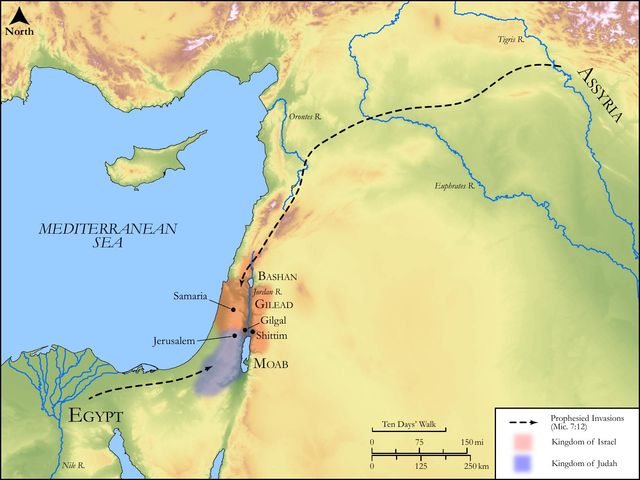
[2.]When he brought them into Canaan. God no less glorified himself, and honoured them, in what he did for them when he brought them into the land of their rest than in what he did for them when he brought them out of the land of their servitude. When Moses, Aaron, and Miriam, were dead, yet they found God the same. Let them remember now what God did for them, First, In baffling and defeating the designs of Balak and Balaam against them, which he did by the power he has over the hearts and tongues of men, Mic 6:5. Let them remember what Balak the king of Moab consulted, what mischief he devised and designed to do to Israel, when they encamped in the plains of Moab; that which he consulted was to curse Israel, to divide between them and their God, and to disengage him from the protection of them. Among the heathen, when they made war upon any people, they endeavoured by magic charms or otherwise to get from them their tutelar gods, as to rob Troy of its Palladium. Macrobius has a chapter de ritu evocandi Deos - concerning the solemnity of calling out the gods. Balak would try this against Israel; but remember what Balaam the son of Beor answered him, how contrary to his own intention and inclination; instead of cursing Israel, he blessed them, to the extreme confusion and vexation of Balak. Let them remember the malice of the heathen against them, and for that reason never learn the way of the heathen, nor associate with them. Let them remember the kindness of their God to them, how he turned the curse into a blessing (because the Lord thy God loved thee, as it is, Deu 23:5), and for that reason never forsake him. Note, The disappointing of the devices of the church's enemies ought always to be remembered to the glory of the church's protector, who can make the answer of the tongue directly to contradict the preparation and consultation of the heart, Pro 16:1. Secondly, In bringing them from Shittim, their last lodgment out of Canaan, unto Gilgal, their first lodgment in Canaan. There it was, between Shittim and Gilgal, that, upon the death of Moses, Joshua, a type of Christ, was raised up to put Israel in possession of the land of promise and to fight their battles; there it was that they passed over Jordan through the divided waters, and renewed the covenant of circumcision; these mercies of God to their fathers they must now remember, that they may know the righteousness of the Lord, his righteousness (so the word is), his justice in destroying the Canaanites, his goodness in giving rest to his people Israel, and his faithfulness to his promise made unto the fathers. The remembrance of what God had done to them might convince them of all this, and engage them for ever to his service. Or they may refer to the controversy now pleaded between God and Israel; let them remember God's many favours to them and their fathers, and compare with them their unworthy ungrateful conduct towards him, that they may know the righteousness of the Lord in contending with them, and it may appear that in this controversy he has right on his side; his ways are equal, for he will be justified when he speaks, and clear when he judges.
Historical interpretation
Historical reception
1 surviving comment on this verse from the historical church.
(Chapter VI—Verses 1, 2.) Listen to what the Lord is saying: Rise up, contend with the mountains, and let the hills hear your voice. Listen, O mountains, to the Lord's judgment, and you mighty foundations of the earth, for the Lord will judge with his people and with Israel. Septuagint: Listen to what the Lord has spoken: Rise up, judge among the mountains, and let the hills hear your voice. Listen, O mountains, to the Lord's judgment, and you valleys, foundations of the earth, for the Lord will judge his people and with Israel. For the firm foundations of the earth, which are interpreted as the seventy valleys and foundations of the earth, Symmachus and Theodotion translated it, and the ancient foundations of the earth: but the fifth edition presented the Hebrew itself, Ethanim, the foundations of the earth. Therefore, the first voice of the prophet is: Hear what the Lord is saying. Then God speaks to the prophet: Rise up, contend with judgment against the mountains, and let the hills hear your voice. Again, the prophet, as he had been commanded, speaks to the mountains, and not only to the mountains, but also to the strong foundations of the earth, and says, Hear, O mountains, the judgment of the Lord, and you strong foundations of the earth. He gives the reason why he compels them to hear. Because the judgment of the Lord will be pronounced upon his people, and with Israel it will be judged. They have transferred hills and valleys to the mountains to which the prophet speaks and to the strong foundations of the earth, understanding this, as it seems to me, that the people have done nothing worthy to be heard from the mountains, either from the hills that are inferior to the height of the mountains, or from the valleys submerged in the deepest part. Arise, he says, contend in judgment before the mountains, and let the hills hear your voice. He commands those who are sitting, lying, sleeping, or dead to arise, according to what the Apostle says: Awake, you who sleep, and arise from the dead, and Christ shall give you light (Ephesians 5:14). Arise from the dead, so that you may walk in newness of life, that you may leave the earth and strive for higher things. And contend in judgment against the mountains, which I believe to signify no one other than the Angels, to whom the care of human matters is entrusted, as the Song of Deuteronomy concords with the same: When the Most High divided the nations, when he scattered the sons of Adam, he set the bounds of the nations according to the number of the angels of God (Deuteronomy 32:8). Hello, we are the administrators of the spirit, sent to minister to those who will inherit salvation. And strive for justice, so that whether mountains or hills ((or valleys)) are found, it may not be considered unworthy of the people whom I have appointed, or that the blame be removed from the people and referred to the leaders. Let us read the Apocalypse of John the Apostle, in which the Angels of the Churches are praised and accused for their virtues and vices, for which they are said to preside. For just as sometimes the fault lies with the bishops, sometimes with the people; and often the teacher sins, often the student; sometimes it is the fault of the father, sometimes of the son, so that they may be taught either well or poorly: in this way, in the judgment of God, either a charge will be brought against the angels, if they do not carry out everything that pertains to their duty, or against the people, if they have disregarded those who do everything themselves. There are those who interpret the mountains and hills and the strong foundations of the earth as Abraham, Isaac and Jacob, and the other patriarchs, to whom it is as if they were listeners and authors, and who are summoned to judgment, for the cause of the people of Israel may be investigated. Others believe that mountains, hills, and valleys are inhabited by angels, as we said above, either serving God in the heavens, or governing over humans on this earth, or being stationed below, among those who have become earthly due to their own fault, they are said to be the foundations of the earth: concerning which foundations and elsewhere we find it written: A fire is kindled in my wrath, it shall burn unto the lowest hell, and shall consume the earth with her increase, and set on fire the foundations of the mountains (Deut. 32:22). The strong and ancient foundations of the earth (whose cause the earth has not passed until now, and hanging over the void, remains balanced) are the merits of the righteous, of whom the Apostle speaks: Built upon the foundations of the apostles and prophets (Ephesians 2:20). Therefore, just as the apostles, prophets, and the entire chorus of martyrs are the strong foundations of the earth, so according to the Septuagint, the valleys and cliffs, which are more significantly called φάραγγες in Greek, are their foundations, who have received the image of the dwelling place (Mss. choici). Therefore, the judgment of the Lord will be with His people, and with Israel it will be judged. He who could, as it were, inflict punishments like God for the sins of a sinful people, does not want to appear mighty, but just, and calls sinners to judgment, according to the prophecy: Come, let us argue it out, says the Lord (Isaiah 43:26), even now He calls the people of Israel, with the presence of Angels and all creatures, if there is anything to be answered, so that God may be justified in His words and prevail when He is judged (Psalm 50).
Continue studying Micah 6:2 across the web’s major study libraries — every link below opens this exact verse, chapter, or book on the destination site.
Read & Compare
 BibleGatewayThis verse in more than 200 translations and 70 languages.
 Bible.comThe YouVersion reader — hundreds of translations, reading plans, and highlights.
 ESV.orgCrossway's official English Standard Version reader.
 NET BibleThe NET translation with 60,000+ translators' notes on every rendering decision.
 STEP BibleTyndale House's free study tool — original text, vocabulary, and scholarly resources.
 BibliaLogos Bible Software's free web reader.
 USCCBThe New American Bible (Revised Edition) with the U.S. bishops' study notes.
Commentaries
 BibleHub CommentariesDozens of classic commentaries on this verse, gathered on one page.
 StudyLightMore than 100 commentary sets — the largest collection on the web.
 BibleRefPlain-English commentary on what this verse means, verse by verse.
 Enduring WordDavid Guzik's free commentary on this chapter, widely used by Bible teachers.
 Bible Study ToolsVerse commentary alongside Greek and Hebrew study aids.
Original Language & Research
- BibleHub InterlinearThe verse word by word — original language, transliteration, and English.
- BibleHub LexiconEvery word's original-language definition and Strong's entry.
 Blue Letter BibleDeep-study tools — Strong's numbers, concordance, and word studies.
 SefariaThe Hebrew text with Rashi and centuries of Jewish commentary.
Sermons, Hymns & Audio


TrulyRandomVerse is not affiliated with these sites and doesn’t control their content. They’re linked because they’re genuinely useful.
Summary
Micah 6:2 dramatically opens a divine lawsuit, portraying God as a plaintiff bringing a formal legal case against His unfaithful covenant people, Israel. By summoning the mountains and the very foundations of the earth as witnesses, the prophet underscores the gravity and universal scope of God's indictment. This verse sets the stage for a profound confrontation, revealing God's justice and His persistent desire to engage with His people concerning their covenant violations.
Context
ShowHideLiterary Context
Micah 6:2 is the immediate follow-up to the divine summons issued in Micah 6:1. The preceding verse establishes the setting for a courtroom of creation, where God calls upon the natural world to "arise, contend thou before the mountains, and let the hills hear thy voice." Verse 2 then clarifies the nature of this contention: it is "the LORD'S controversy" (a legal dispute) with His people. This dramatic opening to chapter 6 marks a shift in tone from the previous chapters, which largely contained pronouncements of judgment and calls to repentance. Here, God formally initiates a "rib" (lawsuit) against Israel, inviting the entire created order to bear witness to the proceedings. The subsequent verses (Micah 6:3-5) detail God's gracious acts in the past, serving as evidence of His faithfulness, which contrasts sharply with Israel's unfaithfulness, before moving to the people's misguided attempts at appeasement in Micah 6:6-7.
Historical & Cultural Context
The prophet Micah ministered in Judah during the reigns of Jotham, Ahaz, and Hezekiah (approximately 740-687 BCE). This period was marked by significant political upheaval, moral decay, and spiritual apostasy in both the northern kingdom of Israel and the southern kingdom of Judah. The Assyrian Empire was a dominant force, threatening and eventually conquering the northern kingdom (Samaria fell in 722 BCE, as detailed in 2 Kings 17). Judah itself was under immense pressure and faced the threat of invasion. Culturally, the people had adopted pagan practices, engaged in oppression, and neglected the covenant laws of God, particularly those related to justice, righteousness, and humility (as highlighted later in Micah 6:8). The concept of a "divine lawsuit" (rib) was a familiar legal metaphor in Israel, where the covenant at Sinai carried its own curses for violation, as set out in Deuteronomy 28, framed as legal proceedings. God, as the LORD of the covenant with Israel, was bringing charges against His people for breach of the covenant.
Key Themes
ShowHideMicah 6:2 introduces and reinforces several key themes prevalent throughout the book of Micah and the prophetic literature. The most prominent is the Divine Lawsuit (Hebrew: rîyb), where God formally presents a case against His people for their covenant disobedience. This theme underscores God's justice and His commitment to the covenant relationship He established with Israel at Sinai. Another crucial theme is Creation as Witness, as the "mountains" and "strong foundations of the earth" are called to hear God's charges. This imagery emphasizes the universal scope of God's authority and the undeniable nature of Israel's transgressions, echoing similar calls in Deuteronomy 32:1 and Isaiah 1:2. Finally, the phrase "he will plead with Israel" introduces the theme of God's Patient Persuasion and Desire for Repentance. While it is a legal confrontation, God's "pleading" (Hebrew: yâkach) suggests a desire not merely to condemn but to convince, to bring His people to a realization of their sin and a return to faithfulness, reflecting His enduring love and grace even in judgment.
Exposition and Analysis
ShowHideKey Word Analysis
ShowHideThis term denotes a "contest (personal or legal)," "dispute," or "suit." In the context of Micah 6:2, it is not merely a disagreement but a formal legal proceeding initiated by God against His people. It signifies a breach of covenant, where God, as the righteous judge and covenant God, brings charges against Israel for their unfaithfulness. This "controversy" is rooted in their failure to uphold the stipulations of the Mosaic Covenant.
Meaning "permanence," and concretely, "permanent," "hard," or "mighty." When applied to the "foundations of the earth," it emphasizes their enduring, unshakeable nature. These are not flimsy, temporary structures but the very bedrock of creation, making them fitting and impartial witnesses to a dispute of eternal significance. Their strength and permanence highlight the gravity and eternal implications of God's case.
A primitive root meaning "to be right (i.e. correct)," and reciprocally, "to argue." Causatively, it means "to decide, justify or convict." This word carries a rich semantic range, including to argue a case, rebuke, reprove, or reason together. In Micah 6:2, it conveys God's active engagement in the legal process, not just as a prosecutor but as one who desires to convince His people of their wrongdoing, aiming for their understanding and potential restoration rather than immediate, silent condemnation.
Verse Breakdown
ShowHide"Hear ye, O mountains, the LORD'S controversy, and ye strong foundations of the earth:"
This opening clause is a powerful summons, personifying the most ancient and enduring elements of creation—the mountains and the very foundations of the earth—and calling them to attention. They are not merely passive observers but are invoked as silent, impartial witnesses to the impending divine lawsuit. The phrase "the LORD'S controversy" immediately establishes the nature of the event: a legal dispute initiated by Yahweh, the covenant God of Israel. The scale of the witnesses underscores the immense gravity and universal implications of the charges God is about to lay against His people, indicating that their actions are not hidden but are known to the Creator of all things.
"for the LORD hath a controversy with his people,"
This explanatory clause directly states the reason for the summons of creation. The "controversy" (rîyb) is explicitly identified as belonging to the LORD (Yahweh) and is directed "with his people," Israel. This highlights the unique, covenantal relationship God has with Israel, making their unfaithfulness a profound betrayal of a sacred bond. It is not a dispute with a foreign nation, but with those whom He chose, redeemed, and entered into a covenant with. This emphasizes the personal and relational nature of God's grievance, rooted in their failure to live up to their covenant obligations.
"and he will plead with Israel."
This final clause clarifies God's intent within this legal proceeding. The verb "plead" (yâkach) suggests more than just accusation; it implies a process of argumentation, reasoning, and conviction. God is not merely condemning but is engaging with His people, presenting His case with the aim of bringing them to an understanding of their sin and a recognition of His righteousness. This reveals God's patient love and His desire for His people to repent and return to Him, offering a glimmer of hope for reconciliation even in the midst of judgment.
Literary Devices
ShowHideMicah 6:2 masterfully employs several literary devices to convey its powerful message. Personification is evident in the direct address to the "mountains" and "strong foundations of the earth," commanding them to "hear." This imbues inanimate objects with the capacity for hearing and witnessing, elevating the divine lawsuit to an event before all creation. The entire verse functions as a Legal Metaphor, framing God's interaction with Israel as a formal courtroom proceeding. Terms like "controversy" (rîyb) and "plead" (yâkach) are legalistic, portraying God as both the plaintiff and the judge, and Israel as the defendant. This metaphor underscores God's justice and His adherence to covenantal law. Furthermore, there is a clear Parallelism in the repetition of "the LORD'S controversy," first in the summons of creation and then in the direct statement of its subject ("with his people"). This repetition emphasizes the central theme of the divine lawsuit and reinforces the gravity of the situation. The use of Hyperbole or Imagery of Creation in calling upon the earth's foundations highlights the immense scale and universal significance of Israel's covenant breach, implying that their unfaithfulness is an offense against the very order of creation.
Theological and Thematic Connections
ShowHideMicah 6:2 profoundly articulates God's unwavering commitment to His covenant and His justice in holding His people accountable. The "controversy" is not arbitrary anger but a righteous legal case, demonstrating that God operates according to His own established moral order and covenant stipulations. This divine lawsuit underscores the seriousness of sin, particularly covenant unfaithfulness, and reveals that God will not ignore the breaches of His relationship with humanity. Yet, the act of "pleading" also reveals God's persistent grace and desire for His people's repentance and restoration, even in the face of their rebellion. It highlights that God's judgment is often redemptive, aimed at bringing His people back to Himself.
Reflection and Application
ShowHideMicah 6:2 serves as a powerful reminder that our actions, especially within the context of our covenant relationship with God, have eternal significance. Just as God called the mountains and foundations of the earth to witness His controversy with ancient Israel, so too are our lives lived before an omnipresent God who sees and knows all. This verse challenges us to consider the depth of our own faithfulness to God's commands and His covenant. Are we truly living in accordance with His will, or are there areas where we, like Israel, are in "controversy" with Him due to our disobedience, injustice, or spiritual apathy? God's willingness to "plead" with His people, to reason and convict, speaks to His enduring patience and His desire for reconciliation. This should prompt us to humbly examine our hearts, confess our shortcomings, and respond with genuine repentance, trusting in His restorative grace. It calls us to live lives that honor our covenant with Him, marked by justice, mercy, and humility, rather than being found in opposition to His righteous character.
Questions for Reflection
ShowHideFAQ
ShowHideWhat is the significance of God calling the mountains and foundations of the earth to "hear" His controversy?
ShowHideThe significance lies in the dramatic and universal scope it lends to God's lawsuit. By summoning the most ancient, enduring, and unshakeable elements of creation—the "mountains" and "strong foundations of the earth"—God is calling upon impartial, eternal witnesses to His dispute with Israel. This emphasizes that Israel's covenant unfaithfulness is not a minor, private matter, but a profound breach with universal implications, known to the very fabric of the created order. It underscores God's absolute sovereignty over all creation and highlights the undeniable nature of Israel's guilt, as even inanimate objects are called to testify to His righteous judgment and their rebellion (similar imagery is found in Deuteronomy 32:1 and Isaiah 1:2).
Christ-Centered Fulfillment
ShowHideMicah 6:2, with its depiction of God's "controversy" and His "pleading" with Israel, finds its ultimate Christ-centered fulfillment in the person and work of Jesus Christ. While the Old Testament divine lawsuit highlights humanity's failure to uphold the Law, Christ perfectly fulfilled the Law, becoming the righteous one who stands in our place. He is the ultimate advocate and mediator who "pleads" our case before the Father, not by arguing our innocence, but by offering His own perfect sacrifice as atonement for our sins, as seen in 1 John 2:1. Furthermore, Jesus is the one through whom God's justice and mercy are fully reconciled; He is both the righteous judge who will hold all accountable (John 5:22) and the Lamb of God who takes away the sin of the world (John 1:29). The "controversy" that God had with His people under the old covenant is resolved for believers in the new covenant established through Christ's blood (Hebrews 8:6-13). Through faith in Him, we are no longer under condemnation but are reconciled to God, experiencing the peace that surpasses understanding because Christ has borne the full weight of the divine lawsuit on our behalf (Romans 5:1).