


Hosea 4:1
Bible text: King James Version (1769 Blayney text) · Public domain
Bible text: King James Version with Strong's numbers · Public domain
Bible text: Berean Standard Bible · Public domain
Bible text: American Standard Version (1901) · Public domain
Bible text: World English Bible, Messianic edition · Public domain
Bible text: Geneva Bible (1599) · Public domain
Bible text: Young's Literal Translation · Public domain
- שִׁמְעוּshim·'UhearH8085V-Qal-Imp-2mpVerb Qal Imperative 2nd Plural Masculine
- דְבַרde·var[the] word ofH1697N-mscNoun Singular Masculine Construct
- יְהוָהYah·wehYahwehH3068N-properNoun Proper Title
- בְּנֵיbe·NeiO people ofH1121N-mpcNoun Plural Masculine Construct
- יִשְׂרָאֵלYis·ra·'ElIsraelH3478N-properNoun Proper Location
- כִּיkiforH3588PrtParticle Conditional
- רִיבriva case at lawH7379N-msNoun Singular Masculine Absolute
- לַיהוָהla·Yah·weh[belongs] to YahwehH3068Prep-l ¦ N-properNoun Proper Titleלַ[belongs] toיהוָהYahweh
- עִם'imwithH5973PrepPreposition
- יוֹשְׁבֵיyo·she·Vei[the] inhabitants ofH3427V-Qal-Prtcpl-mpVerb Qal Participle Plural Masculine Construct
- הָאָרֶץha·'A·retzthe landH776Art ¦ N-fsNoun Singular Feminine Absoluteהָtheאָרֶץland
- כִּיkiforH3588PrtParticle Conditional
- אֵין'einthere notH369N-mscNoun Singular Masculine Construct
- אֱמֶת'e·Met[is] faithfulnessH571N-fsNoun Singular Feminine Absolute
- וְאֵיןve·'einand there notH369Conj-w ¦ N-mscNoun Singular Masculine Constructוְandאֵיןthere not
- חֶסֶדChe·sed[is] covenant loyaltyH2617N-msNoun Singular Masculine Absolute
- וְאֵיןve·'einand there notH369Conj-w ¦ N-mscNoun Singular Masculine Constructוְandאֵיןthere not
- דַּעַתDa·'at[is] knowledge ofH1847N-fscNoun Singular Feminine Construct
- אֱלֹהִים'E·lo·HimGodH430N-mpNoun Plural Masculine Absolute
- בָּאָרֶץba·'A·retzin the landH776Prep-b ¦ N-fsNoun Singular Feminine Absoluteבָּin theאָרֶץland
English is a literal word-by-word gloss of the Hebrew, not the KJV's wording. Why?
This is the original text the KJV's translators worked from — each Hebrew word with its own literal English meaning in this verse, prepared by scholars at Tyndale House, Cambridge. The KJV translates whole sentences, not word by word, so its wording differs: one Hebrew word can become several English words, and the KJV may choose “the LORD” where the gloss reads “Yahweh”. Both are faithful — they answer different questions. For the KJV's own rendering, switch to the KJV text.
Details
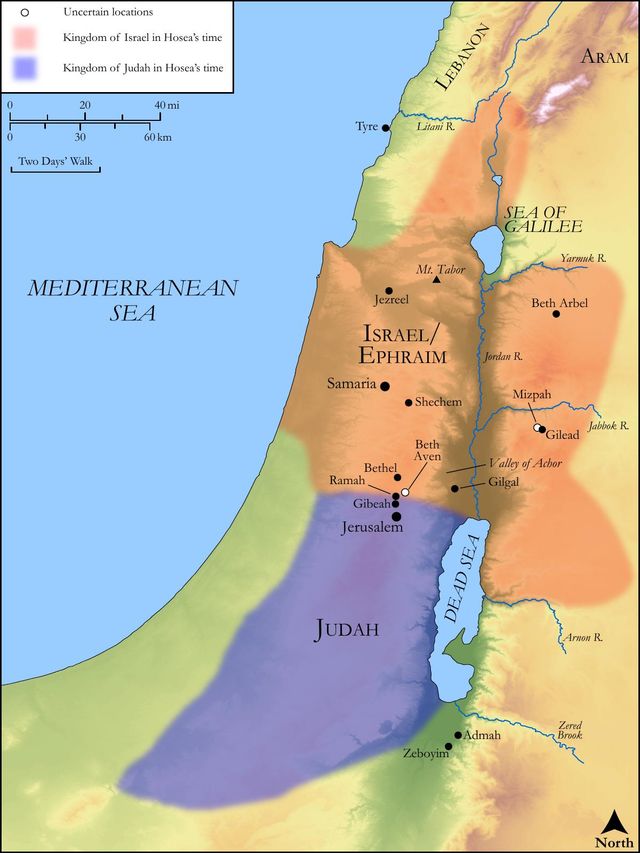
See on the biblical-era map
Study this verse
Public-domain commentary
Matthew Henry
From his Commentary on the Whole Bible. Henry comments on passages, not single verses — this entry covers Hosea 4:1–5. His three-level outline is real structure in the source text, so it is rendered as structure.
Here is, I. The court set, and both attendance and attention demanded: "Hear the word of the Lord, you children of Israel, for to you is the word of this conviction sent, whether you will hear or whether you will forbear." Whom may God expect to give him a fair hearing, and take from him a fair warning, but the children of Israel, his own professing people? Yea, they will be ready enough to hear when God speaks comfortably to them; but are they willing to hear when he has a controversy with them? Yes, they must hear him when he pleads against them, when he has something to lay to their charge: The Lord has a controversy with the inhabitants of the land, of this land, of this holy land. Note, Sin is the great mischief-maker; it sows discord between God and Israel. God sees sin in his own people, and a good action he has against them for it. Some more particular actions lie against his own people, which do not lie against other sinners. He has a controversy with them for breaking covenant with him, for bringing a reproach upon him, and for an ungrateful return to him for his favours. God's controversy will be pleaded, pleaded by the judgments of his mouth before they are pleaded by the judgments of his hand, that he may be justified in all he does and may make it appear that he desires not the death of sinners; and God's pleadings ought to be attended to, for, sooner or later, they shall have a hearing.
II.The indictment read, by which the whole nation stands charged with crimes of a heinous nature, by which God is highly provoked.
1.They are charged with national omissions of the most important duties: There is no truth nor mercy, neither justice nor charity, these most weighty matters of the law, as our Saviour accounts them (Mat 23:23), judgment, mercy, and faith. The generality of the people seemed to have no sense at all of the thing called honesty; they made no conscience of what they said and did, though ever so contrary to the truth and injurious to their neighbour. Much less had they any sense of mercy, or any obligation they were under to pity and help the poor. And it is not strange that there is no truth and mercy when there is no knowledge of God in the land. What good can be expected where there is no knowledge of God? It was the privilege of that land that in Israel God was made known, and his name was great, which was an aggravation of their sin, that they did not know him, Psa 76:1.
2.Hence follows national commissions of the most enormous sins against both the first and second table, for they had no regard at all to either. Swearing, and lying, and killing, and stealing, and committing adultery, against the third, ninth, sixth, eighth, and seventh commandments, were to be found in all corners of the land, and among all orders and degrees of men among them, Hos 4:2. The corruption was universal; what good people there were among them were either lost or hid, or they hid themselves. By these they break out, that is, they transgress all bounds of reason and conscience, and the divine law; they have exceeded (Job 36:9); they have been overmuch wicked (Ecc 7:17); they suffer their corruptions to break out; they themselves break over, and break through, all that stands in their way and would stop them in their sinful career, as water overflows the banks. Note, Sin is a violent thing and its power exorbitant; when men's hearts are fully set in them to do evil (Ecc 8:11) what will be restrained from them? Gen 11:6. When they break out thus blood touches blood, that is, abundance of murders are committed in all parts of the country, and, as it were, in a constant series and succession. Caedes aliae aliis sunt contiguae - Murders touch murders; a stream of blood runs down among them, even royal blood. It was about this time that there was so much blood shed in grasping at the crown; Shallum slew Zechariah, and Menahem slew Shallum, Pekah slew Pekahiah, and Hoshea slew Pekah; and the like bloody work, it is likely, there was among other contenders, so that the land was polluted with blood (Psa 106:38); it was filled with blood from one end to the other, Kg2 21:16.
III.Sentence passed upon this guilty and polluted land, Hos 4:3.
It shall be utterly destroyed and laid waste. The whole land is infected with sin, and therefore the whole land shall mourn under God's sore judgments, shall sit in mourning, being stripped of all its wealth and beauty. As the valleys are said to shout for joy, and sing, when there are plenty and peace, so here they are said to mourn when by war and famine they are made desolate. The whole land shall be brimstone, and salt, and burning, was as threatened in the law, Deu 29:23. They had broken all God's commandments, and now God threatens to take away all their comforts. The land mourns when there is neither grass for the cattle nor herbs for the service of man; and then every one that dwells therein shall languish for want of nice food to support a wasting life, and fret for want of the usual dainties for delight. The beasts of the field will languish, Jer 14:5, Jer 14:6. Nay, the destruction of the fruits of the earth shall be so great that there shall not be picking for the fowls of the air, to keep them alive; they shall suffer with man, and their dying, or growing lean, will be a punishment to those who used to have their tables replenished with wild-fowl. Nay, the fishes of the sea shall be taken away, or gathered together, that they may go away in shoals to some other coast, and then the fishing trade will be worth nothing. This desolation shall be in that respect more general than that by Noah's flood, for that did not affect the fishes of the sea, but this shall. It was part of one of the plagues of Egypt that he slew their fish (Psa 105:29); when the waters are dried the fish die, Isa 50:2; Zep 1:2, Zep 1:3. Note, When man becomes disobedient to God, it is just that the inferior creatures should be made unserviceable to man. Oh what reason have we to admire God's patience and mercy to our land, that though there is in it so much swearing, and lying, and killing, and stealing, and adultery, yet there is plenty of flesh, and fish, and fowl, on our tables!
IV.An order of court that no pains should be taken with the condemned criminal to bring him to repentance, with the reason for that order. Observe,
1.The order itself (Hos 4:4): Yet let no man strive nor reprove another; let no means be used to reduce and reclaim them; let their physicians give them up as desperate and past cure. It intimates that as long as there is any hope we ought to reprove sinners for their sins; it is a duty we owe to one another to give and to take reproofs; it was one of the laws of Moses (Lev 19:17), Thou shalt in any wise rebuke thy neighbour; it is an instance of brotherly love. Sometimes there is need to rebuke sharply, not only to reprove, but to strive, so loth are men to part with their sins. But it is a sign that persons and people are abandoned to ruin when God says, Let them not be reproved. Yet this is to be understood as God's commands sometimes to the prophets not to pray for them, notwithstanding which they did pray for them; but the meaning is, They are so hardened in sin, and so ripened for ruin, that it will be to little purpose either to deal with them or to deal with God for them. Note, It bodes ill to a people when reprovers are silenced, and when those who should witness against the sins of the times, retire into a corner, and give up the cause. See Ch2 25:16.
2.The reasons of this order. Let them not reprove one another; for,
(1.)They are determined to go on in sin, and no reproofs will cure them of that: Thy people are as those that strive with the priests; they have grown so very impudent in sin, so very insolent, and impatient of reproof, that they will fly in the face even of a priest himself if he should but give them the least check, without any regard to his character and office; and how then can it be thought that they should take a reproof from a private person? Note, Those sinners have their hearts wickedly hardened who quarrel with their ministers for dealing faithfully with them; and those who rebel against ministerial reproof, which is an ordinance of God for their reformation, have forfeited the benefit of brotherly reproof too. Perhaps this may refer to the late wickedness of Joash king of Judah, and his people, who stoned Zechariah, the son of Jehoiada, for delivering them a message from God, Ch2 24:21. He was a priest; with him they strove when he was officiating between the temple and the altar; and Dr. Lightfoot thinks the prophet had an eye to his case when he spoke (Hos 4:2) of blood touching blood; the blood of the sacrificer was mingled with the blood of the sacrifice, That, says he, was the apex of their wickedness - thence their ruin was to be dated (Mat 23:35), as this is of their incorrigibleness, that they are as those who strive with the priest, therefore let no man reprove them; for,
(2.)God also is determined to proceed in their ruin (Hos 4:5): "Therefore, because thou wilt take no reproof, no advice, thou shalt fall, and it is in vain for any to think of preventing it, for the decree has gone forth. Thou shalt stumble and fall in the day, and the prophet, the false prophet that flattered and seduced thee, shall fall with thee in the night; both thou and thy prophet shall fall night and day, shall be continually falling into one calamity or other; the darkness of the night shall not help to cover thee from trouble nor the light of the day help thee to flee from it." The prophets are blind leaders and the people blind followers; and to the blind day and night are alike, so that whether it be day or night both shall fall together into the ditch. "Thou shalt fall in the day, when thy fall is least feared by thyself and thou art very secure; and in the day, when it will be seen and observed by others, and turn most to thy shame; and the prophet shall fall in the night, when to himself it will be most terrible." Note, The ruin of those who have helped to ruin others will, in a special manner, be intolerable. And did the children think that when they were in danger of falling their mother would help them? It shall be in vain to expect it, for I will destroy thy mother, Samaria, the mother-city, the whole state, or kingdom, which is as a mother to every part. It shall all be made silent. Note, When all are involved in guilt nothing less can be expected than that all should be involved in ruin.
Historical interpretation
Historical reception
1 surviving comment on this verse from the historical church.
"Hear the word of the Lord, sons of Israel; for judgment is for the Lord with the inhabitants of the earth: for there is no truth, nor mercy, nor knowledge of God in the land. Cursed, and lying, and murder, and theft, and adultery have overflowed: and blood has touched blood." LXX: "Hear the word of the Lord, sons of Israel; for judgment is for the Lord with the inhabitants of the earth: for there is no truth, nor mercy, nor knowledge of God over the earth. Curse, and lying, and murder, and theft, and adultery have been spilt over the earth, and they have mixed blood with blood." From the beginning of the prophet to this point, under the description of a prostitute and an adulteress, whose punishment is severe and long-lasting, a later restoration to their former or a better state is made for the ten tribes or two, and the sins of all are counted. Again now to Israel, that is, the speech turns to the ten tribes, explaining that God, angered, does not threaten and inflict such great punishments in vain: lest perhaps the sentence be not seen to have been passed justly, but by the power of God on those who have not sinned. Hear, said the prophet, the word of the Lord, O sons of Israel: for the Lord desires to judge with his people and to expose the reasons for his anger. There is no truth, and there is no mercy, and there is no knowledge of God in the land. For truth cannot be sustained without mercy, and mercy without truth makes the negligent; therefore, the one is mingled with the other, and whoever does not have either also does not have knowledge of God. But on the contrary, for truth there is falsehood, and for mercy there is cursing, murder, theft, adultery. He did not say, "there is"; but to demonstrate the abundance of sins, he uses the expression, "they have inundated" (Al. "they have overflowed"); and for the knowledge of God, which is not on earth, blood touched blood, or blood mingled with blood, so that they could increase sins with sins and add new ones to old. Indeed, those who are inhabitants of the earth and not sojourners are called to judgment: for from the face of the North evils blaze forth upon the inhabitants of the earth. And in the Apocalypse of John: Woe, woe, woe is said to the inhabitants of the earth. But he who is able to say with the prophet: “I am a stranger with thee, and a sojourner, as all my fathers were” (Psa. 38:13), and passes through this world like a stranger and a sojourner, follows after truth and mercy and the knowledge of God, lest he be overwhelmed by an inundation of curses and falsehood, of murder, and theft, and adultery, and of blood.
Continue studying Hosea 4:1 across the web’s major study libraries — every link below opens this exact verse, chapter, or book on the destination site.
Read & Compare
 BibleGatewayThis verse in more than 200 translations and 70 languages.
 Bible.comThe YouVersion reader — hundreds of translations, reading plans, and highlights.
 ESV.orgCrossway's official English Standard Version reader.
 NET BibleThe NET translation with 60,000+ translators' notes on every rendering decision.
 STEP BibleTyndale House's free study tool — original text, vocabulary, and scholarly resources.
 BibliaLogos Bible Software's free web reader.
 USCCBThe New American Bible (Revised Edition) with the U.S. bishops' study notes.
Commentaries
 BibleHub CommentariesDozens of classic commentaries on this verse, gathered on one page.
 StudyLightMore than 100 commentary sets — the largest collection on the web.
 BibleRefPlain-English commentary on what this verse means, verse by verse.
 Enduring WordDavid Guzik's free commentary on this chapter, widely used by Bible teachers.
 Bible Study ToolsVerse commentary alongside Greek and Hebrew study aids.
Original Language & Research
- BibleHub InterlinearThe verse word by word — original language, transliteration, and English.
- BibleHub LexiconEvery word's original-language definition and Strong's entry.
 Blue Letter BibleDeep-study tools — Strong's numbers, concordance, and word studies.
 SefariaThe Hebrew text with Rashi and centuries of Jewish commentary.
Sermons, Hymns & Audio


TrulyRandomVerse is not affiliated with these sites and doesn’t control their content. They’re linked because they’re genuinely useful.
Summary
Hosea 4:1 opens a divine indictment against the Northern Kingdom of Israel, serving as a formal summons to hear the LORD's legal case against His covenant people. God declares a "controversy" or lawsuit with the inhabitants of the land, detailing the core charges: a pervasive absence of truth, mercy, and the knowledge of God. This verse powerfully establishes the spiritual and moral decay that underlies Israel's societal breakdown, setting the stage for the subsequent pronouncements of judgment and calls to repentance throughout the book.
Context
ShowHideLiterary Context
Hosea 4:1 marks a pivotal transition in the book of Hosea. Chapters 1-3 primarily focus on Hosea's symbolic marriage to Gomer, illustrating Israel's spiritual adultery and God's persistent, long-suffering love. Chapter 4, however, shifts from symbolic narrative to direct prophetic discourse, initiating a series of explicit accusations and pronouncements of judgment against Israel. This verse functions as the formal opening of a divine lawsuit (rîyb), akin to a legal summons, where God Himself acts as the plaintiff bringing charges against His unfaithful people. It sets the thematic framework for the subsequent chapters, which elaborate on the specific sins and their devastating consequences.
Historical & Cultural Context
The prophet Hosea ministered to the Northern Kingdom of Israel (Ephraim) during the tumultuous reigns of Jeroboam II and his successors (c. 750-715 BC), a period marked by outward prosperity but profound internal moral and spiritual decline. Politically, Israel was unstable, experiencing rapid successions of kings, assassinations, and alliances with foreign powers. Religiously, syncretism was rampant, with the worship of Yahweh corrupted by Baal worship and other Canaanite fertility cults, particularly at centers like Bethel and Dan. Socially, injustice, violence, and corruption were widespread. The "land" (ʼerets) in this verse refers specifically to the territory of Israel, whose inhabitants had abandoned the covenant stipulations given at Sinai, leading to the breakdown of their relationship with God and the fabric of their society.
Key Themes
ShowHideThis verse introduces several foundational themes that resonate throughout Hosea and the broader prophetic literature. The concept of God having a "controversy" (rîyb) with His people highlights the covenant lawsuit theme, where God holds Israel accountable for violating the terms of their covenant relationship (e.g., Deuteronomy 28). The explicit charges—lack of truth (ʼemeth), mercy (chêçêd), and knowledge of God (daʻath ʼĕlôhîym)—underscore the theme of spiritual apostasy and the erosion of core covenant virtues. This spiritual decay is presented as the root cause of Israel's societal breakdown, leading to the consequences detailed in Hosea 4:2-3. The verse also implicitly touches on the theme of divine justice and the inevitability of judgment when God's people persistently reject His ways, a theme further developed in passages like Hosea 5:1-7.
Exposition and Analysis
ShowHideKey Word Analysis
ShowHideThis term signifies a legal dispute or lawsuit. In this context, it portrays God as the plaintiff bringing formal charges against Israel for their breach of the covenant. It is not merely an argument but a judicial process where God presents His case against His people.
This crucial Hebrew term denotes "covenant loyalty," "steadfast love," or "unfailing kindness." It describes the faithful love and commitment expected within a relationship, particularly between God and His people, and among people. Its absence indicates a profound breakdown in the relational fabric of Israelite society and their connection with God.
This is not merely intellectual acquaintance but an intimate, experiential, and relational knowledge that involves personal relationship, obedience, and alignment with God's will. The lack of this deep, transformative knowledge of God is presented as the foundational problem, leading to the decay of truth and mercy and, consequently, societal collapse.
Verse Breakdown
ShowHide"Hear the word of the LORD, ye children of Israel:"
This serves as a solemn summons, a prophetic imperative calling the entire nation to attention. It emphasizes that the message originates directly from Yahweh, the covenant God of Israel, lending it ultimate authority and urgency. The phrase "children of Israel" (bên Yisrâʼêl) highlights their identity as God's chosen people, making their unfaithfulness all the more grievous.
"for the LORD hath a controversy with the inhabitants of the land,"
This clause declares the core issue: God is initiating a legal dispute or lawsuit (rîyb) against His people. The "inhabitants of the land" (yâshab ʼerets) refers to those dwelling in Israel, underscoring that the entire society, from leaders to common people, is implicated in this divine indictment.
"because there is no truth, nor mercy, nor knowledge of God in the land."
This tripartite declaration outlines the specific charges. These are not merely individual failings but pervasive deficiencies that have permeated the entire nation. "Truth" (ʼemeth) implies faithfulness and integrity, "mercy" (chêçêd) signifies covenant loyalty and steadfast love, and "knowledge of God" (daʻath ʼĕlôhîym) points to an intimate, relational understanding and obedience to God. Their absence signifies a complete breakdown of the covenant relationship and the moral fabric of society.
Literary Devices
ShowHideHosea 4:1 powerfully employs several literary devices. Legal Imagery is central, with the term "controversy" (rîyb) establishing the scene as a divine lawsuit. God is presented as the plaintiff, Israel as the defendant, and the charges are explicitly laid out. This framework underscores the seriousness of Israel's covenant breach. The phrase "Hear the word of the LORD" (shâmaʻ dâbâr Yᵉhôvâh) functions as a Prophetic Summons, a direct and authoritative call to attention, typical of prophetic pronouncements. Furthermore, the repetition of "in the land" (ʼerets) at the beginning and end of the charges creates a sense of pervasive decay, emphasizing that the lack of truth, mercy, and knowledge of God is not isolated but has infected the entire nation and its territory, highlighting the Totality of their spiritual corruption.
Theological and Thematic Connections
ShowHideHosea 4:1 profoundly connects to the biblical understanding of covenant and the nature of God's relationship with His people. The "controversy" reveals God's righteous indignation and His commitment to holding His people accountable to the covenant He established with them. The absence of truth, mercy, and knowledge of God signifies a complete failure to live up to the core stipulations of that covenant, which required both vertical faithfulness to God and horizontal love and justice among people. This verse underscores that true religion is not merely ritualistic observance but a transformative, relational reality that produces integrity, compassion, and a deep, experiential understanding of God's character and will. The spiritual decay described here is the root cause of the societal breakdown detailed in the subsequent verses, demonstrating the inseparable link between a nation's spiritual health and its moral and social well-being.
Reflection and Application
ShowHideHosea 4:1 stands as a timeless mirror for individuals and communities, urging us to examine the foundational virtues upon which our lives and societies are built. The divine indictment against ancient Israel for their lack of truth, mercy, and knowledge of God remains profoundly relevant. This verse challenges us to move beyond superficial religiosity or mere intellectual assent to faith, calling us instead to cultivate a deep, intimate, and transformative knowledge of God that shapes our character and actions. It compels us to embody integrity (ʼemeth) in all our dealings, demonstrating steadfast love and compassion (chêçêd) towards others, reflecting the very nature of God. When these core virtues are absent, whether in personal lives or collective societies, the result is moral decay, oppression, and a broken relationship with God, leading inevitably to consequences. Therefore, we are called to actively pursue a genuine relationship with God, allowing His truth and mercy to permeate every aspect of our being, ensuring that our faith is not just professed but lived out authentically.
Questions for Reflection
ShowHideFAQ
ShowHideWhat does it mean that "the LORD hath a controversy" with Israel?
ShowHideThe phrase "the LORD hath a controversy" (Hebrew: rîyb) signifies that God is bringing a formal legal charge or lawsuit against the nation of Israel. It's a divine indictment, where God acts as the plaintiff, presenting His case against His people for their unfaithfulness and breach of the covenant established with them. This legal imagery underscores the seriousness of their sin and God's righteous judgment, as seen in other prophetic books where God calls His people to account, such as Micah 6:1-2.
Why are "truth, mercy, and knowledge of God" specifically mentioned as missing?
ShowHideThese three virtues represent the foundational pillars of the covenant relationship between God and Israel, and the ethical life expected of His people. "Truth" (ʼemeth) speaks to faithfulness, integrity, and reliability. "Mercy" (chêçêd) is covenant loyalty, steadfast love, and unfailing kindness, both towards God and fellow humans. "Knowledge of God" (daʻath ʼĕlôhîym) is not just intellectual understanding but an intimate, experiential, and obedient relationship with Him. Their absence indicates a complete breakdown of genuine faith and obedience, leading to moral and social decay. This lack of true knowledge is particularly emphasized as the root problem, as further elaborated in Hosea 4:6.
Christ-Centered Fulfillment
ShowHideHosea 4:1, with its stark indictment of Israel's lack of truth, mercy, and knowledge of God, finds its ultimate fulfillment and resolution in Jesus Christ. Where Israel failed to embody these covenant virtues, Jesus perfectly embodies them. He is the very "truth" (John 14:6 "John 14:6 - Jesus is the Way, the Truth, and the Life") incarnate, the faithful and reliable Son who perfectly reflects the Father's integrity. He is the ultimate expression of God's "mercy" (chêçêd), demonstrating steadfast love and covenant faithfulness through His life, death, and resurrection (Ephesians 2:4-5 "Ephesians 2:4-5 - God's Rich Mercy"). Furthermore, Jesus is the perfect "knowledge of God" made manifest, for "no one knows the Father except the Son and anyone to whom the Son chooses to reveal Him" (Matthew 11:27 "Matthew 11:27 - No One Knows the Father Except the Son"). Through Christ, the controversy between God and humanity, stemming from our own lack of truth, mercy, and knowledge of Him, is resolved. He takes away the sin of the world (John 1:29 "John 1:29 - Jesus, the Lamb of God"), offering reconciliation and enabling those who believe in Him to receive the Holy Spirit, who then empowers them to live lives characterized by truth, mercy, and a growing, intimate knowledge of God (Galatians 5:22-23 "Galatians 5:22-23 - Fruit of the Spirit"). Thus, what Israel lacked, Christ provides in abundance, inviting us into a renewed covenant relationship built on His perfect fulfillment.