


Jeremiah 25:31
Bible text: King James Version (1769 Blayney text) · Public domain
Bible text: King James Version with Strong's numbers · Public domain
Bible text: Berean Standard Bible · Public domain
Bible text: American Standard Version (1901) · Public domain
Bible text: World English Bible, Messianic edition · Public domain
Bible text: Geneva Bible (1599) · Public domain
Bible text: Young's Literal Translation · Public domain
- בָּאba'it has comeH935V-Qal-Perf-3msVerb Qal Perfect 3rd Singular Masculine
- שָׁאוֹןsha·'Onan uproarH7588N-msNoun Singular Masculine Absolute
- עַד'adtoH5704PrepPreposition
- קְצֵהke·Tzeh[the] end ofH7097N-mscNoun Singular Masculine Construct
- הָאָרֶץha·'A·retzthe earthH776Art ¦ N-fsNoun Singular Feminine Absoluteהָtheאָרֶץearth
- כִּיkiforH3588PrtParticle Conditional
- רִיבriva controversyH7379N-msNoun Singular Masculine Absolute
- לַיהוָהla·Yah·weh[belongs] to YahwehH3068Prep-l ¦ N-properNoun Proper Titleלַ[belongs] toיהוָהYahweh
- בַּגּוֹיִםba·go·Yimon the nationsH1471Prep-b ¦ N-mpNoun Plural Masculine Absoluteבַּon theגּוֹיִםnations
- נִשְׁפָּטnish·Pat[is] about to enter into judgmentH8199V-Niphal-Prtcpl-msVerb Niphal Participle Singular Masculine Absolute
- הוּאhu'heH1931Pro-3msPronoun Personal 3rd Singular Masculine
- לְכָלle·kholto allH3605Prep-l ¦ N-mscNoun Singular Masculine Constructלְtoכָלall
- בָּשָׂרba·SarfleshH1320N-msNoun Singular Masculine Absolute
- הָרְשָׁעִיםha·re·sha·'Imthe wicked [people]H7563Art ¦ N-mpNoun Plural Masculine Absoluteהָtheרְשָׁעִיםwicked [people]
- נְתָנָםne·ta·Namhe has delivered up themH5414V-Qal-Perf-3ms ¦ 3mpVerb Qal Perfect 3rd Singular Masculineנְתָנָhe has delivered upםthem
- לַחֶרֶבla·Che·revto the swordH2719Prep-l ¦ N-fsNoun Singular Feminine Absoluteלַto theחֶרֶבsword
- נְאֻםne·'um[the] utterance ofH5002N-mscNoun Singular Masculine Construct
- יְהוָהYah·wehYahwehH3068N-properNoun Proper Title
English is a literal word-by-word gloss of the Hebrew, not the KJV's wording. Why?
This is the original text the KJV's translators worked from — each Hebrew word with its own literal English meaning in this verse, prepared by scholars at Tyndale House, Cambridge. The KJV translates whole sentences, not word by word, so its wording differs: one Hebrew word can become several English words, and the KJV may choose “the LORD” where the gloss reads “Yahweh”. Both are faithful — they answer different questions. For the KJV's own rendering, switch to the KJV text.
Details
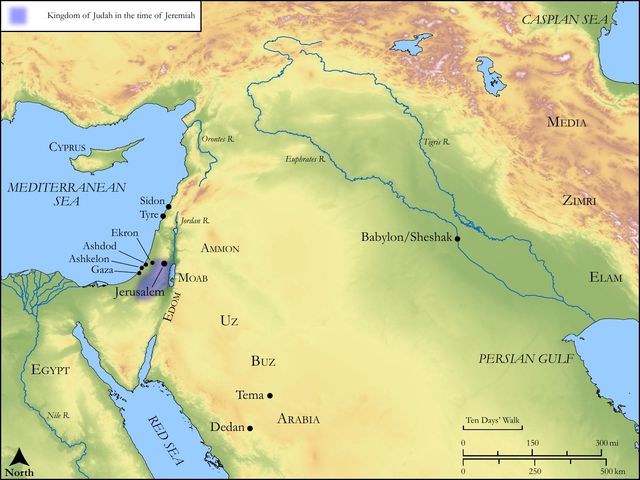
See on the biblical-era map
Study this verse
Public-domain commentary
Matthew Henry
From his Commentary on the Whole Bible. Henry comments on passages, not single verses — this entry covers Jeremiah 25:30–38.
We have, in these verses, a further description of those terrible desolations which the king of Babylon with his armies should make in all the countries and nations round about Jerusalem. In Jerusalem God had erected his temple; there were his oracles and ordinances, which the neighbouring nations should have attended to and might have received benefit by; thither they should have applied for the knowledge of God and their duty, and then they might have had reason to bless God for their neighbourhood to Jerusalem; but they, instead of that, taking all opportunities either to debauch or to disturb that holy city, when God came to reckon with Jerusalem because it learned so much of the way of the nations, he reckoned with the nations because they learned so little of the way of Jerusalem.
They will soon be aware of Nebuchadrezzar's making war upon them; but the prophet is here directed to tell them that it is God himself that makes war upon them, a God with whom there is no contending. 1. The war is here proclaimed (Jer 25:30): The Lord shall roar from on high; not from Mount Zion and Jerusalem (as Joe 3:16, Amo 1:2), but from heaven, from his holy habitation there; for now Jerusalem is one of the places against which he roars. He shall mightily roar upon his habitation on earth from that above. He has been long silent, and seemed not to take notice of the wickedness of the nations; the times of this ignorance God winked at; but now he shall give a shout, as the assailants in battle do, against all the inhabitants of the earth, to whom it shall be a shout of terror, and yet a shout of joy in heaven, as theirs that tread the grapes; for, when God is reckoning with the proud enemies of his kingdom among men, there is a great voice of much people heard in heaven, saying, Hallelujah, Rev 19:1. He roars as a lion (Amo 3:4, Amo 3:8), as a lion that has forsaken his covert (Jer 25:38), and is going abroad to seek his prey, upon which he roars, that he may the more easily seize it. 2. The manifesto is here published, showing the causes and reasons why God proclaims this war (Jer 25:31): The Lord has a controversy with the nations; he has just cause to contend with them, and he will take this way of pleading with them. His quarrel with them is, in one word, for their wickedness, their contempt of him, and his authority over them and kindness to them. He will give those that are wicked to the sword. They have provoked God to anger, and thence comes all this destruction; it is because of the fierce anger of the Lord (Jer 25:37 and again Jer 25:38), the fierceness of the oppressor, or (as it might better be read) the fierceness of the oppressing sword (for the word is feminine) is because of his fierce anger; and we are sure that he is never angry without cause; but who knows the power of his anger? 3. The alarm is here given and taken: A noise will come even to the ends of the earth, so loud shall it roar, so far shall it reach, Jer 25:31. The alarm is not given by sound of trumpet, or beat of drum, but by a whirlwind, a great whirlwind, storm, or tempest, which shall be raised up from the coasts, the remote coasts of the earth, Jer 25:32. The Chaldean army shall be like a hurricane raised in the north, but thence carried on with incredible fierceness and swiftness, bearing down all before it. It is like the whirlwind out of which God answered Job, which was exceedingly terrible, Job 37:1; Job 38:1. And, when the wrath of God thus roars like a lion from heaven, no marvel if it be echoed with shrieks from earth; for who can choose but tremble when God thus speaks in displeasure? See Hos 11:10. Now the shepherds shall howl and cry, the kings, and princes, and the great ones of the earth, the principal of the flock. They used to be the most courageous and secure, but now their hearts shall fail them; they shall wallow themselves in the ashes, Jer 25:34. Seeing themselves utterly unable to make head against the enemy, and seeing their country, which they have the charge of and a concern for, inevitably ruined, they shall abandon themselves to sorrow. There shall be a voice of the cry of the shepherds, and a howling of the principal of the flock shall be heard, Jer 25:36. Those are great calamities indeed that strike such a terror upon the great men, and put them into this consternation. The Lord hath spoiled their pasture, in which they fed their flock, and out of which they fed themselves; the spoiling of that makes them cry-out thus. Perhaps, carrying on the metaphor of a lion roaring, it alludes to the great fright that shepherds are in when they hear a roaring lion coming towards their flocks, and find they have no way to flee (Jer 25:35) for their own safety, neither can the principal of their flock escape. The enemy will be so numerous, so furious, so sedulous, and the extent of their armies so vast, that it will be impossible to avoid falling into their hands. Note, As we cannot out-face, so we cannot out-run, the judgments of God. This is that for which the shepherds howl and cry. 4. The progress of this war is here described (Jer 25:32): Behold, evil shall go forth from nation to nation; as the cup goes round, every nation shall have its share and take warning by the calamities of another to repent and reform. Nay, as if this ere to be a little representation of the last and general judgment, it shall reach from one end of the earth even unto the other end of the earth, Jer 25:33. The day of vengeance is in his heart, and now his hand shall find out all his enemies, wherever they are, Psa 21:8. Note, When our neighbour's house is on fire it is time to be concerned for our own. When one nation is a seat of war every neighbouring nation should hear, and fear, and make its peace with God. 5. The dismal consequences of this war are here foretold: The days of slaughter and dispersions are accomplished, that is, they are fully come (Jer 25:34), the time fixed in the divine counsel for the slaughter of some and the dispersion of the rest, which will make the nations completely desolate. Multitudes shall fall by the sword of the merciless Chaldeans, so that the slain of the Lord shall be every where found: they are slain by commission from him, and are sacrificed to his justice. The slain for sin are the slain of the Lord. To complete the misery of their slaughter, they shall not be lamented in particular, so general shall the matter of lamentation be. Nay, they shall not be gathered up, nor buried, for they shall have no friends left to bury them, and the enemies shall not have so much humanity in them as to do it; and then they shall be as dung upon the earth, so vile and noisome: and it is well if, as dung manures the earth and makes it fruitful, so these horrid spectacles, which lie as monuments of divine justice, might be a means to awaken the inhabitants of the earth to learn righteousness. The effect of this war will be the desolation of the whole land that is the seat of it (Jer 25:38), one land after another. But here are two expressions more that seem to make the case in a particular manner piteous. (1.) You shall fall like a pleasant vessel, Jer 25:34. The most desirable persons among them, who most valued themselves and were most valued, who were looked upon as vessels of honour, shall fall by the sword. You shall fall as a Venice glass or a China dish, which is soon broken all to pieces. Even the tender and delicate shall share in the common calamity; the sword devours one as well as another. (2.) Even the peaceable habitations are cut down. Those that used to be quiet, and not molested, the habitations in which you have long dwelt in peace, shall now be no longer such, but cut down by the war. Or, Those who used to be quiet, and not molesting any of their neighbours, those who lived in peace, easily, and gave no provocation to any, even those shall not escape. This is one of the direful effects of war, that even those who were most harmless and inoffensive suffer hard things. Blessed be God, there is a peaceable habitation above for all the sons of peace, which is out of the reach of fire and sword.
Historical interpretation
Historical reception
1 surviving comment on this verse from the historical church.
(Verse 30, 31.) And you shall prophesy to them all these words, and you shall say to them: The Lord will roar from on high (or give a response), and from His holy habitation He will utter His voice. He roars loudly over His glorious place (or responds to His place), His shout resounds like those who trample the earth. The sound (or destruction) reaches to the ends (or above) of the earth: for the Lord has a judgment with the nations: He shall judge all flesh: I have given the wicked (or I gave the wicked) to the sword, says the Lord. First, let us say that the truth of the interpretation is evident. You will prophesy to all nations, he says, and you will declare that the Lord roars from on high, that is, he gives a clear sign of his anger; according to what is written: The lion will roar, and who will not fear? The Lord has spoken, and who will not prophesy? And from his holy dwelling he will make his voice heard, to terrify all who hear it. He will roar over his sanctuary, that is, over the Temple. And when he roars like those treading the winepress, a loud noise will be sung, and during the pouring out of the mutual blood, a mournful song will be chanted: which Symmachus calls a conclusion; Aquila, a remedy. The sound of this singing and song will reach to the ends of the earth, because the judgment of the Lord is with the nations. But if the judgment of the Lord is with the nations, then the merits of the nations are different (Hosea 4). To explain that passage, as some want: Whoever does not believe is already judged (John 3:18). Indeed, he is judged because he did not believe; but those who do not believe among themselves will be subjected to different punishments. He himself is judged with all flesh, so that no one may leave uninjudged. But the ungodly, that is, those who do not believe in the Lord, are handed over to eternal sword. Allegorical interpreters according to the Septuagint explain this passage in such a way that they interpret the Lord's open threat in a positive manner. The Lord, they say, will give a response from on high to those whom he intends to save. And from His holy place He will give His voice, and He will answer with His word in His place. But they, like reapers full of fruit, will respond to His message: Destruction will come upon all the inhabitants of the earth, not upon the whole earth, but upon a part of the earth, namely those who do not believe. Judgment will be among the nations, and He will judge with all flesh. But the wicked will be delivered by the sword.
Continue studying Jeremiah 25:31 across the web’s major study libraries — every link below opens this exact verse, chapter, or book on the destination site.
Read & Compare
 BibleGatewayThis verse in more than 200 translations and 70 languages.
 Bible.comThe YouVersion reader — hundreds of translations, reading plans, and highlights.
 ESV.orgCrossway's official English Standard Version reader.
 NET BibleThe NET translation with 60,000+ translators' notes on every rendering decision.
 STEP BibleTyndale House's free study tool — original text, vocabulary, and scholarly resources.
 BibliaLogos Bible Software's free web reader.
 USCCBThe New American Bible (Revised Edition) with the U.S. bishops' study notes.
Commentaries
 BibleHub CommentariesDozens of classic commentaries on this verse, gathered on one page.
 StudyLightMore than 100 commentary sets — the largest collection on the web.
 BibleRefPlain-English commentary on what this verse means, verse by verse.
 Enduring WordDavid Guzik's free commentary on this chapter, widely used by Bible teachers.
 Bible Study ToolsVerse commentary alongside Greek and Hebrew study aids.
Original Language & Research
- BibleHub InterlinearThe verse word by word — original language, transliteration, and English.
- BibleHub LexiconEvery word's original-language definition and Strong's entry.
 Blue Letter BibleDeep-study tools — Strong's numbers, concordance, and word studies.
 SefariaThe Hebrew text with Rashi and centuries of Jewish commentary.
Sermons, Hymns & Audio


TrulyRandomVerse is not affiliated with these sites and doesn’t control their content. They’re linked because they’re genuinely useful.
Summary
Jeremiah 25:31 serves as a profound prophetic declaration, announcing the LORD's impending and widespread judgment upon the nations. It foretells a "noise"—a tumultuous uproar signifying divine retribution—that will reverberate "to the ends of the earth," emphasizing the universal scope of God's sovereign authority. The verse powerfully depicts God engaging in a legal "controversy" with all humanity, acting as both prosecutor and judge, ultimately condemning the wicked to destruction by the "sword," thereby underscoring the certainty and severity of His righteous justice against all unrighteousness.
Context
ShowHideLiterary Context
Jeremiah 25 is a pivotal chapter within the book of Jeremiah, consolidating prophecies delivered during a critical period in Judah's history, specifically the fourth year of King Jehoiakim's reign, just prior to Nebuchadnezzar's initial invasion of Judah. The chapter sets the stage by recounting Judah's persistent disobedience and rejection of God's warnings delivered through His prophets, despite divine patience and numerous calls to repentance, as highlighted in Jeremiah 25:3-7. This historical context culminates in the pronouncement of the seventy-year Babylonian captivity for Judah, a direct consequence of their unfaithfulness (Jeremiah 25:11). Jeremiah 25:31 is situated within a broader oracle often referred to as the "Cup of Wrath" prophecy, spanning Jeremiah 25:15-29, where God commands Jeremiah to compel various nations to drink from a cup symbolizing His furious judgment. This particular verse functions as a climactic summary statement, emphasizing the universal reach and the judicial nature of this divine reckoning, which inevitably leads to the destruction of the wicked.
Historical & Cultural Context
The prophetic message of Jeremiah 25 was delivered during a period of profound geopolitical upheaval among the nations. The Neo-Babylonian Empire was rapidly consolidating its power under Nebuchadnezzar, challenging the waning influence of the Assyrian Empire and the declining strength of Egypt. Judah, under the reign of King Jehoiakim, found itself precariously positioned between these formidable regional powers, often vacillating in its political alliances and, more significantly, in its covenant faithfulness to Yahweh. Culturally, the concept of a divine "controversy" or "lawsuit" (Hebrew: rîyb) was a familiar legal metaphor among the prophets of Israel, as in Micah's word, "the LORD hath a controversy with his people." The LORD was often depicted as bringing charges against a rebellious people or against nations who had transgressed His covenant or His decrees. Jeremiah's prophecy masterfully employs this imagery to convey that God's impending judgment is not an arbitrary display of raw power but a just and righteous legal proceeding against nations that have consistently violated His universal moral order, engaged in idolatry, and oppressed His people. The "sword" (Hebrew: chereb) was a ubiquitous instrument of warfare and execution in this era, serving as a potent symbol of the violent, destructive, and decisive nature of the impending divine judgment.
Key Themes
ShowHideJeremiah 25:31 powerfully articulates several foundational themes prevalent throughout the book of Jeremiah and the broader corpus of prophetic literature. Firstly, it emphatically underscores the Universal Sovereignty of God, demonstrating that the LORD's authority and jurisdiction extend far beyond the confines of Judah to encompass "all flesh" and "the ends of the earth." He is depicted not merely as a tribal deity but as the supreme judge over all nations, holding them accountable for their actions. Secondly, the verse highlights the critical theme of Divine Justice and Accountability, portraying God as an unyielding and righteous judge who holds nations responsible for their moral transgressions. The "controversy" (Jeremiah 25:31) signifies a formal legal case brought against the nations for their pervasive wickedness and rebellion against His moral law, a theme echoed in numerous oracles against foreign nations throughout the Old Testament, such as those found in Isaiah 13-23. Thirdly, it emphasizes the Inevitable Consequences of Wickedness, unequivocally stating that "them that are wicked" are "given to the sword." This illustrates the inescapable truth that persistent unrighteousness, idolatry, and injustice inevitably lead to divine retribution and destruction, a principle consistently affirmed in wisdom literature like Proverbs 11:21. Finally, the concluding phrase "saith the LORD" reinforces the Certainty and Authority of God's Word, affirming that these prophecies are not mere human predictions but divinely ordained declarations that will assuredly come to pass, demonstrating God's faithfulness to His pronouncements.
Exposition and Analysis
ShowHideKey Word Analysis
ShowHideThis term (H7379) denotes a legal dispute, a lawsuit, or a contention. In the context of Jeremiah 25:31, it powerfully portrays the LORD as a divine plaintiff who is bringing formal charges against the nations. It signifies that God's actions are not arbitrary displays of power but are rooted in a just accusation and a righteous verdict against the pervasive unrighteousness and rebellion of humanity and the nations. This implies a formal, judicial process where God is the aggrieved party, asserting His sovereign rights and moral authority.
The word (H8199) primarily means to judge, to govern, or to execute judgment. While it can carry the nuance of arguing or litigating a case, in this specific context, especially following the declaration of a "controversy" and preceding the outcome of the "sword," it signifies the active carrying out of a judicial sentence. God is not merely engaging in a debate; He is acting as both the prosecutor and the executor of justice, bringing His verdict to fruition through decisive and punitive action.
This adjective (H7563) describes someone who is morally wrong, ungodly, or concretely, an actively bad person. It refers to those who are guilty, condemned, and stand in direct opposition to God's righteous standards and moral law. In Jeremiah 25:31, this term specifically identifies the recipients of God's severe judgment—those whose actions, character, and spiritual orientation are fundamentally out of alignment with divine justice and morality, thus meriting divine retribution.
Verse Breakdown
ShowHide"A noise shall come [even] to the ends of the earth"
This opening clause vividly describes the widespread and inescapable impact of God's impending judgment. The "noise" (H7588, shâʼôwn) suggests a great uproar, tumult, or the terrifying din of war and destruction, indicating a cataclysmic event. The phrase "to the ends of the earth" (H7097, qâtseh and H776, ʼerets) emphatically conveys the universal, inescapable scope of this divine reckoning, signifying that no nation or people group, no matter how remote, will be untouched by the consequences of their actions.
"for the LORD hath a controversy with the nations"
This clause provides the divine rationale and theological foundation for the impending "noise." The LORD (H3068, Yᵉhôvâh), the covenant God of Israel and the sovereign Creator, is depicted as having a legal "controversy" (H7379, rîyb) or formal lawsuit against "the nations" (H1471, gôwy). This signifies that God's judgment is not arbitrary or capricious but is a just and warranted response to the accumulated sins, idolatry, oppression, and rebellion perpetrated by the peoples of the earth against His universal moral order.
"he will plead with all flesh"
Building upon the established legal imagery, this phrase further elaborates on God's active engagement in this divine lawsuit. To "plead" (H8199, shâphaṭ) here means to judge, to pronounce sentence, or to execute judgment. "All flesh" (H1320, bâsâr) is a comprehensive and inclusive term for all humanity, emphasizing the universal reach of God's judicial action. It means God will directly confront, indict, and judge every individual and nation without exception.
"he will give them [that are] wicked to the sword, saith the LORD."
This final clause declares the inevitable and severe outcome of God's judgment. Those identified as "wicked" (H7563, râshâʻ) will be "given" (H5414, nâthan) to the "sword" (H2719, chereb), a powerful and stark symbol of violent destruction, divine wrath, and the ultimate consequence of unrighteousness, often enacted through warfare and conquest. The concluding "saith the LORD" (H5002, nᵉʼum and H3068, Yᵉhôvâh) serves as an authoritative divine stamp, guaranteeing the absolute certainty, immutability, and divine origin of this prophetic pronouncement.
Literary Devices
ShowHideJeremiah 25:31 masterfully employs several potent literary devices to convey its message of universal and decisive judgment. Hyperbole is vividly evident in the phrase "A noise shall come [even] to the ends of the earth," which dramatically emphasizes the vast, inescapable, and globally comprehensive reach of God's impending judgment, suggesting a scale of destruction that is truly universal. Anthropomorphism is central to the verse, as God is portrayed with human-like actions and attributes: He "hath a controversy" and "will plead." This device makes the abstract concept of divine justice relatable and tangible, presenting God as a righteous judge engaged in a formal legal dispute with humanity, highlighting His active involvement in human affairs. The "sword" functions as a powerful Symbol or Metonymy, representing not merely a physical weapon but the broader concept of violent destruction, divine wrath, and the ultimate, fatal consequence of unrighteousness and rebellion against God. Finally, the repetition of "saith the LORD" at the end serves as a powerful Affirmation of divine authority, reinforcing the absolute certainty, immutability, and divine origin of the prophecy, leaving no doubt as to its inevitable fulfillment.
Theological and Thematic Connections
ShowHideJeremiah 25:31 stands as a profound theological statement on God's universal sovereignty and His unwavering commitment to justice. It decisively dismantles any notion of a limited, tribal deity, asserting Yahweh's supreme authority over all nations and peoples, demonstrating that His dominion extends far beyond Israel's borders. The "controversy" highlights that God's judgment is not capricious or arbitrary but is based on a righteous legal case against the deep-seated wickedness of humanity. This divine reckoning serves as a stark and sobering reminder that sin, whether individual or corporate, carries severe and inevitable consequences, and no one is exempt from ultimate accountability before the Creator. This passage powerfully foreshadows a future day of universal judgment where all will face the consequences of their actions, ultimately affirming God's immutable character as both perfectly just and absolutely holy.
Reflection and Application
ShowHideJeremiah 25:31 serves as a timeless and profoundly sobering reminder of God's ultimate authority and the certainty of His justice. In a world often marked by pervasive injustice, moral relativism, and the apparent impunity of the wicked, this verse stands as an unshakeable declaration that a day of comprehensive reckoning is coming for all. It challenges us to deeply consider our own accountability, not just as isolated individuals but also as integral members of communities and nations. Are we actively living in alignment with God's righteous standards, or are we, through our actions or inactions, contributing to the "wickedness" that inevitably incurs divine judgment? This passage calls us to cultivate a profound sense of humility and reverence before the Almighty, urging us to recognize that our choices and actions, both personal and collective, have eternal consequences. Furthermore, it offers a measure of profound hope for the oppressed and overlooked, knowing with certainty that the God of perfect justice will ultimately right all wrongs, vindicate the righteous, and bring a decisive end to all unrighteousness, establishing His perfect order.
Questions for Reflection
ShowHideFAQ
ShowHideWhat does "the LORD hath a controversy with the nations" mean?
ShowHideThis phrase signifies that God is initiating a formal legal case or lawsuit against the nations of the world. It portrays the LORD as a divine judge and prosecutor, holding all peoples accountable for their pervasive unrighteousness, idolatry, and rebellion against His moral law and universal standards. It implies that His impending judgment is not an arbitrary act of power but a just and warranted response to their accumulated sins, much like a legal proceeding where charges are laid, evidence is presented, and a righteous verdict is rendered. This concept is deeply rooted in the biblical understanding of God's covenant relationship with humanity and His role as the sovereign ruler over all creation, as seen in passages like Micah 6:2.
Does "he will plead with all flesh" imply God will reason with people, or something else?
ShowHideWhile the word "plead" can sometimes carry the nuance of reasoning or arguing a case, in the specific context of Jeremiah 25:31, especially when paired with the preceding "controversy" and the ensuing outcome of "the sword," it carries the much stronger and more definitive meaning of executing judgment or pronouncing and carrying out a sentence. The Hebrew word (shâphaṭ) primarily means to judge, govern, or carry out a judicial verdict. Therefore, "he will plead with all flesh" means God will actively and decisively judge all humanity, bringing His divine sentence to bear upon them. It is not a negotiation or a debate, but a powerful declaration and execution of His righteous judgment, as further illustrated in other judgment passages like Joel 3:2.
Christ-Centered Fulfillment
ShowHideJeremiah 25:31, with its pronouncement of universal judgment and the "sword" of divine wrath, finds its ultimate fulfillment and profound reinterpretation in the person and redemptive work of Jesus Christ. While the Old Testament prophets foretold a coming day when God would "plead with all flesh" and bring judgment upon the wicked, the New Testament reveals that this divine authority to judge is ultimately committed entirely to the Son. John 5:22 unequivocally declares that the Father "judges no one, but has given all judgment to the Son." Jesus, who first came as the sacrificial Lamb of God to take away the sin of the world (John 1:29), will return not only as Savior but also as the righteous and sovereign Judge, wielding the "sword" of His word. Revelation 19:15 vividly portrays Christ with a sharp sword coming out of His mouth, "with which to strike down the nations," symbolizing His authoritative and decisive judgment. Thus, the "controversy with the nations" and the giving of the wicked to the "sword" are not merely historical events but point forward to Christ's final, decisive judgment at the end of the age, where He will justly separate the righteous from the wicked and establish His eternal kingdom in perfect righteousness (Matthew 25:31-46). In Him, both the terrifying severity of God's holiness and the boundless richness of His mercy are perfectly revealed, offering salvation and redemption to "all flesh" who repent and believe, even as He remains the one before whom "every knee should bow" in ultimate accountability and worship (Philippians 2:10-11).