


Jeremiah 25:32
Bible text: King James Version (1769 Blayney text) · Public domain
Bible text: King James Version with Strong's numbers · Public domain
Bible text: Berean Standard Bible · Public domain
Bible text: American Standard Version (1901) · Public domain
Bible text: World English Bible, Messianic edition · Public domain
Bible text: Geneva Bible (1599) · Public domain
Bible text: Young's Literal Translation · Public domain
- כֹּהkohthusH3541AdvAdverb
- אָמַר'a·Marhe saysH559V-Qal-Perf-3msVerb Qal Perfect 3rd Singular Masculine
- יְהוָהYah·wehYahwehH3068N-properNoun Proper Title
- צְבָאוֹתtze·va·'otof hostsH6635N-fpNoun Plural Feminine Absolute
- הִנֵּהhi·Nehthere!H2009PrtParticle Interjection
- רָעָהra·'AhcalamityH7451N-fsNoun Singular Feminine Absolute
- יֹצֵאתyo·Tzet[is] about to go forthH3318V-Qal-Prtcpl-fsVerb Qal Participle Singular Feminine Absolute
- מִגּוֹיmi·Goyfrom nationH1471Prep-m ¦ N-msNoun Singular Masculine Absoluteמִfromגּוֹיnation
- אֶל'eltoH413PrepPreposition
- גּוֹיGoynationH1471N-msNoun Singular Masculine Absolute
- וְסַעַרve·Sa·'arand a stormH5591Conj-w ¦ N-msNoun Singular Masculine Absoluteוְandסַעַרa storm
- גָּדוֹלga·DolgreatH1419Adj-msAdjective Singular Masculine Absolute
- יֵעוֹרye·'orit will be rousedH5782V-Niphal-Imperf-3msVerb Niphal Imperfect 3rd Singular Masculine
- מִיַּרְכְּתֵיmi·yar·ke·teifrom [the] remotest parts ofH3411Prep-m ¦ N-fdcNoun Dual Feminine Constructמִfromיַּרְכְּתֵי[the] remotest parts of
- אָרֶץ'A·retz[the] earthH776N-fsNoun Singular Feminine Absolute
English is a literal word-by-word gloss of the Hebrew, not the KJV's wording. Why?
This is the original text the KJV's translators worked from — each Hebrew word with its own literal English meaning in this verse, prepared by scholars at Tyndale House, Cambridge. The KJV translates whole sentences, not word by word, so its wording differs: one Hebrew word can become several English words, and the KJV may choose “the LORD” where the gloss reads “Yahweh”. Both are faithful — they answer different questions. For the KJV's own rendering, switch to the KJV text.
Details
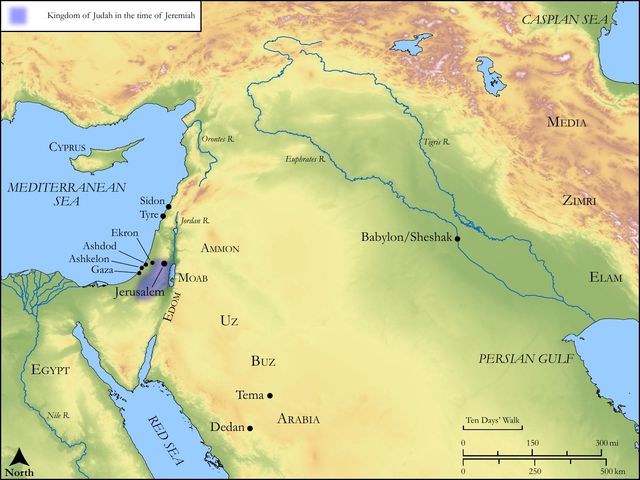
See on the biblical-era map
Study this verse
Public-domain commentary
Matthew Henry
From his Commentary on the Whole Bible. Henry comments on passages, not single verses — this entry covers Jeremiah 25:30–38.
We have, in these verses, a further description of those terrible desolations which the king of Babylon with his armies should make in all the countries and nations round about Jerusalem. In Jerusalem God had erected his temple; there were his oracles and ordinances, which the neighbouring nations should have attended to and might have received benefit by; thither they should have applied for the knowledge of God and their duty, and then they might have had reason to bless God for their neighbourhood to Jerusalem; but they, instead of that, taking all opportunities either to debauch or to disturb that holy city, when God came to reckon with Jerusalem because it learned so much of the way of the nations, he reckoned with the nations because they learned so little of the way of Jerusalem.
They will soon be aware of Nebuchadrezzar's making war upon them; but the prophet is here directed to tell them that it is God himself that makes war upon them, a God with whom there is no contending. 1. The war is here proclaimed (Jer 25:30): The Lord shall roar from on high; not from Mount Zion and Jerusalem (as Joe 3:16, Amo 1:2), but from heaven, from his holy habitation there; for now Jerusalem is one of the places against which he roars. He shall mightily roar upon his habitation on earth from that above. He has been long silent, and seemed not to take notice of the wickedness of the nations; the times of this ignorance God winked at; but now he shall give a shout, as the assailants in battle do, against all the inhabitants of the earth, to whom it shall be a shout of terror, and yet a shout of joy in heaven, as theirs that tread the grapes; for, when God is reckoning with the proud enemies of his kingdom among men, there is a great voice of much people heard in heaven, saying, Hallelujah, Rev 19:1. He roars as a lion (Amo 3:4, Amo 3:8), as a lion that has forsaken his covert (Jer 25:38), and is going abroad to seek his prey, upon which he roars, that he may the more easily seize it. 2. The manifesto is here published, showing the causes and reasons why God proclaims this war (Jer 25:31): The Lord has a controversy with the nations; he has just cause to contend with them, and he will take this way of pleading with them. His quarrel with them is, in one word, for their wickedness, their contempt of him, and his authority over them and kindness to them. He will give those that are wicked to the sword. They have provoked God to anger, and thence comes all this destruction; it is because of the fierce anger of the Lord (Jer 25:37 and again Jer 25:38), the fierceness of the oppressor, or (as it might better be read) the fierceness of the oppressing sword (for the word is feminine) is because of his fierce anger; and we are sure that he is never angry without cause; but who knows the power of his anger? 3. The alarm is here given and taken: A noise will come even to the ends of the earth, so loud shall it roar, so far shall it reach, Jer 25:31. The alarm is not given by sound of trumpet, or beat of drum, but by a whirlwind, a great whirlwind, storm, or tempest, which shall be raised up from the coasts, the remote coasts of the earth, Jer 25:32. The Chaldean army shall be like a hurricane raised in the north, but thence carried on with incredible fierceness and swiftness, bearing down all before it. It is like the whirlwind out of which God answered Job, which was exceedingly terrible, Job 37:1; Job 38:1. And, when the wrath of God thus roars like a lion from heaven, no marvel if it be echoed with shrieks from earth; for who can choose but tremble when God thus speaks in displeasure? See Hos 11:10. Now the shepherds shall howl and cry, the kings, and princes, and the great ones of the earth, the principal of the flock. They used to be the most courageous and secure, but now their hearts shall fail them; they shall wallow themselves in the ashes, Jer 25:34. Seeing themselves utterly unable to make head against the enemy, and seeing their country, which they have the charge of and a concern for, inevitably ruined, they shall abandon themselves to sorrow. There shall be a voice of the cry of the shepherds, and a howling of the principal of the flock shall be heard, Jer 25:36. Those are great calamities indeed that strike such a terror upon the great men, and put them into this consternation. The Lord hath spoiled their pasture, in which they fed their flock, and out of which they fed themselves; the spoiling of that makes them cry-out thus. Perhaps, carrying on the metaphor of a lion roaring, it alludes to the great fright that shepherds are in when they hear a roaring lion coming towards their flocks, and find they have no way to flee (Jer 25:35) for their own safety, neither can the principal of their flock escape. The enemy will be so numerous, so furious, so sedulous, and the extent of their armies so vast, that it will be impossible to avoid falling into their hands. Note, As we cannot out-face, so we cannot out-run, the judgments of God. This is that for which the shepherds howl and cry. 4. The progress of this war is here described (Jer 25:32): Behold, evil shall go forth from nation to nation; as the cup goes round, every nation shall have its share and take warning by the calamities of another to repent and reform. Nay, as if this ere to be a little representation of the last and general judgment, it shall reach from one end of the earth even unto the other end of the earth, Jer 25:33. The day of vengeance is in his heart, and now his hand shall find out all his enemies, wherever they are, Psa 21:8. Note, When our neighbour's house is on fire it is time to be concerned for our own. When one nation is a seat of war every neighbouring nation should hear, and fear, and make its peace with God. 5. The dismal consequences of this war are here foretold: The days of slaughter and dispersions are accomplished, that is, they are fully come (Jer 25:34), the time fixed in the divine counsel for the slaughter of some and the dispersion of the rest, which will make the nations completely desolate. Multitudes shall fall by the sword of the merciless Chaldeans, so that the slain of the Lord shall be every where found: they are slain by commission from him, and are sacrificed to his justice. The slain for sin are the slain of the Lord. To complete the misery of their slaughter, they shall not be lamented in particular, so general shall the matter of lamentation be. Nay, they shall not be gathered up, nor buried, for they shall have no friends left to bury them, and the enemies shall not have so much humanity in them as to do it; and then they shall be as dung upon the earth, so vile and noisome: and it is well if, as dung manures the earth and makes it fruitful, so these horrid spectacles, which lie as monuments of divine justice, might be a means to awaken the inhabitants of the earth to learn righteousness. The effect of this war will be the desolation of the whole land that is the seat of it (Jer 25:38), one land after another. But here are two expressions more that seem to make the case in a particular manner piteous. (1.) You shall fall like a pleasant vessel, Jer 25:34. The most desirable persons among them, who most valued themselves and were most valued, who were looked upon as vessels of honour, shall fall by the sword. You shall fall as a Venice glass or a China dish, which is soon broken all to pieces. Even the tender and delicate shall share in the common calamity; the sword devours one as well as another. (2.) Even the peaceable habitations are cut down. Those that used to be quiet, and not molested, the habitations in which you have long dwelt in peace, shall now be no longer such, but cut down by the war. Or, Those who used to be quiet, and not molesting any of their neighbours, those who lived in peace, easily, and gave no provocation to any, even those shall not escape. This is one of the direful effects of war, that even those who were most harmless and inoffensive suffer hard things. Blessed be God, there is a peaceable habitation above for all the sons of peace, which is out of the reach of fire and sword.
Historical interpretation
Historical reception
1 surviving comment on this verse from the historical church.
(Verse 32, 33.) Thus says the Lord of hosts: Behold, affliction (or evil) will come forth from nation to nation, and a great whirlwind (or storm) will come forth from the ends of the earth. And those slain (or wounded by the Lord) on that day will be from one end of the earth to the other end. They shall not be lamented, nor shall they be gathered or buried; they shall lie on the surface of the earth like manure. Let those who try to do violence to the Holy Scripture be ashamed, as they interpret those things which are full of threats in a positive way. But concerning this matter, I believe the Lord also said: 'A nation will rise against a nation, and a kingdom against a kingdom' (Luke 21:10), and the other things that are contained in the sentiment of the Gospel. Let us understand these things either according to the historical events themselves, when all the nations around were subjugated by the Babylonian king and felt the cruelty of his empire, or according to the prophecy that will happen long after in the end of the world. They are said to be killed by the Lord, not because the Lord Himself strikes, but so that in the destruction of the wicked, the will and authority of the Lord may be fulfilled.
Continue studying Jeremiah 25:32 across the web’s major study libraries — every link below opens this exact verse, chapter, or book on the destination site.
Read & Compare
 BibleGatewayThis verse in more than 200 translations and 70 languages.
 Bible.comThe YouVersion reader — hundreds of translations, reading plans, and highlights.
 ESV.orgCrossway's official English Standard Version reader.
 NET BibleThe NET translation with 60,000+ translators' notes on every rendering decision.
 STEP BibleTyndale House's free study tool — original text, vocabulary, and scholarly resources.
 BibliaLogos Bible Software's free web reader.
 USCCBThe New American Bible (Revised Edition) with the U.S. bishops' study notes.
Commentaries
 BibleHub CommentariesDozens of classic commentaries on this verse, gathered on one page.
 StudyLightMore than 100 commentary sets — the largest collection on the web.
 BibleRefPlain-English commentary on what this verse means, verse by verse.
 Enduring WordDavid Guzik's free commentary on this chapter, widely used by Bible teachers.
 Bible Study ToolsVerse commentary alongside Greek and Hebrew study aids.
Original Language & Research
- BibleHub InterlinearThe verse word by word — original language, transliteration, and English.
- BibleHub LexiconEvery word's original-language definition and Strong's entry.
 Blue Letter BibleDeep-study tools — Strong's numbers, concordance, and word studies.
 SefariaThe Hebrew text with Rashi and centuries of Jewish commentary.
Sermons, Hymns & Audio


TrulyRandomVerse is not affiliated with these sites and doesn’t control their content. They’re linked because they’re genuinely useful.
Summary
Jeremiah 25:32 delivers a profound prophetic declaration from the LORD of hosts, foretelling a widespread and devastating judgment that will sweep across the nations. This verse encapsulates the climax of a series of oracles concerning God's impending wrath, signifying a global catastrophe that originates from divine decree and will manifest with the irresistible force of a great whirlwind, affecting even the remotest parts of the earth. It underscores God's absolute sovereignty over all peoples and His unwavering commitment to justice, revealing a divine reckoning that extends far beyond Judah to encompass the entire known world.
Context
ShowHideLiterary Context
Jeremiah 25 stands as a pivotal chapter within the book of Jeremiah, marking a significant shift from prophecies primarily directed at Judah to a broader, universal scope of judgment. Preceding this verse, Jeremiah has detailed Judah's seventy years of Babylonian captivity due to their persistent idolatry and disobedience, as prophesied in Jeremiah 25:1-11. The "cup of wrath" prophecy, beginning in Jeremiah 25:15, describes God commanding Jeremiah to make all nations drink from this cup, signifying their impending destruction. Verse 32 specifically introduces the far-reaching and overwhelming nature of this judgment, acting as a summary statement of the global devastation that will ensue, extending beyond Judah to all the kingdoms of the earth. It is part of a larger oracle that culminates in the destruction of Babylon itself, demonstrating God's ultimate control over all empires and their destinies.
Historical & Cultural Context
The prophecy in Jeremiah 25 is generally dated to the fourth year of Jehoiakim, king of Judah (circa 605 BC), a critical juncture in the ancient Near East. This period saw the rapid ascendancy of the Neo-Babylonian Empire under Nebuchadnezzar, which had just decisively defeated Egypt at the Battle of Carchemish. Judah, caught between these two superpowers, had aligned itself with Egypt, a decision Jeremiah consistently warned against. The cultural understanding of divine judgment often involved the use of conquering armies as instruments of God's wrath, a concept deeply embedded in Israelite prophetic tradition. The "whirlwind" imagery would have resonated powerfully with the destructive force of desert storms, a familiar and terrifying natural phenomenon in the region, making the metaphor of God's judgment vivid and immediate to Jeremiah's audience.
Key Themes
ShowHideJeremiah 25:32 powerfully contributes to several overarching themes found throughout the book of Jeremiah and the Old Testament. Firstly, it highlights Divine Sovereignty, asserting God's absolute authority not only over His covenant people but over all nations and the course of human history. He is the "LORD of hosts," capable of orchestrating global events to fulfill His purposes. Secondly, the verse emphasizes Universal Judgment, demonstrating that God's justice is not limited to Israel but extends to all who rebel against His moral order. This foreshadows the broader biblical truth that all humanity is accountable to God, as articulated in Romans 3:23. Thirdly, the imagery of the "whirlwind" underscores the Irresistibility of God's Wrath and the futility of human resistance against His decreed judgments. Finally, it reinforces the theme of Prophetic Warning and Fulfillment, where God's words spoken through His prophets are not idle threats but certainties that will come to pass, urging repentance before the inevitable judgment, as seen in Ezekiel 33:11.
Exposition and Analysis
ShowHideKey Word Analysis
ShowHideThis profound divine title combines H3068 (Yᵉhôvâh), signifying "the self-Existent or Eternal," the Jewish national name of God, with H6635 (tsâbâʼ), meaning "a mass of persons (or figuratively, things), especially reg. organized for war (an army)." Together, "LORD of hosts" emphasizes God's supreme authority and power as the commander of heavenly armies and earthly forces. It portrays Him as the sovereign orchestrator of global events, capable of raising up and casting down nations to bring about His decreed judgments. The title reinforces that the impending "evil" is not random chaos but a deliberate, organized act of divine justice.
Derived from a root meaning "bad" or "to break," this word encompasses both moral evil (wickedness, naughtiness) and the calamitous consequences of evil, such as adversity, affliction, and disaster. In Jeremiah 25:32, while rooted in the moral evil and rebellion of nations, "evil" primarily refers to the devastating judgment and calamity that will be unleashed upon them. It signifies the destructive effects of God's wrath, manifesting as widespread suffering, war, and societal collapse, rather than merely a moral failing.
This term, which can also appear as sᵉʻârâ (feminine), describes a hurricane, storm, or tempest. In biblical literature, the whirlwind frequently serves as a powerful metaphor for God's destructive judgment, His awe-inspiring presence, or the chaotic forces He unleashes. Here, it vividly portrays the overwhelming, sudden, and devastating power of the impending judgment, implying a force that no nation can withstand and that leaves widespread devastation in its wake. It suggests a rapid, uncontrollable, and all-encompassing divine intervention.
Verse Breakdown
ShowHide"Thus saith the LORD of hosts,"
This opening phrase functions as a classic divine oracle formula, asserting the absolute authority and divine origin of the prophecy. It establishes that the subsequent declaration is not Jeremiah's personal opinion or a human conjecture, but a direct, undeniable word from God Himself—specifically from Yahweh, the sovereign commander of all creation and heavenly armies. This lends immense weight, certainty, and solemnity to the pronouncement, demanding attention and obedience.
"Behold, evil shall go forth from nation to nation,"
This clause declares the widespread, pervasive, and contagious nature of the impending judgment. The "evil" here refers to calamity, disaster, and the destructive consequences of God's wrath, which will not be confined to a single land or people but will spread relentlessly across various nations. It signifies a chain reaction of destruction, indicating a global scope of divine retribution for widespread sin and rebellion, impacting one kingdom after another.
"and a great whirlwind shall be raised up from the coasts of the earth."
This powerful imagery describes the irresistible and destructive force of God's judgment. The "great whirlwind" symbolizes a sudden, chaotic, and overwhelming force (likely conquering armies acting as God's instruments, such as the Babylonians) that will sweep across the entire known world, reaching its "coasts" or furthest extremities. The phrase "shall be raised up" implies divine initiation and orchestration, emphasizing that this global catastrophe is not random or accidental but a deliberate act of God's righteous anger and sovereign will.
Literary Devices
ShowHideJeremiah 25:32 employs several potent literary devices to convey its message of impending global judgment with striking force. The most prominent is Metaphor, specifically the comparison of God's judgment to "a great whirlwind." A whirlwind is a force of nature that is sudden, chaotic, and leaves widespread devastation in its wake, powerfully symbolizing the overwhelming and destructive power of God's wrath that no nation can withstand. The phrase "evil shall go forth from nation to nation" uses Personification by attributing agency to "evil," suggesting it actively "goes forth" or spreads, emphasizing its pervasive and relentless nature. The phrase "from the coasts of the earth" employs Hyperbole or Merism to convey the idea of the judgment's universal reach, implying it will affect every part of the known world, from its literal borders to its furthest extremities. Lastly, the opening "Thus saith the LORD of hosts" is a classic example of a Divine Oracle Formula, a common prophetic convention that underscores the divine origin and authoritative nature of the message, leaving no doubt that this is God's own declaration.
Theological and Thematic Connections
ShowHideJeremiah 25:32 is a profound theological statement on God's universal sovereignty and His unwavering commitment to justice. It reveals that God's authority extends far beyond Israel, encompassing all nations and holding them accountable for their actions. The impending "evil" and "whirlwind" are not random occurrences but instruments of divine judgment, demonstrating that God is actively involved in the affairs of humanity, orchestrating historical events to fulfill His righteous purposes. This prophecy serves as a stark reminder that no nation or individual is exempt from God's moral standards or His eventual reckoning. It foreshadows the ultimate "Day of the Lord" when all unrighteousness will be judged, and God's perfect justice will be fully established across the earth, a truth echoed throughout the prophetic literature.
Reflection and Application
ShowHideJeremiah 25:32, though a prophecy of ancient judgment, holds timeless truths for contemporary reflection and application. It calls us to recognize God's absolute sovereignty over all nations and historical events. In a world often characterized by political instability, international conflict, and widespread moral decay, this verse reminds us that God remains firmly in control, and His justice will ultimately prevail. It challenges us to consider the seriousness of sin, both individually and corporately, and the inevitable consequences of rebellion against God's righteous standards. For believers, it offers a profound sense of security: even amidst global turmoil and apparent chaos, the "LORD of hosts" is orchestrating His purposes. This should inspire both a healthy fear of God and a deep trust in His ultimate plan, prompting us to live righteously and seek justice in our spheres of influence, knowing that all nations are accountable to Him. It compels us to examine our own lives and societies, asking if we are living in alignment with His will or if we are contributing to the "evil" that invites divine reckoning.
Questions for Reflection
ShowHideFAQ
ShowHideWhat does "evil shall go forth from nation to nation" specifically refer to?
ShowHideIn Jeremiah 25:32, "evil" (Hebrew: ra') primarily refers to calamity, disaster, and the devastating consequences of divine judgment. It signifies a widespread plague of destruction, likely executed through conquering armies (specifically the Babylonians, who served as God's instrument), that will not be confined to one nation but will spread from one kingdom to another. This highlights the interconnectedness of nations in their sin and their shared fate under God's universal judgment, as described in the broader context of Jeremiah 25:15-29.
What is the symbolic meaning of the "great whirlwind"?
ShowHideThe "great whirlwind" (Hebrew: sa'ar) is a powerful metaphor for the overwhelming, sudden, and irresistible force of God's judgment. In biblical imagery, whirlwinds often symbolize divine power, wrath, and the chaotic destruction that accompanies God's intervention in human affairs (e.g., Nahum 1:3). Here, it represents the devastating military campaigns and societal upheaval that will sweep across the earth, leaving widespread destruction in their wake, all orchestrated by the "LORD of hosts" as an instrument of His righteous anger.
Is this prophecy limited to ancient history, or does it have relevance for today?
ShowHideWhile Jeremiah 25:32 had a specific historical fulfillment in the Babylonian conquests and subsequent judgments on surrounding nations, its underlying theological principles have enduring relevance. It speaks to God's unchanging character as a righteous judge, His sovereignty over all nations, and the universal accountability of humanity. It serves as a timeless warning that sin and rebellion against God's moral order will ultimately lead to judgment. Therefore, it reminds us that God remains sovereign over global events and that His justice will ultimately prevail, whether through historical consequences or in the ultimate "Day of the Lord" when all unrighteousness will be confronted, as prophesied in 2 Peter 3:10.
Christ-Centered Fulfillment
ShowHideJeremiah 25:32, with its stark prophecy of universal judgment and the "great whirlwind" of divine wrath, finds its ultimate Christ-centered fulfillment not merely in historical events but profoundly in the person and redemptive work of Jesus Christ. While the Old Testament prophecies often describe God's judgment as a sweeping force against rebellious nations, the New Testament reveals that the full weight of God's wrath against human sin was poured out upon Christ on the cross. He became the Lamb of God who takes away the sin of the world, bearing the judgment that humanity deserved, thereby offering a way of escape from the "whirlwind" of divine condemnation for all who believe (Romans 5:9). Furthermore, the "coasts of the earth" that experience judgment in Jeremiah's prophecy also become the very "coasts" to which the good news of salvation is carried through Christ's Great Commission, as His followers are sent to be His witnesses to the ends of the earth. Ultimately, the "LORD of hosts" who sends forth evil in judgment is the same God who, in Christ, offers reconciliation and peace, and who will one day return not only as judge but as the triumphant King to establish His eternal kingdom, bringing final justice and lasting righteousness to all the earth (Revelation 19:11).