


Isaiah 30:30
Bible text: King James Version (1769 Blayney text) · Public domain
Bible text: King James Version with Strong's numbers · Public domain
Bible text: Berean Standard Bible · Public domain
Bible text: American Standard Version (1901) · Public domain
Bible text: World English Bible, Messianic edition · Public domain
Bible text: Geneva Bible (1599) · Public domain
Bible text: Young's Literal Translation · Public domain
- וְהִשְׁמִיעַve·hish·Mi·a'and he will cause to hearH8085Conj-w ¦ V-Hiphil-ConsecPerf-3msVerb Hiphil Consecutive Perfect 3rd Singular Masculineוְandהִשְׁמִיעַhe will cause to hear
- יְהוָהYah·wehYahwehH3068N-properNoun Proper Title
- אֶת'et<obj.>H853DirObjMParticle Object Indicator
- הוֹדHod[the] majesty ofH1935N-mscNoun Singular Masculine Construct
- קוֹלוֹko·Lohis voiceH6963N-msc ¦ 3msNoun Singular Masculine Constructקוֹלvoiceוֹhis
- וְנַחַתve·Na·chatand [the] lowering ofH5183Conj-w ¦ N-mscNoun Singular Masculine Constructוְandנַחַת[the] lowering of
- זְרוֹעוֹze·ro·'Ohis armH2220N-fsc ¦ 3msNoun Singular Feminine Constructזְרוֹעarmוֹhis
- יַרְאֶהyar·'Ehhe will showH7200V-Hiphil-Imperf-3msVerb Hiphil Imperfect 3rd Singular Masculine
- בְּזַעַףbe·Za·'afwith rage ofH2197Prep-b ¦ N-mscNoun Singular Masculine Constructבְּwithזַעַףrage of
- אַף'AfangerH639N-msNoun Singular Masculine Absolute
- וְלַהַבve·La·havand a flame ofH3851Conj-w ¦ N-mscNoun Singular Masculine Constructוְandלַהַבa flame of
- אֵשׁ'eshfireH784N-csNoun Singular common gender Absolute
- אוֹכֵלָה'o·khe·LahconsumingH398V-Qal-Prtcpl-fsVerb Qal Participle Singular Feminine Absolute
- נֶפֶץNe·fetza driving stormH5311N-msNoun Singular Masculine Absolute
- וָזֶרֶםva·Ze·remand a rainstormH2230Conj-w ¦ N-msNoun Singular Masculine Absoluteוָandזֶרֶםa rainstorm
- וְאֶבֶןve·'E·venand stone[s] ofH68Conj-w ¦ N-fscNoun Singular Feminine Constructוְandאֶבֶןstone[s] of
- בָּרָדba·RadhailH1259N-msNoun Singular Masculine Absolute
English is a literal word-by-word gloss of the Hebrew, not the KJV's wording. Why?
This is the original text the KJV's translators worked from — each Hebrew word with its own literal English meaning in this verse, prepared by scholars at Tyndale House, Cambridge. The KJV translates whole sentences, not word by word, so its wording differs: one Hebrew word can become several English words, and the KJV may choose “the LORD” where the gloss reads “Yahweh”. Both are faithful — they answer different questions. For the KJV's own rendering, switch to the KJV text.
Details
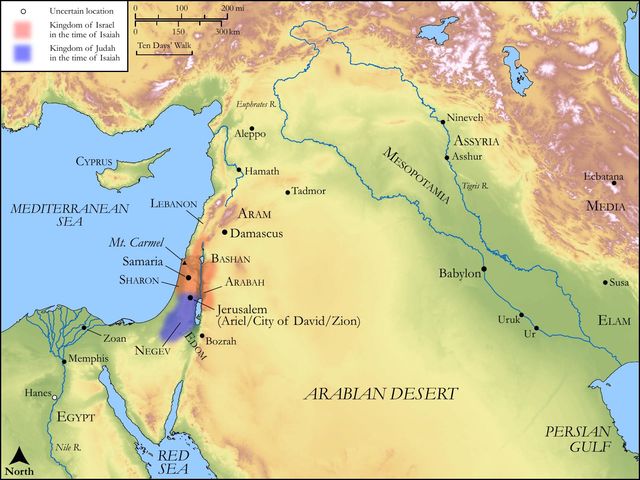
See on the biblical-era map
Study this verse
Public-domain commentary
Matthew Henry
From his Commentary on the Whole Bible. Henry comments on passages, not single verses — this entry covers Isaiah 30:27–33.
This terrible prediction of the ruin of the Assyrian army, though it is a threatening to them, is part of the promise to the Israel of God, that God would not only punish the Assyrians for the mischief they had done to the Israel of God, but would disable and deter them from doing the like again; and this prediction, which would now shortly be accomplished, would ratify and confirm the foregoing promises, which should be accomplished in the latter days. Here is,
I.God Almighty angry, and coming forth in anger against the Assyrians.
He is here introduced in all the power and all the terror of his wrath, Isa 30:27. The name of Jehovah, which the Assyrians disdain and set at a distance from them, as if they were out of its reach and it could do them no harm, behold, it comes from far. A messenger in the name of the Lord comes from as far off as heaven itself. He is a messenger of wrath, burning with his anger. God's lips are full of indignation at the blasphemy of Rabshakeh, who compared the God of Israel with the gods of the heathen; his tongue is as a devouring fire, for he can speak his proud enemies to ruin; his very breath comes with as much force as an overflowing stream, and with it he shall slay the wicked, Isa 11:4. He does not stifle or smother his resentments, as men do theirs when they are either causeless or impotent; but he shall cause his glorious voice to be heard when he proclaims war with an enemy that sets him at defiance, Isa 30:30. He shall display the indignation of his anger, anger in the highest degree; it shall be as the flame of a devouring fire, which carries and consumes all before it, with lightning or dissipation, and with tempest and hailstones, all which are the formidable phenomena of nature, and therefore expressive of the terror of the Almighty God of nature.
II.The execution done by this anger of the Lord.
Men are often angry when they can only threaten and talk big; but when God causes his glorious voice to be heard that shall not be all: he will show the lighting down of his arm too, Isa 30:30. The operations of his providence shall accomplish the menaces of his word. Those that would not see the lifting up of his arm (Isa 26:11) shall feel the lighting down of it, and find, to their cost, that the burden thereof is heavy (Isa 30:27), so heavy that they cannot bear it, nor bear up against it, but must unavoidably sink and be crushed under it. Who knows the power of his anger or imagines what an offended God can do? Five things are here prepared for the execution: - 1. Here is an overflowing stream, that shall reach to the midst of the neck, shall quite overwhelm the whole body of the army, and Sennacherib only, the head of it, shall keep above water and escape this stroke, while yet he is reserved for another in the house of Nisroch his god. The Assyrian army had been to Judah as an overflowing stream, reaching even to the neck (Isa 8:7, Isa 8:8), and now the breath of God's wrath will be so to it. 2. Here is a sieve of vanity, with which God would sift those nations of which the Assyrian army was composed, Isa 30:28. The great God can sift nations, for they are all before him as the small dust of the balance; he will sift them, not to gather out of them any that should be preserved, but so as to shake them one against another, put them into great consternation, and shake them all away at last; for it is a sieve of vanity (which retains nothing) that they are shaken with, and they are found all chaff. 3. Here is a bridle, which God has in their jaws, to curb and restrain them from doing the mischief they would do, and to force and constrain them to serve his purposes against their own will, Isa 10:7. God particularly says of Sennacherib (Isa 37:29) that he will put a hook in his nose and a bridle in his lips. It is a bridle causing them to err, forcing them to such methods as will certainly be destructive to themselves and their interest and in which they will be infatuated. God with a word guides his people into the right way (Isa 30:21), but with a bridle he turns his enemies headlong upon their own ruin. 4. Here is a rod and a staff, even the voice of the Lord, his word giving orders concerning it, with which the Assyrian shall be beaten down, Isa 30:31. The Assyrian had been himself a rod in God's hand for the chastising of his people, and had smitten them, Isa 10:5. That was a transient rod; but against the Assyrian shall go forth a grounded staff, that shall give a steady blow, shall stick close to him and strike home, so as to leave an impression upon him. It is a staff with a foundation, founded upon the enemies' deserts and God's determinate counsel. It is a consumption determined (Isa 10:23), and therefore there is no escaping it, no getting out of the reach of it; it shall pass in every place where an Assyrian is found, and the Lord shall lay it upon him, and cause it to rest, Isa 30:32. Such is the woeful case of those that persist in enmity to God: the wrath of God abides on them. 5. Here is Tophet ordained and prepared for them, Isa 30:33. The valley of the son of Hinnom, adjoining to Jerusalem, was called Tophet. In that valley, it is supposed, many of the Assyrian regiments lay encamped, and were there slain by the destroying angel; or there the bodies of those that were so slain were burned. Hezekiah had lately, and from yesterday (so the word is) ordained it; that is, say some, he had cleared it of the images that were set up in it, to which they there burnt their children, and so prepared it to be a receptacle for the dead bodies of their enemies, for the king of Assyria (that is, for his army) it is prepared, and there is fuel enough ready to burn them all; and they shall be consumed as suddenly and effectually as if the fire were kept burning by a continual stream of brimstone, for such the breath of the Lord, his word and his wrath, will be to it. Now as the prophet, in the foregoing promises, slides insensibly into the promises of gospel graces and comforts, so here, in the threatening of the ruin of Sennacherib's army, he points at the final and everlasting destruction of all impenitent sinners. Our Saviour calls the future misery of the damned Gehenna, in allusion to the valley of Hinnom, which gives some countenance to the applying of this to that misery, as also that in the Apocalypse it is so often called the lake that burns with fire and brimstone. This is said to be prepared of old for the devil and his angels, for the greatest of sinners, the proudest, and that think themselves not accountable to any for what they say and do; even for kings it is prepared. It is deep and large, sufficient to receive the world of the ungodly; the pile thereof is fire and much wood. God's wrath is the fire, and sinners make themselves fuel to it; and the breath of the Lord (the power of his anger) kindles it, and will keep it ever burning. See Isa 66:24. Wherefore stand in awe and sin not.
III.The great joy which this should occasion to the people of God.
The Assyrian's fall is Jerusalem's triumph (Isa 30:29): You shall have a song as in the night, a psalm of praise such as those sing who by night stand in the house of the Lord, and sing to his glory who gives songs in the night. It shall not be a song of vain mirth, but a sacred song, such as was sung when a holy solemnity was kept in a grave and religious manner. Our joy in the fall of the church's enemies must be a holy joy, gladness of heart, as when one goes, with a pipe (such as the sons of the prophets used when they prophesied, Sa1 10:5), to the mountain of the Lord, there to celebrate the praises of the Mighty One of Israel. Nay, in every place where the divine vengeance shall pursue the Assyrians they shall not only fall unlamented, but all their neighbours shall attend their fall with tabrets and harps, pleased to see how God, in battles of shaking, such as shake them out of the world, fights with them (Isa 30:32); for when the wicked perish there is shouting; and it is with a particular satisfaction that wise and good men see the ruin of those who, like the Assyrians, have insolently bidden defiance to God and trampled upon all mankind.
Historical interpretation
Historical reception
1 surviving comment on this verse from the historical church.
(Verse 30 and following) And the Lord will cause the glory of His voice to be heard, and He will show the terror of His arm in the threat of His fury and the devouring flame of fire. He will strike with whirlwind and hailstones. At the voice of the Lord, Assyria will tremble, struck down like a virgin, and there will be a passage firmly established by the rod: which the Lord will cause to rest upon him with timbrels and harps, and in battles He will conquer them in principal places. For Topheth has been prepared since yesterday, prepared by the king, deep and wide. Its fire is nourished, and there are many trees: the breath of the Lord, like a stream of burning sulfur, will set it ablaze. LXX: And the Lord will cause the glory of his voice to be heard, and he will show the fury of his arm with wrath and anger, and with a devouring flame of fire, he will strike vehemently, and like water and hail descending with force. For at the voice of the Lord the Assyrians will be overcome, with the blow with which he will strike them, and it will be all around him, that is, the place where he had hope of help, in which he trusted. They themselves will fight against him with tambourines and harps, in exchange. For you will be deceived before many days: is a kingdom also prepared for you? A deep valley, with wood placed, fire and the wood of many; the fury of the Lord, like a valley set on fire with sulfur. I could, in accordance with the Hebrew text, indicate to those who are reading what seems to me to be happening; but what shall I do, when some declare that I will have an incomplete work unless I also discuss the edition of the 70 interpreters? Therefore, I will follow the intended order of discussion. The voice of the Lord and his precept will become known to all, and the strength of his arm will be revealed to all when the time of retribution comes, when the flame and whirlwind, the size of hailstones, and the weight of stones will be abandoned. Indeed, in the prophecy of Ezekiel, as we have said, he writes at length about Gog and Magog (Ezek. XXXVIII, and Xxvix). At the command of his voice, Assur will tremble, struck with a rod. Every impious person, every imitator of the enemy nation: not that only the Assyrian will be struck on the day of judgment, but by the Assyrian we understand the devil. Finally, it follows: And the passage of the rod will be established, which the Lord will make to rest upon him. And this is the meaning: He will not strike him with a rod, and then lift him up again, as those who punish do; but rather, as if firmly rooted and firmly fixed, will cause him to remain in his punishments. And if it is understood in this way, where will be the repentance of the devil, especially when it is said to sinners: Go into eternal fire, which was prepared for the devil and his angels (Matthew 25:41). With timbrels and harps, and with principal weapons, the Lord will conquer them, namely the demons and all the wicked ones, with the joy of all. For from yesterday and from past time, Thopheth, that is, a broad and spacious hell, has been prepared by the Lord the King, which burns them with eternal fires. Its nourishment and fuel is fire, and many woods, that is, perpetual flame and the torments of sinners. And since, just as from a burning furnace and fire, the prophetic speech had foretold, it keeps the metaphor, so that by the breath and spirit and will of the Lord, we may know that it is set on fire, with mixed sulfur, which kindles the flames, to make the torments more fierce. Moreover, what is said in the Septuagint: 'At the voice of the Lord the Assyrians shall be overcome, when he shall strike them with the plague, and he shall be in a circle where he was before, and the hope of help, in which he trusted: they themselves with timbrels and harps shall fight against him out of sudden change,' signifies that they rise up against the devil, who had once been subject to him, and fight against him with joy and gladness out of sudden change, while understanding their own error, they destroy him by whom they had been deceived. And it is said to him, because he deceived himself from the beginning, thinking his kingdom to be eternal, for which hell and eternal punishments are prepared.
Continue studying Isaiah 30:30 across the web’s major study libraries — every link below opens this exact verse, chapter, or book on the destination site.
Read & Compare
 BibleGatewayThis verse in more than 200 translations and 70 languages.
 Bible.comThe YouVersion reader — hundreds of translations, reading plans, and highlights.
 ESV.orgCrossway's official English Standard Version reader.
 NET BibleThe NET translation with 60,000+ translators' notes on every rendering decision.
 STEP BibleTyndale House's free study tool — original text, vocabulary, and scholarly resources.
 BibliaLogos Bible Software's free web reader.
 USCCBThe New American Bible (Revised Edition) with the U.S. bishops' study notes.
Commentaries
 BibleHub CommentariesDozens of classic commentaries on this verse, gathered on one page.
 StudyLightMore than 100 commentary sets — the largest collection on the web.
 BibleRefPlain-English commentary on what this verse means, verse by verse.
 Enduring WordDavid Guzik's free commentary on this chapter, widely used by Bible teachers.
 Bible Study ToolsVerse commentary alongside Greek and Hebrew study aids.
Original Language & Research
- BibleHub InterlinearThe verse word by word — original language, transliteration, and English.
- BibleHub LexiconEvery word's original-language definition and Strong's entry.
 Blue Letter BibleDeep-study tools — Strong's numbers, concordance, and word studies.
 SefariaThe Hebrew text with Rashi and centuries of Jewish commentary.
Sermons, Hymns & Audio


TrulyRandomVerse is not affiliated with these sites and doesn’t control their content. They’re linked because they’re genuinely useful.
Summary
Isaiah 30:30 powerfully depicts the LORD's majestic and terrifying intervention, showcasing a dramatic divine display of power and judgment. This verse portrays God's "glorious voice" and the "lighting down of his arm" as instruments of His righteous indignation, unleashing a torrent of destructive forces—including devouring fire, scattering, tempest, and hailstones—against His adversaries. It stands as a profound declaration of God's absolute sovereignty and His active role in executing justice, ultimately ensuring the deliverance of His faithful people.
Context
ShowHideLiterary Context
Isaiah 30 is a pivotal chapter within the larger prophetic book, primarily addressing Judah's misguided reliance on foreign alliances, particularly with Egypt, rather than trusting in the LORD. The chapter begins with a stern "woe" against such rebellious behavior, highlighting the futility and shame of seeking help apart from God, as detailed in Isaiah 30:1-7. It then shifts to a lament over Judah's stubborn unwillingness to listen to God's warnings and obey His commands, a theme elaborated in Isaiah 30:8-17. This is followed by profound promises of God's patience, mercy, and ultimate restoration for a repentant remnant, beautifully articulated in Isaiah 30:18-26. Verses 27-33 specifically transition to a dramatic description of the LORD's coming judgment upon Assyria, Judah's primary oppressor at the time, portraying it as a fiery, destructive, and decisive divine intervention. Verse 30, therefore, serves as a climactic description of the overwhelming force and indignation with which God will act against His enemies, ensuring justice and ultimate deliverance for His faithful people, culminating in the destruction of Tophet, prepared for the Assyrian king, as prophesied in Isaiah 30:33.
Historical & Cultural Context
The prophecies in Isaiah 30 are set against the turbulent backdrop of the late 8th century BCE, a period of intense geopolitical upheaval. The northern kingdom of Israel had already fallen to the formidable Neo-Assyrian Empire in 722 BCE, and the southern kingdom of Judah faced constant existential threats from this expanding power. King Hezekiah of Judah, despite the prophet Isaiah's fervent warnings, was tempted to form an alliance with Egypt to resist Assyrian aggression. This political maneuvering reflected a deeper spiritual crisis within Judah: a profound lack of faith in God's ability and willingness to protect His covenant people. Culturally, the people of Judah were intimately familiar with the concept of divine judgment expressed through powerful natural phenomena—tempests, hailstones, and consuming fire—which were often seen in the ancient Near East as direct, tangible manifestations of a deity's wrath or power. The imagery of God's "arm" (representing His strength and executive power) and "voice" (representing His authority and decree) would have resonated deeply within a culture that understood power in terms of visible, decisive action and authoritative pronouncement.
Key Themes
ShowHideThis verse powerfully contributes to several overarching themes prevalent throughout the book of Isaiah and the broader prophetic literature. Firstly, it underscores the theme of Divine Sovereignty and Omnipotence, demonstrating God's absolute control over creation and history, able to wield natural forces and military might as instruments of His divine will. This stands in stark contrast to the fleeting and ultimately futile power of human alliances and armies, a point emphatically emphasized throughout Isaiah 31. Secondly, it highlights Divine Judgment and Righteous Wrath, portraying God's holy indignation against sin, rebellion, and injustice. The "devouring fire" and "indignation of his anger" are not arbitrary acts but a just and necessary response to those who defy His covenant and oppress His people, a theme powerfully echoed in the judgment against Babylon in Isaiah 13. Finally, it reinforces the theme of God's Active Intervention and Deliverance, showing that God is not a distant or passive deity but one who powerfully intervenes in human affairs to protect His faithful remnant and execute His redemptive plan, ultimately bringing about salvation for those who humbly wait on Him, as promised in Isaiah 30:18.
Exposition and Analysis
ShowHideKey Word Analysis
ShowHideThis word signifies grandeur, majesty, splendor, and honor. When applied to God's voice, it emphasizes the inherent majesty and awe-inspiring nature of His divine utterance. It is not merely a sound, but a manifestation of His inherent glory and authority, commanding attention and inspiring reverence or terror in all who hear it.
The "arm" is a powerful biblical metaphor for strength, power, and decisive action. When God's arm is described as "lighting down," it conveys a swift, forceful, and unavoidable exertion of His might, often in the context of judgment or deliverance. It implies an overwhelming, irresistible force that none can withstand.
This primitive root means "to eat" or "to consume," used both literally and figuratively. In the context of fire, it speaks to the destructive, all-consuming nature of God's judgment. It implies a complete and irreversible destruction, leaving nothing behind, underscoring the intensity and finality of His righteous wrath.
This term refers specifically to hail, often in conjunction with "stone" (H68, ʼeben). In biblical contexts, hailstones are frequently depicted as instruments of divine judgment, signifying God's direct intervention in nature to execute His will and punish the wicked, as seen in the plagues of Egypt.
Verse Breakdown
ShowHide"And the LORD shall cause his glorious voice to be heard"
This opening clause introduces the divine actor, Yahweh (the LORD), and His primary instrument of revelation and command: His voice. The adjective "glorious" (H1935, hôwd) emphasizes the inherent majesty, authority, and awe-inspiring nature of God's utterance. It signifies a voice that commands attention, signifies divine presence, and radiates immense power, not merely speaking but making itself powerfully known and felt.
"and shall shew the lighting down of his arm"
This phrase describes a visible, active, and decisive display of God's power. "Lighting down" (H5183, Nachath) suggests a swift, heavy descent or imposition, while "arm" (H2220, zᵉrôwaʻ) is a common biblical metaphor for strength, power, and decisive action. Together, they convey an immediate, forceful, and unavoidable exertion of divine might, implying a sudden, impactful, and irresistible intervention.
"with the indignation of his anger"
This clause explicitly states the motivation behind God's action. "Indignation" (H2197, zaʻaph) denotes fierce anger or rage, while "anger" (H639, ʼaph) refers to wrath, often characterized by rapid breathing or a flushed face. This potent combination underscores the righteous, intense displeasure of God against sin, rebellion, and injustice, indicating that His actions are not arbitrary but driven by holy justice and moral rectitude.
"and with the flame of a devouring fire"
This introduces a primary instrument of God's judgment. "Flame" (H3851, lahab) and "fire" (H784, ʼêsh) are common biblical symbols for divine presence, purification, and, critically, judgment. "Devouring" (H398, ʼâkal) emphasizes the consuming, destructive power of this fire, signifying complete and irreversible destruction of that which opposes God.
"with scattering, and tempest, and hailstones"
This final clause lists additional natural phenomena that serve as instruments of God's wrath, each contributing to the overwhelming display of divine power. "Scattering" (H5311, nephets) suggests dispersal or breaking apart, often associated with the force of a storm. "Tempest" (H2230, zerem) refers to a gushing storm or flood, implying overwhelming force and deluge. "Hailstones" (H68, ʼeben combined with H1259, bârâd) are large, destructive ice pellets, a classic biblical image of divine judgment. Collectively, these elements illustrate the multifaceted, comprehensive, and utterly overwhelming nature of God's intervention.
Literary Devices
ShowHideIsaiah 30:30 is exceptionally rich in Imagery, painting a vivid and terrifying picture of God's powerful intervention through a cascade of sensory details. The "glorious voice," the "lighting down of his arm," the "flame of a devouring fire," and the "tempest, and hailstones" all contribute to a dramatic and awe-inspiring mental landscape that evokes both reverence and dread. Anthropomorphism is prominently evident in the description of God having a "voice" and an "arm," attributing human-like physical characteristics to convey His active presence and power in a way comprehensible to human readers, emphasizing His direct engagement. The phrase "lighting down of his arm" functions as a potent Metaphor for God's swift, decisive, and irresistible action, representing His strength, authority, and the execution of His will. The series of destructive elements—"flame of a devouring fire, with scattering, and tempest, and hailstones"—employs Accumulation or a Climax of increasingly intense and destructive forces, emphasizing the overwhelming, comprehensive, and inescapable nature of God's judgment. The overall tone is one of Hyperbole, using exaggerated language to underscore the immense, terrifying, and absolute power of the divine wrath.
Theological and Thematic Connections
ShowHideIsaiah 30:30 serves as a powerful theological declaration of God's absolute sovereignty and His active, decisive engagement in the affairs of humanity, particularly in judgment against rebellion and deliverance for His people. It underscores that Yahweh is not a passive or distant deity but a God who intervenes with overwhelming power and righteous indignation. This passage profoundly reveals God's character as both majestic and fearsome, demonstrating that His holiness demands a just response to sin and injustice. The destructive imagery, while terrifying, ultimately points to God's unwavering commitment to His covenant and His ultimate victory over all opposing forces, ensuring justice and the establishment of His kingdom. The same immense power that judges the wicked is the power that protects, delivers, and saves the righteous.
Reflection and Application
ShowHideIsaiah 30:30 calls us to a profound and reverent understanding of God's immense power and unyielding holiness. In a world that frequently seeks security in human strength, political alliances, material wealth, or technological advancement, this verse serves as a stark and necessary reminder that true security, lasting justice, and ultimate peace ultimately rest solely in the hands of the sovereign LORD. It challenges us to deeply examine where our trust truly lies: in fleeting human solutions and fragile worldly systems, or in the unchanging, all-powerful, and utterly reliable God. For those who persist in rebellion against Him or seek to live independently of His divine will, this passage is a sobering warning of the inevitable and severe consequences of divine judgment. However, for the faithful, for those who humble themselves and trust in Him, it offers immense comfort and unwavering assurance, knowing that the same mighty power that brings judgment upon the wicked is the very power that protects, delivers, and vindicates His own. It encourages us to live in humble obedience, relying completely on His grace and strength, and to find profound peace in His unfailing sovereignty, even amidst the greatest chaos and uncertainty.
Questions for Reflection
ShowHideFAQ
ShowHideWhat is the significance of "the lighting down of his arm" in this verse?
ShowHideThe phrase "the lighting down of his arm" (Hebrew: neḥāt zəroaʻ) is a powerful anthropomorphic image. The "arm" is a common biblical metaphor for strength, power, and decisive action, as vividly seen in passages like Exodus 15:16. "Lighting down" suggests a swift, sudden, and heavy descent or imposition. Together, it signifies God's direct, immediate, and overwhelming exertion of His power, often in the context of executing judgment or bringing about deliverance. It implies that His intervention is unavoidable, carries immense force, and will accomplish His divine will with irresistible might.
How does "devouring fire" relate to God's character in the Bible?
ShowHide"Devouring fire" is a recurring biblical motif that encapsulates several profound aspects of God's character. Firstly, it represents His holiness and purity, which inherently consume all that is impure or unholy, as declared in Hebrews 12:29. Secondly, it powerfully symbolizes His righteous judgment and wrath against sin and rebellion, vividly illustrated in the destruction of Sodom and Gomorrah by fire from heaven (Genesis 19:24). Thirdly, it can also represent His presence and refining power, burning away dross to purify His people and prepare them for His service, as described in Malachi 3:2-3. In Isaiah 30:30, it primarily emphasizes the destructive, consuming, and inescapable nature of God's judgment against His adversaries.
Christ-Centered Fulfillment
ShowHideWhile Isaiah 30:30 speaks of God's terrifying judgment executed through natural forces and divine power, its ultimate Christ-centered fulfillment is found in the person and redemptive work of Jesus Christ. The "glorious voice" and "lighting down of his arm" foreshadow the ultimate divine intervention, not merely in judgment, but profoundly in salvation and ultimate triumph. Jesus, the very Word made flesh who dwelt among us (John 1:14), embodies the "glorious voice" of God, speaking words of life, truth, and ultimate judgment (John 12:48). His "arm" of power is most profoundly "shown" not in a tempest of hailstones, but in His mighty acts of redemption: casting out demons by the finger of God (Luke 11:20), healing the sick and restoring the broken (Matthew 8:16), conquering death through His glorious resurrection (Romans 1:4), and ultimately defeating the powers of sin and death on the cross. The "indignation of his anger" against sin was perfectly and completely poured out upon Christ, the Lamb of God, who bore the full wrath that humanity deserved (Romans 5:9). The "devouring fire" of God's holiness, which consumes all impurity, is ultimately satisfied in Christ's perfect and atoning sacrifice, allowing reconciliation and peace for all who believe. Thus, the terrifying power described in Isaiah 30:30, while a solemn warning to the rebellious, becomes a profound promise of secure deliverance for those who find refuge in the powerful, saving "arm" of God revealed in Jesus Christ, who will one day return with power and great glory to execute final judgment and establish His eternal kingdom (Matthew 24:30).