


Isaiah 29:6
- מֵעִםme·'Imfrom withH5973Prep-m ¦ PrepPrepositionמֵfromעִםwith
- יְהוָהYah·wehYahwehH3068N-properNoun Proper Title
- צְבָאוֹתtze·va·'Otof hostsH6635N-fpNoun Plural Feminine Absolute
- תִּפָּקֵדti·pa·Kedyou will be visitedH6485V-Niphal-Imperf-2msVerb Niphal Imperfect 2nd Singular Masculine
- בְּרַעַםbe·Ra·'amwith thunderH7482Prep-b ¦ N-msNoun Singular Masculine Absoluteבְּwithרַעַםthunder
- וּבְרַעַשׁu·ve·Ra·'ashand with earthquakeH7494Conj-w ¦ Prep-b ¦ N-msNoun Singular Masculine Absoluteוּandבְwithרַעַשׁearthquake
- וְקוֹלve·Koland noiseH6963Conj-w ¦ N-msNoun Singular Masculine Absoluteוְandקוֹלnoise
- גָּדוֹלga·DolgreatH1419Adj-msAdjective Singular Masculine Absolute
- סוּפָהsu·Faha storm-windH5492N-fsNoun Singular Feminine Absolute
- וּסְעָרָהu·se·'a·Rahand a tempestH5591Conj-w ¦ N-fsNoun Singular Feminine Absoluteוּandסְעָרָהa tempest
- וְלַהַבve·La·havand a flame ofH3851Conj-w ¦ N-mscNoun Singular Masculine Constructוְandלַהַבa flame of
- אֵשׁ'eshfireH784N-csNoun Singular common gender Absolute
- אוֹכֵלָה'o·khe·LahdevouringH398V-Qal-Prtcpl-fsVerb Qal Participle Singular Feminine Absolute
English is a literal word-by-word gloss of the Hebrew, not the KJV's wording. Why?
This is the original text the KJV's translators worked from — each Hebrew word with its own literal English meaning in this verse, prepared by scholars at Tyndale House, Cambridge. The KJV translates whole sentences, not word by word, so its wording differs: one Hebrew word can become several English words, and the KJV may choose “the LORD” where the gloss reads “Yahweh”. Both are faithful — they answer different questions. For the KJV's own rendering, switch to the KJV text.
Details
See on the biblical-era map
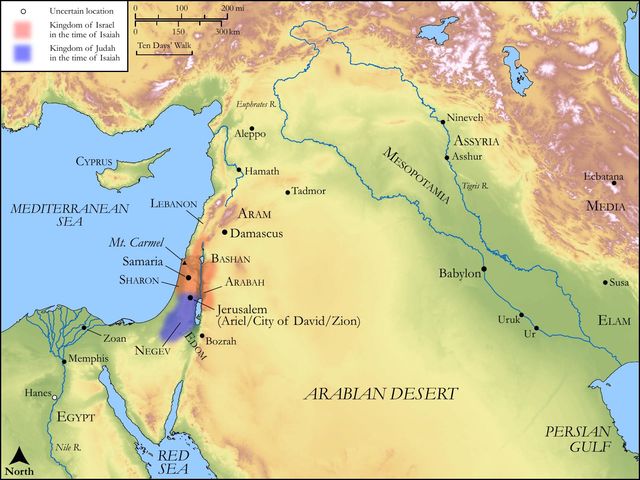
Study this verse
Public-domain commentary
Matthew Henry
From his Commentary on the Whole Bible. Henry comments on passages, not single verses — this entry covers Isaiah 29:1–8. His four-level outline is real structure in the source text, so it is rendered as structure.
That it is Jerusalem which is here called Ariel is agreed, for that was the city where David dwelt; that part of it which was called Zion was in a particular manner the city of David, in which both the temple and the palace were. But why it is so called is very uncertain: probably the name and the reason were then well known. Cities, as well as persons, get surnames and nicknames. Ariel signifies the lion of God, or the strong lion: as the lion is king among beasts, so was Jerusalem among the cities, giving law to all about her; it was the city of the great King (Psa 48:1, Psa 48:2); it was the head-city of Judah, who is called a lion's whelp (Gen 49:9) and whose ensign was a lion; and he that is the lion of the tribe of Judah was the glory of it. Jerusalem was a terror sometimes to the neighbouring nations, and, while she was a righteous city, was bold as a lion. Some make Ariel to signify the altar of burnt-offerings, which devoured the beasts offered in sacrifice as the lion does his prey. Woe to that altar in the city where David dwelt; that was destroyed with the temple by the Chaldeans. I rather take it as a woe to Jerusalem, Jerusalem; it is repeated here, as it is Mat 23:37, that it might be the more awakening. Here is,
I.The distress of Jerusalem foretold.
Though Jerusalem be a strong city, as a lion, though a holy city, as a lion of God, yet, if iniquity be found there, woe be to it. It was the city where David dwelt; it was he that brought that to it which was its glory, and which made it a type of the gospel church, and his dwelling in it was typical of Christ's residence in his church. This mentioned as an aggravation of Jerusalem's sin, that in it were set both the testimony of Israel and the thrones of the house of David.
1.Let Jerusalem know that her external performance of religious services will not serve as an exemption from the judgments of God (Isa 29:1): "Add year to year; go on in the road of your annual feasts, let all your males appear there three times a year before the Lord, and none empty, according to the law and custom, and let them never miss any of these solemnities: let them kill the sacrifices, as they used to do; but, as long as their lives are unreformed and their hearts unhumbled, let them not think thus to pacify an offended God and to turn away his wrath." Note, Hypocrites may be found in a constant track of devout exercises, and treading around in them, and with these they may flatter themselves, but can never please God nor make their peace with him.
2.Let her know that God is coming forth against her in displeasure, that she shall be visited of the Lord of hosts (Isa 29:6); her sins shall be enquired into and punished: God will reckon for them with terrible judgments, with the frightful alarms and rueful desolations of war, which shall be like thunder and earthquakes, storms and tempests, and devouring fire, especially upon the account of the great noise. When a foreign enemy was not in the borders, but in the bowels of their country, roaring and ravaging, and laying all waste (especially such an army as that of the Assyrians, whose commanders being so very insolent, as appears by the conduct of Rabshakeh, the common soldiers, no doubt, were much more rude), they might see the Lord of those hosts visiting them with thunder and storm. Yet, this being here said to be a great noise, perhaps it is intimated that they shall be worse frightened than hurt. Particularly,
(1.)Jerusalem shall be besieged, straitly besieged. He does not say, I will destroy Ariel, but I will distress Ariel; and she is therefore brought into distress, that, being thereby awakened to repent and reform, she may not be brought to destruction. I will (Isa 29:3) encamp against thee round about. It was the enemy's army that encamped against it; but God says that he will do it, for they are his hand, he does it by them. God had often and long, by a host of angels, encamped for them round about them for their protection and deliverance; but now he was turned to be their enemy and fought against them. The siege laid against them was of his laying, and the forts raised against them were of his raising. Note, When men fight against us we must, in them, see God contending with us.
(2.)She shall be in grief to see the country laid waste and all the fenced cities of Judah in the enemies' hand: There shall be heaviness and sorrow (Isa 29:2), mourning and lamentation - so these two words are sometimes rendered. Those that are most merry and jovial are commonly, when they come to be in distress, most overwhelmed with heaviness and sorrow; their laughter is then turned into mourning. "All Jerusalem shall then be unto me as Ariel, as the altar, with fire upon it and slain victims about it:" so it was when Jerusalem was destroyed by the Chaldeans; and many, no doubt, were slain when it was besieged by the Assyrians. "the whole city shall be an altar, in which sinners, falling by the judgments that are abroad, shall be as victims to divine justice." Or thus: - "There shall be heaviness and sorrow; they shall repent, and reform, and return to God, and then it shall be to me as Ariel. Jerusalem shall be like itself, shall become to me a Jerusalem again, a holy city," Isa 1:26.
(3.)She shall be humbled, and mortified, and made submissive (Isa 29:4): "Thou shalt be brought down from the height of arrogancy and insolence to which thou hast arrived: the proud looks and the proud language shall be brought down by one humbling providence after another." Those that despise God's judgments shall be humbled by them; for the proudest sinners shall either bend or break before him. They had talked big, had lifted up the horn on high, and had spoken with a stiff neck (Psa 75:5); but now thou shalt speak out of the ground, out of the dust, as one that has a familiar spirit, whispering out of the dust. This intimates,
[1.]That they should be faint and feeble, not able to speak up, nor to say all they would say; but as those who are sick, or whose spirits are ready to fail, their speech shall be low and interrupted.
[2.]That they should be fearful, and in consternation, forced to speak low as being afraid lest their enemies should overhear them and take advantage against them.
[3.]That they should be tame, and obliged to submit to the conquerors. When Hezekiah submitted to the king of Assyria, saying, I have offended, that which thou puttest on me I will bear (Kg2 18:14), then his speech was low, out of the dust. God can make those to crouch that have been most daring, and quite dispirit them.
II.The destruction of Jerusalem's enemies is foretold, for the comfort of all that were her friends and well-wishers in this distress (Isa 29:5, Isa 29:7): "Thou shalt be brought down (Isa 29:4), to speak out of the dust; so low thou shalt be reduced. But" (so it may be rendered) "the multitude of thy strangers and thy terrible ones, the numerous armies of the enemy, shall themselves be like small dust, not able to speak at all, or as much as whisper, but as chaff that passes away. Thou shalt be abased, but they shall be quite dispersed, smitten and slain after another manner (Isa 27:7); they shall pass away, yea it shall be in an instant, suddenly: the enemy shall be surprised with the destruction, and you with the salvation." The army of the Assyrians was by an angel laid dead upon the spot, in an instant, suddenly. Such will be the destruction of the enemies of the gospel Jerusalem. In one hour shall their judgment come, Rev 18:10. Again (Isa 29:6), "Thou shalt be visited, or (as it used to be rendered) She shall be visited with thunder and a great noise. Thou shalt be put into a fright which thou shalt soon recover. But (Isa 29:7) the multitude of the nations that fight against her shall be as a dream of a night-vision; they and their prosperity and success shall soon vanish past recall." The multitude of the nations that fight against Zion shall be as a hungry man who dreams that he eats, but still is hungry; that is,
1.Whereas they hoped to make a prey of Jerusalem, and to enrich themselves with the plunder of that opulent city, their hopes shall prove vain dreams, with which their fancies may please and sport themselves for a while, but they shall be disappointed. They fancied themselves masters of Jerusalem, but shall never be so.
2.They themselves, and all their pomp, and power, and prosperity, shall vanish like a dream when one awakes, shall be of as little value and as short continuance. Psa 73:20. He shall fly away as a dream Job 20:8. The army of Sennacherib vanished and was gone quickly, though it had filled the country as a dream fills a man's head, especially as a dream of meat fills the head of him that went to bed hungry. Many understand these verses as part of the threatening of wrath, when God comes to distress Jerusalem, and lay siege to her.
(1.)The multitude of her friends, whom she relies upon for help shall do her no good; for, though they are terrible ones, they shall be like the small dust, and shall pass away.
(2.)The multitude of her enemies shall never think they can do her mischief enough; but, when they have devoured her much, still they shall be but like a man who dreams he eats, hungry, and greedy to devour her more.
Historical interpretation
Historical reception
1 surviving comment on this verse from the historical church.
(Chapter 19, verse 1, and following) Woe to Ariel, Ariel the city that David besieged. Year after year is added, the appointed feasts have come to an end. I will besiege Ariel, and she will be sad and mournful; she will be like an Ariel to me. I will encircle you like a sphere, and I will throw up a mound against you, and I will set up siege works against you. You will be brought low, and your speech will come from the ground, and your voice will be like that of a python from the earth, and your speech will mumble from the dust. And it will be like the fine dust of those who blow against you, and like the passing smoke of those who have prevailed against you. And suddenly, immediately, it will be visited by the Lord of hosts, with thunder and earthquake, and with a great voice of whirlwind and tempest, and with the flame of devouring fire. And it will be like the dream of a night vision, the multitude of all the nations that have fought against Ariel, and all who have warred against her and besieged her and prevailed against her. As a hungry person dreams and eats, and when he has awakened, his soul is empty; and as a thirsty person dreams and drinks, and when he has awakened, he is still thirsty, and his soul is empty: so will be the multitude of all the nations that have fought against Mount Zion. Woe to Ariel, Ariel, the city that David besieged! Gather together year after year, eat, for you will eat with Moab; for I will oppress Ariel, and her strength and wealth will be mine, and I will encamp around you like David, and I will send a rampart around you, and set up towers all around you, and your words will be humbled on the ground, and your words will be brought down to the ground. And your voice will be like that of those who speak from the earth, and your voice will weaken to the ground. And the wealth of the wicked will be like dust from a wheel, and like ashes that are carried away, the multitude of those who oppressed you; it will be sudden from the Lord of hosts. For there will be a visitation with thunder, and a great shaking, a powerful storm, and a devouring flame of fire. And they will be like a dreamer at night, the wealth of all the nations that have fought against Ariel, and all who have fought against Jerusalem and gathered against it, and afflicted it. And they shall be like those who hunger and eat in dreams: when they wake up, their dream is in vain, and like one who thirsts and drinks in a dream, when he wakes up, he will still be thirsty, and his soul will have hoped in vain. So shall be the riches of all the nations that have fought against Mount Zion. Because we have interpreted, Woe, in Hebrew it is written Oi (), which is sometimes used in the vocative case, so that Ariel may not mourn, but call out; although in the current context it should be understood as mourning. Ariel is also interpreted as the lion of God; and for the city which Aquila interpreted, πολίχνην, that is, a small town or village, is read in Hebrew as Cariath, which properly means a village, and in Syriac it is called Cartha, hence it is also called a village of forests Cariath Jarim. Finally, in the earlier passage (Isaiah 1:21) where we read: How has the faithful city Zion become a prostitute? for city, Cariath is written, that is, a village: which we can express as a translation of Aquila literally, as a little city. Therefore, Ariel, which means the lion of God, was once called the strongest Jerusalem: or, as others believe, the temple and altar of God that was in Jerusalem. And what follows: Which David conquered, as Symmachus interpreted it, the stronghold of David, and Theodotion, the encampment of David, is read in Hebrew as Hana, which the most learned Hebrews wanted to signify as dwelling place. So if we read: which David conquered, let us refer to that time when David captured the fortress of Zion, while the blind and lame resisted, and Joab, the first, ascended the heights. But according to Symmachus and Theodotion, it should be understood that David restored and fortified it, and a year was added to the year, or subtracted, as Aquila interpreted; and the festivals have passed. For when the temple was destroyed and the Jewish religion abolished, all their festivities perished. And the Lord says that He will encamp around Ariel with the army of Babylon, and it will be sad and mournful when it is destroyed by them. And again under Jesus, the son of Josedech, the high priest, and Zorobabel, the son of Salathiel, were Ezra and Nehemiah, when Haggai and Zechariah prophesied that it would be like Ariel, having the appearance of the ancient temple, but without its magnificence and adornment. Moreover, the Lord threatens that He will surround Ariel with a sphere, and cast a rampart against it, and set up fortifications for its siege, and fulfill what He Himself laments concerning Jerusalem in the Gospel: 'If thou hadst known, even thou, at least in this thy day, the things which belong unto thy peace! But now they are hid from thine eyes. For the days shall come upon thee, that thine enemies shall cast a trench about thee, and compass thee round, and keep thee in on every side, and shall lay thee even with the ground' (Luke 19:42-44). And Jerusalem will be trampled by the nations until the time of the Gentiles is fulfilled. In other words, the same prophet now says that she who was humiliated will speak from the earth, and her voice will be heard from the dust. Her voice will be like that of a python from the earth, and it will murmur like sparrows, so that through these words he may signify the necromancy of the magi, by which they are said to summon souls and hear the voices of thin shades, or rather, of demons. Finally, regarding the python, Aquila interpreted the great one, which is called in Hebrew Cheb (), which the 70 interpreters translated as speaking of the earth. With these words, it is indicated that the ruin of the temple will last until the end of the world, collapsed into ashes and never to be raised again. And so, O Ariel, the army of Roman power will surround you, and they will be compared to an innumerable dust that flies through the air. Therefore, it is not the weakness of their opponents that the dust and ashes are compared to, but the multitude that is equal to countless grains of sand. And this will happen suddenly and quickly, so that in the midst of peace, wars will rise up under Nero, and the Lord of hosts will visit Jerusalem with thunder and earthquake, and whirlwind and devouring fire, which signifies the burning of the temple. But the Romans, after the Jews were defeated and Jerusalem was destroyed under Titus and Vespasian, offered the plundered vessels of God to the Capitol; and they thought that their own power and the favor of the gods, rather than the anger of God, was the reason for what they had done, as if in a dream and in a nightly vision, they will possess all riches. And just as someone who is hungry thinks in their dreams that they are eating, and someone who is thirsty drinks from dry throats, and when they wake up their thirst becomes even stronger, deceived by the empty drink: so the multitude of all nations, who fought against the power of Rome and subjugated to it, will have wealth like a shadow, and a cloud, and a dream of the night, which they will leave behind with their untimely destruction. In the place where we have been placed, all who have waged war and besieged and prevailed against it have been translated to seventy, and all who have fought against Jerusalem, which is not found in Hebrew. In this beginning of the chapter, where we said, 'A year is added to a year, or subtracted,' they are interpreted as 'gather the fruits or produce, year upon year;' 'eat, for you will eat with Moab.' And the meaning is, before the acceptable year of the Lord's preaching comes, indeed two years, of which we read in the Song of Habakkuk according to the Hebrew: 'In the midst of two times you will be known' (Habakkuk 3), 'sow for yourselves in tears so that you may reap in joy' (Psalm 126). It is written in the Gospel according to John that the Lord came to Jerusalem three times during the Passover, which makes two years (John 2:13). However, what follows, 'For you shall eat with Moab,' is not found in Hebrew. We can say that unless the fruits of repentance are gathered for themselves, they will begin to eat with those who do not enter the Church of the Lord forever. The other things in which they seem to disagree are obvious, and from what we have explained, their interpretation is easy. I know that I have read Ariel's interpretation, my light is God's, which is far different. Here the first syllable is written with Aleph and Res: lux autem quae Hebraice dicitur Or, inter Aleph et Res mediam habet litteram Vau, quae in praesenti nomine non habetur. And everything that is now said against Ariel refers to heretics, who consider their doctrine to be the light of God, and they must be fought by the true David: all their solemnities must be taken away, and present joy must be turned into future sorrow: to whom God commands to repent, lest they begin to eat with the Moabites, and be similar to the Gentiles. For he will attack Ariel himself, and he will surround all their power and wealth with his army. And with the towers, that is, the leaders of the Church, he will humble their words on the earth, so that they may not raise their mouth to heaven, but be written on the earth, speak of the earth, and be like dust scattered by the wind. And all the wealth of the wicked will appear in an instant, when he visits them in his majesty, descending in a whirlwind, storm, and fire of punishment; and they will understand that all their wealth, the pomp of their words, and the arguments of their verses, are compared in vain to a dream of someone eating and drinking: those who fight against Jerusalem, the vision of peace; or against Ariel, the strongest lion, and ultimately against Mount Zion, where the city of the Church cannot be hidden.
Continue studying Isaiah 29:6 across the web’s major study libraries — every link below opens this exact verse, chapter, or book on the destination site.
Read & Compare
 BibleGatewayThis verse in more than 200 translations and 70 languages.
 Bible.comThe YouVersion reader — hundreds of translations, reading plans, and highlights.
 ESV.orgCrossway's official English Standard Version reader.
 NET BibleThe NET translation with 60,000+ translators' notes on every rendering decision.
 STEP BibleTyndale House's free study tool — original text, vocabulary, and scholarly resources.
 BibliaLogos Bible Software's free web reader.
 USCCBThe New American Bible (Revised Edition) with the U.S. bishops' study notes.
Commentaries
 BibleHub CommentariesDozens of classic commentaries on this verse, gathered on one page.
 StudyLightMore than 100 commentary sets — the largest collection on the web.
 BibleRefPlain-English commentary on what this verse means, verse by verse.
 Enduring WordDavid Guzik's free commentary on this chapter, widely used by Bible teachers.
 Bible Study ToolsVerse commentary alongside Greek and Hebrew study aids.
Original Language & Research
- BibleHub InterlinearThe verse word by word — original language, transliteration, and English.
- BibleHub LexiconEvery word's original-language definition and Strong's entry.
 Blue Letter BibleDeep-study tools — Strong's numbers, concordance, and word studies.
 SefariaThe Hebrew text with Rashi and centuries of Jewish commentary.
Sermons, Hymns & Audio


TrulyRandomVerse is not affiliated with these sites and doesn’t control their content. They’re linked because they’re genuinely useful.
Summary
Isaiah 29:6 delivers a stark prophecy of divine judgment upon Jerusalem, referred to as Ariel, through an overwhelming display of God's power. The verse vividly depicts this visitation as a cataclysmic event, employing imagery of thunder, earthquake, immense noise, violent storms, and consuming fire. This dramatic portrayal underscores the inescapable and devastating nature of the Lord of hosts' intervention against a people marked by spiritual complacency and rebellion, signifying a moment of profound divine reckoning that aims to purify and humble.
Context
ShowHideLiterary Context
Isaiah 29:6 is centrally positioned within a significant oracle (Isaiah 29:1-24) directed at Jerusalem, symbolically named "Ariel," a term that can signify "lion of God" (referring to Jerusalem's strength or perhaps the altar's sacrificial fire) or "altar hearth." The preceding verses (Isaiah 29:1-5) establish Jerusalem's impending siege and distress, highlighting its spiritual deafness and self-reliance despite its religious outward appearance. The "visitation" described in verse 6 represents the culmination of this divine displeasure, a powerful and destructive act that follows the pronouncements of judgment and the city's deep spiritual slumber (Isaiah 29:9-12). The vivid imagery of natural phenomena in verse 6 serves to emphasize the irresistible force of God's judgment, setting the stage for the subsequent lament, the eventual promise of restoration for a repentant remnant (Isaiah 29:17-24), and the contrast between human wisdom and divine understanding.
Historical & Cultural Context
The prophecy in Isaiah 29 is set against the tumultuous backdrop of Judah's political and spiritual landscape during the late 8th century BCE. Jerusalem, though the spiritual and political capital, had grown complacent and increasingly relied on human alliances, particularly with Egypt, rather than trusting solely in the Lord for security against the rising Assyrian Empire. During Isaiah's prophetic ministry, Assyria posed an existential threat, frequently encroaching upon Judah's borders. The "visitation" described in this verse, while potentially alluding to a military siege (such as Sennacherib's siege of Jerusalem in 701 BCE), transcends mere human conflict through its use of cosmic, natural disaster language. For an ancient Near Eastern audience, powerful natural phenomena like thunder, earthquakes, and storms were universally understood as direct manifestations of divine power, wrath, and judgment, often associated with theophany (the appearance of God). This imagery would have evoked profound awe and terror, signifying an undeniable divine intervention.
Key Themes
ShowHideThis verse powerfully contributes to several overarching themes prevalent in Isaiah and the broader prophetic literature. Foremost is the theme of Divine Judgment, where God's holiness and righteousness demand a response to sin, and persistent rebellion inevitably leads to severe consequences. The intensity of the natural phenomena symbolizes the overwhelming severity of this divine wrath, particularly against spiritual hypocrisy and formalistic worship, as starkly highlighted in Isaiah 29:13. It also powerfully reinforces the theme of God's Sovereignty and Power, emphasizing that the LORD of hosts is the absolute commander of all creation and history, capable of executing His will through any means necessary. The imagery of destructive forces underscores His irresistible might and control over both the natural world and human affairs. Furthermore, the verse serves as a stark warning about the Consequences of Unfaithfulness, illustrating that outward religious practice without genuine inward devotion and trust in God leads to divine reckoning, a theme powerfully echoed in Amos 5:21-24.
Exposition and Analysis
ShowHideKey Word Analysis
ShowHideThis primitive root carries a wide semantic range, meaning "to visit." However, its context determines whether the visitation is for blessing, care, or, as in Isaiah 29:6, for hostile intent, oversight, or punishment. The accompanying imagery of destructive forces unequivocally points to a visitation of severe judgment and reckoning, implying that God is calling Jerusalem to account for its actions, bringing about a punitive and judicial intervention.
This is the sacred, personal, and covenantal name of God, often rendered "the LORD" in English translations. It signifies the self-existent, eternal, and covenant-keeping God. Its presence here emphasizes that this judgment is not random or impersonal, but a deliberate act of the sovereign God who, despite His covenant relationship with His people, holds them accountable for their unfaithfulness and rebellion.
A primitive word for fire, used literally or figuratively. In biblical contexts, fire often symbolizes God's presence, purity, and holiness, but also His consuming wrath against sin. The phrase "flame of devouring fire" (combining lahab 'flame' and ʼâkal 'devouring' with ʼêsh 'fire') intensifies this destructive aspect, portraying an irresistible and all-consuming judgment that purifies through destruction, leaving nothing untouched by its intense heat and power.
Verse Breakdown
ShowHide"Thou shalt be visited of the LORD of hosts"
This opening clause immediately establishes the divine agent and the recipient of the action. "Thou" refers to Ariel/Jerusalem, the unfaithful city. The "LORD of hosts" (Hebrew: Yahweh Sabaoth) signifies God as the absolute commander of heavenly armies and all creation, emphasizing His omnipotence, authority, and ability to execute His will. The term "visited" (Hebrew: pâqad) in this context denotes a punitive, judicial visitation, where God intervenes to bring judgment upon His unfaithful people, holding them accountable for their spiritual complacency and rebellion.
"with thunder, and with earthquake, and great noise"
This tripartite description begins to unpack the nature of the divine visitation. "Thunder" (Hebrew: raʻam) and "earthquake" (Hebrew: raʻash) are powerful, awe-inspiring natural phenomena often associated with theophany (God's appearance) and divine judgment in the Old Testament, signifying God's overwhelming power and presence. "Great noise" (Hebrew: gâdôwl qôwl) further amplifies the sense of chaos, terror, and the sheer magnitude of the impending event, suggesting a cacophony of destruction and the terrifying sound of God's intervention.
"with storm and tempest"
These terms (Hebrew: çûwphâh and çaʻar) continue the imagery of violent natural forces. "Storm" and "tempest" evoke uncontrollable, destructive winds and torrential rains, further emphasizing the overwhelming and inescapable nature of God's judgment. They suggest a complete upheaval and a force that sweeps away all resistance, leaving devastation in its wake, signifying a comprehensive and relentless divine assault.
"and the flame of devouring fire"
This final phrase culminates the destructive imagery, bringing it to a terrifying crescendo. "Flame" (Hebrew: lahab) and "fire" (Hebrew: ʼêsh) combine with "devouring" (Hebrew: ʼâkal) to portray a consuming, purifying, and utterly destructive force. This "devouring fire" is a recurring biblical motif for God's holy wrath and His unyielding opposition to sin, signifying a judgment that utterly consumes and purifies, leaving nothing untouched by its intensity.
Literary Devices
ShowHideIsaiah 29:6 is exceptionally rich in Imagery, painting a vivid and terrifying picture of divine judgment through a cascade of natural phenomena. The prophet masterfully employs Metaphor and Symbolism by using "thunder," "earthquake," "storm," "tempest," and "devouring fire" not merely as literal weather events, but as potent representations of God's overwhelming wrath, irresistible power, and the terrifying nature of His intervention. This creates a powerful sense of Hyperbole, exaggerating the scale of the destruction to convey the absolute magnitude and terrifying nature of the divine intervention. The cumulative effect of these destructive images creates a dramatic sense of Climax, building from audible terror (thunder, great noise) to physical upheaval (earthquake, storm) and finally to complete annihilation (devouring fire), emphasizing the escalating severity and totality of God's judgment. The repeated use of the preposition "with" (Hebrew: bĕ) creates a powerful Parallelism that reinforces the multifaceted, comprehensive, and inescapable nature of this divine visitation, underscoring that every aspect of creation is at God's command to execute His righteous decree.
Theological and Thematic Connections
ShowHideIsaiah 29:6 profoundly illustrates the theological truth that God, as the sovereign Lord of hosts, is not merely a distant deity but an active, decisive participant in human history, who intervenes powerfully when His people stray from covenant faithfulness. This "visitation" underscores His unwavering holiness, justice, and righteousness, demonstrating that spiritual apathy, hypocrisy, and rebellion have severe and inescapable consequences. The imagery of overwhelming natural forces highlights God's absolute power and control over all creation, which He can wield as instruments of His righteous judgment. This passage serves as a powerful reminder that God's character encompasses both merciful love and consuming wrath, demanding genuine repentance, sincere worship, and unwavering trust from His people, lest they face the full weight of His divine reckoning.
Reflection and Application
ShowHideIsaiah 29:6 serves as a potent spiritual mirror, calling us to examine the authenticity of our faith and the sincerity of our devotion. It reminds us that God is not indifferent to superficiality or hypocrisy; He desires a heart fully surrendered and reliant on Him, not on human wisdom, worldly power, or empty religious rituals. The overwhelming imagery of divine judgment compels us to take sin seriously and to cultivate a reverent fear of the Lord, recognizing His ultimate authority and power over all creation and all human affairs. This passage encourages us to move beyond mere outward religious observance to a deep, transformative relationship with God, ensuring that our trust is placed solely in Him. It's a profound call to humility, genuine repentance, and unwavering faith in the face of life's challenges, knowing that God's presence, whether in judgment or blessing, is always purposeful, just, and ultimately for our good, drawing us back to Himself.
Questions for Reflection
ShowHideFAQ
ShowHideWhat does "LORD of hosts" mean in this context?
ShowHideThe title "LORD of hosts" (Hebrew: Yahweh Sabaoth) emphasizes God's absolute sovereignty, omnipotence, and His role as the divine warrior. "Hosts" refers to armies, whether heavenly (angels) or earthly, signifying that God is the supreme commander of all forces in the universe. In Isaiah 29:6, it underscores that the impending judgment is not a random or chaotic event but a deliberate, powerful act orchestrated by the Almighty God, who commands all creation to execute His righteous will. This title reassures that no power, human or natural, can withstand His decree or thwart His purposes.
Is the "visitation" in Isaiah 29:6 a literal prediction of natural disasters?
ShowHideWhile the language uses vivid imagery of natural phenomena like thunder, earthquake, storm, and fire, it is primarily symbolic and metaphorical rather than a literal prediction of specific natural disasters in isolation. These powerful images are employed to convey the overwhelming, inescapable, and destructive nature of God's judgment upon Jerusalem. They represent the severity and totality of His divine reckoning, which could manifest through various means, including military conquest (like the Assyrian siege), but ultimately orchestrated by God's sovereign hand. The focus is on the divine power and purpose behind the event, not necessarily the precise literal form it will take. Similar imagery is used in other prophetic books to describe God's powerful interventions, such as in Psalm 18:7-15 or Nahum 1:3-6.
Christ-Centered Fulfillment
ShowHideWhile Isaiah 29:6 describes a terrifying visitation of judgment upon unfaithful Jerusalem, its profound imagery of divine power and reckoning finds its ultimate fulfillment and reinterpretation in the person and work of Jesus Christ. The "LORD of hosts" who brings judgment is the very same God who, in Christ, offers profound salvation and reconciliation. The consuming fire of God's holiness, which devours sin and rebellion, is fully satisfied in the ultimate sacrifice of the Lamb of God, Jesus, who bore the full weight of divine wrath on the cross. Through His atoning death, Christ became the propitiation for our sins, absorbing the "devouring fire" of God's judgment so that all who believe might be spared from condemnation and receive eternal life. Furthermore, the "visitation" of the Lord is transformed from one of punitive judgment for believers to one of merciful grace and spiritual renewal. Just as the Old Testament prophets spoke of a future day when God would shake the heavens and the earth, Hebrews 12:26-29 reinterprets this shaking, not as a final destruction for those in Christ, but as a purification that leads to an unshakable kingdom. Thus, in Christ, the terrifying power of God's judgment is revealed as the very foundation for His redemptive love, offering reconciliation and eternal life to all who believe, transforming the anticipated "storm and tempest" into the profound peace of God's abiding presence.