


Matthew 24:7
- ἘγερθήσεταιEgerthēsetaiWill rise upG1453V-FPI-3SVerb Future Passive Indicative 3rd Singular
- γὰρgarforG1063CONJConjunction
- ἔθνοςethnosnationG1484N-NSNNoun Nominative Singular Neuter
- ἐπὶepiagainstG1909PREPPreposition
- ἔθνοςethnosnationG1484N-ASNNoun Accusative Singular Neuter
- καὶkaiandG2532CONJConjunction
- βασιλείαbasileiakingdomG932N-NSFNoun Nominative Singular Feminine
- ἐπὶepiagainstG1909PREPPreposition
- βασιλείανbasileiankingdomG932N-ASFNoun Accusative Singular Feminine
- καὶkaiandG2532CONJConjunction
- ἔσονταιesontaithere will beG1510V-FDI-3PVerb Future Middle Deponent Indicative 3rd Plural
- λιμοὶlimoifaminesG3042N-NPMNoun Nominative Plural Masculine
- καὶkaiandG2532CONJConjunction
- λοιμοὶloimoipestilencesG3061N-NPMNoun Nominative Plural Masculine
- καὶkaiandG2532CONJConjunction
- σεισμοὶseismoiearthquakesG4578N-NPMNoun Nominative Plural Masculine
- κατὰkatainG2596PREPPreposition
- τόπουςtopous[various] placesG5117N-APMNoun Accusative Plural Masculine
English is a literal word-by-word gloss of the Greek, not the KJV's wording. Why?
This is the original text the KJV's translators worked from — each Greek word with its own literal English meaning in this verse, prepared by scholars at Tyndale House, Cambridge. The KJV translates whole sentences, not word by word, so its wording differs: one Greek word can become several English words, and the KJV may choose “charity” where the gloss reads “love”. Both are faithful — they answer different questions. For the KJV's own rendering, switch to the KJV text.
Details
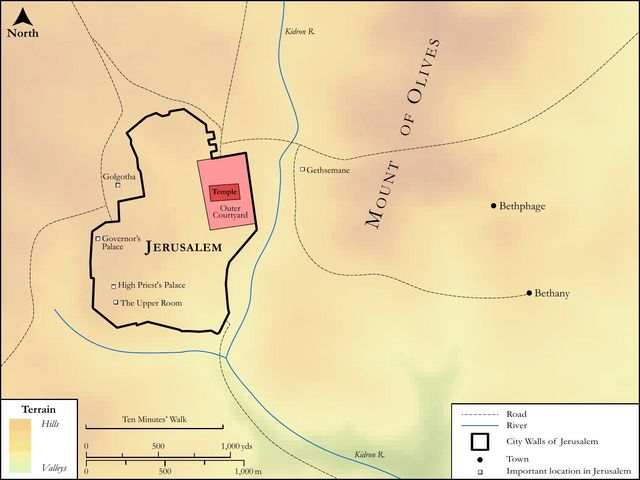
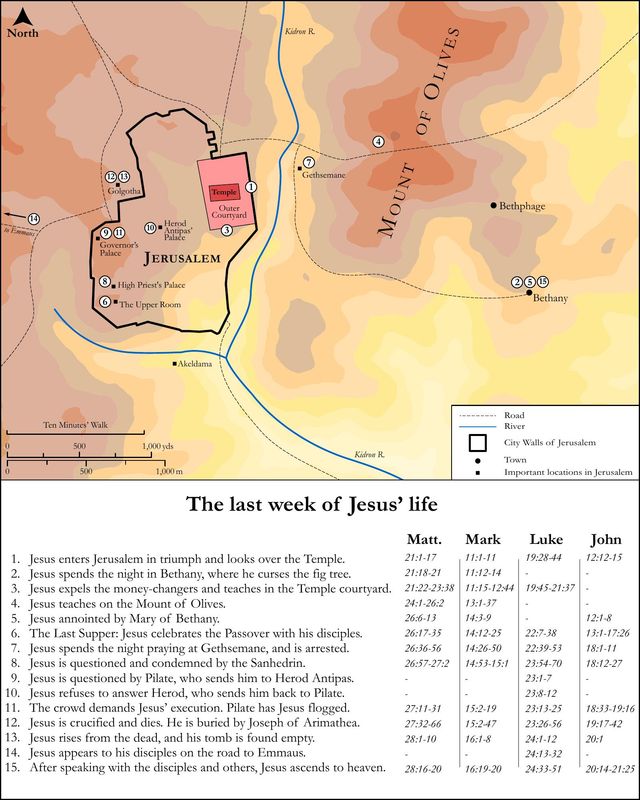
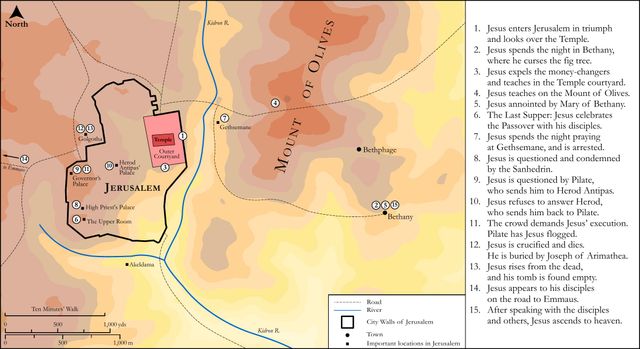
See on the biblical-era map
Study this verse
Historical interpretation
Eight Centuries of Reception
11 surviving comments on this verse. Each one is dated, so this reads as a timeline rather than a list.
Select a marker to jump to its quote. Markers stagger vertically where authors wrote within a few decades of each other.
Watch for your life's sake. Let not your lamps be quenched, nor your loins unloosed; but be ye ready, for ye know not the hour in which our Lord cometh. But often shall ye come together, seeking the things which are befitting to your souls: for the whole time of your faith will not profit you, if ye be not made perfect in the last time. For in the last days false prophets and corrupters shall be multiplied, and the sheep shall be turned into wolves, and love shall be turned into hate; for when lawlessness increaseth, they shall hate and persecute and betray one another, and then shall appear the world-deceiver as Son of God, and shall do signs and wonders, and the earth shall be delivered into his hands, and he shall do iniquitous things which have never yet come to pass since the beginning. Then shall the creation of men come into the fire of trial, and many shall be made to stumble and shall perish; but they that endure in their faith shall be saved from under the curse itself. And then shall appear the signs of the truth; first, the sign of an out-spreading in heaven; then the sign of the sound of the trumpet; and the third, the resurrection of the dead; yet not of all, but as it is said: The Lord shall come and all His saints with Him. Then shall the world see the Lord coming upon the clouds of heaven.
They that are deceived are many, because wide is the gate that leadeth to destruction, and many there be which go in thereat. (Mat. 7:13.) This one thing is enough to detect the Antichrists and seducers that they shall say, I am Christ, which Christ Himself is no where read to have said: for the works of God, and the word which He taught, and His power, were enough to produce belief that He is Christ. For every discourse which professes to expound Scripture faithfully, and has not the truth, is Antichrist. For the truth is Christ, that which feigns itself to be the truth is Antichrist. So also all virtues are Christ, all that feigns itself to be virtue is Antichrist; for Christ has in Himself in truth all manner of good for the edification of men, but the devil has forged resemblances of the same for the deceiving of the saints. We have need therefore of God to help us, that none deceive us, neither word nor power. It is a bad thing to find any one erring in his course of life; but I esteem it much worse not to think according to the most true rule of Scripture.
To hear the shouts raised in the battles, is to hear wars; to hear rumours of wars, is to hear accounts of wars waged afar off.
Or otherwise; As the body sickens before the death of the man, so it must needs be that before the consummation of this world the earth should be shaken, as though it were palsied, with frequent earthquakes, the air should gather a deadly quality and become pestilential, and that the vital energy of the soil should fail, and its fruits wither. And by consequence of this scarcity, men are stirred up to robbery and war. But because war and strife arise sometimes from covctousness, and sometimes from desire of power and empty glory, of these which shall happen before the end of the world a yet deeper cause shall be assignable. For as Christ's coming brought through His divine power peace to divers nations, so it shall be on the other hand, that when iniquity shall abound, the love of many shall wax cold, and God and His Christ shall desert them; wars shall be again when actions which beget wars are not hindered by holiness; and hostile powers when they are not restrained by the Saints and by Christ shall work unchecked in the hearts of men, stirring up nation against nation, and kingdom against kingdom. But if, as some will have it, famine and pestilence are from the Angels of Satan, these shall then gather might from opposite powers, when the salt of the earth, and the lights of the world, Christ's disciples, shall be no longer, destroying those things which the malice of dæmons hatches. Ofttimes in Israel famines and pestilences were caused by sin, and removed by the prayers of the Saints. (1 Kings 17:1. Jer. 14. James 5:17, 18.) Well is that said, In divers places, for God will not destroy the whole race of men at once, but judging them in portions, He gives opportunity of repentance. But if some stop be not put to these evils in their commencement, they will progress to worse, as it follows, These all are the beginnings of sorrows, that is, sorrows common to the whole world, and those which are to come upon the wicked who shall be tormented in most sharp pains.
This must come to pass before we can see the perfection of that wisdom which is in Christ; but not yet shall be that end which we seek, for a peaceful end is far from those men.
For in the last days false prophets shall be multiplied, and such as corrupt the word; and the sheep shall be changed into wolves, and love into hatred: for through the abounding of iniquity the love of many shall wax cold. For men shall hate, and persecute, and betray one another. And then shall appear the deceiver of the world, the enemy of the truth, the prince of lies, [2 Thessalonians 2:3-12] whom the Lord Jesus "shall destroy with the spirit of His mouth, who takes away the wicked with His lips; and many shall be offended at Him. But they that endure to the end, the same shall be saved. And then shall appear the sign of the Son of man in heaven;" [Isaiah 11:4; Matthew 24:1-51] and afterwards shall be the voice of a trumpet by the archangel; and in that interval shall be the revival of those that were asleep. And then shall the Lord come, and all His saints with Him, with a great concussion above the clouds, with the angels of His power, [Matthew 16:27] in the throne of His kingdom, to condemn the devil, the deceiver of the world, and to render to every one according to his deeds. "Then shall the wicked go away into everlasting punishment, but the righteous shall go into life eternal," [Matthew 25:46] to inherit those things "which eye has not seen, nor ear heard, nor have entered into the heart of man, such things as God has prepared for them that love Him;" [1 Corinthians 2:9] and they shall rejoice in the kingdom of God, which is in Christ Jesus.
"For nation shall rise against nation, and kingdom against kingdom."
But by "wars and rumors of wars," He meaneth, what I before said, the troubles coming upon them. After this, because, as I have already said, they supposed after that war the end would come, see how He warns them, saying, "But the end is not yet. For nation," He saith, "shall rise against nation, and kingdom against kingdom." Of the preludes to the ills of the Jews doth He speak.
Then to show that He Himself also will assail the Jews with them, and war on them, He speaks not of battles only, but also of plagues sent from God, famines, and pestilences, and earthquakes, showing that the wars also He Himself permitted to come upon them, and that these things do not happen for no purpose according to what has been before the accustomed course of things amongst men, but proceed from the wrath on high.
Therefore He saith, they shall come not by themselves or at once, but with signs. For that the Jews may not say, that they who then believed were the authors of these evils, therefore hath He told them also of the cause of their coming upon them. "For verily I say unto you," He said before, "all these things shall come upon this generation," having made mention of the stain of blood on them.
For the war, saith He, shall be twofold that of the deceivers, and that of the enemies, but the former far more grievous, as coming upon them in the confusion and turmoils, and when men were terrified and troubled. For indeed great was the storm then, when the Roman power was beginning to flourish, and cities were taken, and camps and weapons were set in motion, and many were readily believed.
But of wars in Jerusalem is He speaking; for it is not surely of those without, and everywhere in the world; for what did they care for these? And besides, He would thus say nothing new, if He were speaking of the calamities of the world at large, which are happening always. For before this, were wars, and tumults, and fightings; but He speaks of the Jewish wars coming upon them at no great distance, for henceforth the Roman arms were a matter of anxiety. Since then these things also were sufficient to confound them, He foretells them all.
Then to show that He Himself also will assail the Jews with them, and war on them, He speaks not of battles only, but also of plagues sent from God, famines, and pestilences, and earthquakes, showing that the wars also He Himself permitted to come upon them, and that these things do not happen for no purpose according to what has been before the accustomed course of things amongst men, but proceed from the wrath on high.
Therefore He saith, they shall come not by themselves or at once, but with signs. For that the Jews may not say, that they who then believed were the authors of these evils, therefore hath He told them also of the cause of their coming upon them. "For verily I say unto you," He said before, "all these things shall come upon this generation," having made mention of the stain of blood on them.
Then lest on hearing of the showers of evils, they should suppose the gospel to be broken through, He added, "See, be not troubled, for all things must come to pass," i.e which I foretold, and the approach of the temptations will set aside none of the things which I have said; but there shall indeed be tumults and confusion, but nothing shall shake my predictions.
Then since He had said to the Jews, "Ye shall not see me, till ye shall say, Blessed is He that cometh in the name of the Lord;" and the disciples supposed that together with the destruction would be the end also; to set right this secret thought of theirs, He said, "But the end is not yet." For that they did suspect even as I said, you may learn from their question. For, what did they ask? When shall these things be? i.e. when shall Jerusalem be destroyed? And what is the sign of Thy coming, and of the end of the world?
But He answered nothing directly to this question, but first speaks of those other things that are urgent, and which it was needful for them to learn first. For neither concerning Jerusalem straightway, nor of His own second coming, did He speak, but touching the ills that were to meet them at the doors. Wherefore also He makes them earnest in their exertions, by saying, "Take heed that no man deceive you; for many shall come in my name, saying, I am Christ."
Afterwards, when He hath roused them to listen about these things (for, "take heed," saith He, "that no man deceive you"); and having made them energetic, and prepared them to be watchful, and hath spoken first of the false Christs, then He speaks of the ills of Jerusalem, assuring them ever by the things already past, foolish and contentious though they were, of those which were yet to come.
But by "wars and rumors of wars," He meaneth, what I before said, the troubles coming upon them. After this, because, as I have already said, they supposed after that war the end would come, see how He warns them, saying, "But the end is not yet. For nation," He saith, "shall rise against nation, and kingdom against kingdom." Of the preludes to the ills of the Jews doth He speak. "All these are the beginning of sorrows," that is, of those that befall them.
Here He speaks of the battles which should be fought at Jerusalem; when He says, Ye shall hear wars, and rumours of wars.
And because this might alarm the disciples, He continues, See that ye be not troubled. And because they supposed that the end of the world would follow immediately after the war in which Jerusalem should be destroyed, He corrects their suspicions concerning this, These things must come to pass, but the end is not yet.
And to show that He also should fight against the Jews, He tells them not only of wars, but of calamities inflicted by Providence, And there shall be pestilences, and famines, and earthquakes in divers places.
And these things shall not happen according to the order of nature before established among men, but shall come of wrath from heaven, and therefore He said not that they should come only, or come suddenly, but adds significantly, These all are the beginnings of troubles, that is, of the Jewish troubles.
(Verses 7, 8.) For nation shall rise against nation, and kingdom against kingdom, and there shall be pestilences and famines, and earthquakes in various places. But all these things are the beginnings of sorrows. I do not doubt that these things indeed shall come to pass literally as they are written. But it seems to me that the kingdom against kingdom and their pestilence, whose speech spreads like cancer (2 Timothy 2), and the famine to hear the word of God, and the commotion of the whole earth, and the separation from true faith, are more understood in heretics who fight against each other, making victory for the Church. But what he said: These things, however, are the beginnings of sorrows, are better translated as birth pains, so that it may be understood as a kind of conception of the coming of the Antichrist, not as childbirth.
That is, Think not that the day of judgment is at hand, but that it is reserved against another time; the sign of which is plainly put in what follows, For nation shall rise against-nation, and kingdom against kingdom.
Figuratively; Kingdom rising against kingdom and pestilence of that discourse which spreadeth as a plague-spot, and hunger of hearing the word of God, and commotion throughout the earth, and separation from the true faith, my be rather understood of the heretics, who fighting among themselves give the victory to the Church.
These all are the beginnings of sorrows, is better understood of pains of labour, as it were the conception of the coming of Antichrist, and not of the birth.
(Ep. 199. 25.) To this enquiry of the disciples the Lord makes answer, declaring all things which were to come to pass from that time forwards, whether relating to the destruction of Jerusalem, which had given occasion to their enquiry; or to His coming through the Church, in which He ceases not to come to the end of time; for He is acknowledged as coming among His own, while new members are daily born to Him; or relating to the end itself when He shall appear to judge the quick and the dead. When then He describes the signs which shall attend these three events, we must carefully consider which signs belong to which events, lest perchance we refer to one that which belongs to another.
The final tribulation is preceded by many tribulations, and through the frequent evils that come before, the perpetual evils that will follow are indicated. And therefore after wars and seditions the end does not come immediately, because many evils must run before, so that they may be able to announce evil without end. But since so many signs of disturbance have been mentioned, we ought to touch briefly upon the consideration of each one, because it is necessary that we suffer some things from heaven, some from earth, some from the elements, some from men. For he says: "Nation will rise against nation"—behold the disturbance of men; "there will be great earthquakes in various places"—behold the look of wrath from above; "there will be pestilences"—behold the disorder of bodies; "there will be famine"—behold the barrenness of the earth. Because therefore all things are to be brought to an end, before the end all things are disturbed; and we who have sinned in all things are struck in all things.
RABANUS.b Or, this is a warning to the Apostles not to flee from Jerusalem and Judæa in terror of these things, when they should begin to come upon them; because the end was not immediately, but the desolation of the province, and the destruction of the city and temple should not come till the fortieth year. And we know that most grievous woes, which spread over the whole province, fell out to the very letter.
Nation shall rise against nation, shows the disquietude of men's minds; pestilences, the affliction of their bodies; famines, the barrenness of the soil; earthquakes in dicers places, wrath from heaven above.
Continue studying Matthew 24:7 across the web’s major study libraries — every link below opens this exact verse, chapter, or book on the destination site.
Read & Compare
 BibleGatewayThis verse in more than 200 translations and 70 languages.
 Bible.comThe YouVersion reader — hundreds of translations, reading plans, and highlights.
 ESV.orgCrossway's official English Standard Version reader.
 NET BibleThe NET translation with 60,000+ translators' notes on every rendering decision.
 STEP BibleTyndale House's free study tool — original text, vocabulary, and scholarly resources.
 BibliaLogos Bible Software's free web reader.
 USCCBThe New American Bible (Revised Edition) with the U.S. bishops' study notes.
Commentaries
 BibleHub CommentariesDozens of classic commentaries on this verse, gathered on one page.
 StudyLightMore than 100 commentary sets — the largest collection on the web.
 BibleRefPlain-English commentary on what this verse means, verse by verse.
 Enduring WordDavid Guzik's free commentary on this chapter, widely used by Bible teachers.
 Bible Study ToolsVerse commentary alongside Greek and Hebrew study aids.
Original Language & Research
- BibleHub InterlinearThe verse word by word — original language, transliteration, and English.
- BibleHub LexiconEvery word's original-language definition and Strong's entry.
 Blue Letter BibleDeep-study tools — Strong's numbers, concordance, and word studies.
 CNTR CollationThe earliest Greek manuscripts of this verse, collated letter by letter.
Sermons, Hymns & Audio


TrulyRandomVerse is not affiliated with these sites and doesn’t control their content. They’re linked because they’re genuinely useful.
Summary
Matthew 24:7, a pivotal verse within Jesus' Olivet Discourse, serves as a solemn prophecy detailing a series of escalating global tribulations that will precede His second coming and the consummation of the age. It foretells a future marked by widespread geopolitical strife, encompassing both international wars and internal ethnic conflicts, alongside devastating natural calamities such as famines, pestilences, and earthquakes, all occurring in various locations across the earth. Jesus characterizes these events not as the end itself, but as the "beginning of sorrows," akin to labor pains, signaling the imminent arrival of a new era.
Context
ShowHideLiterary Context
Matthew 24:7 is nestled within Jesus' extensive eschatological discourse, delivered privately to His disciples on the Mount of Olives in response to their questions about the signs of His coming and the end of the age (as prompted by Matthew 24:3). This verse immediately follows Jesus' warning against deception and false messiahs (Matthew 24:4-5). It is part of a sequence of "signs" that Jesus describes, which, while significant, are explicitly stated in the subsequent verse, Matthew 24:8, to be merely "the beginning of sorrows" or "birth pangs"—events that increase in frequency and intensity, but still precede the ultimate end. The discourse then progresses to describe persecution of believers, the rise of false prophets, the preaching of the gospel to all nations, and ultimately, the Great Tribulation and Jesus' glorious return.
Historical & Cultural Context
Jesus' audience, primarily Jewish disciples, would have been familiar with Old Testament prophetic traditions concerning a "Day of the Lord" marked by divine judgment, cosmic disturbances, and national upheaval (e.g., Isaiah 13:9-13, Joel 2:30-31). The Roman Empire, under whose dominion Judea then lay, was a vast and often tumultuous entity, experiencing periodic revolts, famines, and local disasters. The concept of "nation rising against nation" would resonate with the frequent ethnic tensions and rebellions within the empire, as well as broader imperial conflicts. "Pestilences" and "famines" were common scourges in the ancient world, often following wars or natural disasters, and "earthquakes" were a known threat in the seismically active Mediterranean region. Jesus' prophecy, however, elevates these familiar occurrences to a global and prophetic scale, indicating their significance as divine markers in the unfolding of history.
Key Themes
ShowHideMatthew 24:7 contributes significantly to several overarching themes within the Olivet Discourse and the broader New Testament eschatology. Firstly, it underscores the theme of Global Tribulation and Disorder, portraying a world increasingly embroiled in conflict and suffering, a stark contrast to the peace of God's coming kingdom. Secondly, it highlights the Sovereignty of God over history; these events are not random chaos but are part of a divinely ordained sequence, serving as signs that point to a greater purpose. Thirdly, the verse, especially when read with Matthew 24:8, introduces the theme of "Birth Pangs" (ὠδίνες), a powerful metaphor suggesting that these escalating trials are necessary precursors to the "birth" of the new age and Christ's glorious return, implying both pain and ultimate promise. Finally, it implicitly calls for Watchfulness and Endurance from believers, as these signs are given not to cause fear, but to prompt spiritual alertness and faithful perseverance in the face of escalating global turmoil, as further emphasized in passages like Matthew 24:42.
Exposition and Analysis
ShowHideKey Word Analysis
ShowHideDerived probably from ἔθω, meaning a race or tribe, often by implication referring to a foreign or non-Jewish people (Gentile, heathen). In this context, it signifies distinct ethnic or national groups, highlighting conflicts not only between political states but also between peoples of common habit or origin, emphasizing the widespread nature of human division.
Probably akin to the base of ἀγορά (through the idea of collecting one's faculties), meaning to waken or rouse. It can refer to rising from sleep, from a prone position, from inactivity, or even from nonexistence. Here, it denotes an active, aggressive movement or uprising of one group against another, emphasizing the initiation of conflict and hostile action.
Of uncertain affinity, referring to a plague or pest. This term specifically denotes widespread infectious diseases or epidemics, bringing about significant suffering and death on a large scale. While its presence in some ancient manuscripts of Matthew 24:7 is debated, its inclusion in the KJV text aligns with the broader prophetic context of widespread human suffering and divine judgment.
Verse Breakdown
ShowHide"For nation shall rise against nation"
This clause introduces a period of intense geopolitical and ethnic strife. The Greek éthnos (nation) encompasses both political entities and distinct ethnic groups, suggesting conflicts that transcend mere state borders to include internal tribal or racial hostilities. This indicates a pervasive breakdown of peace and increasing global unrest.
"and kingdom against kingdom"
Parallel to the preceding phrase, this emphasizes large-scale, organized warfare between established political powers. The repetition and parallelism underscore the pervasive and escalating nature of global conflict that will characterize the end times, moving beyond localized skirmishes to full-scale international confrontations.
"and there shall be famines"
Following the conflicts, Jesus predicts widespread food shortages. Famines are often a direct consequence of war, which disrupts agriculture, supply chains, and economic stability, leading to widespread starvation and immense human suffering.
"and pestilences"
This refers to widespread epidemics or plagues. Such diseases often follow periods of conflict and famine, exacerbated by poor sanitation, displacement, and weakened populations, causing further devastation and loss of life on a massive scale.
"and earthquakes"
Jesus includes natural disasters, specifically significant geological disturbances. Earthquakes cause immense destruction to infrastructure, loss of life, and contribute to the overall instability and distress of the predicted period, adding another dimension to the global turmoil.
"in divers places"
The Greek katá tópos (according to place) indicates that these events will not be confined to a single region or isolated incident but will occur in various, disparate locations across the globe. This suggests a widespread, yet not necessarily simultaneous or universally encompassing, pattern of distress, highlighting the global nature of these "birth pangs."
Literary Devices
ShowHideMatthew 24:7 employs several powerful literary devices to convey its prophetic message. Parallelism is evident in the phrase "nation shall rise against nation, and kingdom against kingdom," which uses synonymous parallelism to intensify the description of widespread conflict, emphasizing both ethnic and political dimensions of strife. The verse also utilizes enumeration by listing "famines, and pestilences, and earthquakes." This catalogue of disasters creates a cumulative effect, painting a comprehensive picture of the multifaceted suffering and instability that will characterize the end times. The phrase "in divers places" functions as a qualifier, specifying the geographical scope of these events—widespread but not necessarily universal at any given moment, adding a layer of realism and pervasiveness to the prophecy. While not directly in this verse, the broader context of Matthew 24:8 introduces the powerful metaphor of "birth pangs," which frames these enumerated calamities as necessary, intensifying precursors to a new, glorious reality.
Theological and Thematic Connections
ShowHideMatthew 24:7 presents a sobering theological reality: the world, prior to Christ's glorious return, will experience increasing levels of distress and disorder. These events are not random occurrences but serve as divinely appointed "signs of the times," fulfilling prophetic scripture and signaling the approaching culmination of God's redemptive plan. The theological implication is that God remains sovereign over history, even amidst chaos and suffering, using these events to draw humanity's attention to His ultimate purposes and the urgency of the gospel. They serve as a stark reminder of the fallenness of creation and the pervasive effects of sin, which manifest not only in human conflict but also in the groaning of the natural world. For believers, these signs are meant to foster spiritual vigilance, not despair, reinforcing the hope of Christ's certain return and the establishment of His eternal kingdom of peace.
Reflection and Application
ShowHideMatthew 24:7 is not merely a historical prediction but a profound call to spiritual discernment and steadfastness for every generation of believers. In a world increasingly characterized by geopolitical tensions, natural disasters, and global health crises, this verse reminds us that these are not anomalies but part of a larger, divinely orchestrated narrative. Rather than succumbing to fear or cynicism, believers are called to cultivate a posture of hopeful realism. We are to be acutely aware of the world's brokenness, recognizing these "birth pangs" as indicators of the approaching new creation, yet simultaneously grounded in the unchanging truth of God's sovereignty and Christ's ultimate victory. This awareness should fuel our commitment to living faithfully, pursuing justice, extending compassion to those affected by suffering, and urgently proclaiming the gospel of peace and redemption to a world in turmoil. Our hope is not in the cessation of these troubles, but in the One who overcomes them and will bring all things to their appointed end.
Questions for Reflection
ShowHideFAQ
ShowHideDoes Matthew 24:7 mean that every war, famine, or earthquake is a direct sign of the end times?
ShowHideNot necessarily. Jesus states that these events are "the beginning of sorrows" (Matthew 24:8), implying that they are general indicators that will increase in frequency and intensity as the end approaches, rather than isolated events signaling the immediate return of Christ. Wars, famines, and earthquakes have occurred throughout history. The prophetic significance lies in their global prevalence, their increasing intensity, and their cumulative effect as part of a larger pattern of distress that characterizes the "birth pangs" leading up to the end of the age and Christ's second coming. Believers are called to discern the overall pattern and trajectory, not to pinpoint specific dates or events.
What is the significance of "in divers places"?
ShowHideThe phrase "in divers places" (Greek: katá tópos) signifies that these tribulations—wars, famines, pestilences, and earthquakes—will not be confined to a single geographical region but will occur in various, widespread locations across the globe. This emphasizes the global nature of the distress, indicating that no single nation or region will be entirely exempt from these patterns of suffering. It suggests a pervasive, worldwide phenomenon, rather than a localized or isolated series of events, underscoring the universal scope of the "birth pangs" leading to the end.
Christ-Centered Fulfillment
ShowHideWhile Matthew 24:7 describes events that precede Christ's return rather than directly prophesying His first coming, it finds its profound Christ-centered fulfillment in several ways. Firstly, it is Jesus Himself who, as the divine Prophet, authoritatively declares these signs, demonstrating His omniscience and sovereign control over history. His words assure believers that even amidst global chaos, His plan is unfolding precisely as foretold, leading to His glorious advent. Secondly, these "birth pangs" ultimately point to the "birth" of the new age, inaugurated by Christ's second coming. The suffering described in Matthew 24:7 serves as a stark reminder of the world's desperate need for the King of Peace, whose ultimate reign will bring an end to all wars, famines, and suffering (Revelation 21:4). The gospel, which Jesus commands to be preached to all nations even amidst these tribulations (Matthew 24:14), is the only true hope for humanity facing such distress, offering reconciliation with God through the Lamb who takes away the sin of the world (John 1:29). Thus, Matthew 24:7, though bleak in its description of earthly woes, ultimately magnifies Christ as the Alpha and Omega, the one who initiates these signs and will ultimately bring about their cessation through His victorious return and the establishment of His eternal kingdom of righteousness (Revelation 11:15).