


Amos 1:2
Bible text: King James Version (1769 Blayney text) · Public domain
Bible text: King James Version with Strong's numbers · Public domain
Bible text: Berean Standard Bible · Public domain
Bible text: American Standard Version (1901) · Public domain
Bible text: World English Bible, Messianic edition · Public domain
Bible text: Geneva Bible (1599) · Public domain
Bible text: Young's Literal Translation · Public domain
- וַיֹּאמַרvai·yo·Marand he saidH559Conj-w ¦ V-Qal-ConsecImperf-3msVerb Qal Consecutive Imperfect 3rd Singular Masculineוַandיֹּאמַרhe said
- יְהוָהYah·wehYahwehH3068N-properNoun Proper Title
- מִצִיּוֹןmi·tzi·Yonfrom ZionH6726Prep-m ¦ N-properNoun Proper LocationמִfromצִיּוֹןZion
- יִשְׁאָגyish·'Aghe will roarH7580V-Qal-Imperf-3msVerb Qal Imperfect 3rd Singular Masculine
- וּמִירוּשָׁלִַםu·mi·ru·sha·Limand from JerusalemH3389Conj-w ¦ Prep-m ¦ N-properNoun Proper LocationוּandמִfromירוּשָׁלִַםJerusalem
- יִתֵּןyi·Tenhe will give forthH5414V-Qal-Imperf-3msVerb Qal Imperfect 3rd Singular Masculine
- קוֹלוֹko·Lohis voiceH6963N-msc ¦ 3msNoun Singular Masculine Constructקוֹלvoiceוֹhis
- וְאָבְלוּve·'a·ve·Luand they will dry upH56Conj-w ¦ V-Qal-ConsecPerf-3cpVerb Qal Consecutive Perfect 3rd Plural common genderוְandאָבְלוּthey will dry up
- נְאוֹתne·'ot[the] pastures ofH4999N-fpcNoun Plural Feminine Construct
- הָרֹעִיםha·ro·'Imthe shepherdsH7462Art ¦ V-Qal-Prtcpl-mpVerb Qal Participle Plural Masculine Absoluteהָtheרֹעִיםshepherds
- וְיָבֵשׁve·ya·Veshand it will witherH3001Conj-w ¦ V-Qal-ConsecPerf-3msVerb Qal Consecutive Perfect 3rd Singular Masculineוְandיָבֵשׁit will wither
- רֹאשׁrosh[the] top ofH7218N-mscNoun Singular Masculine Construct
- הַכַּרְמֶלha·kar·Mel<the> CarmelH3760Art ¦ N-properNoun Proper Locationהַ<the>כַּרְמֶלCarmel
English is a literal word-by-word gloss of the Hebrew, not the KJV's wording. Why?
This is the original text the KJV's translators worked from — each Hebrew word with its own literal English meaning in this verse, prepared by scholars at Tyndale House, Cambridge. The KJV translates whole sentences, not word by word, so its wording differs: one Hebrew word can become several English words, and the KJV may choose “the LORD” where the gloss reads “Yahweh”. Both are faithful — they answer different questions. For the KJV's own rendering, switch to the KJV text.
Details
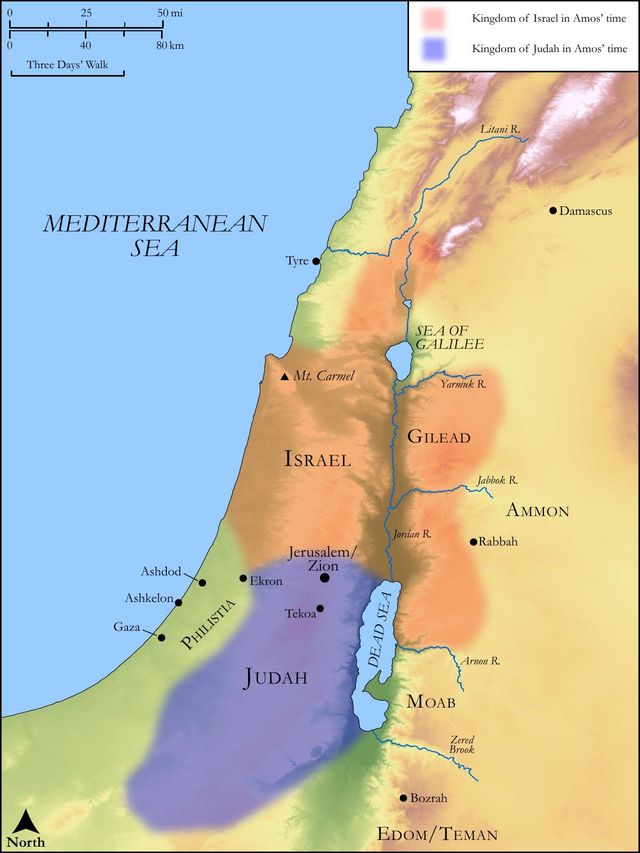
See on the biblical-era map
Study this verse
Public-domain commentary
Matthew Henry
From his Commentary on the Whole Bible. Henry comments on passages, not single verses — this entry covers Amos 1:1–2. His two-level outline is real structure in the source text, so it is rendered as structure.
Here is, I. The general character of this prophecy. It consists of the words which the prophet saw. Are words to be seen? Yes, God's words are; the apostles speak of the word of life, which they had not only heard, but which they had seen with their eyes, which they had looked upon, and which their hands had handled (Jo1 1:1), such a real substantial thing is the word of God. The prophet saw these words, that is, 1. They were revealed to him in a vision, as John is said to see the voice that spoke to him, Rev 1:12. 2. That which was foretold by them was to him as certain as if he had seen it with his bodily eyes. It intimates how strong he was in that faith which is the evidence of things not seen.
II.The person by whom this prophecy was sent - Amos, who was among the herdmen of Tekoa, and was one of them.
Some think he was a rich dealer in cattle; the word is used concerning the king of Moab (Kg2 3:4, He was a sheep-master); it is probable that he got money by that business, and yet he must quit it, to follow God as a prophet. Others think he was a poor keeper of cattle, for we find (Amo 7:14, Amo 7:15) that he was withal a gatherer of wild figs, a poor employment by which we may suppose he could but just get his bread, and that God took him, as he did David, from following the flock, and Elisha from following the plough. Many were trained up for great employments, in the quiet, innocent, contemplative business of shepherds. When God would send a prophet to reprove and warn his people, he employed a shepherd, a herdsman, to do it; for they had made themselves as the horse and mule that have no understanding, nay, worse than the ox that knows his owner. God sometimes chooses the foolish things of the world to confound the wise, Co1 1:27. Note, Those whom God has endued with abilities for his service ought not to be despised nor laid aside for the meanness either of their origin or of their beginnings. Though Amos himself is not ashamed to own that he was a herdsman, yet others ought not to upbraid him with it nor think the worse of him for it.
III.The persons concerned in the prophecy of this book; it is concerning Israel, the ten tribes, who were now ripened in sin and ripening apace for ruin. God has raised them up prophets among themselves (Amo 2:11), but they regarded them not; therefore God sends them one from Tekoa, in the land of Judah, that, coming from another country, he might be the more valued, and perhaps he was the rather sent out of his own country because there he was despised for his having been a herdsman. See Mat 13:55-57.
IV.The time when these prophecies were delivered.
1.The book is dated, as laws used to be, by the reigns of the kings under whom the prophet prophesied. It was in the days of Uzziah king of Judah, when the affairs of that kingdom went very well, and of Jeroboam the second kind of Israel, when the affairs of that kingdom went pretty well; yet then they must both be told both of the sins they were guilty of and of the judgments that were coming upon them for those sins, that they might not with the present gleam of prosperity flatter themselves either into an opinion of their innocence or a confidence of their perpetual security.
2.It is dated by a particular event to which is prophecy had a reference; it was two years before the earthquake, that earthquake which is mentioned to have been in the days of Uzziah (Zac 14:5), which put the nation into a dreadful fright, for it is there said, They fled before it. But how could they flee from it? Some conjecture that this earthquake was at the time of Isaiah's vision, when the posts of the door were moved, Isa 6:4. The tradition of the Jews is that it happened just at the time when Uzziah presumptuously invaded the priest's office and went in to burn incense, Ch2 26:16. Josephus mentions this earthquake, Antiq. 9.225, and says, "By it half of a mountain was removed and carried to a plain four furlongs off; and it spoiled the king's gardens." God by this prophet gave warning of it two years before, that God by it would shake down their houses, Amo 3:15.
V.The introduction to these prophecies, containing the general scope of them (Amo 1:2):
The Lord will roar from Zion. His threatenings by his prophets, and the executions of those threatenings in his providence, will be as terrible as the roaring of a lion is to the shepherds and their flocks. Amos here speaks the same language with his contemporaries, Hosea (Hos 11:10) and Joel, Joe 3:16. The lion roars before he tears; God gives warning before he strikes. Observe,
1.Whence this warning comes - from Zion and Jerusalem, from the oracles of God there delivered; for by them is they servant warned, Psa 19:11. Our God, whose special residence is there, will issue out warrants, given at that court, as it were, for the executing of judgments on the land. See Jer 25:30. In Zion was the mercy-seat; thence the Lord roars, intimating that God's acts of justice are consistent with mercy, allayed and mitigated by mercy, nay, as they are warnings, they are really acts of mercy. We are chastened, that we may be not be condemned.
2.What effect the warning has: The habitations of the shepherds mourn, either because they fear the roaring lion or because they feel what is signified by that comparison, the consequences of a great drought (Amo 4:7), which made the top of Carmel (of the most fruitful fields) to wither and become a desert, Joe 1:12-17.
Historical interpretation
Historical reception
1 surviving comment on this verse from the historical church.
(Verse 2.) And he said: The Lord from Zion shall roar, and from Jerusalem he shall give his voice. And the pastures of the shepherds have shone, and the top of Carmel has dried up. LXX: And he said: The Lord from Zion has spoken, and from Jerusalem he has given his voice, and the pastures of the shepherds have shone, and the top of Carmel has dried up. It is natural that all artisans of their craft speak with examples, and each one brings forth the likeness of the one in which he has spent his time: for example, the sailor and the navigator compare their sadness to a storm; they call damage, shipwreck; they call their enemies, adverse winds. Once again, it names prosperity and joy, the most gentle breeze and favorable winds; calm seas and waters, like peaceful fields. From the opposite direction, the soldier signifies whatever he says, shield, sword, armor, helmet, spear, bow, arrow, death, wound, and victory. In the mouths of philosophers, Socrates and Plato are always present, Xenophon and Theophrastus, Zeno and Aristotle, Stoics and Peripatetics. Orators praise Lysias and Hyperides, Pericles and Demosthenes, Gracchi, Catos, Ciceros, and Hortensius in heaven. If they are epic poets, they frequently mention Homer and Virgil; if they are lyric poets, they celebrate Pindar and Flaccus. Why were these things said? To show that even the prophet Amos, who was a shepherd of shepherds, not in cultivated places with planted trees and vineyards, or certainly among green forests and meadows, but in the vastness of the wilderness, where the fierceness of lions and the killing of livestock dwell, made use of his skill in words, in order to mention the terrible and fearful voice of the Lord, the roaring of lions, and the growling of a lion. Comparing the destruction of the Israelite cities to the solitude of shepherds and the dryness of mountains: The Lord, he says, will roar from Zion, and from Jerusalem he will give his voice. In Hebrew, to roar is called Jesag: Beautifully he will roar from Zion, and from Jerusalem he will give his voice, where the temple and the religion of God were, in order to teach that God is not present in the cities of Israel, that is, in Bethel and Dan, where the golden calves were, nor in the capital city of Samaria and Jezreel, but rather in the true religion, which was practiced at that time in Zion and Jerusalem. With the roaring of Zion, and giving his voice from Jerusalem (for the law shall go forth from Zion, and the word of the Lord from Jerusalem), all the shepherds and kings of Israel have mourned, and the peak of Carmel has dried up, which once abounded with joyful pastures. Carmel is called in Greek and Latin, but in Hebrew it is called Chermel: and there are two mountains, which are called by this name. One in which Nabal was, Carmelus, the husband of Abigail to the South. According to Ptolemy, the place formerly called Acho, which is close to the sea, where the prophet Elias obtained rain on bended knees (1 Kings 15). If therefore it refers to Chermel, where Nabal lived, it is more suitable for the flocks of shepherds, because it is close to the wilderness (3 Kings 18). But if it refers to that place which is near the coast, it pertains to the kings and the pride of the kings of Israel, whom he says are to be devastated like the desert mountains when captivity is imminent. Otherwise, when the Lord from Zion and Jerusalem, from the watchtower of the Church, which is situated on the mountain and cannot be hidden, and in which the vision of peace is, has given through the old and new Testament, and through the ecclesiastical teachers his voice, and has sounded as a clear trumpet, then all the beautiful things of the shepherds, that is, the doctrine of the heretics, which seemed composed in beautiful language, and the knowledge of circumcision (for this is interpreted as Chermel, through which they promise themselves the knowledge of the true circumcision), will mourn and wither, and thousands of peoples, who are called flocks because of their simplicity, will wither suddenly with drought.
Continue studying Amos 1:2 across the web’s major study libraries — every link below opens this exact verse, chapter, or book on the destination site.
Read & Compare
 BibleGatewayThis verse in more than 200 translations and 70 languages.
 Bible.comThe YouVersion reader — hundreds of translations, reading plans, and highlights.
 ESV.orgCrossway's official English Standard Version reader.
 NET BibleThe NET translation with 60,000+ translators' notes on every rendering decision.
 STEP BibleTyndale House's free study tool — original text, vocabulary, and scholarly resources.
 BibliaLogos Bible Software's free web reader.
 USCCBThe New American Bible (Revised Edition) with the U.S. bishops' study notes.
Commentaries
 BibleHub CommentariesDozens of classic commentaries on this verse, gathered on one page.
 StudyLightMore than 100 commentary sets — the largest collection on the web.
 BibleRefPlain-English commentary on what this verse means, verse by verse.
 Enduring WordDavid Guzik's free commentary on this chapter, widely used by Bible teachers.
 Bible Study ToolsVerse commentary alongside Greek and Hebrew study aids.
Original Language & Research
- BibleHub InterlinearThe verse word by word — original language, transliteration, and English.
- BibleHub LexiconEvery word's original-language definition and Strong's entry.
 Blue Letter BibleDeep-study tools — Strong's numbers, concordance, and word studies.
 SefariaThe Hebrew text with Rashi and centuries of Jewish commentary.
Sermons, Hymns & Audio


TrulyRandomVerse is not affiliated with these sites and doesn’t control their content. They’re linked because they’re genuinely useful.
Summary
Amos 1:2 serves as a dramatic and foreboding overture to the prophet Amos's message, immediately establishing the divine origin and terrifying nature of the impending judgment. It vividly portrays the LORD as a lion roaring from His holy dwelling in Zion and Jerusalem, a sound that signals not only His sovereign authority but also the devastating desolation that will sweep across the land, causing both the fertile pastures and the renowned Mount Carmel to mourn and wither. This verse sets the stage for the subsequent pronouncements of judgment against Israel and the surrounding nations, underscoring the certainty and severity of God's righteous wrath against sin.
Context
ShowHideLiterary Context
This verse functions as a powerful superscription or thematic prologue to the entire book of Amos. Following the brief introductory statement in Amos 1:1, which identifies the prophet and his historical setting, Amos 1:2 immediately plunges the reader into the core message: God's imminent and inescapable judgment. The imagery of God roaring like a lion from Zion establishes a consistent motif of divine judgment that reverberates throughout the subsequent oracles against Damascus, Philistia, Tyre, Edom, Ammon, Moab, Judah, and especially Israel. It sets a tone of urgency and divine authority, indicating that the following prophecies are not mere human pronouncements but the very voice of God.
Historical & Cultural Context
Amos prophesied during the reigns of Uzziah king of Judah and Jeroboam II king of Israel, a period of remarkable economic prosperity and political stability for both kingdoms, particularly the Northern Kingdom of Israel. However, beneath this veneer of success lay deep-seated oppression, moral corruption, and religious apostasy. The wealthy oppressed the poor, justice was perverted, and idolatry was rampant, often cloaked under a facade of religious observance. The mention of "shepherds" and "Carmel" grounds the prophecy in the agricultural and pastoral realities of the land, highlighting that the judgment would impact the very foundations of their livelihood and the natural beauty they took for granted. Mount Carmel, known for its lush forests and fertility, represents the pinnacle of natural abundance, making its predicted withering a potent symbol of total devastation.
Key Themes
ShowHideAmos 1:2 introduces several foundational themes that permeate the book. The most prominent is Divine Judgment, depicted through the terrifying metaphor of the LORD's roar, signifying an active, decisive, and destructive intervention by God against the unrighteousness of His people and the nations. This judgment is rooted in God's Sovereignty and Authority, as His voice emanates from Zion and Jerusalem, demonstrating His universal dominion over all creation and human affairs, even when His prophet is sent to the Northern Kingdom. Furthermore, the verse foreshadows Widespread Desolation, indicating that the consequences of sin will not be limited but will impact both the natural world and human society, leading to a profound loss of prosperity, joy, and life itself. This serves as a stark warning, emphasizing the biblical principle that actions have consequences, particularly when a covenant people strays from God's commands, as outlined in passages like Deuteronomy 28:15.
Exposition and Analysis
ShowHideKey Word Analysis
ShowHideThis is the covenant name of God, often translated as "Yahweh" or "Jehovah," emphasizing His self-existence, eternal nature, and His covenant relationship with Israel. The use of this specific name underscores that the impending judgment is not arbitrary but comes from the faithful, covenant-keeping God who has a just claim on His people. It signifies that the one who roars is the sovereign God of Israel, not a lesser deity.
A primitive root meaning "to rumble or moan," specifically used to describe the fierce, terrifying cry of a lion. This word choice is crucial, as it conveys the majestic, powerful, and utterly terrifying nature of God's pronouncement of judgment. It is not a whisper or a gentle word, but a loud, authoritative sound that strikes fear and signifies an imminent, decisive, and destructive action, leaving no doubt about its source or impact.
This root means "to dry up (as water) or wither (as herbage)," but also "to be ashamed, confused or disappointed." In this context, it vividly describes the physical desolation of the land, particularly Mount Carmel, symbolizing the loss of fertility and life. The secondary meaning of shame or disappointment also subtly hints at the spiritual and emotional devastation that will accompany the physical ruin, as the people's hopes and pride are utterly dashed.
Verse Breakdown
ShowHide"And he said, The LORD will roar from Zion, and utter his voice from Jerusalem"
This opening clause immediately establishes the divine source and nature of the prophecy. "He said" refers to the LORD, not Amos, emphasizing that the message originates from God Himself. The imagery of the LORD "roaring" like a lion from His holy dwelling places, Zion and Jerusalem, conveys His majestic power, terrifying authority, and the certainty of His impending judgment. The roar is a sound of warning and impending attack, signifying that God is about to act decisively against the unrighteousness of His people.
"and the habitations of the shepherds shall mourn"
This phrase describes the immediate and widespread impact of God's judgment. "Habitations of the shepherds" refers to the pastures, dwellings, and livelihoods of those dependent on the land, symbolizing the rural population and the very agricultural foundation of society. Their "mourning" indicates profound sorrow, loss, and desolation, suggesting that the judgment will strip away their prosperity and cause deep distress.
"and the top of Carmel shall wither"
This final clause provides a potent symbol of the comprehensive nature of the desolation. Mount Carmel was renowned for its lush fertility, beauty, and abundant vegetation, often representing the epitome of prosperity in Israel. Its "withering" signifies a complete reversal of fortune, a drying up of life and abundance, illustrating that no part of the land, however strong or beautiful, will be spared from the devastating effects of God's righteous judgment.
Literary Devices
ShowHideAmos 1:2 is rich in Imagery, particularly the powerful metaphor of God as a roaring lion. This Metaphor vividly conveys God's raw power, His terrifying majesty, and the predatory nature of His impending judgment. The lion's roar is a sound of warning before an attack, signifying an inescapable and destructive force. The verse also employs Personification, as "the habitations of the shepherds shall mourn" and "the top of Carmel shall wither." Giving human emotions (mourning) and actions (withering due to distress) to inanimate objects or geographical features intensifies the sense of widespread grief and desolation that will grip the land. The contrast between Carmel's renowned fertility and its predicted "withering" also creates a sharp Juxtaposition, highlighting the severity and unexpectedness of the coming judgment. This dramatic opening serves as a powerful Proleptic statement, foreshadowing the comprehensive destruction detailed throughout the book.
Theological and Thematic Connections
ShowHideAmos 1:2 powerfully asserts the absolute sovereignty and moral governance of God over creation and humanity. The imagery of the LORD roaring from Zion underscores that divine judgment is not a random event but a deliberate act emanating from His holy presence and righteous character. This judgment is a direct consequence of sin and injustice, demonstrating that God is not indifferent to the moral decay of His people or the nations. The desolation described is a tangible manifestation of God's wrath, serving as a stark reminder that disobedience to His covenant and disregard for His justice will inevitably lead to severe consequences. This foundational truth about God's character — His holiness, justice, and ultimate authority — is a recurring theme throughout biblical prophecy, calling all to repentance and reverence.
Reflection and Application
ShowHideAmos 1:2 serves as a timeless and sobering reminder of God's unwavering holiness and justice. In a world often characterized by moral relativism and a diminishing sense of accountability, this verse powerfully declares that God is not silent in the face of injustice and rebellion. His "roar" from Zion is a call to attention, a declaration that He sees, He knows, and He will act. For believers today, this should cultivate a profound reverence for God, recognizing His authority not just as a loving Father but also as a righteous Judge. It challenges us to examine our own lives and communities for any areas of compromise with sin, oppression, or spiritual apathy. While we live under the grace of the new covenant, the principles of God's character remain immutable. We are called to live justly, love mercy, and walk humbly with our God, understanding that true peace and prosperity are found not in material abundance or political stability, but in faithful obedience to His commands and a deep, abiding fear of the LORD. This verse compels us to take God's warnings seriously and to respond with genuine repentance and transformed living.
Questions for Reflection
ShowHideFAQ
ShowHideWhy does God "roar" from Zion and Jerusalem, specifically?
ShowHideThe imagery of God roaring from Zion and Jerusalem is highly significant because these locations represent His dwelling place and the center of His covenant relationship with Israel. Zion is often synonymous with Jerusalem, the capital city and the site of the Temple. By roaring from these holy places, God emphasizes that the judgment is not arbitrary or from a distant deity, but from the very God who established a covenant with His people and resided among them. It underscores His sovereign authority over His chosen land and people, and signals that judgment begins from the house of God, as indicated in 1 Peter 4:17. This also signifies that the judgment is rooted in His righteous character and covenant faithfulness, as His holy presence cannot tolerate unrepentant sin.
Christ-Centered Fulfillment
ShowHideWhile Amos 1:2 speaks of God's roaring judgment against sin, its ultimate fulfillment and resolution are found in Jesus Christ. The "roar" of the LORD from Zion, a sound of terrifying judgment, is ultimately silenced and satisfied in the person and work of Christ. He is the Lamb of God who takes away the sin of the world, absorbing the full wrath and judgment of God on the cross (John 1:29). Through His sacrifice, the curse of the law and the withering effects of sin, symbolized by the mourning shepherds and withered Carmel, are overcome. Furthermore, Jesus Himself is depicted as the Lion of the Tribe of Judah (Revelation 5:5), who, through His victory over sin and death, brings about a new creation where mourning is turned into joy and desolation into flourishing life (Revelation 21:4). Thus, the terrifying roar of judgment in Amos foreshadows the ultimate divine intervention, not just in judgment, but in the redemptive work of Christ, who reconciles humanity to God and inaugurates a kingdom where righteousness reigns.