


Jeremiah 25:37
Bible text: King James Version (1769 Blayney text) · Public domain
Bible text: Berean Standard Bible · Public domain
Bible text: American Standard Version (1901) · Public domain
Bible text: World English Bible, Messianic edition · Public domain
Bible text: Geneva Bible (1599) · Public domain
Bible text: Young's Literal Translation · Public domain
- וְנָדַמּוּve·na·Da·muand they will be devastatedH1826Conj-w ¦ V-Niphal-ConsecPerf-3cpVerb Niphal Consecutive Perfect 3rd Plural common genderוְandנָדַמּוּthey will be devastated
- נְאוֹתne·'ot[the] pastures ofH4999N-fpcNoun Plural Feminine Construct
- הַשָּׁלוֹםha·sha·Lom<the> peaceH7965Art ¦ N-msNoun Singular Masculine Absoluteהַ<the>שָּׁלוֹםpeace
- מִפְּנֵיmi·pe·Nei<from> because ofH6440Prep-m ¦ N-mpcNoun Plural Masculine Constructמִ<from>פְּנֵיbecause of
- חֲרוֹןcha·Ron[the] burning ofH2740N-mscNoun Singular Masculine Construct
- אַף'af[the] anger ofH639N-mscNoun Singular Masculine Construct
- יְהוָהYah·wehYahwehH3068N-properNoun Proper Title
English is a literal word-by-word gloss of the Hebrew, not the KJV's wording. Why?
This is the original text the KJV's translators worked from — each Hebrew word with its own literal English meaning in this verse, prepared by scholars at Tyndale House, Cambridge. The KJV translates whole sentences, not word by word, so its wording differs: one Hebrew word can become several English words, and the KJV may choose “the LORD” where the gloss reads “Yahweh”. Both are faithful — they answer different questions. For the KJV's own rendering, switch to the KJV text.
Details
See on the biblical-era map
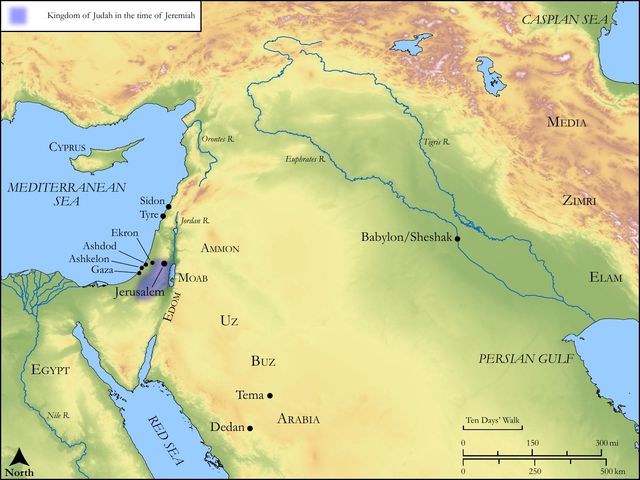
Study this verse
Public-domain commentary
Matthew Henry
From his Commentary on the Whole Bible. Henry comments on passages, not single verses — this entry covers Jeremiah 25:30–38.
We have, in these verses, a further description of those terrible desolations which the king of Babylon with his armies should make in all the countries and nations round about Jerusalem. In Jerusalem God had erected his temple; there were his oracles and ordinances, which the neighbouring nations should have attended to and might have received benefit by; thither they should have applied for the knowledge of God and their duty, and then they might have had reason to bless God for their neighbourhood to Jerusalem; but they, instead of that, taking all opportunities either to debauch or to disturb that holy city, when God came to reckon with Jerusalem because it learned so much of the way of the nations, he reckoned with the nations because they learned so little of the way of Jerusalem.
They will soon be aware of Nebuchadrezzar's making war upon them; but the prophet is here directed to tell them that it is God himself that makes war upon them, a God with whom there is no contending. 1. The war is here proclaimed (Jer 25:30): The Lord shall roar from on high; not from Mount Zion and Jerusalem (as Joe 3:16, Amo 1:2), but from heaven, from his holy habitation there; for now Jerusalem is one of the places against which he roars. He shall mightily roar upon his habitation on earth from that above. He has been long silent, and seemed not to take notice of the wickedness of the nations; the times of this ignorance God winked at; but now he shall give a shout, as the assailants in battle do, against all the inhabitants of the earth, to whom it shall be a shout of terror, and yet a shout of joy in heaven, as theirs that tread the grapes; for, when God is reckoning with the proud enemies of his kingdom among men, there is a great voice of much people heard in heaven, saying, Hallelujah, Rev 19:1. He roars as a lion (Amo 3:4, Amo 3:8), as a lion that has forsaken his covert (Jer 25:38), and is going abroad to seek his prey, upon which he roars, that he may the more easily seize it. 2. The manifesto is here published, showing the causes and reasons why God proclaims this war (Jer 25:31): The Lord has a controversy with the nations; he has just cause to contend with them, and he will take this way of pleading with them. His quarrel with them is, in one word, for their wickedness, their contempt of him, and his authority over them and kindness to them. He will give those that are wicked to the sword. They have provoked God to anger, and thence comes all this destruction; it is because of the fierce anger of the Lord (Jer 25:37 and again Jer 25:38), the fierceness of the oppressor, or (as it might better be read) the fierceness of the oppressing sword (for the word is feminine) is because of his fierce anger; and we are sure that he is never angry without cause; but who knows the power of his anger? 3. The alarm is here given and taken: A noise will come even to the ends of the earth, so loud shall it roar, so far shall it reach, Jer 25:31. The alarm is not given by sound of trumpet, or beat of drum, but by a whirlwind, a great whirlwind, storm, or tempest, which shall be raised up from the coasts, the remote coasts of the earth, Jer 25:32. The Chaldean army shall be like a hurricane raised in the north, but thence carried on with incredible fierceness and swiftness, bearing down all before it. It is like the whirlwind out of which God answered Job, which was exceedingly terrible, Job 37:1; Job 38:1. And, when the wrath of God thus roars like a lion from heaven, no marvel if it be echoed with shrieks from earth; for who can choose but tremble when God thus speaks in displeasure? See Hos 11:10. Now the shepherds shall howl and cry, the kings, and princes, and the great ones of the earth, the principal of the flock. They used to be the most courageous and secure, but now their hearts shall fail them; they shall wallow themselves in the ashes, Jer 25:34. Seeing themselves utterly unable to make head against the enemy, and seeing their country, which they have the charge of and a concern for, inevitably ruined, they shall abandon themselves to sorrow. There shall be a voice of the cry of the shepherds, and a howling of the principal of the flock shall be heard, Jer 25:36. Those are great calamities indeed that strike such a terror upon the great men, and put them into this consternation. The Lord hath spoiled their pasture, in which they fed their flock, and out of which they fed themselves; the spoiling of that makes them cry-out thus. Perhaps, carrying on the metaphor of a lion roaring, it alludes to the great fright that shepherds are in when they hear a roaring lion coming towards their flocks, and find they have no way to flee (Jer 25:35) for their own safety, neither can the principal of their flock escape. The enemy will be so numerous, so furious, so sedulous, and the extent of their armies so vast, that it will be impossible to avoid falling into their hands. Note, As we cannot out-face, so we cannot out-run, the judgments of God. This is that for which the shepherds howl and cry. 4. The progress of this war is here described (Jer 25:32): Behold, evil shall go forth from nation to nation; as the cup goes round, every nation shall have its share and take warning by the calamities of another to repent and reform. Nay, as if this ere to be a little representation of the last and general judgment, it shall reach from one end of the earth even unto the other end of the earth, Jer 25:33. The day of vengeance is in his heart, and now his hand shall find out all his enemies, wherever they are, Psa 21:8. Note, When our neighbour's house is on fire it is time to be concerned for our own. When one nation is a seat of war every neighbouring nation should hear, and fear, and make its peace with God. 5. The dismal consequences of this war are here foretold: The days of slaughter and dispersions are accomplished, that is, they are fully come (Jer 25:34), the time fixed in the divine counsel for the slaughter of some and the dispersion of the rest, which will make the nations completely desolate. Multitudes shall fall by the sword of the merciless Chaldeans, so that the slain of the Lord shall be every where found: they are slain by commission from him, and are sacrificed to his justice. The slain for sin are the slain of the Lord. To complete the misery of their slaughter, they shall not be lamented in particular, so general shall the matter of lamentation be. Nay, they shall not be gathered up, nor buried, for they shall have no friends left to bury them, and the enemies shall not have so much humanity in them as to do it; and then they shall be as dung upon the earth, so vile and noisome: and it is well if, as dung manures the earth and makes it fruitful, so these horrid spectacles, which lie as monuments of divine justice, might be a means to awaken the inhabitants of the earth to learn righteousness. The effect of this war will be the desolation of the whole land that is the seat of it (Jer 25:38), one land after another. But here are two expressions more that seem to make the case in a particular manner piteous. (1.) You shall fall like a pleasant vessel, Jer 25:34. The most desirable persons among them, who most valued themselves and were most valued, who were looked upon as vessels of honour, shall fall by the sword. You shall fall as a Venice glass or a China dish, which is soon broken all to pieces. Even the tender and delicate shall share in the common calamity; the sword devours one as well as another. (2.) Even the peaceable habitations are cut down. Those that used to be quiet, and not molested, the habitations in which you have long dwelt in peace, shall now be no longer such, but cut down by the war. Or, Those who used to be quiet, and not molesting any of their neighbours, those who lived in peace, easily, and gave no provocation to any, even those shall not escape. This is one of the direful effects of war, that even those who were most harmless and inoffensive suffer hard things. Blessed be God, there is a peaceable habitation above for all the sons of peace, which is out of the reach of fire and sword.
Historical interpretation
Historical reception
1 surviving comment on this verse from the historical church.
(Verses 37, 38) He has abandoned his shelter (or den) like a lion. (And to be more accurate, his tent: for this is what 'Succho' means in Hebrew.) Because their land has become a desolation (or impassable) from the wrath of the dove (or from the face of the great sword) and from the face of the fury of the Lord. The Lord, of whom it was said above, will roar from on high, and from his holy dwelling he will give forth his voice. Roaring, he will roar over his glory, he himself will abandon his tent, of which it is written: He has made it in peace, or in Salem, that is, his dwelling place, and his habitation in Zion (Psalm 75:2): he himself will abandon his seat, and he will fulfill what he spoke through the same prophet: I have forsaken my house, I have abandoned my inheritance (Jeremiah 12:7). But it left its den like a lion, so that all the beasts have power over its land. For with the lion as their guardian and ruler, no one dares approach it. It has become, he says, their land, undoubtedly to the point that either the Jewish people or certainly all the nations will be desolated and made impassable by the face of the dove's wrath. It is not surprising that the dove of the Lord is understood to be Nebuchadnezzar, who has read himself being called the servant of the Lord above him. For why they have translated Seventy, a great sword. May we receive a dove and in the person of Jerusalem, that he may be angry and sad, having lost the custody of his lion, and his land coming into desolation.
Continue studying Jeremiah 25:37 across the web’s major study libraries — every link below opens this exact verse, chapter, or book on the destination site.
Read & Compare
 BibleGatewayThis verse in more than 200 translations and 70 languages.
 Bible.comThe YouVersion reader — hundreds of translations, reading plans, and highlights.
 ESV.orgCrossway's official English Standard Version reader.
 NET BibleThe NET translation with 60,000+ translators' notes on every rendering decision.
 STEP BibleTyndale House's free study tool — original text, vocabulary, and scholarly resources.
 BibliaLogos Bible Software's free web reader.
 USCCBThe New American Bible (Revised Edition) with the U.S. bishops' study notes.
Commentaries
 BibleHub CommentariesDozens of classic commentaries on this verse, gathered on one page.
 StudyLightMore than 100 commentary sets — the largest collection on the web.
 BibleRefPlain-English commentary on what this verse means, verse by verse.
 Enduring WordDavid Guzik's free commentary on this chapter, widely used by Bible teachers.
 Bible Study ToolsVerse commentary alongside Greek and Hebrew study aids.
Original Language & Research
- BibleHub InterlinearThe verse word by word — original language, transliteration, and English.
- BibleHub LexiconEvery word's original-language definition and Strong's entry.
 Blue Letter BibleDeep-study tools — Strong's numbers, concordance, and word studies.
 SefariaThe Hebrew text with Rashi and centuries of Jewish commentary.
Sermons, Hymns & Audio


TrulyRandomVerse is not affiliated with these sites and doesn’t control their content. They’re linked because they’re genuinely useful.
Summary
Jeremiah 25:37 vividly portrays the comprehensive desolation awaiting seemingly secure and tranquil dwelling places, serving as a stark declaration of divine judgment. This verse, embedded within a broader prophetic pronouncement against Judah and surrounding nations, underscores that the widespread destruction is not arbitrary but a direct and inevitable consequence of the Lord's intense, righteous wrath against persistent sin and rebellion. It powerfully communicates the ultimate fragility of human-established security in the face of God's sovereign and just intervention.
Context
ShowHideLiterary Context
Jeremiah 25:37 is situated within a sweeping prophetic oracle delivered by Jeremiah in the fourth year of King Jehoiakim (around 605 BC), a critical period preceding the Babylonian exile. The chapter begins with a retrospective on Judah's seventy years of unfaithfulness and the impending seventy-year Babylonian captivity as divine punishment (Jeremiah 25:1-14). The prophecy then expands dramatically to encompass God's judgment upon "all the nations" (Jeremiah 25:15-29), symbolized by the "cup of the wine of this fury" that all must drink (Jeremiah 25:15). Verses 30-38 culminate this section with a poetic, apocalyptic vision of the Lord roaring like a lion from on high, unleashing a "great noise" and widespread destruction across the earth, sparing no one. Within this universal judgment, verse 37 specifically highlights the utter demolition of "peaceable habitations," emphasizing the all-encompassing nature of God's wrath, which will reach even the most secure and cherished places.
Historical & Cultural Context
The historical backdrop for Jeremiah 25 is the tumultuous late 7th century BC, a period marked by the decline of Assyria and the rapid ascendance of the Neo-Babylonian Empire under Nebuchadnezzar. Judah, a small kingdom caught between these shifting powers, repeatedly vacillated between political alliances and, more significantly, engaged in persistent idolatry and oppression, despite fervent warnings from prophets like Jeremiah. The phrase "peaceable habitations" (Hebrew: n'aot shalom) would have resonated deeply with an agrarian society. N'aot refers to pastures or dwelling places, often implying lush, settled, and secure areas for flocks and people. Shalom denotes not just absence of conflict, but holistic well-being, prosperity, and completeness. Thus, "peaceable habitations" would have conjured images of idyllic, stable communities, perhaps even the pastoral lands where shepherds and their flocks found security. The destruction of such places would have been particularly shocking, signaling the complete reversal of fortune and the shattering of any illusion of safety or prosperity, directly confronting the false sense of security held by many in Judah.
Key Themes
ShowHideJeremiah 25:37 powerfully contributes to several overarching themes prevalent in Jeremiah and the broader prophetic corpus. Firstly, it underscores the theme of Divine Judgment, portraying God's righteous and fierce anger (chârôwn 'aph) as the ultimate, active cause of widespread devastation. This is not arbitrary wrath but a just, holy response to persistent sin, idolatry, and covenant breaking, as consistently condemned throughout Jeremiah's prophecies (e.g., Jeremiah 7:1-15). Secondly, the verse highlights the Futility of Human Security and False Hope, demonstrating that human-made stability or perceived peace is ultimately fragile and cannot withstand divine wrath. The destruction of "peaceable habitations" shatters any illusion that Judah or other nations could escape the consequences of their actions through their own strength or perceived tranquility. Thirdly, it reinforces the theme of God's Sovereignty Over All Nations, emphasizing that His judgment extends beyond His covenant people to all who defy Him, as He is the Lord of all the earth and holds all nations accountable (Jeremiah 25:29). Finally, the verse implicitly serves as a stark warning regarding the Consequences of Unrepentance, illustrating that continued rebellion against God inevitably leads to severe and comprehensive desolation.
Exposition and Analysis
ShowHideKey Word Analysis
ShowHideFrom a root meaning "to be comely" or "suitable," this word (H4999) refers to a home, a dwelling place, or figuratively, a pasture. It conveys a sense of pleasantness, suitability, and often, security or rest. Its use here, combined with "peaceable" (shâlôwm), emphasizes places that were considered safe, tranquil, and well-established, making their destruction all the more impactful as a reversal of expected well-being.
This primitive root (H1826) carries a range of meanings, including "to be dumb," "to be astonished," "to stop," and "to perish." In this context, it signifies a forceful cessation, a being brought to an end, or being laid waste. It implies thorough destruction, not merely damage, but a complete silencing, desolation, or annihilation of what once existed, rendering it still and lifeless.
Derived from a root meaning "to burn," this word (H2740) denotes a burning of anger, intense displeasure, or fury. It describes a deep, settled, and active wrath, indicating the severity and intensity of God's indignation against sin. It is not a fleeting emotion but a consuming, righteous anger that brings about severe and devastating consequences, a reflection of His holy character in the face of unrighteousness.
Verse Breakdown
ShowHide"And the peaceable habitations are cut down"
This opening clause immediately presents the devastating outcome of divine judgment. The "peaceable habitations" (Hebrew: n'aot shalom) refer to places once characterized by tranquility, security, and prosperity, encompassing not just physical dwellings but entire communities or regions that enjoyed a sense of well-being and stability. The phrase "cut down" (from dâmam) vividly portrays their complete desolation and cessation, implying that these once-secure and thriving places will be utterly destroyed, silenced, and rendered uninhabitable, their peace irrevocably shattered.
"because of the fierce anger of the LORD."
This second clause provides the ultimate divine rationale and causal agent for the widespread destruction. The "fierce anger" (chârôwn 'aph) of the Lord (Yahweh, H3068) is a powerful and frequently used expression in the Old Testament for God's intense, burning wrath—His holy and righteous indignation against the sin, idolatry, and rebellion of Judah and the nations. This clarifies that the impending judgment is not random misfortune or a natural disaster, but a deliberate, just, and severe consequence directly stemming from God's holy character and His unyielding response to unrepentant wickedness.
Literary Devices
ShowHideJeremiah 25:37 employs several potent Literary Devices to convey its message of impending, comprehensive judgment. The phrase "peaceable habitations" serves as a powerful instance of Irony, as these places, by their very definition, are meant to be secure and tranquil, yet they are precisely the targets of utter destruction. This highlights the complete reversal of fortune and the shattering of any false sense of security. The act of being "cut down" is a vivid Metaphor for utter destruction and desolation, evoking imagery of something vibrant, established, and living being violently brought to an end, silenced, or laid waste. Furthermore, the "fierce anger of the LORD" is a profound example of Anthropomorphism, attributing a human emotion (anger) to God to help human readers grasp the intensity, nature, and active power of His righteous indignation against sin. This Personification of God's wrath underscores its active and destructive force, portraying it as the driving, irresistible power behind the impending catastrophe.
Theological and Thematic Connections
ShowHideJeremiah 25:37 profoundly articulates the theological truth of God's active, righteous, and inescapable judgment against sin. It reveals that the Lord, Yahweh, is not a passive observer of human wickedness but actively intervenes in history to bring about consequences for rebellion and unfaithfulness. His "fierce anger" is not an uncontrolled outburst but a holy and just response to persistent idolatry, injustice, and covenant breaking. This verse serves as a stark reminder that true peace and security are not found in earthly structures, human endeavors, or perceived tranquility, but only in humble alignment with God's will and His righteous standards. When humanity deviates from His ways, even the most "peaceable habitations" become vulnerable to the just outpouring of His wrath, demonstrating His absolute sovereignty over all nations and their destinies, and affirming that He is a God who will by no means clear the guilty.
Reflection and Application
ShowHideJeremiah 25:37 offers a profound and sobering reminder of the gravity of sin and the certainty of divine justice. It challenges any human tendency to place ultimate trust in fleeting earthly securities—whether wealth, political stability, military might, technological advancement, or even a perceived state of tranquility. The vivid imagery of "peaceable habitations" being "cut down" powerfully illustrates that no human construct or condition, no matter how secure or cherished, is immune to the consequences of persistent disobedience to God. For us today, this verse compels a deep introspection into where our ultimate security and peace truly reside. It urges us to abandon any false sense of invulnerability and to recognize that genuine, enduring peace and lasting well-being are found only in humble submission to the Lord and faithful adherence to His righteous ways. It is a powerful call to repentance, urging individuals and societies to turn from self-reliance, idolatry, and sin, and to seek the true and lasting peace that comes from God alone, before His righteous wrath is fully manifested.
Questions for Reflection
ShowHideFAQ
ShowHideDoes God still get "fiercely angry" today, or was this only for Old Testament times?
ShowHideThe fundamental truth of God's righteous indignation against sin remains constant, though its manifestations differ between the Old and New Covenants. The Bible consistently portrays God as holy and just, meaning He cannot tolerate sin. In the Old Testament, His anger often resulted in temporal judgments on nations or individuals, as seen in Jeremiah 25:37. In the New Testament, while the ultimate wrath for believers was fully poured out on Christ, the concept of God's wrath is still profoundly present. It is described as a future, eternal judgment for those who reject Christ and persist in ungodliness (Romans 2:5-8). Furthermore, even in this age, there are present consequences for sinful choices that reflect God's displeasure, as seen in the "giving over" passages in Romans 1:18-32. Therefore, God's character as one who is righteously angry at sin has not changed, though His covenantal dealings with humanity have progressed and culminated in Christ's atoning work.
Christ-Centered Fulfillment
ShowHideJeremiah 25:37, with its stark portrayal of "peaceable habitations" being "cut down because of the fierce anger of the LORD," finds its ultimate Christ-centered fulfillment in the person and redemptive work of Jesus. While this verse speaks of temporal judgment upon nations for their unrepentant sin, the New Testament reveals that the full weight of God's fierce anger against all human sin was ultimately and perfectly poured out upon Christ on the cross. He became the Lamb of God who takes away the sin of the world (John 1:29), bearing the divine wrath that humanity justly deserved. Through His atoning sacrifice, Jesus provides the only true and lasting "peaceable habitation" for humanity—a spiritual dwelling place of reconciliation and security with God that can never be "cut down" by divine judgment. The peace that was shattered by sin and divine wrath is now offered to all who believe in Christ, for He is "our peace" (Ephesians 2:14), having broken down the dividing wall of hostility and made peace through the blood of His cross (Colossians 1:20). Thus, what Jeremiah prophesied as destruction due to God's anger is ultimately resolved in Christ, who absorbed that anger, offering eternal peace, security, and true rest to all who find their refuge in Him.