


Isaiah 34:2
- כִּיkiforH3588PrtParticle Conditional
- קֶצֶףKe·tzefwrathH7110N-msNoun Singular Masculine Absolute
- לַיהוָהla·Yah·weh[belongs] to YahwehH3068Prep-l ¦ N-properNoun Proper Titleלַ[belongs] toיהוָהYahweh
- עַל'altowardsH5921PrepPreposition
- כָּלkolallH3605N-mscNoun Singular Masculine Construct
- הַגּוֹיִםha·go·Yimthe nationsH1471Art ¦ N-mpNoun Plural Masculine Absoluteהַtheגּוֹיִםnations
- וְחֵמָהve·che·Mahand rageH2534Conj-w ¦ N-fsNoun Singular Feminine Absoluteוְandחֵמָהrage
- עַל'altowardsH5921PrepPreposition
- כָּלkoleveryH3605N-mscNoun Singular Masculine Construct
- צְבָאָםtze·va·'Amtheir armyH6635N-msc ¦ 3mpNoun Singular Masculine Constructצְבָאָarmyםtheir
- הֶחֱרִימָםhe·che·ri·Mamhe will totally destroy themH2763V-Hiphil-Perf-3ms ¦ 3mpVerb Hiphil Perfect 3rd Singular Masculineהֶחֱרִימָhe will totally destroyםthem
- נְתָנָםne·ta·Namhe will deliver up themH5414V-Qal-Perf-3ms ¦ 3mpVerb Qal Perfect 3rd Singular Masculineנְתָנָhe will deliver upםthem
- לַטָּבַחla·Ta·vachto <the> slaughterH2874Prep-l ¦ N-msNoun Singular Masculine Absoluteלַto <the>טָּבַחslaughter
English is a literal word-by-word gloss of the Hebrew, not the KJV's wording. Why?
This is the original text the KJV's translators worked from — each Hebrew word with its own literal English meaning in this verse, prepared by scholars at Tyndale House, Cambridge. The KJV translates whole sentences, not word by word, so its wording differs: one Hebrew word can become several English words, and the KJV may choose “the LORD” where the gloss reads “Yahweh”. Both are faithful — they answer different questions. For the KJV's own rendering, switch to the KJV text.
Details
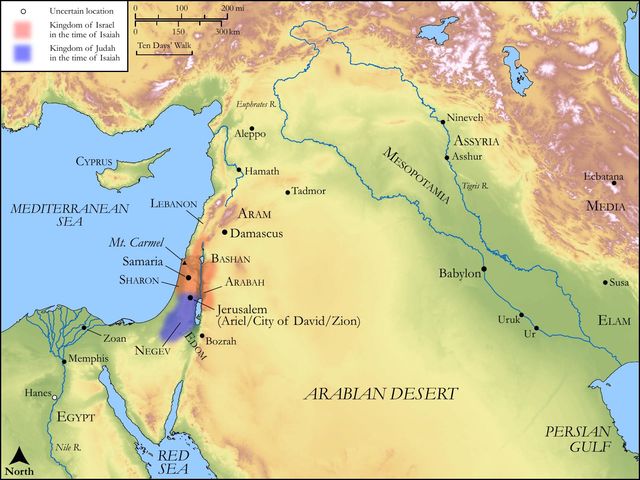
See on the biblical-era map
Study this verse
Public-domain commentary
Matthew Henry
From his Commentary on the Whole Bible. Henry comments on passages, not single verses — this entry covers Isaiah 34:1–8. His three-level outline is real structure in the source text, so it is rendered as structure.
Here we have a prophecy, as elsewhere we have a history, of the wars of the Lord, which we are sure are all both righteous and successful. This world, as it is his creature, he does good to; but as it is in the interest of Satan, who is called the god of this world, he fights against it.
I.Here is the trumpet sounded and the war proclaimed, Isa 34:1.
All nations must hear and hearken, not only because what God is about to do is well worthy their remark (as Isa 33:13), but because they are all concerned in it; it is with them that God has a quarrel; it is against them that God is coming forth in wrath. Let them all take notice that the great God is angry with them; his indignation is upon all nations, and therefore let all nations come near to hear. The trumpet is blown in the city (Amo 3:6), and the watchmen on the walls cry, Hearken to the sound of the trumpet, Jer 6:17. Let the earth hear, and the fulness thereof, for it is the Lord's (Psa 24:1) and ought to hearken to its Maker and Master. The world must hear, and all things that come forth of it, the children of men, that are of the earth earthy, come out of it, and must return to it; or the inanimate products of the earth are called to, as more likely to hearken than sinners, whose hearts are hardened against the calls of God. Hear, O you mountains! the Lord's controversy, Mic 6:2. It is so just a controversy that all the world may be safely appealed to concerning the equity of it.
II.Here is the manifesto published, setting forth,
1.Whom he makes war against (Isa 34:2): The indignation of the Lord is upon all nations; they are all in confederacy against God and religion, all in the interests of the devil, and therefore he is angry with them all, even with all the nations that forget him. He has long suffered all nations to walk in their own ways (Act 14:16), but now he will no longer keep silence. As they have all had the benefit of his patience, so they must all expect now to feel his resentments. His fury is in a special manner upon all their armies,
(1.)Because with them they have done mischief to the people of God; those are they that have made bloody work with them, and therefore they must be sure to have blood given them to drink.
(2.)Because with them they hope to make their part good against the justice and power of God they trust to them as their defence, and therefore on them, in the first place, God's fury will come. Armies before God's fury are but as dry stubble before a consuming fire, though ever so numerous and courageous.
2.Whom he makes war for, and what are the grounds and reasons of the war (Isa 34:8): It is the day of the Lord's vengeance, and he it is to whom vengeance belongs, and who is never unrighteous in taking vengeance, Rom 3:5. As there is a day of the Lord's patience, so there will be a day of his vengeance; for, though he bear long, he will not bear always. It is the year of recompences for the controversy of Zion. Zion is the holy city, the city of our solemnities, a type and figure of the church of God in the world. Zion has a just quarrel with her neighbours for the wrongs they have done her, for all their treacherous and barbarous usage of her, profaning her holy things, laying waste her palaces, and slaying her sons. She has left it to God to plead her cause, and he will do so when the time, even the set time, to favour Zion shall have come; then he will recompense to her persecutors and oppressors all the mischiefs they have done her. The controversy will be decided, that Zion has been wronged, and therein Zion's God has been himself abused. Judgment will be given upon this decision, and execution done. Note, There is a time prefixed in the divine counsels for the deliverance of the church and the destruction of her enemies, a year of the redeemed, which will come, a year of recompences for the controversy of Zion; and we must patiently wait till then, and judge nothing before the time.
III.Here are the operations of the war, and the methods of it, settled, with an infallible assurance of success.
1.The sword of the Lord is bathed in heaven; this is all the preparation here made for the war, Isa 34:5. It may probably allude to some custom they had then of bathing their swords in some liquor or other, to harden them or brighten them; it is the same with the furbishing of it, that it may glitter, Eze 21:9-11. God's sword is bathed in heaven, in his counsel and decree, in his justice and power, and then there is not standing before it.
2.It shall come down. What he has determined shall without fail be put in execution. It shall come down from heaven, and the higher the place is, whence it comes, the heavier will it fall. It will come down upon Idumea, the people of God's curse, the people that lie under his curse and are by it doomed to destruction. Miserable, for ever miserable, are those that have by their sins made themselves the people of God's curse; for the sword of the Lord will infallibly attend the curse of the Lord and execute the sentences of it; and those whom he curses are cursed indeed. It shall come down to judgment, to execute judgment upon sinners. Note, God's sword of war is always a sword of justice. It is observed of him out of whose mouth goeth the sharp sword that in righteousness he doth judge and make war, Rev 19:11, Rev 19:15.
3.The nations and their armies shall be given up to the sword (Isa 34:2): God has delivered them to the slaughter, and then they cannot deliver themselves, nor can all the friends they have deliver them from it. Those only are slain whom God delivers to the slaughter, for the keys of death are in his hand; and, in delivering them to the slaughter, he has utterly destroyed them; their destruction is as sure, when God has doomed them to it, as if they were destroyed already, utterly destroyed. God has, in effect, delivered all the cruel enemies of his church to the slaughter by that word (Rev 13:10), He that kills with the sword must be killed by the sword, for the Lord is righteous.
4.Pursuant to the sentence, a terrible slaughter shall be made among them (Isa 34:6): The sword of the Lord, when it comes down with commission, does vast execution; it is filled, satiated, surfeited, with blood, the blood of the slain, and made fat with their fatness. When the day of God's abused mercy and patience is over the sword of his justice gives no quarter, spares none. Men have by sin lost the honour of the human nature and made themselves like the beasts that perish; they are therefore justly denied the compassion and respect that are owing to the human nature and killed as beasts, and no more is made of slaying an army of men than of butchering a flock of lambs or goats and feeding on the fat of the kidneys of rams. Nay, the sword of the Lord shall not only dispatch the lambs and goats, the infantry of their armies, the poor common soldiers, but (Isa 34:7) the unicorns too shall be made to come down with them, and the bullocks with the bulls, though they are ever so proud, and strong, and fierce (the great men, and the mighty men, and the chief captains Rev 6:15), the sword of the Lord will make as easy a prey of as of the lambs and the goats. The greatest of men are nothing before the wrath of the great God. See what bloody work will be made: The land shall be soaked with blood, as with the rain that comes often upon it and in great abundance; and their dust, their dry and barren land, shall be made fat with the fatness of men slain in their full strength, as with manure. Nay even the mountains, which are hard and rocky, shall be melted with their blood, Isa 34:3. These expressions are hyperbolical (as St. John's vision of blood to the horse-bridles, Rev 14:20), and are made use of because they sound very dreadful to sense (it makes us even shiver to think of such abundance of human gore), and are therefore proper to express the terror of God's wrath, which is dreadful beyond conception and expression. See what work sin and wrath make even in this world, and think how much more terrible the wrath to come is, which will bring down the unicorns themselves to the bars of the pit.
5.This great slaughter will be a great sacrifice to the justice of God (Isa 34:6): The Lord has a sacrifice in Bozrah; there it is that the great Redeemer has his garments dyed with blood, Isa 63:1. Sacrifices were intended for the honour of God, to make it appear that he hates sin and demands satisfaction for it, and that nothing but blood will make atonement; and for these ends the slaughter is made, that in it the wrath of God may be revealed from heaven against all the ungodliness and unrighteousness of men, especially their ungodly unrighteous enmity to his people, which was the sin that the Edomites were notoriously guilty of. In great sacrifices abundance of beasts were killed, hecatombs offered, and their blood poured out before the altar; and so will it be in this day of the Lord's vengeance. And thus would the whole earth have been soaked with the blood of sinners if Jesus Christ, the great propitiation, had not shed his blood for us; but those who reject him, and will not make a covenant with God by that sacrifice, will themselves fall as victims to divine wrath. Damned sinners are everlasting sacrifices, Mar 9:48, Mar 9:49. Those that sacrifice not (which is the character of the ungodly, Ecc 9:2) must be sacrificed.
6.These slain shall be detestable to mankind, and shall be as much their loathing as ever they were their terror (Isa 34:3): They shall be cast out, and none shall pay them the respect of a decent burial; but their stink shall come up out of their carcases, that all people by the odious smell, as well as by the ghastly sight, may be made to conceive an indignation against sin and a dread of the wrath of God. They lie unburied, that they may remain monuments of divine justice.
7.The effect and consequence of this slaughter shall be universal confusion and desolation, as if the whole frame of nature were dissolved and melted down (Isa 34:4): All the host of heaven shall pine and waste away (so the word is); the sun shall be darkened, and the moon look black, or be turned into blood; the heavens themselves shall be rolled together as a scroll or parchment when we have done with it, and lay it by, or as when it is shrivelled up by the heat of the fire. The stars shall fall as the leaves in autumn; all the beauty, joy, and comfort, of the vanquished nation shall be lost and done away, magistracy and government shall be abolished, and all dominion and rule, but that of the sword of war, shall fall. Conquerors, in those times, affected to lay waste the countries they conquered; and such a complete desolation is here described by such figurative expressions as will yet have a literal and full accomplishment in the dissolution of all things at the end of time, of which last day of judgment the judgments which God does now sometimes remarkably execute on sinful nations are figures, earnests, and forerunners; and by these we should be awakened to think of that, for which reason these expressions are used here and Rev 6:12, Rev 6:13. But they are used without a metaphor, Pe2 3:10, where we are told that the heavens shall pass away with a great noise and the earth shall be burnt up.
Historical interpretation
Historical reception
1 surviving comment on this verse from the historical church.
(Chapter 34, Verse 1, etc.) Come near, you nations, and listen; pay attention, you peoples! Let the earth and all that fills it hear, the world and all that springs from it. For the Lord's indignation is against all the nations, and His fury is against all their armies; He has utterly destroyed them and given them over to slaughter. Their slain will be thrown out, and the stench of their corpses will rise; the mountains will be drenched with their blood. And all the host of heaven will rot away; the skies will roll up like a scroll, and all their host will wither away like a withered leaf from the vine, like foliage from the fig tree. For my sword is drenched in the heavens; indeed, it is drunk with blood. Behold, he will come down upon Idumea, and upon the people of my slaughter, to judgment. The sword of the Lord is filled with blood, it is made thick with fatness, with the blood of lambs and goats, with the fatness of the kidneys of rams: for there is a victim of the Lord in Bosra, and a great slaughter in the land of Edom. And the unicorns shall come down with them, and the bullocks with the bulls: and their land shall be soaked with blood, and their soil made fat with fatness. After the overthrow of Jerusalem, and the shipwreck of the once very firm ship, and the plunder of all its furnishings, it is said concerning the destruction of all nations, and concerning the consummation of the world, which is in the future day of judgment. Whereby all peoples and nations of the earth and its fullness, the world and all its offspring, both those inhabited places and those uninhabitable due to excessive cold and heat, are commanded to hear, and to know with every trembling of the mind what is to come. For the wrath of the Lord is not only against one nation, the Jews, but also against the Assyrians and Chaldeans, the Egyptians, Moabites, and Ammonites, and the Philistines; but also against all nations, and against the entire host, or as the Septuagint translated, their number. She is described as a venture, which kills them and causes the stench of decaying bodies to rise up high, signifying the sins of all nations, so that their filth and impurities fill the mountains with blood. The lofty virtues and angels that presided over each nation and all the celestial hosts wither away, or fold up like a book, and all their armies and forces, as the LXX have translated, and the stars flow down like leaves, which, with the approaching cold, fall off dried and contracted from the vine and fig tree. Which also the Savior speaks in the Gospel: Stars will fall from heaven, and the powers of heaven will be shaken, and then the sign of the Son of Man will appear in heaven (Matthew 24:29-30). And it is to be considered that it does not say that the heavens will perish, but that they will be folded up or rolled up, like a book, so that after all sins have been exposed and read, those that were previously open may be folded up, so that the sins of many may no longer be written in them. Regarding these type of books, Daniel speaks in his volume: Judgment sat, and the books were opened (Dan. 7:10), in which the deeds of each individual were described. Many people think that the stars are falling, according to the Book of Revelation of John (Rev. 6 and 8). And that which is written elsewhere: All the stars will burn out and the sky and earth will pass away (Luke 21:2). For the figure of this world is passing away. Some believe that these stars are being referred to. which glow in the sky, so as to show in part and as a whole, namely that through the fall of the stars even the destruction of the heavens is revealed. But others think that these stars are going to fall, of which even the Apostle Paul writes: For our struggle is not against flesh and blood, but against the rulers, against the authorities, against the cosmic powers of this present darkness, against the spiritual forces of evil in the heavenly places. It is not surprising, therefore, if the demons who dwell in the air are said to be heavenly, since even the birds of the sky, which certainly do not fly in the heavens but in the air, are called celestial in Scripture. For Satan himself transforms into an angel of light (2 Cor. 11), simulating a star. And the Savior saw him falling from heaven like lightning (Luke 10). And in a metaphorical sense, he is called fallen from the great star: How you have fallen from heaven, O Lucifer, son of the morning! (Isaiah 14:12). All these things will happen, because his sword is drunk in the sky, the punishment and the sentence, and the vengeance against sinners, which is brought forth by the Lord. This sword and dagger in Ezekiel (Ezek. XXI) is sharpened against the wicked; and after many are killed, he is ordered to enter his sheath. And when he is drunk and filled in the sky; that is, in the air, which is called heaven according to the custom of the Scriptures, then he will also descend to Edom, that is, to the earthly: so that after the punishment of the demons, even the souls of men may be judged. Idumaea indeed in our language means earthly. And it is filled with blood; and thickened with the fat of lambs and goats, and of the marrow of rams and bulls: that it may signify both princes and people to be punished. For the Lord's victim is in Bosra, and a great slaughter in the land of Edom. Of which Bosra and Idumaea the same prophet also witnesses in the following, saying: Who is this that comes from Edom, with red garments from Bosra? And some think that Bosra, which means 'flesh', is called so because through the sacrifice of the Lord in Bosra, the torments of all are shown in the flesh: they are caught in a pious error. In the present place, it is not by the letter Sin, which is put in Bosor (), that is, in the flesh: but it is written with Sade, and it is called Bosra (), which according to Jesus and Jeremiah is not in Edom, that is, Edom; but it is found in the land of Moab (Jeremiah 48). But Bosra in our language sounds fortified and surrounded, or firm: it teaches that the city of the lands of the Lord is solidified by His will, according to what is sung in the psalm; He founded it above the seas, and He placed it above the rivers (Psalm 24, 2); and about the firmness of the earth, it is said in the person of God: I have strengthened its pillars (Psalm 75, 3). And when the sacrifice of the Lord shall be in Bosra, and his slaughter in Edom, unicorns shall come down with them, and the powerful bulls, namely kings and princes of the earth; and all the slaughter and blood shall be filled with the fat of the once rich and powerful. Through these words, according to human custom, instilling terror in those who hear them, torments are shown to all the rulers and powerful ones, as well as the people and the humble. Bosra, that is, fortified and strengthened, and Edom, or Duma, and Idumea, are understood by the Jewish teachers to refer to Rome, and everything concerning it is said in the following chapter.
Continue studying Isaiah 34:2 across the web’s major study libraries — every link below opens this exact verse, chapter, or book on the destination site.
Read & Compare
 BibleGatewayThis verse in more than 200 translations and 70 languages.
 Bible.comThe YouVersion reader — hundreds of translations, reading plans, and highlights.
 ESV.orgCrossway's official English Standard Version reader.
 NET BibleThe NET translation with 60,000+ translators' notes on every rendering decision.
 STEP BibleTyndale House's free study tool — original text, vocabulary, and scholarly resources.
 BibliaLogos Bible Software's free web reader.
 USCCBThe New American Bible (Revised Edition) with the U.S. bishops' study notes.
Commentaries
 BibleHub CommentariesDozens of classic commentaries on this verse, gathered on one page.
 StudyLightMore than 100 commentary sets — the largest collection on the web.
 BibleRefPlain-English commentary on what this verse means, verse by verse.
 Enduring WordDavid Guzik's free commentary on this chapter, widely used by Bible teachers.
 Bible Study ToolsVerse commentary alongside Greek and Hebrew study aids.
Original Language & Research
- BibleHub InterlinearThe verse word by word — original language, transliteration, and English.
- BibleHub LexiconEvery word's original-language definition and Strong's entry.
 Blue Letter BibleDeep-study tools — Strong's numbers, concordance, and word studies.
 SefariaThe Hebrew text with Rashi and centuries of Jewish commentary.
Sermons, Hymns & Audio


TrulyRandomVerse is not affiliated with these sites and doesn’t control their content. They’re linked because they’re genuinely useful.
Summary
Isaiah 34:2 powerfully declares the Lord's universal and decisive judgment against all nations and their armies, portraying His righteous indignation and fury as a consuming fire that utterly destroys and delivers them to slaughter. This verse serves as a solemn pronouncement of divine retribution, emphasizing God's absolute sovereignty over human history and His unwavering commitment to justice against global rebellion and wickedness, setting the stage for the ultimate redemption of His people.
Context
ShowHideLiterary Context
Isaiah 34 initiates a dramatic prophetic oracle, often referred to as "The Little Apocalypse" (chapters 34-35), which stands in stark contrast to the preceding chapters (28-33) that deal with specific judgments against Israel and Judah, interspersed with promises of restoration. Chapter 34 specifically focuses on God's judgment against the nations, with a particular emphasis on Edom, Israel's ancient adversary. Verse 2 broadens this scope from Edom to "all nations," establishing a universal context for the divine wrath. This chapter serves as a theological prelude to the glorious promises of redemption and restoration for God's people found in Isaiah 35, highlighting that divine justice and the purging of evil are necessary precursors to the establishment of God's righteous kingdom. The intensity of the language here underscores the severity of the rebellion against God's cosmic order.
Historical & Cultural Context
The book of Isaiah was written during a tumultuous period in Judah's history, spanning the reigns of Uzziah, Jotham, Ahaz, and Hezekiah (c. 740-681 BC). This era was marked by the rise of Assyrian imperial power, which threatened and eventually conquered many nations, including the Northern Kingdom of Israel. Judah itself faced constant pressure and invasions. Nations like Edom, often portrayed as a symbol of hostility toward God's people, frequently engaged in conflict and oppression. The cultural context involved a worldview where national deities were believed to contend for supremacy, but Isaiah consistently asserts Yahweh's unique sovereignty over all nations and their gods. The imagery of war, armies, and slaughter was deeply familiar to the audience, reflecting the constant geopolitical instability and the brutal realities of ancient warfare. This prophecy, therefore, speaks to a people living under the shadow of powerful, often idolatrous, empires, affirming that even the mightiest human forces are subject to the ultimate authority of the Lord.
Key Themes
ShowHideIsaiah 34:2 contributes significantly to several overarching themes in Isaiah. Firstly, it underscores the theme of Divine Sovereignty and Judgment, asserting that the Lord, not any earthly empire, holds ultimate control over the destiny of nations. His judgment is not arbitrary but a righteous response to the pervasive sin and rebellion of humanity, as seen in the broader prophetic condemnations against injustice and idolatry throughout Isaiah 1. Secondly, it highlights the Universality of God's Justice. While specific nations are often named, the declaration "upon all nations" in this verse emphasizes that no people group or political entity is exempt from divine accountability, echoing the global scope of God's covenant and moral law. This contrasts with the particularity of God's covenant with Israel while affirming His universal reign. Thirdly, the verse reinforces the Certainty of Prophetic Fulfillment. The use of the prophetic perfect tense ("he hath utterly destroyed them, he hath delivered them") indicates that from God's perspective, this future judgment is as good as accomplished, reflecting the unshakeable nature of His word and His omnipotence in bringing His decrees to pass, a truth powerfully echoed in Isaiah 46:10.
Exposition and Analysis
ShowHideKey Word Analysis
ShowHideThis term (H1471) refers to a foreign nation, or by extension, a Gentile. It can also figuratively denote a troop of animals or a flight of locusts. In Isaiah 34:2, it emphasizes the global scope of God's judgment, extending beyond Israel's immediate enemies to encompass all peoples who stand in defiance of His righteous rule. It signifies a comprehensive, rather than localized, reckoning.
This word (H2534) is derived from a root meaning "heat," and figuratively describes intense anger, rage, or even poison (from its fever). It vividly portrays a vehement outpouring of God's displeasure against sin and rebellion. This is not a fleeting emotion but a settled, righteous response to profound wickedness.
This primitive root (H2763) means to seclude, specifically by a ban, to devote to religious uses (especially destruction). It implies making something accursed, consecrating it for destruction, or utterly slaying. This term underscores the totality and finality of God's judgment, suggesting a comprehensive and irreversible dedication to annihilation.
Verse Breakdown
ShowHide"For the indignation of the LORD is upon all nations,"
This opening clause establishes both the universal scope and the divine source of the impending judgment. "Indignation" (H7110, qetseph') signifies a fierce, boiling wrath, a righteous anger against the pervasive sin and rebellion of humanity. It is not arbitrary but a just response from the sovereign God (H3068, Yᵉhôvâh') who oversees all nations (H1471, gôwy').
"and his fury upon all their armies:"
This phrase intensifies the previous declaration, specifying that the divine wrath is directed not only at the nations themselves but also at their organized military might (H6635, tsâbâʼ'). "Fury" (H2534, chêmâh') denotes a vehement, burning anger, emphasizing the destructive power of God's judgment. This targets the very instruments of national power and aggression, highlighting their futility against the Almighty.
"he hath utterly destroyed them,"
This clause employs the prophetic perfect tense, indicating that from God's eternal perspective, this future destruction is as good as accomplished. The Hebrew term (H2763, châram') implies a complete and irreversible dedication to destruction, often in the context of a ban or devotion to annihilation. It signifies a comprehensive and total judgment, leaving nothing behind.
"he hath delivered them to the slaughter."
This final clause further emphasizes the absolute certainty and severity of the judgment. "Delivered" (H5414, nâthan') means to give, put, or appoint, indicating God's active role in handing them over. "Slaughter" (H2874, ṭebach') refers to the act of butchering or a place of slaughter, vividly portraying the devastating and deadly outcome of God's righteous wrath.
Literary Devices
ShowHideIsaiah 34:2 employs several powerful Literary Devices to convey its message of impending judgment. The primary device is Hyperbole, as the declaration that God's wrath is "upon all nations" and that He "hath utterly destroyed them" and "delivered them to the slaughter" uses exaggerated language to emphasize the comprehensive and devastating nature of the divine judgment, even if not every single nation is literally annihilated in a single event. This serves to underscore the universality of God's authority and the certainty of His justice. There is also strong Personification of God's attributes, as "indignation" and "fury" are presented as active forces emanating from the Lord, almost as if they are tangible entities unleashed upon the world. Furthermore, the verse utilizes the Prophetic Perfect tense ("he hath utterly destroyed them, he hath delivered them"), a grammatical feature in Hebrew where a future event is described as if it has already occurred, conveying the absolute certainty and inevitability of God's decree. This rhetorical choice instills a sense of solemn finality and the unalterable nature of divine judgment.
Theological and Thematic Connections
ShowHideIsaiah 34:2 profoundly articulates God's unwavering commitment to justice and His absolute sovereignty over all creation. It reveals that divine wrath is not capricious but a righteous response to widespread rebellion, idolatry, and the oppression perpetuated by human nations. This judgment serves to purify the earth and prepare the way for God's ultimate kingdom, demonstrating that no earthly power can ultimately defy His will. The universality of this judgment underscores that all humanity is accountable to the Creator, and that persistent sin will inevitably incur His just recompense. This divine reckoning is a necessary precursor to the peace and restoration promised to God's people, affirming that God will ultimately set all things right.
Reflection and Application
ShowHideIsaiah 34:2 stands as a stark reminder that the God of the Bible is not merely a benevolent deity but also a righteous judge who holds all nations and individuals accountable. In a world often characterized by geopolitical strife, injustice, and the unchecked pursuit of power, this verse offers a sobering perspective: no empire, no military might, and no political agenda can ultimately escape the scrutiny and judgment of the Almighty. For believers, this truth can be both comforting and challenging. It offers comfort in the assurance that God will ultimately right all wrongs, bring an end to injustice, and establish His perfect kingdom. It challenges us to examine our own allegiances and to ensure that our trust is placed in God's eternal kingdom rather than in fleeting earthly powers. For all, it is a call to humility, repentance, and a recognition of divine sovereignty, urging us to align our lives and our societies with God's righteous standards, knowing that His judgment is certain and His word unfailing.
Questions for Reflection
ShowHideFAQ
ShowHideDoes "all nations" literally mean every single nation on earth will be utterly destroyed?
ShowHideWhile the language of "all nations" and "utterly destroyed" is comprehensive, prophetic literature often employs hyperbole and sweeping statements to convey the certainty and universality of God's judgment, rather than a literal, simultaneous annihilation of every single person or nation. The phrase "all nations" (H1471, gôwy') signifies that no nation is exempt from God's scrutiny or accountability, and that His judgment extends beyond Israel's immediate enemies to encompass the entire rebellious world system. The "utter destruction" (H2763, châram') speaks to the decisive and irreversible nature of His judgment against the wicked, which may manifest through various historical events, culminating in the final eschatological judgment. This verse underlines the principle that God is sovereign over all peoples and will ultimately bring justice against all forms of unrighteousness and defiance, as seen in other passages describing God's judgment on the earth (e.g., Zephaniah 1:1-3).
Christ-Centered Fulfillment
ShowHideIsaiah 34:2, with its vivid portrayal of God's universal indignation and fury against the nations, finds its ultimate fulfillment and resolution in the person and work of Jesus Christ. While the Old Testament prophets foretold a day of the Lord's wrath, it is in Christ that this judgment is both perfectly executed and mercifully averted for those who believe. Jesus, as the Son of God, is the appointed judge of all humanity, the one through whom God's righteous judgment will be fully unleashed upon all who reject Him and persist in rebellion, as powerfully declared in John 5:22. Yet, paradoxically, Christ also bore the full weight of God's indignation and fury on the cross, becoming the Lamb of God who takes away the sin of the world. His sacrifice absorbed the divine wrath that was due to humanity, offering a path to reconciliation and escape from the "slaughter" that awaits the unrepentant. Thus, while Isaiah 34:2 speaks of a terrifying judgment, it simultaneously points to the profound need for a Savior, whose atoning work ultimately fulfills the demands of divine justice while extending boundless grace to those who seek refuge in Him, ushering in the new heavens and new earth where righteousness dwells, as beautifully described in 2 Peter 3:13.