


Revelation 6:13
- καὶkaiandG2532CONJConjunction
- οἱhoitheG3588T-NPMDefinite article Nominative Plural Masculine
- ἀστέρεςasteresstarsG792N-NPMNoun Nominative Plural Masculine
- τοῦtou<the>G3588T-GSMDefinite article Genitive Singular Masculine
- οὐρανοῦouranouof heavenG3772N-GSMNoun Genitive Singular Masculine
- ἔπεσανepesanfellG4098V-2AAI-3PVerb 2nd Aorist Active Indicative 3rd Plural
- εἰςeistoG1519PREPPreposition
- τὴνtēntheG3588T-ASFDefinite article Accusative Singular Feminine
- γῆνgēnearthG1093N-ASFNoun Accusative Singular Feminine
- ὡςhōsasG5613PRTParticle or Disjunctive
- συκῆsukēa fig treeG4808N-NSFNoun Nominative Singular Feminine
- βάλλειballeicastsG906V-PAI-3SVerb Present Active Indicative 3rd Singular
- τοὺςtoustheG3588T-APMDefinite article Accusative Plural Masculine
- ὀλύνθουςolunthousunripe figsG3653N-APMNoun Accusative Plural Masculine
- αὐτῆςautēsof itG846P-GSFPersonal pronoun Genitive Singular Feminine
- ὑπὸhupobyG5259PREPPreposition
- ἀνέμουanemoua windG417N-GSMNoun Genitive Singular Masculine
- μεγάλουmegalougreatG3173A-GSMAdjective Genitive Singular Masculine
- σειομένηseiomenēbeing shakenG4579V-PPP-NSFVerb Present Passive Participle Nominative Singular Feminine
English is a literal word-by-word gloss of the Greek, not the KJV's wording. Why?
This is the original text the KJV's translators worked from — each Greek word with its own literal English meaning in this verse, prepared by scholars at Tyndale House, Cambridge. The KJV translates whole sentences, not word by word, so its wording differs: one Greek word can become several English words, and the KJV may choose “charity” where the gloss reads “love”. Both are faithful — they answer different questions. For the KJV's own rendering, switch to the KJV text.
Details
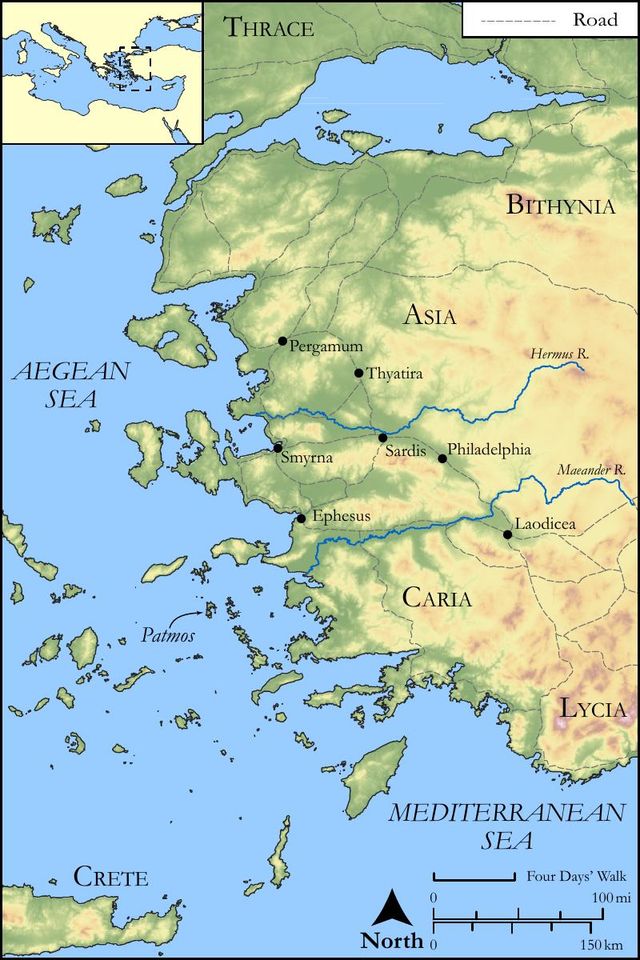
See on the biblical-era map

Study this verse
Public-domain commentary
Matthew Henry
From his Commentary on the Whole Bible. Henry comments on passages, not single verses — this entry covers Revelation 6:9–17. His four-level outline is real structure in the source text, so it is rendered as structure.
In the remaining part of this chapter we have the opening of the fifth and the sixth seals.
I.The fifth seal.
Here is no mention made of any one who called the apostle to make his observation, probably because the decorum of the vision was to be observed, and each of the four living creatures had discharged its duty of a monitor before, or because the events here opened lay out of the sight, and beyond the time, of the present ministers of the church; or because it does not contain a new prophecy of any future events, but rather opens a spring of support and consolation to those who had been and still were under great tribulation for the sake of Christ and the gospel. Here observe,
1.The sight this apostle saw at the opening of the fifth seal; it was a very affecting sight (Rev 6:9): I saw under the altar the souls of those that were slain for the word of God, and for the testimony which they held. He saw the souls of the martyrs. Here observe,
(1.)Where he saw them - under the altar; at the foot of the altar of incense, in the most holy place; he saw them in heaven, at the foot of Christ. Hence note,
[1.]Persecutors can only kill the body, and after that there is no more that they can do; their souls live.
[2.]God has provided a good place in the better world for those who are faithful to death and are not allowed a place any longer on earth.
[3.]Holy martyrs are very near to Christ in heaven, they have the highest place there.
[4.]It is not their own death, but the sacrifice of Christ, that gives them a reception into heaven and a reward there; they do not wash their robes in their own blood, but in the blood of the Lamb.
(2.)What was the cause in which they suffered - the word of God and the testimony which they held, for believing the word of God, and attesting or confessing the truth of it; this profession of their faith they held fast without wavering, even though they died for it. A noble cause, the best that any man can lay down his life for - faith in God's word and a confession of that faith.
2.The cry he heard; it was a loud cry, and contained a humble expostulation about the long delay of avenging justice against their enemies: How long, O Lord, holy and true, dost thou not judge and avenge our blood on those that dwell on the earth? Rev 6:10. Observe,
(1.)Even the spirits of just men made perfect retain a proper resentment of the wrong they have sustained by their cruel enemies; and though they die in charity, praying, as Christ did, that God would forgive them, yet they are desirous that, for the honour of God, and Christ, and the gospel, and for the terror and conviction of others, God will take a just revenge upon the sin of persecution, even while he pardons and saves the persecutors.
(2.)They commit their cause to him to whom vengeance belongeth, and leave it in his hand; they are not for avenging themselves, but leave all to God.
(3.)There will be joy in heaven at the destruction of the implacable enemies of Christ and Christianity, as well as at the conversion of other sinners. When Babylon falls, it will be said, Rejoice over her, O thou heaven, and you holy apostles and prophets, for God hath avenged you on her, Rev 18:20.
3.He observed the kind return that was made to this cry (Rev 6:11), both what was given to them and what was said to them.
(1.)What was given to them - white robes, the robes of victory and of honour; their present happiness was an abundant recompence of their past sufferings.
(2.)What was said to them - that they should be satisfied, and easy in themselves, for it would not be long ere the number of their fellow-sufferers would be fulfilled. This is a language rather suited to the imperfect state of the saints in this world than to the perfection of their state in heaven; there is no impatience, no uneasiness, no need of admonition; but in this world there is great need of patience. Observe,
[1.]There is a number of Christians, known to God, who are appointed as sheep for the slaughter, set apart to be God's witnesses.
[2.]As the measure of the sin of persecutors is filling up, so is the number of the persecuted martyred servants of Christ.
[3.]When this number is fulfilled, God will take a just and glorious revenge upon their cruel persecutors; he will recompense tribulation to those who trouble them, and to those that are troubled full and uninterrupted rest.
II.We have here the sixth seal opened, Rev 6:12.
Some refer this to the great revolutions in the empire at Constantine's time, the downfall of paganism; others, with great probability, to the destruction of Jerusalem, as an emblem of the general judgment, and destruction of the wicked, at the end of the world; and, indeed, the awful characters of this event are so much the same with those signs mentioned by our Saviour as foreboding the destruction of Jerusalem, as hardly to leave any room for doubting but that the same thing is meant in both places, though some think that event was past already. See Mat 24:29, Mat 24:30. Here observe,
1.The tremendous events that were hastening; and here are several occurrences that contribute to make that day and dispensation very dreadful: - (1.) There was a great earthquake. This may be taken in a political sense; the very foundations of the Jewish church and state would be terribly shaken, though they seemed to be as stable as the earth itself. (2.) The sun became black as sackcloth of hair, either naturally, by a total eclipse, or politically, by the fall of the chief rulers and governors of the land. (3.) The moon should become as blood; the inferior officers, or their military men, should be all wallowing in their own blood. (4.) The stars of heaven shall fall to the earth (Rev 6:13), and that as a fig-tree casteth her untimely figs, when she is shaken of a mighty wind. The stars may signify all the men of note and influence among them, though in lower spheres of activity; there should be a general desolation. (5.) The heaven should depart as a scroll when it is rolled together. This may signify that their ecclesiastical state should perish and be laid aside for ever. (6.) Every mountain and island shall be moved out of its place. The destruction of the Jewish nation should affect and affright all the nations round about, those who were highest in honour and those who seemed to be best secured; it would be a judgment that should astonish all the world. This leads to,
2.The dread and terror that would seize upon all sorts of men in that great and awful day, Rev 6:15. No authority, nor grandeur, nor riches, nor valour, nor strength, would be able to support men at that time; yea, the very poor slaves, who, one would think, had nothing to fear, because they had nothing to lose, would be all in amazement at that day. Here observe,
(1.)The degree of their terror and astonishment: it should prevail so far as to make them, like distracted desperate men, call to the mountains to fall upon them, and to the hills to cover them; they would be glad to be no more seen; yea, to have no longer any being.
(2.)The cause of their terror, namely, the angry countenance of him that sits on the throne, and the wrath of the Lamb. Observe,
[1.]That which is matter of displeasure to Christ is so to God; they are so entirely one that what pleases or displeases the one pleases or displeases the other.
[2.]Though God be invisible, he can make the inhabitants of this world sensible of his awful frowns.
[3.]Though Christ be a lamb, yet he can be angry, even to wrath, and the wrath of the Lamb is exceedingly dreadful; for if the Redeemer, that appeases the wrath of God, himself be our wrathful enemy, where shall we have a friend to plead for us? Those perish without remedy who perish by the wrath of the Redeemer.
[4.]As men have their day of opportunity, and their seasons of grace, so God has his day of righteous wrath; and, when that day shall come, the most stout-hearted sinners will not be able to stand before him: all these terrors actually fell upon the sinners in Judea and Jerusalem in the day of their destruction, and they will all, in the utmost degree, fall upon impenitent sinners, at the general judgment of the last day.
Historical interpretation
Eight Centuries of Reception
7 surviving comments on this verse. Each one is dated, so this reads as a timeline rather than a list.
Select a marker to jump to its quote. Markers stagger vertically where authors wrote within a few decades of each other.
"And the stars too shall fall from heaven, even as a fig-tree casteth her green figs when she is shaken of a mighty wind." "The mountains shall melt like wax at the presence of the Lord; " that is, "when He riseth to shake terribly the earth.
"And the stars fell to the earth." The falling of the stars are the faithful who are troubled for Christ's sake.
"Even as a fig-tree casteth her untimely figs." The fig-tree, when shaken, loses its untimely figs-when men are separated from the Church by persecution.
The stars signify those in the church who for a time seem, according to human opinion, to stand out from the number of the elect, but who, when the fury of a sharp persecution comes near, are said to fall from their high status as though from heaven. The Lord foretold this in the Gospel, saying, “For then there will be tribulation such as has never been or shall be. And unless those days had been shortened, no flesh would have been saved. But for the sake of the elect, those days will be shortened.” The tree represents the church, and the sour fruit, which another translation calls “unripened,” represents people. The winds are the turbulent turmoil of persecution by which people are shaken and fall from the church. And it is proper that they are compared with the unripened fruit of the fig tree. For they are either unfaithful and, “twisted like a deceitful bow,” prefer this to the faith that they have abandoned, or because of the immaturity of the time the church suffers in them a tearful miscarriage, although it had sought for a happy birth at their conception.
“The stars fell.” As has been already written of those deceived by Antiochus, this refers also to those who think themselves to be lights of the world but who will fall, being crushed by the events of that time, as the Lord said, “to lead astray, if it were possible, even the elect by the great tribulation.” This is perhaps the reason the fig tree is taken as a parable, for when the wind of the devil shakes it, it casts down its immature fruit that is not yet ripened by the heat of temptations or made sweet by grace. We know that this can be understood in either a good or in a bad sense, whether from the two baskets of good and evil figs that appear in Jeremiah or from the fig tree that Christ made to wither and that mentioned in the Song. But whether these things will occur in a visible manner when Christ comes in glory as judge, only he knows who has the hidden treasures of wisdom and knowledge.
And the stars fell to the earth, etc. Those who shine outwardly in the Church, driven by the wind of the final persecution, will be shown to have been earthly. Their deeds are rightly compared to the gross, immature, useless, and perishable fruits of the fig tree.
And the stars of heaven fell upon the earth, as the fig tree casteth its green figs when it is shaken by a great wind. Heaven is the Church of the saints, which, as it contains countless lives of saints, shines in the night of this life as if stars were radiating light on it from above. Therefore the stars falling from heaven upon the earth mean those who seem to stick to the faith or works of the saints rushing down to the iniquity of overt error out of love for the earth. This is also what is meant by the fig tree casting its green figs, for when all the Church is shaken by the last persecution, it is as if a fig tree were shaken by a great wind. Furthermore, another translation has “bitter green fig.”
The stars of the sky fell to the earth, it is said, happened either by chance and was perceptible; if not, the account suggests that the heavenly light ceased, and everything was darkened (Luke 23:44-45, Matt. 27:45, Mark 15:33).
Continue studying Revelation 6:13 across the web’s major study libraries — every link below opens this exact verse, chapter, or book on the destination site.
Read & Compare
 BibleGatewayThis verse in more than 200 translations and 70 languages.
 Bible.comThe YouVersion reader — hundreds of translations, reading plans, and highlights.
 ESV.orgCrossway's official English Standard Version reader.
 NET BibleThe NET translation with 60,000+ translators' notes on every rendering decision.
 STEP BibleTyndale House's free study tool — original text, vocabulary, and scholarly resources.
 BibliaLogos Bible Software's free web reader.
 USCCBThe New American Bible (Revised Edition) with the U.S. bishops' study notes.
Commentaries
 BibleHub CommentariesDozens of classic commentaries on this verse, gathered on one page.
 StudyLightMore than 100 commentary sets — the largest collection on the web.
 BibleRefPlain-English commentary on what this verse means, verse by verse.
 Enduring WordDavid Guzik's free commentary on this chapter, widely used by Bible teachers.
 Bible Study ToolsVerse commentary alongside Greek and Hebrew study aids.
Original Language & Research
- BibleHub InterlinearThe verse word by word — original language, transliteration, and English.
- BibleHub LexiconEvery word's original-language definition and Strong's entry.
 Blue Letter BibleDeep-study tools — Strong's numbers, concordance, and word studies.
 CNTR CollationThe earliest Greek manuscripts of this verse, collated letter by letter.
Sermons, Hymns & Audio


TrulyRandomVerse is not affiliated with these sites and doesn’t control their content. They’re linked because they’re genuinely useful.
Summary
Revelation 6:13 vividly portrays a cataclysmic cosmic event occurring during the opening of the sixth seal, depicting the stars of heaven falling to the earth. This dramatic imagery is powerfully likened to a fig tree shedding its unripe fruit when violently shaken by a mighty wind, signifying a sudden, widespread, and inevitable collapse of celestial order, indicative of profound divine judgment and the unraveling of the created world.
Context
ShowHideLiterary Context
This verse is an integral part of the sequence of judgments unleashed as the Lamb opens the seven seals in Revelation 6. Following the devastating impacts of the four horsemen (conquest, war, famine, and death) and the poignant cry of the martyrs under the fifth seal, the sixth seal ushers in a series of unparalleled cosmic and terrestrial disturbances. These include a great earthquake, the sun turning black, the moon becoming like blood, and the very stars falling from the sky. This escalating sequence of events culminates in the terrified cry of humanity, recognizing the arrival of the great day of God's wrath, setting the stage for the interlude of the sealed multitude before the trumpets begin.
Historical & Cultural Context
In the ancient world, "stars" (Greek: astḗr) did not exclusively refer to distant suns as understood in modern astronomy. The term often encompassed a broader range of celestial phenomena, including meteors, comets, or even perceived movements of planets. For a first-century audience, the idea of stars falling would evoke images of intense meteor showers or other dramatic, terrifying celestial occurrences. The fig tree was a common and significant plant in ancient Israel, often symbolizing prosperity, peace, or even the nation of Israel itself. The imagery of a fig tree shedding its "untimely figs" (unripe fruit) due to a "mighty wind" would have been a familiar and potent illustration of a natural, yet forceful and unavoidable, dislodgment, emphasizing the totality and ease of the depicted cosmic collapse.
Key Themes
ShowHideRevelation 6:13 powerfully contributes to several overarching themes within the book of Revelation and biblical prophecy. It underscores the theme of Divine Judgment, demonstrating God's absolute sovereignty over creation and His direct intervention in human history to judge sin. The Cataclysmic Events described highlight the unraveling of the created order, signaling a global and universal impact that leaves no one unaffected, emphasizing the profound disruption of both heavens and earth. Furthermore, the vivid imagery resonates with the theme of Fulfillment of Prophecy, echoing numerous Old Testament passages that describe cosmic disturbances as harbingers of the Day of the Lord, a time of divine reckoning. Jesus himself spoke of cosmic signs preceding His return, reinforcing the prophetic significance of these celestial phenomena.
Exposition and Analysis
ShowHideKey Word Analysis
ShowHideThis term, derived from a base implying "strown over the sky," refers to celestial bodies. In ancient cosmology, it could denote not only what we call stars but also meteors, comets, or other visible heavenly phenomena. Here, it likely signifies a widespread, dramatic shower of objects from the sky, rather than literal suns falling, emphasizing a visible and terrifying disruption of the heavens.
This specific Greek word refers to unripe, winter figs that are naturally shed from the tree, especially when under stress from a strong wind. This detail is crucial for the simile, as it highlights the ease, abundance, and inevitability with which the "stars" are dislodged, much like these particular figs are prone to falling en masse.
This verb means "to rock, vibrate, or agitate," indicating a violent, forceful movement. In this context, it describes the intense force of the "mighty wind" upon the fig tree, which directly correlates to the divine power causing the "stars" to fall, underscoring the irresistible nature of this cosmic event.
Verse Breakdown
ShowHide"And the stars of heaven fell unto the earth"
This clause describes a profound cosmic upheaval, where celestial bodies are depicted as dislodged from their positions and descending to the terrestrial realm. It signifies a dramatic loss of order and stability in the heavens, a terrifying and unprecedented event that shatters the perceived permanence of the cosmos.
"even as a fig tree casteth her untimely figs"
This powerful simile provides the reader with a vivid image to comprehend the manner of the "stars'" fall. It emphasizes that the falling is not a slow, singular event, but a sudden, abundant, and effortless shedding, much like a fig tree naturally drops its unripe fruit. The comparison underscores the ease and totality of the celestial collapse.
"when she is shaken of a mighty wind"
This final clause explains the catalyst for the fig tree's shedding, which in turn illuminates the cause of the "stars'" fall. The "mighty wind" represents an irresistible, overwhelming force—a metaphor for divine power or judgment—that causes the swift and complete dislodgment of the "untimely figs." This reinforces the idea that the cosmic event is divinely orchestrated and unstoppable.
Literary Devices
ShowHideRevelation 6:13 is rich with Apocalyptic Imagery, employing highly symbolic and dramatic language to convey profound theological truths rather than literal scientific predictions. The falling stars, sun turning black, and moon like blood are not meant to be interpreted as precise astronomical events but as signs of divine wrath and the unraveling of the created order. The primary literary device is a Simile: "even as a fig tree casteth her untimely figs, when she is shaken of a mighty wind." This comparison vividly illustrates the manner of the stars' fall—sudden, abundant, and inevitable—by likening it to a common natural phenomenon. The use of Hyperbole is also evident, as the description of stars falling to earth is an exaggeration designed to evoke awe, terror, and a sense of overwhelming catastrophe, emphasizing the magnitude of God's judgment. Furthermore, there is Symbolism at play, where "stars" can symbolize not only literal celestial bodies but also powers, authorities, or even angelic beings, suggesting a collapse of all established order—human, spiritual, and cosmic—under divine judgment.
Theological and Thematic Connections
ShowHideRevelation 6:13 profoundly underscores God's absolute sovereignty over all creation, demonstrating that even the seemingly immutable heavens are subject to His will and instruments of His judgment. This cosmic disruption is a terrifying manifestation of divine wrath against a rebellious world, signifying the breaking down of the established order as a prelude to the full manifestation of God's righteous judgment. It aligns with a consistent biblical theme that the "Day of the Lord" will be preceded by dramatic signs in the heavens, serving as a universal warning and a clear declaration of God's ultimate authority and impending intervention in human history. The imagery also highlights the fragility of the created order when confronted with divine power, reminding humanity of its utter dependence on the Creator.
Reflection and Application
ShowHideRevelation 6:13 serves as a sobering reminder of the ultimate authority and power of God, who controls not only human history but also the very fabric of the cosmos. It underscores the severity of divine judgment for a world that rejects its Creator and His Christ, emphasizing that no part of creation is immune to His sovereign will. For believers, this verse, while depicting terrifying events, also points to the unfolding of God's sovereign plan leading to the ultimate establishment of His kingdom. It calls for a life of vigilance, repentance, and unwavering faith, encouraging believers to seek refuge in Christ before the full manifestation of God's wrath. The vivid imagery compels us to consider our spiritual preparedness and to live in light of eternity, recognizing that all earthly stability is ultimately dependent on God's will and that true security is found only in Him.
Questions for Reflection
ShowHideFAQ
ShowHideDoes Revelation 6:13 refer to literal stars in the modern astronomical sense falling to earth?
ShowHideWhile the language is dramatic, it is generally understood within the context of apocalyptic literature, which often employs symbolic and hyperbolic imagery to convey profound theological truths rather than literal scientific predictions. In ancient cosmology, the term "stars" (Greek: astḗr) could encompass various celestial phenomena visible to the naked eye, including meteors, meteor showers, or comets. The emphasis is not on actual suns plummeting, which would annihilate the earth, but on a widespread, terrifying, and unprecedented shower of objects from the sky, causing immense fear and destruction. The simile of the fig tree shedding its "untimely figs" (unripe fruit) reinforces the idea of something easily dislodged and falling in great numbers, signifying the ease and totality of this cosmic upheaval as a sign of God's judgment, echoing similar prophecies in Isaiah 34:4 and Joel 2:30-31.
Christ-Centered Fulfillment
ShowHideRevelation 6:13, though depicting cosmic judgment, finds its ultimate Christ-centered fulfillment in the person and work of Jesus Christ, who is both the Lamb opening the seals and the sovereign Judge of all creation. The very disturbances described, including the falling stars, are part of the judgments unleashed by Christ Himself as He executes God's righteous wrath upon a rebellious world. This cosmic unraveling is not arbitrary chaos but a purposeful act orchestrated by the one to whom all judgment has been committed by the Father. The terror and collapse of the old heavens and earth ultimately point forward to the promise of a new creation, where Christ will reign supreme in perfect righteousness. The severe judgment depicted here is a necessary prelude to the establishment of His eternal kingdom, where there will be new heavens and a new earth in which righteousness dwells. Thus, even in these terrifying images of destruction, we see the sovereign hand of Christ bringing about the consummation of God's redemptive plan, leading to the new Jerusalem where God will dwell with His people forever.