


Revelation 8:10
Bible text: King James Version (1769 Blayney text) · Public domain
Bible text: King James Version with Strong's numbers · Public domain
Bible text: Berean Standard Bible · Public domain
Bible text: American Standard Version (1901) · Public domain
Bible text: World English Bible, Messianic edition · Public domain
Bible text: Geneva Bible (1599) · Public domain
Bible text: Young's Literal Translation · Public domain
- ΚαὶKaiAndG2532CONJConjunction
- ὁhotheG3588T-NSMDefinite article Nominative Singular Masculine
- τρίτοςtritosthirdG5154A-NSMAdjective Nominative Singular Masculine
- ἄγγελοςangelosangelG32N-NSMNoun Nominative Singular Masculine
- ἐσάλπισενesalpisensounded [his] trumpetG4537V-AAI-3SVerb Aorist Active Indicative 3rd Singular
- καὶkaiandG2532CONJConjunction
- ἔπεσενepesenfellG4098V-2AAI-3SVerb 2nd Aorist Active Indicative 3rd Singular
- ἐκekout ofG1537PREPPreposition
- τοῦtou<the>G3588T-GSMDefinite article Genitive Singular Masculine
- οὐρανοῦouranouheavenG3772N-GSMNoun Genitive Singular Masculine
- ἀστὴρastēra starG792N-NSMNoun Nominative Singular Masculine
- μέγαςmegasgreatG3173A-NSMAdjective Nominative Singular Masculine
- καιόμενοςkaiomenosburningG2545V-PPP-NSMVerb Present Passive Participle Nominative Singular Masculine
- ὡςhōslikeG5613PRTParticle or Disjunctive
- λαμπὰςlampasa torchG2985N-NSFNoun Nominative Singular Feminine
- καὶkaiAndG2532CONJConjunction
- ἔπεσενepesenit fellG4098V-2AAI-3SVerb 2nd Aorist Active Indicative 3rd Singular
- ἐπὶepiuponG1909PREPPreposition
- τὸto<the>G3588T-ASNDefinite article Accusative Singular Neuter
- τρίτονtritona thirdG5154A-ASNAdjective Accusative Singular Neuter
- τῶνtōnof theG3588T-GPMDefinite article Genitive Plural Masculine
- ποταμῶνpotamōnriversG4215N-GPMNoun Genitive Plural Masculine
- καὶkaiandG2532CONJConjunction
- ἐπὶepiuponG1909PREPPreposition
- τὰςtastheG3588T-APFDefinite article Accusative Plural Feminine
- πηγὰςpēgasspringsG4077N-APFNoun Accusative Plural Feminine
- τῶνtōn<the>G3588T-GPNDefinite article Genitive Plural Neuter
- ὑδάτωνhudatōnof watersG5204N-GPNNoun Genitive Plural Neuter
English is a literal word-by-word gloss of the Greek, not the KJV's wording. Why?
This is the original text the KJV's translators worked from — each Greek word with its own literal English meaning in this verse, prepared by scholars at Tyndale House, Cambridge. The KJV translates whole sentences, not word by word, so its wording differs: one Greek word can become several English words, and the KJV may choose “charity” where the gloss reads “love”. Both are faithful — they answer different questions. For the KJV's own rendering, switch to the KJV text.
Details
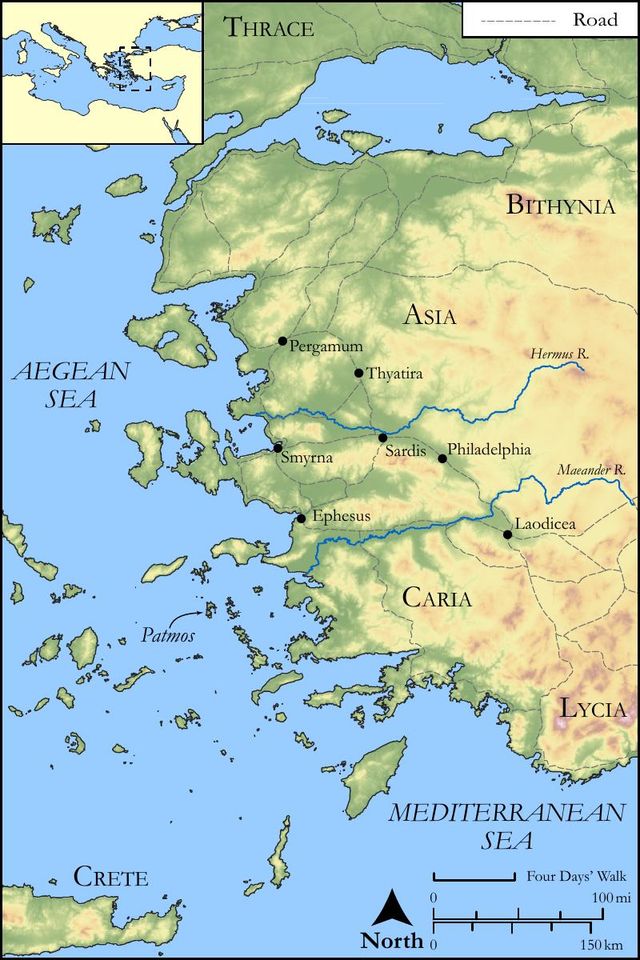
See on the biblical-era maps

Study this verse
Public-domain commentary
Matthew Henry
From his Commentary on the Whole Bible. Henry comments on passages, not single verses — this entry covers Revelation 8:7–13. His two-level outline is real structure in the source text, so it is rendered as structure.
Observe, I. The first angel sounded the first trumpet, and the events which followed were very dismal: There followed hail and fire mingled with blood, etc., Rev 8:7. There was a terrible storm; but whether it is to be understood of a storm of heresies, a mixture of monstrous errors falling on the church (for in that age Arianism prevailed), or a storm or tempest of war falling on the civil state, expositors are not agreed. Mr. Mede takes it to be meant of the Gothic inundation that broke in upon the empire in the year 395, the same year that Theodosius died, when the northern nations, under Alaricus, king of the Goths, broke in upon the western parts of the empire. However, here we observe, 1. It was a very terrible storm-fire, and hail, and blood: a strange mixture! 2. The limitation of it: it fell on the third part of the trees, and on the third part of the grass, and blasted and burnt it up; that is, say some, upon the third part of the clergy and the third part of the laity; or, as others who take it to fall upon the civil state, upon the third part of the great men, and upon the third part of the common people, either upon the Roman empire itself, which was a third part of the then known world, or upon a third part of that empire. The most severe calamities have their bounds and limits set them by the great God.
II.The second angel sounded, and the alarm was followed, as in the first, with terrible events:
A great mountain burning with fire was cast into the sea; and the third part of the sea became blood, Rev 8:8. By this mountain some understand the leader or leaders of the heretics; others, as Mr. Mede, the city of Rome, which was five times sacked by the Goths and Vandals, within the compass of 137 years; first by Alaricus, in the year 410, with great slaughter and cruelty. In these calamities, a third part of the people (called here the sea or collection of waters) were destroyed: here was still a limitation to the third part, for in the midst of judgment God remembers mercy. This storm fell heavy upon the maritime and merchandizing cities and countries of the Roman empire.
III.The third angel sounded, and the alarm had the like effects as before:
There fell a great star from heaven, etc., Rev 8:10. Some take this to be a political star, some eminent governor, and they apply it to Augustulus, who was forced to resign the empire to Odoacer, in the year 480. Others take it to be an ecclesiastical star, some eminent person in the church, compared to a burning lamp, and they fix it upon Pelagius, who proved about this time a falling star, and greatly corrupted the churches of Christ. Observe,
1.Where this star fell: Upon a third part of the rivers, and upon the fountains of waters.
2.What effect it had upon them; it turned those springs and streams into wormwood, made them very bitter, that men were poisoned by them; either the laws, which are springs of civil liberty, and property, and safety, were poisoned by arbitrary power, or the doctrines of the gospel, the springs of spiritual life, refreshment, and vigour to the souls of men, were so corrupted and embittered by a mixture of dangerous errors that the souls of men found their ruin where they sought for their refreshment.
IV.The fourth angel sounded, and the alarm was followed with further calamities. Observe,
1.The nature of this calamity; it was darkness; it fell therefore upon the great luminaries of the heaven, that give light to the world - the sun, and the moon, and the stars, either the guides and governors of the church, or of the state, who are placed in higher orbs than the people, and are to dispense light and benign influences to them.
2.The limitation: it was confined to a third part of these luminaries; there was some light both of the sun by day, and of the moon and stars by night, but it was only a third part of what they had before. Without determining what is matter of controversy in these points among learned men, we rather choose to make these plain and practical remarks: - (1.) Where the gospel comes to a people, and is but coldly received, and has not its proper effects upon their hearts and lives, it is usually followed with dreadful judgments. (2.) God gives warning to men of his judgments before he sends them; he sounds an alarm by the written word, by ministers, by men's own consciences, and by the signs of the times; so that, if a people be surprised, it is their own fault. (3.) The anger of God against a people makes dreadful work among them; it embitters all their comforts, and makes even life itself bitter and burdensome. (4.) God does not in this world stir up all his wrath, but sets bounds to the most terrible judgments. (5.) Corruptions of doctrine and worship in the church are themselves great judgments, and the usual causes and tokens of other judgments coming on a people.
V.Before the other three trumpets are sounded here is solemn warning given to the world how terrible the calamities would be that should follow them, and how miserable those times and places would be on which they fell, Rev 8:13.
1.The messenger was an angel flying in the midst of heaven, as in haste, and coming on an awful errand.
2.The message was a denunciation of further and greater woe and misery than the world had hitherto endured. Here are three woes, to show how much the calamities coming should exceed those that had been already, or to hint how every one of the three succeeding trumpets should introduce its particular and distinct calamity. If less judgments do not take effect, but the church and the world grow worse under them, they must expect greater. God will be known by the judgments that he executes; and he expects, when he comes to punish the world, the inhabitants thereof should tremble before him.
Historical interpretation
Six Centuries of Reception
6 surviving comments on this verse. Each one is dated, so this reads as a timeline rather than a list.
Select a marker to jump to its quote. Markers stagger vertically where authors wrote within a few decades of each other.
The “great star” is the devil, of whom the Lord spoke in the Gospel, “I saw Satan fall from heaven as fire or lightning.” It is possible that this passage also refers to ecclesiastical people, who living the spiritual life in the church, have become forgetful of themselves and like animals bend down to the things of the earth and fall from their positions of authority. We read what has been written of such persons: “Although he is in honor, he does not understand; he is compared to the senseless cattle and has become like them.”
It speaks of men who have fallen from heaven as though from the church, that is, of those who have the public reputation of shining brightly with good merits. For that reason they are compared to stars and torches, as did the apostle Jude, who called them “stars of seduction,” since they lead astray by a superficial splendor. And the Lord also compared such people with walls and “whitewashed tombs.”
Some say that the bitterness revealed through the wormwood is symbolic of the torment that comes to those sinners being punished in Gehenna, who, on account of their number, are reasonably called “waters.” But we think that these depictions signify the sufferings at the time, which has been shown. The star indicates either that these things come upon people from heaven, or it refers to the devil, of whom Isaiah says, “How has the Day Star, which rose in the morning, fallen from heaven.” For, through pleasure he gives people a foul and bitter destruction to drink and through this allows punishing torments to come upon them, although not to everyone, but by the longsuffering of God to a third part.… It is necessary, therefore, that we examine ourselves lest we be judged. As the holy apostle says, “For if we judged ourselves, we should not be judged, but when we are judged by the Lord, we are chastened,” and we receive the sufferings that come upon us with thanksgiving. For those who are concerned about sicknesses in the body bear patiently the cuts and cauteries of the physician, for they desire to be healed. Therefore, [we should examine ourselves] so that being spiritually healthy and bringing no wood to fuel the fire of Gehenna, we might not be condemned with the world but eternally rule with Christ, to whom be glory, honor and worship, together with the Father and the Holy Spirit forever. Amen.
And a great star fell from heaven, burning like a torch, etc. Heretics, whom Jude the apostle calls stars of seduction, falling from the height of the Church, try to infect the springs of divine Scriptures with the flame of their wickedness. They are not afraid to falsify not only the meaning but also the words frequently. They are worthy of the name "wormwood," whose slight mixing tends to embitter great sweetness.
And the third angel sounded the trumpet, and a great star fell from heaven, as it were a burning torch. The Devil is called a star, whether because of the rank he first had or because he transformeth himself into an angel of light; [2 Cor. 11:14] a great star because he was given precedence over all other angels, and a burning torch because of the fervor of his evilness. We should not understand this fall to be the one when he was first ejected from the heavenly abodes, but the one when he was excluded from among the elect by the angel sounding the trumpet, that is by the Church preaching; for heaven is the Church, which the Lord inhabits by presiding over it. And it fell on the third part of the rivers, and upon the fountains of waters, that is upon human nature, which flows by from its birth with the currents of carnal pleasures and thus runs down to death.
I believe this refers to the falling of the star, which, having angered God, made the waters bitter.
Waters are metaphorically called humans, as stated by the prophet regarding "the sounds of many waters; the wonders of the sea's waves are marvelous," (Ps. 92:4) and again "the rivers lifted up their voices, saying, Lord, the rivers lifted up their voices; the rivers lifted up their waves." (Ps. 92:3) These things are to be understood as a form of allegorical speech. However, it must not be disregarded that such events and similar ones occur perceptibly.
Continue studying Revelation 8:10 across the web’s major study libraries — every link below opens this exact verse, chapter, or book on the destination site.
Read & Compare
 BibleGatewayThis verse in more than 200 translations and 70 languages.
 Bible.comThe YouVersion reader — hundreds of translations, reading plans, and highlights.
 ESV.orgCrossway's official English Standard Version reader.
 NET BibleThe NET translation with 60,000+ translators' notes on every rendering decision.
 STEP BibleTyndale House's free study tool — original text, vocabulary, and scholarly resources.
 BibliaLogos Bible Software's free web reader.
 USCCBThe New American Bible (Revised Edition) with the U.S. bishops' study notes.
Commentaries
 BibleHub CommentariesDozens of classic commentaries on this verse, gathered on one page.
 StudyLightMore than 100 commentary sets — the largest collection on the web.
 BibleRefPlain-English commentary on what this verse means, verse by verse.
 Enduring WordDavid Guzik's free commentary on this chapter, widely used by Bible teachers.
 Bible Study ToolsVerse commentary alongside Greek and Hebrew study aids.
Original Language & Research
- BibleHub InterlinearThe verse word by word — original language, transliteration, and English.
- BibleHub LexiconEvery word's original-language definition and Strong's entry.
 Blue Letter BibleDeep-study tools — Strong's numbers, concordance, and word studies.
 CNTR CollationThe earliest Greek manuscripts of this verse, collated letter by letter.
Sermons, Hymns & Audio


TrulyRandomVerse is not affiliated with these sites and doesn’t control their content. They’re linked because they’re genuinely useful.
Summary
Revelation 8:10 vividly describes the third trumpet judgment, where a massive, fiery star falls from the sky, impacting a significant portion of the earth's fresh water sources—rivers and fountains. This catastrophic event contaminates these vital supplies, foreshadowing the widespread death and suffering that will ensue, highlighting God's severe but partial judgments on a rebellious world as part of a series of escalating divine interventions.
Context
ShowHideLiterary Context
This verse is an integral part of the seven trumpet judgments, which begin in Revelation 8:6 following the breaking of the seventh seal. The preceding judgments specifically targeted the earth's vegetation (Revelation 8:7) and the sea, affecting marine life and shipping (Revelation 8:8-9). The third trumpet, therefore, logically extends the pattern of ecological devastation to fresh water sources, demonstrating a systematic unfolding of divine judgment that progressively impacts different spheres of creation. Each judgment affects "a third part," indicating a severe but not yet total destruction, possibly serving as a call to repentance before the final, complete outpouring of God's wrath.
Historical & Cultural Context
In that day, fresh water sources like rivers and springs were absolutely essential for survival, serving as primary sources for drinking, agriculture, and sanitation. Their contamination or destruction would have immediate and catastrophic consequences for human and animal populations. The imagery of a "star" falling from heaven would evoke powerful associations with celestial omens and divine intervention, as stars were often seen as symbols of powerful entities or rulers, and their movements or falls were interpreted as signs of significant earthly events. The concept of divine judgment through natural disasters, including the corruption of water, has precedents in Old Testament narratives, such as the plagues in Egypt where the Nile turned to blood (Exodus 7:17-21).
Key Themes
ShowHideThe passage contributes to several overarching themes in Revelation. Firstly, it underscores the theme of Divine Judgment, portraying God's righteous wrath against an unrepentant world. The systematic nature of the trumpet judgments, each affecting a specific aspect of creation, emphasizes the comprehensive reach of God's sovereign power. Secondly, the phrase "third part" introduces the theme of Partial Devastation, suggesting that these judgments are severe warnings rather than final annihilations, perhaps offering a window for humanity to turn from its wicked ways. This contrasts with the later bowl judgments, which often describe total devastation. Thirdly, the imagery of the "great star" introduces the theme of Symbolism and Apocalyptic Imagery, where natural phenomena often represent spiritual or political realities. While potentially a literal celestial event, the "star" can also symbolize a powerful angelic being or a significant earthly leader, as seen in Revelation 9:1, where another fallen star is explicitly identified with an angel holding the key to the bottomless pit.
Exposition and Analysis
ShowHideKey Word Analysis
ShowHideFrom the base of στρώννυμι, meaning a star as "strown over the sky." In apocalyptic literature, "star" can refer to a literal celestial body, but often symbolically represents a powerful angelic being, a fallen angel, or a significant earthly leader. Its fall signifies a catastrophic event or the removal of a powerful entity from its position.
Probably akin to πέτομαι, conveying the idea of alighting or falling. This verb emphasizes the sudden, decisive, and destructive descent of the star. It denotes a loss of position or a forceful impact, indicating the immediate and tangible effect of the judgment.
Apparently a primary verb meaning "to set on fire" or "to kindle," and by implication, "to consume." This word vividly describes the star's appearance as it descends, emphasizing its intense heat, destructive power, and the fiery nature of the judgment it brings upon the earth's water sources.
Verse Breakdown
ShowHide"And the third angel sounded,"
This clause marks the continuation of the sequence of trumpet judgments. Each sounding of a trumpet signals a new, distinct phase of divine intervention and judgment upon the earth, demonstrating God's sovereign control over the unfolding events.
"and there fell a great star from heaven, burning as it were a lamp,"
This describes the specific nature of the third judgment. A "great star" implies a significant, impactful entity or event. Its origin "from heaven" signifies its divine source or permission. The description "burning as it were a lamp" paints a vivid picture of a blazing, intense, and possibly illuminating object, highlighting its fiery and destructive descent.
"and it fell upon the third part of the rivers, and upon the fountains of waters;"
This specifies the precise target and scope of the judgment. The star's impact is not random but divinely directed to "the third part" of the earth's fresh water systems—both flowing rivers and stationary springs or fountains. This indicates a widespread, yet still partial, contamination or destruction of essential water supplies, leading to severe consequences for life dependent on them.
Literary Devices
ShowHideRevelation 8:10 is rich in Symbolism and Imagery. The "great star" is a potent symbol, likely representing more than just a literal astronomical body. In apocalyptic literature, stars can symbolize powerful spiritual beings (like angels, as suggested by the parallel in Revelation 9:1) or earthly rulers/powers. Its fall signifies a catastrophic descent from a position of prominence or power, bringing divine judgment. The phrase "burning as it were a lamp" employs a Simile, creating vivid Imagery of intense heat and light, emphasizing the destructive and fiery nature of the star's descent and impact. The repeated mention of "the third part" is a numerical Symbolism common in Revelation, indicating a significant but not total devastation, perhaps signifying a measure of divine restraint or a warning before ultimate destruction. The entire scene contributes to the overall Apocalyptic Genre of Revelation, using dramatic, often terrifying, imagery to convey profound theological truths about God's justice and sovereignty.
Theological and Thematic Connections
ShowHideThe third trumpet judgment underscores the profound vulnerability of creation to divine judgment and the critical dependence of life on God's provision. By targeting fresh water sources, this judgment highlights how essential, life-sustaining elements can become instruments of divine wrath when humanity persistently rejects God. It serves as a stark reminder that God retains ultimate sovereignty over all creation and can, at any moment, withdraw the blessings that sustain life. This partial destruction also points to God's patience, offering a severe warning that greater judgments await if repentance is not forthcoming, echoing the principle that divine discipline often begins with limited, escalating consequences.
Reflection and Application
ShowHideRevelation 8:10, though depicting a terrifying future event, offers profound lessons for believers today. It reminds us that our world, with all its vital resources, is ultimately under the sovereign hand of God. The fragility of our ecosystems and the potential for widespread suffering due to the corruption of essential resources should prompt us to greater stewardship of creation and a deeper reliance on God, the ultimate Sustainer of life. Furthermore, the partial nature of these judgments serves as a powerful call to repentance, both individually and corporately. It highlights God's justice, but also His long-suffering, providing opportunities for humanity to turn back to Him before final judgment. For those who trust in Christ, these passages, while sobering, reinforce the certainty of God's ultimate victory and the promise of a new heavens and new earth where righteousness dwells and there will be no more curse.
Questions for Reflection
ShowHideFAQ
ShowHideWhat is the significance of the "great star" in Revelation 8:10?
ShowHideThe "great star" in Revelation 8:10 is highly symbolic. While it could represent a literal celestial body, in apocalyptic literature, "stars" often symbolize powerful spiritual beings (like angels) or significant earthly leaders. The parallel passage in Revelation 9:1 describes another fallen star explicitly identified with an angel holding the key to the bottomless pit. This suggests that the "star" in Revelation 8:10 might also be a powerful spiritual entity, perhaps a fallen angel, acting as an agent of divine judgment. Its "burning as it were a lamp" emphasizes its fiery, destructive nature and the intense impact it has.
Why does the judgment specifically target "the third part of the rivers, and upon the fountains of waters"?
ShowHideThe targeting of "the third part of the rivers, and upon the fountains of waters" in Revelation 8:10 signifies a direct assault on essential fresh water sources, which are critical for human and animal life. In Israel, the contamination of these supplies would lead to widespread sickness and death, as further detailed in Revelation 8:11. The phrase "a third part" is a recurring motif in the trumpet judgments (Revelation 8:7-12), indicating a severe but not total devastation. This partial destruction suggests that these judgments serve as warnings or calls to repentance, rather than immediate, complete annihilation, showcasing God's justice tempered with a measure of restraint.
Christ-Centered Fulfillment
ShowHideWhile Revelation 8:10 describes a future judgment, its Christ-centered fulfillment is found in how these judgments ultimately point to the authority over all things and redemptive work of Jesus Christ. He is the one who holds the keys of death and Hades (Revelation 1:18), and it is through His sovereign permission that these judgments unfold. The suffering depicted, though severe, serves to highlight the desperate need for the salvation that only Christ offers. Furthermore, the ultimate resolution of these woes is found in the New Creation, inaugurated by Christ's return, where He will make all things new (Revelation 21:5). In that new heavens and new earth, there will be no more curse, and the Lamb of God will lead His people to "springs of living water" (Revelation 7:17), a stark contrast to the bitter waters of judgment. Thus, even in scenes of devastation, the redemptive arc of God's plan, centered on Christ's ultimate triumph over sin and death, shines through, promising a future where all suffering is undone and life flows eternally from the throne of God and of the Lamb (Revelation 22:1).