


Revelation 16:4
Bible text: King James Version (1769 Blayney text) · Public domain
Bible text: Berean Standard Bible · Public domain
Bible text: American Standard Version (1901) · Public domain
Bible text: World English Bible, Messianic edition · Public domain
Bible text: Geneva Bible (1599) · Public domain
Bible text: Young's Literal Translation · Public domain
- ΚαὶKaiAndG2532CONJConjunction
- ὁhotheG3588T-NSMDefinite article Nominative Singular Masculine
- τρίτοςtritosthirdG5154A-NSMAdjective Nominative Singular Masculine
- ἄγγελοςangelosangelG32N-NSMNoun Nominative Singular Masculine
- ἐξέχεενexecheenpoured outG1632V-AAI-3SVerb Aorist Active Indicative 3rd Singular
- τὴνtēntheG3588T-ASFDefinite article Accusative Singular Feminine
- φιάληνphialēnbowlG5357N-ASFNoun Accusative Singular Feminine
- αὐτοῦautouof himG846P-GSMPersonal pronoun Genitive Singular Masculine
- εἰςeisintoG1519PREPPreposition
- τοὺςtoustheG3588T-APMDefinite article Accusative Plural Masculine
- ποταμοὺςpotamousriversG4215N-APMNoun Accusative Plural Masculine
- καὶkaiandG2532CONJConjunction
- εἰςeisintoG1519PREPPreposition
- τὰςtastheG3588T-APFDefinite article Accusative Plural Feminine
- πηγὰςpēgasspringsG4077N-APFNoun Accusative Plural Feminine
- τῶνtōnof theG3588T-GPNDefinite article Genitive Plural Neuter
- ὑδάτωνhudatōnwatersG5204N-GPNNoun Genitive Plural Neuter
- καὶkaiandG2532CONJConjunction
- ἐγένετοegenetothey becameG1096V-2ADI-3SVerb 2nd Aorist Middle Deponent Indicative 3rd Singular
- αἷμαhaimabloodG129N-NSNNoun Nominative Singular Neuter
English is a literal word-by-word gloss of the Greek, not the KJV's wording. Why?
This is the original text the KJV's translators worked from — each Greek word with its own literal English meaning in this verse, prepared by scholars at Tyndale House, Cambridge. The KJV translates whole sentences, not word by word, so its wording differs: one Greek word can become several English words, and the KJV may choose “charity” where the gloss reads “love”. Both are faithful — they answer different questions. For the KJV's own rendering, switch to the KJV text.
Details
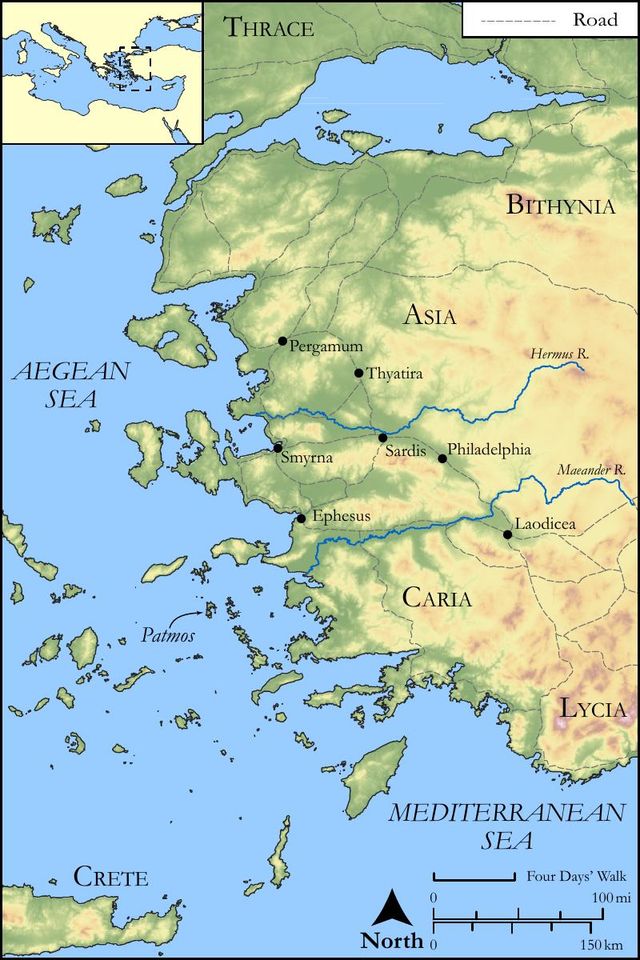
See on the biblical-era maps

Study this verse
Public-domain commentary
Matthew Henry
From his Commentary on the Whole Bible. Henry comments on passages, not single verses — this entry covers Revelation 16:1–7. His four-level outline is real structure in the source text, so it is rendered as structure.
We had in the foregoing chapter the great and solemn preparation that was made for the pouring out of the vials; now we have the performance of that work. Here observe,
I.That, though every thing was made ready before, yet nothing was to be put in execution without an immediate positive order from God; and this he gave out of the temple, answering the prayers of his people, and avenging their quarrel.
II.No sooner was the word of command given than it was immediately obeyed; no delay, no objection made.
We find that some of the best men, as Moses and Jeremiah, did not so readily come in and comply with the call of God to their work; but the angels of God excel not only in strength, but in a readiness to do the will of God. God says, Go your ways, and pour out the vials, and immediately the work is begun. We are taught to pray that the will of God may be done on earth as it is done in heaven. And now we enter upon a series of very terrible dispensations of Providence, of which it is difficult to give the certain meaning or to make the particular application. But in the general it is worth our observation that,
1.We have here a reference and allusion to several of the plagues of Egypt, such as the turning of their waters into blood, and smiting them with boils and sores. Their sins were alike, and so were their punishments.
2.These vials have a plain reference to the seven trumpets, which represented the rise of antichrist; and we learn hence that the fall of the church's enemies shall bear some resemblance to their rise, and that God can bring them down in such ways as they chose to exalt themselves. And the fall of antichrist shall be gradual; as Rome was not built in one day, so neither shall it fall in one day, but it falls by degrees; it shall fall so as to rise no more.
3.The fall of the antichristian interest shall be universal. Every thing that any ways belonged to them, or could be serviceable to them, the premises and all their appurtenances, are put into the writ for destruction: their earth, their air, their sea, their rivers, their cities, all consigned over to ruin, all accursed for the sake of the wickedness of that people. Thus the creation groans and suffers through the sins of men. Now we proceed to,
(1.)The first angel who poured out his vial, Rev 16:2. Observe,
[1.]Where it fell - upon the earth; that is, say some, upon the common people; others upon the body of the Romish clergy, who were the basis of the papacy, and of an earthly spirit, all carrying on earthly designs.
[2.]What it produced - noisome and grievous sores on all who had the mark of the beast. They had marked themselves by their sin; now God marks them out by his judgments. This sore, some think, signifies some of the first appearances of Providence against their state and interest which gave them great uneasiness, as it discovered their inward distemper and was a token of further evil; the plague - tokens appeared.
(2.)The second angel poured out his vial; and here we see,
[1.]Where it fell - upon the sea; that is, say some, upon the jurisdiction and dominion of the papacy; others upon the whole system of their religion, their false doctrines, their corrupt glosses, their superstitious rites, their idolatrous worship, their pardons, indulgences, a great conflux of wicked inventions and institutions, by which they maintain a trade and traffic advantageous to themselves, but injurious to all who deal with them.
[2.]What it produced: It turned the sea into blood, as the blood of a dead man, and every living soul died in the sea. God discovered not only the vanity and falsehood of their religion, but the pernicious and deadly nature of it - that the souls of men were poisoned by that which was pretended to be the sure means of their salvation.
(3.)The next angel poured out his vial; and we are told,
[1.]Where it fell - upon the rivers, and upon the fountains of waters; that is, say some very learned men, upon their emissaries, and especially the Jesuits, who, like streams, conveyed the venom and poison of their errors and idolatries from the spring-head through the earth.
[2.]What effect it had upon them: It turned them into blood; some think it stirred up Christian princes to take a just revenge upon those that had been the great incendiaries of the world, and had occasioned the shedding of the blood of armies and of martyrs. The following doxology (Rev 16:5, Rev 16:6) favours this sense. The instrument that God makes use of in this work is here called the angel of the waters, who extols the righteousness of God in this retaliation: They have shed the blood of thy saints, and thou hast given them blood to drink, for they are worthy, to which another angel answered by full consent, Rev 16:7.
Historical interpretation
Four Centuries of Reception
3 surviving comments on this verse. Each one is dated, so this reads as a timeline rather than a list.
Select a marker to jump to its quote. Markers stagger vertically where authors wrote within a few decades of each other.
[This bowl] contains all of the other nations who have been so overcome by natural error and enmeshed in impure lusts that they even think of divine things in a carnal manner. And so, by these waters one may understand the teachings of the Gentile nations. Therefore, it says, “They became blood,” just as it says in Genesis, “My spirit shall not abide in these people, for they are flesh,” and also in the book of Wisdom, “stirred up by filthy blood for rebuke.” In addition, the apostle says, “To set the mind on the flesh is death” and “the wisdom of the flesh is hostile to God.”
And the third poured out his bowl on the rivers, etc. And those who, to pour their poison into the unsuspecting, pretend to offer sweet things, will be punished with a worthy, eternal plague of vengeance.
The blood of the sea and waters plainly indicate the killings of those encamped near the waters in land battles, as is natural.
Continue studying Revelation 16:4 across the web’s major study libraries — every link below opens this exact verse, chapter, or book on the destination site.
Read & Compare
 BibleGatewayThis verse in more than 200 translations and 70 languages.
 Bible.comThe YouVersion reader — hundreds of translations, reading plans, and highlights.
 ESV.orgCrossway's official English Standard Version reader.
 NET BibleThe NET translation with 60,000+ translators' notes on every rendering decision.
 STEP BibleTyndale House's free study tool — original text, vocabulary, and scholarly resources.
 BibliaLogos Bible Software's free web reader.
 USCCBThe New American Bible (Revised Edition) with the U.S. bishops' study notes.
Commentaries
 BibleHub CommentariesDozens of classic commentaries on this verse, gathered on one page.
 StudyLightMore than 100 commentary sets — the largest collection on the web.
 BibleRefPlain-English commentary on what this verse means, verse by verse.
 Enduring WordDavid Guzik's free commentary on this chapter, widely used by Bible teachers.
 Bible Study ToolsVerse commentary alongside Greek and Hebrew study aids.
Original Language & Research
- BibleHub InterlinearThe verse word by word — original language, transliteration, and English.
- BibleHub LexiconEvery word's original-language definition and Strong's entry.
 Blue Letter BibleDeep-study tools — Strong's numbers, concordance, and word studies.
 CNTR CollationThe earliest Greek manuscripts of this verse, collated letter by letter.
Sermons, Hymns & Audio


TrulyRandomVerse is not affiliated with these sites and doesn’t control their content. They’re linked because they’re genuinely useful.
Summary
Revelation 16:4 details the third of the seven bowl judgments, a cataclysmic outpouring of divine wrath upon the unrepentant earth. In this specific judgment, the fresh water sources—rivers and fountains—are supernaturally transformed into blood, signifying a profound desecration of life-sustaining resources and an escalating intensity of God's righteous retribution against humanity's rebellion and persecution of His saints.
Context
ShowHideLiterary Context
This verse is situated within the climactic series of the seven bowl judgments (Revelation 16:1-21), which represent the final and most severe expressions of God's wrath before the return of Christ. It follows the first bowl, which inflicted grievous sores upon those who bore the mark of the beast (Revelation 16:2), and the second bowl, which turned the sea into blood, causing widespread death among marine life (Revelation 16:3). The progression from sea to fresh water sources demonstrates a systematic and comprehensive targeting of all water, essential for life, indicating an intensifying and inescapable judgment. The subsequent verses in Revelation 16:5-7 provide the divine justification for this specific judgment, revealing it as a righteous act of poetic justice against those who have shed the blood of God's people.
Historical & Cultural Context
The book of Revelation was written during a period of intense persecution of Christians, likely under the Roman Empire, possibly during the reign of Emperor Domitian. The imagery employed, including plagues and disturbances of the waters, would have resonated with Jewish apocalyptic traditions and Old Testament narratives, particularly the plagues upon Egypt. Water, in Israel, was not merely a commodity but a sacred and vital element, often associated with life, purification, and divine provision. The turning of water into blood would have evoked profound horror and a sense of absolute desolation, mirroring the first plague in Egypt, where the Nile, the lifeblood of Egypt, became blood. This historical echo underscores God's consistent character in executing judgment against those who oppress His people and defy His sovereignty.
Key Themes
ShowHideThe third bowl judgment contributes significantly to several overarching themes within Revelation and biblical theology. Foremost is the theme of Divine Judgment and Wrath, showcasing God's active intervention in human history to punish unrepentant sin and rebellion. It powerfully illustrates the theme of Retribution and Justice, as the judgment is explicitly linked to the shedding of the blood of saints and prophets, demonstrating God's unwavering commitment to righteous recompense (Revelation 16:6). Furthermore, the desecration of life-sustaining water highlights the theme of Desecration of Life and Creation, reflecting the profound spiritual corruption of a world that has rejected its Creator and persecuted His image-bearers. This act of judgment underscores the ultimate consequences of rejecting God's grace and opposing His divine will, culminating in a world where even fundamental elements of existence are turned against humanity.
Exposition and Analysis
ShowHideKey Word Analysis
ShowHideThis verb signifies a complete and forceful emptying, emphasizing the swift and unreserved nature of the divine judgment. It is not a trickle but an abundant, unrestrained outpouring, indicating the full measure of God's wrath being dispensed.
This word denotes a transformation or coming into being, indicating a real and observable change. The waters did not merely appear bloody or contaminated; they fundamentally became blood, a literal and terrifying alteration of their very substance.
Beyond its literal meaning, "blood" here carries profound symbolic weight. It represents life, but in this context, it signifies death, defilement, and the shedding of innocent life. The transformation of water into blood is a direct consequence of the world's violence and persecution, a grim mirror reflecting their own actions back upon them.
Verse Breakdown
ShowHide"And the third angel poured out his vial upon the rivers and fountains of waters;"
This clause introduces the agent of judgment—the third angel—and the instrument of judgment—his "vial" (or shallow bowl), which symbolizes the full measure of God's wrath. The specific targets are "the rivers and fountains of waters," explicitly identifying fresh water sources. This distinguishes it from the previous judgment on the sea, indicating a comprehensive and escalating attack on all sources of life-sustaining water.
"and they became blood."
This declarative statement reveals the immediate and terrifying effect of the judgment. The vital fresh water, essential for human and animal life, undergoes a complete and literal transformation into blood. This is not merely a discoloration but a fundamental change in composition, rendering the water undrinkable and symbolizing death and defilement.
Literary Devices
ShowHideThe verse employs several potent literary devices. Symbolism is paramount, with "blood" representing not only death and judgment but also the retributive justice for the "blood" of saints shed by the wicked. Water, typically a symbol of life and purity, is here perverted into its opposite, emphasizing the complete corruption and desecration wrought by divine wrath. The passage also utilizes Allusion, specifically to the first plague of Egypt, where the Nile turned to blood. This allusion connects God's end-time judgments to His historical acts of judgment against oppressive powers, reinforcing His unchanging character and consistent methods of justice. Furthermore, there is an element of Poetic Justice, which is explicitly confirmed in the subsequent verses (Revelation 16:5-7). The world that shed the blood of God's people is now given blood to drink, a direct and fitting consequence for their actions.
Theological and Thematic Connections
ShowHideRevelation 16:4 powerfully underscores the biblical truth of God's absolute sovereignty and His unwavering commitment to justice. This judgment is not arbitrary but a righteous response to profound human wickedness, particularly the persecution of God's faithful. It reveals that God will not forever tolerate rebellion and violence against His people; there is a day of reckoning when His patience gives way to righteous wrath. The transformation of life-giving water into blood vividly illustrates the devastating consequences of rejecting the source of all life and embracing a path of sin and oppression. It serves as a stark reminder that God is both merciful and just, and His justice will ultimately prevail over all unrighteousness.
Reflection and Application
ShowHideRevelation 16:4, while depicting a terrifying future judgment, holds profound implications for our present lives and understanding of God. It compels us to confront the seriousness of sin, especially the shedding of innocent blood and the persecution of God's people, reminding us that such actions have eternal consequences in the eyes of a holy God. This passage calls us to a deeper appreciation for God's justice, assuring us that all wrongs will ultimately be set right, and no act of oppression or violence against His children will go unpunished. For believers, this truth offers comfort and hope in the face of injustice, knowing that God sees and will avenge His elect. For the world, it serves as a sobering warning and an urgent call to repentance. It challenges us to examine our own hearts for any unrepentant sin, to stand for justice, and to share the message of God's mercy and salvation before the day of ultimate judgment arrives.
Questions for Reflection
ShowHideFAQ
ShowHideWhy does God target fresh water sources after the sea?
ShowHideThe progression from the sea to rivers and fountains indicates an escalating and comprehensive nature of the judgment. The sea, being vast, affects a broad ecological system, but fresh water sources are directly consumed by humans and animals, making this judgment far more immediate and devastating to survival. It signifies a systematic deprivation of life-sustaining elements, intensifying the suffering and demonstrating the inescapable reach of God's wrath.
Is this a literal transformation of water into blood, or symbolic?
ShowHideWhile apocalyptic literature often employs symbolism, the language used in Revelation 16:4 ("they became blood") strongly suggests a literal transformation, mirroring the first plague in Exodus. The horror and impact of the judgment are heightened by its literal nature, making the water undrinkable and a source of revulsion rather than sustenance. However, the meaning behind this literal event is deeply symbolic, representing the consequences of bloodshed and the desecration of life by an unrepentant world.
How does this judgment relate to God's love and mercy?
ShowHideWhile seemingly harsh, this judgment is an expression of God's holy justice, which is as much a part of His character as His love and mercy. God's patience is immense (2 Peter 3:9), but there comes a point when persistent rebellion and persecution of His people necessitate divine intervention. These judgments are a final, severe call to repentance for a world that has rejected numerous opportunities for grace. They demonstrate that God takes sin seriously and will ultimately bring justice to those who defy Him and harm His creation and His children.
Christ-Centered Fulfillment
ShowHideWhile Revelation 16:4 depicts a future judgment, its underlying principles find their ultimate resolution and meaning in Christ. The turning of water into blood signifies a world under a curse, deserving of death due to its sin and rejection of God. Yet, it is Jesus Christ who, through His own shed blood on the cross, provided the means for humanity to escape this very wrath. He became the ultimate sacrifice, the Lamb of God who takes away the sin of the world, offering living water that truly satisfies (John 4:10-14) instead of the blood of judgment. Furthermore, Christ is not only the Savior but also the righteous Judge (John 5:22), the one who will execute these very judgments in His second coming. Thus, the terrifying imagery of Revelation 16:4 serves as a stark reminder of the dire consequences of rejecting the gospel of Christ and underscores the profound necessity and preciousness of the salvation offered through His atoning work, which delivers us from the wrath to come (1 Thessalonians 1:10).