


Revelation 8:11
Bible text: King James Version (1769 Blayney text) · Public domain
Bible text: King James Version with Strong's numbers · Public domain
Bible text: Berean Standard Bible · Public domain
Bible text: American Standard Version (1901) · Public domain
Bible text: World English Bible, Messianic edition · Public domain
Bible text: Geneva Bible (1599) · Public domain
Bible text: Young's Literal Translation · Public domain
- καὶkaiAndG2532CONJConjunction
- τὸtotheG3588T-NSNDefinite article Nominative Singular Neuter
- ὄνομαonomanameG3686N-NSNNoun Nominative Singular Neuter
- τοῦtouof theG3588T-GSMDefinite article Genitive Singular Masculine
- ἀστέροςasterosstarG792N-GSMNoun Genitive Singular Masculine
- λέγεταιlegetaiis namedG3004V-PPI-3SVerb Present Passive Indicative 3rd Singular
- Ἄψινθος·ApsinthosWormwoodG894N-NSM-TNoun Nominative Singular Masculine Title
- καὶkaiAndG2532CONJConjunction
- ἐγένετοegenetobecameG1096V-2ADI-3SVerb 2nd Aorist Middle Deponent Indicative 3rd Singular
- τὸto<the>G3588T-NSNDefinite article Nominative Singular Neuter
- τρίτονtritona thirdG5154A-NSNAdjective Nominative Singular Neuter
- τῶνtōnof theG3588T-GPNDefinite article Genitive Plural Neuter
- ὑδάτωνhudatōnwatersG5204N-GPNNoun Genitive Plural Neuter
- εἰςeisintoG1519PREPPreposition
- ἄψινθονapsinthonwormwoodG894N-ASMNoun Accusative Singular Masculine
- καὶkaiandG2532CONJConjunction
- πολλοὶpolloimanyG4183A-NPMAdjective Nominative Plural Masculine
- τῶνtōnof theG3588T-GPMDefinite article Genitive Plural Masculine
- ἀνθρώπωνanthrōpōnmenG444N-GPMNoun Genitive Plural Masculine
- ἀπέθανονapethanondiedG599V-2AAI-3PVerb 2nd Aorist Active Indicative 3rd Plural
- ἐκekfromG1537PREPPreposition
- τῶνtōntheG3588T-GPNDefinite article Genitive Plural Neuter
- ὑδάτωνhudatōnwatersG5204N-GPNNoun Genitive Plural Neuter
- ὅτιhotibecauseG3754CONJConjunction
- ἐπικράνθησανepikranthēsanthey were made bitterG4087V-API-3PVerb Aorist Passive Indicative 3rd Plural
English is a literal word-by-word gloss of the Greek, not the KJV's wording. Why?
This is the original text the KJV's translators worked from — each Greek word with its own literal English meaning in this verse, prepared by scholars at Tyndale House, Cambridge. The KJV translates whole sentences, not word by word, so its wording differs: one Greek word can become several English words, and the KJV may choose “charity” where the gloss reads “love”. Both are faithful — they answer different questions. For the KJV's own rendering, switch to the KJV text.
Details
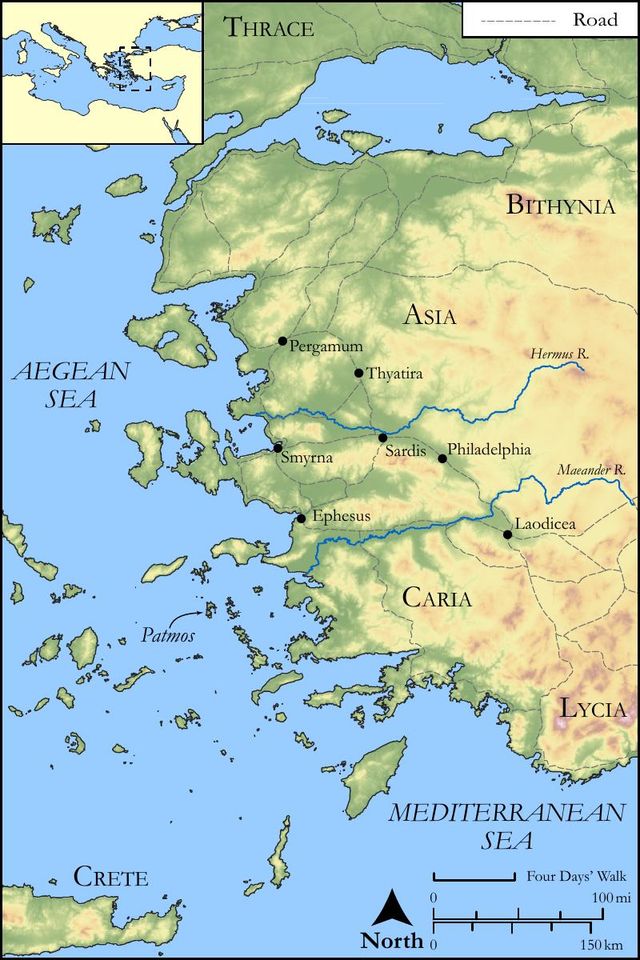
See on the biblical-era maps

Study this verse
Public-domain commentary
Matthew Henry
From his Commentary on the Whole Bible. Henry comments on passages, not single verses — this entry covers Revelation 8:7–13. His two-level outline is real structure in the source text, so it is rendered as structure.
Observe, I. The first angel sounded the first trumpet, and the events which followed were very dismal: There followed hail and fire mingled with blood, etc., Rev 8:7. There was a terrible storm; but whether it is to be understood of a storm of heresies, a mixture of monstrous errors falling on the church (for in that age Arianism prevailed), or a storm or tempest of war falling on the civil state, expositors are not agreed. Mr. Mede takes it to be meant of the Gothic inundation that broke in upon the empire in the year 395, the same year that Theodosius died, when the northern nations, under Alaricus, king of the Goths, broke in upon the western parts of the empire. However, here we observe, 1. It was a very terrible storm-fire, and hail, and blood: a strange mixture! 2. The limitation of it: it fell on the third part of the trees, and on the third part of the grass, and blasted and burnt it up; that is, say some, upon the third part of the clergy and the third part of the laity; or, as others who take it to fall upon the civil state, upon the third part of the great men, and upon the third part of the common people, either upon the Roman empire itself, which was a third part of the then known world, or upon a third part of that empire. The most severe calamities have their bounds and limits set them by the great God.
II.The second angel sounded, and the alarm was followed, as in the first, with terrible events:
A great mountain burning with fire was cast into the sea; and the third part of the sea became blood, Rev 8:8. By this mountain some understand the leader or leaders of the heretics; others, as Mr. Mede, the city of Rome, which was five times sacked by the Goths and Vandals, within the compass of 137 years; first by Alaricus, in the year 410, with great slaughter and cruelty. In these calamities, a third part of the people (called here the sea or collection of waters) were destroyed: here was still a limitation to the third part, for in the midst of judgment God remembers mercy. This storm fell heavy upon the maritime and merchandizing cities and countries of the Roman empire.
III.The third angel sounded, and the alarm had the like effects as before:
There fell a great star from heaven, etc., Rev 8:10. Some take this to be a political star, some eminent governor, and they apply it to Augustulus, who was forced to resign the empire to Odoacer, in the year 480. Others take it to be an ecclesiastical star, some eminent person in the church, compared to a burning lamp, and they fix it upon Pelagius, who proved about this time a falling star, and greatly corrupted the churches of Christ. Observe,
1.Where this star fell: Upon a third part of the rivers, and upon the fountains of waters.
2.What effect it had upon them; it turned those springs and streams into wormwood, made them very bitter, that men were poisoned by them; either the laws, which are springs of civil liberty, and property, and safety, were poisoned by arbitrary power, or the doctrines of the gospel, the springs of spiritual life, refreshment, and vigour to the souls of men, were so corrupted and embittered by a mixture of dangerous errors that the souls of men found their ruin where they sought for their refreshment.
IV.The fourth angel sounded, and the alarm was followed with further calamities. Observe,
1.The nature of this calamity; it was darkness; it fell therefore upon the great luminaries of the heaven, that give light to the world - the sun, and the moon, and the stars, either the guides and governors of the church, or of the state, who are placed in higher orbs than the people, and are to dispense light and benign influences to them.
2.The limitation: it was confined to a third part of these luminaries; there was some light both of the sun by day, and of the moon and stars by night, but it was only a third part of what they had before. Without determining what is matter of controversy in these points among learned men, we rather choose to make these plain and practical remarks: - (1.) Where the gospel comes to a people, and is but coldly received, and has not its proper effects upon their hearts and lives, it is usually followed with dreadful judgments. (2.) God gives warning to men of his judgments before he sends them; he sounds an alarm by the written word, by ministers, by men's own consciences, and by the signs of the times; so that, if a people be surprised, it is their own fault. (3.) The anger of God against a people makes dreadful work among them; it embitters all their comforts, and makes even life itself bitter and burdensome. (4.) God does not in this world stir up all his wrath, but sets bounds to the most terrible judgments. (5.) Corruptions of doctrine and worship in the church are themselves great judgments, and the usual causes and tokens of other judgments coming on a people.
V.Before the other three trumpets are sounded here is solemn warning given to the world how terrible the calamities would be that should follow them, and how miserable those times and places would be on which they fell, Rev 8:13.
1.The messenger was an angel flying in the midst of heaven, as in haste, and coming on an awful errand.
2.The message was a denunciation of further and greater woe and misery than the world had hitherto endured. Here are three woes, to show how much the calamities coming should exceed those that had been already, or to hint how every one of the three succeeding trumpets should introduce its particular and distinct calamity. If less judgments do not take effect, but the church and the world grow worse under them, they must expect greater. God will be known by the judgments that he executes; and he expects, when he comes to punish the world, the inhabitants thereof should tremble before him.
Historical interpretation
Six Centuries of Reception
6 surviving comments on this verse. Each one is dated, so this reads as a timeline rather than a list.
Select a marker to jump to its quote. Markers stagger vertically where authors wrote within a few decades of each other.
The rivers and fountains of waters signify the teachers of the divine Scriptures who instruct others but turn themselves away from the way of truth. Indeed, the name Wormwood indicates either the bitterness or the sweetness of sins, which give a present sweetness to those who desire them but afterwards change themselves into bitterness.
A third part of humankind was made like the star that fell upon it.… Many die from the waters. This can manifestly be interpreted to refer to those who are rebaptized.
Since the ruin of those who are great often confuses many, it says that the star fell upon part of the rivers and fountains, and that its name was Wormwood because of its great bitterness. We know that many are weakened by the fall of such persons and are corrupted by an evil imitation of their teaching. [The star] is rightly compared with wormwood, since a small amount of bitterness, when mixed with that which is sweet, will make the whole bitter. Elsewhere the Scriptures make the same point: “I planted you as a chosen vine; how did you turn into the bitterness of the vine of another?”
And many men died from the waters. For many (as the Apostle says) follow their luxuries, through whom the way of truth is blasphemed (II Pet. II), yet for the people of God, as Moses teaches, every wave of the waters is drinkable.
And the name of the star is called Wormwood. Because the Devil withdrew from the sweetness of truth to turn into the bitterness of falsehood, it is right for him to be allotted the name of Wormwood. Then, since a great many people perish from the examples of the wicked, it is fittingly said after that, and many men died of the waters, because they were made bitter. Indeed when fleshly men perish spiritually for having been enticed by the doctrines of wicked people or the examples of their works, it is as if they died of bitter waters.
Naomi, who long ago suffered many afflictions concerning her children and other misfortunes, was called Bitter. (Ruth 1:20) Bitterness serves as a symbol of the remaining extraordinary hardships. This bitterness is what we sinners experienced at that time, becoming bitter over the glory of the saints, because, indeed, although such good things were prepared for humanity, we ourselves exchanged the present for what was to come.
Continue studying Revelation 8:11 across the web’s major study libraries — every link below opens this exact verse, chapter, or book on the destination site.
Read & Compare
 BibleGatewayThis verse in more than 200 translations and 70 languages.
 Bible.comThe YouVersion reader — hundreds of translations, reading plans, and highlights.
 ESV.orgCrossway's official English Standard Version reader.
 NET BibleThe NET translation with 60,000+ translators' notes on every rendering decision.
 STEP BibleTyndale House's free study tool — original text, vocabulary, and scholarly resources.
 BibliaLogos Bible Software's free web reader.
 USCCBThe New American Bible (Revised Edition) with the U.S. bishops' study notes.
Commentaries
 BibleHub CommentariesDozens of classic commentaries on this verse, gathered on one page.
 StudyLightMore than 100 commentary sets — the largest collection on the web.
 BibleRefPlain-English commentary on what this verse means, verse by verse.
 Enduring WordDavid Guzik's free commentary on this chapter, widely used by Bible teachers.
 Bible Study ToolsVerse commentary alongside Greek and Hebrew study aids.
Original Language & Research
- BibleHub InterlinearThe verse word by word — original language, transliteration, and English.
- BibleHub LexiconEvery word's original-language definition and Strong's entry.
 Blue Letter BibleDeep-study tools — Strong's numbers, concordance, and word studies.
 CNTR CollationThe earliest Greek manuscripts of this verse, collated letter by letter.
Sermons, Hymns & Audio


TrulyRandomVerse is not affiliated with these sites and doesn’t control their content. They’re linked because they’re genuinely useful.
Summary
Revelation 8:11 vividly portrays the catastrophic consequences of the third trumpet judgment, where a celestial body, ominously named "Wormwood," falls to Earth. This event transforms a significant portion—one-third—of the planet's fresh water sources, including rivers and springs, into a bitter and poisonous substance. The immediate and devastating result is widespread death among humanity, directly attributable to consuming these now toxic waters, signifying a severe divine retribution against an unrepentant world.
Context
ShowHideLiterary Context
Revelation 8:11 is an integral part of the sequence of the seven trumpet judgments, which commence after the Lamb breaks the seventh seal. The opening of this seal initiates a period of silence in heaven, followed by seven angels preparing to sound their trumpets, each announcing a distinct and escalating judgment upon the Earth. The first trumpet devastates the land and vegetation (Revelation 8:7), and the second impacts the sea, turning a third of it to blood and destroying maritime life and vessels (Revelation 8:8-9). The third trumpet, detailed in Revelation 8:10-11, specifically targets the Earth's vital fresh water supplies, demonstrating a progression of judgment that moves from land to sea, and then to the very sources of life-sustaining water. This precise targeting underscores the comprehensive nature of God's wrath and the vulnerability of creation to divine decree.
Historical & Cultural Context
The book of Revelation was written during a period of intense persecution of Christians under the Roman Empire, likely during the reign of Emperor Domitian (c. AD 95). John, the author, was exiled to Patmos, and his apocalyptic visions served to encourage and warn the early church. The imagery used in Revelation, including falling stars and poisoned waters, would have resonated with ancient audiences familiar with Old Testament prophetic literature and natural disasters. Water sources were critical for survival in that day, and their contamination would have been understood as a profound calamity, akin to the plagues in Exodus or curses described in Deuteronomy 28. The concept of "wormwood" (Greek: apsinthos) was a well-known plant associated with extreme bitterness and often used metaphorically in the Old Testament to describe the bitter fruit of idolatry, injustice, and divine judgment, as seen in Jeremiah 9:15 and Lamentations 3:15. This cultural understanding would have immediately conveyed the severity and punitive nature of the judgment.
Key Themes
ShowHideRevelation 8:11 contributes significantly to several overarching themes within the book of Revelation and biblical theology. Firstly, it powerfully illustrates the theme of Divine Judgment and Retribution, demonstrating God's active intervention in human history to punish unrepentant sin. The precise targeting of fresh water sources, essential for life, highlights the severity and pervasive reach of this judgment. Secondly, the verse emphasizes the Bitterness and Death that are the inevitable consequences of rebellion against God. The name "Wormwood" itself is a potent symbol of the spiritual and physical bitterness that results from rejecting God's life-giving truth, mirroring the "bitter harvest" of sin found throughout scripture (e.g., Proverbs 5:4). Thirdly, the recurring phrase "the third part" across the trumpet judgments (e.g., Revelation 8:7, Revelation 8:8) underscores the theme of Partial but Severe Destruction. This indicates that while the judgments are devastating, they are not yet total annihilation, serving as a stark warning and a call to repentance before the final, ultimate judgments. Finally, the Symbolism of the Star is a key element, with "stars" often representing angelic beings, spiritual authorities, or prominent human leaders in prophetic literature (e.g., Isaiah 14:12). Whether literal or symbolic, the star's fall signifies a profound spiritual upheaval, or an upheaval in the heavens, that precipitates physical devastation.
Exposition and Analysis
ShowHideKey Word Analysis
ShowHideThis term refers to a plant known for its intensely bitter taste, often used medicinally but also strongly associated with poison and extreme bitterness. In this context, it is not merely a descriptive name but a symbolic representation of the severe and painful consequences of divine judgment. Its application to the star and the waters signifies a profound and deadly spiritual and physical bitterness.
This verb, often translated as "to become" or "to come into being," indicates a transformative event. It highlights that the waters were not inherently bitter but underwent a radical change, actively "becoming" wormwood. This emphasizes the direct and active nature of the judgment, where life-giving water is supernaturally altered into a source of death.
This verb means "to die off" and is used literally here to describe the physical cessation of life for "many men." Its inclusion underscores the lethal impact of the poisoned waters, directly linking the divine judgment to widespread human mortality.
Derived from the word for "bitter," this verb means "to embitter" or "to make bitter," literally or figuratively. It reinforces the nature of the transformation of the waters, emphasizing that their life-sustaining quality was replaced by a deadly, bitter essence, causing the deaths of those who consumed them.
Verse Breakdown
ShowHide"And the name of the star is called Wormwood"
This clause introduces the celestial agent of judgment. The star is not merely identified by a name but is called "Wormwood," signifying that its very essence or purpose is to bring forth bitterness and calamity. This naming is symbolic, linking the star's identity directly to the destructive and painful nature of the impending judgment. It implies that this is not a random astronomical event but a divinely ordained instrument of sorrow.
"and the third part of the waters became wormwood"
This describes the immediate and devastating effect of the star's fall. A significant portion—one-third—of the Earth's fresh water sources (rivers and fountains, as specified in Revelation 8:10) undergoes a supernatural transformation. They do not merely become contaminated but are fundamentally altered to embody the essence of "wormwood," meaning they become intensely bitter and poisonous, rendering them undrinkable and deadly.
"and many men died of the waters, because they were made bitter"
This final clause states the direct consequence of the poisoned waters. The bitterness of the waters is not just unpleasant; it is lethal. "Many men" perish as a direct result of consuming these embittered waters. This highlights the widespread human suffering and mortality caused by this specific judgment, emphasizing the direct link between divine wrath and its physical repercussions on humanity.
Literary Devices
ShowHideRevelation 8:11 is rich in Symbolism. The "star" itself is symbolic, not necessarily a literal celestial body, but often interpreted as a powerful angelic being or a significant figure whose fall brings devastation. Its name, "Wormwood," is a potent Metaphor for the extreme bitterness, sorrow, and judgment that it unleashes. This metaphor draws heavily on Old Testament prophetic tradition, where "wormwood" frequently represents the bitter consequences of idolatry and disobedience (e.g., Deuteronomy 29:18). The transformation of life-giving "waters" into a deadly, bitter substance is a powerful Irony, as a source of sustenance becomes a source of death, underscoring the perversion and reversal of natural order under divine judgment. The phrase "the third part" serves as a Synecdoche, representing a significant, yet not total, portion of the Earth, indicating a severe but partial judgment that serves as a warning rather than a final annihilation. The entire scene employs Apocalyptic Imagery to convey profound theological truths about God's justice and the consequences of human rebellion in a vivid and impactful manner.
Theological and Thematic Connections
ShowHideRevelation 8:11 powerfully underscores the biblical truth of God's sovereignty over creation and His absolute right to judge human sin. The judgment of the waters, essential for life, signifies a profound disruption of the natural order as a direct consequence of humanity's rebellion and unrepentance. This event is not a random catastrophe but a deliberate act of divine retribution, demonstrating that sin has bitter and deadly consequences, both spiritually and physically. It reflects a recurring biblical theme where God uses elements of creation to execute His justice, often turning sources of blessing into instruments of judgment, thereby revealing the futility of human self-reliance apart from Him. The "wormwood" judgment serves as a stark warning, a partial outpouring of wrath intended to prompt repentance before the final and ultimate judgments.
Reflection and Application
ShowHideRevelation 8:11, while depicting a terrifying future judgment, offers profound lessons for believers today. It serves as a stark reminder that sin, left unaddressed, inevitably leads to bitter and deadly consequences, both in this life and the next. Just as the physical waters were poisoned, so too can spiritual "waters"—sources of truth, comfort, and life—become corrupted by false doctrines, worldly pursuits, and unrepentant hearts, leading to spiritual death. This passage calls us to examine the "waters" we drink from: Are they pure, life-giving streams of God's truth, or are they tainted by the bitterness of sin and the world's deceptive promises? For those who have embraced the living water of Christ, this verse deepens our appreciation for the grace and mercy that have spared us from such judgments. It also compels us to live with a renewed sense of urgency, sharing the gospel message—the antidote to spiritual bitterness and death—with a world desperately in need of true, life-giving sustenance. Ultimately, the terror of this judgment should not evoke despair in the believer, but rather a profound gratitude for salvation and a fervent desire to see others turn to the Lord before the day of His wrath.
Questions for Reflection
ShowHideFAQ
ShowHideWhat is the significance of the star being named "Wormwood"?
ShowHideThe naming of the star "Wormwood" (Greek: ápsinthos) is highly symbolic. "Wormwood" refers to a plant known for its extreme bitterness, often associated with poison and sorrow. In the Old Testament, it frequently appears as a metaphor for the bitter consequences of idolatry, injustice, and divine judgment (e.g., Jeremiah 9:15). Therefore, the star's name signifies that its very nature or purpose is to bring forth profound bitterness, suffering, and death. It emphasizes that the ensuing judgment is not random but a direct, painful, and divinely ordained consequence of humanity's sin and rebellion.
Why does only "the third part" of the waters become bitter?
ShowHideThe recurring phrase "the third part" throughout the trumpet judgments (Revelation 8:7, Revelation 8:8, Revelation 8:11) signifies that these judgments, while severe and devastating, are not yet total or final. They represent a significant, widespread, and destructive outpouring of God's wrath, but they are partial. This partiality serves as a warning, a call to repentance, and a demonstration of God's escalating judgment, preceding even more intense and comprehensive judgments to come, such as those associated with the bowls of wrath in Revelation 16. It indicates that God's patience, though strained, has not yet fully run out.
Is the star "Wormwood" a literal star or symbolic?
ShowHideWhile the text describes it as a "great star," most biblical scholars interpret "Wormwood" as symbolic rather than a literal astronomical body. In apocalyptic literature, "stars" often represent powerful angelic beings, spiritual authorities, or prominent human leaders (e.g., Isaiah 14:12 where the king of Babylon is likened to a fallen star, or Revelation 9:1). Given the supernatural transformation of the waters, it is more likely that this "star" is a supernatural entity—perhaps a fallen angel—acting as an instrument of God's judgment, rather than a physical asteroid or comet. Its impact is not merely physical but carries profound spiritual significance.
Christ-Centered Fulfillment
ShowHideRevelation 8:11, with its depiction of bitter, deadly waters, finds its profound Christ-centered fulfillment in the stark contrast between the consequences of sin and the life-giving provision of Jesus Christ. Humanity's rebellion against God leads to a "bitter harvest" of spiritual and physical death, symbolized by the poisoned waters. Yet, Jesus Himself declares, "If anyone thirsts, let him come to me and drink" (John 7:37). He is the "living water" (John 4:10) who quenches spiritual thirst and offers eternal life, contrasting sharply with the deadly waters of judgment. Furthermore, Christ Himself tasted the ultimate bitterness of sin and judgment on the cross, crying out, "My God, my God, why have you forsaken me?" (Matthew 27:46). He bore the full cup of God's wrath, allowing us, through faith in Him, to escape the bitter consequences of our own sin. The judgment of Wormwood reveals the terrifying reality of a world without Christ, where life-sustaining elements become instruments of death. In contrast, Christ transforms the bitter cup of judgment into the sweet fount of salvation, offering cleansing and healing for all who believe, ensuring that those who drink of Him "will never thirst again" (John 4:14). He is the ultimate antidote to the bitterness of sin and death, providing true and everlasting life.