


Revelation 16:3
Bible text: King James Version (1769 Blayney text) · Public domain
Bible text: King James Version with Strong's numbers · Public domain
Bible text: Berean Standard Bible · Public domain
Bible text: American Standard Version (1901) · Public domain
Bible text: World English Bible, Messianic edition · Public domain
Bible text: Geneva Bible (1599) · Public domain
Bible text: Young's Literal Translation · Public domain
- ΚαὶKaiAndG2532CONJConjunction
- ὁhotheG3588T-NSMDefinite article Nominative Singular Masculine
- δεύτεροςdeuterossecondG1208A-NSMAdjective Nominative Singular Masculine
- ἄγγελοςangelosangelG32N-NSMNoun Nominative Singular Masculine
- ἐξέχεενexecheenpoured outG1632V-AAI-3SVerb Aorist Active Indicative 3rd Singular
- τὴνtēntheG3588T-ASFDefinite article Accusative Singular Feminine
- φιάληνphialēnbowlG5357N-ASFNoun Accusative Singular Feminine
- αὐτοῦautouof himG846P-GSMPersonal pronoun Genitive Singular Masculine
- εἰςeisintoG1519PREPPreposition
- τὴνtēntheG3588T-ASFDefinite article Accusative Singular Feminine
- θάλασσανthalassanseaG2281N-ASFNoun Accusative Singular Feminine
- καὶkaiandG2532CONJConjunction
- ἐγένετοegenetoit becameG1096V-2ADI-3SVerb 2nd Aorist Middle Deponent Indicative 3rd Singular
- αἷμαhaimabloodG129N-NSNNoun Nominative Singular Neuter
- ὡςhōsasG5613PRTParticle or Disjunctive
- νεκροῦnekrouof [one] deadG3498A-GSMAdjective Genitive Singular Masculine
- καὶkaiandG2532CONJConjunction
- πᾶσαpasaeveryG3956A-NSFAdjective Nominative Singular Feminine
- ψυχὴpsuchēsoulG5590N-NSFNoun Nominative Singular Feminine
- ζωῆςzōēslivingG2222N-GSFNoun Genitive Singular Feminine
- ἀπέθανενapethanendiedG599V-2AAI-3SVerb 2nd Aorist Active Indicative 3rd Singular
- ἐνeninG1722PREPPreposition
- τῇtēatheG3588T-DSFDefinite article Dative Singular Feminine
- θαλάσσῃthalassēseaG2281N-DSFNoun Dative Singular Feminine
English is a literal word-by-word gloss of the Greek, not the KJV's wording. Why?
This is the original text the KJV's translators worked from — each Greek word with its own literal English meaning in this verse, prepared by scholars at Tyndale House, Cambridge. The KJV translates whole sentences, not word by word, so its wording differs: one Greek word can become several English words, and the KJV may choose “charity” where the gloss reads “love”. Both are faithful — they answer different questions. For the KJV's own rendering, switch to the KJV text.
Details
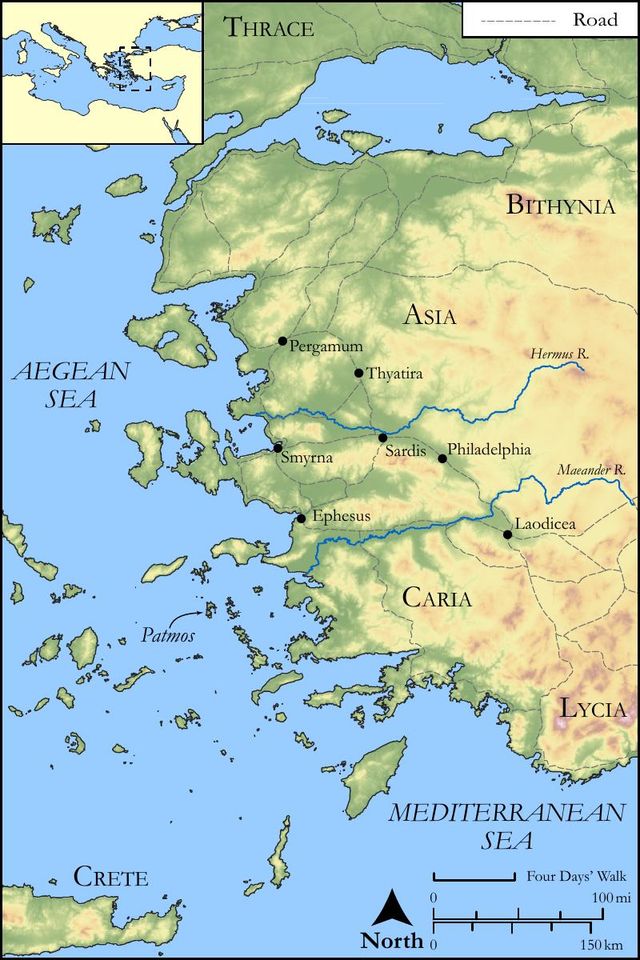
See on the biblical-era maps

Study this verse
Public-domain commentary
Matthew Henry
From his Commentary on the Whole Bible. Henry comments on passages, not single verses — this entry covers Revelation 16:1–7. His four-level outline is real structure in the source text, so it is rendered as structure.
We had in the foregoing chapter the great and solemn preparation that was made for the pouring out of the vials; now we have the performance of that work. Here observe,
I.That, though every thing was made ready before, yet nothing was to be put in execution without an immediate positive order from God; and this he gave out of the temple, answering the prayers of his people, and avenging their quarrel.
II.No sooner was the word of command given than it was immediately obeyed; no delay, no objection made.
We find that some of the best men, as Moses and Jeremiah, did not so readily come in and comply with the call of God to their work; but the angels of God excel not only in strength, but in a readiness to do the will of God. God says, Go your ways, and pour out the vials, and immediately the work is begun. We are taught to pray that the will of God may be done on earth as it is done in heaven. And now we enter upon a series of very terrible dispensations of Providence, of which it is difficult to give the certain meaning or to make the particular application. But in the general it is worth our observation that,
1.We have here a reference and allusion to several of the plagues of Egypt, such as the turning of their waters into blood, and smiting them with boils and sores. Their sins were alike, and so were their punishments.
2.These vials have a plain reference to the seven trumpets, which represented the rise of antichrist; and we learn hence that the fall of the church's enemies shall bear some resemblance to their rise, and that God can bring them down in such ways as they chose to exalt themselves. And the fall of antichrist shall be gradual; as Rome was not built in one day, so neither shall it fall in one day, but it falls by degrees; it shall fall so as to rise no more.
3.The fall of the antichristian interest shall be universal. Every thing that any ways belonged to them, or could be serviceable to them, the premises and all their appurtenances, are put into the writ for destruction: their earth, their air, their sea, their rivers, their cities, all consigned over to ruin, all accursed for the sake of the wickedness of that people. Thus the creation groans and suffers through the sins of men. Now we proceed to,
(1.)The first angel who poured out his vial, Rev 16:2. Observe,
[1.]Where it fell - upon the earth; that is, say some, upon the common people; others upon the body of the Romish clergy, who were the basis of the papacy, and of an earthly spirit, all carrying on earthly designs.
[2.]What it produced - noisome and grievous sores on all who had the mark of the beast. They had marked themselves by their sin; now God marks them out by his judgments. This sore, some think, signifies some of the first appearances of Providence against their state and interest which gave them great uneasiness, as it discovered their inward distemper and was a token of further evil; the plague - tokens appeared.
(2.)The second angel poured out his vial; and here we see,
[1.]Where it fell - upon the sea; that is, say some, upon the jurisdiction and dominion of the papacy; others upon the whole system of their religion, their false doctrines, their corrupt glosses, their superstitious rites, their idolatrous worship, their pardons, indulgences, a great conflux of wicked inventions and institutions, by which they maintain a trade and traffic advantageous to themselves, but injurious to all who deal with them.
[2.]What it produced: It turned the sea into blood, as the blood of a dead man, and every living soul died in the sea. God discovered not only the vanity and falsehood of their religion, but the pernicious and deadly nature of it - that the souls of men were poisoned by that which was pretended to be the sure means of their salvation.
(3.)The next angel poured out his vial; and we are told,
[1.]Where it fell - upon the rivers, and upon the fountains of waters; that is, say some very learned men, upon their emissaries, and especially the Jesuits, who, like streams, conveyed the venom and poison of their errors and idolatries from the spring-head through the earth.
[2.]What effect it had upon them: It turned them into blood; some think it stirred up Christian princes to take a just revenge upon those that had been the great incendiaries of the world, and had occasioned the shedding of the blood of armies and of martyrs. The following doxology (Rev 16:5, Rev 16:6) favours this sense. The instrument that God makes use of in this work is here called the angel of the waters, who extols the righteousness of God in this retaliation: They have shed the blood of thy saints, and thou hast given them blood to drink, for they are worthy, to which another angel answered by full consent, Rev 16:7.
Historical interpretation
Four Centuries of Reception
4 surviving comments on this verse. Each one is dated, so this reads as a timeline rather than a list.
Select a marker to jump to its quote. Markers stagger vertically where authors wrote within a few decades of each other.
[It says that] water turned to blood. It is easy to turn the soul from spiritual matters and think after the manner of the flesh, which we knew without difficulty to be symbolized in that first of the plagues that we read was inflicted upon the Egyptians. For then it reports that the fresh waters were turned to blood, whether the rivers of Egypt or the rain waters, as some translations have it, saying, “And their rain waters [were turned] to blood.” … However, the present passage raises a question, because here it says that the second bowl was poured into the sea, that is, into waters that are bitter and salty. And [the waters] became blood, it says, and every living thing in the sea died. It seems to me that this passage signifies those among the Jews who did not interpret the law spiritually but understood it in a fleshly manner, and therefore they could not discern Christ in it. As the apostle says, “Had they recognized [him], they would not have crucified the Lord of glory.” But in addition to this, they are led by the burden of their deserts to such an extent, as though struck by the second wound of an even worse plague, that they desire the image of the beast and, possessing the mark of its name, think that they ought worship the beast rather than Christ. And so, perhaps in this passage what is described in the exodus to have happened in the first plague is placed in the second bowl, in that from the sterile waters [of the sea] they also move to the filth of blood, through which it says that every living thing in the sea, that is, [every soul] in this world, has been killed, referring to the part from the whole, as in this passage, “There is no one who does good, no, not one.” To be sure, those are characterized by a manifest sterility of whom it is said, “I looked for it to yield grapes, but it yielded thorns.” And these are those whose tongues became so enfeebled that they said to their own condemnation, “his blood be on us and on our children.”
It is not surprising that to expose the weakness of the antichrist and the light-mindedness of the deceived, the divine power would through the holy prophets, Enoch and Elijah, change the sea into “blood as of a dead man,” that is, as of one who had been slain, and would effect the corruption of all in it, just as long ago in Egypt he worked through Moses to expose the hardheartedness of Pharaoh and to demonstrate his own power. And therefore, those who were of secure faith were strengthened and the unstable were made fearful, seeing the creation arrayed against those who fought for the honor of the destroyer. It is also possible that through these words the slaughters that will happen in wars at the coming [of the antichrist] are indicated. For when Gog and Magog will move against each other in the four parts of the world and, in addition, the kings who had not obeyed will be annihilated with their whole armies and there will be slaughter in every place, then the sea will be defiled by sea battles, and the rivers will be mingled with the blood of those who were killed there.
And the second poured out his bowl on the sea, etc. Those who are not only marked with the character of the Antichrist but also attack the stability of Christ's servants with the waves of bitter persecution will be punished with a spiritual vengeance, which he calls blood; and those who boasted of living will be proven to have served the author of death.
The blood of the sea and waters plainly indicate the killings of those encamped near the waters in land battles, as is natural.
Continue studying Revelation 16:3 across the web’s major study libraries — every link below opens this exact verse, chapter, or book on the destination site.
Read & Compare
 BibleGatewayThis verse in more than 200 translations and 70 languages.
 Bible.comThe YouVersion reader — hundreds of translations, reading plans, and highlights.
 ESV.orgCrossway's official English Standard Version reader.
 NET BibleThe NET translation with 60,000+ translators' notes on every rendering decision.
 STEP BibleTyndale House's free study tool — original text, vocabulary, and scholarly resources.
 BibliaLogos Bible Software's free web reader.
 USCCBThe New American Bible (Revised Edition) with the U.S. bishops' study notes.
Commentaries
 BibleHub CommentariesDozens of classic commentaries on this verse, gathered on one page.
 StudyLightMore than 100 commentary sets — the largest collection on the web.
 BibleRefPlain-English commentary on what this verse means, verse by verse.
 Enduring WordDavid Guzik's free commentary on this chapter, widely used by Bible teachers.
 Bible Study ToolsVerse commentary alongside Greek and Hebrew study aids.
Original Language & Research
- BibleHub InterlinearThe verse word by word — original language, transliteration, and English.
- BibleHub LexiconEvery word's original-language definition and Strong's entry.
 Blue Letter BibleDeep-study tools — Strong's numbers, concordance, and word studies.
 CNTR CollationThe earliest Greek manuscripts of this verse, collated letter by letter.
Sermons, Hymns & Audio


TrulyRandomVerse is not affiliated with these sites and doesn’t control their content. They’re linked because they’re genuinely useful.
Summary
Revelation 16:3 describes the second of the seven bowl judgments, where a divine angel pours out a vial upon the sea, causing it to transform into a putrid, death-laden substance akin to the blood of a corpse. This catastrophic event results in the complete annihilation of all marine life, signifying an unprecedented ecological disaster and a severe outpouring of God's righteous wrath upon a rebellious world.
Context
ShowHideLiterary Context
Revelation 16:3 is situated within the "bowl judgments" (Revelation 16:1-21), which represent the final and most intense series of God's wrath poured out upon the earth during the tribulation period, immediately preceding the return of Christ. These judgments are presented as swift, comprehensive, and irreversible, escalating in severity from the trumpet judgments and parallel to the seal judgments, but with greater finality. The preceding verse, Revelation 16:2, describes the first bowl judgment, which inflicts painful sores upon those who bear the mark of the beast. The judgment on the sea in Revelation 16:3 directly follows, initiating a sequence that targets fundamental elements of the natural world—sea, fresh waters, sun, and the seat of the beast—demonstrating God's comprehensive judgment over all creation and human systems.
Historical & Cultural Context
The imagery of water turning to blood would have resonated deeply with ancient audiences familiar with the Old Testament plagues, particularly the first plague upon Egypt found in Exodus 7:17-21. In that instance, the Nile River, the lifeblood of Egypt, was turned to blood, leading to the death of fish and rendering the water undrinkable. This historical precedent established a powerful symbol of divine judgment against a defiant nation. For the Roman world, the sea was crucial for trade, travel, and sustenance. A judgment affecting the entire sea would have been understood as an unimaginable catastrophe, disrupting all aspects of life and commerce, underscoring the global and devastating impact of God's wrath far beyond any localized historical event.
Key Themes
ShowHideThis verse contributes significantly to several key themes within Revelation and broader biblical theology. It powerfully illustrates the theme of Divine Judgment and Wrath, showing God's uncompromising justice against sin and rebellion, culminating in a series of global catastrophes. The judgment also highlights Ecological Devastation, demonstrating how the natural world suffers under the weight of human sin and divine retribution, a stark contrast to the harmonious creation described in Genesis 1. Furthermore, the imagery of the sea turning to blood, reminiscent of the Egyptian plagues, reinforces the theme of God's Sovereignty over Creation and History, asserting His ultimate control and ability to execute judgment on a scale far exceeding any previous historical event, as foreshadowed in passages like Joel 2:30-31.
Exposition and Analysis
ShowHideKey Word Analysis
ShowHideThis verb signifies a coming into being or a transformation. Here, it emphasizes the radical and immediate change of the sea's nature, from a life-sustaining environment to one of death and decay, directly resulting from the angel's action. It implies a complete and fundamental alteration of its essence.
While often associated with life, atonement, or covenant in biblical contexts, here it is qualified by "of a dead [man]," indicating putrid, congealed blood. This signifies not life, but utter corruption, death, and defilement, rendering the sea uninhabitable and a source of horror rather than sustenance.
In this context, psychḗ refers to the animating principle of living beings, specifically marine life. Its use highlights the complete cessation of all life within the sea, emphasizing the totality of the judgment, affecting every creature that possesses this vital principle, from the smallest organism to the largest marine animal.
Verse Breakdown
ShowHide"And the second angel poured out his vial upon the sea"
This clause introduces the divine agent of judgment—the second of the seven angels—and the specific target of this particular plague: "the sea." The "vial" (Greek phialē) refers to a broad, shallow bowl, often used for libations or offerings. Its "pouring out" signifies a swift, complete, and unreserved emptying of its contents, symbolizing the immediate and full execution of God's wrath upon the vast oceans.
"and it became as the blood of a dead [man]:"
This describes the horrific transformation of the sea. The Greek phrase haima nekrou literally means "blood of a corpse" or "blood of a dead one." This is not fresh, flowing, life-giving blood, but congealed, putrefying, and disgusting blood, indicative of utter death and decay. This imagery conveys a scene of profound defilement and pollution, rendering the vast oceans a putrid, death-filled grave.
"and every living soul died in the sea."
This clause reveals the devastating consequence of the sea's transformation. The phrase "every living soul" (Greek pasa psychē zōsa) emphasizes the totality of the destruction of marine life. This is not a partial or localized event but a complete and absolute annihilation of all biological activity within the world's oceans, signifying an unprecedented global ecological catastrophe.
Literary Devices
ShowHideRevelation 16:3 employs several powerful literary devices to convey its message of divine judgment. Symbolism is prominent, with the "sea" often symbolizing the restless nations of the world or the source of chaos and evil in biblical prophecy, and "blood" here representing death, decay, and judgment rather than life. The transformation of the sea into putrid blood is a vivid Metaphor for the spiritual corruption and death that pervades the world under God's wrath. The passage also utilizes Allusion to the Old Testament, specifically the first plague in Egypt where the Nile turned to blood (Exodus 7:20), but escalates its scope to a global scale, highlighting the intensified nature of these final judgments. Furthermore, Hyperbole is evident in the declaration that "every living soul died in the sea," emphasizing the absolute and comprehensive nature of this unparalleled destruction, leaving no marine life spared.
Theological and Thematic Connections
ShowHideRevelation 16:3 serves as a stark reminder of God's absolute sovereignty and His unyielding justice against sin. This judgment, targeting the very source of life in the oceans, underscores the comprehensive nature of divine wrath against a world that has persistently rejected its Creator. It demonstrates that God's patience has reached its limit, and His righteous indignation will be fully poured out, affecting even the fundamental elements of creation. The imagery of putrid blood signifies not only death but also defilement and corruption, reflecting the spiritual decay of humanity that has chosen rebellion over repentance. This plague is a severe act of judgment, revealing God's power to dismantle the very systems that sustain life when His holiness is continually affronted.
Reflection and Application
ShowHideRevelation 16:3, while describing a future cataclysmic event, carries profound and timeless implications for our present lives. It serves as a chilling reminder of the ultimate consequences of unrepentant sin and rebellion against God. The utter devastation of the sea, a vital source of life and sustenance, illustrates that God's judgment is not merely symbolic but has tangible, destructive effects on the created order when His holiness is continually violated. For believers, this passage should deepen our awe of God's perfect justice and His unwavering commitment to righteousness. It compels us to live lives that honor Him, to be vigilant against the deceptive allure of worldly systems, and to recognize the urgency of sharing the Gospel message. It also offers a sobering perspective on the fragility of creation and the profound impact of spiritual choices on the physical world.
Questions for Reflection
ShowHideFAQ
ShowHideIs this plague meant to be understood literally or symbolically?
ShowHideWhile the Book of Revelation employs rich symbolism throughout, many commentators interpret the bowl judgments, including this one, as literal events, given their vivid and specific descriptions of physical calamities. The turning of the sea to "blood of a dead [man]" and the death of "every living soul" in it are described with an intensity that suggests a real, global ecological catastrophe. However, even if literal, these events also carry profound symbolic weight, representing the spiritual death and corruption of a world that has rejected God, and the absolute finality of His judgment. The reference to "blood of a dead [man]" specifically emphasizes putrefaction and decay, not fresh, vital blood, underscoring the horrific nature of this judgment.
Christ-Centered Fulfillment
ShowHideRevelation 16:3, depicting the sea transformed into the blood of a corpse and all life within it perishing, stands in stark contrast to the life-giving blood of Christ. While this judgment signifies the ultimate consequence of humanity's rebellion and rejection of God, it simultaneously highlights the profound grace found in Jesus. The world's seas become a vast grave because of sin, but Jesus, the Lamb of God, shed His own precious blood not for judgment, but for redemption. His atoning sacrifice on the cross, as described in Hebrews 9:22, is the only means by which humanity can escape the wrath to come. Furthermore, Christ's victory over death and sin, culminating in His resurrection, foreshadows a new creation where there will be no more sea, no more death, and no more sorrow (Revelation 21:1-4). Thus, this terrifying judgment underscores the magnitude of the salvation offered through Christ, who bore the full weight of God's wrath so that those who believe might have eternal life and inherit a renewed creation, free from the curse of sin and death.