


Revelation 16:2
Bible text: King James Version (1769 Blayney text) · Public domain
Bible text: King James Version with Strong's numbers · Public domain
Bible text: Berean Standard Bible · Public domain
Bible text: American Standard Version (1901) · Public domain
Bible text: World English Bible, Messianic edition · Public domain
Bible text: Geneva Bible (1599) · Public domain
Bible text: Young's Literal Translation · Public domain
- ΚαὶKaiAndG2532CONJConjunction
- ἀπῆλθενapēlthendepartedG565V-2AAI-3SVerb 2nd Aorist Active Indicative 3rd Singular
- ὁhotheG3588T-NSMDefinite article Nominative Singular Masculine
- πρῶτοςprōtosfirstG4413A-NSMAdjective Nominative Singular Masculine
- καὶkaiandG2532CONJConjunction
- ἐξέχεενexecheenpoured outG1632V-AAI-3SVerb Aorist Active Indicative 3rd Singular
- τὴνtēntheG3588T-ASFDefinite article Accusative Singular Feminine
- φιάληνphialēnbowlG5357N-ASFNoun Accusative Singular Feminine
- αὐτοῦautouof himG846P-GSMPersonal pronoun Genitive Singular Masculine
- εἰςeisintoG1519PREPPreposition
- τὴνtēntheG3588T-ASFDefinite article Accusative Singular Feminine
- γῆνgēnearthG1093N-ASFNoun Accusative Singular Feminine
- καὶkaiandG2532CONJConjunction
- ἐγένετοegenetocameG1096V-2ADI-3SVerb 2nd Aorist Middle Deponent Indicative 3rd Singular
- ἕλκοςhelkosa soreG1668N-NSNNoun Nominative Singular Neuter
- κακὸνkakonharmG2556A-NSNAdjective Nominative Singular Neuter
- καὶkaiandG2532CONJConjunction
- πονηρὸνponērongrievousG4190A-NSNAdjective Nominative Singular Neuter
- ἐπὶepiuponG1909PREPPreposition
- τοὺςtoustheG3588T-APMDefinite article Accusative Plural Masculine
- ἀνθρώπουςanthrōpousmenG444N-APMNoun Accusative Plural Masculine
- τοὺςtousthoseG3588T-APMDefinite article Accusative Plural Masculine
- ἔχονταςechontashavingG2192V-PAP-APMVerb Present Active Participle Accusative Plural Masculine
- τὸtotheG3588T-ASNDefinite article Accusative Singular Neuter
- χάραγμαcharagmamarkG5480N-ASNNoun Accusative Singular Neuter
- τοῦtouof theG3588T-GSNDefinite article Genitive Singular Neuter
- θηρίουthērioubeastG2342N-GSNNoun Genitive Singular Neuter
- καὶkaiandG2532CONJConjunction
- τοὺςtousthoseG3588T-APMDefinite article Accusative Plural Masculine
- προσκυνοῦνταςproskunountasworshipingG4352V-PAP-APMVerb Present Active Participle Accusative Plural Masculine
- τῇtēatheG3588T-DSFDefinite article Dative Singular Feminine
- εἰκόνιeikoniimageG1504N-DSFNoun Dative Singular Feminine
- αὐτοῦautouof itG846P-GSNPersonal pronoun Genitive Singular Neuter
English is a literal word-by-word gloss of the Greek, not the KJV's wording. Why?
This is the original text the KJV's translators worked from — each Greek word with its own literal English meaning in this verse, prepared by scholars at Tyndale House, Cambridge. The KJV translates whole sentences, not word by word, so its wording differs: one Greek word can become several English words, and the KJV may choose “charity” where the gloss reads “love”. Both are faithful — they answer different questions. For the KJV's own rendering, switch to the KJV text.
Details
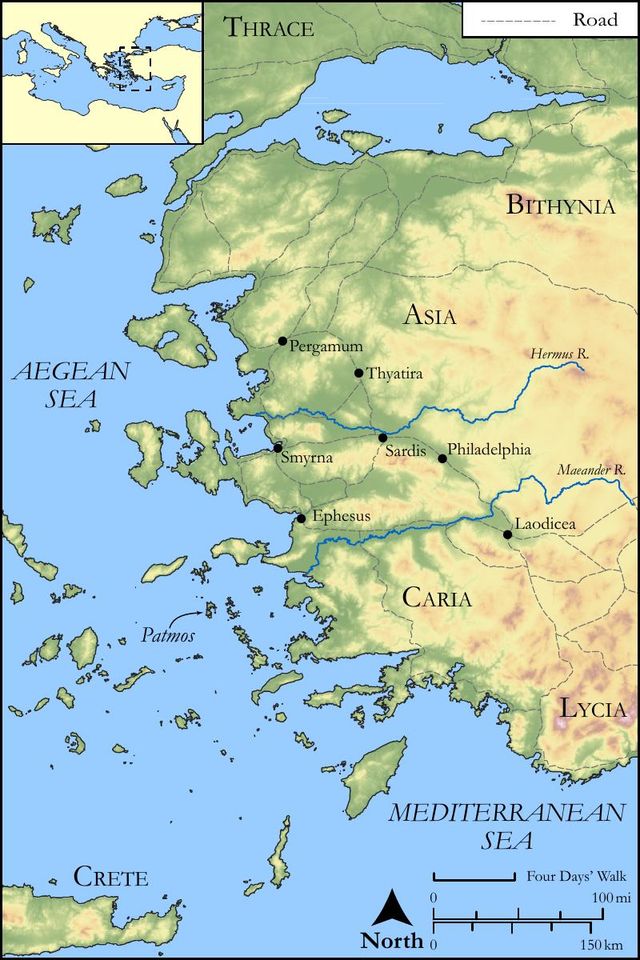
See on the biblical-era maps

Study this verse
Public-domain commentary
Matthew Henry
From his Commentary on the Whole Bible. Henry comments on passages, not single verses — this entry covers Revelation 16:1–7. His four-level outline is real structure in the source text, so it is rendered as structure.
We had in the foregoing chapter the great and solemn preparation that was made for the pouring out of the vials; now we have the performance of that work. Here observe,
I.That, though every thing was made ready before, yet nothing was to be put in execution without an immediate positive order from God; and this he gave out of the temple, answering the prayers of his people, and avenging their quarrel.
II.No sooner was the word of command given than it was immediately obeyed; no delay, no objection made.
We find that some of the best men, as Moses and Jeremiah, did not so readily come in and comply with the call of God to their work; but the angels of God excel not only in strength, but in a readiness to do the will of God. God says, Go your ways, and pour out the vials, and immediately the work is begun. We are taught to pray that the will of God may be done on earth as it is done in heaven. And now we enter upon a series of very terrible dispensations of Providence, of which it is difficult to give the certain meaning or to make the particular application. But in the general it is worth our observation that,
1.We have here a reference and allusion to several of the plagues of Egypt, such as the turning of their waters into blood, and smiting them with boils and sores. Their sins were alike, and so were their punishments.
2.These vials have a plain reference to the seven trumpets, which represented the rise of antichrist; and we learn hence that the fall of the church's enemies shall bear some resemblance to their rise, and that God can bring them down in such ways as they chose to exalt themselves. And the fall of antichrist shall be gradual; as Rome was not built in one day, so neither shall it fall in one day, but it falls by degrees; it shall fall so as to rise no more.
3.The fall of the antichristian interest shall be universal. Every thing that any ways belonged to them, or could be serviceable to them, the premises and all their appurtenances, are put into the writ for destruction: their earth, their air, their sea, their rivers, their cities, all consigned over to ruin, all accursed for the sake of the wickedness of that people. Thus the creation groans and suffers through the sins of men. Now we proceed to,
(1.)The first angel who poured out his vial, Rev 16:2. Observe,
[1.]Where it fell - upon the earth; that is, say some, upon the common people; others upon the body of the Romish clergy, who were the basis of the papacy, and of an earthly spirit, all carrying on earthly designs.
[2.]What it produced - noisome and grievous sores on all who had the mark of the beast. They had marked themselves by their sin; now God marks them out by his judgments. This sore, some think, signifies some of the first appearances of Providence against their state and interest which gave them great uneasiness, as it discovered their inward distemper and was a token of further evil; the plague - tokens appeared.
(2.)The second angel poured out his vial; and here we see,
[1.]Where it fell - upon the sea; that is, say some, upon the jurisdiction and dominion of the papacy; others upon the whole system of their religion, their false doctrines, their corrupt glosses, their superstitious rites, their idolatrous worship, their pardons, indulgences, a great conflux of wicked inventions and institutions, by which they maintain a trade and traffic advantageous to themselves, but injurious to all who deal with them.
[2.]What it produced: It turned the sea into blood, as the blood of a dead man, and every living soul died in the sea. God discovered not only the vanity and falsehood of their religion, but the pernicious and deadly nature of it - that the souls of men were poisoned by that which was pretended to be the sure means of their salvation.
(3.)The next angel poured out his vial; and we are told,
[1.]Where it fell - upon the rivers, and upon the fountains of waters; that is, say some very learned men, upon their emissaries, and especially the Jesuits, who, like streams, conveyed the venom and poison of their errors and idolatries from the spring-head through the earth.
[2.]What effect it had upon them: It turned them into blood; some think it stirred up Christian princes to take a just revenge upon those that had been the great incendiaries of the world, and had occasioned the shedding of the blood of armies and of martyrs. The following doxology (Rev 16:5, Rev 16:6) favours this sense. The instrument that God makes use of in this work is here called the angel of the waters, who extols the righteousness of God in this retaliation: They have shed the blood of thy saints, and thou hast given them blood to drink, for they are worthy, to which another angel answered by full consent, Rev 16:7.
Historical interpretation
Four Centuries of Reception
6 surviving comments on this verse. Each one is dated, so this reads as a timeline rather than a list.
Select a marker to jump to its quote. Markers stagger vertically where authors wrote within a few decades of each other.
All of these plagues are spiritual, and they occur in the soul. For at that time the whole people of the impious will be unharmed by any plague of the body, because they were undeserving to be chastised in the present age, and it was as though they had received all the power of causing pain. However, spiritually all who are impious and haughty are going to suffer, for their sins of will and their mortal sins are sores in their souls.
The character of a mortal wound is such that the smaller the area on the body that is infected, the greater the likelihood that the remaining healthy part of the body can serve for the restoration of the health of the person. And although the preaching of the Lord, Jesus Christ, assists toward the salvation of those who believe yet is a witness of condemnation for those who do not believe, it is possible that from this spot the terrible wound is regarded as inflicting the whole body of those who are lost. For we read about Christ, “Behold, this [child] is set for the ruin and resurrection of many, and for a sign that is spoken against.” This is especially true of the people of the Jews, from whom it is said the antichrist is going to arise. By this one sin they lost the righteous ordinances of the law, if they were able to obey them, and they themselves perished without recourse to cure. For they did not wish to accept the Christ whom had been promised to them, and representing them the elder brother says to his father, “Lo, these many years I have served you, and I never disobeyed your command; yet you never gave me a kid, that I might make merry with my friends,” and following. He represents a people who despised the Lamb, disdaining as it were what is more on the right, for the place of the lambs is on the right, and who favored the kid goat, deviating as it were to the left to be damned, which is to say, they despised the Christ and accepted the antichrist. Therefore, it probably means here that a huge and terrible sore has come upon those persons who have the mark of the beast’s name and who worship its image, so that confounded by the singular guilt of this wound, they are sentenced to the punishment of eternal torments. Concerning this sin, as if of a most terrible sore, the Lord said, “If I had not come and spoken to them, they would not have sin; but now they have no excuse for their sin. If I had not done among them the works that no one else did, they would not have sin; but now they have seen and hated both me and my Father.” This is an incurable sore. To be sure, [the Jews] will have many who follow them by a most wicked imitation, and therefore he has spoken indefinitely about those persons who have the mark of the beast’s name, lest someone think that he was speaking only about the people of the Hebrews. For in a good sense the law calls those peoples the sons of Abraham who imitate him by faith, not that they were born of him according to the flesh but because they confessed Christ, who was from the tribe of Judah and who had victoriously resurrected from the dead. So, in a similar yet bad sense the Jews will have disciples from the nations who by accepting and following the antichrist, who will come from the tribe of Dan, will be marked as their accomplices by the mark of their transgression and will likewise be their partners in the penalties of an eternal damnation.
The bowl here, just as the cup, is to be interpreted as a tormenting activity that, when poured out by the angel, produces an evil sore, which here is symbolic of grief that throbs in the heart even as puss oozes from a sore. This grief occurs in the hearts of apostates, for since they are punished by plagues sent from God, they receive no healing from the antichrist whom they have made their god. Perhaps also their bodies are physically wounded as a reproach to their souls, which have been wounded by the arrows of that deceitful rogue, the devil.
And the first went and poured out his bowl on the earth. Preachers pour out the bowls of God's wrath in two ways: either by spiritually judging and imposing punishments on the impious, as Peter did to Simon, saying: Your money perish with you (Acts VIII); or by manifesting it through preaching to the holy Church, as he also said: For their judgment is not idle, and their destruction does not slumber (II Pet. II). A third way can also be understood, in which any sinner, upon hearing the preaching of the truth, is corrupted by a more severe wound of contradiction. Of which the Lord said: If I had not come and spoken to them, they would have no sin (John XV).
And it became a severe wound, etc. Those who, having forsaken the Lord, worship the devil, will perish spiritually by the grievous wound of the same impiety.
These things could be understood in two ways: either as events that will occur sensibly at the time of the end, or allegorically. For when the Lord, addressing the signs of the end to his own disciples, set forth many of the evils that were then to occur, saying "you will hear of wars and rumors of wars. And there will arise nation against nation and kingdom against kingdom, and there will be famines and plagues and earthquakes in places; and all these are the beginning of birth-pains, and after a little while, for then there will be a great tribulation such as has not occurred from the beginning of the world until now, nor ever will be." (Matt. 24:6-8)
If the things now said were to be interpreted as having happened when each of the seven bowls is poured out, the beginning of the suffering and the pains signified by the sore that arose from the first bowl would be the afflictions and anguishes that distress the souls of men then because of the reports of wars.
Continue studying Revelation 16:2 across the web’s major study libraries — every link below opens this exact verse, chapter, or book on the destination site.
Read & Compare
 BibleGatewayThis verse in more than 200 translations and 70 languages.
 Bible.comThe YouVersion reader — hundreds of translations, reading plans, and highlights.
 ESV.orgCrossway's official English Standard Version reader.
 NET BibleThe NET translation with 60,000+ translators' notes on every rendering decision.
 STEP BibleTyndale House's free study tool — original text, vocabulary, and scholarly resources.
 BibliaLogos Bible Software's free web reader.
 USCCBThe New American Bible (Revised Edition) with the U.S. bishops' study notes.
Commentaries
 BibleHub CommentariesDozens of classic commentaries on this verse, gathered on one page.
 StudyLightMore than 100 commentary sets — the largest collection on the web.
 BibleRefPlain-English commentary on what this verse means, verse by verse.
 Enduring WordDavid Guzik's free commentary on this chapter, widely used by Bible teachers.
 Bible Study ToolsVerse commentary alongside Greek and Hebrew study aids.
Original Language & Research
- BibleHub InterlinearThe verse word by word — original language, transliteration, and English.
- BibleHub LexiconEvery word's original-language definition and Strong's entry.
 Blue Letter BibleDeep-study tools — Strong's numbers, concordance, and word studies.
 CNTR CollationThe earliest Greek manuscripts of this verse, collated letter by letter.
Sermons, Hymns & Audio


TrulyRandomVerse is not affiliated with these sites and doesn’t control their content. They’re linked because they’re genuinely useful.
Summary
Revelation 16:2 initiates the series of seven bowl judgments, depicting the immediate and devastating consequence of the first angel pouring out his vial upon the earth. This specific plague manifests as a painful and repulsive sore, targeting exclusively those individuals who have received the mark of the beast and have actively engaged in the worship of its image, thereby underscoring the precise and retributive nature of divine justice in the eschatological narrative.
Context
ShowHideLiterary Context
Revelation 16:2 is the opening act of the "seven last plagues," introduced in Revelation 15:1. These judgments represent the culmination of God's wrath, following the more localized and partial judgments of the seven seals (Revelation 6) and the seven trumpets (Revelation 8-9). While previous judgments affected only a portion of the earth or humanity, the bowl judgments appear to be more comprehensive, severe, and definitive, directly preceding the final overthrow of Babylon and the beast's kingdom. This verse sets the tone for the remaining bowls, indicating that God's judgment is not indiscriminate but specifically directed towards those who have defiantly aligned themselves with the forces of evil.
Historical & Cultural Context
The imagery of plagues and sores draws heavily from Old Testament narratives, particularly the plagues inflicted upon Egypt in the book of Exodus. The "noisome and grievous sore" directly recalls the sixth Egyptian plague of boils (Exodus 9:9-11). This intertextual connection would have resonated deeply with John's Jewish-Christian audience, signifying God's sovereign power over creation and His historical precedent of delivering His people through acts of judgment against their oppressors. Among the Greeks and Romans, skin diseases were often seen as divine curses or signs of impurity, making such an affliction particularly humiliating and isolating. The specific targeting of those with the "mark of the beast" also reflects the pervasive practice of branding slaves or soldiers with marks of allegiance in that day, making the spiritual allegiance to the beast a clear parallel to earthly servitude.
Key Themes
ShowHideThis verse powerfully contributes to several overarching themes in Revelation. Firstly, it highlights Divine Retribution and Justice, demonstrating that God's judgments are not arbitrary but are righteous responses to human rebellion and idolatry, specifically targeting those who have chosen to defy Him by accepting the mark of the beast and worshipping its image. Secondly, it emphasizes the Consequences of Idolatry and Spiritual Allegiance, illustrating that giving ultimate devotion to anything other than God—in this case, the beast and its system—incurs severe divine displeasure and tangible suffering. Finally, the "noisome and grievous sore" underscores the theme of Physical Manifestation of Spiritual Corruption, where the outward physical affliction serves as a visible sign of the deep spiritual disease that has consumed those who reject God.
Exposition and Analysis
ShowHideKey Word Analysis
ShowHideMeaning an ulcer or boil. This term denotes a painful, festering, and often disfiguring ailment. Its use here immediately evokes the sixth plague upon Egypt, emphasizing the severity and repugnance of the divine judgment.
Meaning a scratch, etching, or stamp, often as a badge of servitude. In Revelation, it signifies allegiance to the beast, a visible and spiritual identification with its anti-God system, implying ownership and loyalty.
Meaning a likeness, statue, profile, or representation. In this context, it refers to the idol or representation of the beast that its followers are compelled to worship, symbolizing the false religion and idolatry propagated by the beast's kingdom.
Verse Breakdown
ShowHide"And the first went, and poured out his vial upon the earth;"
This phrase introduces the immediate action of the first angel. The "vial" (Greek: phiálē, G5357) is a shallow bowl, suggesting a swift and complete outpouring of its contents. The pouring "upon the earth" (Greek: epí tēn gēn, G1909 G1093) indicates a widespread, foundational impact, affecting the very ground and the inhabitants upon it. This signifies the beginning of a decisive, comprehensive judgment.
"and there fell a noisome and grievous sore"
This describes the direct result of the vial's outpouring. The verb "fell" (Greek: egéneto, G1096) indicates an immediate and unavoidable appearance. The "sore" (Greek: hélkos, G1668) is qualified by "noisome" (Greek: kakós, G2556) and "grievous" (Greek: ponērós, G4190). Kakós denotes intrinsic badness or worthlessness, while ponērós implies active harmfulness or malignancy. Together, they describe a deeply unpleasant, painful, and malignant affliction, a physical manifestation of divine wrath.
"upon the men which had the mark of the beast, and [upon] them which worshipped his image."
This clause precisely identifies the targets of this plague. It is not indiscriminate but specifically affects those who have embraced the antichrist system: those who "had the mark of the beast" (Greek: échontas to cháragma tou thēríou, G2192 G5480 G2342) and those who "worshipped his image" (Greek: proskynountas tēn eikóna autou, G4352 G1504 G846). This highlights the retributive nature of the judgment, directly linking the suffering to their allegiance and idolatry, emphasizing that their choices have direct, painful consequences.
Literary Devices
ShowHideRevelation 16:2 employs several potent literary devices. Allusion is prominent, with the "noisome and grievous sore" directly recalling the plague of boils in Exodus 9:9-11, thereby connecting God's end-time judgments to His historical acts of deliverance and judgment against oppressors. Symbolism is central, where the "vial" symbolizes the full measure of God's wrath, the "sore" symbolizes the physical manifestation of spiritual corruption and divine displeasure, and the "mark of the beast" and "his image" symbolize the ultimate allegiance to evil and idolatry. The precise targeting of the plague also demonstrates Retribution, where the punishment directly fits the crime of spiritual rebellion and false worship.
Theological and Thematic Connections
ShowHideRevelation 16:2 profoundly underscores the theological truth of God's perfect justice and His unwavering commitment to righteousness. This judgment is not a random act of violence, but a precise, righteous, and severe consequence for those who have definitively chosen rebellion against God and allegiance to His spiritual adversary. It highlights the ultimate futility and destructive nature of idolatry, demonstrating that worship given to anything other than the Creator leads to spiritual and, ultimately, physical devastation. The targeting of those with the "mark of the beast" and its worshippers reveals that divine judgment is highly discerning, separating the wicked from the righteous and affirming that God sees and responds to every act of defiance. This passage serves as a stark warning about the eternal consequences of rejecting God's sovereignty and embracing the systems of the world that stand in opposition to Him.
Reflection and Application
ShowHideRevelation 16:2, while describing a future apocalyptic event, carries profound and timeless implications for believers today. It serves as a solemn reminder that choices have eternal consequences, and that allegiance to anything other than God ultimately leads to destruction. For those living in a world that increasingly pressures conformity to secular or anti-Christian ideologies, this verse is a powerful call to spiritual discernment and unwavering faithfulness. It challenges us to examine our own allegiances: where do we place our ultimate trust, devotion, and identity? Are we subtly or overtly aligning ourselves with systems that oppose God's truth, or are we resolutely committed to Christ? This passage offers both a stark warning against rebellion and a comforting assurance for the faithful, knowing that God is just and will ultimately bring perfect retribution upon all evil, vindicating His saints and establishing His righteous kingdom.
Questions for Reflection
ShowHideFAQ
ShowHideWhat is the "mark of the beast" and why is it so significant in this judgment?
ShowHideThe "mark of the beast" (Greek: cháragma tou thēríou) is a symbolic and literal identifier of allegiance to the antichrist system, as described in Revelation 13:16-18. It is presented as a necessary requirement for economic participation and social acceptance within the beast's global dominion. Its significance in Revelation 16:2 is paramount because it explicitly defines the target of this first plague: only those who have willingly received this mark and worshipped the beast's image are afflicted. This demonstrates God's precise and righteous judgment, distinguishing between those who have defiantly rejected Him and those who have remained faithful, even unto death (Revelation 14:9-12). The mark represents a conscious and public declaration of loyalty to the beast, making those who bear it legitimate recipients of God's wrath.
Christ-Centered Fulfillment
ShowHideWhile Revelation 16:2 describes a future outpouring of divine wrath, its ultimate Christ-centered fulfillment lies in the vindication of God's justice through Jesus Christ, who is the righteous Judge and the ultimate Victor over all evil. The "noisome and grievous sore" poured out upon the beast's worshippers foreshadows the complete and final defeat of sin, Satan, and all who oppose God, a victory decisively secured by Christ's atoning work on the cross and His glorious resurrection. Through His sacrifice, Jesus bore the full weight of God's wrath against sin, allowing those who trust in Him to escape the judgments described in Revelation. The judgment upon those with the mark of the beast highlights the ultimate triumph of the Lamb of God over all earthly and demonic powers (Revelation 17:14). Ultimately, Christ's return will usher in a new heaven and new earth where righteousness dwells (2 Peter 3:13), and all who bear His name, rather than the mark of the beast, will dwell eternally in His presence, free from suffering and judgment (Revelation 21:3-4). Thus, this passage, though grim, ultimately points to the glory of Christ's reign and the security of those redeemed by His blood.