


Revelation 12:4
Bible text: King James Version (1769 Blayney text) · Public domain
Bible text: King James Version with Strong's numbers · Public domain
Bible text: Berean Standard Bible · Public domain
Bible text: American Standard Version (1901) · Public domain
Bible text: World English Bible, Messianic edition · Public domain
Bible text: Geneva Bible (1599) · Public domain
Bible text: Young's Literal Translation · Public domain
- καὶkaiAndG2532CONJConjunction
- ἡhētheG3588T-NSFDefinite article Nominative Singular Feminine
- οὐρὰouratailG3769N-NSFNoun Nominative Singular Feminine
- αὐτοῦautouof himG846P-GSMPersonal pronoun Genitive Singular Masculine
- σύρειsureidragsG4951V-PAI-3SVerb Present Active Indicative 3rd Singular
- τὸto<the>G3588T-ASNDefinite article Accusative Singular Neuter
- τρίτονtritona thirdG5154A-ASNAdjective Accusative Singular Neuter
- τῶνtōnof theG3588T-GPMDefinite article Genitive Plural Masculine
- ἀστέρωνasterōnstarsG792N-GPMNoun Genitive Plural Masculine
- τοῦtou<the>G3588T-GSMDefinite article Genitive Singular Masculine
- οὐρανοῦouranouof heavenG3772N-GSMNoun Genitive Singular Masculine
- καὶkaiandG2532CONJConjunction
- ἔβαλενebalenhe castG906V-2AAI-3SVerb 2nd Aorist Active Indicative 3rd Singular
- αὐτοὺςautousthemG846P-APMPersonal pronoun Accusative Plural Masculine
- εἰςeistoG1519PREPPreposition
- τὴνtēntheG3588T-ASFDefinite article Accusative Singular Feminine
- γῆνgēnearthG1093N-ASFNoun Accusative Singular Feminine
- καὶkaiandG2532CONJConjunction
- ὁhotheG3588T-NSMDefinite article Nominative Singular Masculine
- δράκωνdrakōndragonG1404N-NSMNoun Nominative Singular Masculine
- ἕστηκενhestēkenhas stoodG2476V-RAI-3SVerb Perfect Active Indicative 3rd Singular
- ἐνώπιονenōpionbeforeG1799PREPPreposition
- τῆςtēstheG3588T-GSFDefinite article Genitive Singular Feminine
- γυναικὸςgunaikoswomanG1135N-GSFNoun Genitive Singular Feminine
- τῆςtēswhoG3588T-GSFDefinite article Genitive Singular Feminine
- μελλούσηςmellousēsis being aboutG3195V-PAP-GSFVerb Present Active Participle Genitive Singular Feminine
- τεκεῖνtekeinto bring forthG5088V-2AANVerb 2nd Aorist Active Infinitive
- ἵναinaso thatG2443CONJConjunction
- ὅτανhotanwhenG3752CONJConjunction
- τέκῃtekēshe may bring forthG5088V-2AAS-3SVerb 2nd Aorist Active Subjunctive 3rd Singular
- τὸtotheG3588T-ASNDefinite article Accusative Singular Neuter
- τέκνονteknonchildG5043N-ASNNoun Accusative Singular Neuter
- αὐτῆςautēsof herG846P-GSFPersonal pronoun Genitive Singular Feminine
- καταφάγῃkataphagēhe may devourG2719V-2AAS-3SVerb 2nd Aorist Active Subjunctive 3rd Singular
English is a literal word-by-word gloss of the Greek, not the KJV's wording. Why?
This is the original text the KJV's translators worked from — each Greek word with its own literal English meaning in this verse, prepared by scholars at Tyndale House, Cambridge. The KJV translates whole sentences, not word by word, so its wording differs: one Greek word can become several English words, and the KJV may choose “charity” where the gloss reads “love”. Both are faithful — they answer different questions. For the KJV's own rendering, switch to the KJV text.
Details
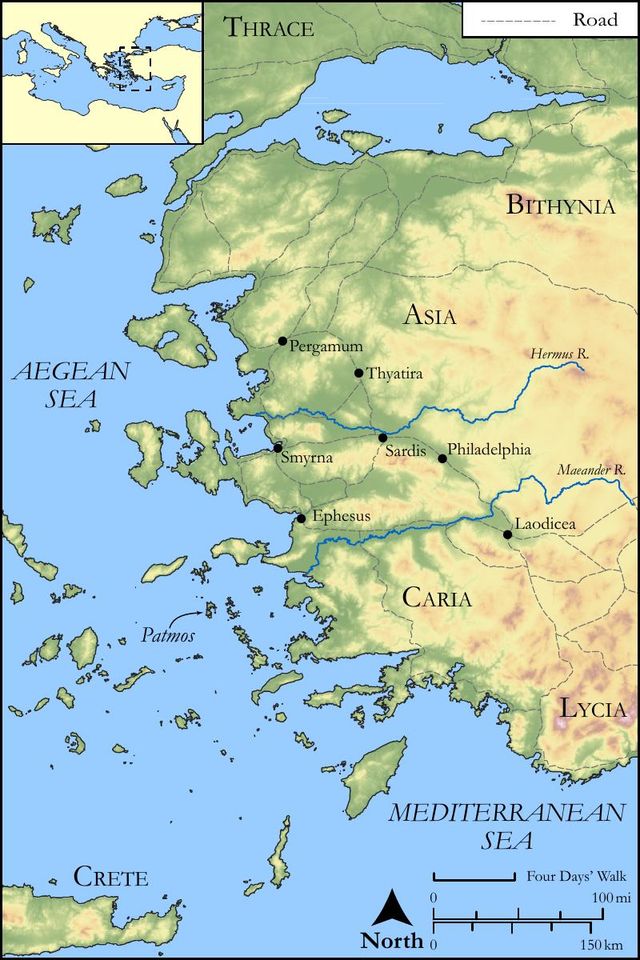
See on the biblical-era maps

Study this verse
Public-domain commentary
Matthew Henry
From his Commentary on the Whole Bible. Henry comments on passages, not single verses — this entry covers Revelation 12:1–11. His four-level outline is real structure in the source text, so it is rendered as structure.
Here we see that early prophecy eminently fulfilled in which God said he would put enmity between the seed of the woman and the seed of the serpent, Gen 3:15. You will observe,
I.The attempts of Satan and his agents to prevent the increase of the church, by devouring her offspring as soon as it was born; of this we have a very lively description in the most proper images.
1.We see how the church is represented in this vision.
(1.)As a woman, the weaker part of the world, but the spouse of Christ, and the mother of the saints.
(2.)As clothed with the sun, the imputed righteousness of the Lord Jesus Christ. Having put on Christ, who is the Sun of righteousness, she, by her relation to Christ, is invested with honourable rights and privileges, and shines in his rays.
(3.)As having the moon under her feet (that is, the world); she stands upon it, but lives above it; her heart and hope are not set upon sublunary things, but on the things that are in heaven, where her head is.
(4.)As having on her head a crown of twelve stars, that is, the doctrine of the gospel preached by the twelve apostles, which is a crown of glory to all true believers.
(5.)As in travail, crying out, and pained to be delivered. She was pregnant, and now in pain to bring forth a holy progeny to Christ, desirous that what was begun in the conviction of sinners might end in their conversion, that when the children were brought to the birth there might be strength to bring forth, and that she might see of the travail of her soul.
2.How the grand enemy of the church is represented.
(1.)As a great red dragon - a dragon for strength and terror - a red dragon for fierceness and cruelty.
(2.)As having seven heads, that is, placed on seven hills, as Rome was; and therefore it is probable that pagan Rome is here meant.
(3.)As having ten horns, divided into ten provinces, as the Roman empire was by Augustus Caesar.
(4.)As having seven crowns upon his head, which is afterwards expounded to be seven kings, Rev 17:10.
(5.)As drawing with his tail a third part of the stars in heaven, and casting them down to the earth, turning the ministers and professors of the Christian religion out of their places and privileges and making them as weak and useless as he could.
(6.)As standing before the woman, to devour her child as soon as it should be born, very vigilant to crush the Christian religion in its birth and entirely to prevent the growth and continuance of it in the world.
II.The unsuccessfulness of these attempts against the church; for,
1.She was safely delivered of a man-child (Rev 12:5), by which some understand Christ, others Constantine, but others, with greater propriety, a race of true believers, strong and united, resembling Christ, and designed, under him, to rule the nations with a rod of iron; that is, to judge the world by their doctrine and lives now, and as assessors with Christ at the great day.
2.Care was taken of this child: it was caught up to God, and to his throne; that is, taken into his special, powerful, and immediate protection. The Christian religion has been from its infancy the special care of the great God and our Saviour Jesus Christ.
3.Care was taken of the mother as well as of the child, Rev 12:6. She fled into the wilderness, a place prepared both for her safety and her sustenance. The church was in an obscure state, dispersed; and this proved her security, through the care of divine Providence. This her obscure and private state was for a limited time, not to continue always.
III.The attempts of the dragon not only proved unsuccessful against the church, but fatal to his own interests; for, upon his endeavour to devour the man-child, he engaged all the powers of heaven against him (Rev 12:7): There was war in heaven. Heaven will espouse the quarrel of the church. Here observe,
1.The seat of this war - in heaven, in the church, which is the kingdom of heaven on earth, under the care of heaven and in the same interest.
2.The parties - Michael and his angels on one side, and the dragon and his angels on the other: Christ, the great Angel of the covenant, and his faithful followers; and Satan and all his instruments. This latter party would be much superior in number and outward strength to the other; but the strength of the church lies in having the Lord Jesus for the captain of their salvation.
3.The success of the battle: The dragon and his angels fought and prevailed not; there was a great struggle on both sides, but the victory fell to Christ and his church, and the dragon and his angels were not only conquered, but cast out; the pagan idolatry, which was a worshipping of devils, was extirpated out of the empire in the time of Constantine.
4.The triumphant song that was composed and used on this occasion, Rev 12:10, Rev 12:11. Here observe,
(1.)How the conqueror is adored: Now have come salvation, strength, and the kingdom of our God, and the power of his Christ. Now God has shown himself to be a mighty God; now Christ has shown himself to be a strong and mighty Saviour; his own arm has brought salvation, and now his kingdom will be greatly enlarged and established. The salvation and strength of the church are all to be ascribed to the king and head of the church.
(2.)How the conquered enemy is described.
[1.]By his malice; he was the accuser of the brethren, and accused them before their God night and day; he appeared before God as an adversary to the church, continually bringing in indictments and accusations against them, whether true or false; thus he accused Job, and thus he accused Joshua the high priest, Zac 3:1. Though he hates the presence of God, yet he is willing to appear there to accuse the people of God. Let us therefore take heed that we give him no cause of accusation against us; and that, when we have sinned, we presently go in before the Lord, and accuse and condemn ourselves, and commit our cause to Christ as our Advocate.
[2.]By his disappointment and defeat: he and all his accusations are cast out, the indictments quashed, and the accuser turned out of the court with just indignation.
(3.)How the victory was gained. The servants of God overcame Satan,
[1.]By the blood of the Lamb, as the meritorious cause. Christ by dying destroyed him that hath the power of death, that is, the devil.
[2.]By the word of their testimony, as the great instrument of war, the sword of the Spirit, which is the word of God, - by a resolute powerful preaching of the everlasting gospel, which is mighty, through God, to pull down strongholds, - and by their courage and patience in sufferings; they loved not their lives unto the death, when the love of life stood in competition with their loyalty to Christ; they loved not their lives so well but they could give them up to death, could lay them down in Christ's cause; their love to their own lives was overcome by stronger affections of another nature; and this their courage and zeal helped to confound their enemies, to convince many of the spectators, to confirm the souls of the faithful, and so contributed greatly to this victory.
Historical interpretation
Eight Centuries of Reception
14 surviving comments on this verse. Each one is dated, so this reads as a timeline rather than a list.
Select a marker to jump to its quote. Markers stagger vertically where authors wrote within a few decades of each other.
By the woman then clothed with the sun," he meant most manifestly the Church, endued with the Father's word, whose brightness is above the sun. And by the "moon under her feet" he referred to her being adorned, like the moon, with heavenly glory. And the words, "upon her head a crown of twelve stars," refer to the twelve apostles by whom the Church was founded. And those, "she, being with child, cries, travailing in birth, and pained to be delivered," mean that the Church will not cease to bear from her heart the Word that is persecuted by the unbelieving in the world. "And she brought forth," he says, "a man-child, who is to rule all the nations; "by which is meant that the Church, always bringing forth Christ, the perfect man-child of God, who is declared to be God and man, becomes the instructor of all the nations. And the words, "her child was caught up unto God and to His throne," signify that he who is always born of her is a heavenly king, and not an earthly; even as David also declared of old when he said, "The Lord said unto my Lord, Sit Thou at my right hand, until I make Thine enemies Thy footstool." "And the dragon," he says, "saw and persecuted the woman which brought forth the man-child. And to the woman were given two wings of the great eagle, that she might fly into the wilderness, where she is nourished for a time, and times, and half a time, from the face of the serpent." That refers to the one thousand two hundred and threescore days (the half of the week) during which the tyrant is to reign and persecute the Church, which flees from city to city, and seeks conceal-meat in the wilderness among the mountains, possessed of no other defence than the two wings of the great eagle, that is to say, the faith of Jesus Christ, who, in stretching forth His holy hands on the holy tree, unfolded two wings, the right and the left, and called to Him all who believed upon Him, and covered them as a hen her chickens. For by the mouth of Malachi also He speaks thus: "And unto you that fear my name shall the Sun of righteousness arise with healing in His wings."
"And his tail drew the third part of the stars of heaven, and cast them upon the earth." Now, that he says that the dragon's tail drew the third part of the stars of heaven, this may be taken in two ways. For many think that he may be able to seduce the third part of the men who believe. But it should more truly be understood, that of the angels that were subject to him, since he was still a prince when he descended from his estate, he seduced the third part; therefore what we said above, the Apocalypse says.
"And the dragon stood before the woman who was beginning to bring forth, that, when she had brought forth, he might devour her child." The red dragon standing and desiring to devour her child when she had brought him forth, is the devil,-to wit, the traitor angel, who thought that the perishing of all men would be alike by death; but He, who was not born of seed, owed nothing to death: wherefore he could not devour Him-that is, detain Him in death-for on the third day He rose again. Finally, also, and before He suffered, he approached to tempt Him as man; but when he found that He was not what he thought Him to be, he departed from Him, even till the time.
The great red dragon—cunning and diverse, seven-headed and horned—that draws down the third part of the stars and stands ready to devour the child of the woman who is travailing, is the devil, who lies in wait to destroy the Christ-accepted mind of the baptized as well as the image and clear features of the Word that has been brought forth in them. But he misses and loses his prey, the regenerate being caught up on high to the throne of God—that is, the mind of those who are renewed is lifted up to the divine seat and the basis of truth against which there is no stumbling, being taught to look upon and regard the things which are there, so that it may not be deceived by the dragon weighing them down. For he is not allowed to destroy those whose thoughts and looks are upwards. And the stars, which the dragon touched with the end of his tail and drew them down to earth, are the bodies of heresies. For we must say that the stars, which are dark, obscure, and falling, are the assemblies of the heterodox; since they, too, wish to be acquainted with the heavenly ones, to have believed in Christ, to have the seat of their soul in heaven, and to come near to the stars as children of light. But they are dragged down, being shaken out by the folds of the dragon, because they did not remain within the triangular forms of godliness, falling away from it with respect to orthodox practice. Thus, too, they are called the third part of the stars, as having gone astray with regard to one of the three persons of the Trinity. As when they say, like Sabellius, that the almighty person of the Father himself suffered; or as when they say, like Artemas, that the person of the Son was born and manifested only in appearance; or when they contend, like the Ebionites, that the prophets spoke of the person of the Spirit by their own power. Of Marcion and Valentinus, and those about Elkesai and others, it is better not even to make mention.
The “tail” is the iniquitous prophets who throw down to earth the stars of heaven, namely, those simple persons who join themselves to them. When he speaks of “a third part of the stars,” he is speaking of the Jews and their leaders who rejected Christ and with impious voices cried out that they did not want Christ to be over them but rather Caesar, and therefore they killed him.
Whenever the Holy Spirit promises and tells of future events, he foretells and shows the future in the church as past event. For in her misfortunes the church is always bringing forth Christ, for which reason he promises the coming of the Son of man always in the reality of similar sufferings. The devil in heaven is always seeking to devour that person who is being born through heavenly things and who is born to God and is caught up to his throne. Indeed, every Christian suffers that which the Head has suffered, who after the third day was going to be raised in glory. For in the person of Herod the whole company of persecutors is revealed. Although Herod alone had died, nonetheless all are indicated, for the Evangelist said, “All who sought the child’s life are dead.” The Lord spoke similarly also to Moses, “All those who were seeking your life are dead,” when another had succeeded [that] pharoah who had sought his life and that of the people.
[Daniel 4:4] "I, Nebuchadnezzar, was at ease in my house and prospering in my palace." The narrative is clear indeed and requires but little interpretation. Because he displeased God, Nebuchadnezzar was turned into a madman and dwelt for seven years amongst the brute beasts and was fed upon the roots of herbs, Afterwards by the mercy of God he was restored to his throne, and praised and glorified the King of heaven, on the ground that all His works are truth and His ways are justice and He is able to abase those who walk in pride. But there are some who claim to understand by the figure of Nebuchadnezzar the hostile power which the Lord speaks of in the Gospel, saying: "I beheld Satan falling from heaven like lightning" (Luke 10:18). Likewise John in Revelation, in the passage where the dragon falls upon the earth drawing a third of the stars with him (Revelation 12:4). Likewise Isaiah: "How hath the morning star fallen, which used to rise early in the morning" (Isaiah 14:12). These authorities assert that it was absolutely impossible for a man who was reared in luxury to subsist on hay for seven years and to dwell among wild beasts for seven years without being at all mangled by them. Also they ask how the imperial authority could have been kept waiting for a mere madman, and how so mighty a kingdom could have gone without a king for so long a period. If, on the other hand, anyone had succeeded him on the throne, how foolish he would have to be thought to surrender an imperial authority which he had possessed for so long. Such a thing would be especially incredible since the historical records of the Chaldeans contain no such record, and since they recorded matters of far less import, it is impossible that they should have left things of major importance unmentioned. And so they pose all of these questions and offer as their own reply the proposition that since the episode does not stand up as genuine history, the figure of Nebuchadnezzar represents the devil. To this position we make not the slightest concession; otherwise everything we read in Scripture may appear to be imperfect representations and mere fables. For once men have lost their reason, who would not perceive them to lead their existence like brutish animals in the open fields and forest regions? And to pass over all other considerations, since Greek and Roman history offer episodes far more incredible, such as Scylla and the Chimaera, the Hydra and the Centaurs, and the birds and wild beasts and flowers and trees, the stars and the stones into which men are related to have been transformed, what is so remarkable about the execution of such a divine judgment as this for the manifestation of God's power and the humbling of the pride of kings? Nebuchadnezzar says, "'I was at ease in my house and prospering in my palace...'" or as Theodo-tion renders it "upon my throne." Now those who follow the interpretation we are opposing understand by the devil's home this world of ours. Concerning the world Satan himself in the Gospel says to the Savior: "All these things have been given over to me" (Luke 4:6). Likewise the Apostle says: "The world lieth in the Wicked One" (1 John 5:19).
Our holy mother church has received you in her womb through the most sacred sign of the cross and with the greatest joy will give birth spiritually as she did also with your brothers. As new and future offspring of such a mother, until she restores to the true Light those born anew through the sacred washing, she feeds in her womb those whom she is carrying with suitable food, and she who is joyful leads those who are joyful to the day of their birth. She does not possess the mind and thought of Eve, who in sadness and in groaning brings forth sons who are themselves without joy but full of lamentation. What that [mother] bound, this [mother] has loosened, so that as [Eve] gave over to death her offspring through her disobedience, this [mother] restores to life through her obedience. All the mysteries that have been done and are being done among you through the ministry of the servants of God—the exorcisms, prayers, spiritual songs, insufflations, the coarse garment, the bowing of the neck, the humility of the feet—all of these things, as I have said, are food that refreshes us in the womb and makes us strong, so that when we have been reborn through baptism, our mother might bring us happy to Christ. And you have received the symbol, the protection of her who desires to bring you to birth against the poison of the serpent. It is written in the Apocalypse of the apostle John that the dragon stood before a woman who was about to give birth, so that when she gave birth, he might devour her child. We all know that the dragon is the devil and that that woman signifies the Virgin Mary, who remaining intact gave birth to our Head who was complete. She herself presents in herself a figure of the holy church, so that just as she remained a virgin while giving birth to a son, so also [the church] at all times brings forth his members without losing her virginity.
The tail symbolizes the evil prophets, that is, heretics who threw down to earth those stars of heaven who joined them through a repeated baptism. They are under the feet of the woman. Many believed that these are persons whom the devil made his companions since they were of the same mind as he. Many believe that these are angels who were thrown down with him when he fell.
The apostate always arms himself against the church, desiring to make those food for himself who are being born anew from her. Rather, through the church he persecutes Christ himself, since he is [the church’s] head, and he makes his own what belongs to the faithful. And therefore [Christ] said to Saul, “Why are you persecuting me?”
It is our opinion that this passage refers either to the former fall of [the devil] from heaven which through a final movement of envy—for elevation was first—brought down with him the apostate angels, or to that movement of his tail which, after the crushing of his head, drags down those who have moved from their heavenly minds. They are figuratively called “stars” because of the brightness of their baptism.
And the dragon stood before the woman, ready to devour her child as soon as it was born. The devil lies in wait for the Church, striving to extinguish the faith of Christ in the hearts of believers, so that whom she brings forth by teaching, he may kill by deceit. His plot was shown in Herod, who, like internal enemies, pretended to want to worship the Lord in order to kill Him.
And his tail drew a third part of the stars of heaven, etc. This indicates the strength and malice of the enemy, whom the Church, with the Lord's help, overcomes, who by deceit like a tail has cast down an innumerable part of the angels or men. For the tail is a blind part, an unclean part, covering its filth with its own veil so it does not appear. Tychonius, in his manner, interprets the third part of the stars that fell as false brethren, suggesting that one-third is the Church, one-third is external enemies, and one-third is the stars that fell.
And his tail drew the third part of the stars of heaven, and cast them to the earth. The dragon's tail is depraved preachers, according to this: The prophet that teacheth lies, he is the tail. [Is. 9:15] People who from the outside seem to stick to the pursuit of heavenly life are made to fall into the iniquity of overt error by false preachers out of love for the earth. About these people Job says, Let the stars be darkened with the mist thereof. [Job 3:9] Now since the tail is the end of the body, we may understand by it the Antichrist and his preachers, if we take it that the past is here being used for the future — and indeed the casting down of these stars will be more manifest then. And the dragon stood before the woman who was ready to be delivered; that, when she should be delivered, he might devour her son. The dragon then stood that he might swallow down the Head after it was born, and he is always standing that he may swallow down the limbs of the Head; but, as the following shows, the woman's son escaped the dragon's bite because he was taken up to the Father's throne. From this there arises a serious question; for neither did Christ physically climb to heaven as soon as he was born and sought by Herod, nor do his limbs avoid the dragon's teeth by leaving the body altogether to come to their Head. One should know then that the right faith, which keeps the commandments of life and is revealed by the sacred pages of the Scriptures, is an ascent of the mind towards God, by means of which one avoids the dragon's evilness. Therefore he does not mean an ascent in the physical sense. Note also that those whom the dragon is not said to stand behind, but before, are those who know his tricks.
And it is said that by his tail he drags a third of the stars of the sky and casts them down to the earth. For he conspired with himself to withdraw the greatest portion of the angels, persuading and causing those heavenly beings to become earthly, and darkness to overshadow the bright ones like stars. The tail, however, reveals the nature of his final and backward failings; for previously, having perceived folly and rebellion himself, and having sufficiently nurtured this in his proud mind, he therefore came to corrupt the rest as well.
And he said that the Dragon stood before the woman who was about to give birth, so that when she gave birth, he might devour her child. From the events concerning the Lord, it was carefully observed that the One who would break his dominion would be born, and the Dragon vigilantly awaited that when the Virgin gave birth, the newborn would perish. Therefore, he was not indifferent, but incited Herod to destroy the male child, who was both strong and brave; one who had no softness nor feminine qualities. For before the child could call a father or mother, Isaiah proclaims to us that "he will take the power of Damascus and the spoils of Samaria against the king of Assyria." (Isa. 8:4)
Continue studying Revelation 12:4 across the web’s major study libraries — every link below opens this exact verse, chapter, or book on the destination site.
Read & Compare
 BibleGatewayThis verse in more than 200 translations and 70 languages.
 Bible.comThe YouVersion reader — hundreds of translations, reading plans, and highlights.
 ESV.orgCrossway's official English Standard Version reader.
 NET BibleThe NET translation with 60,000+ translators' notes on every rendering decision.
 STEP BibleTyndale House's free study tool — original text, vocabulary, and scholarly resources.
 BibliaLogos Bible Software's free web reader.
 USCCBThe New American Bible (Revised Edition) with the U.S. bishops' study notes.
Commentaries
 BibleHub CommentariesDozens of classic commentaries on this verse, gathered on one page.
 StudyLightMore than 100 commentary sets — the largest collection on the web.
 BibleRefPlain-English commentary on what this verse means, verse by verse.
 Enduring WordDavid Guzik's free commentary on this chapter, widely used by Bible teachers.
 Bible Study ToolsVerse commentary alongside Greek and Hebrew study aids.
Original Language & Research
- BibleHub InterlinearThe verse word by word — original language, transliteration, and English.
- BibleHub LexiconEvery word's original-language definition and Strong's entry.
 Blue Letter BibleDeep-study tools — Strong's numbers, concordance, and word studies.
 CNTR CollationThe earliest Greek manuscripts of this verse, collated letter by letter.
Sermons, Hymns & Audio


TrulyRandomVerse is not affiliated with these sites and doesn’t control their content. They’re linked because they’re genuinely useful.
Summary
Revelation 12:4 vividly portrays the conflict between God and Satan, depicting the dragon's ancient rebellion and subsequent fall from heaven, taking a significant portion of angelic beings with him. The verse then shifts to the dragon's malevolent intent to thwart God's redemptive plan by attempting to devour the Messiah immediately upon His birth, underscoring the relentless spiritual warfare surrounding the advent of Christ.
Context
ShowHideLiterary Context
Revelation chapter 12 serves as a pivotal interlude within the apocalyptic visions, shifting focus from the judgments and trumpet blasts to the underlying spiritual conflict driving these events. It introduces key symbolic figures—the woman, the child, and the dragon—whose identities are progressively revealed throughout the chapter. Verse 4 immediately follows the description of the great red dragon in Revelation 12:3, establishing its formidable appearance and power, particularly its seven heads and ten horns, which symbolize its comprehensive authority and destructive might. This verse sets the stage for the dragon's direct confrontation with the woman and her offspring, providing the heavenly backstory to the earthly events of salvation history.
Historical & Cultural Context
The imagery of a great dragon is deeply rooted in Scripture, from the serpent of Eden to Isaiah's promise that the LORD "shall slay the dragon that is in the sea," a figure of evil opposing divine order. In Jewish apocalyptic literature, such figures frequently represented oppressive empires or spiritual adversaries. For John's original audience, likely facing persecution under the Roman Empire, the dragon would have resonated as a symbol of the immense, oppressive power arrayed against God's people. The "stars of heaven" being cast down could evoke Old Testament prophecies of the fall of mighty rulers or spiritual beings (e.g., Isaiah 14:12-15 concerning Babylon's king, often interpreted typologically of Satan's fall). The "woman ready to be delivered" draws upon the long-held messianic expectation within Israel, echoing prophecies of a virgin birth and the coming of a deliverer.
Key Themes
ShowHideThis verse contributes significantly to several overarching themes in Revelation and the broader biblical narrative. It highlights the theme of a Collision of Kingdoms, revealing that earthly struggles are manifestations of a deeper spiritual war between God and Satan. It underscores Satan's Malice and Defeat, portraying his ancient rebellion and his persistent, though ultimately futile, attempts to thwart God's redemptive plan, particularly through the Messiah. The imagery also reinforces the theme of Divine Sovereignty and Protection, as despite the dragon's immense power and destructive intent, God's plan for the child's birth and ascent remains unhindered, as seen in Revelation 12:5. This verse is foundational to understanding the spiritual dynamics at play throughout the book of Revelation.
Exposition and Analysis
ShowHideKey Word Analysis
ShowHideThis term, likely from an alternate form of a word meaning "to look," refers to a fabulous kind of serpent, perhaps one supposed to fascinate. In this context, it is a powerful symbol of Satan, emphasizing his monstrous, ancient, and destructive nature. The imagery of a serpent connects directly to the Tempter in Genesis 3, establishing a continuity of evil throughout biblical history.
From the base of a word meaning "to strow over the sky," this refers to a star. In biblical prophecy and apocalyptic literature, "stars" often symbolize angelic beings, leaders, or people of prominence. Here, "the third part of the stars of heaven" being drawn down by the dragon's tail is widely understood to represent the angelic beings who rebelled with Satan and were cast out of heaven, becoming demons.
From a combination meaning "to eat down," this verb signifies to consume entirely, to devour (literally or figuratively). It powerfully conveys the dragon's malicious intent to utterly destroy the child, reflecting Satan's relentless and murderous opposition to God's redemptive purposes.
Verse Breakdown
ShowHide"And his tail drew the third part of the stars of heaven, and did cast them to the earth:"
This clause describes the dragon's initial act of rebellion and its devastating consequence. The "tail" symbolizes the dragon's influence and power, by which he "drew" or swept away a significant portion of the heavenly host. "The third part of the stars of heaven" is a symbolic representation of the angels who joined Satan in his rebellion against God, resulting in their expulsion from heaven and their subsequent casting "to the earth." This event signifies the origin of evil spiritual forces that operate in the earthly realm.
"and the dragon stood before the woman which was ready to be delivered, for to devour her child as soon as it was born."
This second clause shifts the scene to a specific, critical moment in salvation history. The "dragon" (Satan) positions himself "before the woman" (symbolizing Israel, through whom the Messiah would come), demonstrating his direct and hostile opposition. The woman is "ready to be delivered," indicating the imminent birth of the Messiah. The dragon's purpose is explicitly stated: "for to devour her child as soon as it was born," revealing Satan's ancient and persistent agenda to prevent or destroy the Christ, thereby thwarting God's plan of redemption for humanity.
Literary Devices
ShowHideRevelation 12:4 is rich in Symbolism. The "dragon" is not a literal creature but a symbolic representation of Satan, the Devil, embodying pure evil and destructive power. The "stars of heaven" symbolize angelic beings, specifically those who fell with Satan, illustrating the scale of his rebellion. The "woman" symbolizes Israel, the lineage from which the Messiah would come, and the "child" is a clear symbol of Jesus Christ. The act of the dragon's "tail" drawing the stars signifies his deceptive influence and power to lead others into rebellion. The phrase "devour her child" is a powerful Metaphor for Satan's murderous intent and his attempts to destroy the Messiah, whether through physical means (like Herod's actions) or spiritual attack. The entire passage functions as an Allegory, presenting a spiritual reality—the ongoing conflict between good and evil, God's plan and Satan's opposition—through a vivid narrative of symbolic figures and actions.
Theological and Thematic Connections
ShowHideRevelation 12:4 profoundly illustrates the reality of spiritual warfare and the ancient, relentless enmity of Satan against God's redemptive purposes. It reveals that the conflict is not merely human but spiritual, originating in a heavenly rebellion where a significant portion of angelic beings chose to follow Satan. This fall established the adversary's domain and set in motion his ceaseless efforts to undermine God's plan, culminating in his direct assault on the Messiah. Yet, the very presence of the woman and child, and the dragon's inability to prevent the birth, foreshadows God's ultimate sovereignty and the futility of Satan's schemes against the divine will.
Reflection and Application
ShowHideThis verse serves as a stark reminder that our struggles are not merely against flesh and blood but against spiritual forces of evil. It unveils the ancient origin of Satan's malice, rooted in his rebellion and subsequent expulsion from heaven, taking a third of the angels with him. This understanding should instill in believers a sober awareness of the reality of spiritual warfare, yet also a profound confidence in God's sovereign power. Just as the dragon could not prevent the birth of Christ or devour Him, so too can he not ultimately thwart God's purposes for His church or for individual believers. We are called to stand firm, recognizing the enemy's schemes, but resting in the assurance that our victory is secured in Christ, who has already triumphed over all the powers of darkness.
Questions for Reflection
ShowHideFAQ
ShowHideWho are "the third part of the stars of heaven" that the dragon cast to the earth?
ShowHideIn biblical apocalyptic literature, "stars" often symbolize angelic beings. The consensus among biblical scholars is that "the third part of the stars of heaven" refers to the angels who rebelled against God alongside Satan (the "dragon") and were subsequently cast out of heaven with him. These fallen angels are often identified as demons, who now operate under Satan's authority on earth, as described in Revelation 12:9. This imagery highlights the vast scope of Satan's original rebellion and the origin of the demonic forces that oppose God and humanity.
Christ-Centered Fulfillment
ShowHideRevelation 12:4 finds its profound Christ-centered fulfillment in the person and work of Jesus Christ, who is the "child" the dragon sought to devour. This verse powerfully illustrates the ancient and relentless opposition of Satan to God's redemptive plan, a plan centered entirely on the Messiah. From the protoevangelium in Genesis 3:15, where a coming seed would crush the serpent's head, Satan's singular focus has been to prevent the birth of Christ or, failing that, to destroy Him. Historical events like Herod's slaughter of the innocents (Matthew 2:16) are seen as earthly manifestations of this satanic rage. However, the ultimate triumph of Christ, who was born, lived a sinless life, died on the cross, and rose again, demonstrates the complete futility of the dragon's efforts. Jesus' victory over sin and death (Colossians 2:15) and His ascension to God's throne (Revelation 12:5) signify the definitive defeat of the dragon, ensuring that no spiritual power can ultimately thwart God's purposes or snatch believers from His hand (John 10:28-29). Thus, Revelation 12:4, while depicting Satan's malice, ultimately points to the invincible sovereignty and victorious work of Christ.