


Exodus 3:10
Bible text: King James Version (1769 Blayney text) · Public domain
Bible text: Berean Standard Bible · Public domain
Bible text: American Standard Version (1901) · Public domain
Bible text: World English Bible, Messianic edition · Public domain
Bible text: Geneva Bible (1599) · Public domain
Bible text: Young's Literal Translation · Public domain
- וְעַתָּהve·'a·Tahand thereforeH6258Conj-w ¦ AdvAdverbוְandעַתָּהtherefore
- לְכָהle·Khahgo !H1980V-Qal-Imp-2ms ¦ SfxVerb Qal Imperative 2nd Singular Masculineלְכָgoה!
- וְאֶשְׁלָחֲךָve·'esh·la·cha·Khaand I will send youH7971Conj-w ¦ V-Qal-ConjImperf-1cs ¦ 2msVerb Qal Conjunction+Imperfect 1st Singular common genderוְandאֶשְׁלָחֲI will sendךָyou
- אֶל'eltoH413PrepPreposition
- פַּרְעֹהpar·'OhPharaohH6547N-msNoun Title Singular Masculine Absolute
- וְהוֹצֵאve·ho·Tze'and bring outH3318Conj-w ¦ V-Hiphil-Imp-2msVerb Hiphil Imperative 2nd Singular Masculineוְandהוֹצֵאbring out
- אֶת'et<obj.>H853DirObjMParticle Object Indicator
- עַמִּי'a·Mimy peopleH5971N-msc ¦ 1csNoun Singular Masculine Constructעַמִּpeopleיmy
- בְנֵיve·nei[the] people ofH1121N-mpcNoun Plural Masculine Construct
- יִשְׂרָאֵלYis·ra·'ElIsraelH3478N-properNoun Proper Location
- מִמִּצְרָיִםmi·mitz·Ra·yimfrom EgyptH4714Prep-m ¦ N-properNoun Proper LocationמִfromמִּצְרָיִםEgypt
English is a literal word-by-word gloss of the Hebrew, not the KJV's wording. Why?
This is the original text the KJV's translators worked from — each Hebrew word with its own literal English meaning in this verse, prepared by scholars at Tyndale House, Cambridge. The KJV translates whole sentences, not word by word, so its wording differs: one Hebrew word can become several English words, and the KJV may choose “the LORD” where the gloss reads “Yahweh”. Both are faithful — they answer different questions. For the KJV's own rendering, switch to the KJV text.
Details
See on the biblical-era maps

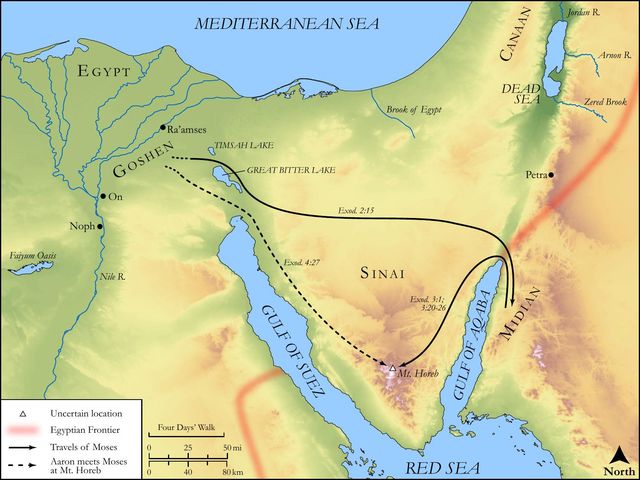
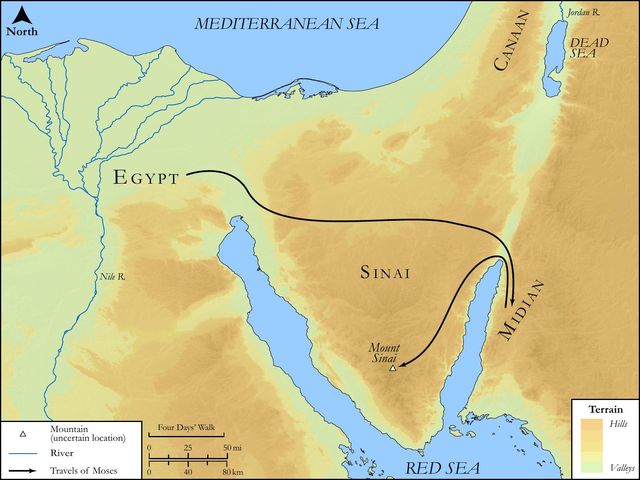
Study this verse
Public-domain commentary
Matthew Henry
From his Commentary on the Whole Bible. Henry comments on passages, not single verses — this entry covers Exodus 3:7–10. His two-level outline is real structure in the source text, so it is rendered as structure.
Now that Moses had put off his shoes (for, no doubt, he observed the orders given him, Exo 3:5), and covered his face, God enters upon the particular business that was now to be concerted, which was the bringing of Israel out of Egypt. Now, after forty years of Israel's bondage and Moses's banishment, when we may suppose both he and they began to despair, they of being delivered and he of delivering them, at length, the time has come, even the year of the redeemed. Note, God often comes for the salvation of his people when they have done looking for him. Shall he find faith? Luk 18:8.
Here is, I. The notice God takes of the afflictions of Israel (Exo 3:7, Exo 3:9): Seeing I have seen, not only, I have surely seen, but I have strictly observed and considered the matter. Three things God took cognizance of: - 1. Their sorrows, Exo 3:7. It is likely they were not permitted to make a remonstrance of their grievances to Pharaoh, nor to seek relief against their task-masters in any of his courts, nor scarcely durst complain to one another; but God observed their tears. Note, Even the secret sorrows of God's people are known to him. 2. Their cry: I have heard their cry (Exo 3:7), it has come unto me, Exo 3:9. Note, God is not deaf to the cries of his afflicted people. 3. The tyranny of their persecutors: I have seen the oppression, Exo 3:9. Note, As the poorest of the oppressed are not below God's cognizance, so the highest and greatest of their oppressors are not above his check, but he will surely visit for these things.
II.The promise God makes of their speedy deliverance and enlargement: I have come down to deliver them, Exo 3:8.
1.It denotes his resolution to deliver them, and that his heart was upon it, so that it should be done speedily and effectually, and by methods out of the common road of providence: when God does something very extraordinary he is said to come down to do it, as Isa 64:1.
2.This deliverance was typical of our redemption by Christ, in which the eternal Word did indeed come down from heaven to deliver us: it was his errand into the world. He promises also their happy settlement in the land of Canaan, that they should exchange bondage for liberty, poverty for plenty, labour for rest, and the precarious condition of tenants at will for the ease and honour of lords proprietors. Note, Whom God by his grace delivers out of a spiritual Egypt he will bring to a heavenly Canaan.
III.The commission he gives to Moses in order hereunto, Exo 3:10.
He is not only sent as a prophet to Israel, to assure them that they should speedily be delivered (even that would have been a great favour), but he is sent as an ambassador to Pharaoh, to treat with him, or rather as a herald at arms, to demand their discharge, and to denounce war in case of refusal; and he is sent as a prince to Israel, to conduct and command them. Thus is he taken from following the ewes great with young, to a pastoral office much more noble, as David, Psa 78:71. Note, God is the fountain of power, and the powers that be are ordained of him as he pleases. The same hand that now fetched a shepherd out of a desert, to be the planter of a Jewish church, afterwards fetched fishermen from their ships, to be the planters of the Christian church, That the excellency of the power might be of God.
Continue studying Exodus 3:10 across the web’s major study libraries — every link below opens this exact verse, chapter, or book on the destination site.
Read & Compare
 BibleGatewayThis verse in more than 200 translations and 70 languages.
 Bible.comThe YouVersion reader — hundreds of translations, reading plans, and highlights.
 ESV.orgCrossway's official English Standard Version reader.
 NET BibleThe NET translation with 60,000+ translators' notes on every rendering decision.
 STEP BibleTyndale House's free study tool — original text, vocabulary, and scholarly resources.
 BibliaLogos Bible Software's free web reader.
 USCCBThe New American Bible (Revised Edition) with the U.S. bishops' study notes.
Commentaries
 BibleHub CommentariesDozens of classic commentaries on this verse, gathered on one page.
 StudyLightMore than 100 commentary sets — the largest collection on the web.
 BibleRefPlain-English commentary on what this verse means, verse by verse.
 Enduring WordDavid Guzik's free commentary on this chapter, widely used by Bible teachers.
 Bible Study ToolsVerse commentary alongside Greek and Hebrew study aids.
Original Language & Research
- BibleHub InterlinearThe verse word by word — original language, transliteration, and English.
- BibleHub LexiconEvery word's original-language definition and Strong's entry.
 Blue Letter BibleDeep-study tools — Strong's numbers, concordance, and word studies.
 SefariaThe Hebrew text with Rashi and centuries of Jewish commentary.
Sermons, Hymns & Audio


TrulyRandomVerse is not affiliated with these sites and doesn’t control their content. They’re linked because they’re genuinely useful.
Summary
Exodus 3:10 marks the pivotal moment of Moses' divine commissioning at the burning bush, where God issues a direct and authoritative command for him to return to Egypt. This directive initiates the monumental task of leading the enslaved Israelites out of their bondage, thereby setting in motion the fulfillment of God's ancient covenant promises and demonstrating His sovereign power to deliver His chosen people from oppression.
Context
ShowHideLiterary Context
This verse is the culmination of God's dramatic encounter with Moses on Mount Horeb, the "mountain of God." Preceding this command, God had revealed Himself to Moses from the burning bush, declaring His holy name, Yahweh, and expressing His profound awareness of the Israelites' suffering under Egyptian oppression. God explicitly stated His intention to deliver His people, having seen their affliction and heard their cry and purposed to bring them to a good and spacious land flowing with milk and honey, the land of the Canaanites, Hittites, Amorites, Perizzites, Hivites, and Jebusites (Exodus 3:8). Exodus 3:10 transitions from God's declaration of intent and self-revelation to a clear, personal, and imperative directive for Moses to become the instrument of this divine liberation, shifting the narrative focus from God's resolve to Moses' active role.
Historical & Cultural Context
At this time, the Israelites had been enslaved in Egypt for centuries, their population having grown significantly, leading to increased oppression under a new Pharaoh "who did not know Joseph" (Exodus 1:8). They were forced into harsh labor, building store cities like Pithom and Raamses, and their male infants were ordered to be killed to control their numbers (Exodus 1:11-16). Moses, having fled Egypt forty years prior after killing an Egyptian (Exodus 2:11-15), was now a shepherd in Midian, far removed from the royal court he once knew. The Pharaoh of Egypt was considered a divine king, a powerful ruler whose authority was absolute. For God to command Moses to confront such a figure, demanding the release of a vast slave population, was an act of profound defiance against the world's most formidable empire, underscoring the clash between divine sovereignty and human power.
Key Themes
ShowHideExodus 3:10 is central to several major theological and narrative themes within the book of Exodus and the broader Pentateuch. It powerfully introduces the theme of Divine Commissioning, where God personally calls and equips an individual for a specific, monumental task, often despite their perceived inadequacies, as seen in Moses' initial reluctance (Exodus 3:11 and Exodus 4:1-17). This verse also firmly establishes the theme of God's Deliverance and Redemption, portraying God as actively intervening in human history to liberate His oppressed people. It highlights God's Covenant Faithfulness, as the command to bring Israel out of Egypt is a direct step toward fulfilling the promises made to Abraham, Isaac, and Jacob regarding their numerous descendants and the inheritance of the land (Genesis 12:1-3). Furthermore, it sets the stage for the foundational narrative of the Exodus, which becomes the archetypal act of salvation in Israelite theology, demonstrating God's power over all earthly forces and His unique relationship with His chosen nation.
Exposition and Analysis
ShowHideKey Word Analysis
ShowHideMeaning "to walk (literally or figuratively); causatively, to carry (in various senses)." In this context, "Come" is an imperative, an immediate and authoritative divine summons. It signifies a decisive shift from Moses' passive observation to active participation, compelling him to draw near and receive his commission. It's not a suggestion but a direct command to initiate movement towards God's purpose.
Meaning "to send away, for, or out (in a great variety of applications)." This word is crucial, emphasizing God's sovereign initiative and Moses' role as His divinely appointed agent. When God "sends," He empowers, authorizes, and stands behind the one dispatched. Moses is not acting on his own volition but as God's representative, carrying divine authority and a specific, non-negotiable mission directly from the Almighty to Pharaoh.
Meaning "to go (causatively, bring) out, in a great variety of applications, literally and figuratively, direct and proxim." This term conveys a forceful, decisive, and complete act of leading out. It implies a powerful liberation, not a gradual or negotiated release, underscoring the supernatural nature of the deliverance God intends to accomplish through Moses, separating His people entirely from their bondage.
Verse Breakdown
ShowHide"Come now therefore,"
This opening phrase serves as an urgent and authoritative divine imperative. It signals a critical turning point, moving from God's self-revelation and declaration of purpose in the preceding verses to a direct, personal command for Moses to act. The "therefore" links this command directly to God's stated awareness of Israel's suffering and His intention to deliver them, making Moses' mission a direct consequence of God's compassionate resolve.
"and I will send thee unto Pharaoh,"
This clause reveals the core of Moses' divine commissioning and the source of his authority. The emphasis is on God's active role ("I will send"), highlighting that this mission is not Moses' idea or ambition but a sovereign appointment by the Almighty. God chooses His instrument for a monumental and seemingly impossible task, dispatching Moses directly to the most powerful ruler of the time. This sets the stage for a dramatic confrontation between the will of God and the resistance of human power, demonstrating God's supreme authority over all earthly rulers.
"that thou mayest bring forth my people the children of Israel out of Egypt."
This defines the ultimate objective and scope of Moses' mission. The possessive phrase "my people" underscores God's intimate covenant relationship with Israel, affirming that despite their enslavement, they remain His treasured possession, chosen and beloved. The act of "bringing forth" signifies a forceful, decisive, and complete liberation, implying a supernatural deliverance rather than a gradual or negotiated release. This mission is not merely a political or social act but a foundational redemptive event, physically liberating the Israelites from Egyptian slavery and establishing them as God's free nation, a testament to His power, faithfulness, and commitment to His covenant.
Literary Devices
ShowHideThe passage employs several potent literary devices. Divine Imperative is evident in the direct command "Come now therefore," signaling God's absolute authority and the urgency of the moment. The phrase "I will send thee" showcases Divine Agency, emphasizing that God is the primary actor and Moses is His chosen instrument, underscoring the supernatural backing for the mission. The repeated use of "my people" functions as a powerful instance of Possessive Language, highlighting God's intimate covenant relationship with Israel and His personal investment in their liberation. Furthermore, the entire narrative context of the burning bush and the subsequent confrontation with Pharaoh can be seen as Symbolism, where the liberation from Egypt becomes a foundational symbol of God's redemptive power and faithfulness, setting a pattern for future acts of salvation.
Theological and Thematic Connections
ShowHideExodus 3:10 is a foundational text demonstrating God's active involvement in human history, His profound compassion for the oppressed, and His unwavering commitment to His covenant promises. It reveals a God who not only sees and hears the suffering of His people but also sovereignly intervenes, choosing and equipping seemingly ordinary individuals like Moses to accomplish His extraordinary purposes. This commissioning underscores the theme of divine election and the principle that God's power is made perfect in human weakness, as Moses' initial reluctance is met with God's assurance of His presence and provision. The verse initiates the grand narrative of the Exodus, which serves as the archetypal act of redemption in the Old Testament, illustrating God's power to deliver from bondage and establish a new relationship with His people.
Reflection and Application
ShowHideExodus 3:10 offers profound and enduring insights for believers today. Just as God called Moses, an ordinary shepherd tending sheep in the wilderness, He continues to call seemingly ordinary individuals to accomplish extraordinary tasks in His kingdom, equipping them for the mission He gives, despite their own feelings of inadequacy or reluctance. This passage powerfully reminds us that God's power is made perfect in weakness, and His divine calling often extends beyond our comfort zones or perceived capabilities. Furthermore, it provides immense assurance that the God who heard the cries of Israel and acted decisively for their liberation remains attentive to the suffering, injustices, and spiritual bondage in the world today, actively involved in the lives of His people. Moses' subsequent obedience, despite immense challenges and personal doubts, serves as a powerful example of trusting God's power and provision when faced with a divine calling, emphasizing that our obedience is a faithful response to God's initiative and unwavering faithfulness. We are called to participate in God's ongoing work of liberation, whether it be from spiritual darkness, oppression, or personal sin, relying on His commission and power, not our own.
Questions for Reflection
ShowHideFAQ
ShowHideWhy did God choose Moses for this monumental task?
ShowHideGod chose Moses not because of any inherent greatness or qualification, but in His divine sovereignty and according to His perfect timing. Moses had been uniquely prepared through his upbringing in Pharaoh's court, where he gained knowledge of Egyptian culture, language, and administration (Acts 7:22). His forty years as a shepherd in Midian then honed his leadership skills, cultivated humility, and deepened his reliance on God in the wilderness. God's choice highlights His ability to use ordinary individuals, equipping them for His extraordinary purposes, often despite their own feelings of inadequacy or past failures, demonstrating that the power rests with God, not the instrument.
What does the Hebrew word "shalach" (send) imply about Moses' commissioning?
ShowHideThe Hebrew word shalach (שלח - H7971) implies far more than just dispatching someone; it signifies a profound divine appointment with inherent authority and a specific, weighty purpose. When God "sends" someone, it means He empowers them, gives them a clear mission, and stands behind their actions, making them His authorized representative. Moses was not going on his own initiative or with his own power, but as God's emissary, carrying the divine mandate and the backing of the Almighty. This concept of being "sent" by God is foundational to understanding prophetic and apostolic ministries throughout the Bible.
How does this verse connect to God's promises to Abraham, Isaac, and Jacob?
ShowHideExodus 3:10 is a direct and crucial step towards fulfilling the covenant promises God made to the patriarchs, particularly the promise of a great nation and a land. God had explicitly promised Abraham that his descendants would be enslaved in a foreign land for a period but would then be brought out with great possessions (Genesis 15:13-14). Moses' mission to "bring forth my people the children of Israel out of Egypt" is the concrete, divinely initiated action taken to honor those ancient promises, establishing Israel as God's chosen nation and preparing them to inherit the land promised to their forefathers (Genesis 17:8).
Christ-Centered Fulfillment
ShowHideExodus 3:10 profoundly foreshadows the ultimate divine commission and deliverance found in Jesus Christ. Just as Moses was "sent" by God to deliver His people from physical bondage in Egypt, Jesus was supremely "sent" by the Father to deliver humanity from the spiritual bondage of sin and death (John 3:17). Christ is the greater Moses, leading a new and eternal exodus for His people, not to a physical land, but into the kingdom of God and eternal life (Hebrews 3:1-6). His mission, like Moses', was initiated by God's profound compassion for His people, and through His sacrificial death on the cross and triumphant resurrection, He decisively brought forth His people from the dominion of darkness into His marvelous light (Colossians 1:13-14). The Exodus from Egypt, initiated by God's command to Moses, serves as a powerful type of the spiritual liberation accomplished by Christ, fulfilling God's ancient redemptive plan in its ultimate and most profound sense, offering true freedom and access to God's presence (Galatians 5:1).