


Acts 7:22
- καὶkaiAndG2532CONJConjunction
- ἐπαιδεύθηepaideuthēwas instructedG3811V-API-3SVerb Aorist Passive Indicative 3rd Singular
- ΜωϋσῆςMōusēsMosesG3475N-NSM-PNoun Nominative Singular Masculine Individual
- πάσῃpasēallG3956A-DSFAdjective Dative Singular Feminine
- σοφίᾳsophia[the] wisdomG4678N-DSFNoun Dative Singular Feminine
- Αἰγυπτίων·Aiguptiōnof [the] EgyptiansG124A-GPM-LGAdjective Genitive Plural Masculine Location Gentilic
- ἦνēnhe wasG1510V-IAI-3SVerb Imperfect Active Indicative 3rd Singular
- δὲdenowG1161CONJConjunction
- δυνατὸςdunatosmightyG1415A-NSMAdjective Nominative Singular Masculine
- ἐνeninG1722PREPPreposition
- λόγοιςlogoiswordsG3056N-DPMNoun Dative Plural Masculine
- καὶkaiandG2532CONJConjunction
- ἐνeninG1722PREPPreposition
- ἔργοιςergoisdeedsG2041N-DPNNoun Dative Plural Neuter
English is a literal word-by-word gloss of the Greek, not the KJV's wording. Why?
This is the original text the KJV's translators worked from — each Greek word with its own literal English meaning in this verse, prepared by scholars at Tyndale House, Cambridge. The KJV translates whole sentences, not word by word, so its wording differs: one Greek word can become several English words, and the KJV may choose “charity” where the gloss reads “love”. Both are faithful — they answer different questions. For the KJV's own rendering, switch to the KJV text.
Details
See on the biblical-era maps
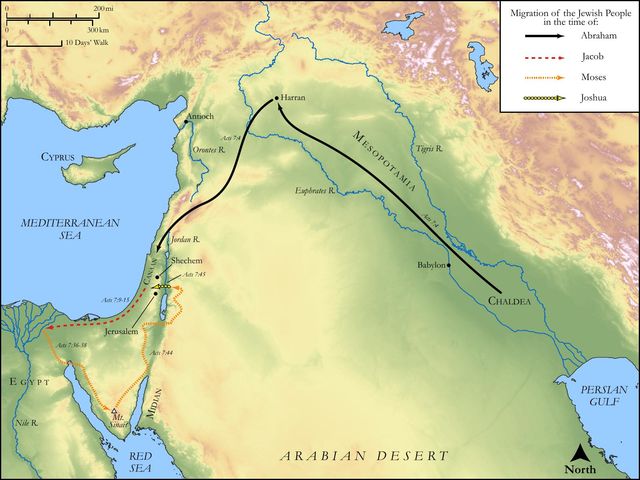
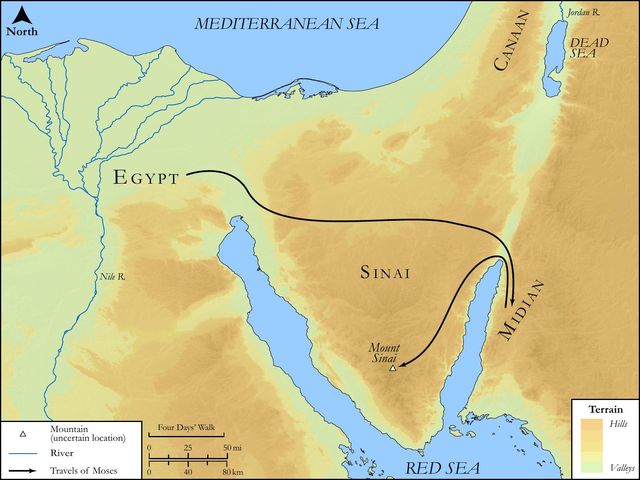
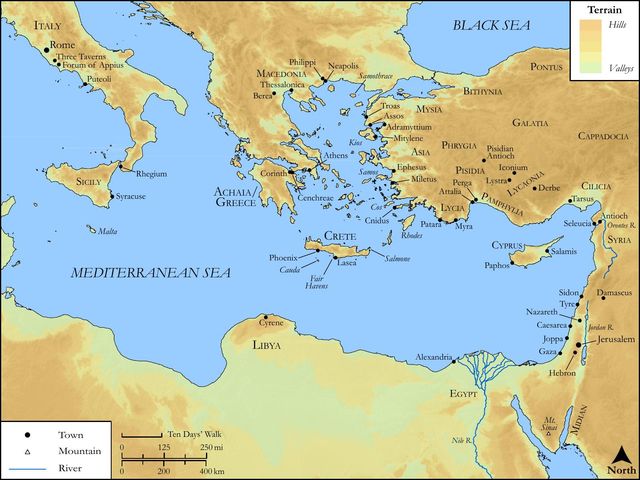
Study this verse
Public-domain commentary
Matthew Henry
From his Commentary on the Whole Bible. Henry comments on passages, not single verses — this entry covers Acts 7:17–29. His two-level outline is real structure in the source text, so it is rendered as structure.
Stephen here goes on to relate,
I.The wonderful increase of the people of Israel in Egypt; it was by a wonder of providence that in a little time they advanced from a family into a nation.
1.It was when the time of the promise drew nigh - the time when they were to be formed into a people. During the first two hundred and fifteen years after the promise made to Abraham, the children of the covenant were increased but to seventy; but in the latter two hundred and fifteen years they increased to six hundred thousand fighting men. The motion of providence is sometimes quickest when it comes nearest the centre. Let us not be discouraged at the slowness of the proceedings towards the accomplishment of God's promises; God knows how to redeem the time that seems to have been lost, and, when the year of the redeemed is at hand, can do a double work in a single day.
2.It was in Egypt, where they were oppressed, and ruled with rigour; when their lives were made so bitter to them that, one would think, they should have wished to be written childless, yet they married, in faith that God in due time would visit them; and God blessed them, who thus honoured him, saying, Be fruitful, and multiply. Suffering times have often been growing times with the church.
II.The extreme hardships which they underwent there, Act 7:18, Act 7:19.
When the Egyptians observed them to increase in number they increased their burdens, in which Stephen observes three things: - 1. Their base ingratitude: They were oppressed by another king that knew not Joseph, that is, did not consider the good service that Joseph had done to that nation; for, if he had, he would not have made so ill a requital to his relations and family. Those that injure good people are very ungrateful, for they are the blessings of the age and place they live in. 2. Their hellish craft and policy: They dealt subtly with our kindred. Come on, said they, let us deal wisely, thinking thereby to secure themselves, but it proved dealing foolishly, for they did but treasure up wrath by it. Those are in a great mistake who think they deal wisely for themselves when they deal deceitfully or unmercifully with their brethren. 3. Their barbarous and inhuman cruelty. That they might effectually extirpate them, they cast out their young children, to the end they might not live. The killing of their infant seed seemed a very likely way to crush an infant nation. Now Stephen seems to observe this to them, not only that they might further see how mean their beginnings were, fitly represented (perhaps with an eye to the exposing of the young children in Egypt) by the forlorn state of a helpless, out-cast infant (Eze 16:4), and how much they were indebted to God for his care of them, which they had forfeited, and made themselves unworthy of: but also that they might consider that what they were now doing against the Christian church in its infancy was as impious and unjust, and would be in the issue as fruitless and ineffectual, as that was which the Egyptians did against the Jewish church in its infancy. "You think you deal subtly in your ill treatment of us, and, in persecuting young converts, you do as they did in casting out the young children; but you will find it is to no purpose, in spite of your malice Christ's disciples will increase and multiply."
III.The raising up of Moses to be their deliverer.
Stephen was charged with having spoken blasphemous words against Moses, in answer to which charge he here speaks very honourably of him.
1.Moses was born when the persecution of Israel was at the hottest, especially in that most cruel instance of it, the murdering of the new-born children: At that time, Moses was born (Act 7:20), and was himself in danger, as soon as he came into the world (as our Saviour also was at Bethlehem) of falling a sacrifice to that bloody edict. God is preparing for his people's deliverance, when their way is darkest, and their distress deepest.
2.He was exceedingly fair; his face began to shine as soon as he was born, as a happy presage of the honour God designed to put upon him; he was asteios tō Theō - fair towards God; he was sanctified from the womb, and this made him beautiful in God's eyes; for it is the beauty of holiness that is in God's sight of great price.
3.He was wonderfully preserved in his infancy, first, by the care of his tender parents, who nourished him three months in their own house, as long as they durst; and then by a favourable providence that threw him into the arms of Pharaoh's daughter, who took him up, and nourished him as her own son (Act 7:21); for those whom God designs to make special use of he will take special care of. And did he thus protect the child Moses? Much more will he secure the interests of his holy child Jesus (as he is called Act 4:27) from the enemies that are gathered together against him.
4.He became a great scholar (Act 7:22): He was learned in all the wisdom of the Egyptians, who were then famed for all manner of polite literature, particularly philosophy, astronomy, and (which perhaps helped to lead them to idolatry) hieroglyphics. Moses, having his education at court, had opportunity of improving himself by the best books, tutors, and conversation, in all the arts and sciences, and had a genius for them. Only we have reason to think that he had not so far forgotten the God of his fathers as to acquaint himself with the unlawful studies and practices of the magicians of Egypt, any further than was necessary to the confuting of them.
5.He became a prime minister of state in Egypt. This seems to be meant by his being mighty in words and deeds. Though he had not a ready way of expressing himself, but stammered, yet he spoke admirably good sense, and every thing he said commanded assent, and carried its own evidence and force of reason along with it; and, in business, none went on with such courage, and conduct, and success. Thus was he prepared, by human helps, for those services, which, after all, he could not be thoroughly furnished for without divine illumination. Now, by all this, Stephen will make it appear that, notwithstanding the malicious insinuations of his persecutors, he had as high and honourable thoughts of Moses as they had.
IV.The attempts which Moses made to deliver Israel, which they spurned, and would not close in with.
This Stephen insists much upon, and it serves for a key to this story (Exo 2:11-15), as does also that other construction which is put upon it by the apostle, Heb 11:24-26. There it is represented as an act of holy self-denial, here as a designed prelude to, or entrance upon, the public service he was to be called out to (Act 7:23): When he was full forty years old, in the prime of his time for preferment in the court of Egypt, it came into his heart (for God put it there) to visit his brethren the children of Israel, and to see which way he might do them any service; and he showed himself as a public person, with a public character.
1.As Israel's saviour. This he gave a specimen of in avenging an oppressed Israelite, and killing the Egyptian that abused him (Act 7:24). Seeing one of his brethren suffer wrong, he was moved with compassion towards the sufferer, and a just indignation at the wrong-doer, as men in public stations should be, and he avenged him that was oppressed, and smote the Egyptian, which, if he had been only a private person, he could not lawfully have done; but he knew that his commission from heaven would bear him out, and he supposed that his brethren (who could not but have some knowledge of the promise made to Abraham, that the nation that should oppress them God would judge) would have understood that God by his hand would deliver them; for he could not have had either presence of mind or strength of body to do what he did, if he had not been clothed with such a divine power as evinced a divine authority. If they had but understood the signs of the times, they might have taken this for the dawning of the day of their deliverance; but they understood not, they did not take this, as it was designed, for the setting up of a standard, and sounding of a trumpet, to proclaim Moses their deliverer.
2.As Israel's judge. This he gave a specimen of, the very next day, in offering to accommodate matters between two contending Hebrews, wherein he plainly assumed a public character (Act 7:26): He showed himself to them as they strove, and, putting on an air of majesty and authority, he would have set them at one again, and as their prince have determined the controversy between them, saying, Sirs, you are brethren, by birth and profession of religion; why do you wrong one to another? For he observed that (as in most strifes) there was a fault on both sides; and therefore, in order to peace and friendship, there must be a mutual remission and condescension. When Moses was to be Israel's deliverer out of Egypt, he slew the Egyptians, and so delivered Israel out of their hands; but, when he was to be Israel's judge and lawgiver, he ruled them with the golden sceptre, not the iron rod; he did not kill and slay them when they strove, but gave them excellent laws and statutes, and decided upon their complaints and appeals made to him, Exo 18:16. But the contending Israelite that was most in the wrong thrust him away (Act 7:27), would not bear the reproof, though a just and gentle one, but was ready to fly in his face, with, Who made thee a ruler and a judge over us? Proud and litigious spirits are impatient of check and control. Rather would these Israelites have their bodies ruled with rigour by their task-masters than be delivered, and have their minds ruled with reason, by their deliverer. The wrong-doer was so enraged at the reproof given him that he upbraided Moses with the service he had done to their nation in killing the Egyptian, which, if they had pleased, would have been the earnest of further and greater service: Wilt thou kill me, as thou didst the Egyptian yesterday? Act 7:28, charging that upon him as his crime, and threatening to accuse him for it, which was the hanging out of the flag of defiance to the Egyptians, and the banner of love and deliverance to Israel. Hereupon Moses fled into the land of Midian, and made no further attempt to deliver Israel till forty years after; he settled as a stranger in Midian, married, and had two sons, by Jethro's daughter, Act 7:29.
Now let us see how this serves Stephen's purpose. 1. They charged him with blaspheming Moses, in answer to which he retorts upon them the indignities which their fathers did to Moses, which they ought to be ashamed of, and humbled for, instead of picking quarrels thus, under pretence of zeal for the honour of Moses, with one that had as great a veneration for him as any of them had. 2. They persecuted him for disputing in defence of Christ and his gospel, in opposition to which they set up Moses and his law: "But," saith he, "you had best take heed," (1.) "Lest you hereby do as your fathers did, refuse and reject one whom God has raised up to be to you a prince and a Saviour; you may understand, if you will not wilfully shut your eyes against the light, that God will, by this Jesus, deliver you out of a worse slavery than that in Egypt; take heed then of thrusting him away, but receive him as a ruler and a judge over you." (2.) "Lest you hereby fare as your fathers fared, who for this were very justly left to die in their slavery, for the deliverance came not till forty years after. This will be the issue of it, you put away the gospel from you, and it will be sent to the Gentiles; you will not have Christ, and you shall not have him, so shall your doom be." Mat 23:38, Mat 23:39.
Historical interpretation
Two Centuries of Reception
5 surviving comments on this verse. Each one is dated, so this reads as a timeline rather than a list.
Select a marker to jump to its quote. Markers stagger vertically where authors wrote within a few decades of each other.
Josephus says, that when Moses had been brought up in the royal palaces, he was chosen as general against the Ethiopians; and having proved victorious, obtained in marriage the daughter of that king, since indeed, out of her affection for him, she delivered the city up to him.
He learned, besides, the literature of the Egyptians, and the knowledge of the heavenly bodies from the Chaldeans and the Egyptians; whence in the Acts he is said "to have been instructed in all the wisdom of the Egyptians."
During the time Moses was in Egypt and “was educated in all the wisdom of the Egyptians,” he was not “feeble in speech” or “slow in tongue,” nor did he profess to be ineloquent. For, so far as concerned the Egyptians, his speech was sonorous and his eloquence incomparable. But when he began to hear the voice of God and recognize divine communications, then he perceived his own voice to be meager and feeble, and he understands his own tongue to be slow and impeded. When he began to recognize that true Word which “was in the beginning with God,” then he announces that he is mute. But let us use an analogy that what we are saying may be more easily understood. If a rational person is compared with the dumb animals, although he may be ignorant and unlearned, he will appear eloquent in comparison with those who are devoid of both reason and speech. But if he is compared with learned and eloquent people who are most excellent in all wisdom, he will appear ineloquent and dumb. But if someone should contemplate the divine Word himself and look at the divine wisdom itself, however learned and wise he be, he will confess that he is a dumb animal in comparison with God to a much greater extent than the cattle are in comparison with us.
Thus Moses led the people out of Egypt, and everyone who follows in the steps of Moses in this way sets free from the Egyptian tyrant all those guided by his word. Those who follow the leader to virtue must, I think, not lack the wealth of Egypt or be deprived of the treasures of the foreigners, but having acquired all the property of their enemies, they must have it for their own use. This is exactly what Moses then commanded the people to do.… It commands those participating through virtue in the free life also to equip themselves with the wealth of pagan learning by which foreigners to the faith beautify themselves. Our guide in virtue commands someone who “borrows” from wealthy Egyptians to receive such things as moral and natural philosophy, geometry, astronomy, dialectic, and whatever else is sought by those outside the church, since these things will be useful when in time the divine sanctuary of mystery must be beautified with the riches of reason.Those who treasured up for themselves such wealth handed it over to Moses as he was working on the tent of mystery, each one making his personal contribution to the construction of the holy places. It is possible to see this happening even now. For many bring to the church of God their profane learning as a kind of gift: Such a man was the great Basil, who acquired the Egyptian wealth in every respect during his youth and dedicated this wealth to God for the adornment of the church, the true tabernacle.
"And Moses was learned in all the wisdom of the Egyptians, and was mighty in words and in deeds." "Was trained," both in discipline and in letters.
Continue studying Acts 7:22 across the web’s major study libraries — every link below opens this exact verse, chapter, or book on the destination site.
Read & Compare
 BibleGatewayThis verse in more than 200 translations and 70 languages.
 Bible.comThe YouVersion reader — hundreds of translations, reading plans, and highlights.
 ESV.orgCrossway's official English Standard Version reader.
 NET BibleThe NET translation with 60,000+ translators' notes on every rendering decision.
 STEP BibleTyndale House's free study tool — original text, vocabulary, and scholarly resources.
 BibliaLogos Bible Software's free web reader.
 USCCBThe New American Bible (Revised Edition) with the U.S. bishops' study notes.
Commentaries
 BibleHub CommentariesDozens of classic commentaries on this verse, gathered on one page.
 StudyLightMore than 100 commentary sets — the largest collection on the web.
 BibleRefPlain-English commentary on what this verse means, verse by verse.
 Enduring WordDavid Guzik's free commentary on this chapter, widely used by Bible teachers.
 Bible Study ToolsVerse commentary alongside Greek and Hebrew study aids.
Original Language & Research
- BibleHub InterlinearThe verse word by word — original language, transliteration, and English.
- BibleHub LexiconEvery word's original-language definition and Strong's entry.
 Blue Letter BibleDeep-study tools — Strong's numbers, concordance, and word studies.
 CNTR CollationThe earliest Greek manuscripts of this verse, collated letter by letter.
Sermons, Hymns & Audio


TrulyRandomVerse is not affiliated with these sites and doesn’t control their content. They’re linked because they’re genuinely useful.
Summary
Acts 7:22, part of Stephen's powerful historical recounting before the Sanhedrin, highlights the extraordinary early life and qualifications of Moses. It asserts that Moses received a comprehensive education in the advanced wisdom of the Egyptians and possessed remarkable abilities in both communication and action, thereby underscoring God's meticulous and providential preparation of this pivotal leader for the monumental task of delivering Israel from bondage and mediating the Law.
Context
ShowHideLiterary Context
Acts 7:22 is embedded within Stephen's lengthy and impassioned defense before the Jewish Sanhedrin, a discourse that traces the history of Israel from Abraham through the patriarchs, the sojourn in Egypt, the wilderness wanderings, and culminates in the building of the Temple. Stephen's primary purpose is to demonstrate God's consistent working through chosen individuals, often outside the confines of the Temple and the Law, and frequently met with rejection by their own people. Moses is presented as a prime example of God's chosen leader, prepared by divine providence, yet ultimately rejected by some of his own people, foreshadowing the rejection of Jesus Christ. This verse specifically details Moses' background, establishing his exceptional qualifications before recounting his divine call and the subsequent events of the Exodus. The narrative arc of Stephen's sermon builds towards his accusation of the Sanhedrin's persistent resistance to the Holy Spirit, mirroring their ancestors' rejection of God's prophets and ultimately, the Messiah.
Historical & Cultural Context
The "wisdom of the Egyptians" refers to the highly developed intellectual and administrative systems of ancient Egypt, a civilization renowned for its advancements in mathematics, astronomy, medicine, architecture, engineering, literature, and governmental administration. Moses, as the adopted son of Pharaoh's daughter (Exodus 2:10), would have had access to the highest levels of education available in the royal court and temple schools. This training would have encompassed not only academic subjects but also the arts of diplomacy, military strategy, and administration—skills crucial for leading a nation. The phrase "mighty in words and in deeds" reflects the expectation for a leader in the ancient world to possess both persuasive eloquence and decisive action, qualities highly valued in Egyptian society. Stephen's statement here aligns with extra-biblical traditions (e.g., Josephus) that portray Moses as a brilliant general and orator, further emphasizing his exceptional preparation for leadership.
Key Themes
ShowHideThis verse contributes significantly to several key themes within Acts and the broader biblical narrative. Firstly, it highlights the theme of Divine Preparation and Providence, demonstrating how God meticulously equips individuals for His purposes, even utilizing secular education and experiences. Moses' training in Egypt, though pagan in origin, was sovereignly orchestrated by God for His redemptive plan. Secondly, it underscores the theme of Leadership Qualities, presenting a model of a well-rounded leader who possesses both intellectual acumen ("wisdom") and practical effectiveness ("mighty in words and in deeds"). This holistic development is seen as essential for the immense task Moses was to undertake. Thirdly, it subtly introduces the theme of Paradox and God's Power in Weakness, especially when contrasted with Moses' own initial reluctance and claim of being "slow of speech" in Exodus 4:10. Stephen's description suggests either a divine transformation of Moses' perceived weakness or an emphasis on his inherent potential and developed capabilities, showcasing God's ability to empower His chosen servants beyond their natural limitations.
Exposition and Analysis
ShowHideKey Word Analysis
ShowHideThis term, derived from the word for "child" (paîs), means "to train up a child," "to educate," or "to discipline (by punishment)." In this context, it signifies a comprehensive and rigorous upbringing, encompassing intellectual instruction, moral formation, and practical training. It implies that Moses was thoroughly schooled and disciplined in the Egyptian system of knowledge.
Refers to comprehensive knowledge, skill, and practical understanding. In the context of Egyptian wisdom, it would have included a vast array of disciplines such as mathematics, astronomy, engineering, medicine, administration, and even their religious and philosophical traditions. Moses' mastery of "all" this wisdom indicates an exceptional intellectual capacity and breadth of learning.
Derived from the verb "to be able" (dúnamai), this adjective means "powerful," "capable," or "effective." When applied to Moses, it denotes his inherent strength, competence, and ability to achieve significant outcomes. It speaks to his inherent power and effectiveness, both in his communication and his actions.
This broad term encompasses "something said," "discourse," "reasoning," or "speech." When Moses is described as "mighty in words," it indicates his eloquence, persuasive power, and authority in communication. It suggests he possessed a compelling rhetorical ability, capable of influencing and commanding.
This word refers to "toil," "work," or "an act." Being "mighty in deeds" signifies Moses' capacity for decisive action, effective leadership, and the successful execution of tasks. It points to his practical ability to bring about results, whether through administrative acts, military leadership, or the performance of miraculous signs.
Verse Breakdown
ShowHide"And Moses was learned in all the wisdom of the Egyptians"
This clause emphasizes Moses' profound intellectual development and comprehensive education within the most advanced civilization of his time. It highlights his mastery of the vast body of Egyptian knowledge, including their sciences, arts, administration, and philosophical thought. This was not a superficial acquaintance but a deep immersion and proficiency.
"and was mighty in words and in deeds"
This second clause describes Moses' practical efficacy and leadership capabilities. "Mighty in words" points to his eloquence, persuasive communication, and authoritative speech, indicating a powerful orator and negotiator. "Mighty in deeds" signifies his capacity for decisive action, effective leadership, and the ability to accomplish significant tasks, whether through administrative acts, military leadership, or the execution of God's will. Together, these phrases portray Moses as a well-rounded and exceptionally capable leader, prepared for the monumental task ahead.
Literary Devices
ShowHideStephen employs Parallelism in the phrase "mighty in words and in deeds," creating a balanced and comprehensive description of Moses' capabilities. This structure emphasizes that Moses was not merely intellectually astute but also practically effective, possessing both rhetorical power and the ability to act decisively. The use of Hyperbole in "all the wisdom of the Egyptians" underscores the unparalleled breadth and depth of Moses' education, suggesting a complete mastery of the most sophisticated knowledge of his era. Furthermore, there is an element of Irony when comparing Stephen's assessment with Moses' own self-description in Exodus 4:10 as "slow of speech." This contrast highlights God's ability to empower and transform individuals, making them "mighty" for His purposes despite their perceived weaknesses or initial reluctance.
Theological and Thematic Connections
ShowHideActs 7:22 profoundly illustrates God's sovereign providence in preparing His chosen servants. Moses' education in the heart of a pagan empire was not an accident but a divine orchestration, equipping him with the administrative, intellectual, and leadership skills necessary to confront Pharaoh and lead a nascent nation. This demonstrates that God can redeem and utilize any background, training, or experience—even those from seemingly ungodly sources—for His redemptive purposes. It also speaks to the nature of true wisdom, which, while it may incorporate worldly knowledge, ultimately finds its source and purpose in God. Moses' human capabilities, though impressive, were ultimately instruments in the hands of a mightier God.
Reflection and Application
ShowHideActs 7:22 offers profound insights for believers today, reminding us that God is sovereign over every detail of our lives, including our education, experiences, and natural abilities. Just as Moses' Egyptian training was redeemed and employed for God's grand design, so too can our diverse backgrounds, skills, and even secular learning be sanctified and used for His glory. This verse encourages us to pursue excellence in our callings, recognizing that intellectual development, effective communication, and decisive action are all valuable attributes that can be consecrated to God's service. Furthermore, it serves as a powerful reminder that God often prepares individuals extensively for significant roles, sometimes through unexpected means or prolonged periods of waiting and learning. Our preparation, whether formal or informal, is never wasted in God's economy. Finally, the contrast with Moses' self-perception in Exodus reminds us that God's power perfects our weaknesses, enabling us to be "mighty" in His strength.
Questions for Reflection
ShowHideFAQ
ShowHideWhat kind of "wisdom" did Moses learn from the Egyptians?
ShowHideThe "wisdom of the Egyptians" refers to the highly advanced and comprehensive knowledge system of ancient Egypt. This would have included disciplines such as mathematics (geometry for construction and land surveying), astronomy (for calendar keeping and navigation), medicine (anatomy, pharmacology), engineering (pyramids, temples, irrigation systems), architecture, literature, and administrative arts. As an adopted member of Pharaoh's household, Moses would have been trained in the highest echelons of this knowledge, preparing him for leadership and governance.
How does Stephen's statement that Moses was "mighty in words" reconcile with Moses' own claim in Exodus 4:10 that he was "slow of speech"?
ShowHideThere are several ways to understand this apparent discrepancy. First, Moses' self-assessment in Exodus 4:10 might have been a genuine feeling of inadequacy or shyness in the face of a divine commission, rather than a factual statement about his overall speaking ability. Stephen, speaking under the inspiration of the Holy Spirit and from a historical perspective, might be referring to Moses' inherent, God-given potential or his developed abilities after his 40 years in Midian, where he may have honed his rhetorical skills. Alternatively, it could imply that God supernaturally empowered Moses' speech when it was needed, transforming his perceived weakness into strength for His purposes. Stephen's statement emphasizes the ultimate outcome of God's preparation and empowerment, rather than Moses' initial hesitation.
Christ-Centered Fulfillment
ShowHideActs 7:22, while describing Moses' extraordinary preparation, ultimately points to the supreme wisdom and power of Jesus Christ. Moses, "learned in all the wisdom of the Egyptians" and "mighty in words and in deeds," serves as a type, or foreshadowing, of the ultimate Prophet and Deliverer. Jesus, unlike Moses, did not need to acquire wisdom from human institutions; He is the very embodiment of divine wisdom, the Logos through whom all things were created (Colossians 1:16). His "words" were not merely persuasive but carried unparalleled authority, as people noted He taught "as one who had authority, and not as their scribes" (Matthew 7:29). His "deeds" were not merely effective actions but miraculous demonstrations of divine power, healing the sick, casting out demons, and even raising the dead, proving His identity as the Son of God (John 10:38). Just as Moses was prepared by God for a great deliverance, Jesus was uniquely prepared and sent by the Father to accomplish the ultimate deliverance from sin and death, fulfilling all that Moses and the prophets foreshadowed (Luke 24:27).