


Matthew 23:38
Bible text: King James Version (1769 Blayney text) · Public domain
Bible text: Berean Standard Bible · Public domain
Bible text: American Standard Version (1901) · Public domain
Bible text: World English Bible, Messianic edition · Public domain
Bible text: Geneva Bible (1599) · Public domain
Bible text: Young's Literal Translation · Public domain
- ἰδοὺidouBeholdG2400INJInterjection
- ἀφίεταιaphietaiis leftG863V-PPI-3SVerb Present Passive Indicative 3rd Singular
- ὑμῖνhuminto youG4771P-2DPPersonal pronoun Dative 2nd Plural
- ὁhotheG3588T-NSMDefinite article Nominative Singular Masculine
- οἶκοςoikoshouseG3624N-NSMNoun Nominative Singular Masculine
- ὑμῶνhumōnof youG4771P-2GPPersonal pronoun Genitive 2nd Plural
- ἔρημοςerēmosdesolate!G2048A-NSMAdjective Nominative Singular Masculine
English is a literal word-by-word gloss of the Greek, not the KJV's wording. Why?
This is the original text the KJV's translators worked from — each Greek word with its own literal English meaning in this verse, prepared by scholars at Tyndale House, Cambridge. The KJV translates whole sentences, not word by word, so its wording differs: one Greek word can become several English words, and the KJV may choose “charity” where the gloss reads “love”. Both are faithful — they answer different questions. For the KJV's own rendering, switch to the KJV text.
Details
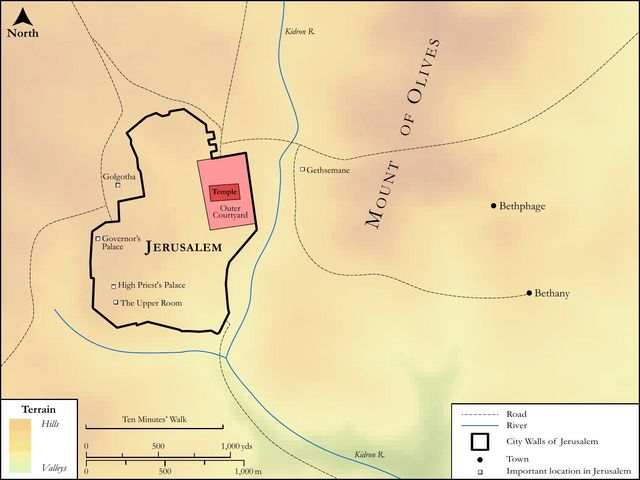
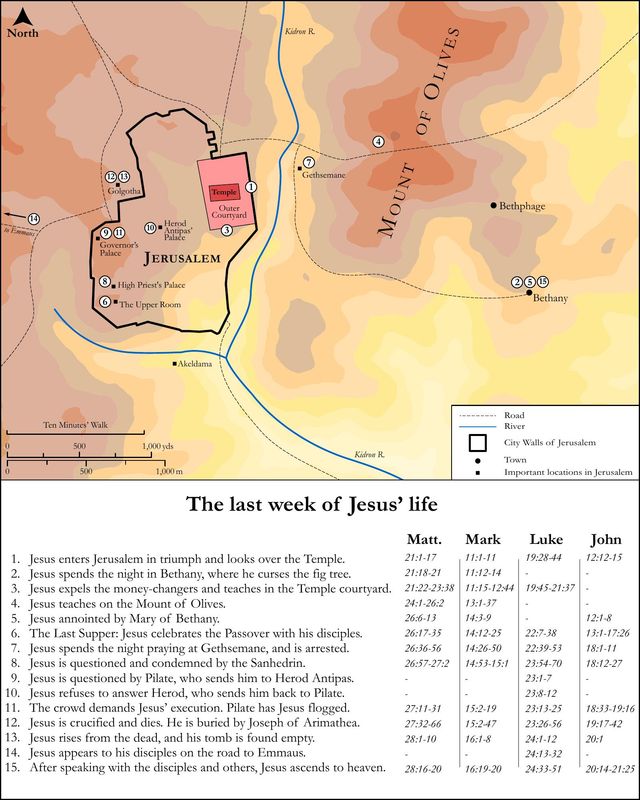
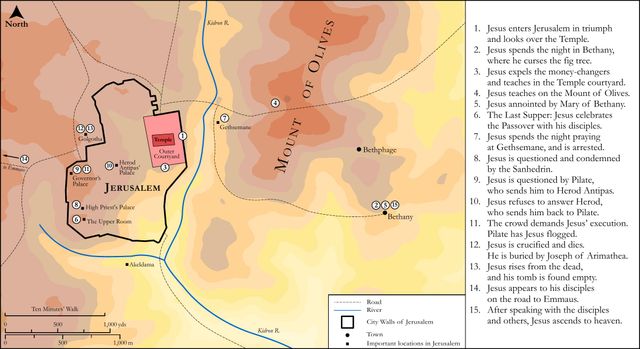
See on the biblical-era maps
Study this verse
Historical interpretation
Six Centuries of Reception
7 surviving comments on this verse. Each one is dated, so this reads as a timeline rather than a list.
Select a marker to jump to its quote. Markers stagger vertically where authors wrote within a few decades of each other.
In like manner to all such as would not be gathered under His wings Christ speaks this threat; Behold, your house is left unto you desolate; i. e. your soul and your body. But if any one of you will not be gathered under the wings of Christ, from the very time when he shall have refused to be so gathered, (by a mental rather than a bodily act,) he shall no more see the beauty of the word, till repenting of his evil purpose he shall say, Blessed is He that cometh in the name of the Lord. And the word of the Lord then comes with a blessing upon a man's heart, when one is turned to God.
For he who having seen many sinning yet remains uncorrected, but rather does the same or worse, is obnoxious to heavier punishment.
The Lord next turns to address the city, desiring to instruct His hearers thereby. O Jerusalem, Jerusalem: this repetition of the name is a mark of compassion and intense love.
Having thus addressed her, and spoken of her cruel murders, He said, as justifying Himself, How often would I have gathered thy children together? as much as to say, Notwithstanding, these thy murders have not alienated Me from thee, but I would have taken thee to Me, not once or twice, but many times. The strength of His affection He shows by the comparison of a hen.
Then He threatens the punishment of which they were ever in fear, to wit, the overthrow of the city and temple, saying, Behold, your house is left unto you desolate.
Otherwise; In this He covertly alludes to His second coming, when surely they shall worship Him. Henceforth, means from the time of His crucifixion.
Then He directs His speech unto the city, in this way too being minded to correct His hearers, and saith, "O Jerusalem, Jerusalem!" What meaneth the repetition? this is the manner of one pitying her, and bemoaning her, and greatly loving her. For, like as unto a woman beloved, herself indeed ever loved, but who had despised Him that loved her, and therefore on the point of being punished, He pleads, being now about to inflict the punishment. Which He doth in the prophets also, using these words, "I said, Turn thou unto me, and she returned not."
Then having called her, He tells also her blood-stained deeds, "Thou that killest the prophets, and stonest them that are sent unto thee, how often would I have gathered thy children together, and ye would not," in this way also pleading for His own dealings; not even with these things hast thou turned me aside, nor withdrawn me from my great affection toward thee, but it was my desire even so, not once or twice, but often to draw thee unto me. "For how often would I have gathered your children together, even as a hen gathereth her chickens, and ye would not." And this He saith, to show that they were ever scattering themselves by their sins. And His affection He indicates by the similitude; for indeed the creature is warm in its love towards its brood. And everywhere in the prophets is this same image of the wings, and in the song of Moses and in the Psalms, indicating His great protection and care.
"But ye would not," He saith. "Behold your house is left desolate," stripped of the succor which cometh from me. Surely it was the same, who also was before protecting them, and holding them together, and preserving them; surely it was He who was ever chastening them. And He appoints a punishment, which they had ever dreaded exceedingly; for it declared the entire overthrow of their polity. "For I say unto you, Ye shall not see me henceforth, till ye shall say, Blessed is He that cometh in the name of the Lord." And this is the language of one that loves earnestly, earnestly drawing them unto Him by the things to come, not merely warning them by the past; for of the future day of His second coming doth He here speak.
What then? Did they not see Him from that time? But it is not that hour which He meaneth in saying, Henceforth, but the time up to His crucifixion.
For since they were forever accusing Him of this, that He was a kind of rival God, and a foe to God, He moves them to love Him by this, namely, by showing Himself to be of one accord with His Father; and He indicates Himself to be the same that was in the prophets. Wherefore also He uses the same words as did the prophets.
And by these He intimated both His resurrection, and His second coming, and made it plain even to the utterly unbelieving, that then most surely they should worship Him. And how did He make this plain? By speaking of many things that were first to be, that He should send prophets, that they should kill them; that it should be in the synagogues; that they should suffer the utmost extremities; that their house should be left desolate; that they should undergo things more grievous than any, and such as never were undergone before. For all these things are enough to furnish even to the most senseless and contentious a clear proof of that which should come to pass at His coming.
For I will ask them, Did He send the prophets and wise men? Did they slay them in their synagogue? Was their house left desolate? Did all the vengeance come upon that generation? It is quite plain that it was so, and no man gainsays it. As then all these things came to pass, so shall those also come to pass, and most surely they shall submit then.
But they shall derive thence no advantage in the way of defense, as neither will they who repent of their course of life then.
Verse 38. Behold, your house shall be left desolate. This very thing Jeremiah had already said in the person of Jeremiah: I have forsaken my house, I have cast off my inheritance: my inheritance is become to me as a lion in the forest. We see with our eyes the house of the Jews left desolate, that is, that temple which shone more brightly, because it lost its inhabitant Christ, and, desiring to seize the inheritance, killed the heir.
By Jerusalem He means not the stones and buildings, but the dwellers there, over whom He laments with the feeling of a Father.
I say unto you, Ye shall not see Me, &c. That is to say, Unless ye shall do penitence, and shall confess that I am He of whom the Prophets have spoken, the Son of the Almighty Father, ye shall not see My face. Thus the Jews have a time allowed for their repentance. Let them confess Him blessed who cometh in the name of the Lord, and they shall then behold Christ's face.
Foreseeing the destruction of the city, and the blow it would receive from the Romans, He called to mind the blood of the saints which had been, and should yet be, shed in it. Thou killedst Esaias who was sent unto thee, and stonedst my servant Jeremias; thou dashedst out the brains of Ezechiel by dragging him over stones; how shalt thou be saved, which wilt not suffer a physician to come nigh thee? And He said not, Didst kill and stone; but, Killest, and Stonest; that is, This is a common and natural practice with thee to kill and stone the saints. She did to the Apostles the same things which she had once done to the Prophets.
As the body, when the spirit departs, first becomes cold, and then decays and decomposes; so also your temple, when God's Spirit shall have withdrawn, shall be first filled with strife and anarchy, and after shall come to ruin.
(non occ.) Let heretics then cease to assign to Christ a beginning from the Virgin; let them leave off to preach one God of the Law and another of the Prophets.
Continue studying Matthew 23:38 across the web’s major study libraries — every link below opens this exact verse, chapter, or book on the destination site.
Read & Compare
 BibleGatewayThis verse in more than 200 translations and 70 languages.
 Bible.comThe YouVersion reader — hundreds of translations, reading plans, and highlights.
 ESV.orgCrossway's official English Standard Version reader.
 NET BibleThe NET translation with 60,000+ translators' notes on every rendering decision.
 STEP BibleTyndale House's free study tool — original text, vocabulary, and scholarly resources.
 BibliaLogos Bible Software's free web reader.
 USCCBThe New American Bible (Revised Edition) with the U.S. bishops' study notes.
Commentaries
 BibleHub CommentariesDozens of classic commentaries on this verse, gathered on one page.
 StudyLightMore than 100 commentary sets — the largest collection on the web.
 BibleRefPlain-English commentary on what this verse means, verse by verse.
 Enduring WordDavid Guzik's free commentary on this chapter, widely used by Bible teachers.
 Bible Study ToolsVerse commentary alongside Greek and Hebrew study aids.
Original Language & Research
- BibleHub InterlinearThe verse word by word — original language, transliteration, and English.
- BibleHub LexiconEvery word's original-language definition and Strong's entry.
 Blue Letter BibleDeep-study tools — Strong's numbers, concordance, and word studies.
 CNTR CollationThe earliest Greek manuscripts of this verse, collated letter by letter.
Sermons, Hymns & Audio


TrulyRandomVerse is not affiliated with these sites and doesn’t control their content. They’re linked because they’re genuinely useful.
Summary
In Matthew 23:38, Jesus pronounces a solemn and definitive judgment upon Jerusalem and its spiritual center, the Temple: "Behold, your house is left unto you desolate." This declaration serves as the climactic culmination of Jesus' severe condemnation of the religious leadership's hypocrisy and the city's rejection of Him as Messiah, signifying an impending divine abandonment and the catastrophic ruin of the Jewish nation's spiritual and physical heart.
Context
ShowHideLiterary Context
This stark declaration is the concluding statement of Jesus' public ministry in Matthew's Gospel before His passion narrative begins. It immediately follows His final and most poignant lament over Jerusalem in Matthew 23:37, where He expresses His deep sorrow and unfulfilled desire to gather the city's inhabitants "as a hen gathers her chicks under her wings." This lament, in turn, is the emotional crescendo following a series of seven "woes" pronounced against the scribes and Pharisees in Matthew 23:13-36. These woes systematically expose their hypocrisy, spiritual blindness, and rejection of God's messengers, culminating in the charge that they would fill up the measure of their fathers' guilt by persecuting and killing the prophets, wise men, and scribes sent to them. The pronouncement of desolation is thus the divine consequence of this persistent rejection and spiritual rebellion.
Historical & Cultural Context
At the time of Jesus' ministry, Jerusalem was the vibrant capital of Judea, and its Temple, rebuilt by Herod the Great, was the magnificent epicenter of Jewish religious life, symbolizing God's presence among His people. The Temple was the place of sacrifice, worship, and the dwelling of the Shekinah glory. For Jesus to declare "your house is left unto you desolate" would have been profoundly shocking and devastating to His Jewish audience. Historically, this prophecy was fulfilled with chilling precision in 70 AD when the Roman armies under Titus besieged and utterly destroyed Jerusalem and the Temple, leaving it in ruins. This event marked the end of the Old Covenant sacrificial system and a monumental shift in Jewish history, confirming Jesus' prophetic authority and the severity of the divine judgment.
Key Themes
ShowHideThe verse powerfully contributes to several overarching themes in Matthew's Gospel and biblical theology. Firstly, it underscores the theme of Divine Judgment and Rejection, demonstrating the severe consequences of rejecting God's ultimate messenger, Jesus Christ. Despite His compassionate desire to gather them, Jerusalem's persistent unbelief and the religious leaders' hardened hearts led to God's withdrawal of His protective presence, a theme echoed in Luke 13:34-35. Secondly, it highlights Prophecy and Fulfillment, as Jesus' words here are a direct and literal prophecy that found its historical fulfillment within a generation, as detailed further in the Olivet Discourse. Finally, the declaration emphasizes Abandonment and Desolation, signifying not merely physical destruction but a profound spiritual emptiness and the loss of divine favor from a place that had become spiritually barren due to its rejection of the Messiah.
Exposition and Analysis
ShowHideKey Word Analysis
ShowHideThis interjection, often translated as "lo!" or "see!", functions as an emphatic particle, drawing immediate and urgent attention to the following statement. It signals a profound, often startling, revelation or a significant turn in the discourse. Here, it underscores the gravity and certainty of the prophecy Jesus is about to deliver, demanding that His hearers fully grasp the weight of His words.
While literally meaning a dwelling or home, oîkos in this context carries profound symbolic weight. It primarily refers to the Temple in Jerusalem, the physical and spiritual center of Jewish worship and the perceived dwelling place of God. However, it also extends to encompass Jerusalem itself, and by extension, the entire nation of Israel, representing their spiritual heritage and identity. The desolation of this "house" therefore implies not just a physical ruin but a spiritual abandonment and loss of divine favor from the very heart of their national and religious life.
This word describes a state of being deserted, empty, solitary, or a wilderness. It conveys a sense of utter abandonment and ruin. In the Septuagint (Greek Old Testament), érēmos is frequently used to describe places laid waste by divine judgment (e.g., Jeremiah 25:9). Here, it signifies not merely a physical emptiness, but a profound spiritual void, indicating that God's protective presence and blessing would be withdrawn, leaving the Temple and the city vulnerable to destruction and devoid of His divine favor.
Verse Breakdown
ShowHide"Behold,"
This opening word, idoú, serves as an urgent summons to attention. Jesus is not merely stating a fact but issuing a solemn, prophetic declaration that demands immediate and serious consideration from His audience. It highlights the absolute certainty and profound significance of what is about to be revealed.
"your house"
This phrase is pregnant with meaning. "Your" emphasizes that the Temple and Jerusalem, which were once God's dwelling place among His people, have now, through the nation's rejection of the Messiah, become "theirs" in a sense of responsibility for their spiritual condition and impending fate. "House" refers primarily to the magnificent Temple in Jerusalem, the heart of Jewish worship and national identity, but also encompasses the city of Jerusalem and, by extension, the entire nation of Israel.
"is left unto you"
This clause signifies an act of divine abandonment. It implies that God is withdrawing His protective presence and favor. The passive voice suggests that this "leaving" is not accidental but a deliberate divine action, a consequence of the nation's persistent unbelief and rejection of God's Son. The phrase "unto you" underscores that this desolation is a direct result of their own choices and actions, not an arbitrary act of God.
"desolate."
The final word, érēmos, vividly describes the outcome. It means empty, deserted, or a wilderness. It prophesies not only the physical destruction of the Temple and Jerusalem (as occurred in 70 AD) but also a spiritual emptiness, a void where God's presence and blessing once resided. It signifies a complete cessation of divine favor and a state of utter ruin, both physically and spiritually, for a people who refused to be gathered by their Messiah.
Literary Devices
ShowHideMatthew 23:38 is rich in literary devices that amplify its profound message. The most prominent is Prophecy, as Jesus' statement is a direct foretelling of the future destruction of Jerusalem and its Temple, an event that would occur within a generation. This prophecy serves to validate Jesus' divine authority and the certainty of divine judgment for persistent unbelief. Symbolism is also central, with "your house" serving as a powerful symbol for the Temple, Jerusalem, and the Jewish nation itself. The desolation of this "house" symbolizes the spiritual abandonment and loss of divine favor that results from rejecting the Messiah. Furthermore, the preceding lament in Matthew 23:37 imbues this verse with a tone of Pathos and Tragedy, highlighting God's sorrowful justice rather than a vengeful one. The word "Behold" (Greek: idoú) acts as an Exclamatory Interjection, drawing the reader's urgent attention to the gravity and certainty of the impending judgment, emphasizing its solemn and irreversible nature.
Theological and Thematic Connections
ShowHideMatthew 23:38 stands as a stark testament to the consequences of rejecting divine truth and the Messiah. Theologically, it underscores God's sovereignty in judgment and His faithfulness to His prophetic word. It reveals that while God is patient and longs for His people's repentance, there are ultimate consequences for persistent unbelief and spiritual rebellion. The desolation of the Temple signifies the end of an era, marking the transition from the Old Covenant system, centered on physical rituals and a localized dwelling place for God, to the New Covenant, where God's presence is found in Christ and His Spirit indwells believers. This verse also highlights the theme of divine abandonment as a consequence of human rejection, a principle seen throughout biblical history.
Reflection and Application
ShowHideMatthew 23:38 serves as a profound and sobering warning for all generations, reminding us that God takes our response to His truth and His messengers with utmost seriousness. Just as Jerusalem faced desolation for rejecting its Messiah, so too do individuals and communities risk spiritual barrenness and judgment when they refuse to heed God's call to repentance and faith. This verse calls us to examine the "house" of our own lives—our hearts, our priorities, our churches—to ensure they are not merely outwardly religious but inwardly transformed and genuinely submitted to Christ. It challenges us to move beyond hypocrisy and superficial faith, embracing a living relationship with Jesus that produces genuine fruit. It also reminds us of God's deep sorrow even in judgment, urging us to respond to His grace before the door of opportunity closes. The ultimate desolation is to be left without God's presence, a fate we must earnestly strive to avoid by embracing the One who offers abundant life.
Questions for Reflection
ShowHideFAQ
ShowHideWhat does "your house" specifically refer to in Matthew 23:38?
ShowHideIn Matthew 23:38, "your house" primarily refers to the Temple in Jerusalem, which was the spiritual and physical center of Jewish life and worship. However, its meaning extends beyond the physical structure to encompass the city of Jerusalem itself, and by extension, the entire nation of Israel. Jesus' use of "your" rather than "My" or "God's" emphasizes that the Temple, once God's dwelling, had become "theirs" in the sense that they were responsible for its spiritual state and had forfeited God's protective presence through their rejection of Him. This is a powerful statement about the spiritual ownership and ultimate fate of a people who had rejected their Messiah.
What does "desolate" mean in this context, and how was this prophecy fulfilled?
ShowHideThe Greek word translated "desolate" is érēmos (G2048), which means deserted, empty, solitary, or a wilderness. In this context, it conveys a profound sense of abandonment, emptiness, and ruin, not merely physical but also spiritual. It signifies that God's protective presence and blessing would be withdrawn from the Temple and the city. This prophecy was literally and dramatically fulfilled in 70 AD when the Roman armies, led by General Titus, besieged and utterly destroyed Jerusalem and the Second Temple. The city was left in ruins, the Temple was burned and dismantled, and the Jewish sacrificial system came to a definitive end. This historical event confirmed the accuracy of Jesus' prophecy and the severity of the divine judgment for rejecting the Messiah, as further detailed in Matthew 24.
Christ-Centered Fulfillment
ShowHideMatthew 23:38, while a prophecy of judgment, finds its Christ-centered fulfillment not in the physical destruction of the Temple alone, but in the radical redefinition of God's dwelling place and the nature of His presence. With the desolation of the Old Covenant Temple, Jesus inaugurates a new spiritual reality where He Himself is the true Temple. As He declared in John 2:19-21, "Destroy this temple, and in three days I will raise it up," speaking of His body. The physical Temple, once the locus of God's presence, became "desolate" because God's presence had departed and was now fully embodied in Christ. Through His death and resurrection, Jesus became the ultimate sacrifice and the new access point to God, rendering the old sacrificial system obsolete. Furthermore, in the New Covenant, believers themselves become the "temple of the Holy Spirit" (1 Corinthians 6:19), and the church, collectively, is built into a "holy temple in the Lord" (Ephesians 2:21-22). Thus, the desolation of the physical house points to the glorious reality that God's presence is now universally accessible through faith in Christ, transforming individuals and communities into living temples, no longer confined to a single stone structure.