


Luke 19:44
Bible text: King James Version (1769 Blayney text) · Public domain
Bible text: King James Version with Strong's numbers · Public domain
Bible text: Berean Standard Bible · Public domain
Bible text: American Standard Version (1901) · Public domain
Bible text: World English Bible, Messianic edition · Public domain
Bible text: Geneva Bible (1599) · Public domain
Bible text: Young's Literal Translation · Public domain
- καὶkaiandG2532CONJConjunction
- ἐδαφιοῦσίνedaphiousinwill level to the groundG1474V-FAI-3PVerb Future Active Indicative 3rd Plural
- σεseyouG4771P-2ASPersonal pronoun Accusative 2nd Singular
- καὶkaiandG2532CONJConjunction
- τὰtatheG3588T-APNDefinite article Accusative Plural Neuter
- τέκναteknachildrenG5043N-APNNoun Accusative Plural Neuter
- σουsouof youG4771P-2GSPersonal pronoun Genitive 2nd Singular
- ἐνenwithinG1722PREPPreposition
- σοὶsoiyouG4771P-2DSPersonal pronoun Dative 2nd Singular
- καὶkaiandG2532CONJConjunction
- οὐκouknotG3756PRT-NNegative Particle Negative
- ἀφήσουσινaphēsousinwill leaveG863V-FAI-3PVerb Future Active Indicative 3rd Plural
- λίθονlithona stoneG3037N-ASMNoun Accusative Singular Masculine
- ἐπὶepiuponG1909PREPPreposition
- λίθονlithona stoneG3037N-ASMNoun Accusative Singular Masculine
- ἐνenwithinG1722PREPPreposition
- σοίsoiyouG4771P-2DSPersonal pronoun Dative 2nd Singular
- ἀνθ᾽anth᾽becauseG473PREPPreposition
- ὧνhōnwhichG3739R-GPNRelative pronoun Genitive Plural Neuter
- οὐκouknotG3756PRT-NNegative Particle Negative
- ἔγνωςegnōsyou knewG1097V-2AAI-2SVerb 2nd Aorist Active Indicative 2nd Singular
- τὸνtontheG3588T-ASMDefinite article Accusative Singular Masculine
- καιρὸνkaironseasonG2540N-ASMNoun Accusative Singular Masculine
- τῆςtēs<the>G3588T-GSFDefinite article Genitive Singular Feminine
- ἐπισκοπῆςepiskopēsof visitationG1984N-GSFNoun Genitive Singular Feminine
- σουsouof youG4771P-2GSPersonal pronoun Genitive 2nd Singular
English is a literal word-by-word gloss of the Greek, not the KJV's wording. Why?
This is the original text the KJV's translators worked from — each Greek word with its own literal English meaning in this verse, prepared by scholars at Tyndale House, Cambridge. The KJV translates whole sentences, not word by word, so its wording differs: one Greek word can become several English words, and the KJV may choose “charity” where the gloss reads “love”. Both are faithful — they answer different questions. For the KJV's own rendering, switch to the KJV text.
Details
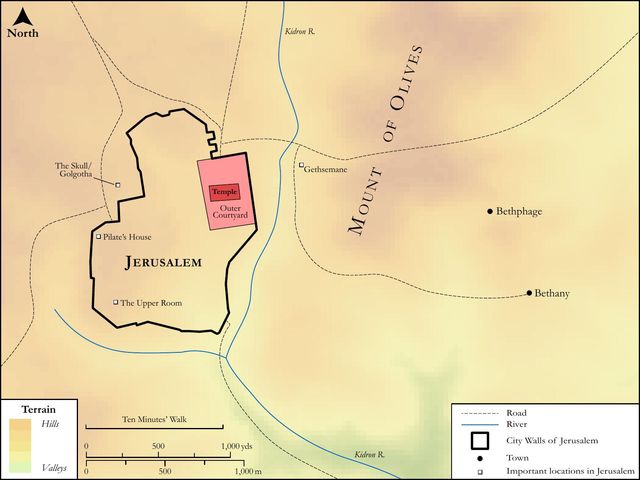
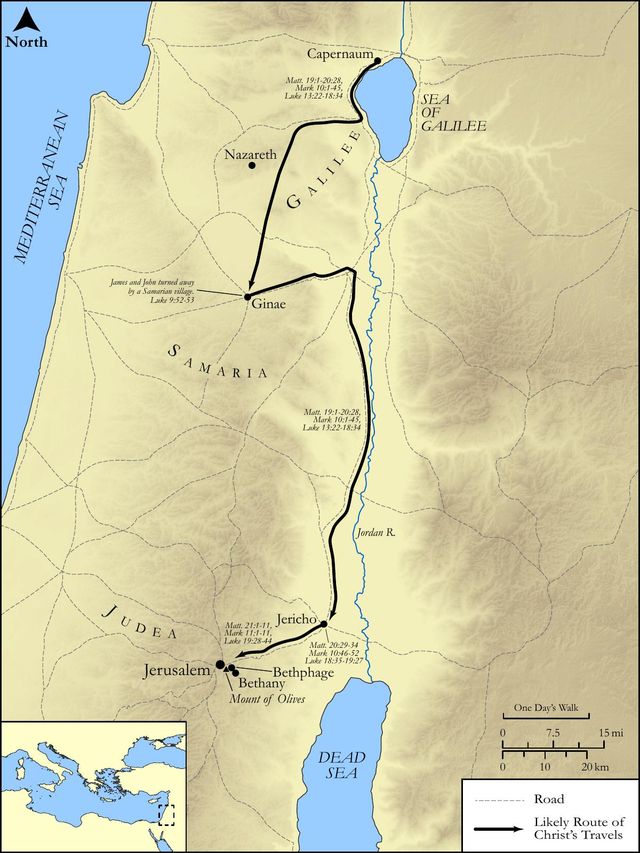
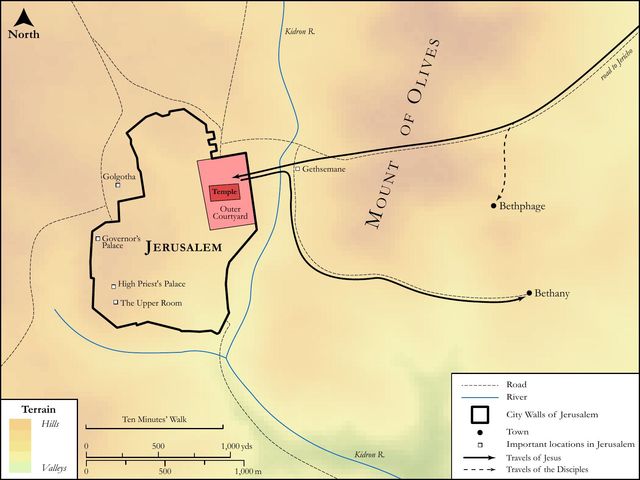
See on the biblical-era maps
Study this verse
Public-domain commentary
Matthew Henry
From his Commentary on the Whole Bible. Henry comments on passages, not single verses — this entry covers Luke 19:41–48. His four-level outline is real structure in the source text, so it is rendered as structure.
The great Ambassador from heaven is here making his public entry into Jerusalem, not to be respected there, but to be rejected; he knew what a nest of vipers he was throwing himself into, and yet see here two instances of his love to that place and his concern for it.
I.The tears he shed for the approaching ruin of the city (Luk 19:41):
When he was come near, he beheld the city, and wept over it. Probably, it was when he was coming down the descent of the hill from the mount of Olives, where he had a full view of the city, the large extent of it, and the many stately structures in it, and his eye affected his heart, and his heart his eye again. See here,
1.What a tender spirit Christ was of; we never read that he laughed, but we often find him in tears. In this very place his father David wept, and those that were with him, though he and they were men of war. There are cases in which it is no disparagement to the stoutest of men to melt into tears.
2.That Jesus Christ wept in the midst of his triumphs, wept when all about him were rejoicing, to show how little he was elevated with the applause and acclamation of the people. Thus he would teach us to rejoice with trembling, and as though we rejoiced not. If Providence do not stain the beauty of our triumphs, we may ourselves see cause to sully it with our sorrows.
3.That he wept over Jerusalem. Note, There are cities to be wept over, and none to be more lamented than Jerusalem, that had been the holy city, and the joy of the whole earth, if it be degenerated. But why did Christ weep at the sight of Jerusalem? Was it because "Yonder is the city in which I must be betrayed and bound, scourged and spit upon, condemned and crucified?" No, he himself gives us the reason of his tears.
(1.)Jerusalem has not improved the day of her opportunities. He wept, and said, If thou hadst known, even thou at least in this thy day, if thou wouldst but yet know, while the gospel is preached to thee, and salvation offered thee by it; if thou wouldest at length bethink thyself, and understand the things that belong to thy peace, the making of thy peace with God, and the securing of thine own spiritual and eternal welfare - but thou dost not know the day of thy visitation, Luk 19:44. The manner of speaking is abrupt: If thou hadst known! O that thou hadst, so some take it; like that O that my people had hearkened unto me, Psa 81:13; Isa 48:18. Or, If thou hadst known, well; like that of the fig-tree, Luk 13:9. How happy had it been for thee! Or, "If thou hadst known, thou wouldest have wept for thyself, and I should have no occasion to weep for thee, but should have rejoiced rather." What he says lays all the blame of Jerusalem's impending ruin upon herself. Note,
[1.]There are things which belong to our peace, which we are all concerned to know and understand; the way how peace is made, the offers made of peace, the terms on which we may have the benefit of peace. The things that belong to our peace are those things that relate to our present and future welfare; these we must know with application.
[2.]There is a time of visitation when those things which belong to our peace may be known by us, and known to good purpose. When we enjoy the means of grace in great plenty, and have the word of God powerfully preached to us - when the Spirit strives with us, and our own consciences are startled and awakened - then is the time of visitation, which we are concerned to improve.
[3.]With those that have long neglected the time of their visitation, if at length, if at last, in this their day, their eyes be opened, and they bethink themselves, all will be well yet. Those shall not be refused that come into the vineyard at the eleventh hour.
[4.]It is the amazing folly of multitudes that enjoy the means of grace, and it will be of fatal consequence to them, that they do not improve the day of their opportunities. The things of their peace are revealed to them, but are not minded or regarded by them; they hide their eyes from them, as if they were not worth taking notice of. They are not aware of the accepted time and the day of salvation, and to let it slip and perish through mere carelessness. None are so blind as those that will not see; nor have any the things of their peace more certainly hidden from their eyes than those that turn their back upon them.
[5.]The sin and folly of those that persist in a contempt of gospel grace are a great grief to the Lord Jesus, and should be so to us. He looks with weeping eyes upon lost souls, that continue impenitent, and run headlong upon their own ruin; he had rather that they would turn and live than go on and die, for he is not willing that any should perish.
(2.)Jerusalem cannot escape the day of her desolation. The things of her peace are now in a manner hidden from her eyes; they will be shortly. Not but that after this the gospel was preached to them by the apostles; all the house of Israel were called to know assuredly that Christ was their peace (Act 2:36), and multitudes were convinced and converted. But as to the body of the nation, and the leading part of it, they were sealed up under unbelief; God had given them the spirit of slumber, Rom 11:8. They were so prejudiced and enraged against the gospel, and those few that did embrace it then, that nothing less than a miracle of divine grace (like that which converted Paul) would work upon them; and it could not be expected that such a miracle should be wrought, and so they were justly given up to judicial blindness and hardness. The peaceful things are not hidden from the eyes of particular persons; but it is too late to think now of the nation of the Jews, as such, becoming a Christian nation, by embracing Christ. And therefore they are marked for ruin, which Christ here foresees and foretels, as the certain consequence of their rejecting Christ. Note, Neglecting the great salvation often brings temporal judgments upon a people; it did so upon Jerusalem in less than forty years after this, when all that Christ here foretold was exactly fulfilled.
[1.]The Romans besieged the city, cast a trench about it, compassed it round, and kept their inhabitants in on every side. Josephus relates that Titus ran up a wall in a very short time, which surrounded the city, and cut off all hopes of escaping.
[2.]They laid it even with the ground. Titus commanded his soldiers to dig up the city, and the whole compass of it was levelled, except three towers; see Josephus's history of the wars of the Jews, 5.356-360; 7.1. Not only the city, but the citizens were laid even with the ground (thy children within thee), by the cruel slaughters that were made of them: and there was scarcely one stone left upon another. This was for their crucifying Christ; this was because they knew not the day of their visitation. Let other cities and nations take warning.
II.The zeal he showed for the present purification of the temple.
Though it must be destroyed ere long, it does not therefore follow that no care must be taken of it in the mean time.
1.Christ cleared it of those who profaned it. He went straight to the temple, and began to cast out the buyers and sellers, Luk 19:45. Hereby (though he was represented as an enemy to the temple, and that was the crime laid to his charge before the high priest) he made it to appear that he had a truer love for the temple than they had who had such a veneration for its corban, its treasury, as a sacred thing; for its purity was more its glory than its wealth was. Christ gave reason for his dislodging the temple-merchants, Luk 19:46. The temple is a house of prayer, set apart for communion with God: the buyers and sellers made it a den of thieves by the fraudulent bargains they made there, which was by no means to be suffered, for it would be a distraction to those who came there to pray.
2.He put it to the best use that ever it was put to, for he taught daily in the temple, Luk 19:47. Note, It is not enough that the corruptions of a church be purged out, but the preaching of the gospel must be encouraged. Now, when Christ preached in the temple, observe here,
(1.)How spiteful the church-rulers were against him; how industrious to seek an opportunity, or pretence rather, to do him a mischief (Luk 19:47): The chief priests and scribes, and the chief of the people, the great sanhedrim, that should have attended him, and summoned the people too to attend him, sought to destroy him, and put him to death.
(2.)How respectful the common people were to him. They were very attentive to hear him. He spent most of his time in the country, and did not then preach in the temple, but, when he did, the people paid him great respect, attended on his preaching with diligence, and let no opportunity slip of hearing him, attended to it with care, and would not lose a word. Some read it, All the people as they heard him, took his part; and so it comes in very properly as a reason why his enemies could not find what they might do against him; they saw the people ready to fly in their faces if they offered him any violence. Till his hour was come his interest in the common people protected him; but, when his hour was come, the chief priests' influence upon the common people delivered him up.
Historical interpretation
Nine Centuries of Reception
10 surviving comments on this verse. Each one is dated, so this reads as a timeline rather than a list.
Select a marker to jump to its quote. Markers stagger vertically where authors wrote within a few decades of each other.
But our Jerusalem is also wept over, because after sin enemies surround it, (that is, wicked spirits,) and cast a trench round it to besiege it, and leave not a stone behind; especially when a man after long continency, after years of chastity, is overcome, and enticed by the blandishments of the flesh, has lost his fortitude and his modesty, and has committed fornication, they will not leave on him one stone upon another, according to Ezekiel, His former righteousness I will not remember. (Ezek 18:24.)
He here declares that His coming was to bring peace to the whole world. For unto this He came, that He should preach both to them that were near, and those that were afar off. But as they did not wish to receive the peace that was announced to them, it was hid from them. And therefore the siege which was shortly to come upon them He most expressly foretells, adding, For the days shall come upon thee, &c.
But how these things were fulfilled we may gather from what is delivered to us by Josephus, who though he was a Jew, related each event as it toot place, in exact accordance with Christ's prophecies.
These things took place in this way in the second year of the reign of Vespasian in agreement with the prophetic pronouncements of our Lord and Savior Jesus Christ. By divine power, he foresaw these events as if already present and wept over them and mourned, according to the writings of the holy Evangelists. They add his own words, when on one occasion he spoke as if to Jerusalem itself. “Would that even today you knew the things that make for peace! Now they are hid from your eyes. For the days shall come upon you, when your enemies will cast up a bank about you and surround you, and hem you in on every side, and dash you to the ground, you and your children within you, and they will not leave one stone upon another in you; because you did not know the time of your visitation.” On another occasion, as if concerning the people, he said, “There will be great distress in the land and wrath on this people. They will fall by the edge of the sword and shall be led away captives into all nations. Jerusalem will be trampled down by the Gentiles until the times of the nations be fulfilled.” Again he says, “When you shall see Jerusalem encircled by an army, then know that its desolation is near.” If one should compare the words of our Savior with the other narratives of the historian, how could he help but marvel and confess the truly divine and supernaturally wonderful foreknowledge and prophecy of our Savior?
He therefore charged us Himself to fast these six days on account of the impiety and transgression of the Jews, commanding us withal to bewail over them, and lament for their perdition. For even He Himself "wept over them, because they knew not the time of their visitation."
In addition to these things, he also appointed a place in which alone it should be lawful to them to sacrifice to God. And all this was arranged with this view, that when the fitting time should come, and they should learn by means of the Prophet that God desires mercy and not sacrifice, they might see Him who should teach them that the place chosen of God, in which it was suitable that victims should be offered to God, is his Wisdom; and that on the other hand they might hear that this place, which seemed chosen for a time, often harassed as it had been by hostile invasions and plunderings, was at last to be wholly destroyed.
"They shall not leave in you a stone upon a stone"—even the very relocation of that city now testifies, because while it is now built in the place where the Lord had been crucified outside the gate, that former Jerusalem, as it is said, was utterly destroyed. From what fault the punishment of its destruction was inflicted upon it is added: "Because you did not know the time of your visitation." For the Creator of all things deigned to visit it through the mystery of his incarnation, but it did not remember the fear and love of him. Whence also through prophecy, in rebuke of the human heart, the birds of heaven are brought forward as testimony, when it is said: "The kite in the sky has known its time; the turtledove and the swallow and the stork have kept the time of their coming, but my people has not known the judgment of the Lord."
Concerning these, what follows can also be aptly understood: "They shall surround you and press you in on every side." For malignant spirits press in upon the soul on every side, when they bring back to it the iniquities not only of deed, but also of speech and moreover of thought, so that she who formerly spread herself abroad through many crimes may at the end be pressed in on all sides in retribution. There follows: "And they shall cast you to the ground, and your children who are in you." Then the soul is cast to the ground through the knowledge of its guilt, when the flesh which it believed to be its life is compelled to return to dust. Then her children fall into death, when the illicit thoughts which now proceed from her are scattered in the final punishment of life, as it is written: "In that day all their thoughts shall perish." These harsh thoughts can also be understood through the signification of stones. For there follows: "And they shall not leave in you stone upon stone." For when a perverse mind adds a yet more perverse thought to a perverse thought, what else does it do but place stone upon stone? But in the destroyed city stone is not left upon stone, because when the soul is led to its punishment, the whole structure of its thoughts is scattered.
Why it suffers this is added: "Because you did not know the time of your visitation." Almighty God is accustomed to visit every wicked soul in many ways. For He visits it continually through His commandment, sometimes through affliction, and sometimes through a miracle, so that it may hear the truths it did not know, and yet if still proud and contemptuous, it may return pricked by pain, or overcome by benefits may blush at the evil it has done. But because it does not recognize the time of its visitation, it is handed over at the end of life to those enemies with whom it will be bound in the fellowship of perpetual damnation at the eternal judgment, as it is written: "When you go with your adversary to the magistrate on the way, make an effort to be freed from him, lest perhaps he drag you to the judge, and the judge hand you over to the officer, and the officer cast you into prison." For our adversary on the way is the word of God, contrary to our carnal desires in the present life. He is freed from it who humbly submits to His commandments. Otherwise the adversary will hand him over to the judge, and the judge will hand him over to the officer, because from the contempt of the Lord's word the guilty sinner will be held liable at the examination of the judge. The judge hands him over to the officer, because He permits the malignant spirit to drag him away for punishment, so that he himself may exact the soul driven from the body for punishment, the soul that willingly consented to him for sin. The officer casts him into prison, because through the malignant spirit he is thrust back into hell until the day of judgment comes, from which point he himself also will be tormented together in the fires of hell.
(Hom. 39. in Ev.) The merciful Redeemer wept then over the fall of the false city, which that city itself knew not was about to come upon it. As it is added, saying, If thou hadst known, even thou (we may here understand) wouldest weep. Thou who now rejoicest, for thou knowest not what is at hand. It follows, at least in this thy day. For when she gave herself up to carnal pleasures, she had the things which in her day might be her peace. But why she had present goods for her peace, is explained by what follows, But now they are hidden from thy eyes. For if the eyes of her heart had not been hidden from the future evils which were hanging over her, she would not have been joyful in the prosperity of the present. Therefore He shortly added the punishment which was near at hand, saying, For the days shall come upon thee.
(ut sup.) By these words the Roman leaders are pointed out. For that overthrow of Jerusalem is described, which was made by the Roman emperors Vespasian and Titus.
This too which is added, namely, They shall not leave in thee one stone upon another, is now witnessed in the altered situation of the same city, which is now built in that place where Christ was crucified without the gate, whereas the former Jerusalem, as it is called, was rooted up from the very foundation. And the crime for which this punishment of overthrow was inflicted is added, Because thou knewest not the time of thy visitation.
(ut sup.) For our Redeemer does not cease to weep through His elect whenever he perceives any to have departed from a good life to follow evil ways. Who if they had known their own damnation, hanging over them, would together with the elect shed tears over themselves. But the corrupt soul here has its day, rejoicing in the passing time; to whom things present are its peace, seeing that it takes delight in that which is temporal. It shuns the foresight of the future which may disturb its present mirth; and hence it follows, But now are they hid from thine eyes.
(Hom. 39. in Ev.) Or else; The evil spirits lay siege to the soul, as it goes forth from the body, for being seized with the love of the flesh, they caress it with delusive pleasures. They surround it with a trench, because bringing all its wickedness which it has committed before the eyes of its mind, they close confine it to the company of its own damnation, that being caught in the very extremity of life, it may see by what enemies it is blockaded, yet be unable to find any way of escape, because it can no longer do good works, since those which it might once have done it despised. On every side also they inclose the soul when its iniquities rise up before it, not only in deed but also in word and thought, that she who before in many ways greatly enlarged herself in wickedness, should now at the end be straitened every way in judgment. Then indeed the soul by the very condition of its guilt is laid prostrate on the ground, while its flesh which it believed to be its life is bid to return to dust. Then its children fall in death, when all unlawful thoughts which only proceed from it, are in the last punishment of life scattered abroad. These may also be signified by the stones. For the corrupt mind when to a corrupt thought it adds one more corrupt, places one stone upon another. But when the soul is led to its doom, the whole structure of its thoughts is rent asunder. But the wicked soul God ceases not to visit with His teaching, sometimes with the scourge and sometimes with a miracle; that the truth which it knew not it may hear, and though still despising it, may return pricked to the heart in sorrow, or overcome with mercies may be ashamed at the evil which it has done. But because it knows not the time of its visitation, at the end of life it is given over to its enemies, that with them it may be joined together in the bond of everlasting damnation.
Again, when our Lord descends from the mount of Olives, the multitude descend also, because since the Author of mercy has suffered humiliation, it is necessary that all those who need His mercy should follow His footsteps.
Because you did not recognize the time of your visitation. For the Creator of all things deigned to visit this city through the mystery of the Incarnation, but it did not remember His fear and love. Hence, through the prophet, the birds of the sky are brought as witnesses against the hardness of the human heart, when it is said: The stork in the sky knows its appointed time, the turtledove, the swallow, and the crane keep the time of their coming, but my people do not know the judgment of the Lord (Jerem. VIII).
That is, of my coming. For I came to visit and to save thee, which if thou hadst known and believed on Me, thou mightest have been reconciled to the Romans, and exempted from all danger, as did those who believed on Christ.
Continue studying Luke 19:44 across the web’s major study libraries — every link below opens this exact verse, chapter, or book on the destination site.
Read & Compare
 BibleGatewayThis verse in more than 200 translations and 70 languages.
 Bible.comThe YouVersion reader — hundreds of translations, reading plans, and highlights.
 ESV.orgCrossway's official English Standard Version reader.
 NET BibleThe NET translation with 60,000+ translators' notes on every rendering decision.
 STEP BibleTyndale House's free study tool — original text, vocabulary, and scholarly resources.
 BibliaLogos Bible Software's free web reader.
 USCCBThe New American Bible (Revised Edition) with the U.S. bishops' study notes.
Commentaries
 BibleHub CommentariesDozens of classic commentaries on this verse, gathered on one page.
 StudyLightMore than 100 commentary sets — the largest collection on the web.
 BibleRefPlain-English commentary on what this verse means, verse by verse.
 Enduring WordDavid Guzik's free commentary on this chapter, widely used by Bible teachers.
 Bible Study ToolsVerse commentary alongside Greek and Hebrew study aids.
Original Language & Research
- BibleHub InterlinearThe verse word by word — original language, transliteration, and English.
- BibleHub LexiconEvery word's original-language definition and Strong's entry.
 Blue Letter BibleDeep-study tools — Strong's numbers, concordance, and word studies.
 CNTR CollationThe earliest Greek manuscripts of this verse, collated letter by letter.
Sermons, Hymns & Audio


TrulyRandomVerse is not affiliated with these sites and doesn’t control their content. They’re linked because they’re genuinely useful.
Summary
Luke 19:44 records Jesus' poignant prophecy concerning the utter destruction of Jerusalem and its inhabitants, a devastating judgment directly attributed to the city's failure to recognize the opportune moment of God's redemptive presence in their midst. This verse, part of Jesus' lament over the city, foretells a complete desolation where not a single stone of its magnificent structures, including the Temple, would remain upon another, and its people would suffer immense loss, all because they did not discern the "time of their visitation" by the Messiah.
Context
ShowHideLiterary Context
This verse immediately follows Jesus' triumphal entry into Jerusalem, a moment of messianic acclamation by His disciples (Luke 19:28-40). However, as Jesus approaches the city, His joy turns to profound sorrow, and He weeps over it, lamenting its impending doom (Luke 19:41-42). The prophecy in Luke 19:43-44 details the exact nature of the siege and destruction, serving as a stark contrast to the earlier celebratory mood and highlighting the city's spiritual blindness despite the clear signs of His messianic identity. This passage underscores the tragic irony of the people's failure to recognize their Savior, even as He presented Himself to them.
Historical & Cultural Context
At the time of Jesus' prophecy, Jerusalem was the spiritual and political heart of Judea, under Roman occupation. The Jewish people harbored strong messianic expectations, often envisioning a political deliverer who would overthrow Roman rule. The city's crown jewel was the Second Temple, a magnificent structure rebuilt by Herod the Great, central to Jewish religious life and national identity. Jesus' prophecy of its complete destruction, "not one stone upon another," would have been shocking and almost unimaginable to His hearers. Historically, this prophecy was fulfilled with chilling precision in 70 AD when the Roman legions, led by General Titus, besieged Jerusalem, culminating in the destruction of the city and the Temple, effectively ending the Jewish-Roman War and marking a cataclysmic event in Jewish history.
Key Themes
ShowHideLuke 19:44 powerfully contributes to several overarching themes in Luke's Gospel and biblical theology. It highlights the theme of Divine Judgment, demonstrating that rejection of God's gracious overtures carries severe consequences, even for His chosen people. The specific details of the destruction underscore the theme of Prophetic Fulfillment, affirming Jesus' divine foresight and the certainty of God's word. Crucially, the verse emphasizes Spiritual Blindness and the Missed Divine Opportunity. Jerusalem's failure to "know the time of thy visitation" (G1097 ginṓskō, G2540 kairós, G1984 episkopḗ) reveals a profound lack of discernment regarding God's redemptive activity through Jesus Christ. This theme resonates with other passages where Jesus laments the spiritual state of His generation, such as His woes against the unrepentant cities in Matthew 11:20-24 or His lament over Jerusalem in Matthew 23:37-39.
Exposition and Analysis
ShowHideKey Word Analysis
ShowHideThis verb (G1474) means "to raze" or "to level to the ground." It conveys a sense of complete demolition and utter devastation, far beyond mere damage. It implies that the city's defenses, buildings, and very foundations would be utterly dismantled, leaving nothing standing. This word emphasizes the totality of the impending destruction, a prophecy that was literally fulfilled in 70 AD.
The word (G3037) refers to a literal stone, but in this context, it carries immense symbolic weight. The phrase "not leave in thee one stone upon another" refers specifically to the Temple and the city's formidable walls. The Temple was the very heart of Jewish identity and worship, built with massive stones. Its complete dismantling signified the end of an era, a profound national and religious catastrophe.
This noun (G1984) denotes an "inspection," "oversight," or "divine intervention." In this context, it refers to God's gracious and redemptive presence in the person of Jesus Christ. It was a time when God was drawing near to His people, offering salvation, healing, and the revelation of His kingdom. The tragedy of Jerusalem was their failure to recognize and respond to this unique and critical divine opportunity.
Verse Breakdown
ShowHide"And shall lay thee even with the ground, and thy children within thee;"
This clause pronounces a comprehensive judgment not only on the physical city but also on its inhabitants. "Lay thee even with the ground" (G1474 edaphízō) speaks to the total destruction of Jerusalem's structures and defenses. The phrase "thy children within thee" highlights the horrific human cost of the siege and destruction—the loss of life, particularly innocent lives, including women and children, trapped within the city walls. It underscores the profound sorrow Jesus felt over the impending suffering of His people.
"and they shall not leave in thee one stone upon another;"
This part of the prophecy specifies the extent of the physical desolation, particularly targeting the magnificent Temple and the city's fortifications. The phrase "not one stone upon another" (G3037 líthos) is a hyperbole that became a literal reality. Historical accounts confirm that the Romans meticulously dismantled the Temple, searching for melted gold, fulfilling Jesus' precise prediction and leaving the site utterly desolate. This detail emphasizes the completeness and irreversible nature of the judgment.
"because thou knewest not the time of thy visitation."
This final clause provides the profound theological reason for Jerusalem's judgment. The city's destruction was not arbitrary but a direct consequence of its spiritual blindness and rejection of God's gracious intervention. "Knewest not" (G1097 ginṓskō) implies a failure of discernment and recognition, not mere ignorance. "The time" (G2540 kairós) refers to a specific, opportune season, a divinely appointed moment. "Thy visitation" (G1984 episkopḗ) refers to God's gracious presence in Jesus, offering salvation and revealing His kingdom. Jerusalem, despite being the center of God's covenant people, failed to recognize its Messiah and the unique opportunity for redemption He presented, sealing its tragic fate.
Literary Devices
ShowHideLuke 19:44 employs several powerful literary devices. The primary device is Prophecy, as Jesus foretells a future event with remarkable precision, which was literally fulfilled in 70 AD. This serves to establish His divine authority and omniscience. The phrase "not leave in thee one stone upon another" functions as a form of Hyperbole that, remarkably, became a literal truth, emphasizing the absolute and devastating nature of the destruction. There is also profound Pathos in Jesus' lament, as His tears and words convey deep sorrow and grief over the city's impending doom, despite its rejection of Him. Furthermore, the verse contains a strong element of Irony: Jerusalem, the city chosen by God, the place where His Temple stood, failed to recognize and receive its own Messiah, leading to its ultimate destruction. This tragic irony underscores the theme of spiritual blindness.
Theological and Thematic Connections
ShowHideLuke 19:44 stands as a stark reminder of the gravity of divine judgment and the consequences of rejecting God's gracious overtures. It reveals God's patience and desire for His people to repent, yet also His unwavering justice when His "visitation" is ignored. The destruction of Jerusalem and its Temple, the very symbols of God's presence among His people, signifies a profound shift in salvation history, emphasizing that God's favor is not tied to a physical location or ethnic lineage but to a responsive heart. The "time of visitation" underscores the concept of divine opportunity—a season of grace and revelation that, if neglected, can lead to severe and irreversible consequences. This passage serves as a timeless warning against spiritual apathy and the failure to discern God's active presence and call in one's life.
Reflection and Application
ShowHideLuke 19:44 is more than a historical prophecy; it is a profound spiritual warning and a call to discerning faith for all generations. Just as Jerusalem failed to recognize "the time of its visitation" in the person of Jesus, we too can become spiritually blind to God's presence and work in our lives and in the world around us. This verse challenges us to cultivate a posture of constant spiritual alertness, actively seeking to understand God's Word and discern His will. Are we recognizing the "visitations" of God in our own lives—the opportunities for repentance, growth, service, or deeper relationship that He presents? The consequences for spiritual apathy or outright rejection can be severe, not necessarily in physical destruction, but in a hardening of the heart and a missed opportunity for profound spiritual blessing and transformation. This passage calls us to humility, responsiveness, and a deep commitment to knowing and following the Lord, ensuring we do not neglect the precious time of His gracious presence.
Questions for Reflection
ShowHideFAQ
ShowHideWhat does "the time of thy visitation" specifically refer to in Luke 19:44?
ShowHide"The time of thy visitation" (Greek: kairós episkopḗ) refers to the specific, divinely appointed period when God, in His grace, drew near to His people, Israel, through the person and ministry of Jesus Christ. It was an opportune season of divine intervention, marked by Jesus' teachings, miracles, and His presentation as the Messiah. Jerusalem's failure was not merely ignorance, but a lack of recognition and acceptance of this crucial moment of God's redemptive presence among them. This concept highlights that God offers specific seasons of grace and revelation, which, if unheeded, can lead to profound consequences.
Was the prophecy in Luke 19:44 literally fulfilled?
ShowHideYes, the prophecy in Luke 19:44 was literally and dramatically fulfilled in 70 AD. During the Jewish-Roman War, the Roman army, led by General Titus, besieged Jerusalem. The city was utterly destroyed, and the Second Temple, a magnificent structure, was systematically dismantled. Historical accounts, particularly from Josephus, confirm that the Romans left "not one stone upon another" as they sought to recover melted gold from the Temple's ruins, and the city itself was razed to the ground, just as Jesus foretold. This historical event serves as powerful evidence of Jesus' divine foresight and the accuracy of biblical prophecy.
What is the significance of "they shall not leave in thee one stone upon another"?
ShowHideThe phrase "they shall not leave in thee one stone upon another" (G3037 líthos) signifies the absolute and complete destruction of Jerusalem, particularly its Temple. The Temple was the spiritual and architectural marvel of Jerusalem, built with massive stones, symbolizing God's presence and the heart of Jewish identity. Jesus' prophecy meant that this sacred and seemingly impregnable structure would be utterly demolished, leaving no trace of its former glory. Its fulfillment in 70 AD was a profound theological statement: God's presence was no longer confined to a physical temple or a specific city, but was now accessible through Christ. It underscored the end of the Old Covenant sacrificial system and the dawn of a new era in salvation history.
Christ-Centered Fulfillment
ShowHideLuke 19:44, while a prophecy of judgment, finds its ultimate Christ-centered fulfillment not only in the historical destruction of Jerusalem but more profoundly in the broader narrative of Christ's rejection and His establishment of a new covenant. Jerusalem's failure to recognize "the time of thy visitation" (G1984 episkopḗ) epitomizes humanity's fallen condition and its inherent blindness to divine truth, a theme echoed in John 1:11 where "He came unto his own, and his own received him not." Jesus, the very embodiment of God's visitation, was rejected by the very people He came to save. Yet, this rejection, though tragic for Jerusalem, became the means of salvation for all who would believe. The tearing down of the physical Temple, as prophesied, foreshadowed the dismantling of the old covenant system and the establishment of Christ as the true and living Temple (John 2:19-21). Through His death and resurrection, Jesus became the ultimate "visitation" of God, offering not judgment but grace, not destruction but eternal life. The warning of Luke 19:44 thus serves as a powerful reminder for all to heed the call of the Gospel, to recognize Christ as God's ultimate "visitation," and to respond in faith before the "acceptable time" (2 Corinthians 6:2) of salvation passes.