


Luke 19:47
Bible text: King James Version (1769 Blayney text) · Public domain
Bible text: King James Version with Strong's numbers · Public domain
Bible text: Berean Standard Bible · Public domain
Bible text: American Standard Version (1901) · Public domain
Bible text: World English Bible, Messianic edition · Public domain
Bible text: Geneva Bible (1599) · Public domain
Bible text: Young's Literal Translation · Public domain
- καὶkaiAndG2532CONJConjunction
- ἦνēnHe wasG1510V-IAI-3SVerb Imperfect Active Indicative 3rd Singular
- διδάσκωνdidaskōnteachingG1321V-PAP-NSMVerb Present Active Participle Nominative Singular Masculine
- τὸto<the>G3588T-ASNDefinite article Accusative Singular Neuter
- καθ᾽kath᾽everyG2596PREPPreposition
- ἡμέρανhēmerandayG2250N-ASFNoun Accusative Singular Feminine
- ἐνeninG1722PREPPreposition
- τῷtōtheG3588T-DSNDefinite article Dative Singular Neuter
- ἱερῷ·hi'erōtempleG2411N-DSNNoun Dative Singular Neuter
- οἱhoitheG3588T-NPMDefinite article Nominative Plural Masculine
- δὲdehoweverG1161CONJConjunction
- ἀρχιερεῖςarchiereischief priestsG749N-NPMNoun Nominative Plural Masculine
- καὶkaiandG2532CONJConjunction
- οἱhoitheG3588T-NPMDefinite article Nominative Plural Masculine
- γραμματεῖςgrammateisscribesG1122N-NPMNoun Nominative Plural Masculine
- ἐζήτουνezētounwere seekingG2212V-IAI-3PVerb Imperfect Active Indicative 3rd Plural
- αὐτὸνautonHimG846P-ASMPersonal pronoun Accusative Singular Masculine
- ἀπολέσαιapolesaito destroyG622V-AANVerb Aorist Active Infinitive
- καὶkaiandG2532CONJConjunction
- οἱhoitheG3588T-NPMDefinite article Nominative Plural Masculine
- πρῶτοιprōtoiforemostG4413A-NPMAdjective Nominative Plural Masculine
- τοῦtouof theG3588T-GSMDefinite article Genitive Singular Masculine
- λαοῦlaoupeopleG2992N-GSMNoun Genitive Singular Masculine
English is a literal word-by-word gloss of the Greek, not the KJV's wording. Why?
This is the original text the KJV's translators worked from — each Greek word with its own literal English meaning in this verse, prepared by scholars at Tyndale House, Cambridge. The KJV translates whole sentences, not word by word, so its wording differs: one Greek word can become several English words, and the KJV may choose “charity” where the gloss reads “love”. Both are faithful — they answer different questions. For the KJV's own rendering, switch to the KJV text.
Details
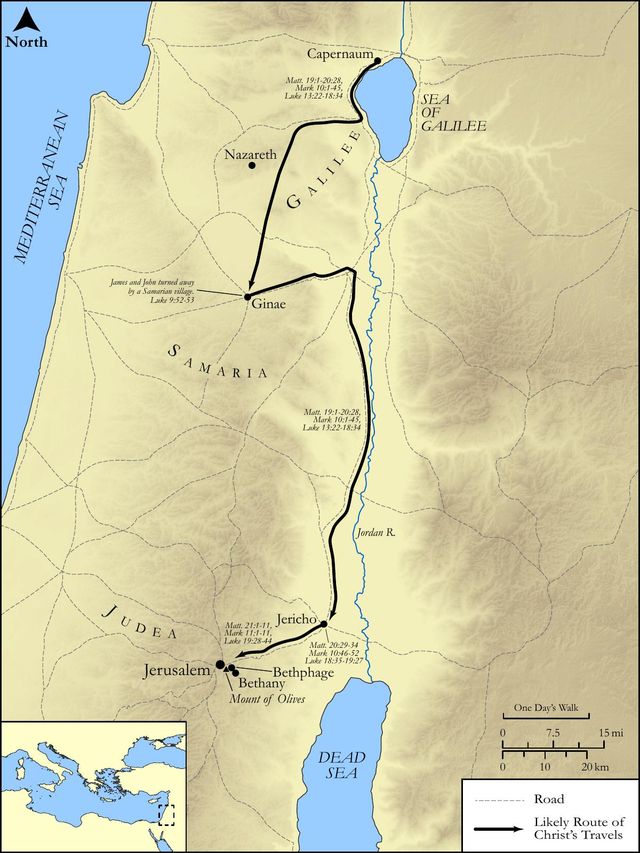
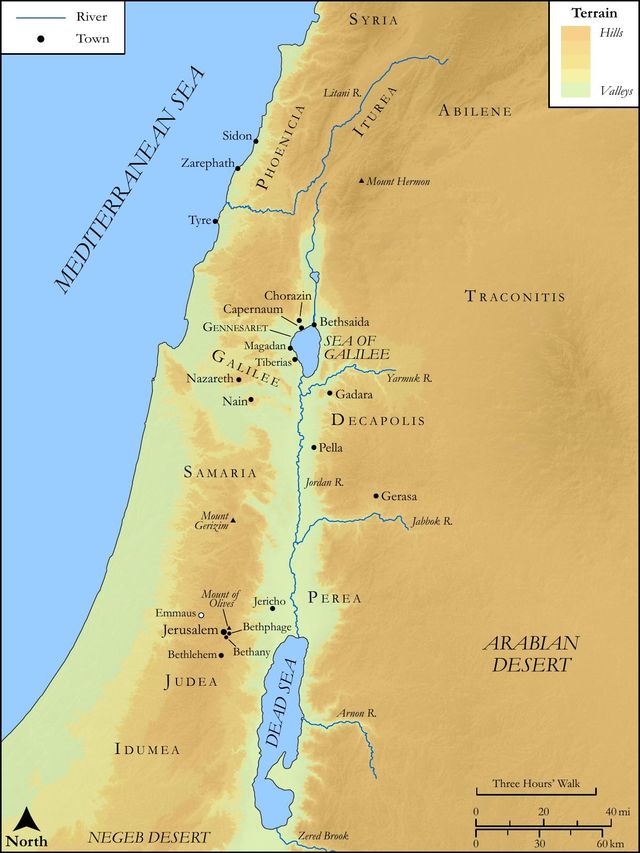
See on the biblical-era maps

Study this verse
Public-domain commentary
Matthew Henry
From his Commentary on the Whole Bible. Henry comments on passages, not single verses — this entry covers Luke 19:41–48. His four-level outline is real structure in the source text, so it is rendered as structure.
The great Ambassador from heaven is here making his public entry into Jerusalem, not to be respected there, but to be rejected; he knew what a nest of vipers he was throwing himself into, and yet see here two instances of his love to that place and his concern for it.
I.The tears he shed for the approaching ruin of the city (Luk 19:41):
When he was come near, he beheld the city, and wept over it. Probably, it was when he was coming down the descent of the hill from the mount of Olives, where he had a full view of the city, the large extent of it, and the many stately structures in it, and his eye affected his heart, and his heart his eye again. See here,
1.What a tender spirit Christ was of; we never read that he laughed, but we often find him in tears. In this very place his father David wept, and those that were with him, though he and they were men of war. There are cases in which it is no disparagement to the stoutest of men to melt into tears.
2.That Jesus Christ wept in the midst of his triumphs, wept when all about him were rejoicing, to show how little he was elevated with the applause and acclamation of the people. Thus he would teach us to rejoice with trembling, and as though we rejoiced not. If Providence do not stain the beauty of our triumphs, we may ourselves see cause to sully it with our sorrows.
3.That he wept over Jerusalem. Note, There are cities to be wept over, and none to be more lamented than Jerusalem, that had been the holy city, and the joy of the whole earth, if it be degenerated. But why did Christ weep at the sight of Jerusalem? Was it because "Yonder is the city in which I must be betrayed and bound, scourged and spit upon, condemned and crucified?" No, he himself gives us the reason of his tears.
(1.)Jerusalem has not improved the day of her opportunities. He wept, and said, If thou hadst known, even thou at least in this thy day, if thou wouldst but yet know, while the gospel is preached to thee, and salvation offered thee by it; if thou wouldest at length bethink thyself, and understand the things that belong to thy peace, the making of thy peace with God, and the securing of thine own spiritual and eternal welfare - but thou dost not know the day of thy visitation, Luk 19:44. The manner of speaking is abrupt: If thou hadst known! O that thou hadst, so some take it; like that O that my people had hearkened unto me, Psa 81:13; Isa 48:18. Or, If thou hadst known, well; like that of the fig-tree, Luk 13:9. How happy had it been for thee! Or, "If thou hadst known, thou wouldest have wept for thyself, and I should have no occasion to weep for thee, but should have rejoiced rather." What he says lays all the blame of Jerusalem's impending ruin upon herself. Note,
[1.]There are things which belong to our peace, which we are all concerned to know and understand; the way how peace is made, the offers made of peace, the terms on which we may have the benefit of peace. The things that belong to our peace are those things that relate to our present and future welfare; these we must know with application.
[2.]There is a time of visitation when those things which belong to our peace may be known by us, and known to good purpose. When we enjoy the means of grace in great plenty, and have the word of God powerfully preached to us - when the Spirit strives with us, and our own consciences are startled and awakened - then is the time of visitation, which we are concerned to improve.
[3.]With those that have long neglected the time of their visitation, if at length, if at last, in this their day, their eyes be opened, and they bethink themselves, all will be well yet. Those shall not be refused that come into the vineyard at the eleventh hour.
[4.]It is the amazing folly of multitudes that enjoy the means of grace, and it will be of fatal consequence to them, that they do not improve the day of their opportunities. The things of their peace are revealed to them, but are not minded or regarded by them; they hide their eyes from them, as if they were not worth taking notice of. They are not aware of the accepted time and the day of salvation, and to let it slip and perish through mere carelessness. None are so blind as those that will not see; nor have any the things of their peace more certainly hidden from their eyes than those that turn their back upon them.
[5.]The sin and folly of those that persist in a contempt of gospel grace are a great grief to the Lord Jesus, and should be so to us. He looks with weeping eyes upon lost souls, that continue impenitent, and run headlong upon their own ruin; he had rather that they would turn and live than go on and die, for he is not willing that any should perish.
(2.)Jerusalem cannot escape the day of her desolation. The things of her peace are now in a manner hidden from her eyes; they will be shortly. Not but that after this the gospel was preached to them by the apostles; all the house of Israel were called to know assuredly that Christ was their peace (Act 2:36), and multitudes were convinced and converted. But as to the body of the nation, and the leading part of it, they were sealed up under unbelief; God had given them the spirit of slumber, Rom 11:8. They were so prejudiced and enraged against the gospel, and those few that did embrace it then, that nothing less than a miracle of divine grace (like that which converted Paul) would work upon them; and it could not be expected that such a miracle should be wrought, and so they were justly given up to judicial blindness and hardness. The peaceful things are not hidden from the eyes of particular persons; but it is too late to think now of the nation of the Jews, as such, becoming a Christian nation, by embracing Christ. And therefore they are marked for ruin, which Christ here foresees and foretels, as the certain consequence of their rejecting Christ. Note, Neglecting the great salvation often brings temporal judgments upon a people; it did so upon Jerusalem in less than forty years after this, when all that Christ here foretold was exactly fulfilled.
[1.]The Romans besieged the city, cast a trench about it, compassed it round, and kept their inhabitants in on every side. Josephus relates that Titus ran up a wall in a very short time, which surrounded the city, and cut off all hopes of escaping.
[2.]They laid it even with the ground. Titus commanded his soldiers to dig up the city, and the whole compass of it was levelled, except three towers; see Josephus's history of the wars of the Jews, 5.356-360; 7.1. Not only the city, but the citizens were laid even with the ground (thy children within thee), by the cruel slaughters that were made of them: and there was scarcely one stone left upon another. This was for their crucifying Christ; this was because they knew not the day of their visitation. Let other cities and nations take warning.
II.The zeal he showed for the present purification of the temple.
Though it must be destroyed ere long, it does not therefore follow that no care must be taken of it in the mean time.
1.Christ cleared it of those who profaned it. He went straight to the temple, and began to cast out the buyers and sellers, Luk 19:45. Hereby (though he was represented as an enemy to the temple, and that was the crime laid to his charge before the high priest) he made it to appear that he had a truer love for the temple than they had who had such a veneration for its corban, its treasury, as a sacred thing; for its purity was more its glory than its wealth was. Christ gave reason for his dislodging the temple-merchants, Luk 19:46. The temple is a house of prayer, set apart for communion with God: the buyers and sellers made it a den of thieves by the fraudulent bargains they made there, which was by no means to be suffered, for it would be a distraction to those who came there to pray.
2.He put it to the best use that ever it was put to, for he taught daily in the temple, Luk 19:47. Note, It is not enough that the corruptions of a church be purged out, but the preaching of the gospel must be encouraged. Now, when Christ preached in the temple, observe here,
(1.)How spiteful the church-rulers were against him; how industrious to seek an opportunity, or pretence rather, to do him a mischief (Luk 19:47): The chief priests and scribes, and the chief of the people, the great sanhedrim, that should have attended him, and summoned the people too to attend him, sought to destroy him, and put him to death.
(2.)How respectful the common people were to him. They were very attentive to hear him. He spent most of his time in the country, and did not then preach in the temple, but, when he did, the people paid him great respect, attended on his preaching with diligence, and let no opportunity slip of hearing him, attended to it with care, and would not lose a word. Some read it, All the people as they heard him, took his part; and so it comes in very properly as a reason why his enemies could not find what they might do against him; they saw the people ready to fly in their faces if they offered him any violence. Till his hour was come his interest in the common people protected him; but, when his hour was come, the chief priests' influence upon the common people delivered him up.
Historical interpretation
Seven Centuries of Reception
10 surviving comments on this verse. Each one is dated, so this reads as a timeline rather than a list.
Select a marker to jump to its quote. Markers stagger vertically where authors wrote within a few decades of each other.
For God wishes not His temple to be a house of traffic, but the dwelling-place of holiness, nor does He fix the priestly service in a saleable performance of religion, but in a free and willing obedience.
Therefore our Lord teaches generally that all worldly bargains should be far removed from the temple of God; but spiritually He drove away the money-changers, who seek gain from the Lord's money, that is, the divine Scripture, lest they should discern good and evil.
Now from what Christ had said and done it was meet that men should worship Him as God, but far from doing this, they sought to slay Him; as it follows, But the chief priests and scribes and the chief of the people sought to destroy him.
As one who possessed authority over the temple, he took care of it.… Their duty was to worship him, as One who with God the Father was Lord of the temple. In their great folly, they did not do this, but rather being savagely eager for hatred, they set up the sharp sting of wickedness against him and hurried to murder, which is the neighbor and brother of envy. It says that they sought to destroy him but could not, because all the people were hanging on him to hear him. Does this not make the punishment of the scribes and Pharisees, and all the rulers of the Jewish ranks, heavier? The whole people, consisting of unlearned persons, hung upon the sacred doctrines and drank the saving word like the rain. They were ready to produce the fruits of faith and place their neck under his commandments. They who had the position to urge on their people to this very thing savagely rebelled and wickedly sought the opportunity for murder. With unbridled violence, they ran upon the rocks, not accepting the faith and wickedly hindering others.
But because our Redeemer does not withhold the words of preaching even from the unworthy and ungrateful, after he maintained the vigor of discipline by casting out the perverse, he soon showed the gift of grace. For it is added: "And he was teaching daily in the temple." We have run through these things briefly, treating them according to the historical sense.
But because against all these perverse things we are ceaselessly instructed by the words of our Redeemer through the sacred pages, what is reported to have been done is still being done now, when it says: "And he was teaching daily in the temple." For when he subtly instructs the mind of the faithful to guard against evils, Truth teaches daily in the temple.
But we must know that we are truly instructed by the words of truth if we look upon our final evils with fear and without ceasing, according to what is said by a certain wise man: "In all your works remember your last end, and you will never sin." Indeed, we ought to consider daily what we have heard from the voice of our same Redeemer: "If only on this day of yours you knew the things that are for your peace; but now they are hidden from your eyes." For while the strict Judge waits and does not yet extend his hand in striking, while there seems to be a certain security of time before the retribution of final vengeance, we ought to consider the evil that follows, and considering it, groan; groaning, avoid it; and look upon the sins we have committed without ceasing; looking upon them, weep; and weeping, wipe them away. Let no joy of passing prosperity dissolve us, nor let transitory things obstruct the eyes of our mind, nor lead us blind to the fire. For if it be considered strictly, from the mouth of Truth it is known how weighty is the reproach, when it is said to the negligent one who does not look ahead to future things: "If only on this day of yours you knew the things that are for your peace; but now they are hidden from your eyes."
(Hom. 39. in Ev.) Or else; The evil spirits lay siege to the soul, as it goes forth from the body, for being seized with the love of the flesh, they caress it with delusive pleasures. They surround it with a trench, because bringing all its wickedness which it has committed before the eyes of its mind, they close confine it to the company of its own damnation, that being caught in the very extremity of life, it may see by what enemies it is blockaded, yet be unable to find any way of escape, because it can no longer do good works, since those which it might once have done it despised. On every side also they inclose the soul when its iniquities rise up before it, not only in deed but also in word and thought, that she who before in many ways greatly enlarged herself in wickedness, should now at the end be straitened every way in judgment. Then indeed the soul by the very condition of its guilt is laid prostrate on the ground, while its flesh which it believed to be its life is bid to return to dust. Then its children fall in death, when all unlawful thoughts which only proceed from it, are in the last punishment of life scattered abroad. These may also be signified by the stones. For the corrupt mind when to a corrupt thought it adds one more corrupt, places one stone upon another. But when the soul is led to its doom, the whole structure of its thoughts is rent asunder. But the wicked soul God ceases not to visit with His teaching, sometimes with the scourge and sometimes with a miracle; that the truth which it knew not it may hear, and though still despising it, may return pricked to the heart in sorrow, or overcome with mercies may be ashamed at the evil which it has done. But because it knows not the time of its visitation, at the end of life it is given over to its enemies, that with them it may be joined together in the bond of everlasting damnation.
(ut sup.) When He had related the evils that were to come upon the city, He straightway entered the temple, that He might cast out them that bought and sold in it. showing that the destruction of the people arose chiefly from the guilt of the priests.
For they who sat in the temple to receive money would doubtless sometimes make exaction to the injury of those who gave them none.
(Hom. 39. ut sup.) But our Redeemer does not withdraw His word of preaching even from the unworthy and ungrateful. Accordingly after having by the ejection of the corrupt maintained the strictness of discipline, He now pours forth the gifts of grace. For it follows, And he was teaching daily in the temple.
(ut sup.) Mystically, such as the temple of God is in a city, such is the life of the religious in a faithful people. And there are frequently some who take upon themselves the religious habit, and while they are receiving the privilege of Holy Orders, are sinking the sacred office of religion into a bargain of worldly traffic. For the sellers in the temple are those who give at a certain price that which is the rightful possession of others. For to sell justice is to observe it on condition of receiving a reward. But the buyers in the temple are those, who whilst unwilling to discharge what is just to their neighbour, and disdaining to do what they are in duty bound to, by paying a price to their patrons, purchase sin.
(ut sup.) And these make the house of God a den of thieves, because when corrupt men hold religious offices, they slay with the sword of their wickedness their neighbours, whom they ought to raise to life by the intercession of their prayers. The temple also is the soul of the faithful, which if it put forth corrupt thoughts to the injury of a neighbour, then is it become as it were a lurking place of thieves. But when the soul of the faithful is wisely instructed to shun evil, truth teaches daily in the temple.
And he was teaching daily in the temple. For when he skillfully instructs the minds of the faithful to guard against evil, Truth teaches daily in the temple.
But the chief priests, and the scribes, and the leaders of the people sought to destroy him, and they did not find what they might do to him. Either because he taught daily in the temple, or because he had cast out the thieves from the temple, or because when he came as King and Lord, he received the praise of a heavenly hymn from such a great throng of believers, the envious leaders sought to destroy him.
And he was teaching daily in the temple. We briefly run through these things according to history, now let us repeat the same to be discussed with moral understanding. Seeing the city, he wept over it, saying: Because if you also had known. This he did once when he announced that the city was destined to perish. This our Redeemer in no way ceases to do daily through his chosen ones, when he considers that some have gone from a good life to reprobate morals. For he weeps for those who do not know why they are wept for, since according to the words of Solomon, they rejoice to do evil, and exult in wicked things (Proverbs II). For if they knew the damnation that threatens them, they would weep for their sins with tears. Truly, in this your day, which is for your peace. The perverse soul has its day here, which rejoices in a fleeting time. To whom the present things are for peace, because while it rejoices in temporal things, while it is exalted by honors, while it is dissolved in the will of the flesh, while it is not terrified by the fear of future punishment, it has peace in its day, which will have the grievous scandal of its damnation on another day. For there it is to be afflicted where the just will rejoice. But now they are hidden from your eyes. The perverse soul, given to present things, dissolved in earthly pleasures, hides from itself the evils that will follow, because it refuses to foresee the future, which disturbs present joy. And while it forsakes itself in the delight of this present life, what else does it do but go to fire with closed eyes? Because days will come upon you, and your enemies will encircle you with a palisade. Who are greater enemies to the human soul than evil spirits? who besiege it when it leaves the body, which they nurture with deceptive delights placed in the love of the flesh. They encircle it with a palisade, because recalling its iniquities, which it has committed, before its mind's eyes, they constrict it, dragging it to the society of their damnation. And they will encircle you, and press you in on every side. Evil spirits press the soul on every side, when they not only repeat the iniquities of deeds, but also of speech and moreover of thoughts, so that the soul, which previously expanded itself greatly in wickedness, in the end may be distressed about all in retribution. And they will dash you to the ground, and your children within you. Then the soul is dashed to the ground by the recognition of its guilt, when the flesh which it believed to be its life, is urged to return to dust. Then they fall at the death of his son, when illicit thoughts that now proceed from her are dispersed in the ultimate vengeance of life, as it is written: On that day all their thoughts will perish. These hard thoughts, indeed, can also be understood by the symbolism of stones. For it follows: And they will not leave a stone upon a stone in you. For when a perverse mind adds perversion to perverse thought, what else does it do but place stone upon stone? But in a destroyed city no stone is left upon a stone because when the soul is led to its vengeance, all the construction of its thoughts is scattered. Because you did not recognize the time of your visitation. Omnipotent God also habitually visits a perverse soul in many ways. For he constantly visits it with a precept, sometimes with a scourge, sometimes indeed with a miracle, so that it may both hear the truths it did not know and, while still proud and disdainful, either return compuncted by pain or be ashamed of the evil it has done, conquered by benefits. But because it does not recognize the time of its visitation, at the end of life it is handed over to those enemies with whom it is bound in the society of eternal judgement of its own damnation. And entering the temple, he began to drive out those who were selling in it and those who were buying. Just as the temple of God is in the city, so in the faithful people is the life of the religious. And often some assume the habit of religion, but while they perceive the place of sacred orders, they attribute the duty of holy religion to the commerce of earthly negotiations. For those who are selling in the temple are those who grant to some as a reward what is rightfully theirs. Indeed, to sell justice is to keep it for the sake of receiving a reward. But those who are buying in the temple are those who, while unwilling to render to their neighbor what is just, and while scorning to do what is rightfully due, buy sin by giving a reward to patrons. To whom it is rightly said: My house is a house of prayer. But you have made it a den of thieves. Because when sometimes perverse men hold a place of religion, they kill with the swords of their malice where they ought to have revitalized their neighbors by the intercession of their prayer. The mind and conscience of the faithful is also the temple and house of God, which, if it brings forth perverse thoughts in harming the neighbor, is like a den where thieves reside and they kill those who walk simply when they strike with the swords of harm against those innocent in any way. For the mind of the faithful is no longer a house of prayer but a den of thieves when, leaving behind innocence and the simplicity of holiness, it strives to do that from which it can harm its neighbors. But because we are endlessly instructed against all these perverse things by the words of our Redeemer through the sacred pages, now this is happening which is said to have been done, when it is said:
Either because He daily taught in the temple, or because He had cast the thieves therefrom, or that coming thereto as King and Lord, He was greeted with the honour of a heavenly hymn of praise.
This may be taken in two ways; either that fearing a tumult of the people they knew not what they should do with Jesus, whom they had settled to destroy; or they sought to destroy Him because they perceived their own authority set aside, and multitudes flocking to hear Him.
The same thing our Lord did also at the beginning of His preaching, as John relates; and now He did it a second time, because the crime of the Jews was much increased by their not having been chastened by the former warning.
Continue studying Luke 19:47 across the web’s major study libraries — every link below opens this exact verse, chapter, or book on the destination site.
Read & Compare
 BibleGatewayThis verse in more than 200 translations and 70 languages.
 Bible.comThe YouVersion reader — hundreds of translations, reading plans, and highlights.
 ESV.orgCrossway's official English Standard Version reader.
 NET BibleThe NET translation with 60,000+ translators' notes on every rendering decision.
 STEP BibleTyndale House's free study tool — original text, vocabulary, and scholarly resources.
 BibliaLogos Bible Software's free web reader.
 USCCBThe New American Bible (Revised Edition) with the U.S. bishops' study notes.
Commentaries
 BibleHub CommentariesDozens of classic commentaries on this verse, gathered on one page.
 StudyLightMore than 100 commentary sets — the largest collection on the web.
 BibleRefPlain-English commentary on what this verse means, verse by verse.
 Enduring WordDavid Guzik's free commentary on this chapter, widely used by Bible teachers.
 Bible Study ToolsVerse commentary alongside Greek and Hebrew study aids.
Original Language & Research
- BibleHub InterlinearThe verse word by word — original language, transliteration, and English.
- BibleHub LexiconEvery word's original-language definition and Strong's entry.
 Blue Letter BibleDeep-study tools — Strong's numbers, concordance, and word studies.
 CNTR CollationThe earliest Greek manuscripts of this verse, collated letter by letter.
Sermons, Hymns & Audio


TrulyRandomVerse is not affiliated with these sites and doesn’t control their content. They’re linked because they’re genuinely useful.
Summary
Luke 19:47 vividly portrays Jesus' unwavering commitment to His public ministry in the Jerusalem Temple during His final days, where He daily taught the crowds. This steadfast proclamation of truth, however, stood in stark contrast to the escalating and malicious opposition from the Jewish religious authorities—specifically the chief priests, scribes, and leaders of the people—who were actively seeking a way to eliminate Him. The verse encapsulates the profound conflict between divine authority and human resistance, setting the stage for the climactic events of the Passion week.
Context
ShowHideLiterary Context
This verse immediately follows two highly provocative acts by Jesus in Jerusalem: His Triumphal Entry and His dramatic cleansing of the Temple. The Triumphal Entry was a messianic claim, publicly acknowledged by the crowds. The Temple cleansing was an assertion of divine authority over the very heart of Jewish worship and commerce, directly challenging the authority of the chief priests who profited from its operations. Against this backdrop of heightened tension and open defiance of the established order, Jesus' decision to teach "daily in the temple" was not merely a continuation of His ministry but a deliberate and sustained confrontation. It solidified His presence and authority in the most sacred and public space, further intensifying the animosity of those whose power and traditions He had so directly challenged.
Historical & Cultural Context
The Jerusalem Temple was far more than a place of worship; it was the epicenter of Jewish religious, economic, and political life. During Passover, the city and Temple courts would have been teeming with pilgrims, making Jesus' daily teachings highly visible and impactful. The "chief priests" (G749, archiereús) were primarily Sadducees, aristocrats who controlled the Temple administration, its vast wealth, and held significant political power, often collaborating with the Roman authorities to maintain their status. The "scribes" (G1122, grammateús) were experts in Jewish Law, often associated with the Pharisees, who held considerable influence over the common people through their interpretations of the Torah. The "chief of the people" (G4413, prōtos + G2992, laós) likely refers to other prominent elders and leaders within the Sanhedrin or local councils. For these groups, Jesus represented an existential threat: He undermined their authority, challenged their interpretations of the Law, disrupted their economic interests in the Temple, and His growing popularity risked provoking Roman intervention, which could lead to the loss of their privileged positions or even their nation's destruction, as voiced by Caiaphas in John 11:48-50.
Key Themes
ShowHideLuke 19:47 contributes significantly to several overarching themes in Luke's Gospel and the broader biblical narrative. Firstly, it highlights the unwavering authority and faithfulness of Jesus in fulfilling His mission, even in the face of mortal danger. His daily teaching underscores His commitment to revealing God's truth to His people. Secondly, the verse starkly illustrates the escalating opposition to God's Messiah, a recurring motif throughout the Gospels, exemplified by passages like John 5:18 where the Jewish leaders sought to kill Him for making Himself equal with God. This opposition is not merely disagreement but a deep-seated, murderous intent, revealing the spiritual blindness and hardened hearts of those who should have recognized Him. Finally, it underscores the profound conflict between divine truth and human tradition/power structures, where the established religious order prioritizes its own authority and self-preservation over the authentic revelation of God. This tension is central to Jesus' ministry, as seen in His critiques of the Pharisees' traditions in Mark 7:8-13.
Exposition and Analysis
ShowHideKey Word Analysis
ShowHideA prolonged (causative) form of a primary verb (to learn); to teach (in the same broad application). This word emphasizes Jesus' primary activity in the Temple: instruction. The imperfect tense (implied by G2258, ēn, "was") combined with "daily" (G2596, katá + G2250, hēméra) indicates a continuous, persistent, and habitual action. Jesus was not merely present; He was actively, consistently imparting truth, asserting His role as the authoritative teacher.
A writer, i.e. (professionally) scribe or secretary. In the New Testament context, these were the legal experts and interpreters of the Mosaic Law, often associated with the Pharisees. Their inclusion alongside the chief priests signifies the broad, unified front of opposition from both the religious and legalistic authorities, representing different factions of the Jewish elite who found common cause in their desire to eliminate Jesus.
G2212 (zētéō) means "to seek (literally or figuratively); specially, (by Hebraism) to worship (God), or (in a bad sense) to plot (against life)." G622 (apóllymi) means "to destroy fully (reflexively, to perish, or lose), literally or figuratively." The combination of these two words reveals the deliberate and ultimate intent of Jesus' adversaries. They were not merely seeking to silence or discredit Him, but actively plotting His complete elimination, a murderous aim that underscores the depth of their hostility and the spiritual battle at play.
Verse Breakdown
ShowHide"And he taught daily in the temple."
This phrase highlights Jesus' unwavering commitment to His mission. Despite the previous day's dramatic cleansing of the Temple and the clear escalation of tension, Jesus did not retreat. His "daily" teaching signifies consistency, public accessibility, and a deliberate assertion of His authority in the very heart of Jewish religious life. The Temple, as the central place of worship and instruction, became the arena for His final, public confrontations and teachings, demonstrating His courage and divine mandate.
"But the chief priests and the scribes and the chief of the people sought to destroy him,"
This clause introduces a stark contrast, marked by the Greek particle "But" (G1161, dé). While Jesus taught, the most powerful and influential religious and civic leaders of Israel were united in their malicious intent. The mention of "chief priests" (G749, archiereús), "scribes" (G1122, grammateús), and "chief of the people" (G4413, prōtos + G2992, laós) emphasizes the comprehensive nature of the opposition, representing the Sanhedrin and the broader Jewish elite. Their "seeking to destroy him" (G2212, zētéō + G622, apóllymi) indicates a deliberate, organized, and ultimately murderous plot, revealing the depth of their fear and hatred toward Jesus.
Literary Devices
ShowHideLuke 19:47 masterfully employs Juxtaposition and Foreshadowing. The verse sharply juxtaposes Jesus' peaceable, authoritative act of teaching with the malevolent, destructive intentions of His adversaries. This contrast highlights the spiritual battle between light and darkness, truth and deception. Jesus, the bringer of life and truth, is met with the plotting of those who seek death and the suppression of truth. Furthermore, the phrase "sought to destroy him" serves as potent Foreshadowing, signaling the imminent Passion narrative. It prepares the reader for the betrayal, arrest, trial, and crucifixion that will soon follow, making it clear that these events are not random occurrences but the culmination of a deliberate, long-standing conspiracy against the Son of God. The Irony is also palpable: those entrusted with guiding God's people were actively plotting against God's own Son.
Theological and Thematic Connections
ShowHideLuke 19:47 powerfully illustrates the persistent theme of divine authority confronting human rebellion and spiritual blindness. Jesus, as the embodiment of God's truth and the rightful King, continues His mission of teaching and revealing the Father's will, even when faced with mortal threats. This highlights His unwavering commitment to His redemptive purpose. Conversely, the unified opposition of the religious elite underscores humanity's inherent resistance to God's rule and revelation when it challenges established power structures or personal comfort. Their desire "to destroy him" reveals not merely political expediency but a profound spiritual darkness that would rather extinguish the light of truth than submit to its transforming power. This conflict sets the stage for the ultimate demonstration of God's love and justice on the cross, where human evil is paradoxically used to accomplish divine salvation.
Reflection and Application
ShowHideLuke 19:47 offers profound insights for believers today, particularly regarding the nature of Christian witness and the reality of spiritual opposition. Jesus' daily, public teaching in the Temple, despite the clear and present danger, exemplifies an unwavering commitment to truth and mission. This challenges us to consider the consistency and courage of our own faith. Are we willing to speak and live out God's truth openly, even when it is unpopular or confronts prevailing cultural norms? The verse also reminds us that faithfulness to God's call often invites hostility from those who reject His ways. The "chief priests and scribes" represent systems and individuals resistant to divine authority, and their desire "to destroy" Jesus foreshadows the persecution believers may face. This prepares us to understand that not all will receive the Gospel message with joy; some may actively seek to undermine or even harm those who proclaim it. Such opposition should not deter us but rather deepen our reliance on God, knowing that He is sovereign even over the darkest human intentions.
Questions for Reflection
ShowHideFAQ
ShowHideWhy did the religious leaders specifically seek to "destroy" Jesus, rather than just silence Him?
ShowHideThe term "destroy" (G622, apóllymi) indicates a desire for Jesus' complete elimination, not merely His incapacitation or discrediting. This extreme animosity stemmed from several factors. Firstly, Jesus' teachings directly challenged their authority and interpretations of the Law, exposing their hypocrisy and legalism (e.g., Matthew 23). Secondly, His actions, such as cleansing the Temple, disrupted their economic interests and control over the Temple system. Thirdly, His growing popularity and messianic claims were perceived as a political threat that could provoke a Roman crackdown, jeopardizing their precarious power and the nation's stability (as articulated by Caiaphas in John 11:48-50). Ultimately, their hardened hearts and spiritual blindness prevented them from recognizing God's Son, leading them to view Him as a blasphemer and a dangerous revolutionary who needed to be permanently removed.
Christ-Centered Fulfillment
ShowHideLuke 19:47, with its stark portrayal of Jesus' daily teaching contrasted with the leaders' murderous intent, powerfully foreshadows the Christ-centered fulfillment of God's redemptive plan. Jesus, the true Prophet and Teacher, continued to proclaim the kingdom of God even as the forces of darkness conspired against Him. His unwavering presence in the Temple, the very heart of Israel's religious life, underscores His identity as the promised Messiah who came to His own, yet His own received Him not. The chief priests and scribes, representatives of the Old Covenant system, sought to "destroy" Him, unknowingly fulfilling the prophetic Scriptures that foretold the suffering and rejection of the Servant of the Lord. This verse sets the stage for the ultimate act of self-giving love: Jesus, the innocent Lamb, willingly submitting to the destructive plans of humanity, knowing that His death would be the means of salvation for all who believe. His teaching in the Temple culminates in His ultimate lesson on the cross, where He, as the Lamb of God who takes away the sin of the world, offers Himself as the perfect sacrifice. Thus, the very plot to "destroy him" becomes the divinely ordained path through which Christ triumphs over sin and death, establishing the new covenant and fulfilling the Law and Prophets. His rejection by the religious leaders ultimately paved the way for His resurrection and the establishment of a new spiritual temple, His body, the Church, where He continues to teach and reign as Lord.