


Mark 11:27
- ΚαὶKaiAndG2532CONJConjunction
- ἔρχονταιerchontaithey comeG2064V-PNI-3PVerb Present Middle Or Passive Deponent Indicative 3rd Plural
- πάλινpalinagainG3825ADVAdverb
- εἰςeistoG1519PREPPreposition
- Ἱεροσόλυμα·Hi'erosolumaJerusalemG2414N-APN-LNoun Accusative Plural Neuter Location
- καὶkaiAndG2532CONJConjunction
- ἐνeninG1722PREPPreposition
- τῷtōtheG3588T-DSNDefinite article Dative Singular Neuter
- ἱερῷhi'erōtempleG2411N-DSNNoun Dative Singular Neuter
- περιπατοῦντοςperipatountoswhen is walkingG4043V-PAP-GSMVerb Present Active Participle Genitive Singular Masculine
- αὐτοῦautouHeG846P-GSMPersonal pronoun Genitive Singular Masculine
- ἔρχονταιerchontaithey comeG2064V-PNI-3PVerb Present Middle Or Passive Deponent Indicative 3rd Plural
- πρὸςprostoG4314PREPPreposition
- αὐτὸνautonHimG846P-ASMPersonal pronoun Accusative Singular Masculine
- οἱhoitheG3588T-NPMDefinite article Nominative Plural Masculine
- ἀρχιερεῖςarchiereischief priestsG749N-NPMNoun Nominative Plural Masculine
- καὶkaiandG2532CONJConjunction
- οἱhoitheG3588T-NPMDefinite article Nominative Plural Masculine
- γραμματεῖςgrammateisscribesG1122N-NPMNoun Nominative Plural Masculine
- καὶkaiandG2532CONJConjunction
- οἱhoitheG3588T-NPMDefinite article Nominative Plural Masculine
- πρεσβύτεροιpresbuteroieldersG4245N-NPMNoun Nominative Plural Masculine
English is a literal word-by-word gloss of the Greek, not the KJV's wording. Why?
This is the original text the KJV's translators worked from — each Greek word with its own literal English meaning in this verse, prepared by scholars at Tyndale House, Cambridge. The KJV translates whole sentences, not word by word, so its wording differs: one Greek word can become several English words, and the KJV may choose “charity” where the gloss reads “love”. Both are faithful — they answer different questions. For the KJV's own rendering, switch to the KJV text.
Details
See on the biblical-era map
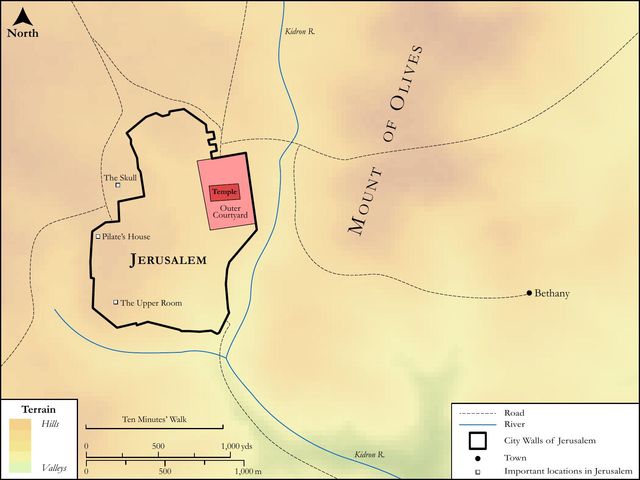
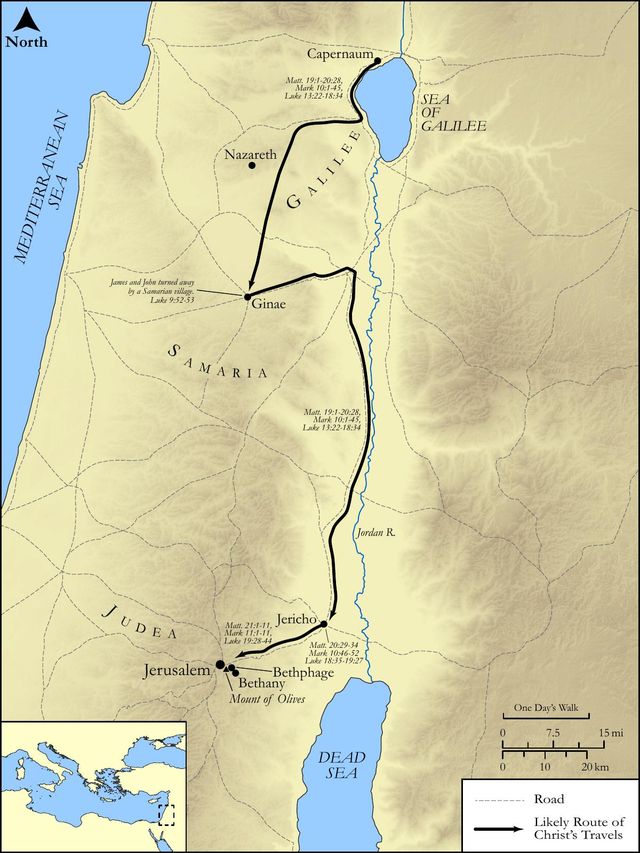
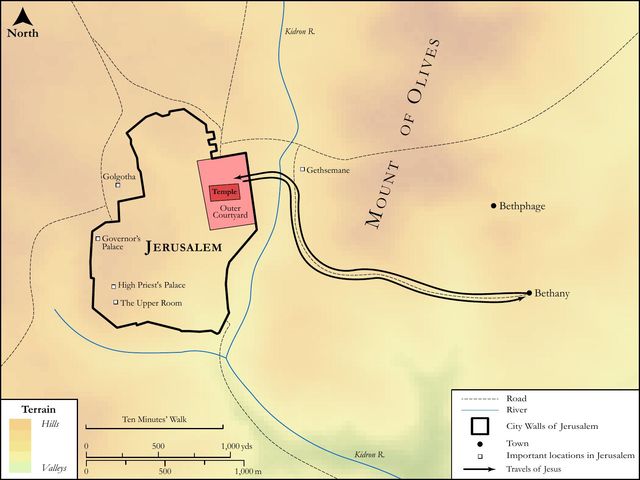
Study this verse
Public-domain commentary
Matthew Henry
From his Commentary on the Whole Bible. Henry comments on passages, not single verses — this entry covers Mark 11:27–33. His three-level outline is real structure in the source text, so it is rendered as structure.
We have here Christ examined by the great Sanhedrim concerning his authority; for they claimed a power to call prophets to an account concerning their mission. They came to him when he was walking in the temple, not for his diversion, but teaching the people, first one company and then another. The Peripatetic philosophers were so called from the custom they had of walking when they taught. The cloisters, or piazzas, in the courts of the temple, were fitted for this purpose. The great men were vexed to see him followed and heard with attention, and therefore came to him with some solemnity, and did as it were arraign him at the bar with this question, By what authority doest thou these things? Mar 11:28. Now observe,
I.How they designed hereby to run him aground, and embarrass him.
If they could make it out before the people, that he had not a legal mission, that he was not duly ordained, though he was ever so well qualified, and preached ever so profitably and well, they would tell the people that they ought not to hear him. This they made the last refuge of an obstinate unbelief; because they were resolved not to receive his doctrine, they were resolved to find some flaw or other in his commission, and will conclude it invalid, if it be not produced and ratified in their court. Thus the Papists resolve their controversy with us very much into the mission of our ministers, and if they have but any pretence to overthrow that, they think they have gained their point, though we have the scripture ever so much on our side. But this is indeed a question, which all that act either as magistrates or ministers, ought to be furnished with a good answer to, and often put to themselves, By what authority do I these things? For how can men preach except they be sent? Or how can they act with comfort, or confidence, or hope of success, except they be authorized? Jer 23:32.
II.How he effectually ran them aground, and embarrassed them, with this question, "What are your thoughts concerning the baptism of John? Was it from heaven, or of men? By what authority did John preach, and baptize, and gather disciples? Answer me, Mar 11:30. Deal fairly and ingenuously, and give a categorical answer, one way or the other." By this resolve of their question into this, our Saviour intimates how near akin his doctrine and baptism were to John's; they had the same original, and the same design and tendency - to introduce the gospel kingdom. Christ might with the better grace put this question to them, because they had sent a committee of their own house to examine John, Joh 1:19. "Now," saith Christ, "what was the result of your enquiries concerning him?"
They knew what they thought of this question; they could not but think that John Baptist was a man sent of God. But the difficulty was, what they should say to it now. Men that oblige not themselves to speak as they think (which is a certain rule) cannot avoid perplexing themselves thus.
1.If they own the baptism of John to be from heaven, as really it was, they shame themselves; for Christ will presently turn it upon them, Why did ye not then believe him, and receive his baptism? They could not bear that Christ should say this, but they could bear it that their own consciences should say so, because they had an art of stifling and silencing them, and because what conscience said, though it might gall and grate them a little, would not shame them; and then they would do well enough, who looked no further than Saul's care, when he was convicted, Honour me now before this people, Sa1 15:30.
2.If they say, "It is of men, he was not sent of God, but his doctrine and baptism were inventions of his own," they expose themselves, the people will be ready to do them a mischief, or a least clamour upon them; for all men counted John that he was a prophet indeed, and therefore they could not bear that he should be reflected on. Note, There is a carnal slavish fear, which not only wicked subjects but wicked rulers likewise are liable to, which God makes use of as a means to keep the world in some order, and to suppress violence, that it shall not always grow up into a rod of wickedness. Now by this dilemma to which Christ brought them,
(1.)They were confounded and baffled, and forced to make a dishonourable retreat; to pretend ignorance - We cannot tell (and that was mortification enough to those proud men), but really to discover the greatest malice and wilfulness. What Christ did by his wisdom, we must labour to do by our well doing - put to silence the ignorance of foolish men, Pe1 2:15.
(2.)Christ came off with honour, and justified himself in refusing to give them an answer to their imperious demand; Neither tell I you by what authority I do these things. They did not deserve to be told; for it was plain that they contended not for truth, but victory; nor did he need to tell them, for the works which he did, told them plainly that he had authority from God to do what he did; since no man could do those miracles which he did unless God were with him. Let them wait but three or four days, and his resurrection shall tell them who gave him his authority, for by that he will be declared to be the Son of God with power, as by their rejecting of him, notwithstanding, they will be declared to be the enemies of God.
Historical interpretation
Four Centuries of Reception
3 surviving comments on this verse. Each one is dated, so this reads as a timeline rather than a list.
Select a marker to jump to its quote. Markers stagger vertically where authors wrote within a few decades of each other.
They envied the Lamp, and were in the dark, wherefore it is said, I have ordained a lamp for mine anointed; his enemies will I clothe with shame. (Ps. 132:17, 18) There follows: And Jesus answering saith unto them, Neither do I tell you by what authority I do these things.
(ubi sup.) And indeed, when they say, By what authority doest thou these things, they doubt its being the power of God, and wish it to be understood that what He did was the devil's work. When they add also, Who gave thee this authority, they evidently deny that He is the Son of God, since they believe that He works miracles, not by His own but by another's power.
(ubi sup.) The Lord might indeed have confuted the cavils of his tempters by a direct answer, but prudently puts them a question, that they might be condemned either by their silence or their speaking, which is evident from what is added, And they reasoned with themselves, saying, If we shall say, From heaven; he will say, Why then did ye not believe him? As if He had said, He whom you confess to have had his prophecy from heaven bore testimony of Me, and ye have heard from him, by what authority I do these things. It goes on: But if we shall say, Of men; they feared the people. They saw then that whatever they answered, they should fall into a snare; fearing to be stoned, they feared still more the confession of the truth. Wherefore it goes on: And they answered and said unto Jesus, We cannot tell.
(ubi sup.) As if He had said, I will not tell you what I know, since ye will not confess what ye know. Further, we must observe that knowledge is hidden from those who seek it, principally for two reasons, namely, when he who seeks for it either has not sufficient capacity to understand what he seeks for, or when through contempt for the truth, or some other reason, he is unworthy of having that for which he seeks opened to him.
They were angry with the Lord, for having cast out of the temple those who had made it a place of merchandize, and therefore they come up to Him, to question and tempt Him. Wherefore it is said: And they come again to Jerusalem: and as he was walking in the temple, there come to him the Chief Priests, and the Scribes, and the elders, and say unto him, By what authority doest thou these things? and who gave thee authority to do these things? As if they had said, Who art thou that doest these things? Dost thou make thyself a doctor, and ordain thyself Chief Priest?
Further, they said this, thinking to bring Him to judgment, so that if He said, by mine own power, they might lay hold upon Him; but if He said, by the power of another, they might make the people leave Him, for they believed Him to be God. But the Lord asks them concerning John, not without a reason, nor in a sophistical way, but because John had borne witness of Him. Wherefore there follows: And Jesus answered and said unto them, I will also ask of you one question, and answer me, and I will tell you by what authority I do these things. The baptism of John, was it from heaven, or of men? answer me.
Continue studying Mark 11:27 across the web’s major study libraries — every link below opens this exact verse, chapter, or book on the destination site.
Read & Compare
 BibleGatewayThis verse in more than 200 translations and 70 languages.
 Bible.comThe YouVersion reader — hundreds of translations, reading plans, and highlights.
 ESV.orgCrossway's official English Standard Version reader.
 NET BibleThe NET translation with 60,000+ translators' notes on every rendering decision.
 STEP BibleTyndale House's free study tool — original text, vocabulary, and scholarly resources.
 BibliaLogos Bible Software's free web reader.
 USCCBThe New American Bible (Revised Edition) with the U.S. bishops' study notes.
Commentaries
 BibleHub CommentariesDozens of classic commentaries on this verse, gathered on one page.
 StudyLightMore than 100 commentary sets — the largest collection on the web.
 BibleRefPlain-English commentary on what this verse means, verse by verse.
 Enduring WordDavid Guzik's free commentary on this chapter, widely used by Bible teachers.
 Bible Study ToolsVerse commentary alongside Greek and Hebrew study aids.
Original Language & Research
- BibleHub InterlinearThe verse word by word — original language, transliteration, and English.
- BibleHub LexiconEvery word's original-language definition and Strong's entry.
 Blue Letter BibleDeep-study tools — Strong's numbers, concordance, and word studies.
 CNTR CollationThe earliest Greek manuscripts of this verse, collated letter by letter.
Sermons, Hymns & Audio


TrulyRandomVerse is not affiliated with these sites and doesn’t control their content. They’re linked because they’re genuinely useful.
Summary
Mark 11:27 marks a pivotal moment in Jesus' final week in Jerusalem, immediately following His dramatic cleansing of the Temple. As Jesus resumes His teaching and presence within the sacred precincts, He is directly confronted by the assembled religious leadership—the chief priests, scribes, and elders. This encounter signals the escalating tension and formal opposition to Jesus' ministry and authority, setting the stage for the intense interrogations and conflicts that will define the remainder of Passion Week and ultimately lead to His crucifixion.
Context
ShowHideLiterary Context
This verse is strategically placed within Mark's narrative of Jesus' Passion Week, beginning with His triumphal entry into Jerusalem (Mark 11:1-11). Immediately preceding this confrontation, Jesus had demonstrated His divine authority by cursing a fig tree, symbolizing barren Israel (Mark 11:12-14), and then by cleansing the Temple courts, overturning the tables of money changers and driving out those who bought and sold, asserting its purpose as a "house of prayer" (Mark 11:15-19). This act of cleansing was a direct challenge to the established religious and economic systems operating within the Temple, an act that deeply provoked the authorities. Verse 27, therefore, is the direct consequence of these bold, authoritative actions, representing the official response of the Jewish leadership to Jesus' perceived usurpation of their control. The subsequent verses (Mark 11:28-33) immediately detail their challenge to His authority, to which Jesus responds with a counter-question about John the Baptist's baptism.
Historical & Cultural Context
Jerusalem during Passover week was a city teeming with pilgrims, significantly increasing the population and the potential for religious and political unrest. The Temple was the epicenter of Jewish life, worship, and national identity, controlled by the priestly aristocracy, primarily Sadducees, who collaborated with Roman authorities to maintain order. The chief priests, scribes, and elders collectively represented the Sanhedrin, the highest Jewish religious and judicial council. The chief priests were the heads of the priestly families, responsible for Temple operations and rituals; the scribes were experts in the Mosaic Law, often Pharisees, who interpreted and taught the Scriptures; and the elders were respected lay leaders. Their combined presence indicates a formal, unified front of the highest echelons of Jewish leadership, convening to address what they considered a grave threat to their authority, the Temple order, and the delicate political balance with Rome. Jesus' actions in the Temple, seen as a prophetic judgment and a direct challenge to their control, necessitated an official response.
Key Themes
ShowHideThis verse contributes significantly to several major themes in Mark's Gospel. Firstly, it highlights the theme of Confrontation and Opposition between Jesus and the Jewish religious establishment, which intensifies dramatically in Jerusalem. The gathering of the chief priests, scribes, and elders underscores the gravity of their unified resistance to Jesus. Secondly, it sets the stage for the theme of Jesus' Authority, which is explicitly challenged in the verses immediately following (Mark 11:28). His actions in the Temple and His teaching presence are perceived as an usurpation of their established power. Thirdly, the setting of Jerusalem, particularly the Temple, functions as a Crucible of Conflict, where the divine mission of Jesus directly clashes with human religious and political systems, ultimately leading to the Passion. This encounter underscores the profound theological divide between Jesus' understanding of God's kingdom and the leaders' preoccupation with their own power and traditions.
Exposition and Analysis
ShowHideKey Word Analysis
ShowHideThis verb, used twice in the verse, signifies movement and arrival. Its repetition emphasizes the deliberate nature of both Jesus' return to Jerusalem and the authorities' approach to Him. It suggests an active engagement and a convergence of parties, setting the scene for an inevitable encounter. The word implies a purposeful coming, not accidental, highlighting the intentionality of the confrontation.
This term describes Jesus' action of "walking at large" or "being occupied with" in the Temple. It denotes His continued public presence and active engagement in teaching and ministry within the sacred space. This was not a casual stroll but a purposeful presence, demonstrating His claim to the Temple as His Father's house and His ongoing prophetic work, which directly challenged the status quo.
This term refers to the high priest and the heads of the priestly families, who were primarily Sadducees and held significant power and responsibility for the Temple's administration and finances. Their presence, alongside the scribes and elders, signifies the unified and official opposition from the highest religious and political authority in Judaism. Their primary concern would have been the disruption of order and the challenge to their established control over the Temple and its practices.
Verse Breakdown
ShowHide"And they come again to Jerusalem:"
This clause re-establishes the setting, emphasizing Jesus' return to the city after spending the night in Bethany (Mark 11:11). The phrase "come again" underscores the continuous nature of His engagement with Jerusalem during Passion Week, a period of intense activity and escalating tension. His repeated presence in the heart of Jewish religious life signals His deliberate engagement with the city and its leadership.
"and as he was walking in the temple,"
This phrase describes Jesus' active presence within the Temple precincts. "Walking in the temple" implies His public teaching and continued assertion of authority within this sacred space, which He had cleansed the day before. It highlights His accessibility and His willingness to confront the religious establishment on their own ground, rather than retreating from the consequences of His actions. The Temple, as the spiritual and economic hub, was the natural arena for this unfolding drama.
"there come to him the chief priests, and the scribes, and the elders,"
This final clause introduces the antagonists. The arrival of this formidable delegation—representing the full spectrum of the Sanhedrin—is a direct response to Jesus' actions and teachings. Their collective presence signifies a formal, unified, and authoritative challenge. The "chief priests" (Sadducean aristocracy), "scribes" (legal experts, often Pharisees), and "elders" (prominent lay leaders) together embody the highest religious and political power in Jewish society, indicating the extreme gravity with which they viewed Jesus' ministry. Their approach to "him" underscores that Jesus is the direct object of their concern and scrutiny.
Literary Devices
ShowHideThe verse employs several literary devices that enhance its dramatic impact. Juxtaposition is evident in the contrast between Jesus' calm "walking in the temple" and the formal, perhaps confrontational, "coming" of the authorities. This highlights the differing motivations and postures of the parties involved. The Synecdoche of "the chief priests, and the scribes, and the elders" represents the entire Sanhedrin, the highest Jewish governing body, indicating the full weight of institutional opposition. This collective designation also serves as Foreshadowing, signaling the organized and escalating nature of the conflict that will culminate in Jesus' trial and crucifixion. The Temple itself functions as a Symbolic Setting, not merely a physical location but a representation of Jewish religious authority and tradition, making it the ideal stage for this confrontation over true authority and worship.
Theological and Thematic Connections
ShowHideMark 11:27 is a crucial turning point, marking the formal initiation of the religious authorities' direct challenge to Jesus' authority, a theme central to Mark's Gospel. Jesus' actions in the Temple, particularly the cleansing, were not merely disciplinary but prophetic, asserting His messianic prerogative and divine authority over the very institution that the chief priests, scribes, and elders controlled. Their unified approach signifies their recognition of Jesus as a significant threat to their established power, theological interpretations, and the delicate balance of their relationship with Roman rule. This confrontation highlights the inherent tension between divine truth and human institutions that prioritize tradition, power, or self-interest over God's revealed will. It underscores that true spiritual authority often clashes with entrenched religious systems, leading to opposition for those who faithfully proclaim God's kingdom.
Reflection and Application
ShowHideThis scene in Mark 11:27 offers profound lessons for believers today. It reminds us that faithfulness to God's truth and the exercise of authentic spiritual authority can often provoke resistance from established powers, even within religious circles. Jesus, walking openly in the Temple, did not shy away from the consequences of His prophetic actions or His claims of authority. He met the opposition head-on, demonstrating courageous obedience to His Father's will. For us, this means understanding that following Christ may lead to uncomfortable confrontations with prevailing norms or entrenched systems, especially when those systems deviate from God's heart. We are called to discern true authority, which flows from God's Spirit and Word, rather than from human tradition or position alone. It encourages us to remain steadfast in our convictions, to speak truth with grace and courage, and to trust that God's authority will ultimately prevail, even when faced with formidable opposition. Our mission, like Jesus', is to live out God's purposes, even when it means challenging the status quo.
Questions for Reflection
ShowHideFAQ
ShowHideWhy did the chief priests, scribes, and elders come to Jesus together?
ShowHideThey came together because they represented the collective authority of the Sanhedrin, the highest Jewish religious and political council. Their unified presence underscored the gravity of the situation and their formal, institutional response to Jesus' actions and teachings. Jesus' cleansing of the Temple (Mark 11:15-19) and His public teaching were perceived as a direct challenge to their control, their interpretation of the Law, and the stability of their relationship with the Roman authorities. Their joint appearance was a strategic move to confront Jesus with the full weight of their combined power and to formally question the source of His authority, as seen in the very next verse (Mark 11:28).
Christ-Centered Fulfillment
ShowHideMark 11:27, though seemingly a simple narrative detail, profoundly points to Christ's identity and mission. His "walking in the temple" after cleansing it is an act of sovereign ownership, fulfilling prophecies of the Messiah coming to His Temple (Malachi 3:1). The confrontation with the chief priests, scribes, and elders foreshadows the ultimate clash between the kingdom of God, embodied in Jesus, and the corrupted religious systems of humanity. Jesus, as the true High Priest (Hebrews 4:14) and the ultimate Temple (John 2:19-21), stands against those who had turned God's house into a "den of thieves" (Mark 11:17). This scene highlights His divine authority, not derived from human institutions or traditions, but inherent in His being as the Son of God (John 5:27). His willingness to face this formidable opposition, knowing it would lead to His crucifixion, demonstrates His unwavering commitment to His Father's will and His redemptive mission to establish a new covenant and a new way of worship, centered on Himself, the perfect sacrifice (Hebrews 9:11-14).