


Mark 11:32
- ἀλλ᾽all᾽ButG235CONJConjunction
- ἐὰνeanifG1437CONDConjunction
- εἴπωμεν·eipōmenshall we sayG2036V-2AAS-1PVerb 2nd Aorist Active Subjunctive 1st Plural
- ἐξexFromG1537PREPPreposition
- ἀνθρώπωνanthrōpōnmen’G444N-GPMNoun Genitive Plural Masculine
- ἐφοβοῦντοephobountothey were afraid ofG5399V-INI-3PVerb Imperfect Middle Or Passive Deponent Indicative 3rd Plural
- τὸνtontheG3588T-ASMDefinite article Accusative Singular Masculine
- ὄχλον·ochloncrowdG3793N-ASMNoun Accusative Singular Masculine
- ἅπαντεςhapantesallG537A-NPMAdjective Nominative Plural Masculine
- γὰρgarforG1063CONJConjunction
- εἶχονeichonwere holdingG2192V-IAI-3PVerb Imperfect Active Indicative 3rd Plural
- τὸνton<the>G3588T-ASMDefinite article Accusative Singular Masculine
- ἸωάννηνIōannēnJohnG2491N-ASM-PNoun Accusative Singular Masculine Individual
- ὄντωςontōstrulyG3689ADVAdverb
- ὅτιhotithatG3754CONJConjunction
- προφήτηςprophētēsa prophetG4396N-NSMNoun Nominative Singular Masculine
- ἦνēnhe wasG1510V-IAI-3SVerb Imperfect Active Indicative 3rd Singular
English is a literal word-by-word gloss of the Greek, not the KJV's wording. Why?
This is the original text the KJV's translators worked from — each Greek word with its own literal English meaning in this verse, prepared by scholars at Tyndale House, Cambridge. The KJV translates whole sentences, not word by word, so its wording differs: one Greek word can become several English words, and the KJV may choose “charity” where the gloss reads “love”. Both are faithful — they answer different questions. For the KJV's own rendering, switch to the KJV text.
Details
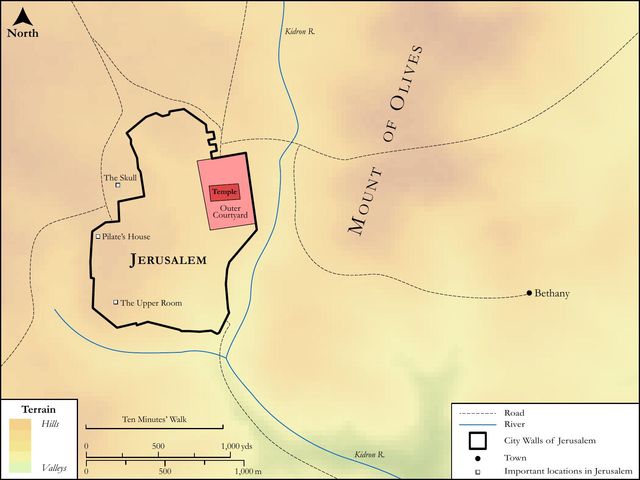
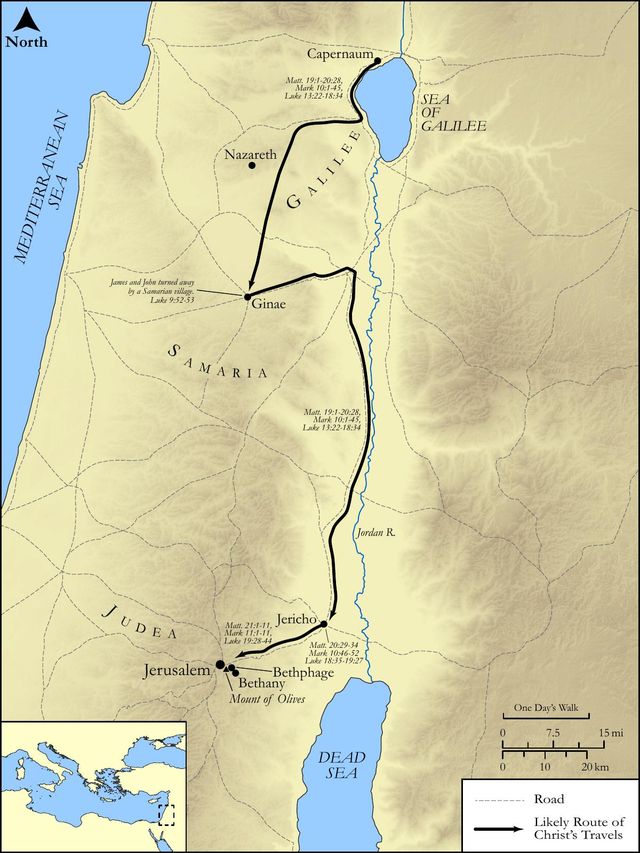
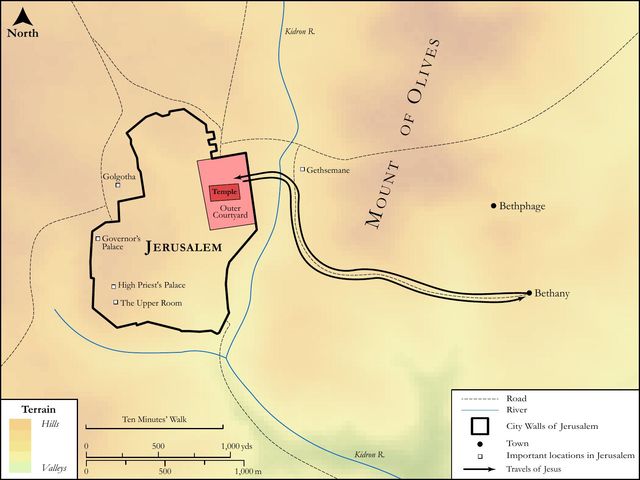
See on the biblical-era map
Study this verse
Public-domain commentary
Matthew Henry
From his Commentary on the Whole Bible. Henry comments on passages, not single verses — this entry covers Mark 11:27–33. His three-level outline is real structure in the source text, so it is rendered as structure.
We have here Christ examined by the great Sanhedrim concerning his authority; for they claimed a power to call prophets to an account concerning their mission. They came to him when he was walking in the temple, not for his diversion, but teaching the people, first one company and then another. The Peripatetic philosophers were so called from the custom they had of walking when they taught. The cloisters, or piazzas, in the courts of the temple, were fitted for this purpose. The great men were vexed to see him followed and heard with attention, and therefore came to him with some solemnity, and did as it were arraign him at the bar with this question, By what authority doest thou these things? Mar 11:28. Now observe,
I.How they designed hereby to run him aground, and embarrass him.
If they could make it out before the people, that he had not a legal mission, that he was not duly ordained, though he was ever so well qualified, and preached ever so profitably and well, they would tell the people that they ought not to hear him. This they made the last refuge of an obstinate unbelief; because they were resolved not to receive his doctrine, they were resolved to find some flaw or other in his commission, and will conclude it invalid, if it be not produced and ratified in their court. Thus the Papists resolve their controversy with us very much into the mission of our ministers, and if they have but any pretence to overthrow that, they think they have gained their point, though we have the scripture ever so much on our side. But this is indeed a question, which all that act either as magistrates or ministers, ought to be furnished with a good answer to, and often put to themselves, By what authority do I these things? For how can men preach except they be sent? Or how can they act with comfort, or confidence, or hope of success, except they be authorized? Jer 23:32.
II.How he effectually ran them aground, and embarrassed them, with this question, "What are your thoughts concerning the baptism of John? Was it from heaven, or of men? By what authority did John preach, and baptize, and gather disciples? Answer me, Mar 11:30. Deal fairly and ingenuously, and give a categorical answer, one way or the other." By this resolve of their question into this, our Saviour intimates how near akin his doctrine and baptism were to John's; they had the same original, and the same design and tendency - to introduce the gospel kingdom. Christ might with the better grace put this question to them, because they had sent a committee of their own house to examine John, Joh 1:19. "Now," saith Christ, "what was the result of your enquiries concerning him?"
They knew what they thought of this question; they could not but think that John Baptist was a man sent of God. But the difficulty was, what they should say to it now. Men that oblige not themselves to speak as they think (which is a certain rule) cannot avoid perplexing themselves thus.
1.If they own the baptism of John to be from heaven, as really it was, they shame themselves; for Christ will presently turn it upon them, Why did ye not then believe him, and receive his baptism? They could not bear that Christ should say this, but they could bear it that their own consciences should say so, because they had an art of stifling and silencing them, and because what conscience said, though it might gall and grate them a little, would not shame them; and then they would do well enough, who looked no further than Saul's care, when he was convicted, Honour me now before this people, Sa1 15:30.
2.If they say, "It is of men, he was not sent of God, but his doctrine and baptism were inventions of his own," they expose themselves, the people will be ready to do them a mischief, or a least clamour upon them; for all men counted John that he was a prophet indeed, and therefore they could not bear that he should be reflected on. Note, There is a carnal slavish fear, which not only wicked subjects but wicked rulers likewise are liable to, which God makes use of as a means to keep the world in some order, and to suppress violence, that it shall not always grow up into a rod of wickedness. Now by this dilemma to which Christ brought them,
(1.)They were confounded and baffled, and forced to make a dishonourable retreat; to pretend ignorance - We cannot tell (and that was mortification enough to those proud men), but really to discover the greatest malice and wilfulness. What Christ did by his wisdom, we must labour to do by our well doing - put to silence the ignorance of foolish men, Pe1 2:15.
(2.)Christ came off with honour, and justified himself in refusing to give them an answer to their imperious demand; Neither tell I you by what authority I do these things. They did not deserve to be told; for it was plain that they contended not for truth, but victory; nor did he need to tell them, for the works which he did, told them plainly that he had authority from God to do what he did; since no man could do those miracles which he did unless God were with him. Let them wait but three or four days, and his resurrection shall tell them who gave him his authority, for by that he will be declared to be the Son of God with power, as by their rejecting of him, notwithstanding, they will be declared to be the enemies of God.
Historical interpretation
Four Centuries of Reception
4 surviving comments on this verse. Each one is dated, so this reads as a timeline rather than a list.
Select a marker to jump to its quote. Markers stagger vertically where authors wrote within a few decades of each other.
They envied the Lamp, and were in the dark, wherefore it is said, I have ordained a lamp for mine anointed; his enemies will I clothe with shame. (Ps. 132:17, 18) There follows: And Jesus answering saith unto them, Neither do I tell you by what authority I do these things.
(ubi sup.) And indeed, when they say, By what authority doest thou these things, they doubt its being the power of God, and wish it to be understood that what He did was the devil's work. When they add also, Who gave thee this authority, they evidently deny that He is the Son of God, since they believe that He works miracles, not by His own but by another's power.
(ubi sup.) The Lord might indeed have confuted the cavils of his tempters by a direct answer, but prudently puts them a question, that they might be condemned either by their silence or their speaking, which is evident from what is added, And they reasoned with themselves, saying, If we shall say, From heaven; he will say, Why then did ye not believe him? As if He had said, He whom you confess to have had his prophecy from heaven bore testimony of Me, and ye have heard from him, by what authority I do these things. It goes on: But if we shall say, Of men; they feared the people. They saw then that whatever they answered, they should fall into a snare; fearing to be stoned, they feared still more the confession of the truth. Wherefore it goes on: And they answered and said unto Jesus, We cannot tell.
(ubi sup.) As if He had said, I will not tell you what I know, since ye will not confess what ye know. Further, we must observe that knowledge is hidden from those who seek it, principally for two reasons, namely, when he who seeks for it either has not sufficient capacity to understand what he seeks for, or when through contempt for the truth, or some other reason, he is unworthy of having that for which he seeks opened to him.
If we say from men, we fear the people. For all held John to be a true prophet. Therefore, they saw that whichever of these they answered, they would fall into a trap, fearing stoning, but more fearing the confession of the truth.
They were angry with the Lord, for having cast out of the temple those who had made it a place of merchandize, and therefore they come up to Him, to question and tempt Him. Wherefore it is said: And they come again to Jerusalem: and as he was walking in the temple, there come to him the Chief Priests, and the Scribes, and the elders, and say unto him, By what authority doest thou these things? and who gave thee authority to do these things? As if they had said, Who art thou that doest these things? Dost thou make thyself a doctor, and ordain thyself Chief Priest?
Further, they said this, thinking to bring Him to judgment, so that if He said, by mine own power, they might lay hold upon Him; but if He said, by the power of another, they might make the people leave Him, for they believed Him to be God. But the Lord asks them concerning John, not without a reason, nor in a sophistical way, but because John had borne witness of Him. Wherefore there follows: And Jesus answered and said unto them, I will also ask of you one question, and answer me, and I will tell you by what authority I do these things. The baptism of John, was it from heaven, or of men? answer me.
Continue studying Mark 11:32 across the web’s major study libraries — every link below opens this exact verse, chapter, or book on the destination site.
Read & Compare
 BibleGatewayThis verse in more than 200 translations and 70 languages.
 Bible.comThe YouVersion reader — hundreds of translations, reading plans, and highlights.
 ESV.orgCrossway's official English Standard Version reader.
 NET BibleThe NET translation with 60,000+ translators' notes on every rendering decision.
 STEP BibleTyndale House's free study tool — original text, vocabulary, and scholarly resources.
 BibliaLogos Bible Software's free web reader.
 USCCBThe New American Bible (Revised Edition) with the U.S. bishops' study notes.
Commentaries
 BibleHub CommentariesDozens of classic commentaries on this verse, gathered on one page.
 StudyLightMore than 100 commentary sets — the largest collection on the web.
 BibleRefPlain-English commentary on what this verse means, verse by verse.
 Enduring WordDavid Guzik's free commentary on this chapter, widely used by Bible teachers.
 Bible Study ToolsVerse commentary alongside Greek and Hebrew study aids.
Original Language & Research
- BibleHub InterlinearThe verse word by word — original language, transliteration, and English.
- BibleHub LexiconEvery word's original-language definition and Strong's entry.
 Blue Letter BibleDeep-study tools — Strong's numbers, concordance, and word studies.
 CNTR CollationThe earliest Greek manuscripts of this verse, collated letter by letter.
Sermons, Hymns & Audio


TrulyRandomVerse is not affiliated with these sites and doesn’t control their content. They’re linked because they’re genuinely useful.
Summary
Mark 11:32 reveals the internal deliberation of the chief priests, scribes, and elders as they faced Jesus' counter-question regarding the authority of John the Baptist. Unable to deny John's divine commission without alienating the populace, and unwilling to affirm it lest Jesus challenge their own unbelief, they were trapped by their fear of popular opinion. This verse highlights their spiritual hypocrisy and the widespread recognition of John as a true prophet, which ultimately cornered the religious authorities and exposed their lack of genuine faith.
Context
ShowHideLiterary Context
This verse is situated immediately after Jesus' triumphal entry into Jerusalem and His dramatic cleansing of the Temple, an act that directly challenged the religious establishment. Following these events, the chief priests, scribes, and elders confront Jesus in the Temple courts, demanding to know by what authority He performs these things (Mark 11:27-28). Instead of directly answering, Jesus poses a counter-question about the origin of John the Baptist's baptism: "Was it from heaven, or from men? Answer me" (Mark 11:29-30). The religious leaders then engage in a private discussion, realizing they are caught in an inescapable dilemma. Mark 11:31 details their internal debate about the implications of saying "from heaven," while Mark 11:32 explains why they could not say "from men," setting the stage for their evasive non-answer in Mark 11:33.
Historical & Cultural Context
First-century Judea was under Roman occupation, but religious authority remained largely with the Sanhedrin, composed of chief priests, scribes, and elders. These leaders were highly sensitive to public perception and popular movements, especially given the volatile political climate and the constant threat of Roman intervention. John the Baptist had garnered immense popular support, with many considering him a prophet in the tradition of Elijah, a figure deeply revered in Jewish eschatological expectation (see Malachi 4:5-6). His ascetic lifestyle, wilderness ministry, and powerful message of repentance resonated deeply with the common people who often felt alienated by the formal Temple hierarchy. The leaders' fear of the people was not merely about losing face but potentially inciting a riot or unrest that could invite Roman reprisal, jeopardizing their precarious position of power.
Key Themes
ShowHideThis verse powerfully contributes to several key themes within the Gospel of Mark. Primarily, it highlights the conflict between divine authority and human authority, underscoring how the religious leaders consistently rejected God's messengers and His truth, prioritizing their own power and prestige. It also emphasizes the spiritual blindness and hypocrisy of those who outwardly claimed spiritual leadership but were driven by worldly fear and political expediency, a theme prevalent throughout Jesus' ministry (e.g., Mark 7:6-9). Furthermore, it affirms the legitimacy and widespread recognition of John the Baptist's prophetic ministry, serving as a crucial bridge between the Old Testament prophets and the coming of Jesus. John's divine commission, acknowledged by the masses, indirectly validates his testimony about Jesus as the Messiah, thereby exposing the leaders' rejection of both John and Jesus as a rejection of God's appointed agents. This entire exchange showcases Jesus' wisdom and strategic brilliance in exposing the true motives of His adversaries without directly falling into their trap.
Exposition and Analysis
ShowHideKey Word Analysis
ShowHideThis verb signifies to be alarmed, frightened, or to revere. In this context, it primarily conveys a sense of being afraid, specifically of the people's reaction. It indicates that the leaders' decision-making was driven by external pressure and the potential negative consequences of popular backlash, rather than by a genuine search for truth or reverence for God. Their fear of man outweighed any fear of God.
Derived from a primary verb meaning "to hold," this word implies that the people held a strong, established belief or opinion about John. It suggests a widespread and firm conviction, not a fleeting thought. This underscores the depth of popular support for John and the difficulty the leaders faced in trying to dismiss his prophetic status. It was a settled matter in the public mind.
This adverb means "really," "certainly," or "of a truth." Its inclusion emphasizes the undeniable reality and widespread acceptance of John's prophetic status among the people. It highlights that John was not merely considered a prophet by a few, but truly and genuinely acknowledged as such by the vast majority, making the leaders' dilemma all the more acute.
Verse Breakdown
ShowHide"But if we shall say, Of men;"
This clause reveals the second half of the religious leaders' internal debate. After considering the implications of affirming John's divine authority, they now weigh the consequences of denying it, contemplating the option that John's baptism originated purely from human initiative, without divine sanction.
"they feared the people:"
This phrase immediately states the critical obstacle to the second option. The leaders' primary concern was not theological accuracy or spiritual truth, but the reaction of the populace. Their fear of public opinion, potential unrest, and the erosion of their own authority superseded any other consideration.
"for all [men] counted John, that he was a prophet indeed."
This final clause provides the explicit reason for their fear. It unequivocally states that John the Baptist was universally recognized and firmly believed to be a genuine prophet by the entire populace. This widespread conviction meant that any public denial of John's prophetic status by the religious authorities would be met with severe popular disapproval, endangering their standing and control.
Literary Devices
ShowHideThe passage employs several potent literary devices. The most prominent is Irony, as the very spiritual leaders who should discern and uphold divine truth are instead paralyzed by the fear of human opinion, highlighting their profound spiritual bankruptcy. Jesus' question itself creates a powerful Dilemma for His adversaries, a rhetorical trap that exposes their true motives and inability to answer honestly. Their fear of the people, rather than fear of God, serves as a form of Characterization, revealing the corrupt nature of their leadership. Furthermore, the narrative uses Foreshadowing, as the leaders' rejection of John's divinely appointed authority, driven by their fear of man, mirrors and anticipates their ultimate rejection of Jesus' authority, leading to His crucifixion.
Theological and Thematic Connections
ShowHideMark 11:32 profoundly illustrates the destructive power of the fear of man when it supplants the fear of God. The religious leaders, ostensibly guardians of divine truth, were so consumed by their concern for public perception and the preservation of their own power that they could not acknowledge what was plainly evident to the common people: John the Baptist was a prophet sent by God. This passage serves as a stark warning against prioritizing human approval over divine truth and integrity. It underscores that true spiritual authority is derived from God, not from popular consensus or political maneuvering. The leaders' refusal to answer honestly exposes their spiritual blindness and hypocrisy, demonstrating that outward religious observance can mask a heart devoid of genuine faith and courage.
Reflection and Application
ShowHideMark 11:32 challenges us to honestly examine our own motivations and allegiances. Are we, like the religious leaders, more concerned with what others think of us, with maintaining our reputation, or avoiding discomfort, than with standing for truth and righteousness? This verse serves as a powerful reminder that genuine faith requires courage to acknowledge and uphold God's truth, even when it is unpopular, inconvenient, or costly. It calls us to cultivate a greater fear of the Lord, which is the beginning of wisdom, rather than succumbing to the enslaving fear of man. True integrity means aligning our words and actions with our convictions, even if it means facing criticism or opposition. This passage also encourages us to discern true authority, recognizing that God often works through unexpected channels and that popular opinion is not always a reliable guide to divine truth. Our ultimate allegiance must be to God and His word, not to the shifting tides of human sentiment.
Questions for Reflection
ShowHideFAQ
ShowHideWhy was John the Baptist's prophetic status so important in this exchange?
ShowHideJohn the Baptist's prophetic status was crucial because he was God's appointed forerunner, preparing the way for Jesus the Messiah. His ministry, marked by a call to repentance and baptism, was widely recognized by the common people as divinely inspired. If the religious leaders acknowledged John's authority as "from heaven," they would then be compelled to explain why they did not believe his testimony about Jesus, which would expose their spiritual hypocrisy and unbelief. If they denied John's authority as "from men," they would face the wrath of the people who held John in high esteem as a true prophet. Jesus' counter-question masterfully trapped them, forcing them to reveal their true motives and lack of genuine spiritual discernment, as they were unwilling to affirm God's work for fear of human consequences. John's role as a prophet was inextricably linked to Jesus' identity and mission, making the question of his authority a direct challenge to the leaders' rejection of God's plan (see Luke 7:29-30).
Christ-Centered Fulfillment
ShowHideMark 11:32, though focusing on the religious leaders' fear and John the Baptist's recognized prophetic status, ultimately points to Christ. John's ministry, divinely ordained and widely acknowledged, served as the direct precursor to Jesus, fulfilling the Old Testament prophecies of a messenger preparing the way of the Lord (e.g., Malachi 3:1). The leaders' inability to affirm John's heavenly authority, due to their fear of the people, reveals their deeper rejection of God's will and His chosen messengers. This fear-driven rejection of John foreshadows their ultimate rejection of Jesus, whose authority was indeed "from heaven" but was met with similar opposition and unbelief from the religious elite (see John 5:36-40). Jesus, as the true Prophet, Priest, and King, possessed ultimate authority, not derived from human consensus or dependent on human approval, but from God the Father Himself (as affirmed in Matthew 28:18). The leaders' dilemma highlights the contrast between those who receive God's truth, even through an unconventional prophet like John, and those who harden their hearts against it, ultimately rejecting the very Son of God who came to save them (see John 1:11). Thus, their fear of man in denying John's authority was a manifestation of their deeper spiritual blindness that prevented them from recognizing and submitting to the divine authority embodied in Christ.