


Luke 21:37
Bible text: King James Version (1769 Blayney text) · Public domain
Bible text: King James Version with Strong's numbers · Public domain
Bible text: Berean Standard Bible · Public domain
Bible text: American Standard Version (1901) · Public domain
Bible text: World English Bible, Messianic edition · Public domain
Bible text: Geneva Bible (1599) · Public domain
Bible text: Young's Literal Translation · Public domain
- ἮνĒnHe wasG1510V-IAI-3SVerb Imperfect Active Indicative 3rd Singular
- δὲdenowG1161CONJConjunction
- τὰςtasduring theG3588T-APFDefinite article Accusative Plural Feminine
- ἡμέραςhēmerasdayG2250N-APFNoun Accusative Plural Feminine
- ἐνeninG1722PREPPreposition
- τῷtōtheG3588T-DSNDefinite article Dative Singular Neuter
- ἱερῷhi'erōtempleG2411N-DSNNoun Dative Singular Neuter
- διδάσκωνdidaskōnteachingG1321V-PAP-NSMVerb Present Active Participle Nominative Singular Masculine
- τὰςtas<the>G3588T-APFDefinite article Accusative Plural Feminine
- δὲdeandG1161CONJConjunction
- νύκταςnuktasthe eveningG3571N-APFNoun Accusative Plural Feminine
- ἐξερχόμενοςexerchomenosgoing outG1831V-PNP-NSMVerb Present Middle Or Passive Deponent Participle Nominative Singular Masculine
- ηὐλίζετοēulizetoHe was lodgingG835V-INI-3SVerb Imperfect Middle Or Passive Deponent Indicative 3rd Singular
- εἰςeisonG1519PREPPreposition
- τὸtotheG3588T-ASNDefinite article Accusative Singular Neuter
- ὄροςorosmountG3735N-ASNNoun Accusative Singular Neuter
- τὸtowhichG3588T-ASNDefinite article Accusative Singular Neuter
- καλούμενονkaloumenonis being calledG2564V-PPP-ASNVerb Present Passive Participle Accusative Singular Neuter
- ἘλαιῶνElaiōnOlivetG1638N-GPF-LNoun Genitive Plural Feminine Location
English is a literal word-by-word gloss of the Greek, not the KJV's wording. Why?
This is the original text the KJV's translators worked from — each Greek word with its own literal English meaning in this verse, prepared by scholars at Tyndale House, Cambridge. The KJV translates whole sentences, not word by word, so its wording differs: one Greek word can become several English words, and the KJV may choose “charity” where the gloss reads “love”. Both are faithful — they answer different questions. For the KJV's own rendering, switch to the KJV text.
Details
See on the biblical-era maps

Study this verse
Public-domain commentary
Matthew Henry
From his Commentary on the Whole Bible. Henry comments on passages, not single verses — this entry covers Luke 21:29–38. His two-level outline is real structure in the source text, so it is rendered as structure.
Here, in the close of this discourse,
I.Christ appoints his disciples to observe the signs of the times, which they might judge by, if they had an eye to the foregoing directions, with as much certainty and assurance as they could judge of the approach of summer by the budding forth of the trees, Luk 21:29-31. As in the kingdom of nature there is a chain of causes, so in the kingdom of providence there is a consequence of one event upon another. When we see a nation filling up the measure of their iniquity, we may conclude that their ruin is nigh; when we see the ruin of persecuting powers hastening on, we may thence infer that the kingdom of God is nigh at hand, that when the opposition given to it is removed it shall gain ground. As we may lawfully prognosticate the change of the seasons when second causes have begun to work, so we may, in the disposal of events, expect something uncommon when God is already raised up out of his holy habitation (Zac 2:13); then stand still and see his salvation.
II.He charges them to look upon those things as neither doubtful nor distant (for then they would not make a due impression on them), but as sure and very near. The destruction of the Jewish nation,
1.Was near (Luk 21:32): This generation shall not pass away till all be fulfilled. There were some now alive that should see it; some that now heard the prediction of it.
2.It was sure; the sentence was irreversible; it was a consumption determined; the decree was gone forth (Luk 21:33): "Heaven and earth shall pass away sooner than any word of mine: nay, they certainly shall pass away, but my words shall not; whether they take hold or no, they will take effect, and not one of them fall to the ground," Sa1 3:19.
III.He cautions them against security and sensuality, by which they would unfit themselves for the trying times that were coming on, and make them to be a great surprise and terror to them (Luk 21:34, Luk 21:35): Take heed to yourselves. This is the word of command given to all Christ's disciples: "Take heed to yourselves, that you be not overpowered by temptations, nor betrayed by your own corruptions." Note, We cannot be safe if we be secure. It concerns us at all times, but especially at some times, to be very cautious. See here,
1.What our danger is: that the day of death and judgment should come upon us unawares, when we do not expect it, and are not prepared for it, - lest, when we are called to meet our Lord, that be found the furthest thing from our thoughts which ought always to be laid nearest our hearts, lest it come upon us as a snare; for so it will come upon the most of men, who dwell upon the earth, and mind earthly things only, and have no converse with heaven; to them it will be as a snare. See Ecc 9:12. It will be a terror and a destruction to them; it will put them into an inexpressible fright, and hold them fast for a doom yet more frightful.
2.What our duty is, in consideration of this danger: we must take heed lest our hearts be overcharged, lest they be burdened and overloaded, and so unfitted and disabled to do what must be done in preparation for death and judgment. Two things we must watch against, lest our hearts be overcharged with them: - (1.) The indulging of the appetites of the body, and allowing of ourselves in the gratifications of sense to an excess: Take heed lest you be overcharged with surfeiting and drunkenness, the immoderate use of meat and drink, which burden the heart, not only with the guilt thereby contracted, but by the ill influence which such disorders of the body have upon the mind; they make men dull and lifeless to their duty, dead and listless in their duty; they stupify the conscience, and cause the mind to be unaffected with those things that are most affecting. (2.) The inordinate pursuit of the good things of this world. The heart is overcharged with the cares of this life. The former is the snare of those that are given to their pleasures: this is the snare of the men of business, that will be rich. We have need to guard on both hands, not only lest at the time when death comes, but lest at any time our hearts should be thus overcharged. Our caution against sin, and our care of our own souls, must be constant.
IV.He counsels them to prepare and get ready for this great day, Luk 21:36. Here see,
1.What should be our aim: that we may be accounted worthy to escape all these things; that, when the judgments of God are abroad, we may be preserved from the malignity of them; that either we may not be involved in the common calamity or it may not be that to us which it is to others; that in the day of death we may escape the sting of it, which is the wrath of God, and the damnation of hell. Yet we must aim not only to escape that, but to stand before the Son of man; not only to stand acquitted before him as our Judge (Psa 1:5), to have boldness in the day of Christ (that is supposed in our escaping all those things), but to stand before him, to attend on him as our Master, to stand continually before his throne, and serve him day and night in his temple (Rev 7:15), always to behold his face, as the angels, Mat 18:10. The saints are here said to be accounted worthy, as before, Luk 20:35. God, by the good work of his grace in them, makes them meet for this happiness, and, by the good will of his grace towards them, accounts them worthy of it: but, as Grotius here says, a great part of our worthiness lies in an acknowledgment of our own unworthiness.
2.What should be our actings in these aims: Watch therefore, and pray always. Watching and praying must go together, Neh 4:9. Those that would escape the wrath to come, and make sure of the joys to come, must watch and pray, and must do so always, must make it the constant business of their lives, (1.) To keep a guard upon themselves. "Watch against sin, watch to every duty, and to the improvement of every opportunity of doing good. Be awake, and keep awake, in expectation of your Lord's coming, that you may be in a right frame to receive him, and bid him welcome." (2.) To keep up their communion with God: "Pray always; be always in an habitual disposition to that duty; keep up stated times for it; abound in it; pray upon all occasions." Those shall be accounted worthy to live a life of praise in the other world that live a life of prayer in this world.
V.In the last two verses we have an account how Christ disposed of himself during those three or four days between his riding in triumph into Jerusalem and the night in which he was betrayed.
1.He was all day teaching in the temple. Christ preached on week-days as well as sabbath days. He was an indefatigable preacher; he preached in the face of opposition, and in the midst of those that he knew sought occasion against him.
2.At night he went out to lodge at a friend's house, in the mount of Olives, about a mile out of town. It is probable that he had some friends in the city that would gladly have lodged him, but he was willing to retire in the evening out of the noise of the town, that he might have more time for secret devotion, now that his hour was at hand.
3.Early in the morning he was in the temple again, where he had a morning lecture for those that were willing to attend it; and the people were forward to hear one that they saw forward to preach (Luk 21:38): They all came early in the morning, flocking to the temple, like doves to their windows, to hear him, though the chief priests and scribes did all they could to prejudice them against him. Sometimes the taste and relish which serious, honest, plain people have of good preaching are more to be valued and judged by than the opinion of the witty and learned, and those in authority.
Historical interpretation
Nine Centuries of Reception
7 surviving comments on this verse. Each one is dated, so this reads as a timeline rather than a list.
Select a marker to jump to its quote. Markers stagger vertically where authors wrote within a few decades of each other.
Like this will be found the admonition of Moses,-so that He who delivers from "the snare" of that day is none other than He who so long before addressed to men the same admonition Some places there were in Jerusalem where to teach; other places outside Jerusalem whither to retire -"in the day-time He was teaching in the temple; "just as He had foretold by Hosea: "In my house did they find me, and there did I speak with them.
He will come again on the clouds of heaven, just as He appeared when He ascended into heaven. Meanwhile He has received from the Father the promised gift, and has shed it forth, even the Holy Spirit-the Third Name in the Godhead, and the Third Degree of the Divine Majesty; the Declarer of the One Monarchy of God, but at the same time the Interpreter of the Economy, to every one who hears and receives the words of the new prophecy; and "the Leader into all truth," such as is in the Father, and the Son, and the Holy Ghost, according to the mystery of the doctrine of Christ.
The crowd of the Jews and their ruler stood up against the glory of Christ and argued with the Lord of all. Anyone may perceive that those Jews prepared their snare against their own souls, because they dug for themselves pitfalls of destruction.…It then says that by day he taught in the temple but lodged during the nights on the mountain called the Mount of Olives. Clearly what he taught were things that surpass the legal service. The time had come when the shadow must be changed into the reality. They also gladly heard him, for they often wondered about him, because Christ’s word was with power.…
He stayed during the nights on the Mount of Olives, avoiding the uproars that were in the city, that in this he might also be an example to us. It is the duty of those who would lead a life quiet and calm, full of rest, to avoid as far as possible the crowd and hubbub.
But what were the things He taught, unless such as transcended the worship of the law?
But because His speech was with power, and with authority He applied to spiritual worship the things which had been delivered in figures by Moses and the Prophets, the people heard Him gladly. As it follows, And the whole people made haste to come early to hear him in the temple. But the people who came to Him before light might with fitness say, O God my God, early do I wait upon thee.
What our Lord commanded in word, He confirms by His example. For He who bid us watch and pray before the coming of the Judge, and the uncertain end of each of us, as the time of His Passion drew near, is Himself instant in teaching, watching, and prayer. As it is said, And in the day time he was teaching in the temple, whereby He conveys by His own example, that it is a thing worthy of God, to watch, or by word and deed to point out the way of truth to our neighbour.
Now mystically, we also when amid our prosperity we behave ourselves soberly, piously, and honestly, teach by day time in the temple, for we hold up to the faithful the model of a good work; but at night we abide on mount Olivet, when in the darkness of anguish we are refreshed with spiritual consolation; and to us also the people come early in the morning, when either having shaken off the works of darkness, or scattered all the clouds of sorrow, they follow our example.
But he was teaching in the temple by day, and by night going out he stayed on the mount called Olivet. And all the people would come early in the morning to him in the temple, to hear him. What the Lord commands in words, he confirms by his deeds. For he who exhorts us to watch and pray, neglecting the pleasures and concerns of this life before the sudden advent of universal judgment, before the uncertain end of each of us, himself, at the time of his impending passion, perseveres in the vigils of his teaching and in prayers, equally indicating by example that it is worthy of God to be vigilant, to show the way of truth to others by word or deed, and either by word calling to faith those for whom he was to suffer, or by prayer commending them to the Father. And we also, when we conduct ourselves soberly, justly, and piously in prosperity, and in adversity do not despair from the height of divine mercy, indeed teach in the temple all days, because we provide a model of good work to the faithful. By night, however, we remain on the Mount of Olives, for in the darkness of distress we breathe through the consolation of spiritual joy. According to him who said: "But I am like a fruitful olive tree in the house of God; I have trusted in the mercy of my God" (Psalm LI). That is, just as the one who bestowed the fruit of mercy on those whom he could, I do not doubt that I am to be shown mercy by the Lord. And to hear us, all the people flock together, when, either having cast off the works of darkness or conquered them by the grace of God, walking honestly as in the day, not in revelry and drunkenness, they imitate us as children of light (Rom. XIII).
Now the Evangelists are silent as to the greater part of Christ's teaching; for whereas He preached for the space nearly of three years, all the teaching which they have written down would scarcely, one might say, suffice for the discourse of a single day. For out of a great many things extracting a few, they have given only a taste as it were of the sweetness of His teaching. But our Lord here instructs us, that we ought to address God at night and in silence, but in day time to be doing good to men; and to gather indeed at night, but in the day distribute what we have gathered. As it is added, And at night he went out and abode in the mount that is called Olivet. Not that He had need of prayer, but He did this for our example.
Continue studying Luke 21:37 across the web’s major study libraries — every link below opens this exact verse, chapter, or book on the destination site.
Read & Compare
 BibleGatewayThis verse in more than 200 translations and 70 languages.
 Bible.comThe YouVersion reader — hundreds of translations, reading plans, and highlights.
 ESV.orgCrossway's official English Standard Version reader.
 NET BibleThe NET translation with 60,000+ translators' notes on every rendering decision.
 STEP BibleTyndale House's free study tool — original text, vocabulary, and scholarly resources.
 BibliaLogos Bible Software's free web reader.
 USCCBThe New American Bible (Revised Edition) with the U.S. bishops' study notes.
Commentaries
 BibleHub CommentariesDozens of classic commentaries on this verse, gathered on one page.
 StudyLightMore than 100 commentary sets — the largest collection on the web.
 BibleRefPlain-English commentary on what this verse means, verse by verse.
 Enduring WordDavid Guzik's free commentary on this chapter, widely used by Bible teachers.
 Bible Study ToolsVerse commentary alongside Greek and Hebrew study aids.
Original Language & Research
- BibleHub InterlinearThe verse word by word — original language, transliteration, and English.
- BibleHub LexiconEvery word's original-language definition and Strong's entry.
 Blue Letter BibleDeep-study tools — Strong's numbers, concordance, and word studies.
 CNTR CollationThe earliest Greek manuscripts of this verse, collated letter by letter.
Sermons, Hymns & Audio


TrulyRandomVerse is not affiliated with these sites and doesn’t control their content. They’re linked because they’re genuinely useful.
Summary
Luke 21:37 offers a profound glimpse into the daily rhythm of Jesus' final week in Jerusalem before His crucifixion, revealing His unwavering commitment to public ministry alongside His essential practice of private spiritual retreat. It portrays a deliberate balance between His active teaching in the bustling Temple during the day and His necessary withdrawal to the quiet solitude of the Mount of Olives each night, underscoring His dedication to both proclaiming God's truth and maintaining intimate communion with the Father.
Context
ShowHideLiterary Context
This verse serves as a concluding summary to Jesus' extensive eschatological discourse, often known as the Olivet Discourse, which spans from Luke 21:5 to Luke 21:36. Having delivered weighty prophecies concerning the destruction of Jerusalem, the signs of the end times, and His glorious second coming, Jesus concludes with a practical description of His own routine, implicitly modeling the watchfulness and spiritual preparedness He just exhorted His disciples to adopt. The preceding verses (Luke 21:34-36) specifically warn against spiritual complacency and encourage constant prayer, making Jesus' actions in Luke 21:37 a living embodiment of His own teaching. This daily pattern of public engagement and private retreat sets the immediate stage for the events of the Passion Week, including the Last Supper and His arrest, which also unfold on the Mount of Olives.
Historical & Cultural Context
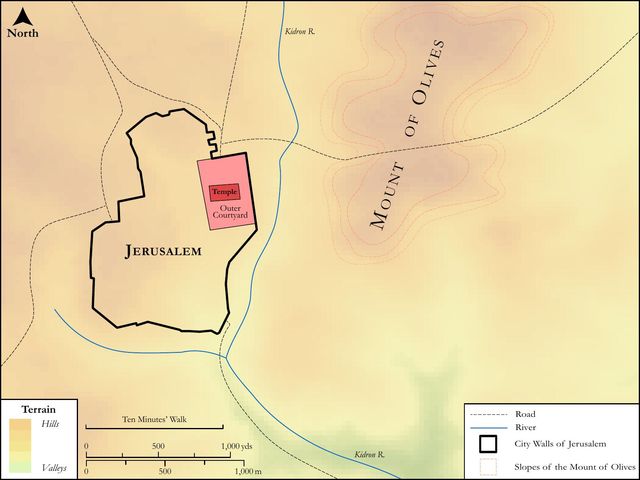
Jerusalem during the Passover week was a city teeming with pilgrims, its population swelling significantly. The Temple was the undisputed spiritual, economic, and social heart of Jewish life, particularly during major festivals. Teaching within its courts was a common practice for rabbis and prophets, providing a public forum for instruction and debate. Jesus' consistent presence there signifies His engagement with the very center of Jewish religious authority and the broader populace. The Mount of Olives lies just east of Jerusalem, separated by the Kidron Valley. It was a common place for pilgrims to camp during festivals, offering a quieter, more natural environment away from the city's noise and crowds. Its proximity made it an ideal location for Jesus and His disciples to find respite and privacy, allowing for undisturbed prayer and rest, a critical need given the intense spiritual and physical demands of His final days.
Key Themes
ShowHideThis verse powerfully contributes to several overarching themes within Luke's Gospel and the broader biblical narrative. Firstly, it highlights Jesus' unwavering dedication to His mission, demonstrating His commitment to teaching and proclaiming the Kingdom of God even as opposition mounted, echoing His earlier declaration in Luke 4:43. Secondly, it underscores the theme of spiritual discipline and dependence on the Father. Jesus' consistent withdrawal to the Mount of Olives for the night reveals His profound need for private communion with God, a pattern seen throughout His ministry, such as His early morning prayers in Mark 1:35. This practice was essential for His spiritual sustenance and preparation for the immense suffering ahead. Lastly, the contrast between the public Temple and the private Mount of Olives subtly emphasizes the dual nature of Jesus' ministry: His public proclamation of truth and His private, intimate relationship with God, both indispensable for His redemptive work.
Exposition and Analysis
ShowHideKey Word Analysis
ShowHideA prolonged (causative) form of a primary verb (to learn); to teach (in the same broad application):--teach. This word emphasizes Jesus' primary activity and role as a rabbi and prophet. It signifies the authoritative and intentional impartation of truth, not merely casual conversation. His daily teaching in the Temple was a central component of His public ministry, demonstrating His commitment to instructing the people in God's ways.
From ἐκ and ἔρχομαι; to issue (literally or figuratively):--come (forth, out), depart (out of), escape, get out, go (abroad, away, forth, out, thence), proceed (forth), spread abroad. This verb denotes a deliberate departure from one place to another. In this context, it signifies Jesus' intentional withdrawal from the public, bustling environment of the Temple and the city to a more secluded location, highlighting His need for separation and privacy.
Middle voice from αὐλή; to pass the night (properly, in the open air):--abide, lodge. This word specifically means to spend the night, often implying lodging in the open air or a simple shelter. It paints a picture of Jesus' humble living arrangements during this intense week, emphasizing His lack of a permanent dwelling and His reliance on simple provisions, while also highlighting the intentionality of His nightly retreat for rest and spiritual communion.
Verse Breakdown
ShowHide"And in the day time he was teaching in the temple"
This clause describes Jesus' primary public activity during the day. "Day time" (G2250 hēméra) refers to the period between dawn and dusk, signifying a consistent, daily routine. "Teaching" (G1321 didáskō) indicates His authoritative instruction, while "in the temple" (G1722 en G2411 hierón) specifies the central, public venue of His ministry, the entire precincts of the Jerusalem Temple. This portrays Jesus as actively engaged in His mission, publicly proclaiming the Kingdom of God and engaging with the crowds and religious leaders.
"and at night he went out, and abode in the mount that is called [the mount] of Olives"
This second clause presents a stark contrast, detailing Jesus' nightly practice. "At night" (G3571 nýx) marks the shift to a period of darkness and rest. "He went out" (G1831 exérchomai) signifies a deliberate departure from the city. "And abode" (G835 aulízomai) indicates that He spent the night there, suggesting a pattern of lodging. The destination, "the mount that is called the mount of Olives" (G1519 eis G3735 óros G2564 kaléō G1636 elaía), specifies a well-known location just outside Jerusalem, providing a quiet retreat from the day's demands. This highlights Jesus' need for solitude, rest, and private communion with God.
Literary Devices
ShowHideLuke 21:37 employs several literary devices to convey its profound message. The most prominent is Contrast, setting the bustling, public activity of "day time... teaching in the temple" against the quiet, private retreat of "at night he went out, and abode in the mount... of Olives." This stark juxtaposition emphasizes the dual nature of Jesus' life and ministry: active engagement with the world balanced by deep, personal communion with God. There is also an element of Symbolism at play. The Temple, as the center of Jewish religious life, symbolizes public ministry, teaching, and confrontation with religious authority. The Mount of Olives, by contrast, symbolizes solitude, prayer, and spiritual preparation, especially given its later association with Jesus' agony in Gethsemane (Luke 22:39-46). Finally, the verse exhibits Foreshadowing. Jesus' consistent retreat to the Mount of Olives during this final week subtly anticipates the climactic events of His passion, particularly His arrest and the Gethsemane prayer, both of which take place on this very mountain, highlighting its significance as a place of profound spiritual struggle and surrender.
Theological and Thematic Connections
ShowHideLuke 21:37 profoundly illustrates the essential rhythm of spiritual life for any believer, mirroring the incarnate Son's perfect example. It underscores the theological principle that effective public ministry and sustained spiritual vitality are deeply rooted in consistent private communion with God. Jesus, though fully divine, demonstrated His full humanity by needing rest, solitude, and direct fellowship with the Father to endure the immense pressures of His mission and to prepare for the ultimate sacrifice. This balance between active service and contemplative retreat is not merely a practical tip but a theological imperative, showing that even the Son of God relied on the Father for strength, guidance, and peace. It affirms the necessity of spiritual discipline as the wellspring of outward fruitfulness, preventing burnout and ensuring that our actions flow from a deep, Spirit-filled reservoir.
Reflection and Application
ShowHideLuke 21:37 offers a timeless and profoundly practical model for every follower of Christ. In a world that often demands constant productivity and public engagement, Jesus' rhythm of daily teaching in the Temple followed by nightly retreat to the Mount of Olives provides a vital corrective. It teaches us that true effectiveness and spiritual resilience are not found in endless activity, but in a deliberate, prayerful balance between public service and private communion with God. Just as Jesus needed to recharge, seek His Father's face, and prepare His spirit for the immense challenges ahead, so too must we prioritize intentional times of withdrawal for prayer, reflection, and rest. This practice guards against spiritual depletion, clarifies our purpose, and empowers us to serve with renewed strength and wisdom, ensuring that our outward actions are always fueled by an inward, intimate relationship with the Lord.
Questions for Reflection
ShowHideFAQ
ShowHideWhy did Jesus teach in the Temple during the day and go to the Mount of Olives at night?
ShowHideJesus' daily routine, as described in Luke 21:37, reflects a strategic and spiritual balance. Teaching in the Temple during the day allowed Him to publicly proclaim God's truth, engage with the crowds, and confront religious leaders in the most prominent and accessible venue in Jerusalem, fulfilling His mission to preach the Kingdom of God (Luke 4:43). His nightly withdrawal to the Mount of Olives served several crucial purposes: it provided a quiet respite from the city's bustle for rest, prayer, and intimate communion with the Father. This private time was essential for His spiritual sustenance, physical replenishment, and preparation for the immense suffering and sacrifice that awaited Him in the coming days, demonstrating His reliance on God even in His divine nature.
Christ-Centered Fulfillment
ShowHideLuke 21:37, though seemingly a simple description of Jesus' daily routine, profoundly reveals His Christ-centered fulfillment as the perfect Son and the ultimate example for humanity. His consistent teaching in the Temple embodies His role as the Word Incarnate (John 1:14), the supreme Teacher who brought God's truth directly to His people, fulfilling the prophetic expectation of a greater prophet than Moses (Deuteronomy 18:15). This public ministry was not merely an act of service but the very revelation of God's redemptive plan, culminating in His own sacrificial death. Furthermore, His nightly retreat to the Mount of Olives, a place of solitude and prayer, underscores His absolute dependence on the Father, even as God. This practice foreshadows His ultimate act of submission and obedience in Gethsemane, also on the Mount of Olives (Luke 22:39-44), where He wrestled with the Father's will before willingly embracing the cross. Thus, Jesus' daily rhythm in Luke 21:37 is a microcosm of His entire redemptive mission: public proclamation of the Kingdom leading to the private, agonizing surrender that secured salvation, demonstrating His perfect humanity and divine commitment to fulfilling the Father's will for the world's redemption (Philippians 2:8).