


Luke 22:39
- ΚαὶKaiAndG2532CONJConjunction
- ἐξελθὼνexelthōnhaving gone forthG1831V-2AAP-NSMVerb 2nd Aorist Active Participle Nominative Singular Masculine
- ἐπορεύθηeporeuthēHe wentG4198V-AOI-3SVerb Aorist Passive Deponent Indicative 3rd Singular
- κατὰkataaccording toG2596PREPPreposition
- τὸtotheG3588T-ASNDefinite article Accusative Singular Neuter
- ἔθοςethoscustomG1485N-ASNNoun Accusative Singular Neuter
- εἰςeistoG1519PREPPreposition
- τὸtotheG3588T-ASNDefinite article Accusative Singular Neuter
- ὄροςorosMountG3735N-ASN-LNoun Accusative Singular Neuter Location
- τῶνtōn<the>G3588T-GPFDefinite article Genitive Plural Feminine
- ἐλαιῶνelaiōnof OlivesG1638N-GPF-LNoun Genitive Plural Feminine Location
- ἠκολούθησανēkolouthēsanfollowedG190V-AAI-3PVerb Aorist Active Indicative 3rd Plural
- δὲdethenG1161CONJConjunction
- αὐτῷautōHimG846P-DSMPersonal pronoun Dative Singular Masculine
- καὶkaialsoG2532CONJConjunction
- οἱhoitheG3588T-NPMDefinite article Nominative Plural Masculine
- μαθηταίmathētaidisciplesG3101N-NPMNoun Nominative Plural Masculine
- αὐτοῦautouof himG846P-GSMPersonal pronoun Genitive Singular Masculine
English is a literal word-by-word gloss of the Greek, not the KJV's wording. Why?
This is the original text the KJV's translators worked from — each Greek word with its own literal English meaning in this verse, prepared by scholars at Tyndale House, Cambridge. The KJV translates whole sentences, not word by word, so its wording differs: one Greek word can become several English words, and the KJV may choose “charity” where the gloss reads “love”. Both are faithful — they answer different questions. For the KJV's own rendering, switch to the KJV text.
Details
See on the biblical-era map
Study this verse
Public-domain commentary
Matthew Henry
From his Commentary on the Whole Bible. Henry comments on passages, not single verses — this entry covers Luke 22:39–46. His three-level outline is real structure in the source text, so it is rendered as structure.
We have here the awful story of Christ's agony in the garden, just before he was betrayed, which was largely related by the other evangelists. In it Christ accommodated himself to that part of his undertaking which he was now entering upon - the making of his soul an offering for sin. He afflicted his own soul with grief for the sin he was to satisfy for, and an apprehension of the wrath of God to which man had by sin made himself obnoxious, which he was pleased as a sacrifice to admit the impressions of, the consuming of a sacrifice with fire from heaven being the surest token of its acceptance. In it Christ entered the lists with the powers of darkness, gave them all the advantages they could desire, and yet conquered them.
I.What we have in this passage which we had before is,
1.That when Christ went out, though it was in the night, and a long walk, his disciples (eleven of them, for Judas had given them the slip) followed him. Having continued with him hitherto in his temptations, they would not leave him now.
2.That he went to the place where he was wont to be private, which intimates that Christ accustomed himself to retirement, was often alone, to teach us to be so, for freedom of converse with God and our own hearts. Though Christ had no conveniency for retirement but a garden, yet he retired. This should particularly be our practice after we have been at the Lord's table; we have then work to do which requires us to be private.
3.That he exhorted his disciples to pray that, though the approaching trial could not be avoided, yet they might not in it enter into temptation to sin; that, when they were in the greatest fright and danger, yet they might not have any inclination to desert Christ, nor take a step towards it: "Pray that you may be kept from sin." 4. That he withdrew from them, and prayed himself; they had their errands at the throne of grace, and he had his, and therefore it was fit that they should pray separately, as sometimes, when they had joint errands, they prayed together. He withdrew about a stone's cast further into the garden, which some reckon about fifty of sixty paces, and there he kneeled down (so it is here) upon the bare ground; but the other evangelists say that afterwards he fell on his face, and there prayed that, if it were the will of God, this cup of suffering, this bitter cup, might be removed from him. This was the language of that innocent dread of suffering which, being really and truly man, he could not but have in his nature. 5. That he, knowing it to be his Father's will that he should suffer and die, and that, as the matter was now settled, it was necessary for our redemption and salvation, presently withdrew that petition, did not insist upon it, but resigned himself to his heavenly Father's will: "Nevertheless not my will be done, not the will of my human nature, but the will of God as it is written concerning me in the volume of the book, which I delight to do, let that be done," Psa 40:7, Psa 40:8. 6. That his disciples were asleep when he was at prayer, and when they should have been themselves praying, Luk 22:45. When he rose from prayer, he found them sleeping, unconcerned in his sorrows; but see what a favourable construction is here put upon it, which we had not in the other evangelists - they were sleeping for sorrow. The great sorrow they were in upon the mournful farewells their Master had been this evening giving them had exhausted their spirits, and made them very dull and heavy, which (it being now late) disposed them to sleep. This teaches us to make the best of our brethren's infirmities, and, if there be one cause better than another, charitably impute them to that. 7. That when he awoke them, then he exhorted them to pray (Luk 22:46): "Why sleep ye? Why do you allow yourselves to sleep? Rise and pray. Shake off your drowsiness, that you may be fit to pray, and pray for grace, that you may be able to shake off your drowsiness." This was like the ship-master's call to Jonah in a storm (Jon 1:6): Arise, call upon thy God. When we find ourselves either by our outward circumstances or our inward dispositions entering into temptation, it concerns us to rise and pray, Lord, help me in this time of need. But,
II.There are three things in this passage which we had not in the other evangelists: -
1.That, when Christ was in his agony, there appeared to him an angel from heaven, strengthening him, Luk 22:43.
(1.)It was an instance of the deep humiliation of our Lord Jesus that he needed the assistance of an angel, and would admit it. The influence of the divine nature withdrew for the present, and then, as to his human nature, he was for a little while lower than the angels, and was capable of receiving help from them.
(2.)When he was not delivered from his sufferings, yet he was strengthened and supported under them, and that was equivalent. If God proportion the shoulders to the burden, we shall have no reason to complain, whatever he is pleased to lay upon us. David owns this a sufficient answer to his prayer, in the day of trouble, that God strengthened him with strength in his soul, and so does the son of David, Psa 138:3.
(3.)The angels ministered to the Lord Jesus in his sufferings. He could have had legions of them to rescue him; nay, this one could have done it, could have chased and conquered the whole band of men that came to take him; but he made use of his ministration only to strengthen him; and the very visit which this angel made him now in his grief, when his enemies were awake and his friends asleep, was such a seasonable token of the divine favour as would be a very great strengthening to him. Yet this was not all: he probably said something to him to strengthen him; put him in mind that his sufferings were in order to his Father's glory, to his own glory, and to the salvation of those that were given him, represented to him the joy set before him, the seed he should see; with these and the like suggestions he encouraged him to go on cheerfully; and what is comforting is strengthening. Perhaps he did something to strengthen him, wiped away his sweat and tears, perhaps ministered some cordial to him, as after his temptation, or, it may be, took him by the arm, and helped him off the ground, or bore him up when he was ready to faint away; and in these services of the angel the Holy Spirit was enischuōn auton - putting strength into him; for so the word signifies. It pleased the Lord to bruise him indeed; yet did he plead against him with his great power? No, but he put strength in him (Job 23:6), as he had promised, Psa 89:21; Isa 49:8; Isa 50:7.
2.That, being in an agony, he prayed more earnestly, Luk 22:44. As his sorrow and trouble grew upon him, he grew more importunate in prayer; not that there was before any coldness or indifferency in his prayers, but there was now a greater vehemency in them, which was expressed in his voice and gesture. Note, Prayer, though never out of season, is in a special manner seasonable when we are in an agony; and the stronger our agonies are the more lively and frequent our prayers should be. Now it was that Christ offered up prayers and supplications with strong crying and tears, and was heard in that he feared (Heb 5:7), and in his fear wrestled, as Jacob with the angel.
3.That, in this agony, his sweat was as it were great drops of blood falling down to the ground. Sweat came in with sin, and was a branch of the curse, Gen 3:19. And therefore, when Christ was made sin and a curse for us, he underwent a grievous sweat, that in the sweat of his face we might eat bread, and that he might sanctify and sweeten all our trials to us. There is some dispute among the critics whether this sweat is only compared to drops of blood, being much thicker than drops of sweat commonly are, the pores of the body being more than ordinarily opened, or whether real blood out of the capillary veins mingled with it, so that it was in colour like blood, and might truly be called a bloody sweat; the matter is not great. Some reckon this one of the times when Christ shed his blood for us, for without the shedding of blood there is no remission. Every pore was as it were a bleeding wound, and his blood stained all his raiment. This showed the travail of his soul. He was now abroad in the open air, in a cool season, upon the cold ground, far in the night, which, one would think, had been enough to strike in a sweat; yet now he breaks out into a sweat, which bespeaks the extremity of the agony he was in.
Historical interpretation
Eight Centuries of Reception
11 surviving comments on this verse. Each one is dated, so this reads as a timeline rather than a list.
Select a marker to jump to its quote. Markers stagger vertically where authors wrote within a few decades of each other.
(Dion. de Martyr. c. 7.) Or when He says, Let this cup pass from me, it is not, let it not come to Me, for unless it had come it could not pass away. It was therefore when He perceived it already present that He began to be afflicted and sorrowful, and as it was close at hand, He says, Let this cup pass; for as that which has passed can neither be said not to have come nor yet to remain, so also the Saviour asks first that the temptation slightly assailing Him may pass away. And this is the not entering into temptation which He counsels to pray for. But the most perfect way of avoiding temptation is manifested, when he says, Nevertheless, not my will, but thine be done. For God is not a tempter to evil, but lie wishes to grant us good things above what we either desire or understand. Therefore He seeks that the perfect will of His Father which He Himself had known, should dispose of the event, which is the same will as His own, as respects the Divine nature. But He shrinks to fulfil the human will, which He calls His own, and which is inferior to His Father's will.
(de Incarn. et cont. Ar.) For here He manifests a double will. One indeed human, which is of the flesh, the other divine. For our human nature, because of the weakness of the flesh, refuses the Passion, but His divine will eagerly embraced it, for that it was not possible that He should be holden of death.
But what meaneth His bending of knees? of which it is said, And he kneeled down, and prayed. It is the way of men to pray to their superiors with their faces on the ground, testifying by the action that the greater of the two are those who are asked. Now it is plain that human nature contains nothing worthy of God's imitation. Accordingly the tokens of respect which we evince to one another, confessing ourselves to be inferior to our neighbours, we have transferred to the humiliation of the Incomparable Nature. And thus He who bore our sicknesses and interceded for us, bent His knee in prayer, by reason of the man which He assumed, giving us an example, that we ought not to exalt ourselves at the time of prayer, but in all things be conformed to humility; for God resisteth the proud, but giveth grace to the humble. (James 4:6, 1 Pet. 5:5.)
(non occ.) Now Apollinaris asserts that Christ had not His own will according to His earthly nature, but that in Christ exists only the will of God who descends from heaven. Let him then say what will is it which God would have by no means to be fulfilled? And the Divine nature does not remove His own will.
But what means His bending of knees? of which it is said, And he kneeled down, and prayed. It is the way of men to pray to their superiors with their faces on the ground, testifying by the action that the greater of the two are those who are asked. Now it is plain that human nature contains nothing worthy of God's imitation. Accordingly the tokens of respect which we evince to one another, confessing ourselves to be inferior to our neighbors, we have transferred to the humiliation of the Incomparable Nature. And thus Hew ho bore our sicknesses and interceded for us, bent His knee in prayer, by reason of the man which He assumed, giving us an example, that we ought not to exalt ourselves at the time of prayer, but in all things be conformed to humility; for God resists the proud, but gives grace to the humble.
Now Apollinaris asserts that Christ had not His own will according to His earthly nature, but that in Christ exists only the will of God who descends from heaven. Let him then say what will is it which God would have by no means to be fulfilled? And the Divine nature does not remove His own will.
He says then, If thou wilt, remove this cup from me, as man refusing death, as God maintaining His own decree.
Now every art is set forth by the words and works of him who teacheth it. Because then our Lord had come to teach no ordinary virtue, therefore He speaks and does the same things. And so having in words commanded to pray, lest they enter into temptation, He does the same likewise in work, saying, Father, if thou be willing, remove this cup from me. He saith not the words, If thou wilt, as if ignorant whether it was pleasing to the Father. For such knowledge was not more difficult than the knowledge of His Father's substance, which He alone clearly knew, according to John, As the Father knoweth me, even so have I known the Father. (John 10:15.) Nor says He this, as refusing His Passion. For He who rebuked a disciple, who wished to prevent His Passion, (Matt. 16:23.) so as even after many commendations, to call him Satan, how should He be unwilling to be crucified? Consider then why it was so said. How great a thing was it to hear that the unspeakable God, who passes all understanding, was content to enter the virgin's womb, to suck her milk, and to undergo every thing human. Since then that was almost incredible which was about to happen, He sent first indeed Prophets to announce it, afterwards He Himself comes clothed in the flesh, so that you could not suppose Him to be a phantom. He permits His flesh to endure all natural infirmities, to hunger, to thirst, to sleep, to labour, to be afflicted, to be tormented; on this account likewise He refuses not death, that He might manifest thereby His true humanity.
By day He was in Jerusalem, but when the darkness of night came on He held converse with His disciples on the mount of Olives; as it is added, And his disciples followed.
The Savior stayed in Jerusalem during the day, evidently teaching the Israelites and revealing to them the way of the kingdom of heaven. When the evening came, he continued with the holy disciples on the Mount of Olives at a spot called Gethsemane. The wise evangelist Matthew tells us this.…“Taking with him Peter and the two sons of Zebedee, he began to be sorrowful and troubled. Then he said to them, ‘My soul is very sorrowful, even to death.’ ” Going forward a little, Christ knelt and prayed, saying, “Father, if you will, put this cup away from me, but not my will but yours be done.” Please see here the depths of the appointed time in the flesh and the height of that unspeakable wisdom. Focus the penetrating eye of the mind on it. If you can see the beautiful art of the mystery, you also will say, “Oh, the depth of the riches both of the wisdom and the knowledge of God! His judgments are unsearchable, and his ways past finding out.”
And he went out and went, according to custom, to the Mount of Olives. And his disciples followed him. The Lord, about to be betrayed by a disciple, goes to the usual place of retreat where he could be most easily found. Where, then, are those who argue that he feared death, and was unwillingly crucified? And beautifully, he leads the disciples imbued with the mysteries of his body and blood to the Mount of Olives, so that he might designate that all those baptized in his death were to be confirmed by the highest chrism of the Holy Spirit, who can say with the Psalmist: "The light of your face, O Lord, has been signed upon us, you have put gladness in my heart" (Psalm 4). And about whom it is added elsewhere: "From the time of their grain, wine, and oil, they were multiplied" (ibid.).
As He was to be betrayed by His disciple, our Lord goes to the place of His wonted retirement, where He might most easily be found; as it follows, And he came out, and went, as he was want, to the mount of Olives.
Rightly does He lead the disciples, about to be instructed in the mysteries of His Body, to the mount of Olives, that He might signify that all who arc baptized in His death should be comforted with the anointing of the Holy Spirit.
It is indeed impossible for the soul of man not to be tempted. Therefore he says not, Pray that ye be not tempted, but, Pray that ye enter not into temptation, that is, that the temptation do not at last overcome you.
He also alone prays for all, who was to suffer alone for all, signifying that His prayer is as far distant from ours as His Passion.
Or He begs the cup to be removed from Him, not indeed from fear of suffering, but from His compassion for the first people, lest they should have to drink the cup first drunk by Him. Therefore He says expressly, not, Remove from Me the cup, but this cup, that is, the cup of the Jewish people, who can have no excuse for their ignorance in slaying Me, having the Law and the Prophets daily prophesying of Me.
When He drew near His Passion, the Saviour also took upon Him the words of weak man; as when something threatens us which we do not wish to come to pass, we then through weakness seek that it may not be, to the end that we also may be prepared by fortitude to find the will of our Creator contrary to our own will.
Now after supper our Lord betakes Himself not to idleness or sleep, but to prayer and teaching. Hence it follows, And when he was at the place, he said unto them, Pray, &c.
Continue studying Luke 22:39 across the web’s major study libraries — every link below opens this exact verse, chapter, or book on the destination site.
Read & Compare
 BibleGatewayThis verse in more than 200 translations and 70 languages.
 Bible.comThe YouVersion reader — hundreds of translations, reading plans, and highlights.
 ESV.orgCrossway's official English Standard Version reader.
 NET BibleThe NET translation with 60,000+ translators' notes on every rendering decision.
 STEP BibleTyndale House's free study tool — original text, vocabulary, and scholarly resources.
 BibliaLogos Bible Software's free web reader.
 USCCBThe New American Bible (Revised Edition) with the U.S. bishops' study notes.
Commentaries
 BibleHub CommentariesDozens of classic commentaries on this verse, gathered on one page.
 StudyLightMore than 100 commentary sets — the largest collection on the web.
 BibleRefPlain-English commentary on what this verse means, verse by verse.
 Enduring WordDavid Guzik's free commentary on this chapter, widely used by Bible teachers.
 Bible Study ToolsVerse commentary alongside Greek and Hebrew study aids.
Original Language & Research
- BibleHub InterlinearThe verse word by word — original language, transliteration, and English.
- BibleHub LexiconEvery word's original-language definition and Strong's entry.
 Blue Letter BibleDeep-study tools — Strong's numbers, concordance, and word studies.
 CNTR CollationThe earliest Greek manuscripts of this verse, collated letter by letter.
Sermons, Hymns & Audio


TrulyRandomVerse is not affiliated with these sites and doesn’t control their content. They’re linked because they’re genuinely useful.
Summary
Luke 22:39 marks a crucial transition in Jesus' final hours, depicting His customary departure from the Upper Room after the Last Supper to the familiar solitude of the Mount of Olives, accompanied by His disciples. This verse establishes the immediate setting for the profound spiritual agony and ultimate submission to the Father's will that Jesus would soon experience in the Garden of Gethsemane, highlighting His deliberate preparation for the cross through prayer.
Context
ShowHideLiterary Context
This verse serves as a direct narrative bridge following the intensely significant events of the Last Supper. In the preceding verses, Jesus instituted the New Covenant through the bread and wine, foretold Peter's denial, and gave His disciples final instructions and warnings about the trials they would face. Having shared this intimate and solemn meal, Jesus now moves from the confines of the Upper Room to a more open, yet secluded, location. Luke 22:39 sets the stage for the unparalleled spiritual struggle in Gethsemane, His betrayal by Judas, and His subsequent arrest, which immediately follow in Luke 22:40-53. It underscores the deliberate and purposeful steps Jesus took toward His appointed suffering.
Historical & Cultural Context
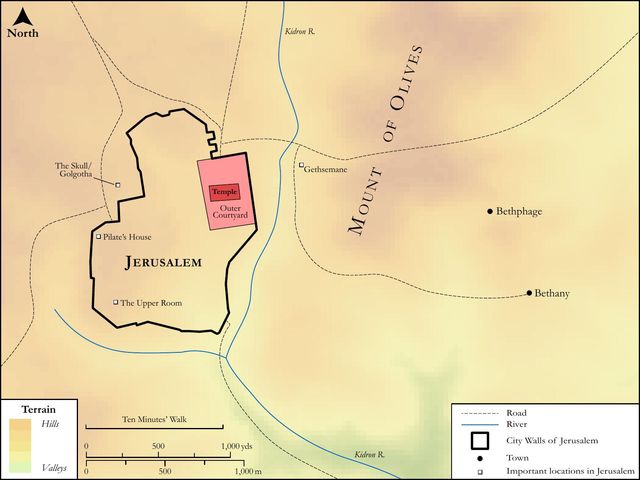
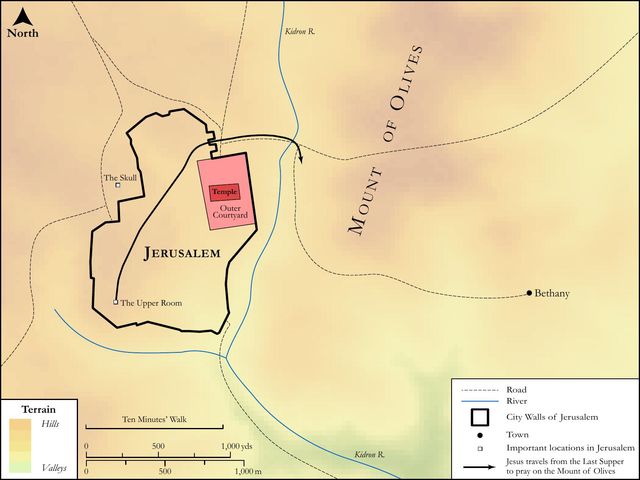
The setting is Jerusalem during the Passover festival, a time of immense spiritual and national significance. The Upper Room was likely within the city walls. The Mount of Olives, located directly east of Jerusalem across the Kidron Valley, was a well-known and frequented place for Jesus. It offered a quiet retreat from the bustling city, a place He often used for prayer, teaching, and rest, as indicated by the phrase "as he was wont" (Luke 21:37). The journey would have involved descending from the city, crossing the Kidron Valley, and ascending the lower slopes of the Mount of Olives to reach the Garden of Gethsemane, a place of olive trees at its base. This geographical movement from the city's intensity to a place of natural solitude underscores the transition from communal meal to personal spiritual battle.
Key Themes
ShowHideLuke 22:39 contributes to several overarching themes in Luke's Gospel and the broader Passion narrative. Firstly, it highlights Jesus' profound commitment to spiritual discipline and prayer, particularly in the face of impending crisis. His habitual retreat to the Mount of Olives demonstrates a consistent reliance on the Father, providing a model for all believers. Secondly, the verse emphasizes preparation for suffering and divine will. Jesus deliberately goes to this place to prepare Himself for the ultimate sacrifice, understanding the cup He is about to drink. This journey is not accidental but a purposeful step toward fulfilling His mission. Thirdly, it subtly introduces the theme of discipleship and its challenges. The disciples "followed him," indicating their presence and initial commitment, yet their subsequent actions in Gethsemane (falling asleep, fleeing) reveal their limited understanding and spiritual unpreparedness for the intensity of the moment, contrasting sharply with Jesus' resolve. This sets up the testing of their faith, foreshadowed by Jesus' earlier warnings to Peter in Luke 22:31-34.
Exposition and Analysis
ShowHideKey Word Analysis
ShowHideThis word (G1485) signifies a usage prescribed by habit or law, a custom or manner. Its inclusion here ("as he was wont") emphasizes that Jesus' journey to the Mount of Olives for prayer was not an isolated incident but a deeply ingrained, consistent spiritual practice. It speaks to His regular discipline of seeking solitude and communion with God, especially before significant events or trials. This habitual practice underscores His reliance on the Father and His commitment to prayer as a foundational aspect of His earthly ministry.
This word (G1636) refers to the olive tree or its fruit. In conjunction with "mount" (G3735, óros), it identifies the specific geographical location, the Mount of Olives. This mountain held both practical significance as a quiet retreat and prophetic significance in Jewish tradition (e.g., Zechariah 14:4). Its presence here grounds the narrative in a real, identifiable place, setting the stage for the events of Gethsemane, which means "oil press," a garden of olive trees.
This verb (G190) means "to be in the same way with," or "to accompany," specifically as a disciple. It indicates that the disciples were physically present with Jesus, continuing their role as His followers. While it suggests their loyalty and proximity, the subsequent narrative reveals their spiritual distance and inability to fully grasp the gravity of the moment, highlighting the distinction between physical presence and spiritual comprehension in discipleship.
Verse Breakdown
ShowHide"¶ And he came out,"
This phrase indicates a departure from a previous location, understood to be the Upper Room within Jerusalem where the Last Supper had just concluded. The act of "coming out" signifies a deliberate transition from the intimate setting of the meal to the public, yet secluded, space where the next phase of the Passion would unfold.
"and went, as he was wont, to the mount of Olives;"
This clause details Jesus' destination and His established pattern of behavior. The "mount of Olives" was Jesus' familiar retreat for prayer and solitude, located just outside Jerusalem. The crucial phrase "as he was wont" (Greek: kata to ethos) highlights that this was a customary practice for Him, underscoring His consistent spiritual discipline and reliance on communion with the Father, especially in moments of great significance or impending trial.
"and his disciples also followed him."
This final clause confirms the presence of Jesus' disciples, who continued to accompany Him. Their following indicates their role as His immediate companions and witnesses to His ministry, even as they remained largely unaware of the profound spiritual battle Jesus was about to face. Their presence sets the scene for their subsequent failure to remain vigilant and their eventual scattering.
Literary Devices
ShowHideLuke 22:39 employs several literary devices that enrich its meaning and impact. Foreshadowing is prominent, as this journey to the Mount of Olives directly precedes Jesus' agony in Gethsemane, His betrayal, and arrest. The serene act of going to a familiar place of prayer subtly hints at the profound spiritual struggle and suffering that is about to commence. The phrase "as he was wont" functions as a form of Characterization, revealing Jesus' deep-seated spiritual discipline and His consistent reliance on prayer, even in the face of unimaginable trials. This highlights His humanity and His perfect example. There is also a subtle Contrast implied between Jesus' intentional and prayerful preparation and the disciples' relative unawareness and eventual spiritual slumber, setting up the dramatic tension of the Gethsemane narrative. Finally, the Symbolism of the Mount of Olives itself, a place associated with prayer, prophecy, and ultimately, the site of His ascension, adds layers of meaning to this pivotal moment.
Theological and Thematic Connections
ShowHideLuke 22:39 is profoundly significant for understanding Jesus' character and the nature of His mission. It reveals a Jesus who, despite His divine nature, consistently relied on prayer and communion with the Father as His source of strength and guidance, especially when facing His greatest trial. This habitual practice underscores the theological truth that even the Son of God submitted Himself to the Father's will and sought divine sustenance. The journey to the Mount of Olives is not merely a geographical movement but a spiritual pilgrimage towards ultimate obedience and sacrifice. It highlights the intimate connection between spiritual discipline and the ability to endure suffering, providing a timeless model for believers to cultivate a consistent prayer life as preparation for life's inevitable challenges, trusting in God's sovereign plan even when it leads through immense pain.
Reflection and Application
ShowHideLuke 22:39 offers a powerful and enduring lesson for every follower of Christ. Jesus, facing the most daunting challenge of His earthly existence, did not rush into it unprepared. Instead, He retreated to His customary place of prayer, seeking communion with His Father. This teaches us the indispensable value of spiritual discipline and the cultivation of consistent habits of prayer and seeking God's presence. In our own lives, when we anticipate or encounter trials, temptations, or significant decisions, our first inclination should be to withdraw and seek divine strength and guidance. Just as Jesus had His "wonted" place, we too need to establish dedicated times and spaces for intimate communion with God, allowing Him to prepare our hearts, clarify our minds, and align our wills with His. This verse challenges us to ask: What are our spiritual habits? Do we prioritize time with God, especially when life becomes difficult?
Questions for Reflection
ShowHideFAQ
ShowHideWhy did Jesus specifically go to the Mount of Olives?
ShowHideJesus went to the Mount of Olives for several reasons, all rooted in His established patterns and the immediate context. Firstly, it was His customary place for prayer and solitude, as indicated by the phrase "as he was wont" (Luke 21:37). He often retreated there to escape the crowds, teach His disciples, and spend time in communion with God. Secondly, its location just outside Jerusalem provided a secluded yet accessible spot for the profound spiritual struggle He was about to endure in Gethsemane. Finally, the Mount of Olives held prophetic significance in Jewish tradition, making it a fitting location for the unfolding of messianic events.
What is the significance of the phrase "as he was wont"?
ShowHideThe phrase "as he was wont" (Greek: kata to ethos) is highly significant because it reveals Jesus' consistent and deeply ingrained spiritual discipline. It means "according to His custom" or "as was His habit." This wasn't a spontaneous decision but a regular practice of seeking God's presence, particularly before crucial moments. It underscores that Jesus, though divine, lived a life of dependence on the Father, modeling for us the vital importance of cultivating consistent spiritual habits, especially prayer, as a foundation for navigating life's challenges and fulfilling God's will.
What does the disciples following Jesus signify in this context?
ShowHideThe disciples "following him" signifies their continued proximity and commitment to Jesus, at least physically. They were still His companions, sharing in His final moments before His arrest. However, the subsequent narrative in Gethsemane reveals a stark contrast between their physical presence and their spiritual preparedness. While they followed, they did not fully grasp the gravity of the impending spiritual battle, ultimately failing to stay awake and pray with Him. Their presence here sets the stage for their impending failure and highlights the difference between merely accompanying Jesus and truly understanding and participating in His mission.
Christ-Centered Fulfillment
ShowHideLuke 22:39, though a seemingly simple transitional verse, is deeply Christ-centered in its implications, setting the stage for the ultimate act of redemption. Jesus' deliberate journey to the Mount of Olives, a place of prayer and solitude, underscores His perfect humanity and His unwavering obedience to the Father's will, even unto death. This act of "going out" and seeking a place of prayer is a profound demonstration of His reliance on God, a reliance that would culminate in His agonizing submission in Gethsemane, where He prayed, "Nevertheless, not my will, but yours, be done" (Luke 22:42). This pre-crucifixion prayer life and His subsequent obedient suffering are central to His identity as the Christ. He is the one who, "though he was in the form of God, did not count equality with God a thing to be grasped, but emptied himself, by taking the form of a servant, being born in the likeness of men. And being found in human form, he humbled himself by becoming obedient to the point of death, even death on a cross" (Philippians 2:6-8). His tears and fervent prayers in the garden, foreshadowed by this journey, are explicitly linked in Hebrews 5:7-8 to His learning obedience through suffering. Thus, this verse points to Jesus as the faithful Son, the obedient Lamb of God (John 1:29), who, through His perfect life of prayer and ultimate sacrifice, secures salvation for all who follow Him.