


John 18:1
- ΤαῦταTautaThese thingsG3778D-APNDemonstrative pronoun Accusative Plural Neuter
- εἰπὼνeipōnhaving saidG2036V-2AAP-NSMVerb 2nd Aorist Active Participle Nominative Singular Masculine
- ὁho<the>G3588T-NSMDefinite article Nominative Singular Masculine
- ἸησοῦςIēsousJesusG2424N-NSM-PNoun Nominative Singular Masculine Individual
- ἐξῆλθενexēlthenwent outG1831V-2AAI-3SVerb 2nd Aorist Active Indicative 3rd Singular
- σὺνsunwithG4862PREPPreposition
- τοῖςtoistheG3588T-DPMDefinite article Dative Plural Masculine
- μαθηταῖςmathētaisdisciplesG3101N-DPMNoun Dative Plural Masculine
- αὐτοῦautouof HimG846P-GSMPersonal pronoun Genitive Singular Masculine
- πέρανperanbeyondG4008PREPPreposition
- τοῦtoutheG3588T-GSMDefinite article Genitive Singular Masculine
- χειμάρρουcheimarrouwinter streamG5493N-GSMNoun Genitive Singular Masculine
- τοῦtouof theG3588T-GSMDefinite article Genitive Singular Masculine
- ΚεδρὼνKedrōnof KidronG2748N-GSM-LNoun Genitive Singular Masculine Location
- ὅπουhopouwhereG3699PREPPreposition
- ἦνēnthere wasG1510V-IAI-3SVerb Imperfect Active Indicative 3rd Singular
- κῆποςkēposa gardenG2779N-NSMNoun Nominative Singular Masculine
- εἰςeisintoG1519PREPPreposition
- ὃνhonwhichG3739R-ASMRelative pronoun Accusative Singular Masculine
- εἰσῆλθενeisēlthenenteredG1525V-2AAI-3SVerb 2nd Aorist Active Indicative 3rd Singular
- αὐτὸςautosHe himselfG846P-NSMPersonal pronoun Nominative Singular Masculine
- καὶkaiandG2532CONJConjunction
- οἱhoitheG3588T-NPMDefinite article Nominative Plural Masculine
- μαθηταὶmathētaidisciplesG3101N-NPMNoun Nominative Plural Masculine
- αὐτοῦautouof HimG846P-GSMPersonal pronoun Genitive Singular Masculine
English is a literal word-by-word gloss of the Greek, not the KJV's wording. Why?
This is the original text the KJV's translators worked from — each Greek word with its own literal English meaning in this verse, prepared by scholars at Tyndale House, Cambridge. The KJV translates whole sentences, not word by word, so its wording differs: one Greek word can become several English words, and the KJV may choose “charity” where the gloss reads “love”. Both are faithful — they answer different questions. For the KJV's own rendering, switch to the KJV text.
Details
See on the biblical-era map
Study this verse
Public-domain commentary
Matthew Henry
From his Commentary on the Whole Bible. Henry comments on passages, not single verses — this entry covers John 18:1–12. His four-level outline is real structure in the source text, so it is rendered as structure.
The hour was now come that the captain of our salvation, who was to be made perfect by sufferings, should engage the enemy. We have here his entrance upon the encounter. The day of recompence is in his heart, and the year of his redeemed is come, and his own arm works the salvation, for he has no second. Let us turn aside now, and see this great sight.
I.Our Lord Jesus, like a bold champion, takes the field first (v.
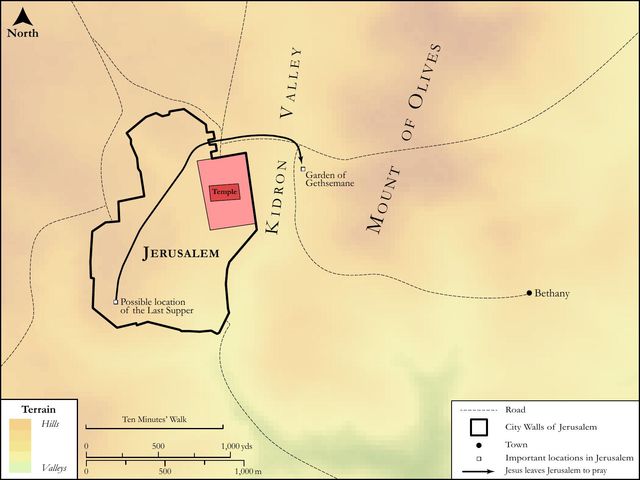
1, 2): When he had spoken these words, preached the sermon, prayed his prayer, and so finished his testimony, he would lose no time, but went forth immediately out of the house, out of the city, by moon-light, for the passover was observed at the full moon, with his disciples (the eleven, for Judas was otherwise employed), and he went over the brook Cedron, which runs between Jerusalem and the mount of Olives, where was a garden, not his own, but some friend's, who allowed him the liberty of it. Observe,
1.That our Lord Jesus entered upon his sufferings when he had spoken these words, as Matt. xxvi. 1, When he had finished all these sayings. Here it is intimated,
(1.)That our Lord Jesus took his work before him. The office of the priest was to teach, and pray, and offer sacrifice. Christ, after teaching and praying, applies himself to make atonement. Christ had said all he had to say as a prophet, and now he addresses himself to the discharge of his office as a priest, to make his soul an offering for sin; and, when he had gone through this, he entered upon his kingly office.
(2.)That having by his sermon prepared his disciples for this hour of trial, and by his prayer prepared himself for it, he then courageously went out to meet it. When he had put on his armour, he entered the lists, and not till then. Let those that suffer according to the will of God, in a good cause, with a good conscience, and having a clear call to it, comfort themselves with this, that Christ will not engage those that are his in any conflict, but he will first do that for them which is necessary to prepare them for it; and if we receive Christ's instructions and comforts, and be interested in his intercession, we may, with an unshaken resolution, venture through the greatest hardships in the way of duty.
2.That he went forth with his disciples. Judas knew what house he was in in the city, and he could have staid and met his sufferings there; but,
(1.)He would do as he was wont to do, and not alter his method, either to meet the cross or to miss it, when his hour was come. It was his custom when he was at Jerusalem, after he had spent the day in public work, to retire at night to the mount of Olives; there his quarters were, in the skirts of the city, for they would not make room for him in the palaces, in the heart of the town. This being his custom, he could not be put out of his method by the foresight of his sufferings, but, as Daniel, did then just as he did aforetime, Dan. vi. 10.
(2.)He was as unwilling that there should be an uproar among the people as his enemies were, for it was not his way to strive or cry. If he had been seized in the city, and a tumult raised thereby, mischief might have been done, and a great deal of blood shed, and therefore he withdrew. Note, When we find ourselves involved in trouble, we should be afraid of involving others with us. It is no disgrace to the followers of Christ to fall tamely. Those who aim at honour from men value themselves upon a resolution to sell their lives as dearly as they can; but those who know that their blood is precious to Christ, and that not a drop of it shall be shed but upon a valuable consideration, need not stand upon such terms.
(3.)He would set us an example in the beginning of his passion, as he did at the end of it, of retirement from the world. Let us go forth to him, without the camp, bearing his reproach, Heb. xiii. 13. We must lay aside, and leave behind, the crowds, and cares, and comforts, of cities, even holy cities, if we would cheerfully take up our cross, and keep up our communion with God therein.
3.That he went over the brook Cedron. He must go over this to go to the mount of Olives, but the notice taken of it intimates that there was something in it significant; and it points,
(1.)At David's prophecy concerning the Messiah (Ps. cx. 7), that he shall drink of the brook in the way; the brook of suffering in the way to his glory and our salvation, signified by the brook Cedron, the black brook, so called either from the darkness of the valley it ran through or the colour of the water, tainted with the dirt of the city; such a brook Christ drank of, when it lay in the way of our redemption, and therefore shall he lift up the head, his own and ours.
(2.)At David's pattern, as a type of the Messiah. In his flight from Absalom, particular notice is taken of his passing over the brook Cedron, and going up by the ascent of mount Olivet, weeping, and all that were with him in tears too, 2 Sam. xv. 23, 30. The Son of David, being driven out by the rebellious Jews, who would not have him to reign over them (and Judas, like Ahithophel, being in the plot against him), passed over the brook in meanness and humiliation, attended by a company of true mourners. The godly kings of Judah had burnt and destroyed the idols they found at the brook Cedron; Asa, 2 Chron. xv. 16; Hezekiah, 2 Chron. xxx. 14; Josiah, 2 Kings xxiii. 4, 6. Into that brook the abominable things were cast. Christ, being now made sin for us, that he might abolish it and take it away, began his passion by the same brook. Mount Olivet, where Christ began his sufferings, lay on the east side of Jerusalem; mount Calvary, where he finished them, on the west; for in them he had an eye to such as should come from the east and the west.
4.That he entered into a garden. This circumstance is taken notice of only by this evangelist, that Christ's sufferings began in a garden. In the garden of Eden sin began; there the curse was pronounced, there the Redeemer was promised, and therefore in a garden that promised seed entered the lists with the old serpent. Christ was buried also in a garden.
(1.)Let us, when we walk in our gardens, take occasion thence to meditate on Christ's sufferings in a garden, to which we owe all the pleasure we have in our gardens, for by them the curse upon the ground for man's sake was removed.
(2.)When we are in the midst of our possessions and enjoyments, we must keep up an expectation of troubles, for our gardens of delight are in a vale of tears.
5.That he had his disciples with him,
(1.)Because he used to take them with him when he retired for prayer.
(2.)They must be witnesses of his sufferings, and his patience under them, that they might with the more assurance and affection preach them to the world (Luke xxiv. 48), and be themselves prepared to suffer.
(3.)He would take them into the danger to show them their weakness, notwithstanding the promises they had made of fidelity. Christ sometimes brings his people into difficulties, that he may magnify himself in their deliverance.
6.That Judas the traitor knew the place, knew it to be the place of his usual retirement, and probably, by some word Christ had dropped, knew that he intended to be there that night, for want of a better closet. A solitary garden is a proper place for meditation and prayer, and after a passover is a proper time to retire for private devotion, that we may pray over the impressions made and the vows renewed, and clench the nail. Mention is made of Judas's knowing the place,
(1.)To aggravate the sin of Judas, that he would betray his Master, notwithstanding the intimate acquaintance he had with him; nay, and that he would make use of his familiarity with Christ, as giving him an opportunity of betraying him; a generous mind would have scorned to do so base a thing. Thus has Christ's holy religion been wounded in the house of its friends, as it could not have been wounded any where else. Many an apostate could not have been so profane, if he had not been a professor; could not have ridiculed scriptures and ordinances, if he had not known them.
(2.)To magnify the love of Christ, that, though he knew where the traitor would seek him, thither he went to be found of him, now that he knew his hour was come. Thus he showed himself willing to suffer and die for us. What he did was not by constraint, but by consent; though as man he said, Let this cup pass away, as Mediator he said, "Lo, I come, I come with a good will." It was late in the night (we may suppose eight or nine o'clock) when Christ went out to the garden; for it was not only his meat and drink, but his rest and sleep, to do the will of him that sent him. When others were going to bed, he was going to prayer, going to suffer.
II.The captain of our salvation having taken the field, the enemy presently comes upon the spot, and attacks him (v.
3): Judas with his men comes thither, commissioned by the chief priests, especially those among them that were Pharisees, who were the most bitter enemies to Christ. This evangelist passes over Christ's agony, because the other three had fully related it, and presently introduces Judas and his company that came to seize him. Observe,
1.The persons employed in this action—a band of men and officers from the chief priests, with Judas.
(1.)Here is a multitude engaged against Christ—a band of men, speira—cohors, a regiment, a Roman band, which some think was five hundred men, others a thousand. Christ's friends were few, his enemies many. Let us therefore not follow a multitude to do evil, nor fear a multitude designing evil to us, if God be for us.
(2.)Here is a mixed multitude; the band of men were Gentiles, Roman soldiers, a detachment out of the guards that were posted in the tower of Antonia, to be a curb upon the city; the officers of the chief priests, hyperetas. Either their domestic servants, or the officers of their courts, were Jews; these had an enmity to each other, but were united against Christ, who came to reconcile both to God in one body.
(3.)It is a commissioned multitude, not a popular tumult; no, they have received orders from the chief priests, upon whose suggestion to the governor that this Jesus was a dangerous man, it is likely they had a warrant from him too to take him up, for they feared the people. See what enemies Christ and his gospel have had, and are likely to have, numerous and potent, and therefore formidable: ecclesiastical and civil powers combined against them, Ps. ii. 1,
2.Christ said it would be so (Matt. x. 18), and found it so. (4.) All under the direction of Judas. He received this band of men; it is probable that he requested it, alleging that it was necessary to send a good force, being as ambitious of the honour of commanding in chief in this expedition as he was covetous of the wages of this unrighteousness. He thought himself wonderfully preferred from coming in the rear of the contemptible twelve to be placed at the head of these formidable hundreds; he never made such a figure before, and promised himself, perhaps, that this should not be the last time, but he should be rewarded with a captain's commission, or better, if he succeeded well in this enterprise.
2.The preparation they had made for an attack: They came with lanterns, and torches, and weapons.
(1.)If Christ should abscond, though they had moonlight, they would have occasion for their lights; but they might have spared these; the second Adam was not driven, as the first was, to hide himself, either for fear or shame, among the trees of the garden. It was folly to light a candle to seek the Sun by.
(2.)If he should resist, they would have occasion for their arms. The weapons of his warfare were spiritual, and at these weapons he had often beaten them, and put them to silence, and therefore they have now recourse to other weapons, swords and staves.
III.Our Lord Jesus gloriously repulsed the first onset of the enemy, v. 4-6, where observe,
1.How he received them, with all the mildness imaginable towards them, and all the calmness imaginable in himself.
(1.)He met them with a very soft and mild question (v. 4): Knowing all things that should come upon him, and therefore not at all surprised with this alarm, with a wonderful intrepidity and presence of mind, undisturbed and undaunted, he went forth to meet them, and, as if he had been unconcerned, softly asked, "Whom seek you? What is the matter? What means this bustle at this time of night?" See here, [1.] Christ's foresight of his sufferings; He knew all those things that should come upon him, for he had bound himself to suffer them. Unless we had strength, as Christ had, to bear the discovery, we should not covet to know what shall come upon us; it would but anticipate our pain; sufficient unto the day is the evil thereof: yet it will do us good to expect sufferings in general, so that when they come we may say, "It is but what we looked for, the cost we sat down and counted upon." [2.] Christ's forwardness to his sufferings; he did not run away from them, but went out to meet them, and reached forth his hand to take the bitter cup. When the people would have forced him to a crown, and offered to make him a king in Galilee, but he withdrew, and hid himself (ch. vi. 15); but, when they came to force him to a cross, he offered himself; for he came to this world to suffer and went to the other world to reign. This will not warrant us needlessly to expose ourselves to trouble, for we know not when our hour is come; but we are called to suffering when we have no way to avoid it but by sin; and, when it comes to this, let none of these things move us, for they cannot hurt us.
(2.)He met them with a very calm and mild answer when they told him whom they were in quest of, v. 5. They said, Jesus of Nazareth; and he said, I am he.
[1.]It should seem, their eyes were held, that they could not know him. It is highly probable that many of the Roman band, at least the officers of the temple, had often seen him, if only to satisfy their curiosity; Judas, however, to be sure, knew him well enough, and yet none of them could pretend to say, Thou art the man we seek. Thus he showed them the folly of bringing lights to see for him, for he could make them not to know him when they saw him; and he has herein shown us how easily he can infatuate the counsels of his enemies, and make them lose themselves, when they are seeking mischief.
[2.]In their enquiries for him they called him Jesus of Nazareth, which was the only title they knew him by, and probably he was so called in their warrant. It was a name of reproach given him, to darken the evidence of his being the Messiah. By this it appears that they knew him not, whence he was; for, if they had known him, surely they would not have persecuted him.
[3.]He fairly answers them: I am he. He did not improve the advantage he had against them by their blindness, as Elisha did against the Syrians, telling them, This is not the way, neither is this the city; but improves it as an opportunity of showing his willingness to suffer. Though they called him Jesus of Nazareth, he answered to the name, for he despised the reproach; he might have said, I am not he, for he was Jesus of Bethlehem; but he would by no means allow equivocations. He has hereby taught us to own him, whatever it cost us; not to be ashamed of him or his words; but even in difficult times to confess Christ crucified, and manfully to fight under his banner. I am he, Ego eimi—I am he, is the glorious name of the blessed God (Exod. iii. 14), and the honour of that name is justly challenged by the blessed Jesus.
[4.]Particular notice is taken, in a parenthesis, that Judas stood with them. He that used to stand with those that followed Christ now stood with those that fought against him. This describes an apostate; he is one that changes sides. He herds himself with those with whom his heart always was, and with whom he shall have his lot in the judgment-day. This is mentioned, First, To show the impudence of Judas. One would wonder where he got the confidence with which he now faced his Master, and was not ashamed, neither could he blush; Satan in his heart gave him a whore's forehead. Secondly, To show that Judas was particularly aimed at in the power which went along with that word, I am he, to foil the aggressors. It was an arrow levelled at the traitor's conscience, and pierced him to the quick; for Christ's coming and his voice will be more terrible to apostates and betrayers than to sinners of any other class.
2.See how he terrified them, and obliged them to retire (v. 6): They went backward, and, like men thunder-struck, fell to the ground. It should seem, they did not fall forward, as humbling themselves before him, and yielding to him, but backward, as standing it out to the utmost. Thus Christ was declared to be more than a man, even when he was trampled upon as a worm, and no man. This word, I am he, had revived his disciples, and raised them up (Matt. xiv. 27); but the same word strikes his enemies down. Hereby he showed plainly,
(1.)What he could have done with them. When he struck them down, he could have struck them dead; when he spoke them to the ground, he could have spoken them to hell, and have sent them, like Korah's company, the next way thither; but he would not do so,
[1.]Because the hour of his suffering was come, and he would not put it by; he would only show that his life was not forced from him, but he laid it down of himself, as he had said.
[2.]Because he would give an instance of his patience and forbearance with the worst of men, and his compassionate love to his very enemies. In striking them down, and no more, he gave them both a call to repent and space to repent; but their hearts were hardened, and all was in vain.
(2.)What he will do at last with all his implacable enemies, that will not repent to give him glory; they shall flee, they shall fall, before him. Now the scripture was accomplished (Ps. xxi. 12), Thou shalt make them turn their back, and Ps. xx. 8. And it will be accomplished more and more; with the breath of his mouth he will slay the wicked, 2 Thess. ii. 8; Rev. xix. 21. Quid judicaturus faciet, qui judicandus hoc facit?—What will he do when he shall come to judge, seeing he did this when he came to be judged?—Augustine.
IV.Having given his enemies a repulse, he gives his friends a protection, and that by his word too, v. 7-9, where we may observe,
1.How he continued to expose himself to their rage, v. 7. They did not lie long where they fell, but, by divine permission, got up again; it is only in the other world that God's judgments are everlasting. When they were down, one would have thought Christ should have made his escape; when they were up again, one would have thought they should have let fall their pursuit; but still we find,
(1.)They are as eager as ever to seize him. It is in some confusion and disorder that they recover themselves; they cannot imagine what ailed them, that they could not keep their ground, but will impute it to any thing rather than Christ's power. Note, There are hearts so very hard in sin that nothing will work upon them to reduce and reclaim them.
(2.)He is as willing as ever to be seized. When they were fallen before him, he did not insult over them, but seeing them at a loss, asked them the same question, Whom seek you? And they gave him the same answer, Jesus of Nazareth. In his repeating the question, he seems to come yet closer to their consciences: "Do you not know whom you seek? Are you not aware that you are in error, and will you meddle with your match? Have you not had enough of it, but will you try the other struggle? Did ever any harden his heart against God and prosper?" In their repeating the same answer, they showed an obstinacy in their wicked way; they still call him Jesus of Nazareth, with as much disdain as ever, and Judas is as unrelenting as any of them. Let us therefore fear lest, by a few bold steps at first in a sinful way, our hearts be hardened.
2.How he contrived to secure his disciples from their rage. He improved this advantage against them for the protection of his followers. When he shows his courage with reference to himself, I have told you that I am he, he shows his care for his disciples, Let these go their way. He speaks this as a command to them, rather than a contract with them; for they lay at his mercy, not he at theirs. He charges them therefore as one having authority: "Let these go their way; it is at your peril if you meddle with them" This aggravated the sin of the disciples in forsaking him, and particularly Peter's in denying him, that Christ had given them this pass, or warrant of protection, and yet they had not faith and courage enough to rely upon it, but betook themselves to such base and sorry shifts for their security. When Christ said, Let these go their way, he intended,
(1.)To manifest his affectionate concern for his disciples. When he exposed himself, he excused them, because they were not as yet fit to suffer; their faith was weak, and their spirits were low, and it would have been as much as their souls, and the lives of their souls, were worth, to bring them into sufferings now. New wine must not be put into old bottles. And, besides, they had other work to do; they must go their way, for they are to go into all the world, to preach the gospel. Destroy them not, for a blessing is in them. Now herein,
[1.]Christ gives us a great encouragement to follow him; for, though he has allotted us sufferings, yet he considers our frame, will wisely time the cross, and proportion it to our strength, and will deliver the godly out of temptation, either from it, or through it.
[2.]He gives us a good example of love to our brethren and concern for their welfare. We must not consult our own ease and safety only, but others, as well as our own, and in some cases more than our own. There is a generous and heroic love, which will enable us to lay down our lives for the brethren, 1 John iii. 16.
(2.)He intended to give a specimen of his undertaking as Mediator. When he offered himself to suffer and die, it was that we might escape. He was our antipsychos—a sufferer in our stead; when he said, Lo, I come, he said also, Let these go their way; like the ram offered instead of Isaac.
3.Now herein he confirmed the word which he had spoken a little before (ch. xvii. 12), Of those whom thou gavest me, I have lost none. Christ, by fulfilling that word in this particular, gave an assurance that it should be accomplished in the full extent of it, not only for those that were now with him, but for all that should believe on him through their word. Though Christ's keeping them was meant especially of the preservation of their souls from sin and apostasy, yet it is here applied to the preservation of their natural lives, and very fitly, for even the body was a part of Christ's charge and care; he is to raise it up at the last day, and therefore to preserve it as well as the spirit and soul, 1 Thess. v. 23; 2 Tim. iv. 17, 18. Christ will preserve the natural life for the service to which it is designed; it is given to him to be used for him, and he will not lose the service of it, but will be magnified in it, whether by life or death; it shall be held in life as long as any use is to be made of it. Christ's witnesses shall not die till they have given in their evidence. But this is not all; this preservation of the disciples was, in the tendency of it, a spiritual preservation. They were now so weak in faith and resolution that in all probability, if they had been called out to suffer at this time, they would have shamed themselves and their Master, and some of them, at least the weaker of them, would have been lost; and therefore, that he might lose none, he would not expose them. The safety and preservation of the saints are owing, not only to the divine grace in proportioning the strength to the trial, but to the divine providence in proportioning the trial to the strength.
V.Having provided for the safety of his disciples, he rebukes the rashness of one of them, and represses the violence of his followers, as he had repulsed the violence of his persecutors, v. 10, 11, where we have,
1.Peter's rashness. He had a sword; it is not likely that he wore one constantly as a gentleman, but they had two swords among them all (Luke xxii. 38), and Peter, being entrusted with one, drew it; for now, if ever, he thought it was his time to use it; and he smote one of the high priest's servants, who was probably one of the forwardest, and aiming, it is likely, to cleave him down the head, missed his blow, and only cut off his right ear. The servant's name, for the greater certainty of the narrative, is recorded; it was Malchus, or Malluch, Neh. x. 4.
(1.)We must here acknowledge Peter's good-will; he had an honest zeal for his Master, though now misguided. He had lately promised to venture his life for him, and would now make his words good. Probably it exasperated Peter to see Judas at the head of this gang; his baseness excited Peter's boldness, and I wonder that when he did draw his sword he did not aim at the traitor's head.
(2.)Yet we must acknowledge Peter's ill conduct; and, though his good intention did excuse, yet it would not justify him.
[1.]He had no warrant from his Master for what he did. Christ's soldiers must wait the word of command, and not outrun it; before they expose themselves to sufferings, they must see to it, not only that their cause be good, but their call clear.
[2.]He transgressed the duty of his place, and resisted the powers that were, which Christ had never countenanced, but forbidden (Matt. v. 39): that you resist not evil [3.] He opposed his Master's sufferings, and, notwithstanding the rebuke he had for it once, is ready to repeat, Master, spare thyself; suffering be far from thee; though Christ had told him that he must and would suffer, and that his hour was now come. Thus, while he seemed to fight for Christ, he fought against him. [4.] He broke the capitulation his Master had lately made with the enemy. When he said, Let these go their way, he not only indented for their safety, but in effect passed his word for their good behaviour, that they should go away peaceably; this Peter heard, and yet would not be bound by it. As we may be guilty of a sinful cowardice when we are called to appear, so we may be of a sinful forwardness when we are called to retire. [5.] He foolishly exposed himself and his fellow disciples to the fury of this enraged multitude. If he had cut off Malchus's head when he cut off his ear, we may suppose the soldiers would have fallen upon all the disciples, and have hewn them to pieces, and would have represented Christ as not better than Barabbas. Thus many have been guilty of self-destruction, in their zeal for self-preservation. [6.] Peter played the coward so soon after this (denying his Master) that we have reason to think he would not have done this but that he saw his Master cause them to fall on the ground, and then he could deal with them; but, when he saw him surrender himself notwithstanding, his courage failed him; whereas the true Christian hero will appear in the cause of Christ, not only when it is prevailing, but when it seems to be declining; will be on the right side, though it be not the rising side.
(3.)We must acknowledge God's over-ruling providence in directing the stroke (so that it should do no more execution, but only cut off his ear, which was rather marking him than maiming him), as also in giving Christ an opportunity to manifest his power and goodness in healing the hurt, Luke xxii. 51. Thus what was in danger of turning to Christ's reproach proved an occasion of that which redounded much to his honour, even among his adversaries.
2.The rebuke his Master gave him (v. 11): Put up thy sword into the sheath, or scabbard; it is a gentle reproof, because it was his zeal that carried him beyond the bounds of discretion. Christ did not aggravate the matter, only bade him do so no more. Many think their being in grief and distress will excuse them if they be hot and hasty with those about them; but Christ has here set us an example of meekness in sufferings. Peter must put up his sword, for it was the sword of the Spirit that was to be committed to him—weapons of warfare not carnal, yet mighty. When Christ with a word felled the aggressors, he showed Peter how he should be armed with a word, quick and powerful, and sharper than any two-edged sword, and with that, not long after this, he laid Ananias and Sapphira dead at his feet.
3.The reason for this rebuke: The cup which my Father has given me, shall I not drink it? Matthew relates another reason which Christ gave for this rebuke, but John preserves this, which he had omitted; in which Christ gives us,
(1.)A full proof of his own submission to his Father's will. Of all that was amiss in what Peter did, he seems to resent nothing so much as that he would have hindered his sufferings now that his hour was come: "What, Peter, wilt thou step in between the cup and the lip? Get thee hence, Satan." If Christ be determined to suffer and die, it is presumption for Peter in word or deed to oppose it: Shall I not drink it? The manner of expression bespeaks a settled resolution, and that he would not entertain a thought to the contrary. He was willing to drink of this cup, though it was a bitter cup, an infusion of the wormwood and the gall, the cup of trembling, a bloody cup, the dregs of the cup of the Lord's wrath, Isa. li. 22. He drank it, that he might put into our hands the cup of salvation, the cup of consolation, the cup of blessing; and therefore he is willing to drink it, because his Father put it into his hand. If his Father will have it so, it is for the best, and be it so.
(2.)A fair pattern to us of submission to God's will in every thing that concerns us. We must pledge Christ in the cup that he drank of (Matt. xx. 23), and must argue ourselves into a compliance.
[1.]It is but a cup; a small matter comparatively, be it what it will. It is not a sea, a red sea, a dead sea, for it is not hell; it is light, and but for a moment.
[2.]It is a cup that is given us; sufferings are gifts.
[3.]It is given us by a Father, who has a Father's authority, and does us no wrong; a Father's affection, and means us no hurt.
VI.Having entirely reconciled himself to the dispensation, he calmly surrendered, and yielded himself a prisoner, not because he could not have made his escape, but because he would not. One would have thought the cure of Malchus's ear should have made them relent, but nothing would win upon them. Maledictus furor, quem nec majestast miraculi nec pietas beneficii confringere potuit—Accursed rage, which the grandeur of the miracle could not appease, nor the tenderness of the favour conciliate.—Anselm. Observe here,
1.How they seized him: They took Jesus. Only some few of them could lay hands on him, but it is charged upon them all, for they were all aiding and abetting. In treason there are not accessaries; all are principals. Now the scripture was fulfilled, Bulls have compassed me (Ps. xxii. 12), compassed me like bees, Ps. cxviii. 12. The breath of our nostrils is taken in their pit, Lam. iv. 20. They had so often been frustrated in their attempts to seize him that now, having got him into their hands, we may suppose they flew upon him with so much the more violence.
2.How they secured him: They bound him. This particular of his sufferings is taken notice of only by this evangelist, that, as soon as ever he was taken, he was bound, pinioned, handcuffed; tradition says, "They bound him with such cruelty that the blood started out at his fingers' ends; and, having bound his hands behind him, they clapped an iron chain about his neck, and with that dragged him along." See Gerhard. Harm. cap. 5.
(1.)This shows the spite of his persecutors. They bound him,
[1.]That they might torment him, and put him in pain, as they bound Samson to afflict him.
[2.]That they might disgrace him, and put him to shame; slaves were bound, so was Christ, though free-born.
[3.]That they might prevent his escape, Judas having told them to hold him fast. See their folly, that they should think to fetter that power which had but just now proved itself omnipotent.
[4.]They bound him as one already condemned, for they were resolved to prosecute him to the death, and that he should die as a fool dieth, that is, as a malefactor, with his hands bound, 2 Sam. iii. 33, 34. Christ had bound the consciences of his persecutors with the power of his word, which galled them; and, to be revenged on him, they laid these bonds on him.
Historical interpretation
Four Centuries of Reception
9 surviving comments on this verse. Each one is dated, so this reads as a timeline rather than a list.
Select a marker to jump to its quote. Markers stagger vertically where authors wrote within a few decades of each other.
And when he had delivered to us the representative mysteries of his precious body and blood, Judas not being present with us, he went out to the Mount of Olives, near the brook Kidron, where there was a garden.
But how came Judas there, or whence had he gained his information when he came? It is evident from this circumstance, that Jesus generally passed the night out of doors. For had He been in the habit of spending it at home, Judas would not have come to the desert, but to the house, expecting there to find Him asleep. And lest, hearing of a "garden," thou shouldest think that Jesus hid Himself, it addeth, that "Judas knew the place"; and not simply so, but that He "often resorted thither with His disciples." For ofttimes He was with them apart, conversing on necessary matters, and such as it was not permitted to others to hear. And He did this especially in mountains and gardens, seeking a place free from disturbance, that their attention might not be distracted from listening.
(Hom. lxxxiii) But why does not John say, When He had prayed, He entered? Because His prayer was a speaking for His disciples' sake. It is now night time; He goes and crosses the brook, and hastens to the place which was known to the traitor; thus giving no trouble to those who were lying in wait for Him, and showing His disciples that He went voluntarily to die.
(Hom. lxxxii) That it might not be thought that He went into a garden to hide Himself, it is added, But Judas who betrayed Him knew the place: for Jesus often resorted thither with His disciples.
(Hom. lxxxiii) Jesus had often met and talked alone with His disciples there, on essential doctrines, such as it was lawful for others to hear. He does this on mountains, and in gardens, to be out of reach of noise and tumult. Judas however went there, because Christ had often passed the night there in the open air. He would have gone to His house, if he had thought he should find Him sleeping there.
An awful thing is death, and very full of terror, but not to those who have learnt the true wisdom which is above. For he that knows nothing certain concerning things to come, but deems it to be a certain dissolution and end of life, with reason shudders and is afraid, as though he were passing into non-existence. But we who, by the grace of God, have learnt the hidden and secret things of His wisdom, and deem the action to be a departure to another place, should have no reason to tremble, but rather to rejoice and be glad, that leaving this perishable life we go to one far better and brighter, and which hath no end. Which Christ teaching by His actions, goeth to His Passion, not by constraint and necessity, but willingly. "These things," it saith, "Jesus spake, and departed beyond the brook Cedron, where was a garden, into the which He entered, and His disciples."
He journeyeth at midnight, and crosseth a river, and hasteth to come to a place known to the traitor, lessening the labor to those who plotted against Him, and freeing them from all trouble; and showeth to the disciples that He came willingly to the action, (a thing which was most of all sufficient to comfort them,) and placeth Himself in the garden as in a prison.
Matthew proceeds with his narrative … as follows: "Then Jesus came with them to a place called Gethsemane." This is mentioned also by Mark. Luke, too, refers to it, although he does not mention the piece of ground by name.… There, we understand, was also the garden that John brings into notice when he gives his narrative.
(Tr. cxii) The discourse, which our Lord had with His disciples after supper, and the prayer which followed, being now ended, the Evangelist begins the account of His Passion. When Jesus had spoken these words, He came forth with His disciples over the brook Cedron, where was a garden, into which He entered, and His disciples. But this did not take place immediately after the prayer was ended; there was an interval containing some things, which John omits, but which are mentioned by the other Evangelists.
(de Con. Ev. iii. c. 3.) A contention took place between them, which of them was the greater, as Luke relates. He also said to Peter, as Luke adds in the same place, Behold, Satan hath desired to have you, that he might sift you as wheat, &c. (Luke 22:31) And according to Matthew and Mark, they sang a hymn, and then went to Mount Olivet. (Mat. 26:30. Mark 14:26) Matthew lastly brings the two narratives together: Then went Jesus with His disciples to a place which is called Gethsemane. That is the place which John mentions here, Where there was a garden, into the which He entered, and His disciples.
(Tr. cxii) When Jesus had spoken these words, shows that He did not enter before He had finished speaking.
When the grand and lengthened discourse was concluded which the Lord delivered after supper, and on the eve of shedding His blood for us, to the disciples who were then with Him, and had added the prayer addressed to His Father, the evangelist John began thereafter the narrative of His passion in these words: "When Jesus had so spoken, He went forth with His disciples over the brook Cedron, where was a garden, into the which He entered, and His disciples. And Judas also, who betrayed Him, knew the place; for Jesus oft-times resorted thither with His disciples." What he here relates of the Lord entering the garden with His disciples did not take place immediately after He had brought the prayer to a close, of which he says, "When Jesus had spoken these words:" but certain other incidents were interposed, which are passed over by the present evangelist and found in the others; just as in this one are found many things on which the others are similarly silent in their own narratives.
Let us, therefore, not take His words, "When Jesus had spoken these words, He went forth with His disciples over the brook Cedron, where was a garden, into the which He entered, and His disciples," as if it were immediately after the utterance of these words that He entered the garden; but let the clause, "When Jesus had spoken these words," bear this meaning, that we are not to suppose Him entering the garden before He had brought these words to a close.
The place was a garden, typifying the paradise of old. For in this place, as it were, all places were recapitulated and our return to humanity’s ancient condition was consummated. For the troubles of humanity began in paradise, while Christ’s suffering, which brought us deliverance from all the evil that happened to us in times past, began in [this] garden.
Over the brook Cedron, i. e. of cedars. It is the genitive in the Greek. He goes over the brook, i. e. drinks of the brook of His Passion. Where there was a garden, that the sin which was committed in a garden, He might blot out in a garden. Paradise signifies garden of delights.
Continue studying John 18:1 across the web’s major study libraries — every link below opens this exact verse, chapter, or book on the destination site.
Read & Compare
 BibleGatewayThis verse in more than 200 translations and 70 languages.
 Bible.comThe YouVersion reader — hundreds of translations, reading plans, and highlights.
 ESV.orgCrossway's official English Standard Version reader.
 NET BibleThe NET translation with 60,000+ translators' notes on every rendering decision.
 STEP BibleTyndale House's free study tool — original text, vocabulary, and scholarly resources.
 BibliaLogos Bible Software's free web reader.
 USCCBThe New American Bible (Revised Edition) with the U.S. bishops' study notes.
Commentaries
 BibleHub CommentariesDozens of classic commentaries on this verse, gathered on one page.
 StudyLightMore than 100 commentary sets — the largest collection on the web.
 BibleRefPlain-English commentary on what this verse means, verse by verse.
 Enduring WordDavid Guzik's free commentary on this chapter, widely used by Bible teachers.
 Bible Study ToolsVerse commentary alongside Greek and Hebrew study aids.
Original Language & Research
- BibleHub InterlinearThe verse word by word — original language, transliteration, and English.
- BibleHub LexiconEvery word's original-language definition and Strong's entry.
 Blue Letter BibleDeep-study tools — Strong's numbers, concordance, and word studies.
 CNTR CollationThe earliest Greek manuscripts of this verse, collated letter by letter.
Sermons, Hymns & Audio


TrulyRandomVerse is not affiliated with these sites and doesn’t control their content. They’re linked because they’re genuinely useful.
Summary
John 18:1 marks a profound and solemn transition in the Gospel narrative, moving from Jesus' intimate final teachings and High Priestly Prayer to the immediate prelude of His Passion. It meticulously details Jesus' deliberate departure with His disciples across the Kidron Valley to a garden, commonly understood as Gethsemane. This verse sets the stage for the imminent betrayal, arrest, and the commencement of the suffering that would culminate in His crucifixion, underscoring His willing submission to the Father's redemptive plan.
Context
ShowHideLiterary Context
This verse serves as a critical hinge in John's Gospel, immediately following the deeply spiritual and intensely personal discourse of John 13-17. Chapters John 14, John 15, and John 16 contain Jesus' farewell address, where He prepared His disciples for His departure, promised the Holy Spirit, and warned them of coming persecution. The climax of this discourse is Jesus' profound High Priestly Prayer in John 17, where He interceded for Himself, His disciples, and all future believers. Thus, John 18:1 signifies a dramatic shift from the Upper Room's communion and spiritual instruction to the external world of confrontation and suffering, emphasizing Jesus' conscious and deliberate movement towards His destiny.
Historical & Cultural Context
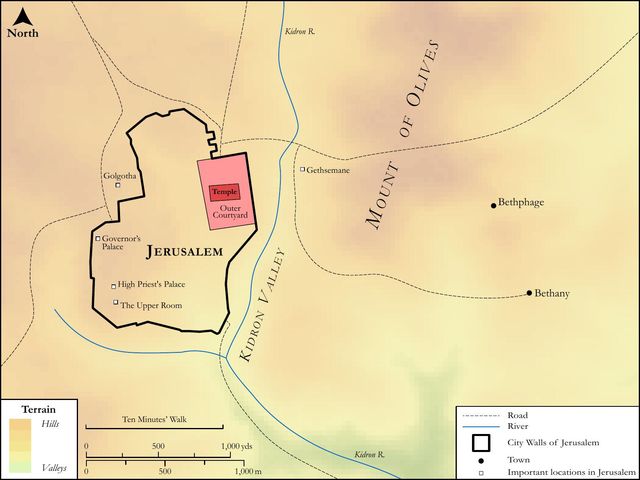
The "brook Cedron" (or Kidron Valley) is a significant geographical feature located directly east of Jerusalem, separating the city from the Mount of Olives. This valley, often dry except during the rainy season when it would become a "winter torrent" (as its Greek name suggests), served as a natural boundary and a traditional route for exiting Jerusalem towards the Mount of Olives. Historically, it held symbolic weight; King David famously crossed the Kidron when fleeing from his son Absalom, a poignant parallel of a king in distress, as recorded in 2 Samuel 15:23. The "garden" mentioned, though not explicitly named Gethsemane in John's account, is universally understood to be the Garden of Gethsemane, meaning "oil press," likely an olive grove on the lower slopes of the Mount of Olives. It was a place Jesus and His disciples frequently visited, making it known to Judas Iscariot, a detail that tragically facilitated the betrayal.
Key Themes
ShowHideJohn 18:1 contributes to several overarching themes within the Gospel. Firstly, it highlights Divine Volition and Sovereignty, as Jesus' act of "going forth" is portrayed not as a passive retreat or flight, but as a deliberate and purposeful step into the events ordained by God. He is in control, willingly embracing the path to the cross. Secondly, the verse marks the Solemn Transition to Suffering, serving as the definitive threshold into the Passion narrative. It signals the end of Jesus' public ministry and private instruction, initiating the sequence of His arrest, trials, and ultimate sacrifice. Thirdly, there is profound Geographical Symbolism at play. Crossing the Kidron Valley, a place associated with historical flight and purification, and entering the garden of Gethsemane, a place that would become synonymous with agony, prayer, and betrayal, powerfully underscores the heavy spiritual and physical journey Jesus was undertaking for the redemption of humanity.
Exposition and Analysis
ShowHideKey Word Analysis
ShowHideThis word (G2036) signifies to "speak or say by word or writing." In John 18:1, it emphasizes that Jesus' departure was directly consequent to His preceding discourse and prayer. It highlights the completion of a significant phase of verbal instruction and intercession, setting a deliberate and intentional tone for the events that follow.
Derived from "ek" (out of) and "erchomai" (to come/go), this verb (G1831) means "to issue (literally or figuratively), to come forth, go out, depart." Its use here underscores Jesus' purposeful and decisive movement. It is not a casual stroll or a reluctant retreat, but a deliberate "going out" into the next, pre-ordained phase of His mission, demonstrating His active agency in fulfilling God's plan.
This compound verb (G1525), formed from "eis" (into) and "erchomai" (to come/go), means "to enter (literally or figuratively)." It describes Jesus' deliberate act of going "into" the garden. Coupled with "went forth," it reinforces the intentionality of His actions, highlighting His conscious decision to move from a place of teaching and prayer into the very location where His betrayal and suffering would commence.
Verse Breakdown
ShowHide"When Jesus had spoken these words"
This phrase directly links the verse to the preceding chapters (John 14-17), emphasizing that Jesus' subsequent actions are a direct consequence and fulfillment of His final teachings and fervent prayer. It highlights the completion of His verbal ministry and the transition to His redemptive suffering.
"he went forth with his disciples"
This signifies Jesus' deliberate and purposeful movement. The inclusion of "his disciples" underscores their continued presence with Him at this critical juncture, though their understanding and resolve would soon be tested. It portrays Jesus as leading them, even into the approaching trial.
"over the brook Cedron"
This detail provides a precise geographical marker, indicating the physical boundary Jesus and His disciples crossed. The Kidron Valley, a "winter torrent," was a common route out of Jerusalem, and its crossing here carries historical and symbolic echoes of movement towards significant, often challenging, events.
"where was a garden, into the which he entered, and his disciples"
This identifies their destination as a specific, known location—a garden. The repetition of "and his disciples" entering with Him emphasizes their shared journey, even though only Jesus fully comprehended the agony that awaited Him there. This garden, Gethsemane, would become the scene of profound prayer, human weakness, and divine resolve.
Literary Devices
ShowHideJohn 18:1 employs several literary devices to convey its profound significance. Transition is the most immediate device, as the verse acts as a clear narrative bridge, shifting the Gospel's focus from Jesus' extensive discourses and prayer to the unfolding Passion narrative. This abrupt shift heightens the dramatic tension. Foreshadowing is also evident; the deliberate movement towards a known, secluded garden, especially after the solemn preceding chapters, subtly hints at the impending betrayal and arrest. The reader, aware of the broader biblical narrative, recognizes this location as the place of Jesus' agony. Furthermore, Geographical Realism grounds the divine narrative in tangible, identifiable locations (the Kidron Valley, a garden), lending authenticity and immediate context to the sacred events. Finally, there is a subtle use of Symbolism in the crossing of the Kidron, which historically evoked themes of flight and purification, subtly connecting Jesus' journey to earlier biblical narratives of suffering and deliverance.
Theological and Thematic Connections
ShowHideJohn 18:1 profoundly illustrates Jesus' unwavering obedience and active participation in God's redemptive plan. His deliberate "going forth" into the garden, knowing full well what awaited Him, is a powerful demonstration of His divine volition and commitment to the Father's will. This is not a passive surrender but a purposeful step towards the cross, highlighting His role as the willing sacrifice for humanity's sin. The transition from intimate prayer to impending suffering underscores the cost of atonement and the depth of divine love. It reveals that even after moments of profound spiritual communion, the path of discipleship often leads through "gardens" of trial and agony, where faith and obedience are tested. Jesus' example here sets the pattern for all who would follow Him, emphasizing that true spiritual strength is found in submission to God's sovereign purpose, even when it leads to suffering.
Reflection and Application
ShowHideJohn 18:1 offers a profound model for navigating life's most challenging transitions. Jesus, having just concluded moments of deep spiritual communion and prayer, deliberately steps into the very place of His betrayal and suffering. This teaches us that spiritual preparation, though vital, does not exempt us from future trials; rather, it equips us to face them with purpose and obedience. We are called to follow Jesus' example, not shrinking from difficult "gardens" in our own lives, but moving forward with a spirit of submission to God's will, even when the path ahead is fraught with pain or uncertainty. This verse encourages us to cultivate a deep reliance on God through prayer, especially before entering periods of significant challenge, trusting that His sovereign plan will unfold even through our suffering. It reminds us that our obedience, like Christ's, is a powerful testament to our faith and love for God, transforming potential defeat into redemptive purpose.
Questions for Reflection
ShowHideFAQ
ShowHideIs the "garden" in John 18:1 explicitly named Gethsemane?
ShowHideNo, John's Gospel does not explicitly name the garden as Gethsemane. However, it is widely understood and accepted by biblical scholars and tradition that the garden mentioned is indeed Gethsemane. This understanding is based on several converging pieces of evidence: the location of the garden "over the brook Cedron" (i.e., the Kidron Valley), which places it on the slopes of the Mount of Olives; the fact that Jesus and His disciples frequently gathered there, making it a known place (John 18:2); and the parallel accounts in the Synoptic Gospels (Matthew 26:36, Mark 14:32, Luke 22:39) which explicitly name the location as Gethsemane. The name "Gethsemane" itself means "oil press," indicating it was likely an olive grove, consistent with its location on the Mount of Olives.
Christ-Centered Fulfillment
ShowHideJohn 18:1, though seemingly a simple geographical and chronological marker, is deeply Christ-centered, revealing Jesus' active fulfillment of His redemptive mission. His deliberate "going forth" over the Kidron and into the garden is not merely a step in a narrative sequence, but a profound act of self-giving, prefiguring His ultimate sacrifice. This moment encapsulates the obedient Lamb of God, who, having completed His final teachings, willingly walks into the very jaws of suffering and death. He is the true King David, not fleeing from a rebellious son, but purposefully entering the valley of the shadow of death to confront the powers of darkness for the sake of His people. Just as the Passover lamb was led to slaughter, so Jesus, the Lamb of God who takes away the sin of the world, deliberately moves towards His appointed hour. His perfect obedience, even to the point of death on a cross (Philippians 2:8), demonstrates the Father's love for a fallen world (Romans 5:8). The garden, a place of agony, becomes the threshold to Calvary, where Christ's suffering would secure eternal life and reconciliation for all who believe, demonstrating that He truly "learned obedience through what he suffered" (Hebrews 5:8).