


John 17:20
- οὐouNotG3756PRT-NNegative Particle Negative
- περὶperiforG4012PREPPreposition
- τούτωνtoutōntheseG3778D-GPMDemonstrative pronoun Genitive Plural Masculine
- δὲdehoweverG1161CONJConjunction
- ἐρωτῶerōtōdo I askG2065V-PAI-1SVerb Present Active Indicative 1st Singular
- μόνονmonononlyG3441A-ASNAdjective Accusative Singular Neuter
- ἀλλὰallabutG235CONJConjunction
- καὶkaialsoG2532CONJConjunction
- περὶperiforG4012PREPPreposition
- τῶνtōnthoseG3588T-GPMDefinite article Genitive Plural Masculine
- πιστευόντωνpisteuontōnare believingG4100V-PAP-GPMVerb Present Active Participle Genitive Plural Masculine
- διὰdiathroughG1223PREPPreposition
- τοῦtoutheG3588T-GSMDefinite article Genitive Singular Masculine
- λόγουlogouwordG3056N-GSMNoun Genitive Singular Masculine
- αὐτῶνautōnof themG846P-GPMPersonal pronoun Genitive Plural Masculine
- εἰςeisinG1519PREPPreposition
- ἐμέ·emeMe myselfG1473P-1ASPersonal pronoun Accusative 1st Singular
English is a literal word-by-word gloss of the Greek, not the KJV's wording. Why?
This is the original text the KJV's translators worked from — each Greek word with its own literal English meaning in this verse, prepared by scholars at Tyndale House, Cambridge. The KJV translates whole sentences, not word by word, so its wording differs: one Greek word can become several English words, and the KJV may choose “charity” where the gloss reads “love”. Both are faithful — they answer different questions. For the KJV's own rendering, switch to the KJV text.
Details
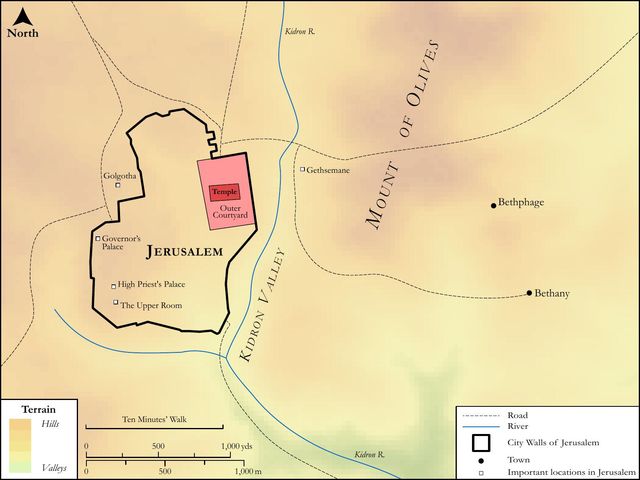
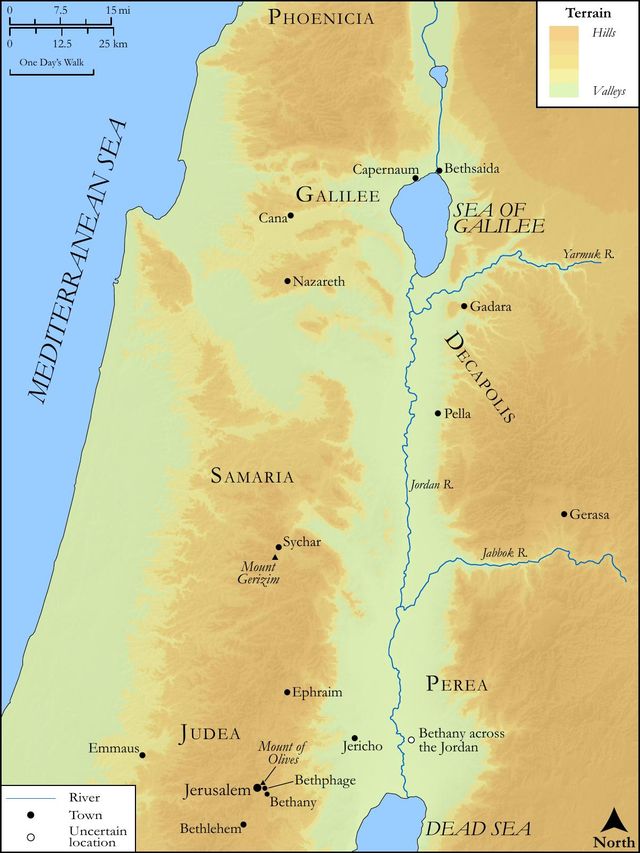
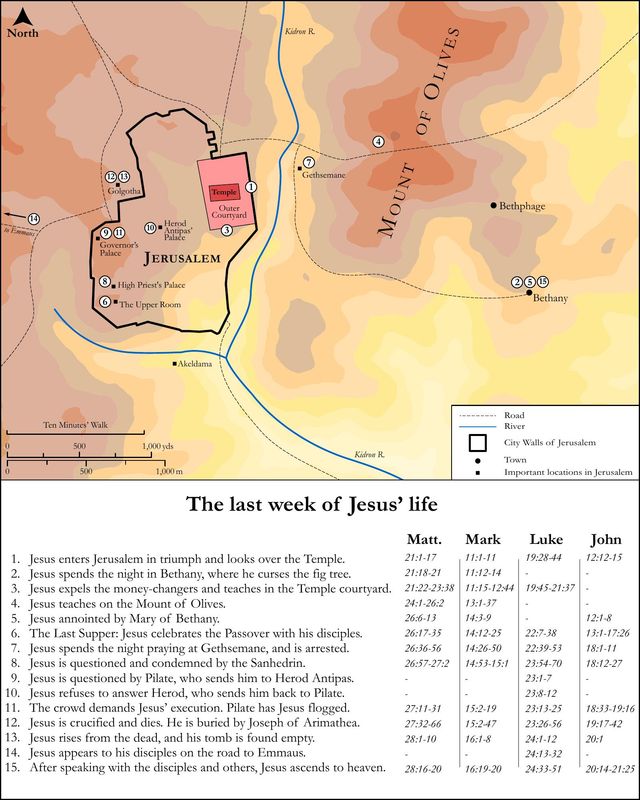
See on the biblical-era map
Study this verse
Public-domain commentary
Matthew Henry
From his Commentary on the Whole Bible. Henry comments on passages, not single verses — this entry covers John 17:20–23. His four-level outline is real structure in the source text, so it is rendered as structure.
Next to their purity he prays for their unity; for the wisdom from above is first pure, then peaceable; and amity is amiable indeed when it is like the ointment on Aaron's holy head, and the dew on Zion's holy hill. Observe,
I.Who are included in this prayer (Joh 17:20):
"Not these only, not these only that are now my disciples" (the eleven, the seventy, with others, men and women that followed him when he was here on earth), "but for those also who shall believe on me through their word, either preached by them in their own day or written by them for the generations to come; I pray for them all, that they all may be one in their interest in this prayer, and may all receive benefit by it." Note, here,
1.Those, and those only, are interested in the mediation of Christ, that do, or shall, believe in him. This is that by which they are described, and it comprehends all the character and duty of a Christian. They that lived then, saw and believed, but they in after ages have not seen, and yet have believed.
2.It is through the word that souls are brought to believe on Christ, and it is for this end that Christ appointed the scriptures to be written, and a standing ministry to continue in the church, while the church stands, that is, while the world stands, for the raising up of a seed.
3.It is certainly and infallibly known to Christ who shall believe on him. He does not here pray at a venture, upon a contingency depending on the treacherous will of man, which pretends to be free, but by reason of sin is in bondage with its children; no, Christ knew very well whom he prayed for, the matter was reduced to a certainty by the divine prescience and purpose; he knew who were given him, who being ordained to eternal life, were entered in the Lamb's book, and should undoubtedly believe, Act 13:48.
4.Jesus Christ intercedes not only for great and eminent believers, but for the meanest and weakest; not for those only that are to be employed in the highest post of trust and honour in his kingdom, but for all, even those that in the eye of the world are inconsiderable. As the divine providence extends itself to the meanest creature, so does the divine grace to the meanest Christian. The good Shepherd has an eye even to the poor of the flock.
5.Jesus Christ in his mediation had an actual regard to those of the chosen remnant that were yet unborn, the people that should be created (Psa 22:31), the other sheep which he must yet bring. Before they are formed in the womb he knows them (Jer 1:5), and prayers are filed in heaven for them beforehand, by him who declareth the end from the beginning, and calleth things that are not as though they were.
II.What is intended in this prayer (Joh 17:21):
That they all may be one. The same was said before (Joh 17:11), that they may be one as we are, and again, Joh 17:22. The heart of Christ was much upon this. Some think that the oneness prayed for in Joh 17:11 has special reference to the disciples as ministers and apostles, that they might be one in their testimony to Christ; and that the harmony of the evangelists, and concurrence of the first preachers of the gospel, are owing to this prayer. Let them be not only of one heart, but of one mouth, speaking the same thing. The unity of the gospel ministers is both the beauty and strength of the gospel interest. But it is certain that the oneness prayed for in Joh 17:21 respects all believers. It is the prayer of Christ for all that are his, and we may be sure it is an answered prayer - that they all may be one, one in us (Joh 17:21), one as e are one (Joh 17:22), made perfect in one, Joh 17:23. It includes three things: -
1.That they might all be incorporated in one body. "Father, look upon them all as one, and ratify that great charter by which they are embodied as one church. Though they live in distant places, from one end of heaven to the other, and in several ages, from the beginning to the close of time, and so cannot have any personal acquaintance or correspondence with each other, yet let them be united in me their common head." As Christ died, so he prayed, to gather them all in one, Joh 11:52; Eph 1:10.
2.That they might all be animated by one Spirit. This is plainly implied in this - that they may be one in us. Union with the Father and Son is obtained and kept up only by the Holy Ghost. He that is joined to the Lord in one spirit, Co1 6:17. Let them all be stamped with the same image and superscription, and influenced by the same power.
3.That they might all be knit together in the bond of love and charity, all of one heart. That they all may be one,
(1.)In judgment and sentiment; not in every little thing - this is neither possible nor needful, but in the great things of God, and in them, by the virtue of this prayer, they are all agreed - that God's favour is better than life - that sin is the worst of evils, Christ the best of friends - that there is another life after this, and the like.
(2.)In disposition and inclination. All that are sanctified have the same divine nature and image; they have all a new heart, and it is one heart.
(3.)They are all one in their designs and aims. Every true Christian, as far as he is so, eyes the glory of God as his highest end, and the glory of heaven as his chief good.
(4.)They are all one in their desires and prayers; though they differ in words and the manner of expressions, yet, having received the same spirit of adoption, and observing the same rule, they pray for the same things in effect.
(5.)All one in love and affection. Every true Christian has that in him which inclines him to love all true Christians as such. That which Christ here prays for is that communion of saints which we profess to believe; the fellowship which all believers have with God, and their intimate union with all the saints in heaven and earth, Jo1 1:3. But this prayer of Christ will not have its complete answer till all the saints come to heaven, for then, and not till then, they shall be perfect in one, Joh 17:23; Eph 4:13.
III.What is intimated by way of plea or argument to enforce this petition; three things: -
1.The oneness that is between the Father and the Son, which is mentioned again and again, Joh 17:11, Joh 17:21-23.
(1.)It is taken for granted that the Father and Son are one, one in nature and essence, equal in power and glory, one in mutual endearments. The Father loveth the Son, and the Son always pleased the Father. They are one in design, and one in operation. The intimacy of this oneness is expressed in these words, thou in me, and I in thee. This he often mentions for his support under his present sufferings, when his enemies were ready to fall upon him, and his friends to fall off from him; yet he was in the Father, and the Father in him.
(2.)This is insisted on in Christ's prayer for his disciples' oneness,
[1.]As the pattern of that oneness, showing how he desired they might be one. Believers are one in some measure as God and Christ are one; for, First, The union of believers is a strict and close union; they are united by a divine nature, by the power of divine grace, in pursuance of the divine counsels. Secondly, It is a holy union, in the Holy Spirit, for holy ends; not a body politic for any secular purpose. Thirdly, It is, and will be at last, a complete union. Father and Son have the same attributes, properties, and perfections; so have believers now, as far as they are sanctified, and when grace shall be perfected in glory they will be exactly consonant to each other, all changed into the same image.
[2.]As the centre of that oneness; that they may be one in us, all meeting here. There is one God and one Mediator; and herein believers are one, that they all agree to depend upon the favour of this one God as their felicity and the merit of this one Mediator as their righteousness. That is a conspiracy, not a union, which doth not centre in God as the end, and Christ as the way. All who are truly united to God and Christ, who are one, will soon be united one to another.
[3.]As a plea for that oneness. The Creator and Redeemer are one in interest and design; but to what purpose are they so, if all believers be not one body with Christ, and do not jointly receive grace for grace from him, as he has received it for them? Christ's design was to reduce revolted mankind to God: "Father," says he, "let all that believe be one, that in one body they may be reconciled" (Eph 2:15, Eph 2:16), which speaks of the uniting of Jews and Gentiles in the church; that great mystery, that the Gentiles should be fellow-heirs, and of the same body (Eph 3:6), to which I think this prayer of Christ principally refers, it being one great thing he aimed at in his dying; and I wonder none of the expositors I have met with should so apply it. "Father, let the Gentiles that believe be incorporated with the believing Jews, and make of twain one new man." Those words, I in them, and thou in me, show what that union is which is so necessary, not only to the beauty, but to the very being, of his church. First, Union with Christ: I in them. Christ dwelling in the hearts of believers is the life and soul of the new man. Secondly, Union with God through him: Thou in me, so as by me to be in them. Thirdly, Union with each other, resulting from these: that they hereby may be made perfect in one. We are complete in him.
2.The design of Christ in all his communications of light and grace to them (Joh 17:22): "The glory which thou gavest me, as the trustee or channel of conveyance, I have accordingly given them, to this intent, that they may be one, as we are one; so that those gifts will be in vain, if they be not one." Now these gifts are either,
(1.)Those that were conferred upon the apostles, and first planters of the church. The glory of being God's ambassadors to the world - the glory of working miracles - the glory of gathering a church out of the world, and erecting the throne of God's kingdom among men - this glory was given to Christ, and some of the honour he put upon them when he sent them to disciple all nations. Or,
(2.)Those that are given in common to all believers. The glory of being in covenant with the Father, and accepted of him, of being laid in his bosom, and designed for a place at his right hand, was the glory which the Father gave to the Redeemer, and he has confirmed it to the redeemed.
[1.]This honour he says he hath given them, because he hath intended it for them, settled it upon them, and secured it to them upon their believing Christ's promises to be real gifts.
[2.]This was given to him to give to them; it was conveyed to him in trust for them, and he was faithful to him that appointed him.
[3.]He gave it to them, that they might be one. First, to entitle them to the privilege of unity, that by virtue of their common relation to one God the Father, and one Lord Jesus Christ, they might be truly denominated one. The gift of the Spirit, that great glory which the Father gave to the Son, by him to be given to all believers, makes them one, for he works all in all, Co1 12:4, etc. Secondly, To engage them to the duty of unity. That in consideration of their agreement and communion in one creed and one covenant, one Spirit and one Bible - in consideration of what they have in one God and one Christ, and of what they hope for in one heaven, they may be of one mind and one mouth. Worldly glory sets men at variance; for if some be advanced others are eclipsed, and therefore, while the disciples dreamed of a temporal kingdom, they were ever and anon quarrelling; but spiritual honours being conferred alike upon all Christ's subjects, they being all made to our God kings and priests, there is no occasion for contest nor emulation. The more Christians are taken up with the glory Christ has given them, the less desirous they will be of vain-glory, and, consequently, the less disposed to quarrel.
3.He pleads the happy influence their oneness would have upon others, and the furtherance it would give to the public good. This is twice urged (Joh 17:21): That the world may believe that thou hast sent me. And again (Joh 17:23): That the world may know it, for without knowledge there can be no true faith. Believers must know what they believe, and why and wherefore they believe it. Those who believe at a venture, venture too far. Now Christ here shows,
(1.)His good-will to the world of mankind in general. Herein he is of his Father's mind, as we are sure he is in every thing, that he would have all men to be saved, and to come to the knowledge of the truth, Ti1 2:4; Pe2 3:9. Therefore it is his will that all means possible should be used, and no stone left unturned, for the conviction and conversion of the world. We know not who are chosen, but we must in our places do our utmost to further men's salvation, and take heed of doing any thing to hinder it.
(2.)The good fruit of the church's oneness; it will be an evidence of the truth of Christianity, and a means of bringing many to embrace it.
[1.]In general, it will recommend Christianity to the world, and to the good opinion of those that are without. First, The embodying of Christians in one society by the gospel charter will greatly promote Christianity. When the world shall see so many of those that were its children called out of its family, distinguished from others, and changed from what they themselves sometimes were, - when they shall see this society raised by the foolishness of preaching, and kept up by miracles of divine providence and grace, and how admirably well it is modelled and constituted, they will be ready to say, We will go with you, for we see that God is with you. Secondly, The uniting of Christians in love and charity is the beauty of their profession, and invites others to join with them, as the love that was among those primo-primitive Christians, Act 2:42, Act 2:43; Act 4:32, Act 4:33. When Christianity, instead of causing quarrels about itself, makes all other strifes to cease, - when it cools the fiery, smooths the rugged, and disposes men to be kind and loving, courteous and beneficent, to all men, studious to preserve and promote peace in all relations and societies, this will recommend it to all that have any thing either of natural religion or natural affection in them.
[2.]In particular, it will beget in men good thoughts, First, Of Christ: They will know and believe that thou hast sent me, By this it will appear that Christ was sent of God, and that his doctrine was divine, in that his religion prevails to join so many of different capacities, tempers, and interests in other things, in one body by faith, with one heart by love. Certainly he was sent by the God of power, who fashions men's hearts alike, and the God of love and peace; when the worshippers of God are one, he is one, and his name one. Secondly, Of Christians: They will know that thou hast loved them as thou hast loved me. Here is, 1. The privilege of believers: the Father himself loveth them with a love resembling his love to his Son, for they are loved in him with an everlasting love. 2. The evidence of their interest in this privilege, and that is their being one. By this it will appear that God loves us, if we love one another with a pure heart; for wherever the love of God is shed abroad in the heart it will change it into the same image. See how much good it would do to the world to know better how dear to God all good Christians are. The Jews had a saying, If the world did but know the worth of good men, they would hedge them about with pearls. Those that have so much of God's love should have more of ours.
Historical interpretation
Seventeen Centuries of Reception
18 surviving comments on this verse. Each one is dated, so this reads as a timeline rather than a list.
Select a marker to jump to its quote. Markers stagger vertically where authors wrote within a few decades of each other.
I am of the opinion, so far as I can see, that this order of the human race has been appointed in order that in the future world—or in ages to come, when there shall be the new heavens and new earth spoken of by Isaiah—that unity may be restored that was promised by the Lord Jesus in his prayer to God the Father on behalf of his disciples. And this is further confirmed by the language of the apostle Paul: “Until we all come in the unity of the faith to a perfect man, to the measure of the stature of the fullness of Christ.” And in keeping with this is the declaration of the same apostle when he exhorts us—who even in the present life are placed in the church, which is a form of that kingdom that is to come—to this same similitude of unity, “That you all speak the same thing and that there be no divisions among you. But that you be perfectly joined together in the same mind and in the same judgment.”
But the Lord prayed and besought not for Himself-for why should He who was guiltless pray on His own behalf?-but for our sins, as He Himself declared, when He said to Peter, "Behold, Satan hath desired that he might sift you as wheat. But I have prayed for thee, that thy faith fail not." And subsequently He beseeches the Father for all, saying, "Neither pray I for these alone, but for them also which shall believe on me through their word; that they all may be one; as Thou, Father, art in me, and I in Thee, that they also may be one in us." The Lord's loving-kindness, no less than His mercy, is great in respect of our salvation, in that, not content to redeem us with His blood, He in addition also prayed for us. Behold now what was the desire of His petition, that like as the Father and Son are one, so also we should abide in absolute unity; so that from this it may be understood how greatly he sins who divides unity and peace, since for this same thing even the Lord besought, desirous doubtless that His people should thus be saved and live in peace, since He knew that discord cannot come into the kingdom of God.
Our Lord prays to His Father that those who shall believe in Him may be one, and as He is in the Father and the Father in Him, so all may be one in Them. Why dost thou bring in here an identity of mind, why a unity of soul and heart through agreement of will? For there would have been no lack of suitable words for our Lord, if it were will that made them one, to have prayed in this fashion: Father, as We are one in will, so may they also be one in will, that we may all be one through agreement.... For those first of all is the prayer of whom it is said, That they all may be one. Then the promotion of unity is set forth by a pattern of unity, when He says, as Thou, Father, art in Me, and I in Thee, that they also may be in Us, so that as the Father is in the Son and the Son in the Father, so through the pattern of this unity all might be one in the Father and the Son.
Now our Lord has not left the minds of His faithful followers in doubt, but has explained the manner in which His nature operates, saying, "That they may be one, as We are one: I in them and Thou in Me, that they may be perfected in one."... If He wished to indicate a mere unity of will, why did He set forth a kind of gradation and sequence in the completion of the unity, unless it were that, since He was in the Father through the nature of Deity, and we on the contrary in Him through His birth in the body, He would have us believe that He is in us through the mystery of the sacraments? And thus there might be taught a perfect unity through a Mediator, whilst, we abiding in Him, He abode in the Father, and as abiding in the Father abode also in us; and so we might arrive at unity with the Father, since in Him Who dwells naturally in the Father by birth, we also dwell naturally, while He Himself abides naturally in us also.
The words of Christ, "I and the Father are one," [heretics] endeavour to refer to a mere concord of unanimity, so that there may be in them a unity of will not of nature, that is, that they may be one not by essence of being, but by identity of will. And they apply to the support of their case the passage in the Acts of the Apostles, "Now of the multitude of them that believed the heart and soul were one," in order to prove that a diversity of souls and hearts may be united into one heart and soul through a mere conformity of will.... Or again, they quote the prayer of our Lord for the salvation of the nations who should believe in Him: "Neither for these only do I pray, but for them also that shall believe on Me through their Word; that they all may be one; even as Thou, Father, art in Me, and I in Thee, that they also may be in Us," to shew that since men cannot, so to speak, be fused back into God or themselves coalesce into one undistinguished mass, this oneness must arise from unity of will, while all perform actions pleasing to God, and unite one with another in the harmonious accord of their thoughts, and that thus it is not nature which makes them one, but will.
The world is to believe that the Son has been sent by the Father because all who shall believe in Him will be one in the Father and the Son. And how they will be so we are soon told: "And the glory which Thou hast given Me I have given unto them." Now I ask whether glory is identical with will, since will is an emotion of the mind while glory is an ornament or embellishment of nature. So then it is the glory received from the Father that the Son hath given to all who shall believe in Him, and certainly not will.... It is then with this object that the received glory was bestowed, that all might be one. So now all are one in glory, because the glory given is none other than that which was received.
(Hom. lxxxii) Another ground of consolation to them, that they were to be the cause of the salvation of others.
(Hom. lxxxii) And with this prayer for unanimity, He concludes His prayer; and then begins a discourse on the same subject: A new commandment I give unto you, that ye love one another.
(Hom. lxxxii) This as again does not express perfect likeness, but only likeness as far as it was possible in men; as when He saith, Be ye merciful, even as your Father, which is in heaven, is merciful. (Luke 6:36)
(Hom. lxxxii) For there is no scandal so great as division, whereas unity amongst believers is a great argument for believing; as He said at the beginning of His discourse, By this shall all men know that ye are My disciples, if ye have love one to another. For if they quarrel, they will not be looked on as the disciples of a peacemaking Master. And I, He saith, not being a peacemaker, they will not acknowledge Me as sent from God.
(Hom. lxxxii. 2) By glory, He means miracles, and doctrines, and unity; which latter is the greater glory. For all who believed through the Apostles are one. If any separated, it was owing to men's own carelessness; not but that our Lord anticipates this happening.
(Hom. lxxxii) Elsewhere He says of Himself and the Father, We will come and make Our abode with Him; by the mention of two persons, stopping the mouths of the Sabellians. Here by saying that the Father comes to the disciples through Him, He refutes the notion of the Arians.
"Neither pray I for these alone, but for them also who shall believe." For since He was dying for them, and said, that "For their sakes I sanctify Myself," lest any one should think that He did this for the Apostles only, He added, "Neither pray I for these only, but for them also who believe on Me through their word." By this again He revived their souls, showing that the disciples should be many. For because He made common what they possessed peculiarly, He comforteth them by showing that they were being made the cause of the salvation of others.
He reminds us that the whole Christian people are one in God, and, as his well-beloved children, are “partakers of the divine nature.” We have already said (and the truth must now be inculcated more in detail) that we are not one in the Father and the Son according to nature but according to grace. For the essence of the human soul and the essence of God are not the same, as the Manichaeans constantly assert. But, says our Lord, “You have loved them as you have loved me.” You see, then, that we are privileged to partake of his essence, not in the realm of nature but of grace. And the reason why we are beloved of the Father is that he has loved the Son—and the members of the body are loved.
In this prayer, therefore, Jesus may seem to have omitted praying for some of His own, unless we carefully examine His words in the prayer itself. For if He prayed first for those, as we have already shown, who were then with Him, and afterwards for those also who should believe on Him through their word, it may be said that He prayed not for those who were neither with Him when He so spake, nor afterwards believed through their word, but had done so at some previous time either of themselves, or in some other supposable manner. For was Nathanael with Him at that time? Was Joseph of Arimathea, who begged His body from Pilate, and of whom this same evangelist John testifies that he was already His disciple? Were His mother, Mary, and other women who, we know from the Gospel, had been prior to that time His disciples? Were those with Him then, of whom this evangelist John frequently says, "Many believed on Him"? For whence came the multitude of those who, with branches of trees, partly preceded and partly followed Him as He sat on the ass, saying, "Blessed is He that cometh in the name of the Lord;" and along with them the children of whom He Himself declared that the prophecy had been uttered, "Out of the mouth of babes and of sucklings Thou hast perfected praise"? Whence the five hundred brethren, to all of whom at once He would not have appeared after His resurrection had they not previously believed on Him? Whence that hundred and nine who, with the eleven, were a hundred and twenty, when, being assembled together after His ascension, they waited and received the promise of the Holy Spirit? Whence came all these, save from those of whom it was said, "Many believed on Him"? For them, therefore, the Saviour did not at this time pray, seeing it was for those He prayed who were then with Him, and for others not who had already, but who were yet to believe on Him through their word.
(Tr. cix) When our Lord had prayed for His disciples, whom He named also Apostles, He added a prayer for all others who should believe on Him; Neither pray I for these alone, but for all others who shall believe on Me through their word.
(Tr. cix) All, i. e. not only those who were then alive, but those who were to be born; not those only who heard the Apostles themselves, but us who were born long after their death. We have all believed in Christ through their word: for they first heard that word from Christ, and then preached it to others, and so it has come down, and will go down to all posterity. We may see that in this prayer there are some disciples whom He does not pray for; for those, i. e. who were neither with Him at the time, nor were about to believe on Him afterwards through the Apostles' word, but believed already. Was Nathanael with Him then, or Joseph of Arimathea, and many others, who, John says, believed on Him? I do not mention old Simeon, or Anna the prophetess, Zacharias, Elisabeth, or John the Baptist; for it might be answered that it was not necessary to pray for dead persons, such as these who departed with such rich merits. With respect to the former then we must understand that they did not yet believe in Him, as He wished, but that after His resurrection, when the Apostles were taught and strengthened by the Holy Spirit, they attained to a right faith. The case of Paul however still remains, An Apostle not of men, or by men; (Gal. 1:1) and that of the robber, who believed when even the teachers themselves of the faith fell away. We must understand then, their word, to mean the word of faith itself which they preached to the world; it being called their word, because it was preached in the first instance and principally by them; for it was being preached by them, when Paul received it by revelation from Jesus Christ Himself. And in this sense the robber too believed their word. Wherefore in this prayer the Redeemer prays for all whom He redeemed, both present and to come. And then follows the thing itself which He prays for, That they all may be one. He asks that for all, which he asked above for the disciples; that all both we and they may be one.
(Tr. cx) We must particularly observe here, that our Lord did not say, that we may be all one, but that they may be all one, as Thou, Father, in Me, and I in Thee, are one, understood. For the Father is so in the Son, that They are one, because They are of one substance; but we can be one in Them, but not with Them; because we and They are not of one substance. They are in us, and we in Them, so as that They are one in Their nature, we one in ours. They are in us, as God is in the temple; we in Them, as the creature is in its Creator. Wherefore He adds, in Us, to show, that our being made one by charity, is to be attributed to the grace of God, not to ourselves.
(iv. de. Trin. c. ix) Or that in ourselves we cannot be one, severed from each other by diverse pleasures, and lusts, and the pollution of sin, from which we must be cleansed by a Mediator, in order to be one in Him.
(Tr. cx) But why does He say, That the world may believe that Thou hast sent Me? Will the world believe when we shall all be one in the Father and the Son? Is not this unity that peace eternal, which is the reward of faith, rather than faith itself? For though in this life all of us who hold in the same common faith are one, yet even this unity is not a means to belief, but the consequence of it. What means then, That all may be one, that the world may believe? He prays for the world when He says, Neither pray I for these alone, but for all those who shall believe on Me through their word. Whereby it appears that He does not make this unity the cause of the world believing, but prays that the world may believe, as He prays that they all may be one. The meaning will be clearer if we always put in the word ask; I ask that they all may be one; I ask that they may be one in Us; I ask that the world may believe that Thou hast sent Me.
(Tr. cx) Then our Saviour, Who, by praying to the Father, showed Himself to be man, now shows that, being God with the Father, He doth what He prays for: And the glory which Thou gavest Me, I have given them. What glory, but immortality, which human nature was about to receive in Him? For that which was to be by unchangeable predestination, though future, He expresses by the past tense. That glory of immortality, which He says was given Him by the Father, we must understand He gave Himself also. For when the Son is silent of His own cooperation in the Father's work, He shows His humility: when He is silent of the Father's cooperation in His work, He shows His equality. In this way here He neither disconnects Himself with the Father's work, when He says, The glory which Thou gavest Me, nor the Father with His work, when He says, I have given them. But as He was pleased by prayer to the Father to obtain that all might be one, so now He is pleased to effect the same by His own gift; for He continues, That all may be one, even as We are one.
(Tr. cx. 4) Nor is this said, however, as if to mean that the Father was not in us, or we in the Father. He only means to say, that He is Mediator between God and man. And what He adds, That they may be made perfect in one, shows that the reconciliation made by this Mediator, was carried on even to the enjoyment of everlasting blessedness. So what follows, That the world may know that Thou hast sent Me, must not be taken to mean the same as the words just above, That the world may believe. For as long as we believe what we do not see, we are not yet made perfect, as we shall be when we have merited to see what we believe. So that when He speaks of their being made perfect, we are to understand such a knowledge as shall be by sight, not such as is by faith. These that believe are the world, not a permanent enemy, but changed from an enemy to a friend; as it follows: And hast loved them, as Thou hast loved Me. The Father loves us in the Son, because He elected us in Him. These words do not prove that we are equal to the Only Begotten Son; for this mode of expression, as one thing so another, does not always signify equality. It sometimes only means, because one thing, therefore another. And this is its meaning here: Thou hast loved them, as Thou hast loved Me, i. e. Thou hast loved them, because Thou hast loved Me. There is no reason for God loving His members, but that He loves him. But since He hateth nothing that He hath made, who can adequately express how much He loves the members of His Only Begotten Son, and still more the Only Begotten Himself.
But we have still in reserve for the further solution of this question the blessed apostle, and that robber who was a villain in wickedness, but a believer on the cross. For the Apostle Paul tells us that he was made an apostle not of men, nor by man, but by Jesus Christ: and speaking of his own gospel, he says, "For I neither received it of man, neither did I learn it, but by the revelation of Jesus Christ." How then was he among those of whom it is said, "They shall believe on me through their word"? On the other hand, the robber believed at the very time when in the case of the teachers themselves such faith as they previously possessed had utterly failed. Not even he, therefore, believed on Christ through their word, and yet his faith was such that he confessed that He whom he saw nailed to the cross would not only rise again, but would also reign, when he said, "Remember me when Thou comest into Thy kingdom."
The Lord Jesus, in the now close proximity of His passion, after praying for His disciples, whom He also named apostles, with whom He had partaken of that last supper from which His betrayer had taken his departure on being revealed by the sop of bread, and with whom, after the latter's departure, and before beginning His prayer in their behalf, He had already spoken at length, conjoined all others also who were yet to believe on Him, and said to the Father, "Neither pray I for these alone," that is, for the disciples who were with Him at the time, "but for them also," He adds, "who shall believe on me through their word." Whereby He wished all His own to be understood: not only such as were then in the flesh, but those also who were yet to come. For all that have since believed on Him have doubtless believed, and shall yet believe till He come, through the word of the apostles; for to themselves He had said, "And ye also shall bear witness, because ye have been with me from the beginning;" and by them was the gospel ministered even before it was written, and every one assuredly who believeth on Christ believeth the gospel. Accordingly, those who He says should believe on Him through their word, are not to be understood as referring only to such as heard the apostles themselves while they lived in the flesh; but others also after their decease, and we, too, born long afterwards, have believed on Christ through their word. For they that were then with Him preached to the others what they had heard from Him; and so their word, that we too might believe, has found its way to us, and wherever His Church exists, and shall yet reach down to posterity, whoever and wherever they be who shall hereafter believe on Him.
Accordingly it remains that if we are to believe that the Lord Jesus, in this prayer, prayed for all of His own who either then were or should thereafter be in this life, which is a state of trial upon earth, we must so understand the expression, "through their word," as to believe that it here signified the word of faith itself which they preached in the world, and that it was called their word because it was primarily and principally preached by them. For it was already in the course of being preached by them in the earth when Paul received that same word of theirs by the revelation of Jesus Christ. Whence also it came about that he compared the Gospel with them, lest by any means he had run, or should run, in vain; and they gave him their right hand because in him also they found, although not given him by them, their own word which they were already preaching, and in which they were now established. And in regard to this word of the resurrection of Christ, it is said by the same apostle, "Whether it were I, or they, so we preach, and so ye believed;" and again, "This is the word of faith," he says, "which we preach, that if thou shalt confess with thy mouth that Jesus is the Lord, and shalt believe in thine heart that God hath raised Him from the dead, thou shalt be saved." And in the Acts of the Apostles we read that in Christ, God hath marked out [the ground of] faith unto all men, in that He hath raised Him from the dead. Accordingly, this word of faith, because principally and primarily preached by the apostles who adhered to Him, was called their word. Not, however, on that account does it cease to be the word of God because it is called their word; for the same apostle says that the Thessalonians received it from him "not as the word of men, but, as it is in truth, the word of God." "Of God," for the very reason that it was freely given by God; but called "their word," because primarily and principally committed to them by God to be preached. In the same way also the thief mentioned above had in the matter of his own faith their word, which was called theirs precisely because the preaching of it primarily and principally pertained to the office they filled.
We are therefore to understand that their faith in Him was not yet such as He wished it to be, inasmuch as even Peter himself, to whom, on making the confession, "Thou art the Christ, the Son of the living God," He had borne so excellent a testimony, was disposed rather to hinder Him from dying than to believe in His resurrection when dead, and hence was called immediately thereafter by the same of Satan. Those, accordingly, are found to be the greater in faith who were long since deceased, and yet, through the revelation of the Spirit, had no manner of doubt that Christ would rise again, than those who, after attaining to the belief that He should redeem Israel, at the sight of His death lost all the hope they previously possessed regarding Him. The best thing for us, therefore, to believe is, that after His resurrection, when the Holy Spirit was bestowed, and the apostles taught and confirmed, and from its outset constituted teachers in the Church, others, through their word, attained the proper faith in Christ, or, in other words, that they then got firm hold of the faith of His resurrection. And in this way also, that all those who seemed to have already believed on Him really belonged to the number of those for whom He prayed, when He said, "Neither pray I for these alone, but for them also who shall believe on me through their word."
And once more, when murmuring arose among the Grecian widows in reference to the serving of the tables, previous to the time when Paul was brought to the faith of Christ, the reply given by the apostles, who before then had adhered to the Lord, was: "It is not good that we should leave the word of God, and serve tables." Then it was that they provided for the ordination of deacons, that they themselves might not be drawn aside from the duty of preaching the word. Hence that was properly enough called their word which is the word of faith, whereby all, from whatever quarter they had heard it, believed on Christ, or, as yet to hear it, should thereafter believe. In this prayer, therefore, all whom He redeemed, whether then alive or thereafter to live in the flesh, were prayed for by our Redeemer when, praying for the apostles who were then with Him, He also conjoined those who were yet to believe on Him through their word.
CHAPTER XI. That the Son is naturally One with God His Father; and that He is in the Father and the Father in Him, according to the essential bond and character of their Unity; and that likewise also we ourselves, when we receive faith in Him, are proved one with each other and with God, both in a corporeal and in a spiritual sense.
Christ is, as it were, the Firstfruits of those who are built up into newness of life, and Himself the first heavenly Man. For, as Paul says: The second Adam, is the Lord from heaven. Therefore also John wrote: And no man hath ascended into heaven, but He That descended out of heaven, even the Son of man. And in close connexion with Him, the Firstfruits, yea, and far nearer unto Him than others, were those who were chosen to be disciples, and who held the rank of His followers; who also with their own eyes beheld His glory, ever attending upon Him, and in converse with Him, and gathering in, as it were, the firstfruits of His succour into their hearts. They were then, and are after Him, Who is far above all others, the Head of the body, the Church, the precious and more estimable members thereof. Furthermore, He prays that on them the blessing and sanctification of the Spirit may be sent down from His Father, but through Him wholly; for it could not be otherwise, since He is the living, and true, and active, and all-performing wisdom and power of Him That begat Him. But that none of those, who are not well-practised attentively to hearken to the inspired writings, might thoughtlessly imagine that upon the disciples only He prayed that the Spirit of God might come down, and that He did not pray for us, who clearly follow after them, and live in an early age of Christianity, the Mediator between God and man, the Advocate and High Priest of our souls, is induced, with a view to check beforehand the foolish imaginations of such men, to add this passage to what He had said, namely: Neither for these only do I pray, but for them also that believe on Me through their word. For it would have been in a manner absurd, that the sentence of condemnation should fall upon all men through one man, who was the first, I mean Adam; and that those who had not sinned at that time, that is, at which the founder of our race transgressed the commandment given unto him, should wear the dishonourable image of the earthy; and yet that when Christ came among us, Who was the Man from heaven, those who were called through Him to righteousness, the righteousness of course that is through faith, should not all be moulded into His Image. And, just as we say that the unlovely image of the earthy is seen in types, and in a form bearing the defilement of sin, and the weakness of death and corruption, and the impurity of fleshly lusts and worldly thoughts; so also, on the other hand, we think that the Image of the heavenly, that is, Christ, shines forth in purity and sincerity, and perfect incorruption, and life, and sanctification. It was, perhaps, impossible for us who had once fallen away through the original transgression to be restored to our pristine glory, except we obtained an ineffable communion and unity with God; for the nature of men upon the earth was ordered at the beginning. And no man can attain to union with God, save by communion with the Holy Spirit, Who implants in us the sanctification of His own Person, and moulds anew into His own life the nature which was subject to corruption, and so brings back to God and to His Likeness that which was bereft of the glory that this confers. And the Son is the express Image of the Father, and His Spirit is the natural Likeness of the Son. For this cause, moulding anew, as it were, into Himself the souls of men, He stamps them with the Likeness of God, and seals them with the Image of the Most High.
[Responding to the question "Many people are quite unable to understand the theological differences which have caused divisions in the Christian Church. Do you consider that these differences are fundamental, and is the time now ripe for reunion?"]
The time is always ripe for reunion. Divisions between Christians are a sin and a scandal, and Christians ought at all times to be making contributions toward reunion, if it is only by their prayers. I am only a layman and a recent Christian, and I do not know much about these things, but in all the things which I have written and thought I have always stuck to traditional, dogmatic positions. The result is that letters of agreement reach me from what are ordinarily regarded as the most different kinds of Christians; for instance, I get letters from Jesuits, monks, nuns, and also from Quakers and Welsh Dissenters, and so on. So it seems to me that the "extremist" elements in every church are nearest one another and the liberal and "broad-minded" people in each body could never be united at all. The world of dogmatic Christianity is a place in which thousands of people of quite different types keep on saying the same thing, and the world of "broad-mindedness" and watered-down "religion" is a world where a small number of people (all of the same type) say totally different things and change their minds every few minutes. We shall never get reunion from them.
Continue studying John 17:20 across the web’s major study libraries — every link below opens this exact verse, chapter, or book on the destination site.
Read & Compare
 BibleGatewayThis verse in more than 200 translations and 70 languages.
 Bible.comThe YouVersion reader — hundreds of translations, reading plans, and highlights.
 ESV.orgCrossway's official English Standard Version reader.
 NET BibleThe NET translation with 60,000+ translators' notes on every rendering decision.
 STEP BibleTyndale House's free study tool — original text, vocabulary, and scholarly resources.
 BibliaLogos Bible Software's free web reader.
 USCCBThe New American Bible (Revised Edition) with the U.S. bishops' study notes.
Commentaries
 BibleHub CommentariesDozens of classic commentaries on this verse, gathered on one page.
 StudyLightMore than 100 commentary sets — the largest collection on the web.
 BibleRefPlain-English commentary on what this verse means, verse by verse.
 Enduring WordDavid Guzik's free commentary on this chapter, widely used by Bible teachers.
 Bible Study ToolsVerse commentary alongside Greek and Hebrew study aids.
Original Language & Research
- BibleHub InterlinearThe verse word by word — original language, transliteration, and English.
- BibleHub LexiconEvery word's original-language definition and Strong's entry.
 Blue Letter BibleDeep-study tools — Strong's numbers, concordance, and word studies.
 CNTR CollationThe earliest Greek manuscripts of this verse, collated letter by letter.
Sermons, Hymns & Audio


TrulyRandomVerse is not affiliated with these sites and doesn’t control their content. They’re linked because they’re genuinely useful.
Summary
John 17:20 stands as a pivotal moment within Jesus' High Priestly Prayer, transcending His immediate circle of disciples to encompass all future believers across time. Spoken just hours before His crucifixion, this verse reveals the expansive, eternal scope of Christ's intercession, demonstrating His profound love and foresight for the entire Church that would come to faith through the apostolic witness. It is a powerful affirmation of His ongoing commitment to those who would believe in Him throughout history.
Context
ShowHideLiterary Context
John 17:20 marks a significant transition within Jesus' "High Priestly Prayer," which unfolds in three main movements. The prayer begins with Jesus interceding for Himself and His glorification (John 17:1-5), setting the stage for His sacrificial work. He then shifts to pray specifically for His eleven apostles, those whom the Father had given Him, asking for their protection, sanctification, and unity in the face of the world's hostility (John 17:6-19). John 17:20 then broadens the scope dramatically, extending His intercession beyond this immediate group to all who would subsequently believe through their testimony. This expansion naturally leads into Jesus' fervent prayer for the unity of all believers in the following verses, emphasizing that the future Church's unity is a direct outcome of His intercession and the apostolic message.
Historical & Cultural Context
This prayer is uttered in the solemn atmosphere of the Upper Room, following the Last Supper and just prior to Jesus' betrayal, arrest, and crucifixion. It reflects the Jewish tradition of prayer, particularly the role of a leader or priest interceding for his community. The disciples, predominantly Galilean Jews, were about to face immense persecution and the daunting task of spreading the Gospel. Jesus' awareness of the future, including the global reach of His message, transcends typical human foresight. The cultural understanding of "word" (λόγος) as a powerful, authoritative declaration, particularly in a rabbinic context, underscores the weight of the apostles' future testimony. This setting highlights the gravity of Jesus' impending sacrifice and His deep concern for the continuity and expansion of His spiritual family.
Key Themes
ShowHideThis verse powerfully contributes to several overarching themes in John's Gospel and biblical theology. Firstly, it underscores Christ's Intercessory Ministry, portraying Jesus not merely as a teacher or miracle-worker, but as the great High Priest who continually prays for His people (a theme echoed in Hebrews 7:25). Secondly, it highlights the Power and Authority of Apostolic Testimony. The phrase "through their word" emphasizes that the Gospel would spread not by force or human wisdom, but by the faithful proclamation of the apostles' eyewitness accounts and teachings, which would later form the foundation of the New Testament Scriptures (Acts 2:42). Finally, it implicitly lays the groundwork for the Unity of the Church, as Jesus' prayer for future believers sets the stage for His subsequent plea for their oneness, reflecting the divine unity He shares with the Father (as seen in John 17:21).
Exposition and Analysis
ShowHideKey Word Analysis
ShowHideThis word, G2065, means "to interrogate" or, by implication, "to request," "beseech," "desire," or "intreat." While it can mean "to ask a question," in the context of prayer, it signifies a direct and earnest request. Here, Jesus is not merely asking, but making a solemn, intercessory appeal to the Father on behalf of His followers.
Meaning "to have faith (in, upon, or with respect to, a person or thing)," or "to credit." By implication, it means "to entrust (especially one's spiritual well-being to Christ)." This term denotes active trust, reliance, and commitment to Jesus, not merely intellectual assent. It is the fundamental response required for salvation and union with Christ.
A primary preposition denoting "the channel of an act." It signifies the means or instrument by which something occurs. In this verse, it explicitly states that belief in Jesus will come "through" the word of the apostles, establishing the foundational role of their message as the divinely appointed conduit for faith.
Meaning "something said (including the thought)," "a topic," "reasoning," or "a computation." In this context, it refers to the message, teaching, or testimony of the apostles concerning Jesus Christ. It encompasses their preaching, their eyewitness accounts, and the inspired truth they would communicate, which would eventually be recorded as the New Testament.
Verse Breakdown
ShowHide"Neither pray I for these alone,"
Jesus clarifies that His intercession is not limited to the eleven disciples present with Him at that moment. The "these" refers specifically to the apostles for whom He has just prayed in the preceding verses (John 17:6-19). This opening clause immediately broadens the scope of His High Priestly prayer, signaling a shift from a specific group to a much larger, future community.
"but for them also which shall believe on me"
This is the expansive heart of the verse. Jesus extends His prayer to include all future generations of believers. The phrase "shall believe" (G4100, pisteúō) emphasizes a future act of faith, highlighting Jesus' divine foreknowledge and His active concern for all who would ever place their trust in Him. This demonstrates the universal reach of His redemptive work and His ongoing care for His Church throughout history.
"through their word;"
This crucial phrase specifies the means by which future believers will come to faith. "Their word" refers to the message, testimony, and teaching of the apostles—the very disciples for whom Jesus had just prayed. It underscores the foundational role of the apostolic witness, both spoken and written (which would become the New Testament Scriptures), as the divinely ordained instrument through which the Gospel would be proclaimed and faith ignited in the hearts of subsequent generations.
Literary Devices
ShowHideJohn 17:20 employs several significant literary devices. The most prominent is Expansion, as Jesus deliberately broadens the scope of His prayer from His immediate disciples to an innumerable future multitude. This highlights the universal and enduring nature of His redemptive work. There is also clear Foreshadowing, as Jesus anticipates the global spread of the Gospel through the apostolic mission, a mission that would only commence fully after His resurrection and the outpouring of the Holy Spirit. The phrase "through their word" functions as a form of Metonymy, where "word" stands for the entire content of the apostolic message, including their eyewitness accounts, teachings, and the inspired Scriptures that would preserve their testimony. Finally, the entire prayer, including this verse, is a profound act of Intercession, showcasing Christ's role as the mediator between God and humanity, continually advocating for His people.
Theological and Thematic Connections
ShowHideJohn 17:20 is profoundly significant, establishing the foundational truth that Christ's intercessory work extends to every believer across history. It affirms that the Church is not an afterthought but a central part of God's redemptive plan, foreseen and prayed for by Jesus Himself. This verse underscores the vital link between the apostolic witness and the birth of faith, emphasizing that genuine belief in Christ is always rooted in the authoritative proclamation of His truth. It also implicitly highlights the unity of the Church, as all who believe "through their word" are brought into one body, a theme Jesus elaborates on immediately after this verse. This prayer provides immense assurance, knowing that our faith is not merely a human decision but a response to a divine call, sustained by the ongoing intercession of our High Priest.
Reflection and Application
ShowHideJohn 17:20 offers profound comfort and a clear call to action for every believer. To know that Jesus, in the gravest hour before His crucifixion, specifically prayed for you—if you have put your faith in Him through the message passed down by the apostles—is an overwhelming demonstration of His personal, enduring love and commitment. This truth should instill deep assurance, reminding us that our salvation is not an accident but a divinely purposed reality, secured by Christ's intercession. It underscores that our faith is not a private, isolated experience but a participation in a grand, historical movement initiated by Jesus Himself. Furthermore, this verse validates and empowers the mission of the Church: just as people believed through the apostles' word, so too are we called to share the Gospel. Our witness, however imperfect, becomes the very means God uses to bring others into the fold, extending the reach of Christ's prayer and fulfilling His commission to make disciples of all nations. This should inspire us to faithfully proclaim the truth, trusting that God will use our testimony to bring others to faith, just as He did through the apostles.
Questions for Reflection
ShowHideFAQ
ShowHideDid Jesus literally pray for me, personally, in John 17:20?
ShowHideYes, in a profound and deeply personal sense. While Jesus did not use your specific name, His prayer for "them also which shall believe on me through their word" explicitly includes every individual who would ever come to faith in Him through the message proclaimed by His apostles. This means that if you are a believer today, you are a direct object of this specific prayer uttered by Jesus before His crucifixion. It highlights His divine foreknowledge and His comprehensive, eternal care for every member of His future Church. It's a powerful assurance that your faith is not an accident, but a part of God's sovereign plan, anticipated and interceded for by Christ Himself.
What does "their word" refer to in this verse?
ShowHide"Their word" (Greek: lógos) refers to the message, teaching, and testimony of the apostles—the immediate disciples for whom Jesus had just prayed in John 17:6-19. This encompasses their eyewitness accounts of Jesus' life, death, and resurrection, their inspired teachings about His person and work, and the Gospel message they would proclaim. This "word" was initially spoken, but it was also preserved and transmitted through the New Testament Scriptures, which are the authoritative record of the apostolic teaching. Therefore, "their word" is the foundational, divinely-revealed truth about Jesus Christ that continues to be the instrument by which people come to saving faith (Romans 10:17).
How does this verse relate to evangelism and missions?
ShowHideJohn 17:20 provides a foundational theological basis for evangelism and missions. It explicitly states that future believers will come to faith "through their word," meaning through the proclamation of the Gospel message by those who have received it. This underscores the essential role of human testimony and preaching in God's plan for salvation. It implies that the Church, as the inheritor of the apostles' mission, is called to continue sharing this "word" so that others may believe. Jesus' prayer for those who would believe through this word serves as both a divine mandate and an assurance that God will work through the faithful witness of His people to bring about His purposes, thereby fulfilling the Great Commission.
Christ-Centered Fulfillment
ShowHideJohn 17:20 finds its ultimate Christ-centered fulfillment in the ongoing, multifaceted ministry of Jesus as the ascended Lord and Head of the Church. This prayer for future believers is not merely a historical utterance but a living reality, actualized through Christ's continuous intercession at the right hand of the Father (as illuminated in Hebrews 7:25 and Romans 8:34). The "word" through which people believe is ultimately Christ Himself, the living Logos, revealed through the apostolic testimony. His prayer ensures the preservation and expansion of His body, the Church, demonstrating His sovereign power to gather His elect from every tribe and nation. The Holy Spirit, sent by Christ (as promised in John 14:26), empowers this "word" to penetrate hearts, bringing about the belief for which Jesus prayed. Thus, John 17:20 is a profound testament to Christ's comprehensive redemptive work, ensuring that His sacrifice on the cross would not be in vain, but would yield a multitude of believers united to Him and to one another, culminating in His glorious return and the full realization of His eternal kingdom (as envisioned in Revelation 7:9-10).