


Acts 4:4
- πολλοὶpolloiManyG4183A-NPMAdjective Nominative Plural Masculine
- δὲdehoweverG1161CONJConjunction
- τῶνtōnof thoseG3588T-GPMDefinite article Genitive Plural Masculine
- ἀκουσάντωνakousantōnhaving heardG191V-AAP-GPMVerb Aorist Active Participle Genitive Plural Masculine
- τὸνtontheG3588T-ASMDefinite article Accusative Singular Masculine
- λόγονlogonwordG3056N-ASMNoun Accusative Singular Masculine
- ἐπίστευσαν·episteusanbelievedG4100V-AAI-3PVerb Aorist Active Indicative 3rd Plural
- καὶkaiandG2532CONJConjunction
- ἐγενήθηegenēthēbecameG1096V-2AOI-3SVerb 2nd Aorist Passive Deponent Indicative 3rd Singular
- ὁhotheG3588T-NSMDefinite article Nominative Singular Masculine
- ἀριθμὸςarithmosnumberG706N-NSMNoun Nominative Singular Masculine
- τῶνtōnof theG3588T-GPMDefinite article Genitive Plural Masculine
- ἀνδρῶνandrōnmenG435N-GPMNoun Genitive Plural Masculine
- ὡςhōsaboutG5613PRTParticle or Disjunctive
- χιλιάδεςchiliadesthousandG5505N-NPFNoun Nominative Plural Feminine
- πέντεpentefiveG4002A-NUIAdjective
English is a literal word-by-word gloss of the Greek, not the KJV's wording. Why?
This is the original text the KJV's translators worked from — each Greek word with its own literal English meaning in this verse, prepared by scholars at Tyndale House, Cambridge. The KJV translates whole sentences, not word by word, so its wording differs: one Greek word can become several English words, and the KJV may choose “charity” where the gloss reads “love”. Both are faithful — they answer different questions. For the KJV's own rendering, switch to the KJV text.
Details
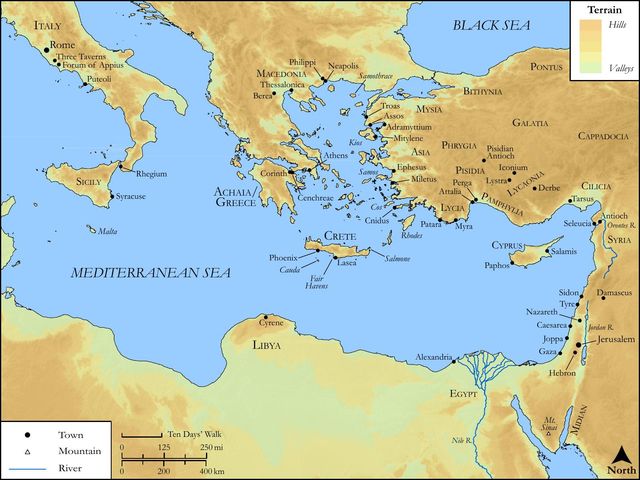
See on the biblical-era map
Study this verse
Public-domain commentary
Matthew Henry
From his Commentary on the Whole Bible. Henry comments on passages, not single verses — this entry covers Acts 4:1–4. His three-level outline is real structure in the source text, so it is rendered as structure.
We have here the interests of the kingdom of heaven successfully carried on, and the powers of darkness appearing against them to put a stop to them. let Christ's servants be ever so resolute, Satan's agents will be spiteful; and therefore, let Satan's agents be ever so spiteful, Christ's servants ought to be resolute.
I.The apostles, Peter and John, went on in their work, and did not labour in vain. The Spirit enabled the ministers to do their part, and the people theirs.
1.The preachers faithfully deliver the doctrine of Christ: They spoke unto the people, to all that were within hearing, Act 4:1. What they said concerned them all, and they spoke it openly and publicly. They taught the people, still taught the people knowledge; taught those that as yet did not believe, for their conviction and conversion; and taught those that did believe, for their comfort and establishment. They preached through Jesus the resurrection from the dead. The doctrine of the resurrection of the dead,
(1.)Was verified in Jesus; this they proved, that Jesus Christ had risen from the dead, as the first, the chief, that should rise from the dead, Act 26:23. They preached the resurrection of Christ as their warrant for what they did. Or,
(2.)It is secured by him to all believers. The resurrection of the dead includes all the happiness of the future state. This they preached through Jesus Christ, attainable through him (Phi 3:10, Phi 3:11), and through him only. They meddled not with matters of state, but kept to their business, and preached to the people heaven as their end and Christ as their way. See Act 17:18.
2.The hearers cheerfully receive it (Act 4:4): Many of those who heard the word believed; not all - perhaps not the most, yet many, to the number of about five thousand, over and above the three thousand we read of before. See how the gospel got ground, and it was the effect of the pouring out of the Spirit. Though the preachers were persecuted, the word prevailed; for sometimes the church's suffering days have been her growing days: the days of her infancy were so.
II.The chief priests and their party now made head against them, and did what they could to crush them; their hands were tied awhile, but their hearts were not in the least changed. Now here observe, 1. Who they were that appeared against the apostles. They were the priests; you may be sure, in the first place, they were always sworn enemies to Christ and his gospel; they were as jealous for their priesthood as Caesar for his monarchy, and would not bear one they thought their rival now, when he was preached as a priest, as much as when he himself preached as a prophet. With them was joined the captain of the temple, who, it is supposed, was a Roman officer, governor of the garrison placed in the tower of Antonia, for the guard of the temple: so that still here were both Jews and Gentiles confederate against Christ. The Sadducees also, who denied the being of spirits and the future state, were zealous against them. "One would wonder" (saith Mr. Baxter) "what should make such brutists as the Sadducees were to be such furious silencers and persecutors. If there is no life to come, what harm can other men's hopes of it do them? But in depraved souls all faculties are vitiated. A blind man has a malignant heart and a cruel hand, to this day." 2. How they stood affected to the apostles' preaching: They were grieved that they taught the people, Act 4:2. It grieved them, both that the gospel doctrine was preached (was so preached, so publicly, so boldly,), and that the people were so ready to hear it. They thought, when they had put Christ to such an ignominious death, his disciples would ever after be ashamed and afraid to own him, and the people would have invincible prejudices against his doctrine; and now it vexed them to see themselves disappointed, and that his gospel got ground, instead of losing it. The wicked shall see it, and be grieved, Psa 112:10. They were grieved at that which they should have rejoiced in, at that which angels rejoice in. Miserable is their case to whom the glory of Christ's kingdom is a grief; for, since the glory of that kingdom is everlasting, it follows of course that their grief will be everlasting too. It grieved them that the apostles preached through Jesus the resurrection from the dead. The Sadducees were grieved that the resurrection from the dead was preached; for they opposed that doctrine, and could not bear to hear of a future state, to hear it so well attested. The chief priests were grieved that they preached the resurrection of the dead through Jesus, that he should have the honour of it; and, though they professed to believe the resurrection of the dead against the Sadducees, yet they would rather give up that important article than have it preached and proved to be through Jesus. 3. How far they proceeded against the apostles (Act 4:3): They laid hands on them (that is, their servants and officers did at their command), and put them in hold, committed them to the custody of the proper officer until the next day; they could not examine them now, for it was even-tide, and yet would defer it no longer than till next day. See how God trains up his servants for sufferings by degrees, and by less trials prepares them for greater; now they resist unto bonds only, but afterwards to blood.
Historical interpretation
Three Centuries of Reception
3 surviving comments on this verse. Each one is dated, so this reads as a timeline rather than a list.
Select a marker to jump to its quote. Markers stagger vertically where authors wrote within a few decades of each other.
Once there were three thousand - there were five thousand - and yet they had all one soul: but now each knows not his brother, and is not ashamed to lay the blame on the number, because it is so great!
"Howbeit, many having heard the word, believed; and the number of the men was about five thousand." How was this? Did they see them in honor? Did they not behold them put in bonds? How then did they believe? Do you see the evident efficacy? And yet even those that believed already might well have become weaker. But no, it is no longer so: for Peter's sermon had laid the seed deep into them, and had taken a hold upon their understandings. Therefore were their enemies incensed, that they did not fear them, that they made no account of their present troubles. For, say they, if He that was crucified effects such great things, and makes the lame to walk, we fear not these men either. This again is of God's ordering. For those who now believe were more numerous than the former. Therefore it was that in their presence they bound the Apostles, to make them also more fearful. But the reverse took place. And they examine them not before the people, but privately, that the hearers may not profit by their boldness.
And the number of men became five thousand. If in the five thousand men whom the Lord fed in the desert (Matthew XIV), the people under the law are understood but were refreshed by the gift of Christ, these five thousand instructed by the apostles' teachings can also signify the people of the Gentiles, who spiritually followed the mysteries of the same law. And both are fittingly granted the heavenly gift in the evening, because when the fullness of time had come, God sent His Son (Galatians IV).
Continue studying Acts 4:4 across the web’s major study libraries — every link below opens this exact verse, chapter, or book on the destination site.
Read & Compare
 BibleGatewayThis verse in more than 200 translations and 70 languages.
 Bible.comThe YouVersion reader — hundreds of translations, reading plans, and highlights.
 ESV.orgCrossway's official English Standard Version reader.
 NET BibleThe NET translation with 60,000+ translators' notes on every rendering decision.
 STEP BibleTyndale House's free study tool — original text, vocabulary, and scholarly resources.
 BibliaLogos Bible Software's free web reader.
 USCCBThe New American Bible (Revised Edition) with the U.S. bishops' study notes.
Commentaries
 BibleHub CommentariesDozens of classic commentaries on this verse, gathered on one page.
 StudyLightMore than 100 commentary sets — the largest collection on the web.
 BibleRefPlain-English commentary on what this verse means, verse by verse.
 Enduring WordDavid Guzik's free commentary on this chapter, widely used by Bible teachers.
 Bible Study ToolsVerse commentary alongside Greek and Hebrew study aids.
Original Language & Research
- BibleHub InterlinearThe verse word by word — original language, transliteration, and English.
- BibleHub LexiconEvery word's original-language definition and Strong's entry.
 Blue Letter BibleDeep-study tools — Strong's numbers, concordance, and word studies.
 CNTR CollationThe earliest Greek manuscripts of this verse, collated letter by letter.
Sermons, Hymns & Audio


TrulyRandomVerse is not affiliated with these sites and doesn’t control their content. They’re linked because they’re genuinely useful.
Summary
Acts 4:4 marks a significant milestone in the early church's expansion, revealing that despite the apostles' arrest and the escalating opposition from religious authorities, the preached "word" continued to bear fruit, leading to a dramatic increase in the number of believers in Jerusalem, with the male members alone reaching approximately five thousand. This verse powerfully illustrates God's sovereignty and the unstoppable nature of the Gospel message even in the face of adversity.
Context
ShowHideLiterary Context
Acts 4:4 is nestled within a narrative of escalating tension and divine empowerment. Immediately preceding it, Peter and John, having miraculously healed a lame man at the Beautiful Gate (Acts 3:1-10), seized the opportunity to preach the resurrection of Jesus to the astonished crowd (Acts 3:11-26). This bold proclamation, particularly the assertion of Jesus' resurrection, deeply disturbed the Sadducees, who denied the resurrection, leading to the arrest of Peter and John by the temple authorities (Acts 4:1-3). Acts 4:4 serves as a powerful counterpoint to this opposition, demonstrating that even as human authorities sought to suppress the message, God's work continued to advance, highlighting the divine power at play that transcends human resistance.
Historical & Cultural Context
The events of Acts 4 unfold in Jerusalem, the heart of Jewish religious and political life, during a period of Roman occupation. The temple was the center of Jewish worship and authority, overseen by the Sanhedrin, the supreme Jewish judicial and religious council. The Sadducees, a powerful aristocratic priestly sect, held significant sway in the temple and were particularly offended by the apostles' teaching on the resurrection, as it challenged their theological tenets. The mention of "men" (Gk. andres) is significant in a patriarchal society where men were typically counted for official purposes, implying the total number of believers, including women and children, would have been considerably higher. The rapid growth of this new movement would have been viewed with suspicion and alarm by the established religious order, who saw it as a potential threat to their authority and the delicate balance of power under Roman rule.
Key Themes
ShowHideActs 4:4 contributes significantly to several overarching themes in the book of Acts. Firstly, it underscores the Power of the Gospel Message, demonstrating that the "word" (Gk. logos) of Christ's resurrection is inherently dynamic and effective, capable of transforming lives and multiplying believers despite external pressures. Secondly, it highlights the theme of Divine Sovereignty Amidst Opposition, showing that God's plan for the church's growth is unstoppable, even when faced with persecution from powerful religious and political entities, as seen throughout the early chapters of Acts, such as the apostles' continued boldness after their release in Acts 4:23-31. Thirdly, the verse exemplifies the theme of Rapid Church Growth, a recurring motif in Acts, building on the initial surge of believers on the Day of Pentecost (Acts 2:41) and foreshadowing future expansions as the Gospel spreads from Jerusalem to the ends of the earth (Acts 1:8).
Exposition and Analysis
ShowHideKey Word Analysis
ShowHideThis primary particle serves as an adversative or continuative conjunction, meaning "but," "and," or "nevertheless." In this context, "howbeit" strongly emphasizes the contrast between the apostles' arrest and the continued, indeed accelerated, growth of the church. It signals that despite the opposition and attempts to suppress the message, God's work was not hindered but rather advanced. It highlights divine sovereignty over human resistance.
A primary verb meaning "to hear" in various senses, including to give audience, come to the ears, or understand. Here, it signifies not merely auditory perception but an attentive reception of the message of the Gospel. It implies an openness to the truth being proclaimed, which is a prerequisite for belief. This hearing is active and leads to a response.
From legō (to speak), logos refers to something said, a topic, reasoning, or by implication, the Divine Expression (Christ). In this context, "the word" refers to the comprehensive message of the Gospel preached by Peter and John—the good news about Jesus Christ, His life, death, resurrection, and the call to repentance and faith. It is the powerful, living message of God that convicts and transforms.
From pistis (faith), this verb means to have faith in, upon, or with respect to a person or thing; to credit; or to entrust (especially one's spiritual well-being to Christ). It denotes a decisive act of trusting reliance and commitment, not mere intellectual assent. This belief is the transformative response to hearing the "word," leading to salvation and incorporation into the community of faith.
A primary verb meaning "to cause to be," "to become," or "to come into being." In this verse, it indicates the dynamic process by which the number of believers came to be approximately five thousand. It's not a static count but a description of a growing, living community. This verb emphasizes the active, ongoing nature of God's work in adding to the church.
Verse Breakdown
ShowHide"Howbeit many of them which heard the word believed"
This clause highlights the immediate and powerful effect of the Gospel message. Despite the apostles being arrested and facing persecution, a significant number of people who heard their proclamation of Jesus' resurrection and call to repentance responded with active faith. The "howbeit" (Gk. dé) emphasizes the contrast between the external opposition and the internal spiritual breakthrough occurring in the hearts of the hearers. It underscores the divine power of the "word" (Gk. logos) to overcome human resistance.
"and the number of the men was about five thousand"
This second clause provides a concrete, astonishing statistic of the church's growth. The "number of the men" (Gk. arithmos tōn andrōn) specifically refers to adult males, implying that the total number of believers, including women and children, would have been substantially higher. This rapid numerical increase, following the three thousand added on Pentecost (Acts 2:41), demonstrates the explosive expansion of the early Christian community in Jerusalem and serves as a powerful testament to the Holy Spirit's work and the compelling nature of the Gospel.
Literary Devices
ShowHideActs 4:4 employs several literary devices to convey its powerful message. Contrast is prominent, with the "Howbeit" (Gk. dé) setting up a direct opposition between the hostile actions of the authorities (arrest, disturbance) and the spiritual fruit (many believed, rapid growth). This highlights the divine sovereignty that transcends human opposition. Hyperbole or Synecdoche might be considered in the "five thousand" figure; while likely a literal count of men, it stands for an even larger, growing community, emphasizing the immense scale of God's work. The "word" functions as a powerful Metonymy for the entire Gospel message and the divine truth it embodies, showing its inherent power to transform. The concise statement itself serves as a Narrative Marker, signaling a significant leap in the church's development and setting the stage for continued conflict and growth in the subsequent narrative.
Theological and Thematic Connections
ShowHideActs 4:4 profoundly illustrates the unstoppable nature of God's redemptive plan and the inherent power of the Gospel message. It underscores that the church's growth is fundamentally a divine work, not merely a human endeavor. Even when faced with severe opposition from powerful religious and political establishments, the "word" of God proves effective, drawing people to faith. This demonstrates God's sovereignty over all human efforts to thwart His purposes, affirming that His kingdom will advance regardless of earthly resistance. The growth is not merely numerical but spiritual, rooted in genuine belief that transforms lives and builds the community of faith, serving as a powerful testimony to the truth of the resurrection and the presence of the Holy Spirit.
Reflection and Application
ShowHideActs 4:4 offers profound encouragement and challenge for believers today. It reminds us that the effectiveness of sharing the Gospel does not depend on favorable circumstances or the absence of opposition, but on the inherent power of God's "word" and the sovereign work of the Holy Spirit. When we proclaim Christ, we are not merely sharing information but participating in a divine act that has the power to transform hearts and lives, even amidst hostility. This verse calls us to boldness in evangelism, trusting that God will bring forth fruit, and to perseverance in faith, knowing that persecution can paradoxically fuel growth and purify the church. It compels us to prioritize the clear and faithful proclamation of the Gospel, understanding that it is God who gives the increase, building His church one believing heart at a time.
Questions for Reflection
ShowHideFAQ
ShowHideWhy does the verse specify "men" when referring to the number of believers?
ShowHideIn ancient Jewish and Roman cultures, official counts or census figures often enumerated adult males, as they were typically the heads of households and held primary civic and religious responsibilities. Therefore, "about five thousand" refers specifically to the number of men who believed. This practice does not exclude women and children from being part of the believing community; rather, it implies that the total number of disciples, including women and children, would have been significantly larger than five thousand. The focus on men indicates the substantial and visible growth of the male leadership and membership within the nascent church, which would have been particularly noteworthy to the authorities.
How could the church grow so rapidly in such a short time, especially with opposition?
ShowHideThe rapid growth of the early church, as seen in Acts 2:41 and here in Acts 4:4, is attributed primarily to the powerful work of the Holy Spirit. The apostles, filled with the Spirit, preached with boldness and clarity, often accompanied by miraculous signs and wonders (like the healing in Acts 3:6-8). The message of Jesus' resurrection resonated deeply with many, and the visible transformation of believers, characterized by unity, generosity, and joy (Acts 2:42-47), served as a compelling witness. Furthermore, the very opposition faced by the apostles, far from stifling the movement, often drew more attention to their message, leading more people to inquire and believe, demonstrating God's ability to use even adversity for His purposes.
Christ-Centered Fulfillment
ShowHideActs 4:4 finds its ultimate fulfillment in the ongoing mission of Jesus Christ to build His church, which He promised even the gates of hell would not prevail against (Matthew 16:18). The "word" that was heard and believed is the Gospel, the good news of Christ's atoning death and glorious resurrection, which is the very power of God for salvation to everyone who believes (Romans 1:16). The growth of the church, even amidst persecution, is a direct testament to the living Lordship of Jesus, who ascended to heaven and poured out His Holy Spirit (Acts 2:33), empowering His disciples to be His witnesses to the ends of the earth (Acts 1:8). This verse foreshadows the global expansion of Christ's kingdom, demonstrating that His redemptive work is irresistible and will ultimately gather a multitude from every tribe, tongue, people, and nation (Revelation 7:9), fulfilling His divine purpose to reconcile all things to Himself (Colossians 1:20).