


2 Samuel 15:23
Bible text: King James Version (1769 Blayney text) · Public domain
Bible text: King James Version with Strong's numbers · Public domain
Bible text: Berean Standard Bible · Public domain
Bible text: American Standard Version (1901) · Public domain
Bible text: World English Bible, Messianic edition · Public domain
Bible text: Geneva Bible (1599) · Public domain
Bible text: Young's Literal Translation · Public domain
- וְכָלve·kholand allH3605Conj-w ¦ N-mscNoun Singular Masculine Constructוְandכָלall
- הָאָרֶץha·'A·retzthe landH776Art ¦ N-fsNoun Singular Feminine Absoluteהָtheאָרֶץland
- בּוֹכִיםbo·Khim[were] weepingH1058V-Qal-Prtcpl-mpVerb Qal Participle Plural Masculine Absolute
- קוֹלKola voiceH6963N-msNoun Singular Masculine Absolute
- גָּדוֹלga·DolgreatH1419Adj-msAdjective Singular Masculine Absolute
- וְכָלve·kholand allH3605Conj-w ¦ N-mscNoun Singular Masculine Constructוְandכָלall
- הָעָםha·'Amthe peopleH5971Art ¦ N-msNoun Singular Masculine Absoluteהָtheעָםpeople
- עֹבְרִים'oe·Rim[were] passing byH5674V-Qal-Prtcpl-mpVerb Qal Participle Plural Masculine Absolute
- וְהַמֶּלֶךְve·ha·Me·lekhand the kingH4428Conj-w ¦ Art ¦ N-msNoun Singular Masculine Absoluteוְandהַtheמֶּלֶךְking
- עֹבֵר'o·Ver[was] passingH5674V-Qal-Prtcpl-msVerb Qal Participle Singular Masculine Absolute
- בְּנַחַלbe·Na·chalin [the] wadi ofH5158Prep-b ¦ N-mscNoun Singular Masculine Constructבְּinנַחַל[the] wadi of
- קִדְרוֹןkid·RonKidronH6939N-properNoun Proper Location
- וְכָלve·kholand allH3605Conj-w ¦ N-mscNoun Singular Masculine Constructוְandכָלall
- הָעָםha·'Amthe peopleH5971Art ¦ N-msNoun Singular Masculine Absoluteהָtheעָםpeople
- עֹבְרִים'oe·Rim[were] passing onH5674V-Qal-Prtcpl-mpVerb Qal Participle Plural Masculine Absolute
- עַל'alonH5921PrepPreposition
- פְּנֵיpe·nei[the] face ofH6440N-mpcNoun Plural Masculine Construct
- דֶרֶךְDe·rekh[the] roadH1870N-csNoun Singular common gender Absolute
- אֶת'et<obj.>H853DirObjMParticle Object Indicator
- הַמִּדְבָּרha·mid·Barthe wildernessH4057Art ¦ N-msNoun Singular Masculine Absoluteהַtheמִּדְבָּרwilderness
English is a literal word-by-word gloss of the Hebrew, not the KJV's wording. Why?
This is the original text the KJV's translators worked from — each Hebrew word with its own literal English meaning in this verse, prepared by scholars at Tyndale House, Cambridge. The KJV translates whole sentences, not word by word, so its wording differs: one Hebrew word can become several English words, and the KJV may choose “the LORD” where the gloss reads “Yahweh”. Both are faithful — they answer different questions. For the KJV's own rendering, switch to the KJV text.
Details
See on the biblical-era maps
Study this verse
Public-domain commentary
Matthew Henry
From his Commentary on the Whole Bible. Henry comments on passages, not single verses — this entry covers 2 Samuel 15:13–23. His three-level outline is real structure in the source text, so it is rendered as structure.
Here is, I. The notice brought to David of Absalom's rebellion, Sa2 15:13. The matter was bad enough, and yet it seems to have been made worse to him (as such things commonly are) than really it was; for he was told that the hearts of the men of Israel (that is, the generality of them, at least the leading men) were after Absalom. But David was the more apt to believe it because now he could call to mind the arts that Absalom had used to inveigle them, and perhaps reflected upon it with regret that he had not done more to counterwork him, and secure his own interest, which he had been too confident of. Note, It is the wisdom of princes to make sure of their subjects; for, if they have them, they have their purses, and arms, and all, at their service.
II.The alarm this gave to David, and the resolutions he came to thereupon.
We may well imagine him in a manner thunderstruck, when he heard that the son he loved so dearly, and had been so indulgent to, was so unnaturally and ungratefully in arms against him. Well might he say with Caesar, Kai su teknon - What, thou my son? Let not parents raise their hopes too high from their children, lest they be disappointed. David did not call a council, but, consulting only with God and his own heart, determined immediately to quit Jerusalem, Sa2 15:14. He took up this strange resolve, so disagreeable to his character as a man of courage, either,
1.As a penitent, submitting to the rod, and lying down under God's correcting hand. Conscience now reminded him of his sin in the matter of Uriah, and the sentence he was under for it, which was that evil should arise against him out of his own house. "Now," thinks he, "the word of God begins to be fulfilled, and it is not for me to contend with it or fight against it; God is righteous and I submit." Before unrighteous Absalom he could justify himself and stand it out; but before the righteous God he must condemn himself and yield to his judgments. Thus he accepts the punishment of his iniquity. Or,
2.As a politician. Jerusalem was a great city, but not tenable; it should seem, by David's prayer (Psa 51:18), that the walls of it were not built up, much less was it regularly fortified. It was too large to be garrisoned by so small a force as David had now with him, He had reason to fear that the generality of the inhabitants were too well affected to Absalom to be true to him. Should he fortify himself here, he might lose the country, in which, especially among those that lay furthest from Absalom's tampering, he hoped to have the most friends. And he had such a kindness for Jerusalem that he was loth to make it the seat of war, and expose it to the calamities of a siege; he will rather quit it tamely to the rebels. Note, Good men, when they suffer themselves, care not how few are involved with them in suffering.
III.His hasty flight from Jerusalem.
His servants agreed to the measures he took, faithfully adhered to him (Sa2 15:15), and assured him of their inviolable allegiance, whereupon,
1.He went out of Jerusalem himself on foot, while his son Absalom had chariots and horses. It is not always the best man, nor the best cause, that makes the best figure. See here, not only the servant, but the traitor, on horseback, while the prince, the rightful prince, walks as a servant upon the earth, Ecc 10:7. Thus he chose to do, to abase himself so much the more under God's hand, and in condescension to his friends and followers, with whom he would walk, in token that he would live and die with them.
2.He took his household with him, his wives and children, that he might protect them in this day of danger, and that they might be a comfort to him in this day of grief. Masters of families, in their greatest frights, must not neglect their households. Ten women, that were concubines, he left behind, to keep the house, thinking that the weakness of their sex would secure them from murder, and their age and relation to him would secure them from rape; but God overruled this for the fulfilling of his word.
3.He took his life-guard with him, or band of pensioners, the Cherethites and Pelethites, who were under the command of Benaiah, and the Gittites, who were under the command of Ittai, Sa2 15:18. These Gittites seem to have been, by birth, Philistines of Gath, who came, a regiment of them, 600 in all, to enter themselves in David's service, having known him at Gath, and being greatly in love with him for his virtue and piety, and having embraced the Jews' religion. David made them of his garde du corps - his body-guard, and they adhered to him in his distress. The Son of David found not such great faith in Israel as in a Roman centurion and a woman of Canaan.
4.As many as would, of the people of Jerusalem, he took with him, and made a halt at some distance from the city, to draw them up, Sa2 15:17. He compelled none. Those whose hearts were with Absalom, to Absalom let them go, and so shall their doom be: they will soon have enough of him. Christ enlists none but volunteers.
IV.His discourse with Ittai the Gittite, who commanded the Philistine-proselytes.
1.David dissuaded him from going along with him, Sa2 15:19, Sa2 15:20. Though he and his men might be greatly serviceable to him yet,
(1.)He would try whether he was hearty for him, and not inclined to Absalom. He therefore bids him return to his post in Jerusalem, and serve the new king. If he was no more than a soldier of fortune (as we say), he would be for that side which would pay and prefer him best; and to that side let him go.
(2.)If he was faithful to David, yet David would not have him exposed to the fatigues and perils he now counted upon. David's tender spirit cannot bear to think that a stranger and an exile, a proselyte and a new convert, who ought, by all means possible, to be encouraged and made easy, should, at his first coming, meet with such hard usage: "Should I make thee go up and down with us? No, return with thy brethren." Generous souls are more concerned at the share others have in their troubles than at their own. Ittai shall therefore be dismissed with a blessing: Mercy and truth be with thee, that is, God's mercy and truth, mercy according to promise, the promise made to those who renounce other gods and put themselves under the wings off the divine Majesty. This is a very proper pious farewell, when we part with a friend, "Mercy and truth be with thee, and then thou art safe, and mayest be easy, wherever thou art." David's dependence was upon the mercy and truth of God for comfort and happiness, both for himself and his friends; see Psa 61:7.
2.Ittai bravely resolved not to leave him, Sa2 15:21. Where David is, whether in life or death, safe or in peril, there will this faithful friend of his be; and he confirms this resolution with an oath, that he might not be tempted to break it. Such a value has he for David, not for the sake of his wealth and greatness (for then he would have deserted him now that he saw him thus reduced), but for the sake of his wisdom and goodness, which were still the same, that, whatever comes of it, he will never leave him. Note, That is a friend indeed who loves at all times, and will adhere to us in adversity. Thus should we cleave to the Son of David with full purpose of heart that neither life nor death shall separate us from his love.
V.The common people's sympathy with David in his affliction.
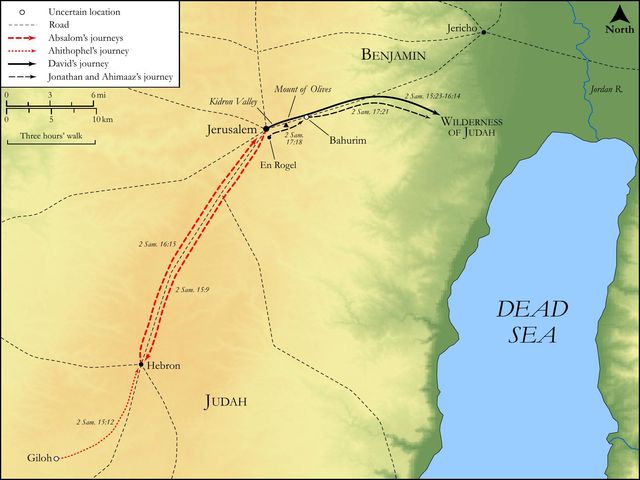
When he and his attendants passed over the brook Kidron (the very same brook that Christ passed over when he entered upon his sufferings, Joh 18:1), towards the way of the wilderness, which lay between Jerusalem and Jericho, all the country wept with a loud voice, Sa2 15:23. Cause enough there was for weeping,
1.To see a prince thus reduced, one that had lived so great forced from his palace and in fear of his life, with a small retinue seeking shelter in a desert, to see the city of David, which he himself won, built, and fortified, made an unsafe abode for David himself. It would move the compassion even of strangers to see a man fallen thus low from such a height, and this by the wickedness of his own son; a piteous case it was. Parents that are abused and ruined by their own children merit the tender sympathy of their friends as much as any of the sons or daughters of affliction. Especially,
2.To see their own prince thus wronged, who had been so great a blessing to their land, and had not done any thing to forfeit the affections of his people; to see him in this distress, and themselves unable to help him, might well draw floods of tears from their eyes.
Continue studying 2 Samuel 15:23 across the web’s major study libraries — every link below opens this exact verse, chapter, or book on the destination site.
Read & Compare
 BibleGatewayThis verse in more than 200 translations and 70 languages.
 Bible.comThe YouVersion reader — hundreds of translations, reading plans, and highlights.
 ESV.orgCrossway's official English Standard Version reader.
 NET BibleThe NET translation with 60,000+ translators' notes on every rendering decision.
 STEP BibleTyndale House's free study tool — original text, vocabulary, and scholarly resources.
 BibliaLogos Bible Software's free web reader.
 USCCBThe New American Bible (Revised Edition) with the U.S. bishops' study notes.
Commentaries
 BibleHub CommentariesDozens of classic commentaries on this verse, gathered on one page.
 StudyLightMore than 100 commentary sets — the largest collection on the web.
 BibleRefPlain-English commentary on what this verse means, verse by verse.
 Enduring WordDavid Guzik's free commentary on this chapter, widely used by Bible teachers.
 Bible Study ToolsVerse commentary alongside Greek and Hebrew study aids.
Original Language & Research
- BibleHub InterlinearThe verse word by word — original language, transliteration, and English.
- BibleHub LexiconEvery word's original-language definition and Strong's entry.
 Blue Letter BibleDeep-study tools — Strong's numbers, concordance, and word studies.
 SefariaThe Hebrew text with Rashi and centuries of Jewish commentary.
Sermons, Hymns & Audio


TrulyRandomVerse is not affiliated with these sites and doesn’t control their content. They’re linked because they’re genuinely useful.
Summary
This verse powerfully encapsulates the deep sorrow and national upheaval accompanying King David's forced departure from Jerusalem. Driven out by the rebellion of his son Absalom, the scene depicts a poignant moment of collective grief as the entire populace witnesses their king and his loyal retinue crossing the Brook Kidron, embarking on a desperate flight into the wilderness. It marks a profound turning point, symbolizing the fragility of power and the painful consequences of familial and national discord, while simultaneously highlighting the enduring loyalty of David's faithful followers.
Context
ShowHideLiterary Context
This verse is situated at a critical juncture in the narrative of Absalom's rebellion against his father, King David. Immediately preceding, the text details Absalom's cunning strategy to win the hearts of the people of Israel, establishing himself as a popular alternative to David's rule (2 Samuel 15:1-6). This culminated in his public declaration of kingship in Hebron, drawing many away from David (2 Samuel 15:7-12). Faced with the overwhelming support for Absalom and desiring to prevent bloodshed within Jerusalem, David makes the difficult and humiliating decision to flee his capital (2 Samuel 15:13-14). The verse directly follows the moving account of Ittai the Gittite's unwavering loyalty, as he pledges to follow David wherever he goes, whether to death or life (2 Samuel 15:19-22), setting a poignant contrast between the treachery of Absalom and the steadfastness of David's faithful remnant.
Historical & Cultural Context
David's reign, though marked by significant military and political successes, was also plagued by internal strife and familial dysfunction. Absalom's rebellion was not merely a personal vendetta but a popular uprising, exploiting existing discontent and Absalom's charismatic appeal. For a king to be forced to flee his capital was an immense humiliation, often interpreted as a sign of divine disfavor or a weakening of his legitimate claim to the throne. The Brook Kidron, a valley or wadi on the eastern side of Jerusalem, served as a natural boundary and was often associated with ritual purity or defilement, as well as a common route for departing the city towards the wilderness. David's crossing of this brook, therefore, carried both practical and profound symbolic weight, marking his painful exit from the sacred city and his temporary loss of power.
Key Themes
ShowHide2 Samuel 15:23 powerfully illustrates several major theological and narrative themes within 2 Samuel and the broader Deuteronomistic History. Foremost among these is the theme of the consequences of sin, particularly David's actions with Bathsheba and Uriah, as prophesied by Nathan (e.g., 2 Samuel 12:10-12). The rebellion and flight are presented as the bitter fruit of David's transgressions, demonstrating God's justice. The verse also highlights the stark contrast between betrayal and loyalty, showcasing Absalom's treachery against the steadfastness of David's loyal followers. Furthermore, it underscores the suffering of the righteous, even a king chosen by God, and the sovereignty of God working through human events, as this period of exile ultimately leads to David's restoration and deeper reliance on divine providence.
Exposition and Analysis
ShowHideKey Word Analysis
ShowHideThis verb denotes a deep, audible weeping, often accompanied by wailing and lamentation. It signifies profound sorrow, grief, and distress, indicating that the emotional impact of David's departure was not confined to a few individuals but was a widespread, public expression of national anguish. The "loud voice" (H1419, gâdôwl for "loud"; H6963, qôwl for "voice") emphasizes the intensity and communal nature of this lament.
This verb is repeated multiple times in the verse, creating a sense of continuous movement and a large-scale exodus. It means "to cross over," "to pass through," or "to go beyond." Its repetition emphasizes the sheer number of people (H5971, ʻam) involved in the flight and the deliberate, collective act of leaving Jerusalem behind, signifying a transition from stability to uncertainty.
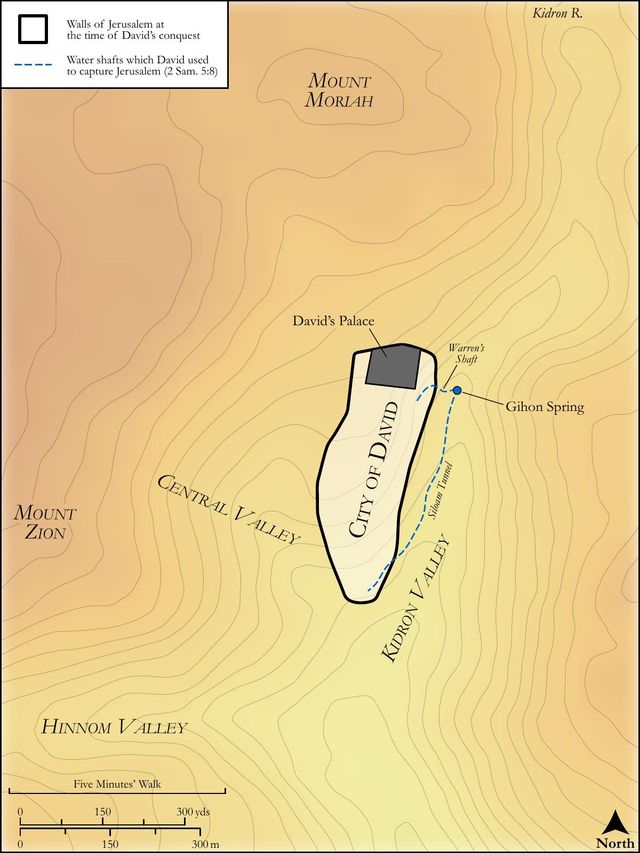
The Hebrew nachal refers to a wadi or seasonal stream, often dry for much of the year, while Qidrôwn likely means "dark" or "dusky." This geographical feature, a valley on the eastern side of Jerusalem, served as a natural boundary. Symbolically, it was often associated with impurity or the disposal of idols (e.g., 1 Kings 15:13), making David's crossing of it a poignant symbol of his humiliation and departure from the holy city, a passage into a period of defilement or distress. The journey "toward the way (H1870, derek) of the wilderness (H4057, midbâr)" further underscores this transition.
Verse Breakdown
ShowHide"And all the country wept with a loud voice"
This opening clause paints a vivid picture of widespread, public lamentation. "All the country" (H776, ʼerets, or "all the land") emphasizes the national scope of the tragedy, indicating that the sorrow was not merely personal for David but deeply affected the entire populace, who grieved for the king, the disruption of peace, and the instability of the kingdom. The "loud voice" underscores the intensity and communal nature of this outpouring of grief.
"and all the people passed over"
This phrase describes the mass exodus of David's loyal followers. The repetition of "all the people" from the previous clause reinforces the idea of a collective, significant movement. It highlights the scale of the forced departure, as a substantial portion of the population chose to accompany their king into exile, demonstrating their allegiance.
"the king also himself passed over the brook Kidron"
This clause focuses specifically on David's personal act of crossing. The emphasis on "the king (H4428, melek) also himself" highlights his deep humiliation and vulnerability. For the anointed king to be forced to leave his capital and cross a boundary like the Kidron signifies a profound loss of power and status, marking a symbolic departure from the sacred city and a descent into a period of trial.
"and all the people passed over, toward the way of the wilderness"
The final clause repeats the act of "passing over" by "all the people," reinforcing the magnitude and continuous nature of the flight. The destination, "the way of the wilderness," signifies a journey into uncertainty, hardship, and a place of refuge. In biblical typology, the wilderness is often a place of testing, purification, and reliance on God, setting the stage for David's spiritual and physical ordeal.
Literary Devices
ShowHideThe verse employs several powerful literary devices to convey its profound emotional and narrative weight. Hyperbole is evident in the phrases "all the country wept" and "all the people passed over," which, while not literally encompassing every single person, effectively conveys the overwhelming and widespread nature of the grief and exodus. Repetition of the verb "passed over" (עָבַר, 'avar) emphasizes the continuous flow of people, underscoring the scale and the determined, yet sorrowful, movement away from Jerusalem. Symbolism is central to the verse, particularly with the "brook Kidron," which serves as a poignant boundary between the city of God's dwelling and the wilderness of exile, foreshadowing later significant crossings. The "wilderness" itself is a powerful symbol of testing, purification, and a place where one is stripped of earthly comforts, forced to rely solely on divine providence. The overall tone of the verse is steeped in pathos, evoking deep sympathy for David and the suffering of his loyal subjects, highlighting the tragic consequences of rebellion and internal strife.
Theological and Thematic Connections
ShowHideThis poignant scene of David's flight from Jerusalem is deeply resonant with theological meaning, serving as a powerful illustration of divine judgment, human suffering, and God's enduring faithfulness even amidst chaos. It underscores the far-reaching consequences of sin, as David's humiliation is a direct fulfillment of Nathan's prophecy concerning the "sword" that would never depart from his house due to his actions with Bathsheba and Uriah. Yet, it also portrays David's humble acceptance of God's hand in his suffering, transforming a moment of weakness into a path of purification and deeper reliance on divine sovereignty. The loyalty of his followers, contrasting sharply with Absalom's betrayal, highlights the enduring power of covenant and fidelity in the face of adversity, pointing to the faithful remnant that God always preserves.
Reflection and Application
ShowHideThe scene of David's sorrowful exodus offers profound lessons for believers navigating personal and collective trials. It reminds us that even those chosen by God, like David, are not immune to suffering, betrayal, or the painful consequences of sin. We learn about resilience in the face of overwhelming adversity, as David, despite his humiliation, continues to trust in God's ultimate plan. The unwavering loyalty of his followers, who chose to endure hardship with their king, challenges us to consider the depth of our own faithfulness to Christ and to one another, especially in times of crisis. David's decision to flee Jerusalem to avoid bloodshed also provides a powerful example of sacrificial leadership, prioritizing the well-being of his people over his own immediate power or reputation. Ultimately, this narrative encourages us to recognize that periods of "wilderness" or exile in our lives, though painful, can be divinely appointed seasons for spiritual refinement, deeper dependence on God, and preparation for future restoration.
Questions for Reflection
ShowHideFAQ
ShowHideWhy did David flee Jerusalem instead of defending it?
ShowHideDavid's decision to flee Jerusalem was primarily a strategic and compassionate one, aimed at preventing bloodshed within the holy city. He prioritized the lives of his innocent citizens and the sanctity of Jerusalem over his own immediate defense of the throne. By withdrawing, he avoided a devastating civil war within the capital. Furthermore, David likely recognized God's hand in these events, accepting the consequences of his past sins as a form of divine discipline. His subsequent humble acceptance of Shimei's curses (2 Samuel 16:5-12) demonstrates his understanding that this humiliation was part of God's sovereign plan.
What is the significance of the Brook Kidron?
ShowHideThe Brook Kidron, a valley on the eastern side of Jerusalem, holds significant symbolic weight in biblical narratives. It served as a natural boundary and was often associated with ritual impurity, a place where idols and defiled objects were disposed of (1 Kings 15:13, 2 Kings 23:4-6). For David, crossing the Kidron symbolized his departure from the holy city, a moment of profound humiliation and a passage into a period of defilement or distress. This same path would later be traversed by Jesus on the night of His betrayal, as He went from Jerusalem to the Garden of Gethsemane (John 18:1), imbuing the Kidron with even deeper Christological significance.
How does this event relate to David's earlier sins?
ShowHideDavid's flight from Absalom's rebellion is widely understood as a direct fulfillment of the prophecy delivered by Nathan the prophet after David's sin with Bathsheba and Uriah. Nathan declared that "the sword shall never depart from your house" and that trouble would arise from David's own household, with his wives being taken publicly (2 Samuel 12:10-12). Absalom's rebellion, his public defilement of David's concubines on the palace roof (2 Samuel 16:20-22), and David's subsequent flight are all presented as the bitter, painful consequences of those earlier transgressions, demonstrating God's justice and the far-reaching impact of sin, even upon the anointed.
Christ-Centered Fulfillment
ShowHideThe sorrowful exodus of King David across the Brook Kidron, a scene of profound humiliation and national lament, powerfully prefigures the ultimate suffering and redemptive journey of the Messiah. David, God's anointed king, is driven from his throne by betrayal, mirroring how Jesus, the true King of Israel, would be rejected by His own people (John 1:11). The very Brook Kidron that David sorrowfully crossed in flight would later become the path Jesus deliberately took on the night of His betrayal, moving from the city to Gethsemane, a journey towards His passion and ultimate sacrifice (John 18:1). David's temporary exile into the wilderness, a period of testing and purification, foreshadows Christ's willing descent into the "wilderness" of human suffering and death, not as a consequence of His own sin, but as the sinless Lamb of God who takes away the sin of the world (John 1:29). While David's flight was a moment of weakness and a consequence of sin, Jesus' journey to the cross was an act of supreme strength and obedience, a deliberate step towards fulfilling God's redemptive plan. David's eventual restoration to his throne points to Christ's glorious resurrection and ascension, securing His eternal reign at the right hand of God (Acts 2:32-36), establishing a kingdom that will never be overthrown (Daniel 2:44).