


2 Samuel 15:24
- וְהִנֵּהve·hi·Nehand there!H2009Conj-w ¦ PrtParticle Interjectionוְandהִנֵּהthere!
- גַםgamalsoH1571AdvAdverb
- צָדוֹקtza·DokZadokH6659N-proper-mNoun Proper Masculine
- וְכָלve·kholand allH3605Conj-w ¦ N-mscNoun Singular Masculine Constructוְandכָלall
- הַלְוִיִּםhal·vi·Yimthe LevitesH3881Art ¦ N-mpNoun Gentilic Plural Masculine AbsoluteהַtheלְוִיִּםLevites
- אִתּוֹ'i·Towith himH854Prep ¦ 3msPreposition Definiteאִתּwithוֹhim
- נֹשְׂאִיםno·se·'Im[were] carryingH5375V-Qal-Prtcpl-mpVerb Qal Participle Plural Masculine Absolute
- אֶת'et<obj.>H853DirObjMParticle Object Indicator
- אֲרוֹן'a·rOn[the] ark ofH727N-mscNoun Singular Masculine Construct
- בְּרִיתbe·Rit[the] covenant ofH1285N-fscNoun Singular Feminine Construct
- הָאֱלֹהִיםha·'E·lo·Him<the> GodH430Art ¦ N-mpNoun Plural Masculine Absoluteהָ<the>אֱלֹהִיםGod
- וַיַּצִּקוּvai·ya·Tzi·kuand they set downH3332Conj-w ¦ V-Hiphil-ConsecImperf-3mpVerb Hiphil Consecutive Imperfect 3rd Plural Masculineוַandיַּצִּקוּthey set down
- אֶת'et<obj.>H853DirObjMParticle Object Indicator
- אֲרוֹן'a·Ron[the] ark ofH727N-mscNoun Singular Masculine Construct
- הָאֱלֹהִיםha·'E·lo·Him<the> GodH430Art ¦ N-mpNoun Plural Masculine Absoluteהָ<the>אֱלֹהִיםGod
- וַיַּעַלvai·Ya·'aland he went upH5927Conj-w ¦ V-Qal-ConsecImperf-3msVerb Qal Consecutive Imperfect 3rd Singular Masculineוַandיַּעַלhe went up
- אֶבְיָתָר'ev·ya·TarAbiatharH54N-proper-mNoun Proper Masculine
- עַד'aduntilH5704PrepPreposition
- תֹּםtomwas finishedH8552V-Qal-InfVerb Qal Infinitive Construct
- כָּלkolallH3605N-mscNoun Singular Masculine Construct
- הָעָםha·'Amthe peopleH5971Art ¦ N-msNoun Singular Masculine Absoluteהָtheעָםpeople
- לַעֲבוֹרla·'a·Vorto pass outH5674Prep-l ¦ V-Qal-InfVerb Qal Infinitive Constructלַtoעֲבוֹרpass out
- מִןminfromH4480PrepPreposition
- הָעִירha·'Irthe cityH5892Art ¦ N-fsNoun Singular Feminine Absoluteהָtheעִירcity
English is a literal word-by-word gloss of the Hebrew, not the KJV's wording. Why?
This is the original text the KJV's translators worked from — each Hebrew word with its own literal English meaning in this verse, prepared by scholars at Tyndale House, Cambridge. The KJV translates whole sentences, not word by word, so its wording differs: one Hebrew word can become several English words, and the KJV may choose “the LORD” where the gloss reads “Yahweh”. Both are faithful — they answer different questions. For the KJV's own rendering, switch to the KJV text.
Details
See on the biblical-era map
Study this verse
Public-domain commentary
Matthew Henry
From his Commentary on the Whole Bible. Henry comments on passages, not single verses — this entry covers 2 Samuel 15:24–30. His three-level outline is real structure in the source text, so it is rendered as structure.
Here we have, I. The fidelity of the priests and Levites and their firm adherence to David and his interest. They knew David's great affection to them and their office, notwithstanding his failings. The method Absalom took to gain people's affections made no impression upon them; he had little religion in him, and therefore they steadily adhered to David. Zadok and Abiathar, and all the Levites, if he go, will accompany him, and take the ark with them, that, by it, they may ask counsel of God for him, Sa2 15:24. Note, Those that are friends to the ark in their prosperity will find it a friend to them in their adversity. Formerly David would not rest till he had found a resting-place for the ark; and now, if the priests may have their mind, the ark shall not rest till David return to his rest.
II.David's dismission of them back into the city, Sa2 15:25, Sa2 15:26.
Abiathar was high priest (Kg1 2:35), but Zadok was his assistant, and attended the ark most closely, while Abiathar was active in public business, Sa2 15:24. Therefore David directs his speech to Zadok, and an excellent speech it is, and shows him to be in a very good frame under his affliction, and that still he holds fast his integrity.
1.He is very solicitous for the safety of the ark: "By all means carry the ark back into the city, let not that be unsettled and exposed with me, lodge that again in the tent pitched for it; surely Absalom, bad as he is, will do that no harm." David's heart, like Eli's trembles for the ark of God. Note, It argues a good principle to be more concerned for the church's prosperity than for our own, to prefer Jerusalem before our chief joy (Psa 137:6), the success of the gospel, and the flourishing of the church, above our own wealth, credit, ease, and safety, even when they are most in hazard.
2.He is very desirous to return to the enjoyment of the privileges of God's house. He will reckon it the greatest instance of God's favour to him if he may but once more be brought back to see it and his habitation. This will be more his joy than to be brought back to his own palace and throne again. Note, Gracious souls measure their comforts and conveniences in this world by the opportunity they give them of communion with God. Hezekiah wished for the recovery of his health for this reason, that he might go up to the house of the Lord, Isa 38:22.
3.He is very submissive to the holy will of God concerning the issue of this dark dispensation. He hopes the best (Sa2 15:25), and hopes for it from the favour of God, which he looks upon to be the fountain of all good: "If God favour me so far, I shall be settled again as formerly." But he provides for the worst: "If he deny me this favour - if he thus say, I have no delight in thee - I know I deserve the continuance of his displeasure; his holy will be done." See him here patiently awaiting the event: "Behold, here am I, as a servant expecting orders;" and see him willing to commit himself to God concerning it: "Let him do to me as seemeth good to him. I have nothing to object. All is well that God does." Observe with what satisfaction and holy complacency he speaks of the divine disposal: not only, "He can do what he will," subscribing to his power (Job 9:12), or, "He has a right to do what he will," subscribing to his sovereignty (Job 33:13), or, "He will do what he will," subscribing to his unchangeableness (Job 23:13, Job 23:15), but, "Let him to what he will," subscribing to his wisdom and goodness. Note, It is our interest, as well as duty, cheerfully to acquiesce in the will of God, whatever befals us. That we may not complain of what is, let us see God's hand in all events; and, that we may not be afraid of what shall be, let us see all events in God's hand.
III.The confidence David put in the priests that they would serve his interest to the utmost of their power in his absence.
He calls Zadok a seer (Sa2 15:27), that is, a wise man, a man that can see into business and discern time and judgment: "Thou hast thy eyes in thy head (Ecc 2:14), and therefore art capable of doing me service, especially by sending me intelligence of the enemy's motions and resolutions." One friend that is a seer, in such an exigency as this, was worth twenty that were not so quick-sighted. For the settling of a private correspondence with the priests in his absence, he appoints,
1.Whom they should send to him - their two sons, Ahimaaz and Jonathan, whose coat, it might be hoped, would be their protection, and of whose prudence and faithfulness he had probably had experience.
2.Whither they should send. He would encamp in the plain of the wilderness till he heard from them (Sa2 15:28), and then would move according to the information and advice they should send him. Hereupon they returned to the city, to await the event. It was a pity that any disturbance should be given to a state so happy as this was, when the prince and the priests had such an entire affection for the confidence in each other.
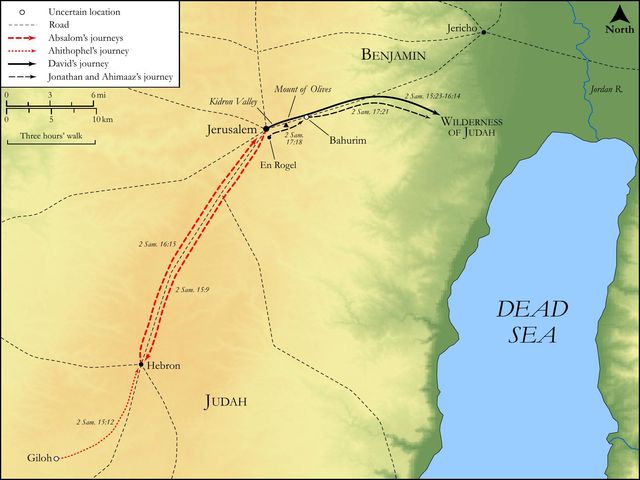
IV.The melancholy posture that David and his men put themselves into, when, at the beginning of their march, they went up the mount of Olives, Sa2 15:30.
1.David himself, as a deep mourner, covered his head and face for shame and blushing, went bare-foot, as a prisoner or a slave, for mortification, and went weeping. Did it become a man of his reputation for courage and greatness of spirit thus to cry like a child, only for fear of an enemy at a distance, against whom he might easily have made head, and perhaps with one bold stroke have routed him? Yes, it did not ill become him, considering how much there was in this trouble,
(1.)Of the unkindness of his son. He could not but weep to think that one who came out of his bowels, and had so often lain in his arms, should thus lift up the heel against him. God himself is said to be grieved with the rebellions of his own children (Psa 95:10) and even broken with their whorish heart, Eze 6:9.
(2.)There was much of the displeasure of his God in it. This infused the wormwood and gall into the affliction and misery, Lam 3:19. His sin was ever before him (Psa 51:3), but never so plain nor ever appearing so black as now. He never wept thus when Saul hunted him: but a wounded conscience makes troubles lie heavily, Psa 38:4.
2.When David wept all his company wept likewise, being much affected with his grief and willing to share in it. It is our duty to weep with those that weep, especially our superiors, and those that are better than we; for, if this be done in the green tree, what will be done in the dry? We must weep with those that weep for sin. When Hezekiah humbled himself for his sin all Jerusalem joined with him, Ch2 32:26. To prevent suffering with sinners, let us sorrow with them.
Continue studying 2 Samuel 15:24 across the web’s major study libraries — every link below opens this exact verse, chapter, or book on the destination site.
Read & Compare
 BibleGatewayThis verse in more than 200 translations and 70 languages.
 Bible.comThe YouVersion reader — hundreds of translations, reading plans, and highlights.
 ESV.orgCrossway's official English Standard Version reader.
 NET BibleThe NET translation with 60,000+ translators' notes on every rendering decision.
 STEP BibleTyndale House's free study tool — original text, vocabulary, and scholarly resources.
 BibliaLogos Bible Software's free web reader.
 USCCBThe New American Bible (Revised Edition) with the U.S. bishops' study notes.
Commentaries
 BibleHub CommentariesDozens of classic commentaries on this verse, gathered on one page.
 StudyLightMore than 100 commentary sets — the largest collection on the web.
 BibleRefPlain-English commentary on what this verse means, verse by verse.
 Enduring WordDavid Guzik's free commentary on this chapter, widely used by Bible teachers.
 Bible Study ToolsVerse commentary alongside Greek and Hebrew study aids.
Original Language & Research
- BibleHub InterlinearThe verse word by word — original language, transliteration, and English.
- BibleHub LexiconEvery word's original-language definition and Strong's entry.
 Blue Letter BibleDeep-study tools — Strong's numbers, concordance, and word studies.
 SefariaThe Hebrew text with Rashi and centuries of Jewish commentary.
Sermons, Hymns & Audio


TrulyRandomVerse is not affiliated with these sites and doesn’t control their content. They’re linked because they’re genuinely useful.
Summary
2 Samuel 15:24 captures a profoundly poignant moment during King David's forced flight from Jerusalem, as his son Absalom's rebellion gains momentum. Amidst the chaos of the exodus, the priests Zadok and Abiathar, accompanied by the Levites, appear bearing the sacred Ark of the Covenant. Their act of bringing the Ark out of the city, and then deliberately setting it down, underscores their unwavering loyalty to David and highlights the Ark's central role as a symbol of God's presence and covenantal faithfulness, setting the stage for David's significant theological decision regarding its return to the city.
Context
ShowHideLiterary Context
This verse is deeply embedded within the dramatic and tragic narrative of Absalom's rebellion, which commences in 2 Samuel 15. Immediately preceding this scene, David has received the devastating news of Absalom's successful coup and the widespread defection of the people of Israel, compelling him to make the urgent and sorrowful decision to flee Jerusalem to prevent bloodshed (2 Samuel 15:13-14). The appearance of Zadok, Abiathar, and the Levites with the Ark in 2 Samuel 15:24 occurs precisely as David and his loyal followers are making their solemn exit from the city. The subsequent verses (2 Samuel 15:25-29) then detail David's profound and faith-filled decision to send the Ark back to Jerusalem, demonstrating his trust in God's sovereign will rather than relying on the Ark as a mere magical charm or military standard. This episode serves as a powerful testament to David's spiritual maturity, contrasting sharply with earlier, less faithful uses of the Ark in Israel's history, such as its capture by the Philistines in 1 Samuel 4.
Historical & Cultural Context
The Ark of the Covenant was unequivocally the most sacred object in ancient Israel, serving as the physical embodiment of God's throne, His manifest presence, and the covenant He established with His people at Mount Sinai. Its customary dwelling place was the Tabernacle (and later, Solomon's Temple), signifying its central role in Israelite worship and national identity. Therefore, its appearance outside the city walls during a king's flight was an extraordinary and deeply symbolic event. The priests and Levites, according to Mosaic law (e.g., Numbers 4), were the exclusive custodians responsible for its care and transport. The joint presence of Zadok and Abiathar, the two chief priests of David's reign, underscores both the immense gravity of the national crisis and their personal, unwavering loyalty to David as God's anointed king. In many ancient Near Eastern cultures, divine symbols or idols were often carried into battle or invoked during times of crisis, with the belief that their physical presence would guarantee victory or divine favor. David's subsequent decision to return the Ark to Jerusalem directly challenges this common cultural understanding, emphasizing a more profound theological truth: God's presence and power are not confined to an object, nor can they be manipulated by human actions.
Key Themes
ShowHideThis pivotal verse contributes significantly to several overarching themes woven throughout the book of 2 Samuel and the broader Deuteronomistic History. Firstly, it powerfully underscores the theme of God's enduring presence and unwavering covenant faithfulness even amidst profound human rebellion, political upheaval, and personal suffering. The Ark's appearance serves as a tangible reminder to the reader that God has not abandoned David or His covenant people, despite the widespread sin and chaos. Secondly, the verse highlights the theme of unwavering loyalty and devotion to the divinely anointed king, exemplified by the actions of Zadok, Abiathar, and the Levites. Their willingness to follow David with the Ark signifies their allegiance not merely to the man, but to the sacred institution of kingship established by God. Finally, and perhaps most importantly, this scene sets the stage for David's profound demonstration of faith, humility, and submission to divine sovereignty in the face of overwhelming adversity. His subsequent decision regarding the Ark, as vividly portrayed in 2 Samuel 15:25, reveals a king who understands that God's will is not to be manipulated by sacred symbols but is enacted through humble trust and obedience, even when the path forward is unclear.
Exposition and Analysis
ShowHideKey Word Analysis
ShowHideFrom a root meaning "to gather," this word refers to a box or chest. In this context, it specifically denotes the Ark of the Covenant, the most sacred object in Israel, which housed the tablets of the Law, Aaron's staff, and a pot of manna. It symbolized God's presence, His throne, and the tangible representation of His covenant with Israel. Its appearance during David's flight was highly significant, representing the divine presence accompanying the king.
Derived from a root suggesting "cutting" (referencing the ancient practice of cutting animals in covenant ceremonies), this term signifies a compact, confederacy, or league. In the biblical context, it primarily refers to the binding agreement between God and His people, particularly the Mosaic Covenant. The "Ark of the Covenant" explicitly links the physical object to the foundational relationship between Yahweh and Israel, emphasizing God's promises and demands.
A primitive root meaning "to pour out," but by implication, also "to place firmly," "to stiffen," or "to grow hard." In this context, it conveys a deliberate and purposeful action of placing the Ark down, implying a halt or a pause. This is not a casual act but a significant moment that creates a space for David's contemplation and subsequent crucial decision regarding the Ark's fate.
Verse Breakdown
ShowHide"¶ And lo Zadok also, and all the Levites [were] with him, bearing the ark of the covenant of God:"
This opening clause dramatically introduces the unexpected yet deeply significant appearance of the priestly contingent. The interjection "lo" (Hebrew hinneh) serves to draw immediate attention to this pivotal sight, emphasizing its importance. Zadok, as one of David's two chief priests, is specifically named, alongside "all the Levites," who were the divinely appointed bearers of the Ark according to the Mosaic Law (Numbers 3:31). Their presence with the Ark underscores their unwavering loyalty to David and their steadfast commitment to their sacred duties, even amidst the profound national upheaval. The Ark's presence itself powerfully symbolizes God's enduring covenantal faithfulness, serving as a potent reminder of divine presence even as the king flees.
"and they set down the ark of God;"
This concise phrase describes the immediate and deliberate action taken by the priests upon reaching David. The Ark is not kept in motion but is purposefully placed on the ground. This action is critically important as it creates a pause in the otherwise chaotic flight, establishing the scene for David's momentous decision in the verses that follow. It signifies a moment of contemplation, a recognition of the Ark's immense sacredness, and a temporary halt to the immediate exodus, allowing for a crucial spiritual and strategic decision.
"and Abiathar went up, until all the people had done passing out of the city."
Abiathar, the other chief priest, is mentioned separately, possibly indicating his distinct role in overseeing the orderly departure of the large multitude of people. The phrase "went up" could suggest he positioned himself at a higher vantage point to better direct the exodus, or simply denotes his active involvement in ensuring that all loyalists exited the city in an organized manner. His presence, alongside Zadok, emphasizes the unified support of the priestly leadership for David. The temporary cessation of the Ark's movement allows for the entire populace loyal to David to pass out of Jerusalem, highlighting the sheer scale of the exodus and the solemn, weighty nature of the moment.
Literary Devices
ShowHideThe passage employs several significant literary devices that enrich its meaning and impact. The most prominent is Symbolism, with the Ark of the Covenant serving as the central and most potent symbol. It represents not only God's tangible presence and His covenant relationship with Israel but also, by extension, the legitimate authority and divine endorsement of the Davidic king. Its dramatic appearance during David's sorrowful flight is a powerful visual statement of divine faithfulness and the enduring nature of God's promises, even when the human situation appears utterly dire. The scene also subtly utilizes Foreshadowing, as the deliberate act of "setting down the ark" quietly anticipates David's profound and counter-intuitive decision to send it back to Jerusalem, thereby foreshadowing his remarkable act of faith and submission to God's sovereignty. Furthermore, the Juxtaposition of the sacred, orderly presence of the Ark with the chaotic, sorrowful flight of the king and his people creates a poignant and powerful contrast, emphasizing the deep spiritual dimension of the crisis and David's ultimate reliance on God's unseen hand rather than on mere physical symbols or perceived advantages. The specific mention of Zadok and Abiathar also functions as Characterization, highlighting their unwavering loyalty to David in a time of widespread defection.
Theological and Thematic Connections
ShowHideThis verse, though concise, is replete with profound theological significance. It powerfully illustrates the inherent tension between human crisis and divine presence. The priests' act of bringing the Ark out of Jerusalem demonstrates a deeply ingrained Israelite understanding that God's presence, tangibly symbolized by the Ark, was absolutely essential for His people and His anointed king, especially during times of dire national need. However, David's subsequent decision to send the Ark back to Jerusalem reveals a more mature and nuanced theological understanding: God's sovereignty and presence are not confined to a physical object, nor can divine favor be manipulated or coerced by its proximity. True faith, as profoundly exemplified by David in this moment, trusts implicitly in God's sovereign will and perfect timing, even when it means relinquishing what might appear to be a crucial spiritual or strategic advantage. This passage thus offers a powerful commentary on the nature of divine immanence and transcendence, reminding believers that God is both intimately present with His people in their suffering and sovereignly active beyond any human control, manipulation, or symbolic representation.
Reflection and Application
ShowHideThe dramatic scene in 2 Samuel 15:24 offers profound and enduring lessons for contemporary believers navigating personal or collective crises. Much like David, we frequently find ourselves desiring tangible assurances of God's presence and favor, often seeking out "arks" in our own lives—whether these manifest as specific spiritual practices, the charismatic presence of a leader, a particular church building, or even a cherished tradition. This passage serves as a powerful challenge, urging us to move beyond a superstitious or manipulative view of God's presence. While the loyalty and devotion of Zadok and the Levites are indeed commendable, David's subsequent, counter-intuitive decision to return the Ark teaches us a deeper truth: true faith is not about possessing or controlling a physical symbol, but about cultivating an unwavering trust in the invisible, sovereign God who works powerfully through all circumstances, both favorable and adverse. In our own moments of upheaval, are we tempted to cling desperately to external comforts, rituals, or symbols, or do we, like David, humbly submit to God's overarching plan, trusting implicitly that His presence is with us regardless of our immediate, often tumultuous, circumstances? This verse calls us to embrace a more profound and mature faith that recognizes God's active presence in the midst of chaos and His unfailing ability to restore and redeem, even when all seems irrevocably lost. It compels us to prioritize humble obedience and unshakeable trust over any perceived spiritual or strategic advantages.
Questions for Reflection
ShowHideFAQ
ShowHideWhy was the Ark of the Covenant so important to the Israelites?
ShowHideThe Ark of the Covenant was paramount to the Israelites because it served as the most tangible symbol of God's unique presence among them and His sacred covenant relationship with them. It was regarded as the earthly throne of Yahweh, the place where He would commune with His people, specifically from between the cherubim above the mercy seat (Exodus 25:22). Within it lay the tablets of the Law, representing God's divine commands and the foundational terms of the covenant. Its presence was intrinsically linked with divine guidance, protection, and miraculous victories, as vividly illustrated during the crossing of the Jordan River (Joshua 3) and the miraculous fall of Jericho (Joshua 6). However, it is crucial to understand that its power was not automatic or magical, as tragically demonstrated when it was captured by the Philistines due to Israel's unfaithfulness and presumption (1 Samuel 4).
What was the significance of Zadok and Abiathar being present with the Ark?
ShowHideThe presence of Zadok and Abiathar, the two chief priests during David's reign, along with the Levites, bearing the Ark, was profoundly significant on multiple levels. Firstly, it demonstrated their unwavering loyalty to King David and, by extension, to the legitimate, divinely appointed kingship. As chief priests, they held the highest spiritual authority and were directly responsible for the Ark's sacred care and the nation's worship. Their decision to bring the Ark out with David signified their conviction that God's presence should accompany His anointed king, even into exile. This act underscored the immense gravity of Absalom's rebellion and highlighted the deep spiritual dimension of the national crisis. Their steadfast loyalty also stood in stark contrast to the widespread defection of the people to Absalom, thereby highlighting a faithful remnant. Historically, Zadok would remain loyal to David and his lineage, eventually becoming the sole high priest under King Solomon, while Abiathar would later be deposed for supporting Adonijah's attempted usurpation (1 Kings 2:26-27).
Why did David send the Ark back to Jerusalem in the next verses?
ShowHideDavid's decision to send the Ark back to Jerusalem, a pivotal moment elaborated in 2 Samuel 15:25-29, was a profound and exemplary act of faith and humble submission to God's sovereignty. David understood that God's presence was not confined to the physical Ark, nor was the Ark a mere good luck charm to guarantee his victory or safe return. He declared, "If I find favor in the eyes of the Lord, he will bring me back and let me see it and his dwelling place again" (2 Samuel 15:25). This statement powerfully demonstrated his trust that God would act according to His divine will, not according to human manipulation of sacred objects. By sending the Ark back, David affirmed that God's true dwelling was in Jerusalem, and his return would be solely by divine grace and favor, not by the Ark's physical presence in his camp. It was an act of profound, humble reliance on God's overarching plan, even in the face of uncertainty, potential defeat, and the loss of his kingdom.
Christ-Centered Fulfillment
ShowHideThe poignant scene of the Ark of the Covenant being brought out during King David's desperate flight, and his subsequent profound decision to send it back to Jerusalem, finds its ultimate and most glorious Christ-centered fulfillment in the person and work of Jesus Christ. The Ark, as the preeminent symbol of God's tangible presence among His people, powerfully foreshadowed the ultimate embodiment of "God with us": Jesus Christ, who is truly "Immanuel" (Matthew 1:23). While the Ark was a physical object, confined to a specific place and requiring careful handling, Christ is the living, omnipresent God who "became flesh and dwelt among us, and we have seen his glory, glory as of the only Son from the Father, full of grace and truth" (John 1:14). David's refusal to treat the Ark as a magical talisman, choosing instead to trust in God's sovereign will to bring him back to Jerusalem, prefigures the glorious New Covenant reality where God's presence is no longer bound by a material object, a physical temple, or a specific geographical location. Instead, God's Spirit now indwells all true believers, making them His living temples (1 Corinthians 3:16). The true "Ark of the Covenant" is Christ Himself, in whom all of God's promises are eternally fulfilled and through whom we now have direct, unhindered access to the very presence of God, not through ritualistic proximity to a sacred box, but through faith in His perfect, atoning sacrifice (Hebrews 9:11-12). Thus, David's profound act of faith, relinquishing the symbol for a deeper reliance on the unseen God, points forward to the spiritual reality of Christ, who is our true dwelling place, our ultimate High Priest, and the supreme manifestation of God's enduring covenant with humanity.