


2 Samuel 8:17
- וְצָדוֹקve·tza·Dokand ZadokH6659Conj-w ¦ N-proper-mNoun Proper MasculineוְandצָדוֹקZadok
- בֶּןben[the] son ofH1121N-mscNoun Singular Masculine Construct
- אֲחִיטוּב'a·chi·TuvAhitubH285N-proper-mNoun Proper Masculine
- וַאֲחִימֶלֶךְva·'a·chi·Me·lekhand AhimelechH288Conj-w ¦ N-proper-mNoun Proper MasculineוַandאֲחִימֶלֶךְAhimelech
- בֶּןben[the] son ofH1121N-mscNoun Singular Masculine Construct
- אֶבְיָתָר'ev·ya·TarAbiatharH54N-proper-mNoun Proper Masculine
- כֹּהֲנִיםko·ha·Nim[were] priestsH3548N-mpNoun Plural Masculine Absolute
- וּשְׂרָיָהu·se·ra·Yahand SeraiahH8304Conj-w ¦ N-proper-mNoun Proper MasculineוּandשְׂרָיָהSeraiah
- סוֹפֵרso·Fer[was] secretaryH5608N-msNoun Singular Masculine Absolute
English is a literal word-by-word gloss of the Hebrew, not the KJV's wording. Why?
This is the original text the KJV's translators worked from — each Hebrew word with its own literal English meaning in this verse, prepared by scholars at Tyndale House, Cambridge. The KJV translates whole sentences, not word by word, so its wording differs: one Hebrew word can become several English words, and the KJV may choose “the LORD” where the gloss reads “Yahweh”. Both are faithful — they answer different questions. For the KJV's own rendering, switch to the KJV text.
Details
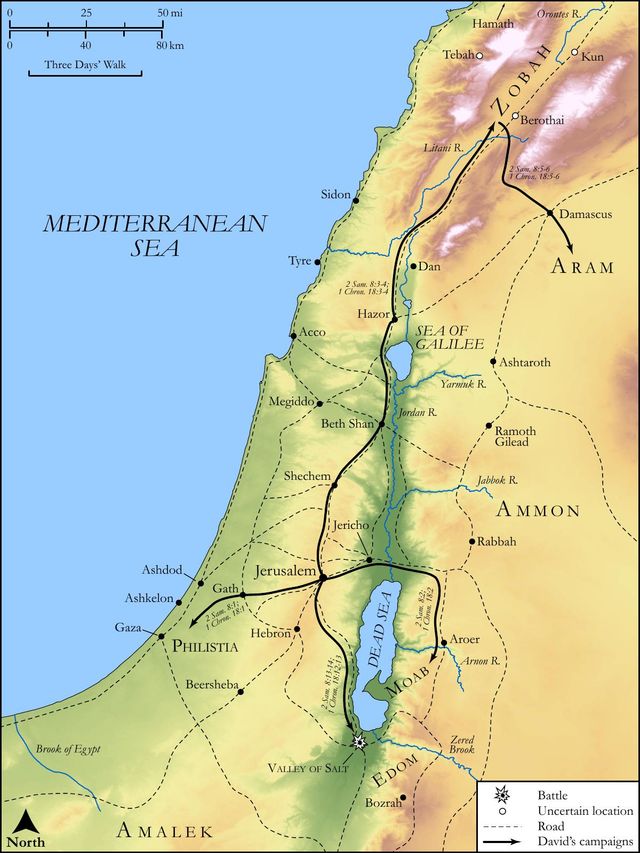
See on the biblical-era maps

Study this verse
Public-domain commentary
Matthew Henry
From his Commentary on the Whole Bible. Henry comments on passages, not single verses — this entry covers 2 Samuel 8:15–18. His two-level outline is real structure in the source text, so it is rendered as structure.
David was not so engaged in his wars abroad as to neglect the administration of the government at home.
I.His care extended itself to all the parts of his dominion:
He reigned over all Israel (Sa2 8:15); not only he had a right to reign over all the tribes, but he did so; they were all safe under his protection, and shared in the fruits of his good government.
II.He did justice with an unbiased unshaken hand:
He executed judgment unto all his people, neither did wrong nor denied or delayed right to any. This intimates,
1.His industry and close application to business, his easiness of access and readiness to admit all addresses and appeals made to him. All his people, even the meanest, and those too of the meanest tribes, were welcome to his council-board.
2.His impartiality and the equity of his proceedings, in administering justice. He never perverted justice through favour or affection, nor had respect of persons in judgment. Herein he was a type of Christ, who was faithful and true, and who doth in righteousness both judge and make war, Rev 19:11. See Psa 72:1, Psa 72:2.
III.He kept good order and good officers in his court.
David being the first king that had an established government (for Saul's reign was short and unsettled) he had the modelling of the administration. In Saul's time we read of no other great officer than Abner, that was captain of the host. But David appointed more officers: Joab that was general of the forces in the field, and Banaiah that was over the Cherethites and Pelethites, who were either the city train-bands (archers and slingers, so the Chaldee), or rather the life-guards, or standing force, that attended the king's person, the pretorian band, the militia. They were ready to do service at home, to assist in the administering of justice, and to preserve the public peace. We find them employed in proclaiming Solomon, Kg1 1:38. 2. Two ecclesiastical officers: Zadok and Ahimelech were priests, that is, they were most employed in the priests' work under Abiathar, the high priest. 3. Two civil officers: one that was recorder, or remembrancer, to put the king in mind of business in its season (he was prime minister of state, yet not entrusted with the custody of the king's conscience, as they say of our lord chancellor, but only of the king's memory; let the king be put in mind of business and he would do it himself); another that was scribe, or secretary of state, that drew up public orders and despatches, and recorded judgments given. 4. David's sons, as they grew up to be fit for business, were made chief rulers; they had places of honour and trust assigned them, in the household, or in the camp, or in the courts of justice, according as their genius led them. They were chief about the king (so it is explained, Ch1 18:17), employed near him, that they might be under his eye. Our Lord Jesus has appointed officers in his kingdom, for his honour and the good of the community; when he ascended on high he gave these gifts (Eph 4:8-11), to every man his work, Mar 13:34. David made his sons chief rulers; but all believers, Christ's spiritual seed, are better preferred, for they are made to our God kings and priests, Rev 1:6.
Historical interpretation
Historical reception
1 surviving comment on this verse from the historical church.
Scribe: Or secretary.
Continue studying 2 Samuel 8:17 across the web’s major study libraries — every link below opens this exact verse, chapter, or book on the destination site.
Read & Compare
 BibleGatewayThis verse in more than 200 translations and 70 languages.
 Bible.comThe YouVersion reader — hundreds of translations, reading plans, and highlights.
 ESV.orgCrossway's official English Standard Version reader.
 NET BibleThe NET translation with 60,000+ translators' notes on every rendering decision.
 STEP BibleTyndale House's free study tool — original text, vocabulary, and scholarly resources.
 BibliaLogos Bible Software's free web reader.
 USCCBThe New American Bible (Revised Edition) with the U.S. bishops' study notes.
Commentaries
 BibleHub CommentariesDozens of classic commentaries on this verse, gathered on one page.
 StudyLightMore than 100 commentary sets — the largest collection on the web.
 BibleRefPlain-English commentary on what this verse means, verse by verse.
 Enduring WordDavid Guzik's free commentary on this chapter, widely used by Bible teachers.
 Bible Study ToolsVerse commentary alongside Greek and Hebrew study aids.
Original Language & Research
- BibleHub InterlinearThe verse word by word — original language, transliteration, and English.
- BibleHub LexiconEvery word's original-language definition and Strong's entry.
 Blue Letter BibleDeep-study tools — Strong's numbers, concordance, and word studies.
 SefariaThe Hebrew text with Rashi and centuries of Jewish commentary.
Sermons, Hymns & Audio


TrulyRandomVerse is not affiliated with these sites and doesn’t control their content. They’re linked because they’re genuinely useful.
Summary
This verse, nestled within a detailed account of King David's administrative structure, meticulously lists key officials appointed to govern his newly consolidated kingdom. Following a series of decisive military victories that secured Israel's borders and expanded its influence, David demonstrates his wisdom and foresight by establishing a stable and ordered government. The mention of Zadok and Ahimelech (or Abiathar) as priests, alongside Seraiah as scribe, highlights the foundational importance of both spiritual leadership and efficient civil administration in David's reign, reflecting a commitment to divine order and effective governance for the flourishing of the nation.
Context
ShowHideLiterary Context
This verse is situated within a pivotal section of 2 Samuel that marks the zenith of David's reign. Chapters 5-7 describe David's establishment of Jerusalem as his capital and the crucial Davidic Covenant, promising an eternal dynasty. Chapter 8 then details David's extensive military campaigns, where he decisively defeats the Philistines, Moabites, Zobah, Aram (Syrians), and Edomites, bringing vast territories under Israelite control and securing immense wealth. This series of victories, summarized in 2 Samuel 8:1-14, culminates in a period of unprecedented peace and prosperity for the nascent kingdom. With external threats subdued and the kingdom expanded, David wisely turns his attention to internal governance. 2 Samuel 8:15-18 provides a concise list of the key officials he appointed to manage his burgeoning empire, demonstrating his commitment to establishing a well-ordered and functional administration reflective of God's blessing and the fulfillment of the covenant promises. The meticulous listing of these officials underscores the stability and organization achieved under David's rule.
Historical & Cultural Context
In the ancient Near East, the establishment of a robust administrative structure was a hallmark of a powerful and stable kingdom. Kings typically surrounded themselves with a council of trusted advisors and officials responsible for various aspects of governance, including military command, treasury, justice, and religious affairs. The roles of "priest" and "scribe" in ancient Israel were particularly significant. Priests, descended from Aaron, were responsible for mediating between God and the people, offering sacrifices, teaching the Law, and consulting God through the Urim and Thummim. Their presence in the king's inner circle underscored the theocratic nature of Israelite kingship, where divine law was paramount. The "scribe" (Hebrew: sopher) was far more than a mere copyist; this official served as a royal secretary, record-keeper, legal advisor, and often managed royal correspondence and archives, making the position vital for the smooth operation of the kingdom's bureaucracy and diplomatic relations. This sophisticated administrative setup reflects the maturation of Israel from a tribal confederacy to a centralized monarchy.
Key Themes
ShowHideThe listing of these officials contributes to several overarching themes within 2 Samuel and the broader Deuteronomistic History. Firstly, it highlights David's organized administration, showcasing his wisdom and foresight in establishing a structured government necessary for managing a growing kingdom. This reflects a commitment to order that mirrors God's own character and His desire for His people to live in an orderly society. Secondly, the presence of both priests and a scribe underscores the integration of spiritual and civil authority under David's rule. David, a "man after God's own heart," understood that the well-being of the nation depended on both faithful adherence to God's commands and efficient practical governance. This balance is crucial, as seen in the king's responsibility to uphold the Law (Deuteronomy 17:18-20). Finally, this passage subtly reinforces the theme of divine blessing and national stability. God's promise to make David's name great and establish his kingdom (as in 2 Samuel 7:9) is tangibly manifested not only in military victories but also in the internal peace and effective governance that allows the nation to flourish under God's appointed leader.
Exposition and Analysis
ShowHideKey Word Analysis
ShowHideThis term refers to one officiating in sacred duties, a priest. In ancient Israel, the kohen held a sacred and indispensable role, serving as mediators between God and the people. Descended from Aaron, priests were responsible for the sacrificial system, maintaining the tabernacle/temple, teaching the Law of Moses, and providing divine guidance through consultation with God (e.g., via the Urim and Thummim). Their presence in David's administration signifies the king's reliance on divine counsel and his commitment to the spiritual health of the nation, recognizing the necessity of divine sanction and guidance for national prosperity.
Meaning to score, inscribe, or enumerate, this term describes a royal secretary or writer. The sopher was a highly educated and influential official in the royal court. Far from merely copying texts, the scribe functioned as a royal secretary, responsible for drafting official documents, managing state archives, handling diplomatic correspondence, and often serving as a legal advisor. This role was critical for the administrative efficiency and stability of the kingdom, demonstrating David's establishment of a sophisticated bureaucracy necessary for governing an expanding empire.
Verse Breakdown
ShowHide"And Zadok the son of Ahitub, and Ahimelech the son of Abiathar, [were] the priests;"
This clause identifies the two chief priestly figures serving in King David's administration. Zadok, from the line of Eleazar (Aaron's elder son), represented the traditional high priestly line that would eventually become the dominant lineage. The mention of "Ahimelech the son of Abiathar" is a well-known textual variant or scribal anomaly, as throughout the Old Testament, Abiathar is consistently identified as the son of Ahimelech (e.g., 1 Samuel 22:20, 2 Samuel 20:25). It was Abiathar, son of Ahimelech, who served prominently alongside Zadok during much of David's reign, having escaped the massacre at Nob and remained loyal to David. Scholars widely interpret this phrasing as a scribal error, a textual inversion, or possibly a reference to a lesser-known son or grandson of Abiathar who also bore the name Ahimelech. Regardless, the core meaning conveyed is the presence of two prominent priestly leaders, representing the two main branches of Aaron's descendants (Eleazar and Ithamar), ensuring comprehensive spiritual guidance and continuity for the nation.
"and Seraiah [was] the scribe;"
This clause names Seraiah as David's chief scribe. His inclusion alongside the priests underscores the dual nature of David's leadership—both spiritual and temporal. As the royal secretary, Seraiah would have been instrumental in managing the kingdom's records, communications, and legal affairs, highlighting the organized and systematic approach David took to governance. This position was vital for the practical administration of justice, taxation, and communication within the burgeoning kingdom.
Literary Devices
ShowHideThe passage, as part of a larger administrative list, primarily employs Catalogue or List as a literary device. This technique serves to convey the completeness, order, and comprehensiveness of David's newly established government. By systematically enumerating key officials, the text emphasizes David's meticulous attention to detail and his success in building a stable and functional kingdom. This listing is not merely informative but also declarative, asserting the established authority and structure of David's reign. Furthermore, there is an implicit Juxtaposition between the spiritual authority (represented by the priests) and the civil/administrative authority (represented by the scribe). This highlights David's holistic approach to governance, where religious devotion and practical administration are intertwined and equally vital for national well-being. This structure demonstrates that David's rule was not merely about military might but also about establishing a divinely sanctioned and well-ordered society that reflected God's character.
Theological and Thematic Connections
ShowHideThe careful listing of David's administrative officials, particularly the priests and the scribe, reveals a profound theological truth about God's desire for order and the integration of spiritual and civil authority. David, as God's chosen king, understood that true national flourishing required not only military prowess but also a foundation of divine law and efficient governance. His appointments reflect a commitment to both the sacred (represented by the priests who mediated with God and taught His Law) and the secular (represented by the scribe who managed the kingdom's practical affairs). This holistic approach underscores the biblical principle that all spheres of life are to be brought under God's dominion and managed according to His wisdom. The dual priesthood of Zadok and Abiathar, though later consolidated under Zadok's line, also speaks to the comprehensive nature of priestly service and the importance of diverse spiritual leadership within God's people, ensuring that all aspects of national life were under divine consideration.
Reflection and Application
ShowHideThe detailed account of David's administrative appointments in 2 Samuel 8:17 offers timeless principles for leadership and organization in any context, from the family to the church to broader society. David, a man after God's own heart, recognized that effective governance required both spiritual grounding and practical competence. He surrounded himself with individuals who possessed diverse skills—priests for spiritual guidance and a scribe for administrative efficiency—demonstrating the wisdom of delegation and the valuing of varied gifts. This passage reminds us that God is a God of order, and His people are called to reflect that order in their lives and institutions. Just as David meticulously structured his kingdom for stability and flourishing, so too are we called to bring intentionality and structure to our endeavors, ensuring that our spiritual values inform and guide our practical actions. This integration of faith and function is vital for creating environments that honor God and serve humanity effectively, fostering true flourishing in every sphere of influence.
Questions for Reflection
ShowHideFAQ
ShowHideWhy is "Ahimelech the son of Abiathar" mentioned, when elsewhere in Scripture it's "Abiathar the son of Ahimelech"?
ShowHideThis phrasing in 2 Samuel 8:17 is a well-known textual difficulty. Throughout the Old Testament, Abiathar is consistently identified as the son of Ahimelech, the priest of Nob, who was massacred by Saul (see 1 Samuel 22:20-23). Abiathar then fled to David and served as a loyal priest alongside Zadok for much of David's reign. Most scholars agree that "Ahimelech the son of Abiathar" is either a scribal error (a simple inversion of names), a textual variant, or possibly refers to a lesser-known son or grandson of Abiathar who also bore the name Ahimelech. However, the dominant and consistent figure serving as priest with Zadok was Abiathar, son of Ahimelech. The key takeaway for the reader is the presence of two chief priestly figures representing the two main lines of Aaron's descendants, serving in David's court.
What was the significance of having two chief priests, Zadok and Abiathar?
ShowHideThe presence of two chief priests, Zadok and Abiathar, in David's administration was highly significant. Zadok belonged to the line of Eleazar, Aaron's elder son, representing the more established priestly lineage that would eventually become the sole high priestly line after Solomon's reign. Abiathar, on the other hand, was from the line of Ithamar, Aaron's younger son, and represented the priestly line that had served the tabernacle at Nob. Their dual service under David likely symbolized the unity of the entire priestly house of Aaron under David's kingship, bridging different priestly traditions and ensuring comprehensive spiritual guidance for the nation. It also provided a system of checks and balances, and perhaps a continuity of priestly service, as Abiathar had been loyal to David from his days as a fugitive (as seen in 1 Samuel 23:6). This dual leadership underscored the importance David placed on seeking divine counsel and maintaining proper religious observance throughout his kingdom.
Christ-Centered Fulfillment
ShowHideThe administrative structure established by King David, with its meticulously appointed priests and scribe, serves as a powerful foreshadowing of the perfect and eternal administration of Jesus Christ. David's kingdom, though divinely blessed and remarkably ordered, was still subject to human limitations, internal strife, and eventual decline. Yet, the very act of establishing a righteous governance, integrating spiritual and civil authority, points to the ultimate King-Priest, Jesus. As the true Son of David, Christ inherits and infinitely surpasses David's throne, establishing a kingdom that "will have no end" (Luke 1:33). He is the Great High Priest, not of the Aaronic line, but "after the order of Melchizedek" (Hebrews 7:17), offering a perfect and final sacrifice for sins, thereby fulfilling and transcending the earthly priesthoods of Zadok and Abiathar. Furthermore, Christ is the ultimate Scribe, the living Word of God, who perfectly interprets and embodies the divine law, teaching with unparalleled authority (as seen in Matthew 7:29). In Christ, we find the perfect integration of spiritual and sovereign authority, the one who perfectly governs His people, mediates their access to God, and administers His eternal kingdom with flawless justice, wisdom, and grace, bringing about the ultimate flourishing of all creation.