


1 Samuel 22:20
Bible text: King James Version (1769 Blayney text) · Public domain
Bible text: Berean Standard Bible · Public domain
Bible text: American Standard Version (1901) · Public domain
Bible text: World English Bible, Messianic edition · Public domain
Bible text: Geneva Bible (1599) · Public domain
Bible text: Young's Literal Translation · Public domain
- וַיִּמָּלֵטvai·yi·ma·Letand he escapedH4422Conj-w ¦ V-Niphal-ConsecImperf-3msVerb Niphal Consecutive Imperfect 3rd Singular Masculineוַandיִּמָּלֵטhe escaped
- בֵּןbena sonH1121N-msNoun Singular Masculine Absolute
- אֶחָד'e·ChadoneH259N-fsNoun Singular Feminine Absolute
- לַאֲחִימֶלֶךְla·'a·chi·Me·lekhof AhimelechH288Prep-l ¦ N-proper-mNoun Proper MasculineלַofאֲחִימֶלֶךְAhimelech
- בֶּןben[the] son ofH1121N-mscNoun Singular Masculine Construct
- אֲחִטוּב'a·chi·TuvAhitubH285N-proper-mNoun Proper Masculine
- וּשְׁמוֹu·she·Moand his nameH8034Conj-w ¦ N-msc ¦ 3msNoun Singular Masculine Constructוּandשְׁמnameוֹhis
- אֶבְיָתָר'ev·ya·Tar[was] AbiatharH54N-proper-mNoun Proper Masculine
- וַיִּבְרַחvai·yiv·Rachand he fledH1272Conj-w ¦ V-Qal-ConsecImperf-3msVerb Qal Consecutive Imperfect 3rd Singular Masculineוַandיִּבְרַחhe fled
- אַחֲרֵי'a·cha·ReiafterH310Adj-mpcAdjective Numerical Plural Masculine Construct
- דָוִדda·VidDavidH1732N-proper-mNoun Proper Masculine
English is a literal word-by-word gloss of the Hebrew, not the KJV's wording. Why?
This is the original text the KJV's translators worked from — each Hebrew word with its own literal English meaning in this verse, prepared by scholars at Tyndale House, Cambridge. The KJV translates whole sentences, not word by word, so its wording differs: one Hebrew word can become several English words, and the KJV may choose “the LORD” where the gloss reads “Yahweh”. Both are faithful — they answer different questions. For the KJV's own rendering, switch to the KJV text.
Details
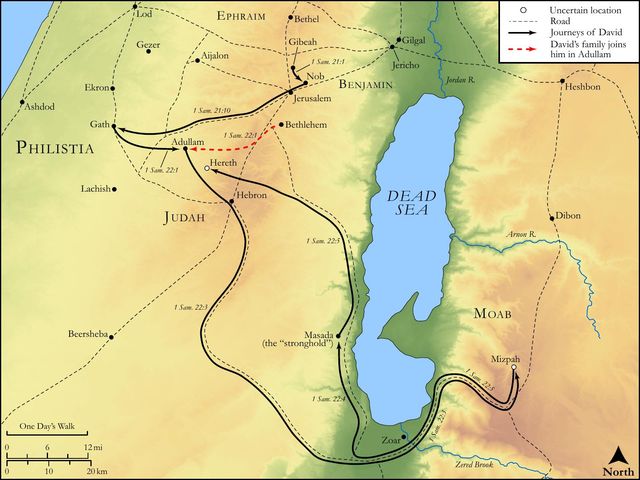
See on the biblical-era map
Study this verse
Public-domain commentary
Matthew Henry
From his Commentary on the Whole Bible. Henry comments on passages, not single verses — this entry covers 1 Samuel 22:20–23.
Here is, 1. The escape of Abiathar, the son of Ahimelech, out of the desolations of the priests' city. Probably when his father went to appear, upon Saul's summons, he was left at home to attend the altar, by which means he escaped the first execution, and, before Doeg and his bloodhounds came to Nob, he had intelligence of the danger, and had time to shift for his own safety. And whither should he go but to David? Sa1 22:20. Let those that suffer for the Son of David commit the keeping of their souls to him, Pe1 4:19. 2. David's resentment of the melancholy tidings he brought. He gave David an account of the bloody work Saul had made among the priests of the Lord (Sa1 22:21), as the disciples of John, when their master was beheaded, went and told Jesus, Mat 14:12. And David greatly lamented the calamity itself, but especially his being accessory to it: I have occasioned the death of all the persons of thy father's house, Sa1 22:22. Note, It is a great trouble to a good man to find himself in any way an occasion of the calamities of the church and ministry. David knew Doeg's character so well that he feared he would do some such mischief as this when he saw him at the sanctuary: I knew he would tell Saul. He calls him Doeg the Edomite, because he retained the heart of an Edomite, though, by embracing the profession of the Jewish religion, he had put on the mask of an Israelite. 3. The protection he granted to Abiathar. He perceived him to be terrified, as he had reason to be, and therefore bade him not to fear, he would be as careful for him as for himself: With me thou shalt be in safeguard, Sa1 22:23. David, having now time to recollect himself, speaks with assurance of his own safety, and promises that Abiathar shall have the full benefit of his protection. It is promised to the Son of David that God will hide him in the shadow of his hand (Isa 49:2), and, with him, all that are his may be sure that they shall be in safeguard, Psa 91:1. David had now not only a prophet, but a priest, a high-priest, with him, to whom he was a blessing and they to him, and both a happy omen of his success. Yet it appears (by Psa 28:6) that Saul had a high priest too, for he had a urim to consult: it is supposed that he preferred Ahitub the father of Zadok, of the family of Eleazar (Ch1 6:8), for even those that hate the power of godliness yet will not be without the form. It must not be forgotten here that David at this time penned Psa 52:1-9, as appears by the title of that psalm, wherein he represents Doeg not only as malicious and spiteful, but as false and deceitful, because though what he said was, for the substance of it, true, yet he put false colours upon it, with a design to do mischief. Yet even then, when the priesthood had become as a withered branch, he looks upon himself as a green olive-tree in the house of God, Psa 52:8. In this great hurry and distraction that David was continually in, yet he found both time and a heart for communion with God, and found comfort in it.
Historical interpretation
Historical reception
1 surviving comment on this verse from the historical church.
One son of Ahimelech escaped, Abiathar, etc. Just as Doeg the Edomite, one who struck down the priests, symbolized the sword of all executioners, so Abiathar, the one who escaped the sword of the striker, represents all the confessors of Christ who could survive that most severe persecution. Therefore, Abiathar is rightly interpreted as "superfluous father," signifying those who, glorious in the paternal title in the Church, survived such a turmoil. He fled to David and announced to him the priests of the Lord who were killed by Saul: just as the pious devotion of those remaining, after the killing was completed, turned to the Lord, ardently commemorating the memory of their slain brethren under his testament through prayer or by offering sacred sacrifices. To this, he himself replies through his own gospel that he had foreseen and predestined long ago that all who wish to live piously in him would suffer persecution for his name's sake; therefore, as a sure debtor of a certain reward, he would bring all souls released by such a death to the joys of eternal life. "I knew," he says, "that while there would never be lacking false brothers in the Church, without a doubt, they would aid external enemies through internal scandals. I knew that while in this whole world there would never be lacking evil ones, by whom the wisdom of the disputing good or the patience of those contending would be exercised and tested, without a doubt, tribulations and temptations would always await the pilgrim Church here. But I am the one who will eternally crown each soul of the elect with a heavenly crown after their struggles on earth."
Continue studying 1 Samuel 22:20 across the web’s major study libraries — every link below opens this exact verse, chapter, or book on the destination site.
Read & Compare
 BibleGatewayThis verse in more than 200 translations and 70 languages.
 Bible.comThe YouVersion reader — hundreds of translations, reading plans, and highlights.
 ESV.orgCrossway's official English Standard Version reader.
 NET BibleThe NET translation with 60,000+ translators' notes on every rendering decision.
 STEP BibleTyndale House's free study tool — original text, vocabulary, and scholarly resources.
 BibliaLogos Bible Software's free web reader.
 USCCBThe New American Bible (Revised Edition) with the U.S. bishops' study notes.
Commentaries
 BibleHub CommentariesDozens of classic commentaries on this verse, gathered on one page.
 StudyLightMore than 100 commentary sets — the largest collection on the web.
 BibleRefPlain-English commentary on what this verse means, verse by verse.
 Enduring WordDavid Guzik's free commentary on this chapter, widely used by Bible teachers.
 Bible Study ToolsVerse commentary alongside Greek and Hebrew study aids.
Original Language & Research
- BibleHub InterlinearThe verse word by word — original language, transliteration, and English.
- BibleHub LexiconEvery word's original-language definition and Strong's entry.
 Blue Letter BibleDeep-study tools — Strong's numbers, concordance, and word studies.
 SefariaThe Hebrew text with Rashi and centuries of Jewish commentary.
Sermons, Hymns & Audio


TrulyRandomVerse is not affiliated with these sites and doesn’t control their content. They’re linked because they’re genuinely useful.
Summary
1 Samuel 22:20 chronicles the miraculous escape of Abiathar, the sole surviving son of the high priest Ahimelech, from King Saul's brutal massacre of the priests of Nob. This pivotal event not only ensures the continuation of the legitimate priestly line but also symbolically transfers the conduit of divine counsel and authority from Saul's rejected reign to David's emerging, God-anointed kingdom, providing David with an indispensable spiritual resource for his future leadership and underscoring God's unwavering faithfulness amidst human depravity.
Context
ShowHideLiterary Context
This verse serves as a stark and pivotal conclusion to one of the most horrifying episodes in King Saul's reign: the massacre of the priests of Nob. Immediately preceding this, David, in his desperate flight from Saul, had sought refuge and provisions from Ahimelech, the high priest, at Nob, receiving the consecrated bread and Goliath's sword, as detailed in 1 Samuel 21. Doeg the Edomite, Saul's chief herdsman, witnessed this interaction and, in an act of malicious betrayal, reported it to Saul, igniting the king's paranoia and fury (see 1 Samuel 22:9-10). Enraged by what he perceived as a conspiracy, Saul ordered the execution of Ahimelech and all the priests of Nob. When his own guards refused this sacrilegious command, Doeg mercilessly carried out the slaughter, killing eighty-five priests and their families, as recounted in 1 Samuel 22:18-19. Abiathar's escape is therefore the lone glimmer of hope amidst this horrific darkness, setting the stage for David's continued reliance on divine guidance through the ephod, which Abiathar brings with him (1 Samuel 23:6).
Historical & Cultural Context
The massacre at Nob was an act of profound sacrilege within ancient Israelite society, directly violating the sanctity of God's anointed servants. The high priest and the priests were divinely appointed mediators, responsible for offering sacrifices, maintaining the tabernacle, and, crucially, seeking divine counsel through the ephod (a priestly garment containing the Urim and Thummim). Saul's command to kill them demonstrated not only his escalating paranoia and tyrannical rule but also his utter disregard for Mosaic law and the sacred institutions God had established. This act solidified his rejection by God, as he was directly attacking the very representatives God had chosen. The escape of Abiathar, the sole survivor, was thus not merely a fortunate accident but a divinely orchestrated event to ensure the continuity of the legitimate priestly line and the availability of the ephod, a critical instrument for discerning God's will, for David, God's chosen king. In a culture where divine guidance was paramount for legitimate leadership, Abiathar's presence with David would legitimize his actions and demonstrate God's continued favor.
Key Themes
ShowHideThis verse powerfully contributes to several overarching themes within 1 Samuel and the broader biblical narrative. Firstly, it highlights Divine Preservation, showcasing God's unwavering commitment to His redemptive plan despite human wickedness. Even in the face of Saul's murderous rampage, God ensures the survival of a remnant, preserving the legitimate priestly line through Abiathar. Secondly, it underscores the Transfer of Authority and Loyalty. Abiathar's flight to David symbolizes a profound shift in divine favor and legitimate spiritual authority from Saul, who had been rejected by God, to David, God's anointed successor. Abiathar's subsequent role as David's trusted priest, providing access to divine counsel, solidifies David's claim to the throne and his reliance on God, contrasting sharply with Saul's increasing spiritual decline and independence from God's will, as evidenced by his disregard for the priests and his later attempts to consult mediums (1 Samuel 28:7-8). This event also reinforces the theme of God's Sovereignty over human evil, demonstrating that no act of human rebellion or violence can ultimately thwart His ultimate purposes.
Exposition and Analysis
ShowHideKey Word Analysis
ShowHideMeaning "father of abundance (i.e. liberal)." This etymology is profoundly significant in light of the verse, as Abiathar, though a lone survivor, becomes a source of spiritual "abundance" for David, bringing the means of divine counsel (the ephod) and ensuring the continuity of the priestly line. His name thus foreshadows his crucial role in providing spiritual sustenance and legitimacy to David's nascent kingdom.
Meaning "to be smooth, i.e. (by implication) to escape (as if by slipperiness); causatively, to release or rescue." This verb denotes a narrow, providential deliverance from danger or destruction, emphasizing a miraculous or highly fortunate evasion of a perilous situation. In this context, it highlights the divine hand in his survival, distinguishing him as the one whom God chose to preserve out of the entire priestly community, a direct act of rescue.
Meaning "to bolt, i.e. figuratively, to flee suddenly." This verb signifies a rapid, urgent movement away from danger, seeking refuge. Abiathar's "flight" is not aimless but directed "after David," indicating a deliberate choice of allegiance and a recognition of David as the legitimate leader, even in his fugitive state. This act solidifies the transfer of spiritual loyalty and resources from Saul's house to David's.
Verse Breakdown
ShowHide"And one of the sons of Ahimelech the son of Ahitub, named Abiathar"
This clause meticulously identifies Abiathar by his lineage, establishing his direct connection to the high priestly family. Ahimelech was the high priest, and Ahitub was his father, linking Abiathar directly to the line of Eli and, ultimately, to Aaron through Ithamar. This precise identification underscores the immense significance of his survival; it is not just any priest but a direct heir to the high priestly office, whose preservation is crucial for the continuation of legitimate divine service.
"escaped"
This single word carries immense theological weight, conveying the miraculous and divinely orchestrated nature of Abiathar's survival from the wholesale slaughter. It highlights God's specific intervention, as he was the only one out of eighty-five priests to escape the sword of Doeg, signifying God's particular purpose for his life and future ministry. His escape is a testament to God's power to preserve His chosen remnant even in the face of overwhelming evil.
"and fled after David"
This final phrase is crucial, indicating Abiathar's decisive action and choice of allegiance. His flight "after David" signifies not only seeking refuge but also a profound transfer of spiritual authority and loyalty. By joining David, Abiathar brings with him the legitimate priestly office and, crucially, the ephod, which would enable David to inquire of the Lord and receive divine guidance—a spiritual resource Saul had increasingly forfeited and disregarded.
Literary Devices
ShowHideThe verse employs several potent literary devices. Foreshadowing is evident in Abiathar's survival, which hints at God's continued plan for David and the preservation of His covenant purposes despite human depravity. His escape also creates a stark contrast between the murderous, God-rejected King Saul and the divinely favored, though currently fugitive, David, who would now be served by the legitimate priestly line. The very act of Abiathar's escape and his subsequent attachment to David functions as powerful symbolism, representing the transfer of divine favor and legitimacy from Saul's house to David's. Furthermore, there's a subtle irony in Saul's attempt to utterly destroy any support for David by annihilating the priestly family, only for God to preserve the one individual who would become David's key spiritual advisor, thereby strengthening David's position and ensuring the continuity of divine counsel for the true king.
Theological and Thematic Connections
ShowHideThe survival of Abiathar in 1 Samuel 22:20 is a profound testament to God's sovereignty and His unwavering commitment to His covenant purposes. Even in the darkest moments of human sin and violence, God is able to preserve a remnant and ensure the continuity of His redemptive plan. This event demonstrates that divine purposes are not contingent on human perfection or the absence of evil, but rather on God's faithfulness to His own promises. Abiathar's escape ensures that the legitimate means of seeking divine counsel remains available for God's chosen king, David, underscoring the importance of divine guidance in leadership and the continuity of God's relationship with His people through appointed mediators. This echoes God's consistent pattern of preserving a faithful remnant throughout biblical history.
Reflection and Application
ShowHideAbiathar's story in 1 Samuel 22:20 offers profound encouragement and challenges for believers today. It reminds us that even when human evil seems to triumph, and circumstances appear utterly bleak, God is actively at work, preserving His purposes and His people. His faithfulness is not negated by the depravity or violence of others; indeed, His power is often most evident in such dire situations. We are called to trust in God's sovereign hand, even when we cannot see the full scope of His plan or understand the immediate reasons for suffering. Furthermore, Abiathar's immediate flight to David, God's anointed, highlights the importance of aligning ourselves with God's chosen path and seeking godly counsel. In times of crisis or uncertainty, where do we turn for guidance? Do we seek the wisdom that comes from God through His Word and His appointed servants, or do we rely solely on our own understanding or worldly advice? This verse also encourages resilience; just as Abiathar, the sole survivor, became a vital resource for David, God can use individuals who have endured immense hardship to fulfill significant roles in His kingdom, demonstrating His ability to bring good out of devastation.
Questions for Reflection
ShowHideFAQ
ShowHideWhy was Abiathar the only priest to escape the massacre at Nob?
ShowHideAbiathar's escape was not merely a stroke of luck but a profound act of divine providence. While the text does not explicitly state how he escaped, his survival ensured the continuation of the legitimate high priestly line, which was crucial for maintaining the spiritual connection between God and His people. More immediately, it ensured that the ephod, the instrument through which God's will was discerned, would remain accessible to David, God's chosen king. This singular preservation underscores God's faithfulness to His covenant and His commitment to His redemptive plan, even amidst human wickedness and violence. God's purposes cannot be thwarted by human evil.
What was the immediate significance of Abiathar joining David?
ShowHideAbiathar's decision to flee to David held immense significance on multiple levels. Firstly, it provided David with a direct link to the legitimate priestly office, thereby legitimizing David's claim as God's anointed king and demonstrating that God's favor had decisively shifted from Saul. Secondly, Abiathar brought with him the ephod (as confirmed in 1 Samuel 23:6), which was essential for inquiring of the Lord and receiving divine guidance. This resource proved invaluable for David throughout his reign, as he consistently sought God's direction before military campaigns and major decisions (e.g., 1 Samuel 30:8). His presence symbolized the transfer of spiritual authority and divine counsel from Saul's rejected kingdom to David's emerging one.
Did Abiathar remain loyal to David throughout his life?
ShowHideFor the vast majority of David's reign, Abiathar served faithfully as one of his two chief priests, alongside Zadok. He was a trusted advisor and remained loyal during Absalom's rebellion (see 2 Samuel 15:24-29). However, in David's old age, Abiathar made a critical error in judgment by supporting Adonijah's attempt to usurp the throne, rather than Solomon, whom David had designated as his successor (1 Kings 1:7). As a result, Solomon later dismissed Abiathar from the priesthood, fulfilling a prophecy against the house of Eli (as recorded in 1 Kings 2:26-27), thus ending the direct line of high priesthood from Ithamar and establishing Zadok's line (from Eleazar) as the sole high priestly house.
Christ-Centered Fulfillment
ShowHideThe narrative of Abiathar's escape and his subsequent service to David profoundly foreshadows the person and work of Jesus Christ. Just as Abiathar, a priest, miraculously survived a massacre to serve God's anointed king in exile, so too does Christ emerge as the ultimate High Priest, having triumphed over death and the forces of evil to serve as King of kings. Abiathar brought the ephod, the means of divine counsel, to David, enabling him to inquire of the Lord. In a far greater and more perfect sense, Jesus Christ is the ultimate revelation of God, the very Word made flesh, who provides perfect and complete access to the Father (as declared in John 1:18). He is not merely a mediator through an instrument but the direct embodiment of divine wisdom and truth, the one through whom we can "draw near with confidence to the throne of grace" (see Hebrews 4:14-16). Abiathar's survival ensured the continuity of the priestly line for Israel; Christ's resurrection ensures the eternal continuity of His perfect priesthood, establishing a new covenant where believers have direct access to God through Him (as taught in Hebrews 7:24-25). He is the true Shepherd-King, gathering His sheep and leading them by His divine counsel, just as David was led by Abiathar, but with infinitely greater authority, perfection, and eternal efficacy (John 10:11).