


1 Kings 2:26
Bible text: King James Version (1769 Blayney text) · Public domain
Bible text: King James Version with Strong's numbers · Public domain
Bible text: Berean Standard Bible · Public domain
Bible text: American Standard Version (1901) · Public domain
Bible text: World English Bible, Messianic edition · Public domain
Bible text: Geneva Bible (1599) · Public domain
Bible text: Young's Literal Translation · Public domain
- וּלְאֶבְיָתָרu·le·'ev·ya·Tarand to AbiatharH54Conj-w ¦ Prep-l ¦ N-proper-mNoun Proper MasculineוּandלְtoאֶבְיָתָרAbiathar
- הַכֹּהֵןha·ko·Henthe priestH3548Art ¦ N-msNoun Singular Masculine Absoluteהַtheכֹּהֵןpriest
- אָמַר'a·Marhe saidH559V-Qal-Perf-3msVerb Qal Perfect 3rd Singular Masculine
- הַמֶּלֶךְha·Me·lekhthe kingH4428Art ¦ N-msNoun Singular Masculine Absoluteהַtheמֶּלֶךְking
- עֲנָתֹת'a·na·TotAnathothH6068N-properNoun Proper Location
- לֵךְlekhgoH1980V-Qal-Imp-2msVerb Qal Imperative 2nd Singular Masculine
- עַל'altoH5921PrepPreposition
- שָׂדֶיךָsa·Dei·khayour fieldsH7704N-mpc ¦ 2msNoun Plural Masculine Constructשָׂדֶיfieldsךָyour
- כִּיkiforH3588PrtParticle Conditional
- אִישׁ'ish[are] a man ofH376N-mscNoun Singular Masculine Construct
- מָוֶתMa·vetdeathH4194N-msNoun Singular Masculine Absolute
- אָתָּה'A·tahyouH859Pro-2msPronoun Personal 2nd Singular Masculine
- וּבַיּוֹםu·vai·Yomand on the dayH3117Conj-w ¦ Prep-b ¦ N-msNoun Singular Masculine Absoluteוּandבַon theיּוֹםday
- הַזֶּהha·Zeh<the> thisH2088Art ¦ PrtParticle Demonstrativeהַ<the>זֶּהthis
- לֹאlo'notH3808NegParticle Negative
- אֲמִיתֶךָ'a·mi·Te·khaI will put to death youH4191V-Hiphil-Imperf-1cs ¦ 2msVerb Hiphil Imperfect 1st Singular common genderאֲמִיתֶI will put to deathךָyou
- כִּיkiforH3588PrtParticle Conditional
- נָשָׂאתָna·Sa·tayou carriedH5375V-Qal-Perf-2msVerb Qal Perfect 2nd Singular Masculine
- אֶת'et<obj.>H853DirObjMParticle Object Indicator
- אֲרוֹן'a·Ron[the] ark ofH727N-mscNoun Singular Masculine Construct
- אֲדֹנָי'a·do·Nai[the] LordH136N-properNoun Proper Title
- יְהֹוִהYah·wehYahwehH3069N-properNoun Proper Title
- לִפְנֵיlif·Nei<to> beforeH6440Prep-l ¦ N-mpcNoun Plural Masculine Constructלִ<to>פְנֵיbefore
- דָּוִדda·VidDavidH1732N-proper-mNoun Proper Masculine
- אָבִי'a·Vimy fatherH1N-msc ¦ 1csNoun Singular Masculine Constructאָבִfatherיmy
- וְכִיve·Khiand forH3588Conj-w ¦ PrtParticle Conditionalוְandכִיfor
- הִתְעַנִּיתָhit·'a·Ni·tayou were afflictedH6031V-Hithpael-Perf-2msVerb Hithpael Perfect 2nd Singular Masculine
- בְּכֹלbe·Kholin allH3605Prep-b ¦ N-msNoun Singular Masculine Absoluteבְּinכֹלall
- אֲשֶׁר'a·SherthatH834RelParticle Relative
- הִתְעַנָּהhit·'a·Nahhe was afflictedH6031V-Hithpael-Perf-3msVerb Hithpael Perfect 3rd Singular Masculine
- אָבִי'a·Vimy fatherH1N-msc ¦ 1csNoun Singular Masculine Constructאָבִfatherיmy
English is a literal word-by-word gloss of the Hebrew, not the KJV's wording. Why?
This is the original text the KJV's translators worked from — each Hebrew word with its own literal English meaning in this verse, prepared by scholars at Tyndale House, Cambridge. The KJV translates whole sentences, not word by word, so its wording differs: one Hebrew word can become several English words, and the KJV may choose “the LORD” where the gloss reads “Yahweh”. Both are faithful — they answer different questions. For the KJV's own rendering, switch to the KJV text.
Details
See on the biblical-era maps

Study this verse
Public-domain commentary
Matthew Henry
From his Commentary on the Whole Bible. Henry comments on passages, not single verses — this entry covers 1 Kings 2:26–34. His three-level outline is real structure in the source text, so it is rendered as structure.
Abiathar and Joab were both aiding and abetting in Adonijah's rebellious attempt, and it is probable were at the bottom of this new motion made of Adonijah for Abishag, and it should seem Solomon knew it, Kg1 2:22. This was, in both, an intolerable affront both to God and to the government, and the worse because of their high station and the great influence their examples might have upon many. They therefore come next to be reckoned with. They are both equally guilty of the treason, but, in the judgment passed upon them, a difference is made and with good reason.
I.Abiathar, in consideration of his old services, is only degraded, Kg1 2:26, Kg1 2:27.
1. Solomon convicts him, and by his great wisdom finds him guilty: "Thou art worthy of death, for joining with Adonijah, when thou knewest on whose head God intended to set the crown." 2. He calls to mind the respect he had formerly shown to David his father, and that he had both ministered to him in holy things (had borne before him the ark of the Lord), and also had tenderly sympathized with him in his afflictions and been afflicted in them all, particularly when he was in exile and distress both by Saul's persecution and Absalom's rebellion. Note, Those that show kindness to God's people shall have it remembered to their advantage one time or other. 3. For this reason he spares Abiathar's life, but deposes him from his offices, and confines him to his country seat at Anathoth, forbids him the court, the city, the tabernacle, the altar, and all inter-meddling in public business, with an intimation likewise that he was upon his good behaviour, and that though Solomon did not put him to death at this time he might another time, if he did not conduct himself well. But, for the present, he was only thrust out from being priest, as rendered unworthy that high station by the opposition he had given to that which he knew to be the will of God. Saul, for a supposed crime, had barbarously slain Abiathar's father, and eighty-five priests, their families, and city. Solomon spares Abiathar himself, though guilty of a real crime. Thus was Saul's government ruined and Solomon's established. As men are to God's ministers, they will find him to them. 4. The depriving of Abiathar was the fulfilling of the threatening against the house of Eli (Sa1 2:30), for he was the last high priest of that family. It was now above eighty years since the ruin was threatened; but God's judgments, though not executed speedily, will be executed surely.
II.Joab, in consideration of his old sins, is put to death.
1.His guilty conscience sent him to the horns of the altar. He heard that Adonijah was executed and Abiathar deposed, and therefore, fearing his turn would be next, he fled for refuge to the altar. Many that, in the day of their security, care not for the service of the altar, will be glad of the protection of it in the day of their distress. Some think Joab designed thereby to devote himself for the future to a constant attendance upon the altar, hoping thereby to obtain his pardon, as some that have lived a dissolute life all their days have thought to atone for their crimes by retiring into a monastery when they are old, leaving the world when it has left them and no thanks to them.
2.Solomon ordered him to be put to death there for the murder of Abner and Amasa; for these were the crimes upon which he thought fit to ground the sentence, rather than upon his treasonable adherence to Adonijah. Joab was indeed worthy of death for turning after Adonijah, in contempt of Solomon and his designation to the throne, though he had not turned after Absalom, Kg1 2:28. Former fidelity will not serve to excuse any after treachery; yet, besides that, Joab had merited well of the house of David, to which and to his country he had done a great deal of good service in his day, in consideration of which, it is probable, Solomon would have pardoned him his offence against him (for clemency gives great reputation and establishment to an infant government), and would have only displaced him as he did Abiathar; but he must die for the murders he had formerly been guilty of, which his father had charged Solomon to call him to an account for. The debt he owed to the innocent blood that was shed, by answering its cries with the blood of him that shed, he could not pay himself, but left it to his son to pay it, who, having power wherewithal, failed not to do it. On this he grounds the sentence, aggravating the crime (Kg1 2:32), that he fell upon two men more righteous and better than he, that had done him no wrong nor meant him any, and, had they lived, might probably have done David better service (if the blood shed be not only innocent, but excellent, the life more valuable that common lives, the crime is the more heinous), that David knew not of it, and yet the case was such that he would be suspected as privy to it; so that Joab endangered his prince's reputation in taking away the life of his rivals, which was a further aggravation. For these crimes,
(1.)He must die, and die by the sword of public justice. By man must his blood be shed, and it lies upon his own head (Kg1 2:32), as theirs does whom he had murdered, Kg1 2:33. Woe to the head that lies under the guilt of blood! Vengeance for murder was long in coming upon Joab; but, when it did come, it remained the longer, being here entailed upon the head of his seed for ever (Kg1 2:33), who, instead of deriving honour, as otherwise they might have done, from his heroic actions, derived guilt, and shame, and a curse, from his villainous actions, on account of which they fared the worse in this world. The seed of such evil doers shall never be renowned.
(2.)He must die at the altar, rather than escape. Joab resolved not to stir from the altar (Kg1 2:30), hoping thereby either to secure himself or else to render Solomon odious to the people, as a profaner of the holy place, if he should put him to death there. Benaiah made a scruple of either killing him there or dragging him thence; but Solomon knew the law, that the altar of God should give no protection to wilful murderers. Exo 21:14, Thou shalt take him from my altar that he may die, may die a sacrifice. In case of such sins as the blood of beasts would atone for the altar was a refuge, but not in Joab's case. He therefore orders him to be executed there, if he could not be got thence, to show that he feared not the censure of the people in doing his duty, but would rectify their mistake, and let them know that the administration of justice is better than sacrifice, and that the holiness of any place should never countenance the wickedness of any person. Those who, by a lively faith, take hold on Christ and his righteousness, with a resolution, if they perish, to perish there, shall find in him a more powerful protection than Joab found at the horns of the altar. Benaiah slew him (Kg1 2:34), with the solemnity, no doubt, of a public execution. The law being thus satisfied, he was buried in his own house in the wilderness, privately, like a criminal, not pompously, like a soldier; yet no indignity was done to his dead body. It is not for man to lay the iniquity upon the bones, whatever God does.
3.Solomon pleased himself with this act of justice, not as it gratified any personal revenge, but as it was the fulfilling of his father's orders and a real kindness to himself and his own government.
(1.)Guilt was hereby removed, Kg1 2:31. By returning the innocent blood that had been shed upon the head of him that shed it, it was taken away from him and from the house of his father, which implies that the blood which is not required from the murderer will be required from the magistrate, at least there is danger lest it should. Those that would have their houses safe and built up must put away iniquity far from them.
(2.)Peace was hereby secured (Kg1 2:33) upon David. He does not mean his person, but, as he explains himself in the next words, Upon his seed, his house, and his throne, shall there be peace for ever from the Lord; thus he expresses his desire that it may be so and his hope that it shall be so. "Now that justice is done, and the cry of blood is satisfied, the government will prosper." Thus righteousness and peace kiss each other. Now that such a turbulent man as Joab is removed there shall be peace. Take away the wicked from before the king, and his throne shall be established in righteousness, Pro 25:5. Solomon, in this blessing of peace upon his house and throne, piously looks upward to God as the author of it. "It shall be peace from the Lord, and peace for ever from the Lord." The Lord of peace himself give us that peace which is everlasting.
Continue studying 1 Kings 2:26 across the web’s major study libraries — every link below opens this exact verse, chapter, or book on the destination site.
Read & Compare
 BibleGatewayThis verse in more than 200 translations and 70 languages.
 Bible.comThe YouVersion reader — hundreds of translations, reading plans, and highlights.
 ESV.orgCrossway's official English Standard Version reader.
 NET BibleThe NET translation with 60,000+ translators' notes on every rendering decision.
 STEP BibleTyndale House's free study tool — original text, vocabulary, and scholarly resources.
 BibliaLogos Bible Software's free web reader.
 USCCBThe New American Bible (Revised Edition) with the U.S. bishops' study notes.
Commentaries
 BibleHub CommentariesDozens of classic commentaries on this verse, gathered on one page.
 StudyLightMore than 100 commentary sets — the largest collection on the web.
 BibleRefPlain-English commentary on what this verse means, verse by verse.
 Enduring WordDavid Guzik's free commentary on this chapter, widely used by Bible teachers.
 Bible Study ToolsVerse commentary alongside Greek and Hebrew study aids.
Original Language & Research
- BibleHub InterlinearThe verse word by word — original language, transliteration, and English.
- BibleHub LexiconEvery word's original-language definition and Strong's entry.
 Blue Letter BibleDeep-study tools — Strong's numbers, concordance, and word studies.
 SefariaThe Hebrew text with Rashi and centuries of Jewish commentary.
Sermons, Hymns & Audio


TrulyRandomVerse is not affiliated with these sites and doesn’t control their content. They’re linked because they’re genuinely useful.
Summary
King Solomon's decree marks a pivotal moment in his consolidation of power, as he pronounces judgment upon Abiathar, one of the two chief priests from his father David's reign. Despite Abiathar's treasonous support of Adonijah's attempted coup, Solomon, demonstrating tempered justice, banishes him to his ancestral home in Anathoth rather than executing him. This decision acknowledges Abiathar's past faithful service in bearing the Ark of the Lord before David and enduring shared afflictions with the late king, while simultaneously fulfilling an ancient prophecy regarding the house of Eli.
Context
ShowHideLiterary Context
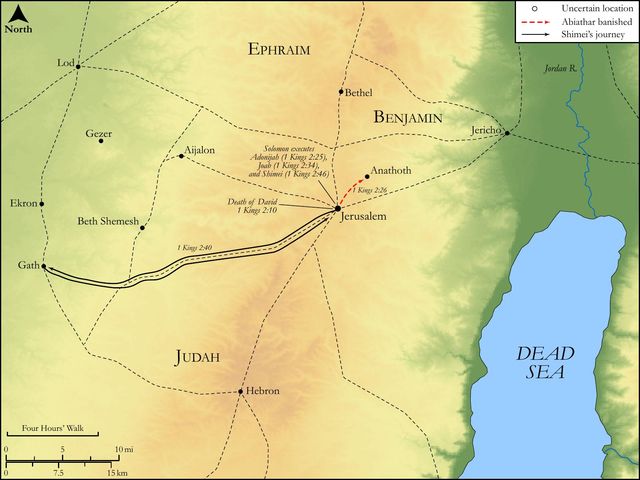
This verse is situated within the opening chapters of 1 Kings, which meticulously chronicle King Solomon's strategic actions to secure his newly inherited throne and establish his kingdom. Following the death of his father, David, Solomon systematically addresses potential threats and disloyal figures, acting on both David's final instructions regarding certain individuals (1 Kings 2:5-9) and his own astute assessment of the political landscape. Abiathar's banishment is part of a calculated series of judgments that include the execution of Adonijah (1 Kings 2:25), Joab (1 Kings 2:34), and Shimei (1 Kings 2:46), effectively eliminating all opposition and solidifying Solomon's undisputed rule. Abiathar's removal from the high priesthood also paves the way for Zadok to become the sole high priest (1 Kings 2:35), marking a significant shift in religious leadership and fulfilling a long-standing prophecy.
Historical & Cultural Context
In ancient Israel, royal succession was often a tumultuous period, fraught with power struggles and potential coups, especially when the designated heir was not the eldest. Loyalty to the reigning monarch was paramount, and any act of supporting a rival claimant, particularly within the royal family or court, constituted treason, a capital offense. Abiathar, as a high priest, held a position of immense spiritual and political influence, making his disloyalty to Solomon particularly grievous. His siding with Adonijah, who attempted to usurp the throne, was a direct challenge to God's anointed successor. The banishment to Anathoth, a Levitical city in the territory of Benjamin (Joshua 21:18), was a severe punishment that stripped him of his office, his access to the royal court, and his public influence, consigning him to a private, rural existence. This was a common form of punishment for high-ranking individuals whose lives were spared but whose power was neutralized, ensuring they could no longer pose a threat.
Key Themes
ShowHideSeveral profound themes emerge from Solomon's judgment on Abiathar. Firstly, Justice Tempered with Mercy is prominently displayed. While Abiathar's actions unequivocally made him "worthy of death" for treason, Solomon chose a lesser punishment, acknowledging the priest's long and faithful service to King David, particularly his role in bearing the Ark of the Lord and sharing in David's afflictions during times of persecution. This demonstrates Solomon's wisdom and a divine balancing of strict justice with compassionate consideration for past loyalty. Secondly, the passage highlights the Consequences of Disloyalty, even for those in esteemed positions. Abiathar's high office and venerable past did not exempt him from severe repercussions for choosing the wrong side in a succession dispute, underscoring the absolute necessity of unwavering loyalty to the divinely appointed king. Finally, and crucially, this event marks the Fulfillment of Prophecy. Abiathar was a direct descendant of Eli, and his removal from the high priesthood directly fulfills the prophecy against the house of Eli recorded in 1 Samuel 2:30-36, which declared that Eli's priestly line would be cut off and that there would be no old man in his house. This divine orchestration, even through human political decisions, underscores God's sovereignty and faithfulness to His word.
Exposition and Analysis
ShowHideKey Word Analysis
ShowHideThis word literally means "man" or "individual," but in this context, when combined with "death" (mâveth, H4194), it forms the idiom "man of death" or "a man deserving of death." This highlights that Abiathar, as an individual, had committed an offense (treason) that legally warranted the capital punishment of death, emphasizing the gravity of his transgression against the king and the kingdom.
This refers to a Levitical city in the territory of Benjamin, which was Abiathar's ancestral home. Being sent "unto thine own fields" in Anathoth signified a complete and definitive removal from the center of power in Jerusalem and from his priestly duties at the sanctuary. It represented a forced retirement, a stripping of all public influence, and a confinement to a private, rural existence, effectively neutralizing his threat.
This verb means "to lift" or "to carry." In this context, it refers to Abiathar's sacred duty of carrying the Ark of the Covenant, the most holy object in Israel, symbolizing God's presence. His participation in this sacred act during David's reign (e.g., during Absalom's rebellion, 2 Samuel 15:24-29) signified his faithful and intimate service to David and, by extension, to the Lord. This act, along with sharing David's afflictions, formed the basis for Solomon's tempered judgment.
Verse Breakdown
ShowHide"And unto Abiathar the priest said the king, Get thee to Anathoth, unto thine own fields;"
This opening clause immediately establishes King Solomon's supreme authority, even over the high priest. The command to "Get thee to Anathoth, unto thine own fields" is a definitive decree of banishment, signifying Abiathar's immediate removal from his esteemed priestly office and from the royal court in Jerusalem. He is sent back to his ancestral, private sphere, effectively ending his public career and influence.
"for thou [art] worthy of death:"
This is Solomon's explicit and unambiguous declaration of Abiathar's guilt. It confirms that Abiathar's actions in supporting Adonijah's attempted usurpation were indeed treasonous and deserved the ultimate penalty under the law. This statement underscores the seriousness of the offense, making Solomon's subsequent decision to show mercy all the more significant and deliberate.
"but I will not at this time put thee to death, because thou barest the ark of the Lord GOD before David my father, and because thou hast been afflicted in all wherein my father was afflicted."
This final clause reveals Solomon's precise rationale for extending mercy. He cites two specific reasons: first, Abiathar's sacred service in carrying the Ark of the Lord before David, symbolizing his faithfulness in priestly duties and proximity to God's presence; and second, his shared suffering alongside David during the turbulent periods of his reign (e.g., Saul's persecution, Absalom's rebellion). These acts of loyalty and endurance during David's trials earned Abiathar a reprieve from the death penalty, demonstrating a profound balance of justice and gratitude.
Literary Devices
ShowHideThe passage employs several effective literary devices to convey its profound meaning. Juxtaposition is evident in the stark contrast between Abiathar being "worthy of death" and Solomon's decision to spare his life, highlighting the king's tempered justice and discernment. This creates a powerful tension between the severity of the crime and the leniency of the punishment. There is also an element of Irony, as a high priest, whose sacred role was to mediate between God and His people and uphold divine order, engages in an act of disloyalty against God's anointed king. Furthermore, the banishment to Anathoth carries potent Symbolism, representing not merely a geographical relocation but a complete loss of power, status, and access to the sacred center of Israelite life. The mention of Abiathar bearing "the ark of the Lord GOD" serves as a powerful Symbol of his past faithfulness and sacred duty, which ultimately provides the grounds for his reprieve. Finally, the entire episode functions as Foreshadowing, setting the stage for the complete fulfillment of the prophecy against the house of Eli, which will be realized with Zadok's sole appointment as high priest, marking a significant shift in the priestly line.
Theological and Thematic Connections
ShowHideThis episode profoundly illustrates God's sovereignty working through human decisions and political maneuvers. While Solomon's judgment appears to be a pragmatic act of statecraft, it simultaneously fulfills a long-standing divine prophecy against the house of Eli, demonstrating that God's word is immutable and His plans will ultimately prevail. The balance of justice and mercy displayed by Solomon reflects a divine attribute, reminding us that while sin has consequences, God's grace can extend reprieve, often in recognition of past faithfulness or for the furtherance of His greater purposes. The removal of a flawed priestly line and the establishment of a new one also points to the necessity of a pure and righteous priesthood, foreshadowing the ultimate high priest who would perfectly mediate between God and humanity.
Reflection and Application
ShowHideSolomon's handling of Abiathar provides a rich tapestry for reflection on leadership, accountability, and the complex interplay of justice and mercy. For leaders, it underscores the weighty responsibility of making difficult decisions that balance strict adherence to principles with compassionate consideration for an individual's history and contributions. It challenges us to consider when and how mercy should be extended without compromising the integrity of justice or the stability of the institution. For individuals, Abiathar's fate serves as a sobering reminder of the serious consequences of disloyalty, particularly in positions of trust or spiritual authority. Even a long history of faithful service does not negate the repercussions of a significant betrayal. Ultimately, the narrative encourages us to trust in God's overarching plan, recognizing that He can orchestrate human events, even those involving political intrigue and personal failings, to bring about His sovereign will and fulfill His prophetic word. It prompts self-examination regarding our own loyalties and the integrity of our service to God and to those He has placed in authority.
Questions for Reflection
ShowHideFAQ
ShowHideWhy was Abiathar not executed for treason, as others were?
ShowHideSolomon explicitly states two primary reasons for sparing Abiathar's life despite his treasonous support for Adonijah's attempted coup. First, Abiathar had faithfully "barest the ark of the Lord GOD before David my father," signifying his long and sacred service as a high priest during David's reign. This act of carrying the Ark was a profound symbol of his dedication and proximity to God's presence. Second, Abiathar "hast been afflicted in all wherein my father was afflicted," meaning he shared in David's many hardships, including the persecutions under Saul and the rebellion of Absalom (2 Samuel 15:24-29). Solomon's decision demonstrates a tempered judgment, balancing strict justice with a recognition of past loyalty and venerable service. Furthermore, his banishment to Anathoth fulfilled the ancient prophecy against the house of Eli (1 Samuel 2:30-36), ensuring that while his life was spared, his priestly line was effectively removed from power, paving the way for Zadok (1 Kings 2:35) to become the sole high priest.
What was the significance of Anathoth?
ShowHideAnathoth was a Levitical city located in the territory of Benjamin (Joshua 21:18). For Abiathar, it was his ancestral home, the place where his family's fields and property were. Being banished "unto thine own fields" meant a complete removal from the political and religious center of Jerusalem. It symbolized his stripping of all public office, influence, and access to the royal court and the sanctuary. His return to a private, rural existence in Anathoth was a severe punishment, effectively ending his public career and neutralizing his power. Anathoth later gained further significance as the hometown of the prophet Jeremiah (Jeremiah 1:1).
Christ-Centered Fulfillment
ShowHideThe banishment of Abiathar, a descendant of Eli, and the subsequent establishment of Zadok as the sole high priest, profoundly foreshadow the perfect and eternal priesthood of Jesus Christ. Abiathar's flawed priesthood, marked by disloyalty and ultimately leading to his removal from office, highlights the inadequacy of the Old Covenant priestly system, which was subject to human sin, mortality, and imperfection. The need for a new, unblemished priesthood is evident. Jesus, however, is the ultimate High Priest, not from the Levitical line of Aaron (or Eli), but from the superior order of Melchizedek (Hebrews 7:11-17). Unlike Abiathar, whose service was temporal and ended in banishment, Christ's priesthood is eternal and incorruptible (Hebrews 7:23-24). He offered a perfect, once-for-all sacrifice for sin, eliminating the need for continuous animal sacrifices (Hebrews 9:26-28), and He ever lives to intercede for His people (Hebrews 7:25). Solomon's tempered justice, while wise and divinely orchestrated, ultimately points to God's perfect justice and boundless mercy found in Christ, who, though innocent and "worthy of death" for our sins, willingly bore the ultimate affliction on the cross, not for His own fault, but for ours (Isaiah 53:4-5), providing eternal life and forgiveness for all who believe.